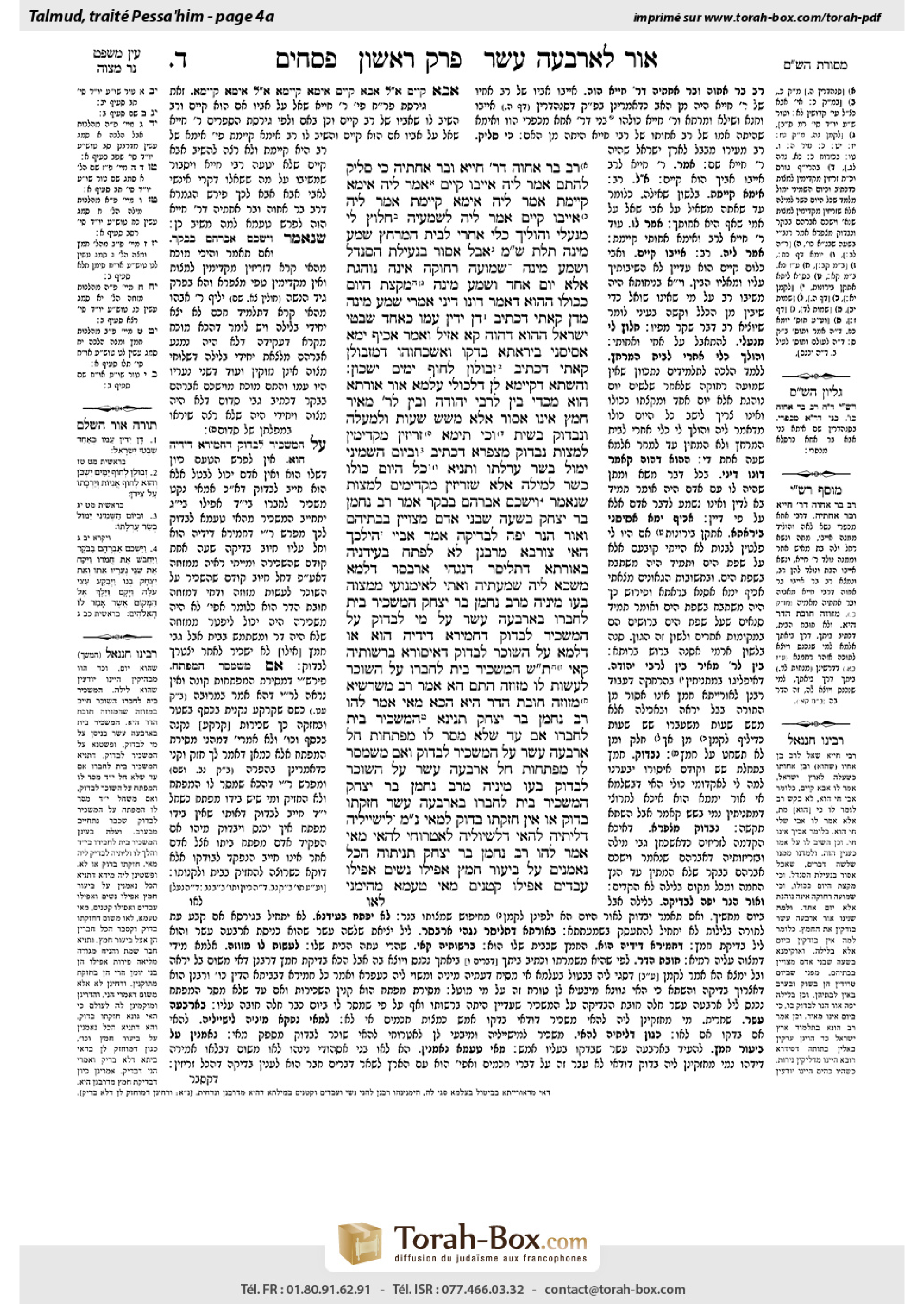
Pesachim 4a: Talmud study for Daf Yomi
Daf Yomi is the daily study of one Talmud folio. Explore 37 tractates with scans, Hebrew text, Sefaria English and AI-generated French translations where annotated.
Passage selection and English or AI-generated French translation are available where the scan has annotations. Daf Study is independent of Torah-Box and Sefaria.
Browse Pesachim · פסחים · All tractatesPesachim 4a text and translations
This page of Pesachim includes the Aramaic text, an English translation and an AI-generated French translation, alongside the scan above.
פסחים ד׳ א · Aramaic and Hebrew text
רַב, בַּר אֲחוּהּ דְּרַבִּי חִיָּיא וּבַר אֲחָתֵיהּ. כִּי סְלֵיק לְהָתָם, אֲמַר לֵיהּ: אַיְיבוּ קַיָּים? אֲמַר לֵיהּ: אִימָּא קַיֶּימֶת?! אֲמַר לֵיהּ: אִימָּא קַיֶּימֶת? אֲמַר לֵיהּ: אַיְיבוּ קַיָּים?!
אֲמַר לֵיהּ לְשַׁמָּעֵיהּ: חֲלוֹץ לִי מִנְעָלַי וְהוֹלֵיךְ כֵּלַי אַחֲרֵי לְבֵית הַמֶּרְחָץ. שְׁמַע מִינַּהּ תְּלָת. שְׁמַע מִינַּהּ: אָבֵל אָסוּר בִּנְעִילַת הַסַּנְדָּל. וּשְׁמַע מִינַּהּ: שְׁמוּעָה רְחוֹקָה אֵינָהּ נוֹהֶגֶת אֶלָּא יוֹם אֶחָד. וּשְׁמַע מִינַּהּ: מִקְצָת הַיּוֹם כְּכוּלּוֹ.
הַהוּא דְּאָמַר: דּוּנוּ דִּינִי. אָמְרִי: שְׁמַע מִינַּהּ מִדָּן קָאָתֵי, דִּכְתִיב: ״דָּן יָדִין עַמּוֹ כְּאַחַד שִׁבְטֵי יִשְׂרָאֵל״.
הָהוּא דַּהֲוָה קָא אָזֵיל וְאָמַר: אַכֵּיף יַמָּא אָסֵיסְנִי בִּירָאתָא. בְּדַקוּ וְאַשְׁכְּחוּהוּ דְּמִזְּבוּלוּן קָאָתֵי, דִּכְתִיב: ״זְבוּלֻן לְחוֹף יַמִּים יִשְׁכֹּן״.
וְהַשְׁתָּא דְּקַיְימָא לַן דִּלְכוּלֵּי עָלְמָא ״אוֹר״ אוּרְתָּא הוּא, מִכְּדֵי בֵּין לְרַבִּי יְהוּדָה וּבֵין לְרַבִּי מֵאִיר — חָמֵץ אֵינוֹ אָסוּר אֶלָּא מִשֵּׁשׁ שָׁעוֹת וּלְמַעְלָה, וְנִבְדּוֹק בְּשֵׁית.
וְכִי תֵּימָא זְרִיזִין מַקְדִּימִין לְמִצְוֹת, נִבְדּוֹק מִצַּפְרָא. דִּכְתִיב: ״וּבַיּוֹם הַשְּׁמִינִי יִמּוֹל בְּשַׂר עָרְלָתוֹ״, וְתַנְיָא: כָּל הַיּוֹם כּוּלּוֹ כָּשֵׁר לְמִילָה, אֶלָּא שֶׁזְּרִיזִין מַקְדִּימִים לְמִצְוֹת, שֶׁנֶּאֱמַר: ״וַיַּשְׁכֵּם אַבְרָהָם בַּבֹּקֶר״.
אָמַר רַב נַחְמָן בַּר יִצְחָק: בְּשָׁעָה שֶׁבְּנֵי אָדָם מְצוּיִין בְּבָתֵּיהֶם, וְאוֹר הַנֵּר יָפֶה לִבְדִיקָה.
אָמַר אַבָּיֵי: הִילְכָּךְ, הַאי צוּרְבָּא מֵרַבָּנַן לָא לִפְתַּח בְּעִידָּנֵיהּ בְּאוּרְתָּא דִתְלֵיסַר דְּנַגְהֵי אַרְבֵּסַר — דִּלְמָא מָשְׁכָא לֵיהּ שְׁמַעְתֵּיהּ, וְאָתֵי לְאִימְּנוֹעֵי מִמִּצְוָה.
בְּעוֹ מִינֵּיהּ מֵרַב נַחְמָן בַּר יִצְחָק: הַמַּשְׂכִּיר בַּיִת לַחֲבֵירוֹ בְּאַרְבָּעָה עָשָׂר, עַל מִי לִבְדּוֹק? עַל הַמַּשְׂכִּיר לִבְדּוֹק — דַּחֲמִירָא דִּידֵיהּ הוּא, אוֹ דִלְמָא עַל הַשּׂוֹכֵר לִבְדּוֹק — דְּאִיסּוּרָא בִּרְשׁוּתֵיהּ קָאֵי? תָּא שְׁמַע: הַמַּשְׂכִּיר בַּיִת לַחֲבֵירוֹ — עַל הַשּׂוֹכֵר לַעֲשׂוֹת לוֹ מְזוּזָה!
הָתָם, הָא אָמַר רַב מְשַׁרְשְׁיָא: מְזוּזָה חוֹבַת הַדָּר הִיא. הָכָא, מַאי? אֲמַר לְהוּ רַב נַחְמָן בַּר יִצְחָק, תְּנֵינָא: הַמַּשְׂכִּיר בַּיִת לַחֲבֵירוֹ, אִם עַד שֶׁלֹּא מָסַר לוֹ מַפְתְּחוֹת חָל אַרְבָּעָה עָשָׂר — עַל הַמַּשְׂכִּיר לִבְדּוֹק, וְאִם מִשֶּׁמָּסַר לוֹ מַפְתְּחוֹת חָל אַרְבָּעָה עָשָׂר — עַל הַשּׂוֹכֵר לִבְדּוֹק.
בְּעוֹ מִינֵּיהּ מֵרַב נַחְמָן בַּר יִצְחָק: הַמַּשְׂכִּיר בַּיִת לַחֲבֵירוֹ בְּאַרְבָּעָה עָשָׂר, חֶזְקָתוֹ בָּדוּק אוֹ אֵין חֶזְקָתוֹ בָּדוּק? לְמַאי נָפְקָא מִינַּהּ? לִישַׁיְּילֵיהּ! דְּלֵיתֵיהּ לְהַאי דִּלְשַׁיּוֹלֵיהּ. לְאַטְרוֹחֵי לְהַאי, מַאי?
אֲמַר לְהוּ רַב נַחְמָן בַּר יִצְחָק, תְּנֵיתוּהָ: הַכֹּל נֶאֱמָנִים עַל בִּיעוּר חָמֵץ, אֲפִילּוּ נָשִׁים אֲפִילּוּ עֲבָדִים אֲפִילּוּ קְטַנִּים. מַאי טַעְמָא מְהֵימְנֵי,
Pesachim 4a · English translation
The Gemara relates: Rav was the son of Rabbi Ḥiyya’s half brother and the son of Rabbi Ḥiyya’s half sister, as Ayevu, Rav’s father, married his own stepsister, Imma. When Rav ascended there, to Eretz Yisrael, Rabbi Ḥiyya said to Rav: Is your father, Ayevu, alive? He said to him, replying with a question: Is your sister, Imma, alive? He said to him: Indeed, is Imma alive? He said to him: Is Ayevu alive? Upon hearing this, Rabbi Ḥiyya understood that both Ayevu and Imma had passed away, and Rav did not wish to say so explicitly.
Rabbi Ḥiyya said to his attendant: Remove my shoes and carry my garments after me to the bathhouse. The Gemara comments: Learn from Rabbi Ḥiyya’s instructions three halakhot. Learn from it that wearing shoes is prohibited for a mourner, which is why he instructed his servant to remove his shoes. And learn from it that for distant tidings mourning is practiced only one day. One who receives tidings of the death of a relative more than thirty days after he died, does not mourn for seven days. The halakhot of mourning apply for only a single day. And learn from it that with regard to the halakhot of mourning, the legal status of part of the day is like that of an entire day. The Gemara derives this halakha from the fact that Rabbi Ḥiyya removed his shoes and immediately thereafter went to the bathhouse, an act that is prohibited for a mourner. He was permitted to do so because the restrictions of the mourning period were no longer in effect after briefly going without shoes.
With regard to the precision required in language, the Gemara relates: A certain man would regularly say whenever involved in conflict: Adjudicate my case [dunu dini]. The Sages said: Learn from it that he descends from the tribe of Dan, as it is written: “Dan will judge [yadin] his people like one of the tribes of Israel” (Genesis 49:16). He expressed himself that way due to his lineage.
The Gemara relates a similar incident: A certain man would regularly walk and say: The bushes on the seashore are cypresses (ge’onim), i.e., items located by the sea are more beautiful than those found in other places. They examined his lineage and found that he descends from the tribe of Zebulun, as it is written: “Zebulun shall dwell by the seashore” (Genesis 49:13). That explains his love of all things close to the sea.
The Gemara returns to the issue of the search for leaven. And now that we maintain that everyone agrees the word or in the mishna is evening, consider the following: After all, both according to the opinion of Rabbi Yehuda and according to that of Rabbi Meir, who disagree with regard to the deadline decreed by the Sages to remove all leaven, it is prohibited to derive benefit from leavened bread by Torah law only from the sixth hour of the day and onward. And if so, let us search for leaven at six hours of the day, and eliminate the leaven at that point.
And lest you say that this halakha is in accordance with the principle that the vigilant are early in the performance of mitzvot, let us search in the morning. The principle: The vigilant are early in the performance of mitzvot, is derived, as it is written: “And on the eighth day the flesh of his foreskin shall be circumcised” (Leviticus 12:3). And it was taught in a baraita: The entire day is suitable for performance of the mitzva of circumcision; however, the vigilant are early in the performance of mitzvot, and circumcise in the morning. As it is stated with regard to the binding of Isaac: “And Abraham arose early in the morning” (Genesis 22:3) after hearing God’s command. This indicates that Abraham arose early in his eagerness to perform God’s commandment.
The Gemara cites an answer to its initial question of why the search for leaven is not conducted in the morning. Rav Naḥman bar Yitzḥak said: One searches for leaven in the evening as it is a time when people are found in their homes, and they have the opportunity to perform the search. And furthermore, the light of the lamp is favorable for conducting a search specifically at night. As the search is conducted with a lamp, it is preferable to search at night.
Abaye said: Therefore, in light of the above halakha, a Torah scholar should not begin his regularly scheduled period of Torah study in the evening at the conclusion of the thirteenth of Nisan that is the evening of the fourteenth, as perhaps he will become engrossed in the halakha he is studying and will come to be prevented from performing the mitzva of searching for leaven.
They raised a dilemma before Rav Naḥman bar Yitzḥak: With regard to one who lets a house to another on the fourteenth of Nisan, upon whom is it incumbent to search for leaven? Is it incumbent upon the lessor to search for leaven, as the leavened bread is his; or is it perhaps incumbent upon the lessee to search, as the source of the prohibition is in his domain since he will be living in the house during Passover? He answered: Come and hear an answer from a baraita: With regard to one who lets a house to another, the obligation is upon the lessee to affix a mezuza for it. Apparently, the person renting the house is obligated to perform the mitzvot connected to the house.
The Gemara rejects this proof: There, in the case of mezuza, didn’t Rav Mesharshiya say: Affixing a mezuza is the obligation of the resident? The fact is that the owner of an uninhabited house is not obligated to affix a mezuza to its doors. If so, the question remains, what is the halakha here? Rav Naḥman bar Yitzḥak said to them that we already learned the resolution to this dilemma in a baraita: One who rents a house to another, if before he delivered the keys to the renter the fourteenth of Nisan began, the obligation is upon the lessor to search for leaven. And if it was after he delivered the keys to him that the fourteenth began, the obligation is upon the lessee to search for leaven.
They raised another dilemma before Rav Naḥman bar Yitzḥak: With regard to one who lets a house to another on the fourteenth of Nisan, is its presumptive status that it has been searched or is it not its presumptive status that it has been searched? The Gemara asks: What is the practical difference between these possibilities? Let him ask the owner of the house. The Gemara responds: The situation here is one where the owner is not here to ask him. The dilemma is whether or not to impose upon the renter to search for the leaven. What is the halakha?
Rav Naḥman bar Yitzḥak said to them that we already learned the resolution to this dilemma based on a related baraita: Everyone is believed to provide testimony about the elimination of leavened bread; even women, even slaves, and even minors. Although these people are typically not relied upon to deliver testimony, they are believed when they provide testimony that they have eliminated leaven. The Gemara asks: What is the reason that they are believed?
Pesachim 4a · Traduction française (IA)
La Guemara rapporte : Rav était le fils du demi-frère de Rabbi Ḥiyya et de la demi-sœur de Rabbi Ḥiyya, car Ayevu, le père de Rav, avait épousé sa propre demi-sœur, Imma. Lorsque Rav monta là-bas, en terre d’Israël, Rabbi Ḥiyya lui demanda : « Ton père, Ayevu, est-il vivant ? » Rav lui répondit par une question : « Ta sœur, Imma, est-elle vivante ? » Rabbi Ḥiyya lui dit : « En effet, Imma est-elle vivante ? » Rav lui demanda : « Ayevu est-il vivant ? » En entendant cela, Rabbi Ḥiyya comprit qu’Ayevu et Imma étaient tous deux décédés et que Rav ne souhaitait pas le dire explicitement.
Rabbi Ḥiyya dit à son serviteur : « Enlève mes chaussures et porte mes vêtements derrière moi jusqu’aux bains. » La Guemara commente : On peut déduire des instructions de Rabbi Ḥiyya trois halakhot. On en déduit que le port de chaussures est interdit à une personne en deuil, raison pour laquelle il ordonna à son serviteur de les lui enlever. On en déduit également qu’en cas de nouvelles tardives, le deuil n’est observé qu’un seul jour. Celui qui apprend le décès d’un proche plus de trente jours après sa mort n’observe pas le deuil pendant sept jours ; les règles du deuil ne s’appliquent qu’un seul jour. On en déduit encore qu’en matière de deuil, une partie de la journée est considérée comme une journée entière. La Guemara déduit cette halakha du fait que Rabbi Ḥiyya enleva ses chaussures, puis se rendit aussitôt aux bains, ce qui est interdit à une personne en deuil. Il fut autorisé à le faire parce que les restrictions du deuil avaient cessé de s’appliquer après qu’il fut resté brièvement sans chaussures.
Au sujet de la précision requise dans le langage, la Guemara rapporte : Un homme avait coutume de dire chaque fois qu’il était impliqué dans un conflit : « Jugez mon affaire » [dunu dini]. Les Sages dirent : On peut en déduire qu’il descend de la tribu de Dan, car il est écrit : « Dan jugera [yadin] son peuple comme l’une des tribus d’Israël » (Genèse 49,16). Il s’exprimait ainsi en raison de son ascendance.
La Guemara rapporte un incident semblable : Un homme avait coutume de se promener en disant : « Les buissons du bord de mer sont des cyprès (ge’onim) », c’est-à-dire que les choses situées près de la mer sont plus belles que celles que l’on trouve ailleurs. On examina son ascendance et l’on découvrit qu’il descendait de la tribu de Zabulon, car il est écrit : « Zabulon habitera au bord de la mer » (Genèse 49,13). Cela explique son goût pour tout ce qui se trouve près de la mer.
La Guemara revient à la question de la recherche du hamets. Et maintenant que nous considérons que tous s’accordent à dire que le mot or dans la Michna désigne le soir, examinons ceci : tant selon l’opinion de Rabbi Yehouda que selon celle de Rabbi Meïr, qui sont en désaccord quant à l’échéance fixée par les Sages pour éliminer tout le hamets, il est interdit, selon la Torah, de tirer profit du pain levé seulement à partir de la sixième heure du jour. Dans ce cas, cherchons le hamets à la sixième heure et éliminons-le à ce moment-là.
Et si tu dis que cette halakha découle du principe selon lequel les personnes zélées devancent l’accomplissement des mitsvot, cherchons-le le matin. Ce principe est déduit, comme il est écrit : « Le huitième jour, on circoncira la chair de son prépuce » (Lévitique 12,3). Et il a été enseigné dans une baraïta : Toute la journée convient à l’accomplissement de la mitsva de la circoncision ; toutefois, les personnes zélées devancent l’accomplissement des mitsvot et circoncisent le matin. Car il est dit, au sujet de la ligature d’Isaac : « Abraham se leva de bon matin » (Genèse 22,3), après avoir entendu l’ordre de Dieu. Cela indique qu’Abraham se leva tôt, désireux d’accomplir le commandement de Dieu.
La Guemara cite une réponse à sa question initiale : pourquoi la recherche du hamets n’a-t-elle pas lieu le matin ? Rav Naḥman bar Yitzḥak dit : On recherche le hamets le soir, car c’est le moment où les gens sont chez eux et peuvent procéder à la recherche. De plus, la lumière de la lampe convient à la recherche précisément la nuit. Puisque la recherche se fait à la lampe, il est préférable de la faire la nuit.
Abaye dit : Par conséquent, compte tenu de la halakha exposée ci-dessus, un érudit en Torah ne devrait pas commencer sa séance habituelle d’étude de la Torah le soir, à la fin du treizième jour de Nisan, c’est-à-dire le soir du quatorze, car il pourrait se plonger dans la halakha qu’il étudie et se trouver ainsi empêché d’accomplir la mitsva de rechercher le hamets.
On posa une question à Rav Naḥman bar Yitzḥak : Lorsqu’un homme loue une maison à un autre le quatorze Nisan, à qui incombe la recherche du hamets ? Incombe-t-elle au bailleur, puisque le hamets lui appartient, ou peut-être au locataire, puisque l’interdiction relève de son domaine, étant donné qu’il habitera la maison pendant Pessaḥ ? Il répondit : Viens entendre la réponse d’une baraïta : Lorsqu’un homme loue une maison à un autre, l’obligation de fixer une mezouza lui incombe, au locataire. Il semble donc que la personne qui loue la maison soit tenue d’accomplir les mitsvot qui s’y rapportent.
La Guemara rejette cette preuve : Dans le cas de la mezouza, Rav Mesharshiya n’a-t-il pas dit que fixer une mezouza est une obligation qui incombe à l’occupant ? En effet, le propriétaire d’une maison inoccupée n’est pas tenu de fixer une mezouza à ses portes. Dans ce cas, quelle est la halakha ici ? Rav Naḥman bar Yitzḥak leur dit que nous avons déjà appris la solution à cette question dans une baraïta : Si quelqu’un loue une maison à un autre et que le quatorze Nisan a commencé avant qu’il ne remette les clés au locataire, l’obligation de rechercher le hamets incombe au bailleur. Si le quatorze a commencé après qu’il lui a remis les clés, l’obligation de rechercher le hamets incombe au locataire.
On posa une autre question à Rav Naḥman bar Yitzḥak : Lorsqu’un homme loue une maison à un autre le quatorze Nisan, présume-t-on qu’elle a été inspectée, ou ne le présume-t-on pas ? La Guemara demande : Quelle différence pratique y a-t-il entre ces possibilités ? Qu’il demande au propriétaire de la maison. La Guemara répond : Il s’agit ici d’une situation où le propriétaire n’est pas là pour qu’on puisse le questionner. La question est de savoir s’il faut ou non obliger le locataire à rechercher le hamets. Quelle est la halakha ?
Rav Naḥman bar Yitzḥak leur dit que nous avons déjà appris la solution à cette question à partir d’une baraïta apparentée : Tous sont jugés dignes de confiance pour témoigner de l’élimination du pain levé, même les femmes, les esclaves et les mineurs. Bien qu’en règle générale on ne se fie pas à ces personnes pour témoigner, elles sont dignes de confiance lorsqu’elles attestent avoir éliminé le hamets. La Guemara demande : Pour quelle raison sont-elles jugées dignes de confiance ?
Traduction française générée par IA à partir de l’édition anglaise de Sefaria. Vérifie toujours un passage avec le texte source.
Text from Sefaria: William Davidson Edition - Vocalized Aramaic (CC BY NC); William Davidson Edition - English (CC BY NC).