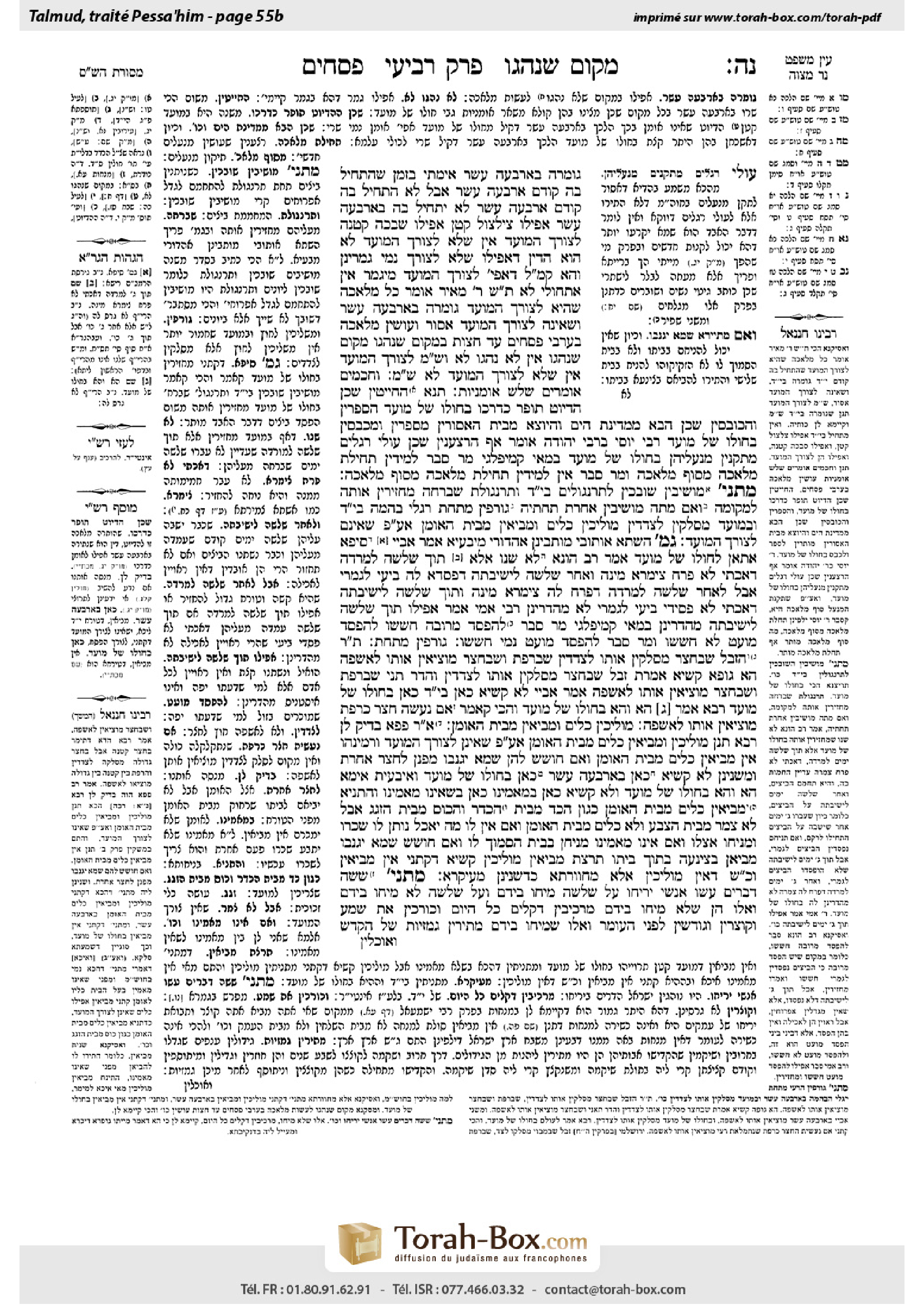
Pesachim 55b: Talmud study for Daf Yomi
Daf Yomi is the daily study of one Talmud folio. Explore 37 tractates with scans, Hebrew text, Sefaria English and AI-generated French translations where annotated.
Passage selection and English or AI-generated French translation are available where the scan has annotations. Daf Study is independent of Torah-Box and Sefaria.
Browse Pesachim · פסחים · All tractatesPesachim 55b text and translations
This page of Pesachim includes the Aramaic text, an English translation and an AI-generated French translation, alongside the scan above.
פסחים נ״ה ב · Aramaic and Hebrew text
גּוֹמְרָהּ בְּאַרְבָּעָה עָשָׂר, אֵימָתַי? בִּזְמַן שֶׁהִתְחִיל בָּהּ קוֹדֶם אַרְבָּעָה עָשָׂר, אֲבָל לֹא הִתְחִיל בָּהּ קוֹדֶם אַרְבָּעָה עָשָׂר — לֹא יַתְחִיל בָּהּ בְּאַרְבָּעָה עָשָׂר, אֲפִילּוּ צִילְצוֹל קָטָן, אֲפִילּוּ שְׂבָכָה קְטַנָּה. לְצוֹרֶךְ הַמּוֹעֵד — אִין, שֶׁלֹּא לְצוֹרֶךְ הַמּוֹעֵד — לָא. הוּא הַדִּין דַּאֲפִילּוּ שֶׁלֹּא לְצוֹרֶךְ נָמֵי גָּמְרִינַן, וְהָא קָא מַשְׁמַע לַן דַּאֲפִילּוּ לְצוֹרֶךְ הַמּוֹעֵד, מִיגְמַר — אִין, אַתְחוֹלֵי — לָא.
תָּא שְׁמַע, רַבִּי מֵאִיר אוֹמֵר: כׇּל מְלָאכָה שֶׁהִיא לְצוֹרֶךְ הַמּוֹעֵד — גּוֹמְרָהּ בְּאַרְבָּעָה עָשָׂר, וְשֶׁאֵינָהּ לְצוֹרֶךְ הַמּוֹעֵד — אָסוּר, וְעוֹשִׂין מְלָאכָה בְּעַרְבֵי פְסָחִים עַד חֲצוֹת בִּמְקוֹם שֶׁנָּהֲגוּ. מְקוֹם שֶׁנָּהֲגוּ — אִין, לֹא נָהֲגוּ — לָא, וּשְׁמַע מִינַּהּ: לְצוֹרֶךְ הַמּוֹעֵד — אִין, שֶׁלֹּא לְצוֹרֶךְ הַמּוֹעֵד — לָא. שְׁמַע מִינַּהּ.
וַחֲכָמִים אוֹמְרִים שָׁלֹשׁ אוּמָּנִיּוֹת. תָּנָא: הַחַיָּיטִין, שֶׁכֵּן הֶדְיוֹט תּוֹפֵר כְּדַרְכּוֹ בְּחוּלּוֹ שֶׁל מוֹעֵד. הַסַּפָּרִין וְהַכּוֹבְסִין, שֶׁכֵּן הַבָּא מִמְּדִינַת הַיָּם וְהַיּוֹצֵא מִבֵּית הָאֲסוּרִין מְסַפְּרִין וּמְכַבְּסִין בְּחוּלּוֹ שֶׁל מוֹעֵד. רַבִּי יוֹסֵי בְּרַבִּי יְהוּדָה אוֹמֵר: אַף הָרַצְעָנִין, שֶׁכֵּן עוֹלֵי רְגָלִים מְתַקְּנִין מִנְעָלֵיהֶן בְּחוּלּוֹ שֶׁל מוֹעֵד.
בְּמַאי קָמִיפַּלְגִי? מָר סָבַר: לְמֵידִין תְּחִילַּת מְלָאכָה מִסּוֹף מְלָאכָה, וּמַר סָבַר: אֵין לְמֵידִין תְּחִילַּת מְלָאכָה מִסּוֹף מְלָאכָה.
מַתְנִי׳ מוֹשִׁיבִין שׁוֹבָכִין לְתַרְנְגוֹלִים בְּאַרְבָּעָה עָשָׂר. וְתַרְנְגוֹלֶת שֶׁבָּרְחָה — מַחֲזִירִין אוֹתָהּ לִמְקוֹמָהּ, וְאִם מֵתָה — מוֹשִׁיבִין אַחֶרֶת תַּחְתֶּיהָ. גּוֹרְפִין מִתַּחַת רַגְלֵי בְּהֵמָה בְּאַרְבָּעָה עָשָׂר, וּבַמּוֹעֵד מְסַלְּקִין לִצְדָדִין. מוֹלִיכִין כֵּלִים וּמְבִיאִין מִבֵּית הָאוּמָּן — אַף עַל פִּי שֶׁאֵינָם לְצוֹרֶךְ הַמּוֹעֵד.
גְּמָ׳ הַשְׁתָּא אוֹתוֹבֵי מוֹתְבִינַן, אַהְדּוֹרֵי מִיבַּעְיָא?! אָמַר אַבָּיֵי: סֵיפָא אֲתָאן לְחוּלּוֹ שֶׁל מוֹעֵד.
אָמַר רַב הוּנָא: לֹא שָׁנוּ אֶלָּא תּוֹךְ שְׁלֹשָׁה לְמִרְדָּהּ — דְּאַכַּתִּי לָא פְּרַח צִימְרָא מִינָּה, וְאַחַר שְׁלֹשָׁה לִישִׁיבָתָהּ — דְּפָסְדָא לַהּ בֵּיעֵי לִגְמָרֵי. אֲבָל לְאַחַר שְׁלֹשָׁה לְמִרְדָּהּ, דִּפְרַח לַהּ צִימְרָא מִינָּה, וְתוֹךְ שְׁלֹשָׁה לִישִׁיבָתָהּ, דְּאַכַּתִּי לָא פְּסִידִי בֵּיעֵי לִגְמָרֵי — לָא מַהְדְּרִינַן. רַבִּי אַמֵּי אָמַר: אֲפִילּוּ תּוֹךְ שְׁלֹשָׁה לִישִׁיבָתָהּ מַהְדְּרִינַן.
בְּמַאי קָמִיפַּלְגִי? מָר סָבַר: לְהֶפְסֵד מְרוּבֶּה חָשְׁשׁוּ, לְהֶפְסֵד מוּעָט — לֹא חָשְׁשׁוּ, וּמָר סָבַר: לְהֶפְסֵד מוּעָט נָמֵי חָשְׁשׁוּ.
גּוֹרְפִין מִתַּחַת. תָּנוּ רַבָּנַן: הַזֶּבֶל שֶׁבֶּחָצֵר מְסַלְּקִין אוֹתוֹ לִצְדָדִין, שֶׁבָּרֶפֶת וְשֶׁבֶּחָצֵר מוֹצִיאִין אוֹתוֹ לָאַשְׁפָּה.
הָא גוּפָא קַשְׁיָא, אָמְרַתְּ: זֶבֶל שֶׁבֶּחָצֵר מְסַלְּקִין אוֹתוֹ לִצְדָדִין, וַהֲדַר תָּנֵי: שֶׁבָּרֶפֶת וְשֶׁבֶּחָצֵר מוֹצִיאִין אוֹתוֹ לָאַשְׁפָּה! אָמַר אַבָּיֵי: לָא קַשְׁיָא, כָּאן בְּאַרְבָּעָה עָשָׂר, כָּאן בְּחוּלּוֹ שֶׁל מוֹעֵד. רָבָא אָמַר: הָא וְהָא בְּחוּלּוֹ שֶׁל מוֹעֵד, וְהָכִי קָאָמַר: אִם נַעֲשָׂה חָצֵר כְּרֶפֶת — מוֹצִיאִין אוֹתוֹ לָאַשְׁפָּה.
מוֹלִיכִין כֵּלִים וּמְבִיאִין מִבֵּית הָאוּמָּן. אָמַר רַב פָּפָּא: בָּדֵיק לַן רָבָא. תְּנַן: מוֹלִיכִין וּמְבִיאִין כֵּלִים מִבֵּית הָאוּמָּן, אַף עַל פִּי שֶׁאֵינָן לְצוֹרֶךְ הַמּוֹעֵד. וּרְמִינְהוּ: אֵין מְבִיאִין כֵּלִים מִבֵּית הָאוּמָּן, וְאִם חוֹשֵׁשׁ לָהֶן שֶׁמָּא יִגָּנְבוּ — מְפַנָּן לְחָצֵר אַחֶרֶת!
וּמְשַׁנֵּינַן, לָא קַשְׁיָא: כָּאן — בְּאַרְבָּעָה עָשָׂר, כָּאן — בְּחוּלּוֹ שֶׁל מוֹעֵד. וְאִיבָּעֵית אֵימָא, הָא וְהָא בְּחוּלּוֹ שֶׁל מוֹעֵד, וְלָא קַשְׁיָא: כָּאן — בְּמַאֲמִינוֹ, כָּאן — בְּשֶׁאֵינוֹ מַאֲמִינוֹ.
וְהָתַנְיָא: מְבִיאִין כֵּלִים מִבֵּית הָאוּמָּן, כְּגוֹן הַכַּד מִבֵּית הַכַּדָּר, וְהַכּוֹס מִבֵּית הַזַּגָּג. אֲבָל לֹא צֶמֶר מִבֵּית הַצַּבָּע, וְלֹא כֵּלִים מִבֵּית הָאוּמָּן, וְאִם אֵין לוֹ מַה יֹּאכַל — נוֹתֵן לוֹ שְׂכָרוֹ וּמַנִּיחוֹ אֶצְלוֹ. וְאִם אֵינוֹ מַאֲמִינוֹ — מַנִּיחָן בְּבַיִת הַסָּמוּךְ לוֹ. וְאִם חוֹשֵׁשׁ שֶׁמָּא יִגָּנְבוּ — מְבִיאָן בְּצִינְעָה בְּתוֹךְ בֵּיתוֹ.
תָּרֵצְתְּ מְבִיאִין. מוֹלִיכִין קַשְׁיָא, דְּקָתָנֵי: אֵין מְבִיאִין וְכׇל שֶׁכֵּן דְּאֵין מוֹלִיכִין! אֶלָּא מְחַוַּורְתָּא כִּדְשַׁנִּינַן מֵעִיקָּרָא.
מַתְנִי׳ שִׁשָּׁה דְּבָרִים עָשׂוּ אַנְשֵׁי יְרִיחוֹ, עַל שְׁלֹשָׁה מִיחוּ בְּיָדָם וְעַל שְׁלֹשָׁה לֹא מִיחוּ בְּיָדָם. וְאֵלּוּ הֵן שֶׁלֹּא מִיחוּ בְּיָדָם: מַרְכִּיבִין דְּקָלִים כׇּל הַיּוֹם, וְכוֹרְכִין אֶת שְׁמַע, וְקוֹצְרִין וְגוֹדְשִׁין לִפְנֵי הָעוֹמֶר. וְאֵלּוּ שֶׁמִּיחוּ בְּיָדָם: מַתִּירִין גַּמְזִיּוֹת שֶׁל הֶקְדֵּשׁ,
Pesachim 55b · English translation
one completes it on the fourteenth. When is that the case? It is when he initiated the labor prior to the fourteenth. However, if he did not initiate the labor prior to the fourteenth, he should not initiate it on the fourteenth, even if it is only manufacturing a small belt or even a small hairnet. The Gemara analyzes this: When it is for the purpose of the Festival, yes, one may complete this labor. However, when it is not for the purpose of the Festival, no, one may not complete it, in accordance with the third possibility above. The Gemara rejects this analysis: Actually, the same is true; we may also complete the task even when it is not for the purpose of the Festival. And this comes to teach us that even when it is for the purpose of the Festival, completing a labor, yes, one may do so, but initiating a labor, no, one may not, in accordance with the third aforementioned possibility.
Come and hear yet another resolution to the dilemma. Rabbi Meir says: With regard to any labor that is for the purpose of the Festival, one may complete it on the fourteenth, and if it is not for the purpose of the Festival, it is prohibited to complete it. And one may perform labor on Passover eves until midday in a place where people were accustomed to do so. The Gemara infers: In a place where people were accustomed to perform labor, yes, one may do so. However, in a place where people were not accustomed to perform labor, no, one may not do so. And learn from it that for the purpose of the Festival, yes, one may perform labor. However, if it is not for the purpose of the Festival, no, one may not do so, in accordance with the first aforementioned possibility. The Gemara concludes: Indeed, learn from it that this is so.
It was stated in the mishna that the Rabbis say: The practitioners of only three crafts are permitted to perform labor until midday on Passover eve. It was taught in explanation of their opinion: The tailors may perform labor on Passover eve, as a layperson is permitted to sew in his usual manner during the intermediate days of the Festival. Since this type of labor is permitted during the intermediate days, when the prohibition against labor is more stringent than on Passover eve, one may be lenient on Passover eve as well. Barbers and launderers, may perform labor on Passover eve, as one who arrives from a country overseas or one who leaves prison who did not have time to cut their hair or launder their clothing before the Festival may cut their hair and wash their clothing on the intermediate days of the Festival. Rabbi Yosei, son of Rabbi Yehuda, says: Shoemakers may also perform their labor, because Festival pilgrims may repair their shoes during the intermediate days of the Festival.
The Gemara asks: With regard to what principle do the Rabbis and Rabbi Yosei disagree? The Gemara answers: One Sage, Rabbi Yosei, son of Rabbi Yehuda, holds: We learn the halakha with regard to the initiation of labor from the halakha with regard to the conclusion of labor; if it is permitted to repair shoes, it is also permitted to initiate their production. And one Sage, the Rabbis, holds: We cannot learn the halakha with regard to the initiation of labor from the halakha with regard to the conclusion of labor; therefore, although it is permitted to repair shoes, it is prohibited to produce new ones.
MISHNA: This mishna continues the discussion of the halakhot of Passover eve. One may place eggs under hens on the fourteenth of Nisan so that the birds will brood until the eggs hatch. And if a hen fled from brooding, one may restore it to its place. And if a brooding hen died, one may place another in its stead. Similarly, one may sweep dung from beneath the legs of an animal on the fourteenth of Nisan. And during the intermediate days of the Festival one may clear it to the sides. Similarly, one may take vessels to the craftsman’s house for repair and bring others from there even though they are not for the purpose of the Festival.
GEMARA: Now, the mishna stated that placing a brooding hen to sit on eggs is permitted; is it necessary to mention that restoring a hen to its brooding place is permitted? Abaye said: In the last clause of the mishna we have arrived at the halakhot of the intermediate days of the Festival, when placing a hen to sit on eggs is prohibited, yet one may nevertheless restore a hen that fled, as failure to do so will cause him to incur a loss. On the fourteenth of Nisan, one may even place a hen to brood ab initio.
Rav Huna said: They taught this halakha that one may restore the hen to the eggs only when it is within three days of its rebellion, when the hen fled from its place, as the heat has not yet completely dissipated from the hen, so that restoring the hen to its place to resume its brooding will be effective; furthermore, this halakha applies only if it is also at least three days after the hen began sitting, when failure to restore the hen to sit on the eggs will cause the eggs to be totally ruined, as on the one hand they are no longer edible, and on the other hand the chick in the egg is only partially formed. However, if it is more than three days after its rebellion, when its heat has completely dissipated, or within three days from when it began sitting, when failure to restore the hen to sit on the eggs will not yet cause the eggs to be totally ruined, one may not restore the hen to sit on the eggs. Rabbi Ami said: Even within three days from when it began sitting, one may restore the hen to sit on the eggs.
The Gemara asks: With regard to what principle do Rav Huna and Rabbi Ami disagree? The Gemara explains: One Sage, Rav Huna, holds that with regard to a major loss, the Sages were concerned about the eggs being completely ruined, and therefore one may restore the hen to its place only if it had already sat on the eggs for three or more days. With regard to a minor loss of being forced to sell at a discount the unhatched eggs that were incubated for less than three days, they were not concerned. And one Sage, Rabbi Ami, holds that with regard to a minor loss, they were also concerned, and therefore the Sages permitted one to restore the hen to its place during the intermediate days of the Festival.
It was stated in the mishna: One may sweep the dung from beneath the legs of an animal on the fourteenth of Nisan. The Sages taught in greater detail in the Tosefta: With regard to the dung in a courtyard, one may clear it to the sides, and with regard to the dung that is in the barn and in a courtyard, one may take it out to the garbage dump.
The Gemara asks: This matter itself is difficult. On the one hand, you said: With regard to the dung in a courtyard, one may clear it to the sides, from which it may be inferred that one may not take it out to the garbage dump. And then it was taught in the Tosefta: With regard to the dung that is in the barn and in a courtyard, one may take it out to the garbage dump. Abaye said: This is not difficult. Here, where the Sages permitted taking out the dung to the garbage dump, it refers to the fourteenth of Nisan. There, where they permitted only moving it to the sides, it refers to the intermediate days of the Festival. Rava said: Both this case and that case refer to the intermediate days, and this is what it is saying: In an ordinary courtyard one may only move the dung to the sides; however, if the courtyard becomes as filthy as a barn, one may take out the dung to the garbage dump.
It was stated in the mishna: One may take vessels to the craftsman’s house for repair and bring others from there. Rav Pappa said: Rava tested us. We learned in the mishna: One may take vessels to the craftsman’s house for repair and bring others from there even if they are not for the purpose of the Festival. He raised a contradiction from that which we learned: One may not bring vessels from a craftsman’s house, and if he is concerned lest they be stolen, he may move them to another courtyard belonging to the craftsman, but not to his own house.
And we answered: This is not difficult. Here, where one may bring vessels from the craftsman’s house, it is referring to the fourteenth of Nisan. There, where one may not bring them, it is referring to the intermediate days of the Festival. And if you wish, say instead that this and that are referring to the intermediate days, and nevertheless, this is not difficult. Here, where one may not bring them home, it is referring to a case where he trusts that the craftsman will return the items; there, where it is permitted to take the vessels home, it is referring to a case where he does not trust him.
As it was taught in the following baraita: One may bring vessels from the house of a craftsman, such as a jug from the house of a potter, or a cup from the house of a glassmaker, but one may bring neither wool from the house of a dyer nor other vessels from the house of a craftsman that are not for the purpose of the Festival. And if the craftsman has nothing to eat, one gives the craftsman his payment on the intermediate days of the Festival and leaves the item with him. And if he does not trust that the craftsman will deliver the items, he leaves them in the adjacent house. And if he is concerned lest the item be stolen, he may bring them to his house surreptitiously.
The Gemara asks: You have resolved the issue of bringing items from a craftsman’s house, but taking items to his house is difficult, as it was taught: One may not bring, and all the more so one may not take items to be repaired. Therefore, the Gemara rejects the second answer and concludes: Rather, it is clear as we answered initially, i.e., the baraita refers to the intermediate days and the mishna refers to Passover eve.
MISHNA: The mishna continues the discussion of the halakhot of Passover eve, along with other local customs. Six actions were performed by the Jewish residents of Jericho, contrary to common practice. With regard to three, the Sages reprimanded them, and with regard to three, the Sages did not reprimand them. And these are the ones with regard to which they did not reprimand them: The residents of Jericho would graft palm trees the entire day on the fourteenth of Nisan; and they would bundle Shema, as explained in the Gemara; and they would harvest and pile grain before the omer offering was brought. And these are the ones with regard to which the Sages reprimanded them: They would permit the use of consecrated branches of carob or sycamore trees. This refers to trees whose branches were cut and consecrated for Temple upkeep, which subsequently sprouted new branches;
Pesachim 55b · Traduction française (IA)
on peut l’achever le quatorze. Dans quel cas ? Lorsque l’on a commencé le travail avant le quatorze. Mais si l’on n’a pas commencé le travail avant le quatorze, on ne doit pas le commencer ce jour-là, même s’il s’agit seulement de fabriquer une petite ceinture ou un petit filet à cheveux. La Guemara analyse cette réponse : lorsqu’il s’agit d’un travail destiné à la fête, oui, on peut l’achever ; mais lorsqu’il n’est pas destiné à la fête, non, on ne peut pas l’achever, conformément à la troisième possibilité évoquée précédemment. La Guemara rejette cette analyse : en réalité, il en va de même ; on peut aussi achever le travail lorsqu’il n’est pas destiné à la fête. Cela vient nous enseigner que même lorsqu’un travail est destiné à la fête, on peut l’achever, mais on ne peut pas le commencer, conformément à la troisième possibilité mentionnée précédemment.
Viens entendre une autre réponse à cette question. Rabbi Meïr dit : Tout travail destiné à la fête peut être achevé le quatorze ; s’il n’est pas destiné à la fête, il est interdit de l’achever. Et l’on peut travailler les veilles de Pessa’h jusqu’à midi dans un endroit où l’on avait coutume de le faire. La Guemara en déduit : dans un endroit où l’on avait coutume de travailler, oui, on peut le faire ; mais dans un endroit où l’on n’avait pas cette coutume, non, on ne peut pas le faire. Apprends donc de là que, pour ce qui est destiné à la fête, oui, on peut travailler ; mais si cela n’est pas destiné à la fête, non, on ne peut pas le faire, conformément à la première possibilité évoquée précédemment. La Guemara conclut : En effet, apprends de là qu’il en est ainsi.
Il a été enseigné dans la Michna que les Sages disent : Les artisans de trois corps de métier seulement sont autorisés à travailler jusqu’à midi la veille de Pessa’h. Pour expliquer leur opinion, il a été enseigné que les tailleurs peuvent travailler la veille de Pessa’h, puisqu’un particulier est autorisé à coudre comme à son habitude pendant les jours intermédiaires de la fête. Puisque ce type de travail est permis pendant les jours intermédiaires, alors que l’interdiction de travailler y est plus stricte que la veille de Pessa’h, on peut aussi se montrer indulgent la veille de Pessa’h. Les barbiers et les blanchisseurs peuvent travailler la veille de Pessa’h, car celui qui revient d’un pays d’outre-mer ou sort de prison, et qui n’a pas eu le temps de se faire couper les cheveux ou de laver ses vêtements avant la fête, peut se faire couper les cheveux et laver ses vêtements pendant les jours intermédiaires de la fête. Rabbi Yossi, fils de Rabbi Yehouda, dit : Les cordonniers peuvent eux aussi travailler, car les pèlerins de la fête peuvent faire réparer leurs chaussures pendant les jours intermédiaires de la fête.
La Guemara demande : Sur quel principe les Sages et Rabbi Yossi sont-ils en désaccord ? La Guemara répond : Un Sage, Rabbi Yossi, fils de Rabbi Yehouda, estime que nous déduisons la halakha relative au commencement d’un travail de celle relative à son achèvement : s’il est permis de réparer des chaussures, il est également permis d’en commencer la fabrication. Un autre Sage, les Sages, estime que nous ne pouvons pas déduire la halakha relative au commencement d’un travail de celle relative à son achèvement ; par conséquent, bien qu’il soit permis de réparer des chaussures, il est interdit d’en fabriquer de nouvelles.
MICHNA : Cette Michna poursuit l’exposé des halakhot de la veille de Pessa’h. Le quatorze Nissan, on peut placer des œufs sous des poules afin qu’elles les couvent jusqu’à leur éclosion. Si une poule qui couvait s’est enfuie, on peut la remettre à sa place. Si une poule qui couvait est morte, on peut en placer une autre à sa place. De même, le quatorze Nissan, on peut balayer le fumier qui se trouve sous les pattes d’un animal. Pendant les jours intermédiaires de la fête, on peut le repousser sur les côtés. De même, on peut apporter des ustensiles chez l’artisan pour les faire réparer et en rapporter d’autres, même s’ils ne sont pas destinés à la fête.
GUEMARA : La Michna a indiqué qu’il est permis de placer une poule sur des œufs pour les couver ; est-il nécessaire de préciser qu’il est permis de remettre à sa place une poule qui s’est enfuie ? Abayé dit : Dans la dernière partie de la Michna, nous en sommes arrivés aux halakhot des jours intermédiaires de la fête, où il est interdit de placer une poule sur des œufs, mais où l’on peut néanmoins remettre à sa place une poule qui s’est enfuie, car ne pas le faire entraînerait une perte. Le quatorze Nissan, on peut même placer une poule à couver d’emblée.
Rav Houna dit : Ils ont enseigné cette halakha, selon laquelle on peut remettre la poule sur les œufs, uniquement dans les trois jours qui suivent son abandon, c’est-à-dire le moment où elle s’est enfuie de sa place, car la chaleur de la poule ne s’est pas encore entièrement dissipée ; la remettre à sa place pour qu’elle reprenne la couvaison sera donc efficace. En outre, cette halakha ne s’applique que si au moins trois jours se sont également écoulés depuis que la poule a commencé à couver : si on ne la remet pas sur les œufs, ceux-ci seront complètement perdus, car ils ne sont plus comestibles alors que le poussin n’est que partiellement formé. Toutefois, si plus de trois jours se sont écoulés depuis son abandon, de sorte que sa chaleur s’est entièrement dissipée, ou si moins de trois jours se sont écoulés depuis qu’elle a commencé à couver, de sorte que ne pas la remettre sur les œufs ne les fera pas encore perdre complètement, on ne peut pas la remettre sur les œufs. Rabbi Ami dit : Même si moins de trois jours se sont écoulés depuis qu’elle a commencé à couver, on peut la remettre sur les œufs.
La Guemara demande : Sur quel principe Rav Houna et Rabbi Ami sont-ils en désaccord ? La Guemara explique : Un Sage, Rav Houna, estime que les Sages se sont préoccupés du risque que les œufs soient complètement perdus lorsqu’il s’agit d’une perte importante ; c’est pourquoi on ne peut remettre la poule à sa place que si elle a déjà couvé les œufs pendant au moins trois jours. En revanche, ils ne se sont pas préoccupés d’une perte mineure, celle qui consiste à devoir vendre à prix réduit les œufs non éclos qui ont été couvés moins de trois jours. Un autre Sage, Rabbi Ami, estime qu’ils se sont aussi préoccupés d’une perte mineure ; c’est pourquoi les Sages ont permis de remettre la poule à sa place pendant les jours intermédiaires de la fête.
Il a été enseigné dans la Michna : Le quatorze Nissan, on peut balayer le fumier qui se trouve sous les pattes d’un animal. Les Sages l’ont enseigné plus en détail dans la Tossefta : le fumier qui se trouve dans une cour peut être repoussé sur les côtés, tandis que le fumier qui se trouve dans une étable et dans une cour peut être emporté à la décharge.
La Guemara demande : Cette question est en elle-même difficile. D’une part, tu as dit que le fumier qui se trouve dans une cour peut être repoussé sur les côtés, ce qui laisse entendre qu’on ne peut pas l’emporter à la décharge. Et ensuite, il a été enseigné dans la Tossefta que le fumier qui se trouve dans une étable et dans une cour peut être emporté à la décharge. Abayé dit : Il n’y a pas de difficulté. Ici, où les Sages ont permis d’emporter le fumier à la décharge, il s’agit du quatorze Nissan. Là, où ils ont seulement permis de le déplacer sur les côtés, il s’agit des jours intermédiaires de la fête. Rava dit : Les deux cas concernent les jours intermédiaires, et voici ce que le texte veut dire : dans une cour ordinaire, on ne peut que repousser le fumier sur les côtés ; toutefois, si la cour devient aussi sale qu’une étable, on peut emporter le fumier à la décharge.
Il a été enseigné dans la Michna : On peut apporter des ustensiles chez l’artisan pour les faire réparer et en rapporter d’autres. Rav Pappa dit : Rava nous a mis à l’épreuve. Nous avons appris dans la Michna qu’on peut apporter des ustensiles chez l’artisan pour les faire réparer et en rapporter d’autres, même s’ils ne sont pas destinés à la fête. Il a soulevé une contradiction à partir de ce que nous avons appris : On ne peut pas rapporter des ustensiles de chez un artisan ; s’il craint qu’ils soient volés, il peut les déplacer dans une autre cour appartenant à l’artisan, mais pas jusque chez lui.
Et nous avons répondu : Il n’y a pas de difficulté. Ici, où l’on peut rapporter les ustensiles de chez l’artisan, il s’agit du quatorze Nissan. Là, où l’on ne peut pas les rapporter, il s’agit des jours intermédiaires de la fête. Et si tu veux, dis plutôt que les deux cas concernent les jours intermédiaires et qu’il n’y a malgré tout pas de difficulté. Ici, où il ne peut pas les rapporter chez lui, il s’agit d’un cas où il a confiance que l’artisan lui rendra les objets ; là, où il est permis de rapporter les ustensiles chez soi, il s’agit d’un cas où il ne lui fait pas confiance.
Comme il a été enseigné dans la baraïta suivante : On peut rapporter des ustensiles de chez un artisan, par exemple une cruche de chez un potier ou une coupe de chez un verrier, mais on ne peut rapporter ni de la laine de chez un teinturier ni d’autres ustensiles de chez un artisan s’ils ne sont pas destinés à la fête. Si l’artisan n’a rien à manger, on lui verse son salaire pendant les jours intermédiaires de la fête et on laisse l’objet chez lui. Si l’on ne fait pas confiance à l’artisan pour livrer les objets, on les laisse dans la maison voisine. Et si l’on craint que l’objet soit volé, on peut les rapporter chez soi en cachette.
La Guemara demande : Tu as résolu la question du rapport des objets de chez un artisan, mais celle de leur apport chez lui reste difficile, car il a été enseigné : On ne peut pas rapporter les objets et, à plus forte raison, on ne peut pas les lui apporter pour les faire réparer. La Guemara rejette donc la seconde réponse et conclut : Il est plutôt clair que la réponse initiale est la bonne, c’est-à-dire que la baraïta concerne les jours intermédiaires et la Michna la veille de Pessa’h.
MICHNA : La Michna poursuit l’exposé des halakhot de la veille de Pessa’h, ainsi que celui d’autres coutumes locales. Les habitants juifs de Jéricho accomplissaient six actes contraires à la pratique courante. Les Sages les réprimandèrent pour trois d’entre eux, mais pas pour les trois autres. Voici ceux pour lesquels ils ne les réprimandèrent pas : les habitants de Jéricho greffaient des palmiers toute la journée du quatorze Nissan ; ils « nouaient » le Chéma, comme l’explique la Guemara ; et ils moissonnaient et entassaient le grain avant que l’offrande du omer ne soit apportée. Voici ceux pour lesquels les Sages les réprimandèrent : ils autorisaient l’usage de branches consacrées de caroubiers ou de sycomores. Il s’agit d’arbres dont les branches avaient été coupées et consacrées à l’entretien du Temple, puis qui avaient poussé de nouvelles branches ;
Traduction française générée par IA à partir de l’édition anglaise de Sefaria. Vérifie toujours un passage avec le texte source.
Text from Sefaria: William Davidson Edition - Vocalized Aramaic (CC BY NC); William Davidson Edition - English (CC BY NC).