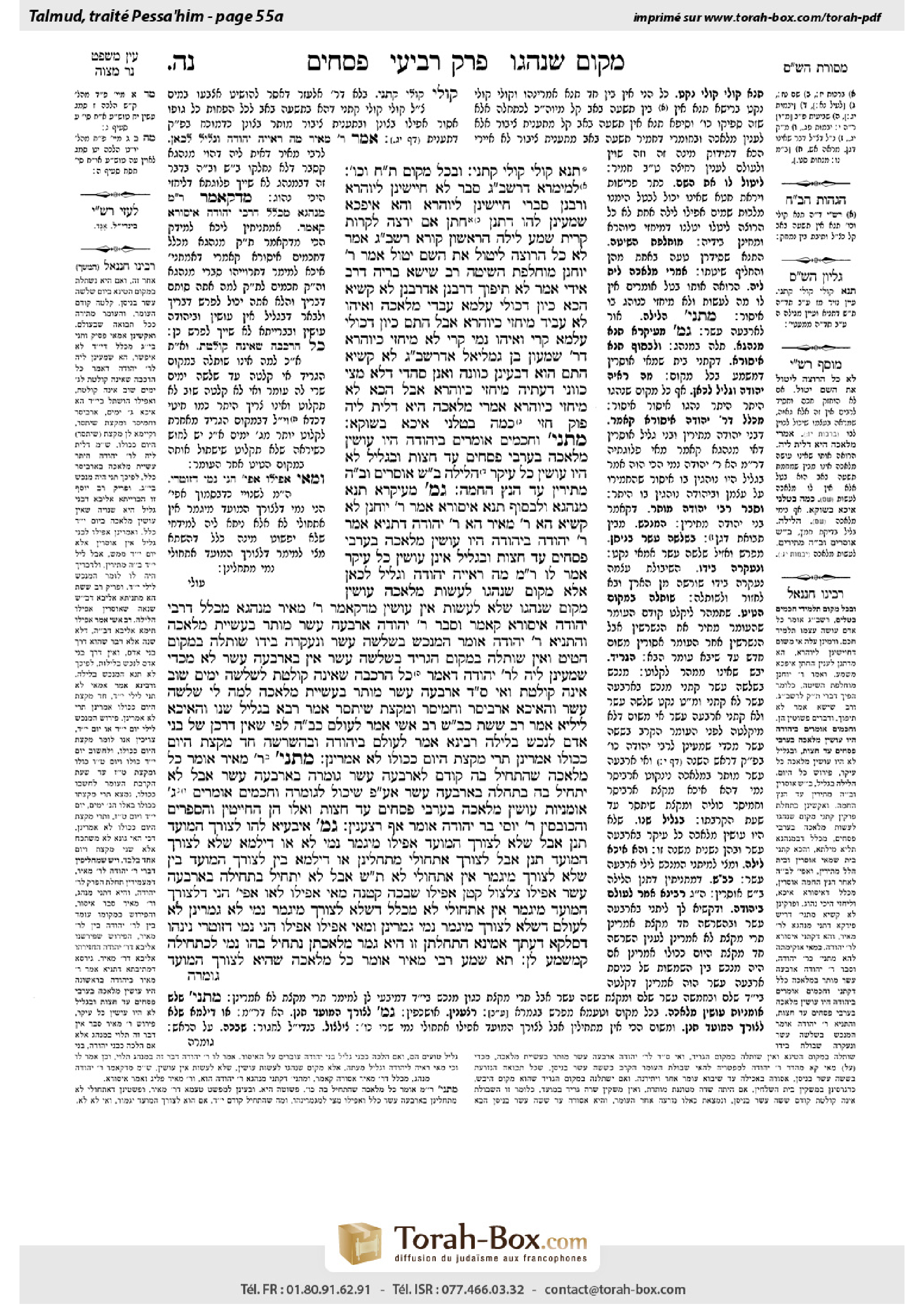
Pesachim 55a: Talmud study for Daf Yomi
Daf Yomi is the daily study of one Talmud folio. Explore 37 tractates with scans, Hebrew text, Sefaria English and AI-generated French translations where annotated.
Passage selection and English or AI-generated French translation are available where the scan has annotations. Daf Study is independent of Torah-Box and Sefaria.
Browse Pesachim · פסחים · All tractatesPesachim 55a text and translations
This page of Pesachim includes the Aramaic text, an English translation and an AI-generated French translation, alongside the scan above.
פסחים נ״ה א · Aramaic and Hebrew text
תַּנָּא קוּלֵּי קוּלֵּי קָתָנֵי.
וּבְכׇל מָקוֹם תַּלְמִידֵי חֲכָמִים וְכוּ׳. לְמֵימְרָא דְּרַבָּן שִׁמְעוֹן בֶּן גַּמְלִיאֵל סָבַר: לָא חָיְישִׁינַן לְיוּהֲרָא, וְרַבָּנַן סָבְרִי: חָיְישִׁינַן לְיוּהֲרָא? וְהָא אִיפְּכָא שָׁמְעִינַן לְהוּ, דִּתְנַן: חָתָן, אִם יִרְצֶה לִקְרוֹת קְרִיַּת שְׁמַע לַיְלָה הָרִאשׁוֹן — קוֹרֵא. רַבָּן שִׁמְעוֹן בֶּן גַּמְלִיאֵל אֲמַר: לֹא כׇּל הָרוֹצֶה לִיטּוֹל אֶת הַשֵּׁם יִטּוֹל.
אָמַר רַבִּי יוֹחָנָן: מוּחְלֶפֶת הַשִּׁיטָה. רַב שִׁישָׁא בְּרֵיהּ דְּרַב אִידִי אָמַר לָא תֵּיפוֹךְ: דְּרַבָּנַן אַדְּרַבָּנַן לָא קַשְׁיָא; הָכָא, כֵּיוָן דְּכוּלֵּי עָלְמָא עָבְדִי מְלָאכָה וְאִיהוּ לָא עָבֵיד — מִיחְזֵי כְּיוּהֲרָא, אֲבָל הָתָם, כֵּיוָן דְּכוּלֵּי עָלְמָא קָרֵי וְאִיהוּ נָמֵי קָרֵי — לָא מִיחְזֵי כְּיוּהֲרָא.
דְּרַבָּן שִׁמְעוֹן בֶּן גַּמְלִיאֵל אַדְּרַבָּן שִׁמְעוֹן בֶּן גַּמְלִיאֵל לָא קַשְׁיָא; הָתָם הוּא דְּבָעֵינַן כַּוּוֹנָה, וַאֲנַן סָהֲדֵי דְּלָא מָצֵי כַּוּוֹנֵי דַּעְתֵּיהּ — מִיחְזֵי כְּיוּהֲרָא: אֲבָל הָכָא לָא מִיחְזֵי כְּיוּהֲרָא, אָמְרִי: מְלָאכָה הִיא דְּלֵית לֵיהּ, פּוֹק חֲזִי כַּמָּה בַּטְלָנֵי אִיכָּא בְּשׁוּקָא.
מַתְנִי׳ וַחֲכָמִים אוֹמְרִים: בִּיהוּדָה הָיוּ עוֹשִׂין מְלָאכָה בְּעַרְבֵי פְסָחִים עַד חֲצוֹת, וּבַגָּלִיל לֹא הָיוּ עוֹשִׂין כׇּל עִיקָּר. הַלַּיְלָה, בֵּית שַׁמַּאי אוֹסְרִים, וּבֵית הִלֵּל מַתִּירִין עַד הָנֵץ הַחַמָּה.
גְּמָ׳ מֵעִיקָּרָא תְּנָא מִנְהָגָא, וּלְבַסּוֹף תְּנָא אִיסּוּרָא!
אָמַר רַבִּי יוֹחָנָן, לָא קַשְׁיָא: הָא — רַבִּי מֵאִיר, הָא — רַבִּי יְהוּדָה. דְּתַנְיָא, אָמַר רַבִּי יְהוּדָה: בִּיהוּדָה הָיוּ עוֹשִׂין מְלָאכָה בְּעַרְבֵי פְסָחִים עַד חֲצוֹת, וּבַגָּלִיל אֵינָן עוֹשִׂין כׇּל עִיקָּר. אָמַר לוֹ רַבִּי מֵאִיר: מָה רְאָיָיה יְהוּדָה וְגָלִיל לְכָאן? אֶלָּא, מָקוֹם שֶׁנָּהֲגוּ לַעֲשׂוֹת מְלָאכָה — עוֹשִׂין, מָקוֹם שֶׁנָּהֲגוּ שֶׁלֹּא לַעֲשׂוֹת — אֵין עוֹשִׂין. מִדְּקָאָמַר רַבִּי מֵאִיר מִנְהָגָא — מִכְּלָל דְּרַבִּי יְהוּדָה אִיסּוּרָא קָאָמַר.
וְסָבַר רַבִּי יְהוּדָה אַרְבָּעָה עָשָׂר מוּתָּר בַּעֲשִׂיַּית מְלָאכָה? וְהָתַנְיָא, רַבִּי יְהוּדָה אוֹמֵר: הַמְנַכֵּשׁ בִּשְׁלֹשָׁה עָשָׂר וְנֶעְקְרָה בְּיָדוֹ — שׁוֹתְלָהּ בִּמְקוֹם הַטִּיט, וְאֵין שׁוֹתְלָהּ בִּמְקוֹם הַגְּרִיד.
בִּשְׁלֹשָׁה עָשָׂר — אִין, בְּאַרְבָּעָה עָשָׂר — לָא. מִכְּדִי שָׁמְעִינַן לֵיהּ לְרַבִּי יְהוּדָה דְּאָמַר: כׇּל הַרְכָּבָה שֶׁאֵינָהּ קוֹלֶטֶת לִשְׁלֹשָׁה יָמִים — שׁוּב אֵינָהּ קוֹלֶטֶת. וְאִי סָלְקָא דַעְתָּךְ אַרְבָּעָה עָשָׂר מוּתָּר בַּעֲשִׂיַּית מְלָאכָה, לְמָה לִי שְׁלֹשָׁה עָשָׂר? וְהָאִיכָּא אַרְבֵּיסַר וַחֲמֵיסַר וּמִקְצָת שִׁיתְּסַר! אָמַר רָבָא: בַּגָּלִיל שָׁנוּ.
וְהָאִיכָּא לֵילְיָא! אָמַר רַב שֵׁשֶׁת: כְּבֵית שַׁמַּאי. רַב אָשֵׁי אָמַר: לְעוֹלָם כְּבֵית הִלֵּל — לְפִי שֶׁאֵין דַּרְכָּן שֶׁל בְּנֵי אָדָם לְנַכֵּשׁ בַּלַּיְלָה.
רָבִינָא אָמַר: לְעוֹלָם בִּיהוּדָה, וּבְהַשְׁרָשָׁה חַד ״מִקְצָת הַיּוֹם כְּכוּלּוֹ״ — אָמְרִינַן, תְּרֵי ״מִקְצָת הַיּוֹם כְּכוּלּוֹ״ — לָא אָמְרִינַן.
מַתְנִי׳ רַבִּי מֵאִיר אוֹמֵר: כׇּל מְלָאכָה שֶׁהִתְחִיל בָּהּ קוֹדֶם לְאַרְבָּעָה עָשָׂר, גּוֹמְרָהּ בְּאַרְבָּעָה עָשָׂר. אֲבָל לֹא יַתְחִיל בָּהּ בַּתְּחִלָּה בְּאַרְבָּעָה עָשָׂר, אַף עַל פִּי שֶׁיָּכוֹל לְגוֹמְרָהּ. וַחֲכָמִים אוֹמְרִים: שָׁלֹשׁ אוּמָּנִיּוֹת עוֹשִׂין מְלָאכָה בְּעַרְבֵי פְסָחִים עַד חֲצוֹת, וְאֵלּוּ הֵן: הַחַיָּיטִין, וְהַסַּפָּרִים, וְהַכּוֹבְסִין. רַבִּי יוֹסֵי בַּר יְהוּדָה אוֹמֵר: אַף רַצְעָנִין.
גְּמָ׳ אִיבַּעְיָא לְהוּ: לְצוֹרֶךְ הַמּוֹעֵד תְּנַן, אֲבָל שֶׁלֹּא לְצוֹרֶךְ הַמּוֹעֵד — אֲפִילּוּ מִיגְמַר נָמֵי לָא, אוֹ דִילְמָא: שֶׁלֹּא לְצוֹרֶךְ הַמּוֹעֵד תְּנַן, אֲבָל לְצוֹרֶךְ — אַתְחוֹלֵי מַתְחֲלִינַן, אוֹ דִילְמָא: בֵּין לְצוֹרֶךְ הַמּוֹעֵד בֵּין שֶׁלֹּא לְצוֹרֶךְ, מִיגְמַר — אִין, אַתְחוֹלֵי — לָא.
תָּא שְׁמַע: אֲבָל לֹא יַתְחִיל בַּתְּחִילָּה בְּאַרְבָּעָה עָשָׂר אֲפִילּוּ צִלְצוֹל קָטָן אֲפִילּוּ שְׂבָכָה קְטַנָּה. מַאי ״אֲפִילּוּ״? לָאו אֲפִילּוּ הָנֵי, דִּלְצוֹרֶךְ הַמּוֹעֵד, מִיגְמַר — אִין, אַתְחוֹלֵי — לָא?! מִכְּלָל דְּשֶׁלֹּא לְצוֹרֶךְ — מִיגְמַר נָמֵי לָא גָּמְרִינַן!
לָא, לְעוֹלָם דְּשֶׁלֹּא לְצוֹרֶךְ מִיגְמַר נָמֵי גָּמְרִינַן, וּמַאי ״אֲפִילּוּ״? אֲפִילּוּ הָנֵי נָמֵי, דְּזוּטְרֵי נִינְהוּ, דְּסָלְקָא דַּעְתָּךְ אָמֵינָא הַתְחָלָתָן זוֹ הִיא גְּמַר מְלַאכְתָּן — נַתְחֵיל בְּהוּ נָמֵי לְכַתְּחִילָּה, קָמַשְׁמַע לַן.
תָּא שְׁמַע. רַבִּי מֵאִיר אוֹמֵר: כׇּל מְלָאכָה שֶׁהִיא לְצוֹרֶךְ הַמּוֹעֵד —
Pesachim 55a · English translation
The tanna is teaching a series of leniencies. He taught only those aspects in which the Ninth of Av is more lenient than a communal fast. He did not teach those aspects in which it is more stringent. There was no attempt made to enumerate all the differences.
It was stated in the mishna: And in all places Torah scholars are idle and do not perform labor on the Ninth of Av, and according to Rabban Shimon ben Gamliel one should always conduct himself like a Torah scholar in this regard and refrain from performing labor. The Gemara asks: Is that to say that Rabban Shimon ben Gamliel holds that we are not concerned about presumptuousness when a person conducts himself like a Torah scholar? And conversely, do the Rabbis hold that we are concerned about presumptuousness? Didn’t we hear them say the opposite? As we learned in a mishna: With regard to the recitation of Shema on one’s wedding night, the Rabbis said that if a groom wishes to recite Shema on the first night despite his exemption, he may do so. Rabban Shimon ben Gamliel says: Not everyone who wishes to assume the reputation of a God-fearing person may assume it, and consequently not everyone who wishes to recite Shema on his wedding night may do so. Their opinions in that mishna appear contrary to their opinions in the current mishna.
Rabbi Yoḥanan said: The attribution of the opinions is reversed in one of the sources. Rav Sheisha, son of Rav Idi, said: Do not reverse either text, as it is possible to resolve the difficulty in another manner. The contradiction between the statement of the Rabbis here and the statement of the Rabbis there is not difficult. Here, on the Ninth of Av, since everyone is performing labor and he is not performing labor, his idleness is conspicuous and appears like presumptuousness. However, there, in the case of reciting Shema on one’s wedding night, it does not appear like presumptuousness, as everyone is reciting Shema and he is also reciting it with them.
Similarly, the contradiction between the statement of Rabban Shimon ben Gamliel here and the statement of Rabban Shimon ben Gamliel there is not difficult. There, in the case of reciting Shema on one’s wedding night, it is that we require concentration, and it is clear to all that he is unable to concentrate because of his preoccupation with the mitzva that he must perform. Therefore, if he recites Shema it appears like presumptuousness. It is as though he is announcing: I am able to concentrate although others in my situation are not. However, here, by not performing labor on the Ninth of Av it does not appear like presumptuousness, as people say: It is because he has no labor to perform. Go out and see how many idle people there are in the marketplace, even on days when it is permitted to perform labor.
MISHNA: Apropos the discussion of performing labor on Passover eve, differences in other customs were cited. And the Rabbis say: In Judea, people would perform labor on Passover eves until midday, and in the Galilee people would not perform labor on Passover eve at all. With regard to performing labor on the night before Passover eve, the night between the thirteenth and fourteenth of Nisan, Beit Shammai prohibit performing labor, and Beit Hillel permit doing so until sunrise.
GEMARA: The Gemara asks with regard to the mishna: Initially, at the beginning of the chapter, the tanna taught that in certain places there is merely a custom not to perform labor, and yet ultimately, in this latest mishna, he taught that according to the opinion of Beit Shammai, it is prohibited to perform labor. Apparently, performance of labor is not dependent on custom but is actually prohibited.
Rabbi Yoḥanan said: This is not difficult, since that first mishna is in accordance with the opinion of Rabbi Meir, and this current mishna is in accordance with the opinion of Rabbi Yehuda. As it was taught in a baraita that Rabbi Yehuda said: In Judea they would perform labor on Passover eves until midday, and in the Galilee they would not perform labor at all. Rabbi Meir said to him: What proof do you cite from Judea and the Galilee to the discussion here? Rather, in a place where people were accustomed to perform labor, one performs labor, and in a place where people were accustomed not to perform labor, one does not perform labor. The Gemara analyzes this baraita: From the fact that Rabbi Meir is speaking about custom, by inference, Rabbi Yehuda is speaking about a prohibition against performing labor in the Galilee.
The Gemara asks: And does Rabbi Yehuda hold that performance of labor on the fourteenth is permitted everywhere other than the Galilee? Wasn’t it taught in a baraita that Rabbi Yehuda says: With regard to one who is weeding a field on the thirteenth of Nisan and a stalk of grain was uprooted in his hand, he plants it in a muddy place so that it will take root before the omer offering is brought on the sixteenth of Nisan? It will then be permitted to eat the grain after the omer offering is brought. However, one should not plant it in a dry place, as it will not take root there immediately. If it begins to sprout only after the omer offering is brought, that grain will remain prohibited until after the following year’s omer offering is brought.
From Rabbi Yehuda’s statement it can be inferred that if a person was weeding on the thirteenth of Nisan, yes, this is the halakha; however, on the fourteenth of Nisan, no, one may not replant the stalk of grain. Now, we learned that Rabbi Yehuda said: Any graft that does not take hold within three days will no longer take hold. If it could enter your mind that performing labor on the fourteenth is permitted, why do I need this halakha to be taught specifically with regard to the thirteenth? It would have been a greater novelty had he taught the halakha with regard to a case that occurs on the fourteenth. Aren’t there three days remaining for grain planted on the fourteenth to take root before the omer offering, i.e., the fourteenth of Nisan, the fifteenth of Nisan, and part of the sixteenth of Nisan? Rava said: They taught this halakha of replanting a stalk of wheat with regard to the Galilee; as mentioned in the baraita, Rabbi Yehuda says that in the Galilee they do not perform labor at all.
The Gemara further asks: Isn’t there the night between the thirteenth and the fourteenth of Nisan, during which according to the opinion of Beit Hillel, labor is permitted even in the Galilee, which is the halakha? Rabbi Yehuda could have taught the halakha with regard to weeding on the night before the fourteenth. Rav Sheshet said: Rabbi Yehuda said this in accordance with the opinion of Beit Shammai, who prohibit performing labor that night. Rav Ashi said: There is no reason to suggest implausibly that Rabbi Yehuda holds in accordance with the opinion of Beit Shammai, contrary to the accepted halakha. Actually, Rabbi Yehuda holds in accordance with the opinion of Beit Hillel. However, he did not teach the case about the night before the fourteenth of Nisan because it is not the typical manner of people to weed at night. It is virtually impossible to identify weeds in the dark.
Ravina said: Actually, it can be explained that Rabbi Yehuda is referring to Judea. With regard to a plant taking root, we state only once the principle: The legal status of part of the day is like that of the entire day, but we do not state twice the principle: The legal status of part of the day is like that of the entire day. When discussing a plant that was replanted on the fourteenth, in the tally of three days, the legal status of part of both the fourteenth and the sixteenth cannot be like that of entire days. A plant takes root after a fixed amount of time, and this is not affected by formalistic halakhic principles like: The legal status of part of the day is like that of the entire day.
MISHNA: Rabbi Meir says: With regard to any labor that one began before the fourteenth of Nisan, he may complete it on the fourteenth before midday. However, one may not begin to perform that labor from the outset on the fourteenth, even if he is able to complete it before midday. And the Rabbis say: The practitioners of only three crafts are permitted to perform labor until midday on Passover eve, and they are: Tailors, barbers, and launderers, whose work is needed for the Festival. Rabbi Yosei bar Yehuda says: Even shoemakers are permitted to work on the fourteenth.
GEMARA: A dilemma was raised before the Sages: Was it with regard to labor for the purpose of the Festival that we learned in the mishna that Rabbi Meir permits completing labor on the fourteenth, but labor that is not for the purpose of the Festival may not even be completed? Or perhaps it was with regard to labor that is not for the purpose of the Festival that we learned that Rabbi Meir permits completing labor on the fourteenth, but with regard to labor that is for the purpose of the Festival, we may even initiate it. Or perhaps, with regard to both labor that is for the purpose of the Festival and labor that is not for the purpose of the Festival, completing, yes, it is permitted, but initiating, no, it is prohibited.
Come and hear a resolution to the dilemma from that which we learned: However, one may not begin work from the outset on the fourteenth, even if it is a small belt, or even a small hairnet. What is the meaning of the term even in this context? Isn’t it that even with regard to those items that are for the purpose of the Festival, completing, yes, it is permitted, but initiating, no, it is prohibited? And by inference, with regard to labor that is not for the purpose of the Festival, we may not even complete labor that was begun previously. This supports the first possibility cited above.
The Gemara rejects this answer: No; actually this means that even labor that is not for the purpose of the Festival we may also complete, in accordance with the third possibility above. And what is the meaning of the term even? It is that this halakha applies even to these items, a belt and a hairnet, which are small; as it could enter your mind to say: Since they are small and their initiation is their completion, let us even initiate their manufacture on the fourteenth ab initio. Therefore, it teaches us that even with regard to this type of labor, initiating is prohibited. This baraita does not provide an unequivocal resolution to the dilemma.
Come and hear the resolution to the dilemma from another source from another source. Rabbi Meir says: With regard to any labor that is for the purpose of the Festival,
Pesachim 55a · Traduction française (IA)
Le tanna enseigne une série d’assouplissements. Il n’a enseigné que les aspects sous lesquels le Neuf Av est moins strict qu’un jeûne communautaire, et non ceux sous lesquels il est plus strict. Il n’était pas question d’énumérer toutes les différences.
Il a été enseigné dans la Michna : « En tout lieu, les sages de la Torah cessent leur activité et ne travaillent pas le Neuf Av », et, selon Rabban Chimon ben Gamliel, on doit toujours se conduire comme un sage de la Torah à cet égard et s’abstenir de travailler. La Guemara demande : Cela signifie-t-il que Rabban Chimon ben Gamliel estime qu’il ne faut pas craindre la présomption lorsqu’une personne se conduit comme un sage de la Torah ? Et, à l’inverse, les Rabbins estiment-ils qu’il faut craindre la présomption ? Ne les avons-nous pas entendus dire le contraire ? En effet, nous avons appris dans une Michna, au sujet de la récitation du Chéma la nuit de noces, que les Rabbins disent que si un marié souhaite réciter le Chéma la première nuit malgré son exemption, il le peut. Rabban Chimon ben Gamliel dit : « Quiconque souhaite passer pour un homme craignant Dieu ne peut pas s’arroger cette réputation. » Par conséquent, quiconque souhaite réciter le Chéma la nuit de ses noces ne le peut pas nécessairement. Leurs opinions dans cette Michna semblent contraires à celles qu’ils expriment dans la Michna actuelle.
Rabbi Yoḥanan a dit : L’attribution des opinions est inversée dans l’une des sources. Rav Cheisha, fils de Rav Idi, a dit : N’inversez aucun des deux textes, car il est possible de résoudre la difficulté autrement. Il n’y a pas de difficulté entre la déclaration des Rabbins ici et celle des Rabbins là-bas. Ici, le Neuf Av, puisque tout le monde travaille et que lui ne travaille pas, son inactivité est manifeste et paraît présomptueuse. En revanche, là-bas, dans le cas de la récitation du Chéma la nuit de noces, cela ne paraît pas présomptueux, car tout le monde récite le Chéma et lui aussi le récite avec les autres.
De même, il n’y a pas de difficulté entre la déclaration de Rabban Chimon ben Gamliel ici et celle de Rabban Chimon ben Gamliel là-bas. Là-bas, dans le cas de la récitation du Chéma la nuit de noces, il faut se concentrer, et il est clair pour tous que le marié est incapable de se concentrer parce qu’il est préoccupé par la mitsva qu’il doit accomplir. Par conséquent, s’il récite le Chéma, cela paraît présomptueux, comme s’il annonçait : « Je suis capable de me concentrer, contrairement aux autres personnes dans ma situation. » En revanche, ici, ne pas travailler le Neuf Av ne paraît pas présomptueux, car les gens disent : « C’est parce qu’il n’a pas de travail à faire. » Allez voir combien de personnes sont inactives sur la place du marché, même les jours où il est permis de travailler.
MICHNA : À propos de la discussion sur le travail la veille de Pessaḥ, d’autres différences de coutumes sont citées. Les Rabbins disent : En Judée, on travaillait la veille de Pessaḥ jusqu’à midi, tandis qu’en Galilée, on ne travaillait pas du tout la veille de Pessaḥ. Quant au travail la nuit précédant la veille de Pessaḥ, c’est-à-dire dans la nuit du treize au quatorze Nissan, Beit Chammaï l’interdisent, tandis que Beit Hillel le permettent jusqu’au lever du soleil.
GUEMARA : La Guemara pose une question à propos de la Michna : Au début du chapitre, le tanna a enseigné qu’en certains lieux, il s’agit simplement d’une coutume de ne pas travailler ; pourtant, dans cette dernière Michna, il enseigne que, selon l’opinion de Beit Chammaï, il est interdit de travailler. Apparemment, le travail ne dépend pas d’une coutume, mais est véritablement interdit.
Rabbi Yoḥanan a dit : Il n’y a pas de difficulté, car la première Michna suit l’opinion de Rabbi Meïr, tandis que la Michna actuelle suit celle de Rabbi Yehouda. En effet, il a été enseigné dans une baraïta que Rabbi Yehouda a dit : « En Judée, on travaillait la veille de Pessaḥ jusqu’à midi, tandis qu’en Galilée, on ne travaillait pas du tout. » Rabbi Meïr lui a dit : « Quelle preuve tires-tu de la Judée et de la Galilée pour la discussion qui nous occupe ? Il faut plutôt dire que, dans un lieu où l’on avait coutume de travailler, on travaille, et que, dans un lieu où l’on avait coutume de ne pas travailler, on ne travaille pas. » La Guemara analyse cette baraïta : Du fait que Rabbi Meïr parle de coutume, on peut déduire que Rabbi Yehouda, lui, parle d’une interdiction de travailler en Galilée.
La Guemara demande : Rabbi Yehouda estime-t-il que le travail est permis le quatorze partout sauf en Galilée ? N’a-t-il pas été enseigné dans une baraïta que Rabbi Yehouda dit : « Celui qui désherbe un champ le treize Nissan et arrache un épi de céréale le plante dans un endroit boueux, afin qu’il prenne racine avant que l’offrande de l’omer soit apportée le seize Nissan. Il sera alors permis de manger le grain après l’apport de l’offrande de l’omer. Toutefois, il ne faut pas le planter dans un endroit sec, car il n’y prendra pas racine immédiatement. S’il ne commence à germer qu’après l’apport de l’offrande de l’omer, ce grain restera interdit jusqu’à l’apport de l’offrande de l’omer de l’année suivante. »
On peut déduire de la déclaration de Rabbi Yehouda que si quelqu’un désherbe le treize Nissan, oui, c’est bien la halakha ; mais le quatorze Nissan, non, il ne peut pas replanter l’épi de céréale. Or, nous avons appris que Rabbi Yehouda a dit : « Toute greffe qui ne prend pas dans les trois jours ne prendra plus. » S’il pouvait vous venir à l’esprit que le travail est permis le quatorze, pourquoi cette halakha est-elle enseignée précisément à propos du treize ? Il aurait été bien plus étonnant qu’elle soit enseignée pour un cas survenant le quatorze. Ne reste-t-il pas trois jours à une céréale plantée le quatorze pour prendre racine avant l’apport de l’offrande de l’omer, à savoir le quatorze Nissan, le quinze Nissan et une partie du seize Nissan ? Rava a dit : Cette halakha de replanter un épi de blé a été enseignée à propos de la Galilée ; comme cela a été mentionné dans la baraïta, Rabbi Yehouda dit qu’en Galilée on ne travaille pas du tout.
La Guemara demande encore : N’y a-t-il pas la nuit du treize au quatorze Nissan, pendant laquelle, selon l’opinion de Beit Hillel, le travail est permis même en Galilée, conformément à la halakha ? Rabbi Yehouda aurait pu enseigner la halakha à propos du désherbage dans la nuit précédant le quatorze. Rav Chechet a dit : Rabbi Yehouda a parlé conformément à l’opinion de Beit Chammaï, qui interdit de travailler cette nuit-là. Rav Achi a dit : Il n’y a aucune raison de supposer, de manière invraisemblable, que Rabbi Yehouda suit l’opinion de Beit Chammaï, contrairement à la halakha admise. En réalité, Rabbi Yehouda suit l’opinion de Beit Hillel. Toutefois, il n’a pas enseigné le cas de la nuit précédant le quatorze Nissan, car les gens n’ont pas coutume de désherber la nuit. Il est quasiment impossible de distinguer les mauvaises herbes dans l’obscurité.
Ravina a dit : En réalité, on peut expliquer que Rabbi Yehouda parle de la Judée. Pour qu’une plante prenne racine, nous appliquons une seule fois le principe selon lequel une partie de la journée a le statut de la journée entière, mais nous ne l’appliquons pas deux fois. Lorsqu’on parle d’une plante replantée le quatorze, dans le calcul des trois jours, une partie du quatorze et une partie du seize ne peuvent pas chacune avoir le statut d’une journée entière. Une plante prend racine après un laps de temps déterminé, et cela n’est pas affecté par des principes halakhiques formels tels que celui selon lequel une partie de la journée a le statut de la journée entière.
MICHNA : Rabbi Meïr dit : Tout travail commencé avant le quatorze Nissan peut être achevé le quatorze avant midi. Cependant, on ne peut pas commencer ce travail le quatorze, même si l’on peut l’achever avant midi. Les Rabbins disent : Seuls les artisans de trois métiers sont autorisés à travailler jusqu’à midi la veille de Pessaḥ : les tailleurs, les barbiers et les blanchisseurs, dont le travail est nécessaire pour la fête. Rabbi Yossi bar Yehouda dit : Les cordonniers aussi sont autorisés à travailler le quatorze.
GUEMARA : Les Sages se sont demandé : La Michna enseigne-t-elle que Rabbi Meïr permet d’achever le quatorze un travail destiné à la fête, mais qu’un travail qui n’est pas destiné à la fête ne peut même pas être achevé ? Ou bien enseigne-t-elle que Rabbi Meïr permet d’achever le quatorze un travail qui n’est pas destiné à la fête, mais que l’on peut même commencer un travail destiné à la fête ? Ou peut-être, pour les deux catégories de travaux, ceux destinés à la fête et ceux qui ne le sont pas, l’achever, oui, cela est permis, mais le commencer, non, cela est interdit.
Viens et écoute la réponse à la question, tirée de ce que nous avons appris : « Toutefois, on ne peut pas commencer un travail le quatorze, même s’il s’agit d’une petite ceinture ou d’un petit filet à cheveux. » Quel est ici le sens du terme « même » ? N’est-ce pas que, même pour ces objets destinés à la fête, on peut les achever, oui, mais non les commencer ? Et l’on peut en déduire que, pour un travail qui n’est pas destiné à la fête, on ne peut même pas achever un travail commencé auparavant. Cela appuie la première possibilité mentionnée ci-dessus.
La Guemara rejette cette réponse : Non ; en réalité, cela signifie qu’on peut également achever un travail qui n’est pas destiné à la fête, conformément à la troisième possibilité exposée ci-dessus. Quel est alors le sens du terme « même » ? Il s’agit de préciser que cette halakha s’applique même à ces objets, une ceinture et un filet à cheveux, qui sont petits. En effet, on aurait pu penser : puisqu’ils sont petits et que commencer leur fabrication revient à l’achever, autorisons même à en commencer la fabrication le quatorze. C’est pourquoi la baraïta nous enseigne que, même pour ce type de travail, il est interdit de le commencer. Cette baraïta ne fournit pas de réponse concluante à la question.
Viens et écoute la réponse à la question d’une autre source, d’une autre source. Rabbi Meïr dit : « Tout travail destiné à la fête… »
Traduction française générée par IA à partir de l’édition anglaise de Sefaria. Vérifie toujours un passage avec le texte source.
Text from Sefaria: William Davidson Edition - Vocalized Aramaic (CC BY NC); William Davidson Edition - English (CC BY NC).