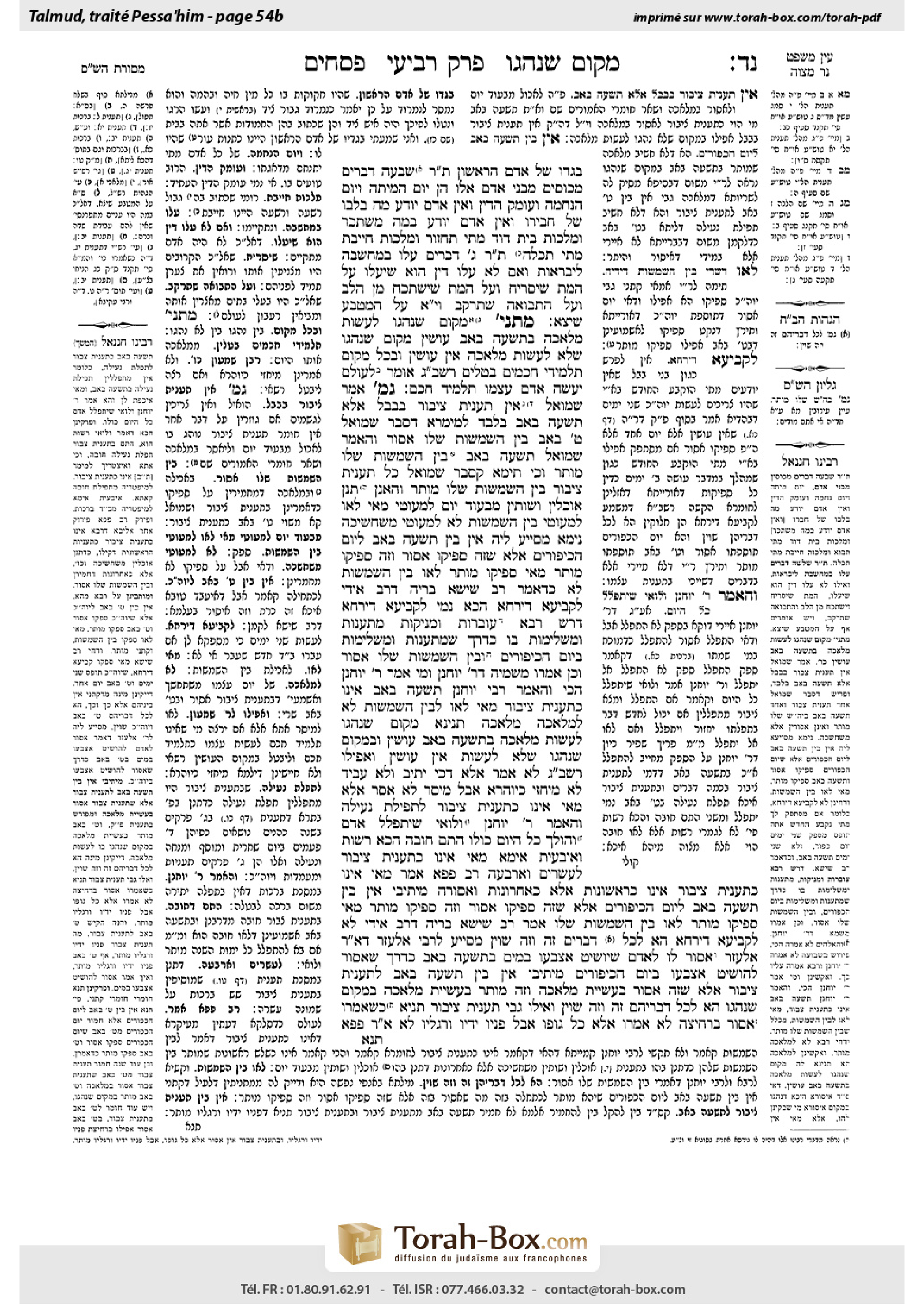
Pesachim 54b: Talmud study for Daf Yomi
Daf Yomi is the daily study of one Talmud folio. Explore 37 tractates with scans, Hebrew text, Sefaria English and AI-generated French translations where annotated.
Passage selection and English or AI-generated French translation are available where the scan has annotations. Daf Study is independent of Torah-Box and Sefaria.
Browse Pesachim · פסחים · All tractatesPesachim 54b text and translations
This page of Pesachim includes the Aramaic text, an English translation and an AI-generated French translation, alongside the scan above.
פסחים נ״ד ב · Aramaic and Hebrew text
בִּגְדּוֹ שֶׁל אָדָם הָרִאשׁוֹן.
תָּנוּ רַבָּנַן: שִׁבְעָה דְּבָרִים מְכוּסִּים מִבְּנֵי אָדָם, אֵלּוּ הֵן: יוֹם הַמִּיתָה, וְיוֹם הַנֶּחָמָה, וְעוֹמֶק הַדִּין, וְאֵין אָדָם יוֹדֵעַ מָה בְּלִבּוֹ שֶׁל חֲבֵירוֹ, וְאֵין אָדָם יוֹדֵעַ בַּמֶּה מִשְׂתַּכֵּר, וּמַלְכוּת בֵּית דָּוִד מָתַי תַּחְזוֹר, וּמַלְכוּת חַיֶּיבֶת מָתַי תִּכְלֶה.
תָּנוּ רַבָּנַן: שְׁלֹשָׁה דְּבָרִים עָלוּ בְּמַחְשָׁבָה לִיבָּרְאוֹת, וְאִם לֹא עָלוּ — דִּין הוּא שֶׁיַּעֲלוּ: עַל הַמֵּת שֶׁיַּסְרִיחַ. וְעַל הַמֵּת שֶׁיִּשְׁתַּכֵּחַ מִן הַלֵּב. וְעַל הַתְּבוּאָה שֶׁתֵּרָקֵב. וְיֵשׁ אוֹמְרִים: עַל הַמַּטְבֵּעַ שֶׁיֵּצֵא.
מַתְנִי׳ מָקוֹם שֶׁנָּהֲגוּ לַעֲשׂוֹת מְלָאכָה בְּתִשְׁעָה בְּאָב — עוֹשִׂין, מָקוֹם שֶׁנָּהֲגוּ שֶׁלֹּא לַעֲשׂוֹת מְלָאכָה — אֵין עוֹשִׂין, וּבְכׇל מָקוֹם תַּלְמִידֵי חֲכָמִים בְּטֵלִים. רַבָּן שִׁמְעוֹן בֶּן גַּמְלִיאֵל אוֹמֵר: לְעוֹלָם יַעֲשֶׂה אָדָם עַצְמוֹ תַּלְמִיד חָכָם.
גְּמָ׳ אָמַר שְׁמוּאֵל: אֵין תַּעֲנִית צִיבּוּר בְּבָבֶל אֶלָּא תִּשְׁעָה בְּאָב בִּלְבַד. לְמֵימְרָא דְּסָבַר שְׁמוּאֵל תִּשְׁעָה בְּאָב בֵּין הַשְּׁמָשׁוֹת שֶׁלּוֹ אָסוּר? וְהָאָמַר שְׁמוּאֵל: תִּשְׁעָה בְּאָב בֵּין הַשְּׁמָשׁוֹת שֶׁלּוֹ מוּתָּר. וְכִי תֵּימָא קָסָבַר שְׁמוּאֵל: כׇּל תַּעֲנִית צִיבּוּר בֵּין הַשְּׁמָשׁוֹת שֶׁלּוֹ מוּתָּר, וְהָאֲנַן תְּנַן: ״אוֹכְלִין וְשׁוֹתִין מִבְּעוֹד יוֹם״. לְמַעוֹטֵי מַאי, לָאו לְמַעוֹטֵי בֵּין הַשְּׁמָשׁוֹת? לָא, לְמַעוֹטֵי מִשֶּׁחָשֵׁיכָה.
נֵימָא מְסַיַּיע לֵיהּ: אֵין בֵּין תִּשְׁעָה בְּאָב לְיוֹם הַכִּיפּוּרִים, אֶלָּא שֶׁזֶּה סְפֵיקוֹ אָסוּר, וְזֶה סְפֵיקוֹ מוּתָּר.
מַאי סְפֵיקוֹ מוּתָּר — לָאו בֵּין הַשְּׁמָשׁוֹת? לָא, כִּדְאָמַר רַב שִׁישָׁא בְּרֵיהּ דְּרַב אִידִי: לִקְבִיעָא דְיַרְחָא, הָכָא נָמֵי — לִקְבִיעָא דְיַרְחָא.
דָּרֵשׁ רָבָא: עוּבָּרוֹת וּמְנִיקוֹת — מִתְעַנּוֹת וּמַשְׁלִימוֹת בּוֹ, כְּדֶרֶךְ שֶׁמִּתְעַנּוֹת וּמַשְׁלִימוֹת בְּיוֹם הַכִּיפּוּרִים, וּבֵין הַשְּׁמָשׁוֹת שֶׁלּוֹ אָסוּר. וְכֵן אָמְרוּ מִשְּׁמֵיהּ דְּרַבִּי יוֹחָנָן. וּמִי אָמַר רַבִּי יוֹחָנָן הָכִי? וְהָאָמַר רַבִּי יוֹחָנָן: תִּשְׁעָה בְּאָב אֵינוֹ כְּתַעֲנִית צִיבּוּר. מַאי לָאו, לְבֵין הַשְּׁמָשׁוֹת? לֹא, לִמְלָאכָה.
מְלָאכָה? תְּנֵינָא: מָקוֹם שֶׁנָּהֲגוּ לַעֲשׂוֹת מְלָאכָה בְּתִשְׁעָה בְּאָב — עוֹשִׂין, וּבְמָקוֹם שֶׁנָּהֲגוּ שֶׁלֹּא לַעֲשׂוֹת — אֵין עוֹשִׂין. וַאֲפִילּוּ רַבָּן שִׁמְעוֹן בֶּן גַּמְלִיאֵל לָא אָמַר אֶלָּא דְּכִי יָתֵיב וְלָא עָבֵיד, לָא מִיחְזֵי כְּיוּהֲרָא, אֲבָל מֵיסָר — לָא אָסַר.
אֶלָּא: מַאי אֵינוֹ כְּתַעֲנִית צִיבּוּר — לִתְפִילַּת נְעִילָה. וְהָאָמַר רַבִּי יוֹחָנָן: וּלְוַאי שֶׁיִּתְפַּלֵּל אָדָם וְהוֹלֵךְ כׇּל הַיּוֹם כּוּלּוֹ!
הָתָם חוֹבָה, הָכָא רְשׁוּת. וְאִיבָּעֵית אֵימָא: מַאי אֵינוֹ כְּתַעֲנִית צִיבּוּר — לְעֶשְׂרִים וְאַרְבָּעָה.
רַב פָּפָּא אָמַר: מַאי ״אֵינוֹ כְּתַעֲנִית צִיבּוּר״ — אֵינוֹ כָּרִאשׁוֹנוֹת, אֶלָּא כָּאַחֲרוֹנוֹת, וַאֲסוּרָה.
מֵיתִיבִי: אֵין בֵּין תִּשְׁעָה בְּאָב לְיוֹם הַכִּיפּוּרִים אֶלָּא שֶׁזֶּה סְפֵיקוֹ אָסוּר וְזֶה סְפֵיקוֹ מוּתָּר, מַאי סְפֵיקוֹ מוּתָּר — לָאו בֵּין הַשְּׁמָשׁוֹת שֶׁלּוֹ! אָמַר רַב שִׁישָׁא בְּרֵיהּ דְּרַב אִידִי: לָא, לִקְבִיעָא דְיַרְחָא, הָא לְכׇל דְּבָרִים — זֶה וָזֶה שָׁוִין.
מְסַיַּיע לְרַבִּי אֶלְעָזָר, דְּאָמַר רַבִּי אֶלְעָזָר: אָסוּר לוֹ לְאָדָם שֶׁיּוֹשִׁיט אֶצְבָּעוֹ בְּמַיִם בְּתִשְׁעָה בְּאָב, כְּדֶרֶךְ שֶׁאָסוּר לְהוֹשִׁיט אֶצְבָּעוֹ בְּיוֹם הַכִּיפּוּרִים.
מֵיתִיבִי: אֵין בֵּין תִּשְׁעָה בְּאָב לְתַעֲנִית צִיבּוּר אֶלָּא שֶׁזֶּה אָסוּר בַּעֲשִׂיַּית מְלָאכָה וְזֶה מוּתָּר בַּעֲשִׂיַּית מְלָאכָה בִּמְקוֹם שֶׁנָּהֲגוּ. הָא לְכׇל דִּבְרֵיהֶם — זֶה וָזֶה שָׁוִין. וְאִילּוּ גַּבֵּי תַּעֲנִית צִיבּוּר תַּנְיָא: כְּשֶׁאָמְרוּ ״אָסוּר בִּרְחִיצָה״, לֹא אָמְרוּ אֶלָּא כׇּל גּוּפוֹ, אֲבָל פָּנָיו יָדָיו וְרַגְלָיו — לֹא!
אָמַר רַב פָּפָּא:
Pesachim 54b · English translation
the garment of Adam, the first man, was created at this time, as it is stated: “And God made for Adam and his wife garments of skins and clothed them” (Genesis 3:21).
Apropos the list of items created during twilight, the Gemara cites that the Sages taught: Seven matters are concealed from people, and they are: The day of death; and the day of consolation from one’s concerns; the profundity of justice, ascertaining the truth in certain disputes; and a person also does not know what is in the heart of another; and a person does not know in what way he will earn a profit; and one does not know when the monarchy of the house of David will be restored to Israel; and when the wicked Roman monarchy will cease to exist.
The Sages taught on a similar note: The thoughts of three matters arose in God’s mind to be created, and if they did not arise in His thoughts, by right they should have arisen in His thoughts, as they are fundamental to the existence of the world. God created a world in which a corpse rots, so that it requires burial and the family does not continually suffer by seeing the corpse; that the deceased are forgotten from the heart, and the sense of pain and loss diminishes with time; and that grain will rot so that it cannot be hoarded forever, and therefore one must sell his produce. And some say: He instituted that currency will circulate so that people will accept money as a method of payment.
MISHNA: This mishna continues the previous discussion of customs. In a place where people were accustomed to perform labor on the Ninth of Av, one performs labor. In a place where people were accustomed not to perform labor, one does not perform labor. And in all places Torah scholars are idle and do not perform labor on the Ninth of Av, due to the mourning over the Temple’s destruction. Rabban Shimon ben Gamliel says: With regard to the Ninth of Av, a person should always conduct himself as a Torah scholar and refrain from performing labor.
GEMARA: Shmuel said: The only communal fast in Babylonia during which all the stringencies of a communal fast are observed is the Ninth of Av. The Gemara asks: Is that to say, based on the parallel he drew between them, that Shmuel holds that the Ninth of Av is as stringent as communal fast days, in that during twilight on the Ninth of Av all activities prohibited on the Ninth of Av are prohibited? But didn’t Shmuel say: During twilight of the Ninth of Av all activities prohibited on the Ninth of Av are permitted, and the Sages did not decree any prohibitions during this time? And if you say that Shmuel holds: With regard to every communal fast, during twilight those activities considered to be afflictions are permitted, didn’t we learn in a mishna with regard to a public fast day: One may eat and drink while it is still day? The Gemara analyzes this statement: What does the expression: While it is still day, come to exclude? What, isn’t it to exclude twilight of a communal fast day, when these activities are prohibited? The Gemara rejects this: No, it is to exclude the time after dark, when these afflictions are certainly in effect.
The Gemara suggests: Let us say that this baraita supports Shmuel’s opinion: The only difference between the Ninth of Av and Yom Kippur is that with regard to this, Yom Kippur, its uncertainty is prohibited, as eating and drinking on Yom Kippur is prohibited by Torah law, whereas with regard to that, the Ninth of Av, its uncertainty is permitted, as the afflictions of the Ninth of Av are rabbinic decrees.
The Gemara explains the support for Shmuel’s opinion: What is the meaning of the expression: With regard to that, the Ninth of Av, its uncertainty is permitted? Is it not referring to twilight, with regard to which there is uncertainty whether it is day or night? Apparently, it is permitted to eat during twilight on the Ninth of Av. The Gemara rejects this: No, it is as Rav Sheisha, son of Rav Idi, said in a different context: It is referring to uncertainty with regard to the determination of the first day of the new month, which would require observance of the Festival for two days. Here, too, the baraita is referring to uncertainty with regard to determination of the first day of the new month. Since the Ninth of Av is a fast of rabbinic origin, there is no requirement to observe two days.
Rava taught: Pregnant women and nursing women fast and complete the fast on the Ninth of Av in the manner that they fast and complete the fast on Yom Kippur, and during twilight on the Ninth of Av it is prohibited to eat or drink. And they likewise said so in the name of Rabbi Yoḥanan. The Gemara asks: And did Rabbi Yoḥanan actually say that? Didn’t Rabbi Yoḥanan say: The Ninth of Av is not like a communal fast decreed to pray for rain? What, isn’t it referring to the matter of twilight? Apparently, Rabbi Yoḥanan holds that it is permitted to eat and drink during twilight on the Ninth of Av. The Gemara answers: No, it is referring to performing labor, which is prohibited on the Ninth of Av, in contrast to other fasts.
The Gemara expresses surprise: It is referring to performing labor? We already learned explicitly in the mishna: In a place where people were accustomed to perform labor on the Ninth of Av, one performs labor; in a place where people were accustomed not to perform labor, one does not perform labor. Apparently, the prohibition against performing labor on the Ninth of Av depends on local custom and is not an outright prohibition. And even Rabban Shimon ben Gamliel only said that one may conduct himself as a Torah scholar and refrain from performing labor because when one sits and does not perform labor, it does not appear as presumptuousness on his part. It does not create the impression that he actually considers himself a Torah scholar because others may simply think that he has no work to do. However, in terms of prohibiting the performance of labor, he does not prohibit performing labor on the Ninth of Av.
Rather, what is the meaning of the expression: The Ninth of Av is not like a communal fast? It was stated with regard to the closing prayer. On a communal fast day there are four prayers, and on Yom Kippur there are five prayers, but on the Ninth of Av there are only three prayers, like an ordinary weekday. But didn’t Rabbi Yoḥanan say: If only a person would continue to pray throughout the entire day? This indicates that according to Rabbi Yoḥanan, a person may recite additional prayers if he so chooses.
The Gemara answers: There, on a communal fast day, it is a requirement to recite four prayers; here, on the Ninth of Av, reciting additional prayers is optional according to Rabbi Yoḥanan. And if you wish, say instead: What is the meaning of the expression: The Ninth of Av is not like a communal fast? It is with regard to the twenty-four blessings that are recited on a communal fast, as six blessings were added to the eighteen blessings of the daily Amida prayer. On the Ninth of Av one recites only the standard eighteen blessings.
Rav Pappa said: What is the meaning of the phrase: The Ninth of Av is not like a communal fast? It comes to teach a stringency. There are different types of communal fasts for rain. The first three fasts are the least stringent; the next three are more stringent; and the final seven fasts are the most stringent of all. The statement teaches that the Ninth of Av is not like the first fast days, which are more lenient in several respects; for example, they do not begin during twilight. Rather, it is like the final fast days, when eating and performing labor are prohibited during twilight.
The Gemara raises an objection: Didn’t we already learn that the only difference between the Ninth of Av and Yom Kippur is that with regard to this, Yom Kippur, its uncertainty is prohibited, because eating and drinking on Yom Kippur are prohibited by Torah law, whereas with regard to that, the Ninth of Av, its uncertainty is permitted? What is the meaning of the expression referring to the Ninth of Av: Its uncertainty is permitted? Is it not referring to its twilight, contrary to the statement of Rav Pappa? The Gemara rejects this. Rav Sheisha, son of Rav Idi, said in a different context: No. It is uncertainty with regard to the determination of the first day of the new month. There is no requirement to observe a second day of the Ninth of Av. By inference, with regard to all other matters this and that are equal.
The Gemara comments: This statement supports the opinion of Rabbi Elazar, as Rabbi Elazar said: It is prohibited for a person to extend his finger into water on the Ninth of Av, just as it is prohibited for him to extend his finger into water on Yom Kippur.
The Gemara raises an objection: The only difference between the Ninth of Av and a communal fast is that on this day, a communal fast, performance of labor is prohibited, and on that day, the Ninth of Av, performance of labor is permitted in a place where people are accustomed to perform labor. By inference, with regard to all other matters this and that are equal. However, with regard to a communal fast, it was taught in a baraita: When the Sages said that bathing is prohibited, they said it only with regard to washing one’s entire body, but with regard to washing one’s face, one’s hands, and one’s feet in increments, the Sages did not say that it was prohibited. Apparently, with respect to washing, the Rabbis were stricter with regard to the Ninth of Av than they were with regard to a communal fast.
Rav Pappa said:
Pesachim 54b · Traduction française (IA)
Le vêtement d’Adam, le premier homme, fut créé à ce moment-là, comme il est dit : « Dieu fit pour Adam et sa femme des vêtements de peau et les en revêtit » (Genèse 3,21).
À propos de la liste des éléments créés au crépuscule, la Guemara rapporte que les Sages ont enseigné : Sept choses sont cachées aux hommes : le jour de la mort ; le jour où l’on sera délivré de ses soucis ; la profondeur de la justice, c’est-à-dire la vérité dans certaines controverses ; ce qui se trouve dans le cœur d’autrui ; la manière dont une personne réalisera un bénéfice ; le moment où la royauté de la maison de David sera rétablie en Israël ; et le moment où la méchante royauté romaine cessera d’exister.
Dans le même ordre d’idées, les Sages ont enseigné : La pensée de trois choses à créer vint à l’esprit de Dieu ; et même si cette pensée ne lui était pas venue, elle aurait dû lui venir, car ces choses sont fondamentales à l’existence du monde. Dieu créa un monde où un cadavre se décompose, de sorte qu’il doit être enterré et que sa famille ne souffre pas continuellement en le voyant ; où les morts sont oubliés dans le cœur, et où la douleur et le sentiment de perte s’atténuent avec le temps ; et où le grain se gâte, de sorte qu’il ne peut être entreposé indéfiniment et qu’il faut donc vendre ses récoltes. Certains disent : Il institua aussi la circulation de la monnaie, afin que les gens acceptent l’argent comme moyen de paiement.
MICHNA : Cette Michna poursuit la discussion précédente sur les coutumes. Dans un lieu où les gens avaient coutume de travailler le Neuf Av, on travaille. Dans un lieu où les gens avaient coutume de ne pas travailler, on ne travaille pas. Dans tous les lieux, les érudits en Torah cessent toute activité et ne travaillent pas le Neuf Av, en raison du deuil de la destruction du Temple. Rabban Shimon ben Gamliel dit : Le Neuf Av, une personne doit toujours se conduire comme un érudit en Torah et s’abstenir de travailler.
GUEMARA : Shmuel a dit : En Babylonie, le seul jeûne communautaire pendant lequel on observe toutes les rigueurs d’un jeûne communautaire est le Neuf Av. La Guemara demande : Faut-il en déduire, d’après le parallèle qu’il a établi entre eux, que Shmuel considère le Neuf Av aussi rigoureux que les jours de jeûne communautaire, en ce que, au crépuscule du Neuf Av, toutes les activités interdites le Neuf Av sont également interdites ? Mais Shmuel n’a-t-il pas dit : Au crépuscule du Neuf Av, toutes les activités interdites le Neuf Av sont permises, et les Sages n’ont décrété aucune interdiction pour cette période ? Et si tu dis que Shmuel considère que, pour chaque jeûne communautaire, les actes qui constituent des afflictions sont permis au crépuscule, n’avons-nous pas appris dans une Michna à propos d’un jour de jeûne public : On peut manger et boire tant qu’il fait encore jour ? La Guemara analyse cette déclaration : Qu’est-ce que l’expression « tant qu’il fait encore jour » vient exclure ? N’exclut-elle pas le crépuscule d’un jour de jeûne communautaire, où ces activités sont interdites ? La Guemara rejette cette interprétation : Non, elle exclut le temps après la tombée de la nuit, où ces afflictions sont certainement en vigueur.
La Guemara suggère : Disons que cette baraïta appuie l’opinion de Shmuel : La seule différence entre le Neuf Av et Yom Kippour est que, dans le cas de celui-ci, Yom Kippour, son incertitude est interdite, car manger et boire à Yom Kippour sont interdits par la Torah, tandis que, dans le cas de celui-là, le Neuf Av, son incertitude est permise, car les afflictions du Neuf Av relèvent de décrets rabbiniques.
La Guemara explique en quoi cela appuie l’opinion de Shmuel : Que signifie l’expression « dans le cas de celui-là, le Neuf Av, son incertitude est permise » ? Ne désigne-t-elle pas le crépuscule, période où l’on ne sait pas s’il fait encore jour ou s’il fait déjà nuit ? Apparemment, il est permis de manger au crépuscule du Neuf Av. La Guemara rejette cette interprétation : Non, comme l’a dit Rav Sheisha, fils de Rav Idi, dans un autre contexte, il s’agit de l’incertitude concernant la détermination du premier jour du nouveau mois, ce qui exigerait d’observer la fête pendant deux jours. Ici aussi, la baraïta parle de l’incertitude concernant la détermination du premier jour du nouveau mois. Puisque le jeûne du Neuf Av est d’origine rabbinique, il n’est pas nécessaire de l’observer pendant deux jours.
Rava a enseigné : Les femmes enceintes et les femmes qui allaitent jeûnent jusqu’au bout le Neuf Av, comme elles jeûnent jusqu’au bout à Yom Kippour, et il est interdit de manger ou de boire au crépuscule du Neuf Av. Ils ont également dit cela au nom de Rabbi Yoḥanan. La Guemara demande : Rabbi Yoḥanan a-t-il réellement dit cela ? Rabbi Yoḥanan n’a-t-il pas dit que le Neuf Av n’est pas comme un jeûne communautaire décrété pour prier en faveur de la pluie ? Ne s’agit-il pas du crépuscule ? Apparemment, Rabbi Yoḥanan considère qu’il est permis de manger et de boire au crépuscule du Neuf Av. La Guemara répond : Non, il s’agit du travail, qui est interdit le Neuf Av, contrairement aux autres jeûnes.
La Guemara s’étonne : S’agit-il du travail ? Nous avons déjà appris explicitement dans la Michna : Dans un lieu où les gens avaient coutume de travailler le Neuf Av, on travaille ; dans un lieu où les gens avaient coutume de ne pas travailler, on ne travaille pas. Apparemment, l’interdiction de travailler le Neuf Av dépend de la coutume locale et ne constitue pas une interdiction absolue. Même Rabban Shimon ben Gamliel a seulement dit qu’on peut se conduire comme un érudit en Torah et s’abstenir de travailler, car lorsqu’on reste assis sans travailler, cela ne paraît pas présomptueux de sa part. Cela ne donne pas l’impression qu’il se considère réellement comme un érudit en Torah, car les autres peuvent simplement penser qu’il n’a pas de travail à faire. Cependant, en ce qui concerne l’interdiction de travailler, il n’interdit pas le travail le Neuf Av.
Mais alors, que signifie l’expression « le Neuf Av n’est pas comme un jeûne communautaire » ? Elle concerne la prière de clôture. Un jour de jeûne communautaire, on récite quatre prières, et à Yom Kippour, cinq prières, mais le Neuf Av, on n’en récite que trois, comme un jour ordinaire de semaine. Mais Rabbi Yoḥanan n’a-t-il pas dit : « Si seulement une personne pouvait continuer à prier toute la journée ! » Cela indique que, selon Rabbi Yoḥanan, une personne peut réciter des prières supplémentaires si elle le souhaite.
La Guemara répond : Là, un jour de jeûne communautaire, il est obligatoire de réciter quatre prières ; ici, le Neuf Av, réciter des prières supplémentaires est facultatif, selon Rabbi Yoḥanan. Et si tu préfères, dis plutôt : Que signifie l’expression « le Neuf Av n’est pas comme un jeûne communautaire » ? Elle concerne les vingt-quatre bénédictions récitées lors d’un jeûne communautaire, car six bénédictions sont ajoutées aux dix-huit bénédictions de l’Amida quotidienne. Le Neuf Av, on ne récite que les dix-huit bénédictions habituelles.
Rav Pappa a dit : Que signifie l’expression « le Neuf Av n’est pas comme un jeûne communautaire » ? Elle vient enseigner une rigueur. Il existe différentes catégories de jeûnes pour la pluie. Les trois premiers jeûnes sont les moins rigoureux ; les trois suivants sont plus rigoureux ; et les sept derniers sont les plus rigoureux de tous. Cette déclaration enseigne que le Neuf Av n’est pas comme les premiers jours de jeûne, qui sont plus souples à plusieurs égards ; par exemple, ils ne commencent pas au crépuscule. Il est plutôt comme les derniers jours de jeûne, où manger et travailler sont interdits au crépuscule.
La Guemara soulève une objection : N’avons-nous pas déjà appris que la seule différence entre le Neuf Av et Yom Kippour est que, dans le cas de celui-ci, Yom Kippour, son incertitude est interdite, car manger et boire à Yom Kippour sont interdits par la Torah, tandis que, dans le cas de celui-là, le Neuf Av, son incertitude est permise ? Que signifie l’expression relative au Neuf Av : « Son incertitude est permise » ? Ne désigne-t-elle pas son crépuscule, contrairement à la déclaration de Rav Pappa ? La Guemara rejette cette interprétation. Rav Sheisha, fils de Rav Idi, a dit dans un autre contexte : Non, il s’agit de l’incertitude concernant la détermination du premier jour du nouveau mois. Il n’est pas nécessaire d’observer un second jour du Neuf Av. Il en découle que, pour toutes les autres questions, celui-ci et celui-là sont égaux.
La Guemara commente : Cette déclaration appuie l’opinion de Rabbi Elazar, car Rabbi Elazar a dit : Il est interdit à une personne de tremper ne serait-ce qu’un doigt dans l’eau le Neuf Av, tout comme il lui est interdit de tremper ne serait-ce qu’un doigt dans l’eau à Yom Kippour.
La Guemara soulève une objection : La seule différence entre le Neuf Av et un jeûne communautaire est que, ce jour-là, le jour de jeûne communautaire, le travail est interdit, tandis que, ce jour-là, le Neuf Av, le travail est permis dans un lieu où les gens ont coutume de travailler. Il en découle que, pour toutes les autres questions, celui-ci et celui-là sont égaux. Or, concernant un jeûne communautaire, une baraïta enseigne : Lorsque les Sages ont dit que les ablutions étaient interdites, ils ne parlaient que du lavage du corps entier ; quant au lavage du visage, des mains et des pieds séparément, les Sages ne l’ont pas interdit. Apparemment, en matière de lavage, les rabbins sont plus stricts pour le Neuf Av que pour un jeûne communautaire.
Rav Pappa a dit :
Traduction française générée par IA à partir de l’édition anglaise de Sefaria. Vérifie toujours un passage avec le texte source.
Text from Sefaria: William Davidson Edition - Vocalized Aramaic (CC BY NC); William Davidson Edition - English (CC BY NC).