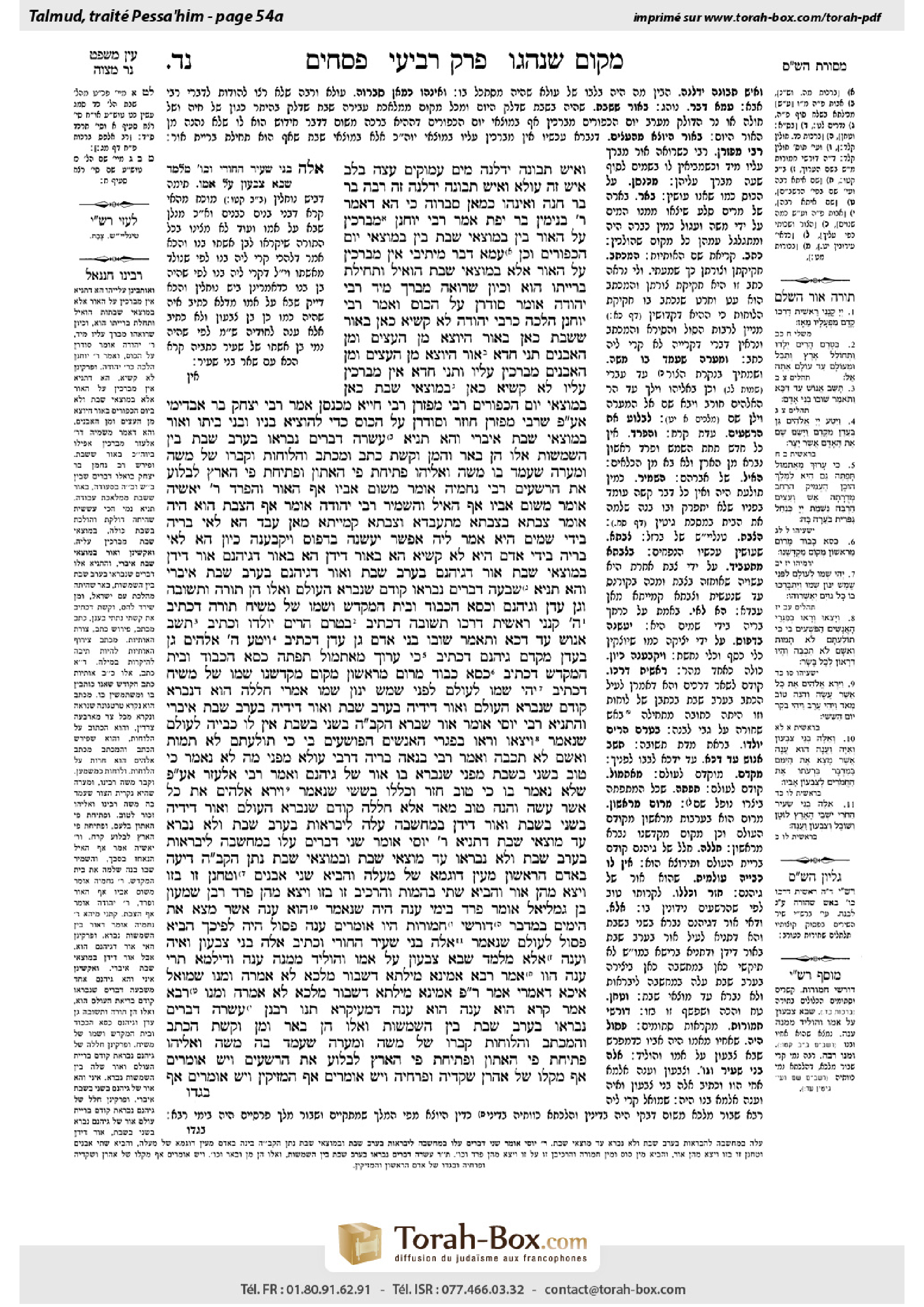
Pesachim 54a: Talmud study for Daf Yomi
Daf Yomi is the daily study of one Talmud folio. Explore 37 tractates with scans, Hebrew text, Sefaria English and AI-generated French translations where annotated.
Passage selection and English or AI-generated French translation are available where the scan has annotations. Daf Study is independent of Torah-Box and Sefaria.
Browse Pesachim · פסחים · All tractatesPesachim 54a text and translations
This page of Pesachim includes the Aramaic text, an English translation and an AI-generated French translation, alongside the scan above.
פסחים נ״ד א · Aramaic and Hebrew text
וְאִישׁ תְּבוּנָה יִדְלֶנָּה״. ״מַיִם עֲמוּקִּים עֵצָה בְלֶב אִישׁ״ — זֶה עוּלָּא. ״וְאִישׁ תְּבוּנָה יִדְלֶנָּה״ — זֶה רַבָּה בַּר בַּר חָנָה. וְאִינְהוּ כְּמַאן סַבְרוּהָ? כִּי הָא דְּאָמַר רַבִּי בִּנְיָמִין בַּר יֶפֶת אָמַר רַבִּי יוֹחָנָן: מְבָרְכִין עַל הָאוּר בֵּין בְּמוֹצָאֵי שַׁבָּת בֵּין בְּמוֹצָאֵי יוֹם הַכִּפּוּרִים. וְכֵן עַמָּא דָּבַר.
מֵיתִיבִי: אֵין מְבָרְכִין עַל הָאוּר אֶלָּא בְּמוֹצָאֵי שַׁבָּת, הוֹאִיל וּתְחִילַּת בְּרִיָּיתוֹ הוּא. וְכֵיוָן שֶׁרוֹאֶה — מְבָרֵךְ מִיָּד. רַבִּי יְהוּדָה אוֹמֵר, סוֹדְרָן עַל הַכּוֹס. וְאָמַר רַבִּי יוֹחָנָן: הֲלָכָה כְּרַבִּי יְהוּדָה!
לָא קַשְׁיָא: כָּאן בְּאוּר שֶׁשָּׁבַת, כָּאן בְּאוּר הַיּוֹצֵא מִן הָעֵצִים וּמִן הָאֲבָנִים.
תָּנֵי חֲדָא: אוּר הַיּוֹצֵא מִן הָעֵצִים וּמִן הָאֲבָנִים מְבָרְכִין עָלָיו, וְתָנֵי חֲדָא: אֵין מְבָרְכִין עָלָיו. לָא קַשְׁיָא: כָּאן בְּמוֹצָאֵי שַׁבָּת, כָּאן בְּמוֹצָאֵי יוֹם הַכִּפּוּרִים.
רַבִּי מְפַזְּרָן. רַבִּי חִיָּיא מְכַנְּסָן. אָמַר רַבִּי יִצְחָק בַּר אַבְדִּימִי: אַף עַל פִּי שֶׁרַבִּי מְפַזְּרָן — חוֹזֵר וְסוֹדְרָן עַל הַכּוֹס, כְּדֵי לְהוֹצִיא בָּנָיו וּבְנֵי בֵּיתוֹ.
וְאוּר בְּמוֹצָאֵי שַׁבָּת אִיבְּרִי? וְהָא תַּנְיָא: עֲשָׂרָה דְּבָרִים נִבְרְאוּ בְּעֶרֶב שַׁבָּת בֵּין הַשְּׁמָשׁוֹת, אֵלּוּ הֵן: בְּאֵר, וְהַמָּן, וְקֶשֶׁת, כְּתָב, וּמַכְתֵּב, וְהַלּוּחוֹת, וְקִבְרוֹ שֶׁל מֹשֶׁה, וּמְעָרָה שֶׁעָמַד בּוֹ מֹשֶׁה וְאֵלִיָּהוּ, פְּתִיחַת פִּי הָאָתוֹן, וּפְתִיחַת פִּי הָאָרֶץ לִבְלוֹעַ אֶת הָרְשָׁעִים.
רַבִּי נְחֶמְיָה אוֹמֵר מִשּׁוּם אָבִיו: אַף הָאוּר וְהַפֶּרֶד. רַבִּי יֹאשִׁיָּה אוֹמֵר מִשּׁוּם אָבִיו: אַף הָאַיִל, וְהַשָּׁמִיר. רַבִּי יְהוּדָה אוֹמֵר: אַף הַצְּבָת. הוּא הָיָה אוֹמֵר: צְבָתָא בִּצְבָתָא מִתְעַבְדָא, וּצְבָתָא קַמַּיְיתָא מַאן עֲבַד? הָא לָאיֵ בְּרִיָּה בִּידֵי שָׁמַיִם הִיא. אֲמַר לֵיהּ: אֶפְשָׁר יַעֲשֶׂנָּה בִּדְפוּס וְיִקְבָּעֶנָּה כֵּיוָן. הָא לָאיֵ בְּרִיָּה בִּידֵי אָדָם הִיא.
לָא קַשְׁיָא: הָא בְּאוּר דִּידַן, הָא בְּאוּר דְּגֵיהִנָּם. אוּר דִּידַן — בְּמוֹצָאֵי שַׁבָּת, אוּר דְּגֵיהִנָּם — בְּעֶרֶב שַׁבָּת. וְאוּר דְּגֵיהִנָּם בְּעֶרֶב שַׁבָּת אִיבְּרִי? וְהָא תַּנְיָא: שִׁבְעָה דְּבָרִים נִבְרְאוּ קוֹדֶם שֶׁנִּבְרָא הָעוֹלָם, וְאֵלּוּ הֵן: תּוֹרָה, וּתְשׁוּבָה, וְגַן עֵדֶן, וְגֵיהִנָּם, וְכִסֵּא הַכָּבוֹד, וּבֵית הַמִּקְדָּשׁ, וּשְׁמוֹ שֶׁל מָשִׁיחַ.
תּוֹרָה, דִּכְתִיב: ״ה׳ קָנָנִי רֵאשִׁית דַּרְכּוֹ״. תְּשׁוּבָה, דִּכְתִיב: ״בְּטֶרֶם הָרִים יֻלָּדוּ״, וּכְתִיב: ״תָּשֵׁב אֱנוֹשׁ עַד דַּכָּא וַתֹּאמֶר שׁוּבוּ בְנֵי אָדָם״.
גַּן עֵדֶן, דִּכְתִיב: ״וַיִּטַּע ה׳ אֱלֹהִים גַּן בְּעֵדֶן מִקֶּדֶם״. גֵּיהִנָּם, דִּכְתִיב: ״כִּי עָרוּךְ מֵאֶתְמוּל תׇּפְתֶּה״.
כִּסֵּא הַכָּבוֹד וּבֵית הַמִּקְדָּשׁ, דִּכְתִיב: ״כִּסֵּא כָבוֹד מָרוֹם מֵרִאשׁוֹן מְקוֹם מִקְדָּשֵׁנוּ״. שְׁמוֹ שֶׁל מָשִׁיחַ, דִּכְתִיב: ״יְהִי שְׁמוֹ לְעוֹלָם לִפְנֵי שֶׁמֶשׁ יִנּוֹן שְׁמוֹ״!
אָמְרִי, חֲלָלָהּ הוּא דְּנִבְרָא קוֹדֶם שֶׁנִּבְרָא הָעוֹלָם, וְאוּר דִּידֵיהּ בְּעֶרֶב שַׁבָּת.
וְאוּר דִּידֵיהּ בְּעֶרֶב שַׁבָּת אִיבְּרִי? וְהַתַּנְיָא, רַבִּי יוֹסֵי אוֹמֵר: אוּר שֶׁבָּרָא הַקָּדוֹשׁ בָּרוּךְ הוּא בְּשֵׁנִי בַּשַּׁבָּת אֵין לוֹ כְּבִיָּיה לְעוֹלָם, שֶׁנֶּאֱמַר: ״וְיָצְאוּ וְרָאוּ בְּפִגְרֵי הָאֲנָשִׁים הַפּוֹשְׁעִים בִּי כִּי תוֹלַעְתָּם לֹא תָמוּת וְאִשָּׁם לֹא תִכְבֶּה״, וְאָמַר רַבִּי בְּנָאָה בְּרֵיהּ דְּרַבִּי עוּלָּא: מִפְּנֵי מָה לֹא נֶאֱמַר ״כִּי טוֹב״ בְּשֵׁנִי בַּשַּׁבָּת — מִפְּנֵי שֶׁנִּבְרָא בּוֹ אוּר שֶׁל גֵּיהִנָּם. וְאָמַר רַבִּי אֶלְעָזָר: אַף עַל פִּי שֶׁלֹּא נֶאֱמַר בּוֹ ״כִּי טוֹב״, חָזַר וּכְלָלוֹ בַּשִּׁשִּׁי, שֶׁנֶּאֱמַר: ״וַיַּרְא אֱלֹהִים אֶת כׇּל אֲשֶׁר עָשָׂה וְהִנֵּה טוֹב מְאֹד״.
אֶלָּא: חֲלָלָהּ — קוֹדֶם שֶׁנִּבְרָא הָעוֹלָם, וְאוּר דִּידֵיהּ — בְּשֵׁנִי בַּשַּׁבָּת. וְאוּר דִּידַן — בְּמַחְשָׁבָה עָלָה לִיבָּרְאוֹת בְּעֶרֶב שַׁבָּת, וְלֹא נִבְרָא עַד מוֹצָאֵי שַׁבָּת. דְּתַנְיָא, רַבִּי יוֹסֵי אוֹמֵר: שְׁנֵי דְבָרִים עָלוּ בְּמַחְשָׁבָה לִיבָּרְאוֹת בְּעֶרֶב שַׁבָּת, וְלֹא נִבְרְאוּ עַד מוֹצָאֵי שַׁבָּת, וּבְמוֹצָאֵי שַׁבָּת נָתַן הַקָּדוֹשׁ בָּרוּךְ הוּא דֵּיעָה בְּאָדָם הָרִאשׁוֹן מֵעֵין דּוּגְמָא שֶׁל מַעְלָה, וְהֵבִיא שְׁנֵי אֲבָנִים וּטְחָנָן זוֹ בָּזוֹ, וְיָצָא מֵהֶן אוּר, וְהֵבִיא שְׁתֵּי בְהֵמוֹת וְהִרְכִּיב זוֹ בָּזוֹ וְיָצָא מֵהֶן פֶּרֶד. רַבָּן שִׁמְעוֹן בֶּן גַּמְלִיאֵל אוֹמֵר: פֶּרֶד בִּימֵי עֲנָה הָיָה, שֶׁנֶּאֱמַר: ״הוּא עֲנָה אֲשֶׁר מָצָא אֶת הַיֵּמִם בַּמִּדְבָּר״.
דּוֹרְשֵׁי חֲמוּרוֹת, הָיוּ אוֹמְרִים: עֲנָה פָּסוּל הָיָה, לְפִיכָךְ הֵבִיא פְּסוּל לְעוֹלָם, שֶׁנֶּאֱמַר: ״אֵלֶּה בְנֵי שֵׂעִיר הַחֹרִי״, וּכְתִיב: ״אֵלֶּה בְנֵי צִבְעוֹן וְאַיָּה וַעֲנָה״! אֶלָּא, מְלַמֵּד שֶׁבָּא צִבְעוֹן עַל אִמּוֹ וְהוֹלִיד מִמֶּנָּה עֲנָה.
וְדִילְמָא תְּרֵי עֲנָה הֲווֹ?! אָמַר רָבָא: אָמֵינָא מִילְּתָא דְּשַׁבּוּר מַלְכָּא לָא אַמְרַהּ, וּמַנּוּ? שְׁמוּאֵל. אִיכָּא דְּאָמְרִי: אָמַר רַב פָּפָּא: אָמֵינָא מִילְּתָא דְּשַׁבּוּר מַלְכָּא לָא אַמְרַהּ, וּמַנּוּ? רָבָא; אָמַר קְרָא: ״הוּא עֲנָה״ — הוּא עֲנָה דְּמֵעִיקָּרָא.
תָּנוּ רַבָּנַן: עֲשָׂרָה דְּבָרִים נִבְרְאוּ בְּעֶרֶב שַׁבָּת בֵּין הַשְּׁמָשׁוֹת, וְאֵלּוּ הֵן: בְּאֵר, וּמָן, וְקֶשֶׁת, הַכְּתָב, וְהַמַּכְתֵּב, וְהַלּוּחוֹת, קִבְרוֹ שֶׁל מֹשֶׁה, וּמְעָרָה שֶׁעָמַד בָּהּ מֹשֶׁה וְאֵלִיָּהוּ, פְּתִיחַת פִּי הָאָתוֹן, וּפְתִיחַת פִּי הָאָרֶץ לִבְלוֹעַ אֶת הָרְשָׁעִים. וְיֵשׁ אוֹמְרִים: אַף מַקְלוֹ שֶׁל אַהֲרֹן שְׁקֵדֶיהָ וּפְרָחֶיהָ, וְיֵשׁ אוֹמְרִים: אַף הַמַּזִּיקִין, וְיֵשׁ אוֹמְרִים: אַף
Pesachim 54a · English translation
but a man of understanding will draw it out” (Proverbs 20:5). Counsel in the heart of man is like deep water; that is a reference to Ulla, who had a thought but did not articulate it. But a man of understanding will draw it out; that is a reference to Rabba bar bar Ḥana, who understood the allusion even though it was not articulated. The Gemara asks: And in accordance with whose opinion do Ulla and Rabba bar bar Ḥana hold, leading them to reject Rabbi Abba’s statement of Rabbi Yoḥanan’s opinion? The Gemara answers: They hold in accordance with that which Rabbi Binyamin bar Yefet said that Rabbi Yoḥanan said: One recites the blessing over fire both at the conclusion of Shabbat and at the conclusion of Yom Kippur. And that is how the people act.
The Gemara raises an objection from that which was previously taught: One recites a blessing over fire only at the conclusion of Shabbat and not at the conclusion of Festivals or Yom Kippur, since the conclusion of Shabbat is the time of its original creation. And once he sees it, he recites the blessing immediately. Rabbi Yehuda says: One does not recite the blessing immediately; rather, he waits and arranges and recites the blessings over fire and spices over the cup of wine that accompanies the recitation of havdala. And Rabbi Yoḥanan said: The halakha is in accordance with the opinion of Rabbi Yehuda. How does Rabbi Yoḥanan explain the baraita?
The Gemara answers: This is not difficult. Here, where Rabbi Yoḥanan said that one recites the blessing at the conclusion of Yom Kippur, it is referring to fire that rested on Yom Kippur, i.e., fire for which no prohibition was involved in its kindling, either because it was kindled before Yom Kippur or because it was kindled in a permitted manner, e.g., for a dangerously ill person. There, where Rabbi Yoḥanan said that the blessing is recited only at the conclusion of Shabbat, it is referring to fire generated from wood and from stones after Shabbat, similar to the primordial fire, which was created at the conclusion of Shabbat.
It was taught in one baraita: With regard to fire generated from wood and stones, one recites a blessing over it; and it was taught in one other baraita: One does not recite a blessing over it. This apparent contradiction is not difficult. Here, where the baraita states that one recites a blessing, it is referring to the conclusion of Shabbat. There, where the baraita states that one does not recite a blessing, it is referring to the conclusion of Yom Kippur.
Rabbi Yehuda HaNasi would distribute the blessings over the fire and the spices, reciting each when the opportunity arose. Rabbi Ḥiyya would collect them, reciting all the blessings at the same time in the framework of havdala. Rabbi Yitzḥak bar Avdimi said: Even though Rabbi Yehuda HaNasi distributes them and recites each blessing at his first opportunity, he repeats the blessings and arranges and recites them over the cup of wine in order to discharge the obligation of his children and the members of his household.
The Gemara stated that fire was originally created at the conclusion of Shabbat. The Gemara asks: Was fire created at the conclusion of Shabbat? Wasn’t it taught in a baraita: Ten miraculous phenomena were created in heaven on Shabbat eve during twilight, and were revealed in the world only later? They were: Miriam’s well, and the manna that fell in the desert, and the rainbow, writing [ketav], and the writing instrument [mikhtav], and the tablets of the Ten Commandments, and the grave of Moses, and the cave in which Moses and Elijah stood, the opening of the mouth of Balaam’s donkey, and the opening of the earth’s mouth to swallow the wicked in the incident involving Korah.
Rabbi Neḥemya said in the name of his father: Even the fire and the mule, which is a product of crossbreeding, were created at that time. Rabbi Yoshiya said in the name of his father: Even the ram slaughtered by Abraham in place of Isaac, and the shamir worm used to shape the stones for the altar, were created at that time. Rabbi Yehuda says: Even the tongs were created at this time. He would say: Tongs can be fashioned only with other tongs, but who fashioned the first tongs? Indeed, the first pair of tongs was fashioned at the hand of Heaven. An anonymous questioner said to him: It is possible to fashion tongs with a mold and align it without the need for other tongs. Indeed, the first tongs were a creation of man. In any event, fire was originally created before Shabbat, not at the conclusion of Shabbat.
The Gemara answers: This is not difficult. This baraita is referring to our fire, and that baraita is referring to the fire of Gehenna. The Gemara explains: Our fire was created at the conclusion of Shabbat, but the fire of Gehenna was created on Shabbat eve. The Gemara proceeds to ask: Was the fire of Gehenna created on Shabbat eve? Wasn’t it taught in a baraita: Seven phenomena were created before the world was created, and they are: Torah, and repentance, and the Garden of Eden, and Gehenna, and the Throne of Glory, and the Temple, and the name of Messiah.
The Gemara provides sources for the notion that each of these phenomena was created before the world was. Torah was created before the world was created, as it is written: “The Lord made me as the beginning of His way, the first of His works of old” (Proverbs 8:22), which, based on the subsequent verses, is referring to the Torah. Repentance was created before the world was created, as it is written: “Before the mountains were brought forth, or ever You had formed the earth and the world, even from everlasting to everlasting, You are God,” and it is written immediately afterward: “You return man to contrition; and You say: Repent, children of man” (Psalms 90:2–3).
The Garden of Eden was created before the world was created, as it is written: “And God planted the Garden of Eden in the east [mikedem]” (Genesis 2:8). The term: In the east [mikedem] is interpreted in the sense of: Before [mikodem], i.e., before the world was created. Gehenna was created before the world was created, as it is written: “For its hearth is ordained of old” (Isaiah 30:33). The hearth, i.e., Gehenna, was created before the world was created.
The Throne of Glory and the Temple were created before the world was created, as it is written: “Your Throne of Glory on high from the beginning, in the place of our Sanctuary” (Jeremiah 17:12). The name of Messiah was created before the world was created, as it is written in the chapter discussing the Messiah: “May his name endure forever; his name existed before the sun” (Psalms 72:17). The name of Messiah already existed before the creation of the sun and the rest of the world. This baraita states that Gehenna was created before the world was created and not during twilight before the first Shabbat.
They say in answer: The void of Gehenna was created before the world, but its fire was created on Shabbat eve.
The Gemara asks: And was its fire created on Shabbat eve? Wasn’t it taught in a baraita that Rabbi Yosei says: The fire that the Holy One, Blessed be He, created on the second day of the week will never be extinguished, as it is stated: “And they shall go forth, and look upon the carcasses of the men who have rebelled against Me; for their worm shall not die, nor will their fire be extinguished; and they shall be an abhorrence to all flesh” (Isaiah 66:24)? And Rabbi Bana’a, son of Rabbi Ulla, said: Why doesn’t the verse state: That it was good, at the end of the second day of the week of Creation, as it does on the other days? It is because on that day the fire of Gehenna was created. And Rabbi Elazar said that even though: That it was good, was not stated with regard to the creations of the second day, He later included it on the sixth day, as it is stated: “And God saw all that He had done and behold, it was very good” (Genesis 1:31).
Rather, the void of Gehenna was created before the world was created, and its fire was created only on the second day of the week. And the thought arose in God’s mind to create our fire on Shabbat eve; however, it was not actually created until the conclusion of Shabbat, as it was taught in a baraita that Rabbi Yosei says: The thoughts of two phenomena arose in God’s mind on Shabbat eve, but were not actually created until the conclusion of Shabbat. At the conclusion of Shabbat, the Holy One, Blessed be He, granted Adam, the first man, creative knowledge similar to divine knowledge, and he brought two rocks and rubbed them against each other, and the first fire emerged from them. Adam also brought two animals, a female horse and a male donkey, and mated them with each other, and the resultant offspring that emerged from them was a mule. Rabban Shimon ben Gamliel disagrees and says that the first mule was in the days of Anah, as it is stated: “And these are the children of Zibeon: Aiah and Anah; this is Anah who found the mules in the wilderness, as he fed the donkeys of Zibeon his father” (Genesis 36:24).
The interpreters of Torah symbolism [ḥamurot] would say: Anah was the product of an incestuous relationship, and as a result he was spiritually unfit to produce offspring. Therefore, he brought an example of unfitness, i.e., an animal physically unfit to produce offspring, into the world, as it is stated: “These are the sons of Seir the Horite, the inhabitants of the land: Lotan, and Shoval, and Zibeon, and Anah” (Genesis 36:20). And it is also stated: “And these are the sons of Zibeon: Aiah and Anah” (Genesis 36:24). One verse describes both Anah and Zibeon as sons of Seir, meaning that they are brothers, while the other verse describes Anah as Zibeon’s son. Rather, this teaches that Zibeon cohabited with his mother, the wife of Seir, and fathered Anah from her. He is called Seir’s son although in fact he was the offspring of Seir’s son and Seir’s wife.
The Gemara asks: And perhaps there were two people named Anah, one the son of Zibeon and the other the son of Seir? Rava said: I will state a matter that even King Shapur did not state. And who is this King Shapur? This cannot be a reference to Shapur, king of Persia; rather, it must be an epithet for someone else. He is Shmuel, whose legal rulings were accepted by the public like the edicts of a king by his subjects. Some say a different version, that it was Rav Pappa who said: I will state a matter that even King Shapur did not state. And who is he that Rav Pappa is referring to by the epithet King Shapur? He is Rava. The verse said: “This is Anah who found the mules,” indicating that he is the same Anah mentioned initially in the earlier verse.
The Sages taught: Ten phenomena were created on Shabbat eve during twilight, and they were: Miriam’s well, and manna, and the rainbow, writing, and the writing instrument, and the tablets, the grave of Moses, and the cave in which Moses and Elijah stood, the opening of the mouth of Balaam’s donkey, and the opening of the mouth of the earth to swallow the wicked in the time of Korah. And some say that even Aaron’s staff was created then with its almonds and its blossoms. Some say that even the demons were created at this time. And some say that even
Pesachim 54a · Traduction française (IA)
« Mais l’homme intelligent saura le tirer » (Proverbes 20,5). Le conseil dans le cœur de l’homme est comme une eau profonde : cela fait référence à Oula, qui avait une pensée mais ne l’exprima pas. Mais l’homme intelligent saura le tirer : cela fait référence à Rabba bar bar Ḥana, qui comprit l’allusion bien qu’elle n’eût pas été exprimée. La Guemara demande : De l’avis de qui Oula et Rabba bar bar Ḥana se réclament-ils donc pour rejeter la déclaration de Rabbi Abba au nom de Rabbi Yoḥanan ? La Guemara répond : Ils se réclament de ce que Rabbi Binyamin bar Yefet a dit au nom de Rabbi Yoḥanan : On récite la bénédiction sur le feu aussi bien à la fin de Chabbat qu’à la fin de Yom Kippour. Et c’est ainsi que les gens agissent.
La Guemara soulève une objection à partir de ce qui a été enseigné précédemment : On récite une bénédiction sur le feu uniquement à la fin de Chabbat, et non à la fin des fêtes ni de Yom Kippour, car la fin de Chabbat correspond au moment de sa création originelle. Dès qu’on voit le feu, on récite immédiatement la bénédiction. Rabbi Yehouda dit : On ne récite pas immédiatement la bénédiction ; on attend plutôt, puis on ordonne et récite les bénédictions sur le feu et les aromates sur la coupe de vin qui accompagne la récitation de la havdala. Or Rabbi Yoḥanan a dit : La halakha suit l’opinion de Rabbi Yehouda. Comment Rabbi Yoḥanan explique-t-il la baraïta ?
La Guemara répond : Il n’y a pas de difficulté. Ici, lorsque Rabbi Yoḥanan a dit qu’on récite la bénédiction à la fin de Yom Kippour, il s’agit d’un feu qui a brûlé pendant Yom Kippour, c’est-à-dire d’un feu dont l’allumage ne contrevenait à aucune interdiction, soit parce qu’il avait été allumé avant Yom Kippour, soit parce qu’il avait été allumé de manière permise, par exemple pour une personne gravement malade. Là, lorsque Rabbi Yoḥanan a dit qu’on ne récite la bénédiction qu’à la fin de Chabbat, il s’agit d’un feu produit avec du bois et des pierres après Chabbat, semblable au feu primordial, qui fut créé à la fin de Chabbat.
Il a été enseigné dans une baraïta : On récite une bénédiction sur un feu produit avec du bois et des pierres ; et une autre baraïta enseigne qu’on ne récite pas de bénédiction sur ce feu. Cette contradiction apparente ne pose pas de difficulté. Ici, lorsque la baraïta dit qu’on récite une bénédiction, il s’agit de la fin de Chabbat. Là, lorsque la baraïta dit qu’on ne récite pas de bénédiction, il s’agit de la fin de Yom Kippour.
Rabbi Yehouda HaNassi disait séparément les bénédictions sur le feu et les aromates, récitant chacune dès que l’occasion se présentait. Rabbi Ḥiyya les regroupait et récitait toutes les bénédictions en même temps dans le cadre de la havdala. Rabbi Yitzḥak bar Avdimi a dit : Bien que Rabbi Yehouda HaNassi les dise séparément et récite chaque bénédiction à la première occasion, il répète les bénédictions, puis les ordonne et les récite sur la coupe de vin, afin d’acquitter de leur obligation ses enfants et les membres de son foyer.
La Guemara a déclaré que le feu fut créé à la fin de Chabbat. Elle demande : Le feu fut-il créé à la fin de Chabbat ? N’a-t-il pas été enseigné dans une baraïta : Dix phénomènes miraculeux furent créés au ciel la veille de Chabbat, au crépuscule, et ne se manifestèrent dans le monde que plus tard ? Ce sont : le puits de Myriam, la manne qui tomba dans le désert, l’arc-en-ciel, l’écriture [ketav], l’instrument à écrire [mikhtav], les Tables des Dix Commandements, la tombe de Moïse, la grotte où se tinrent Moïse et Élie, l’ouverture de la bouche de l’ânesse de Balaam et l’ouverture de la bouche de la terre pour engloutir les méchants dans l’épisode de Koré.
Rabbi Neḥemya a dit au nom de son père : Même le feu et le mulet, produit d’un croisement, furent créés à ce moment-là. Rabbi Yoshiya a dit au nom de son père : Même le bélier qu’Abraham sacrifia à la place d’Isaac et le ver shamir, utilisé pour tailler les pierres de l’autel, furent créés à ce moment-là. Rabbi Yehouda dit : Même les tenailles furent créées à ce moment-là. Il disait : On ne peut fabriquer des tenailles qu’avec d’autres tenailles ; mais qui fabriqua les premières tenailles ? En vérité, la première paire de tenailles fut façonnée par la main du Ciel. Un interlocuteur anonyme lui dit : Il est possible de fabriquer des tenailles à l’aide d’un moule et de les ajuster sans avoir besoin d’autres tenailles. En vérité, les premières tenailles furent une création humaine. Quoi qu’il en soit, le feu fut créé à l’origine avant Chabbat, et non à la fin de Chabbat.
La Guemara répond : Il n’y a pas de difficulté. Cette baraïta parle de notre feu, et l’autre baraïta du feu de la Géhenne. La Guemara explique : Notre feu fut créé à la fin de Chabbat, mais le feu de la Géhenne fut créé la veille de Chabbat. La Guemara poursuit sa question : Le feu de la Géhenne fut-il créé la veille de Chabbat ? N’a-t-il pas été enseigné dans une baraïta : Sept phénomènes furent créés avant la création du monde : la Torah, la repentance, le Jardin d’Éden, la Géhenne, le Trône de Gloire, le Temple et le nom du Messie.
La Guemara fournit des sources attestant que chacun de ces phénomènes fut créé avant le monde. La Torah fut créée avant le monde, comme il est écrit : « Le Seigneur m’a créée au commencement de sa voie, comme la première de ses œuvres d’autrefois » (Proverbes 8,22), ce qui, d’après les versets suivants, fait référence à la Torah. La repentance fut créée avant le monde, comme il est écrit : « Avant que les montagnes fussent nées, avant que tu eusses formé la terre et le monde, d’éternité en éternité, tu es Dieu », et il est écrit immédiatement après : « Tu ramènes l’homme à la contrition, et tu dis : Repentez-vous, enfants de l’homme » (Psaumes 90,2-3).
Le Jardin d’Éden fut créé avant le monde, comme il est écrit : « Et Dieu planta un Jardin d’Éden à l’est [mikedem] » (Genèse 2,8). L’expression « à l’est » [mikedem] est interprétée au sens de « auparavant » [mikodem], c’est-à-dire avant la création du monde. La Géhenne fut créée avant le monde, comme il est écrit : « Car son foyer est préparé depuis longtemps » (Isaïe 30,33). Le foyer, c’est-à-dire la Géhenne, fut créé avant le monde.
Le Trône de Gloire et le Temple furent créés avant le monde, comme il est écrit : « Ton Trône de Gloire, élevé depuis le commencement, à l’emplacement de notre Sanctuaire » (Jérémie 17,12). Le nom du Messie fut créé avant le monde, comme il est écrit dans le passage consacré au Messie : « Que son nom subsiste à jamais ; son nom existait avant le soleil » (Psaumes 72,17). Le nom du Messie existait déjà avant la création du soleil et du reste du monde. Cette baraïta affirme que la Géhenne fut créée avant le monde, et non au crépuscule précédant le premier Chabbat.
Ils répondent : Le gouffre de la Géhenne fut créé avant le monde, mais son feu fut créé la veille de Chabbat.
La Guemara demande : Son feu fut-il créé la veille de Chabbat ? N’a-t-il pas été enseigné dans une baraïta que Rabbi Yosei dit : Le feu que le Saint, béni soit-Il, créa le deuxième jour de la semaine ne s’éteindra jamais, comme il est dit : « Ils sortiront et verront les cadavres des hommes qui se sont révoltés contre Moi ; car leur ver ne mourra pas et leur feu ne s’éteindra pas, et ils seront une horreur pour toute chair » (Isaïe 66,24) ? Et Rabbi Bana’a, fils de Rabbi Oula, a dit : Pourquoi le verset ne dit-il pas « que cela était bon » à la fin du deuxième jour de la semaine de la Création, comme il le fait pour les autres jours ? C’est parce que le feu de la Géhenne fut créé ce jour-là. Rabbi Elazar a dit que, bien que l’expression « que cela était bon » n’ait pas été employée à propos des créations du deuxième jour, Dieu l’inclut ensuite le sixième jour, comme il est dit : « Dieu vit tout ce qu’il avait fait, et voici, cela était très bon » (Genèse 1,31).
En réalité, le gouffre de la Géhenne fut créé avant le monde, et son feu ne fut créé que le deuxième jour de la semaine. L’idée de créer notre feu vint à l’esprit de Dieu la veille de Chabbat ; toutefois, il ne fut effectivement créé qu’à la fin de Chabbat, comme il a été enseigné dans une baraïta que Rabbi Yosei dit : L’idée de créer deux phénomènes vint à l’esprit de Dieu la veille de Chabbat, mais ils ne furent effectivement créés qu’à la fin de Chabbat. À la fin de Chabbat, le Saint, béni soit-Il, accorda à Adam, le premier homme, un savoir créateur semblable au savoir divin. Adam prit deux pierres et les frotta l’une contre l’autre ; le premier feu en jaillit. Adam prit également deux animaux, une jument et un âne mâle, et les accoupla ; le petit qui en naquit fut un mulet. Rabban Shimon ben Gamliel n’est pas d’accord et dit que le premier mulet apparut à l’époque d’Anah, comme il est dit : « Voici les enfants de Tsivéon : Aïa et Anah ; c’est cet Anah qui trouva les mulets dans le désert, tandis qu’il faisait paître les ânes de Tsivéon, son père » (Genèse 36,24).
Les interprètes des symboles de la Torah [ḥamurot] disaient : Anah était issu d’une relation incestueuse et, par conséquent, était spirituellement inapte à engendrer. Il introduisit donc dans le monde un exemple d’inaptitude, c’est-à-dire un animal physiquement incapable d’engendrer, comme il est dit : « Voici les fils de Séïr le Horien, habitants du pays : Lotan, Shoval, Tsivéon et Anah » (Genèse 36,20). Il est également dit : « Voici les enfants de Tsivéon : Aïa et Anah » (Genèse 36,24). Un verset décrit Anah et Tsivéon comme des fils de Séïr, ce qui signifie qu’ils sont frères, tandis que l’autre verset décrit Anah comme le fils de Tsivéon. Cela enseigne plutôt que Tsivéon eut des relations avec sa mère, l’épouse de Séïr, et engendra Anah avec elle. Anah est appelé fils de Séïr, bien qu’en réalité il soit issu du fils de Séïr et de l’épouse de Séïr.
La Guemara demande : Et peut-être y avait-il deux hommes nommés Anah, l’un fils de Tsivéon et l’autre fils de Séïr ? Rava dit : Je vais énoncer une chose que même le roi Shapur n’a pas énoncée. Et qui est ce roi Shapur ? Il ne peut s’agir de Shapur, roi de Perse ; ce doit donc être un sobriquet désignant quelqu’un d’autre. C’est Shmuel, dont les décisions halakhiques étaient acceptées par le public comme les édits d’un roi par ses sujets. Selon une autre version, c’est Rav Pappa qui dit : Je vais énoncer une chose que même le roi Shapur n’a pas énoncée. Et qui Rav Pappa désigne-t-il par le sobriquet de roi Shapur ? C’est Rava. Le verset dit : « C’est cet Anah qui trouva les mulets », ce qui indique qu’il s’agit du même Anah que celui mentionné initialement dans le verset précédent.
Les Sages ont enseigné : Dix phénomènes furent créés la veille de Chabbat, au crépuscule : le puits de Myriam, la manne, l’arc-en-ciel, l’écriture, l’instrument à écrire, les Tables, la tombe de Moïse, la grotte où se tinrent Moïse et Élie, l’ouverture de la bouche de l’ânesse de Balaam et l’ouverture de la bouche de la terre pour engloutir les méchants à l’époque de Koré. Certains disent que même le bâton d’Aaron fut créé alors, avec ses amandes et ses fleurs. Certains disent que même les démons furent créés à ce moment-là. Et certains disent que même
Traduction française générée par IA à partir de l’édition anglaise de Sefaria. Vérifie toujours un passage avec le texte source.
Text from Sefaria: William Davidson Edition - Vocalized Aramaic (CC BY NC); William Davidson Edition - English (CC BY NC).