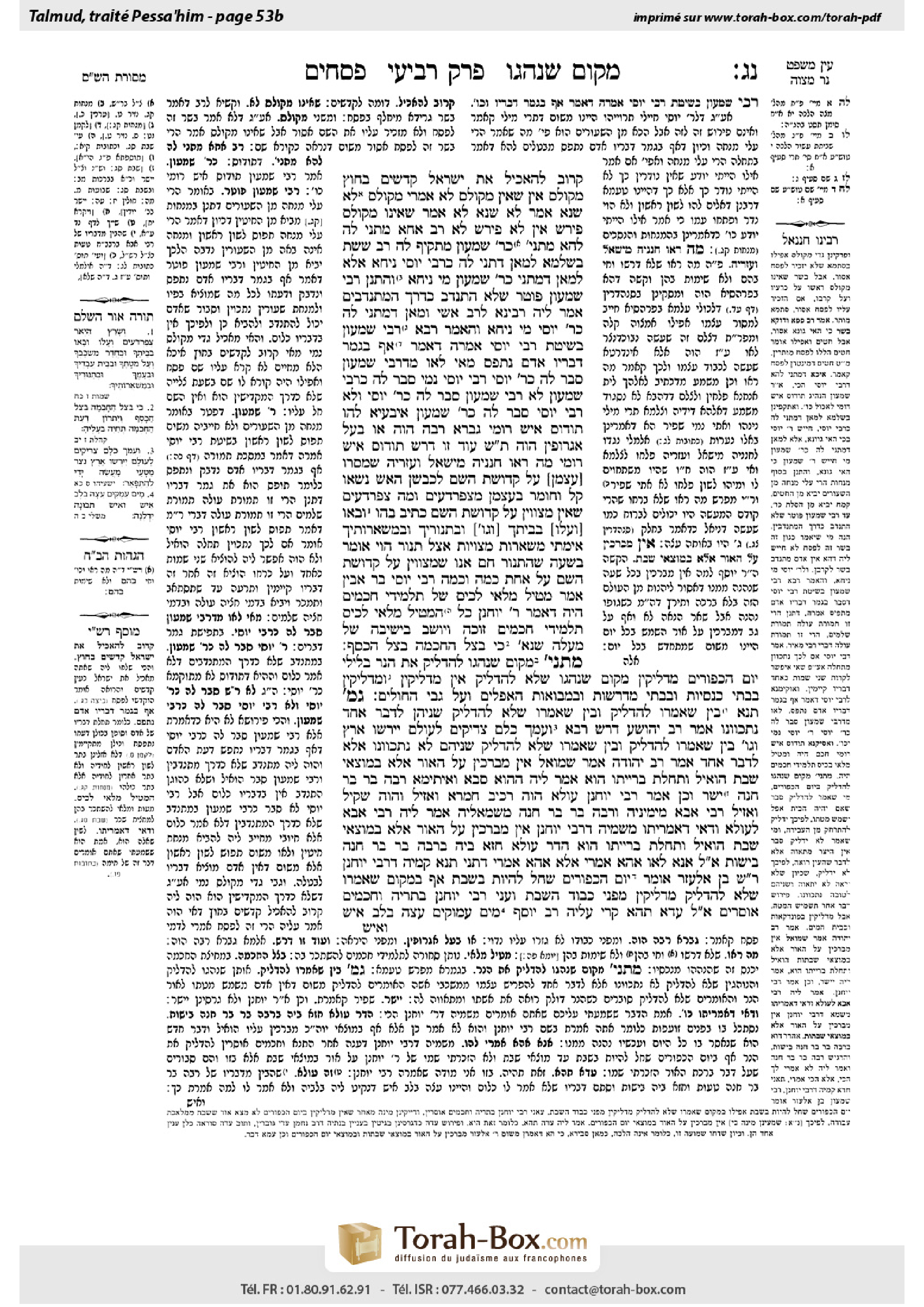
Pesachim 53b: Talmud study for Daf Yomi
Daf Yomi is the daily study of one Talmud folio. Explore 37 tractates with scans, Hebrew text, Sefaria English and AI-generated French translations where annotated.
Passage selection and English or AI-generated French translation are available where the scan has annotations. Daf Study is independent of Torah-Box and Sefaria.
Browse Pesachim · פסחים · All tractatesPesachim 53b text and translations
This page of Pesachim includes the Aramaic text, an English translation and an AI-generated French translation, alongside the scan above.
פסחים נ״ג ב · Aramaic and Hebrew text
קָרוֹב לְהַאֲכִיל אֶת יִשְׂרָאֵל קָדָשִׁים בַּחוּץ. מְקוּלָּס — אִין, שֶׁאֵין מְקוּלָּס — לָא! אָמְרִי, מְקוּלָּס: לָא שְׁנָא אֲמַר, לָא שְׁנָא לָא אֲמַר. שֶׁאֵינוֹ מְקוּלָּס: פֵּירֵשׁ — אִין, לֹא פֵּירֵשׁ — לָא.
רַב אַחָא מַתְנִי לַהּ לְהָא מַתְנִיתִין כְּרַבִּי שִׁמְעוֹן. מַתְקֵיף לַהּ רַב שֵׁשֶׁת: בִּשְׁלָמָא לְמַאן דְּתָנֵי לַהּ כְּרַבִּי יוֹסֵי — נִיחָא, אֶלָּא לְמַאן דְּמַתְנֵי כְּרַבִּי שִׁמְעוֹן — מִי נִיחָא?
וְהָתְנַן: רַבִּי שִׁמְעוֹן פּוֹטֵר, שֶׁלֹּא הִתְנַדֵּב כְּדֶרֶךְ הַמִּתְנַדְּבִים.
אֲמַר לֵיהּ רָבִינָא לְרַב אָשֵׁי: וּמַאן דְּמַתְנֵי לַהּ כְּרַבִּי יוֹסֵי מִי נִיחָא? וְהָאָמַר רָבָא: רַבִּי שִׁמְעוֹן בְּשִׁיטַת רַבִּי יוֹסֵי אֲמָרָהּ, דְּאָמַר: אַף בִּגְמַר דְּבָרָיו אָדָם נִתְפָּס.
מַאי לָאו: מִדְּרַבִּי שִׁמְעוֹן סָבַר לַהּ כְּרַבִּי יוֹסֵי, רַבִּי יוֹסֵי נָמֵי סָבַר לַהּ כְּרַבִּי שִׁמְעוֹן! לָא, רַבִּי שִׁמְעוֹן סָבַר לַהּ כְּרַבִּי יוֹסֵי, וְלָא רַבִּי יוֹסֵי סָבַר לַהּ כְּרַבִּי שִׁמְעוֹן.
אִיבַּעְיָא לְהוּ: תּוֹדוֹס אִישׁ רוֹמִי גַּבְרָא רַבָּה הֲוָה, אוֹ בַּעַל אֶגְרוֹפִין הֲוָה?
תָּא שְׁמַע. עוֹד זוֹ דָּרַשׁ תּוֹדוֹס אִישׁ רוֹמִי: מָה רָאוּ חֲנַנְיָה מִישָׁאֵל וַעֲזַרְיָה שֶׁמָּסְרוּ [עַצְמָן] עַל קְדוּשַּׁת הַשֵּׁם לְכִבְשַׁן הָאֵשׁ?
נָשְׂאוּ קַל וָחוֹמֶר בְּעַצְמָן מִצְּפַרְדְּעִים. וּמָה צְפַרְדְּעִים שֶׁאֵין מְצֻוִּוין עַל קְדוּשַּׁת הַשֵּׁם, כְּתִיב בְּהוּ: ״וּבָאוּ [וְעָלוּ] בְּבֵיתֶךָ [וְגוֹ׳] וּבְתַנּוּרֶיךָ וּבְמִשְׁאֲרוֹתֶיךָ״, אֵימָתַי מִשְׁאָרוֹת מְצוּיוֹת אֵצֶל תַּנּוּר? הֱוֵי אוֹמֵר בְּשָׁעָה שֶׁהַתַּנּוּר חַם. אָנוּ שֶׁמְּצֻוִּוין עַל קְדוּשַּׁת הַשֵּׁם — עַל אַחַת כַּמָּה וְכַמָּה.
רַבִּי יוֹסֵי בַּר אָבִין אָמַר: מֵטִיל מְלַאי לְכִיס שֶׁל תַּלְמִידֵי חֲכָמִים הָיָה. דְּאָמַר רַבִּי יוֹחָנָן: כׇּל הַמֵּטִיל מְלַאי לְכִיס תַּלְמִידֵי חֲכָמִים זוֹכֶה וְיוֹשֵׁב בִּישִׁיבָה שֶׁל מַעְלָה, שֶׁנֶּאֱמַר: ״כִּי בְּצֵל הַחׇכְמָה בְּצֵל הַכָּסֶף״.
מַתְנִי׳ מָקוֹם שֶׁנָּהֲגוּ לְהַדְלִיק אֶת הַנֵּר בְּלֵילֵי יוֹם הַכִּפּוּרִים — מַדְלִיקִין. מָקוֹם שֶׁנָּהֲגוּ שֶׁלֹּא לְהַדְלִיק — אֵין מַדְלִיקִין. וּמַדְלִיקִין בְּבָתֵּי כְנֵסִיּוֹת וּבְבָתֵּי מִדְרָשׁוֹת וּבִמְבוֹאוֹת הָאֲפֵלִים וְעַל גַּבֵּי הַחוֹלִים.
גְּמָ׳ תָּנָא: בֵּין שֶׁאָמְרוּ לְהַדְלִיק וּבֵין שֶׁאָמְרוּ שֶׁלֹּא לְהַדְלִיק — שְׁנֵיהֶן לְדָבָר אֶחָד נִתְכַּוְּונוּ. אָמַר רַב יְהוֹשֻׁעַ: דָּרֵשׁ רָבָא ״וְעַמֵּךְ כֻּלָּם צַדִּיקִים לְעוֹלָם יִירְשׁוּ אָרֶץ וְגוֹ׳״, בֵּין שֶׁאָמְרוּ לְהַדְלִיק וּבֵין שֶׁאָמְרוּ שֶׁלֹּא לְהַדְלִיק — שְׁנֵיהֶם לֹא נִתְכַּוְּונוּ אֶלָּא לְדָבָר אֶחָד.
אָמַר רַב יְהוּדָה אָמַר שְׁמוּאֵל: אֵין מְבָרְכִין עַל הָאוּר אֶלָּא בְּמוֹצָאֵי שַׁבָּת, הוֹאִיל וּתְחִלַּת בְּרִיָּיתוֹ הוּא. אֲמַר לֵיהּ הָהוּא סָבָא, וְאִיתֵּימָא רַבָּה בַּר בַּר חָנָה: יִשַׁר, וְכֵן אָמַר רַבִּי יוֹחָנָן. עוּלָּא הֲוָה רְכִיב חֲמָרָא וְאָזֵיל, וַהֲוָה שָׁקֵיל וְאָזֵיל רַבִּי אַבָּא מִיַּמִּינֵיהּ וְרַבָּה בַּר בַּר חָנָה מִשְּׂמָאלֵיהּ. אֲמַר לֵיהּ רַבִּי אַבָּא לְעוּלָּא: וַדַּאי דְּאָמְרִיתוּ מִשְּׁמֵיהּ דְּרַבִּי יוֹחָנָן ״אֵין מְבָרְכִין עַל הָאוּר אֶלָּא בְּמוֹצָאֵי שַׁבָּת, הוֹאִיל וּתְחִלַּת בְּרִיָּיתוֹ הוּא״.
הֲדַר עוּלָּא, חֲזָא בֵּיהּ בְּרַבָּה בַּר בַּר חָנָה בִּישׁוּת. אֲמַר לֵיהּ: אֲנָא לָאו אַהָא אֲמַרִי, אֶלָּא אַהָא אָמְרִי — דְּתָנֵי תַּנָּא קַמֵּיהּ דְּרַבִּי יוֹחָנָן, רַבִּי שִׁמְעוֹן בֶּן אֶלְעָזָר אוֹמֵר: יוֹם הַכִּפּוּרִים שֶׁחָל לִהְיוֹת בְּשַׁבָּת, אַף בְּמָקוֹם שֶׁאָמְרוּ שֶׁלֹּא לְהַדְלִיק — מַדְלִיקִין מִפְּנֵי כְּבוֹד הַשַּׁבָּת. וְעָנֵי רַבִּי יוֹחָנָן בָּתְרֵיהּ: וַחֲכָמִים אוֹסְרִים. אֲמַר לֵיהּ: עָדָא תְּהֵא.
קָרֵי עֲלֵיהּ רַב יוֹסֵף: ״מַיִם עֲמוּקִּים עֵצָה בְלֶב אִישׁ
Pesachim 53b · English translation
Doing so is akin to feeding Jews consecrated meat outside the permitted area, as due to its resemblance to the Paschal lamb it could be misleading. The Gemara analyzes this statement: A goat roasted whole, yes, it is prohibited; a goat not roasted whole, no, it is not prohibited. This contradicts Rav, who prohibited roasting even ordinary meat. The Sages say that this is the distinction: With regard to a goat roasted whole, there is no difference if one said it is for Passover, and there is no difference if one did not say it is for Passover. In either case, it looks like a sacrifice and it is prohibited. With regard to a goat not roasted whole, if one specified that it is for Passover, yes, it is prohibited because it appears that he is consecrating it as a sacrifice. However, if one did not specify that it is for Passover, no, it is not prohibited, as there is no need for concern.
Rav Aḥa teaches this baraita about Theodosius in accordance with the opinion of Rabbi Shimon. Rav Sheshet strongly objected to this: Granted, according to the one who learns it in accordance with the opinion of Rabbi Yosei, it works out well. However, according to the one who teaches it in accordance with the opinion of Rabbi Shimon, does it work out well? Didn’t we learn in a mishna about a dispute with regard to one who consecrated an item for a purpose for which it was unsuited, e.g., a case where one sought to bring a meal-offering of barley, although meal-offerings may be brought only from wheat? In that case, the Rabbis say he is required to bring a meal-offering of wheat because in the first part of his statement he vowed to bring a meal-offering.
Rabbi Shimon exempts him from any obligation, as in his opinion, he did not donate in the manner typical of donors. In other words, Rabbi Shimon relates to the statement: A meal-offering of barley, as a single entity. Since no meal-offering of that kind exists, one is not required to bring an offering at all. Similarly, with regard to Passover, since one can consecrate only a living animal as a sacrifice and cannot consecrate meat as a sacrifice, if one declares: This meat is for Passover, it is in no way similar to consecrating an animal, and the meat has no sanctity.
Ravina said to Rav Ashi: And according to the one who teaches it in accordance with the opinion of Rabbi Yosei, does it work out well? Didn’t Rava say: With regard to a meal-offering of barley, Rabbi Shimon stated his opinion in accordance with the opinion of Rabbi Yosei, who said: A person is also held accountable for the conclusion of his statement. The Sages disagreed with regard to the halakhot of consecration in a case where one consecrates an animal for two objectives in the same statement, e.g., as both a burnt-offering and a peace-offering. According to Rabbi Meir, one is held accountable for the beginning of his statement. Since he mentioned the burnt-offering first, the animal assumes the status of a burnt-offering. However, Rabbi Yosei says that one’s entire statement is significant, and that the animal is consecrated for two sacrifices. The owner must wait until the animal becomes blemished, redeem it, and use the money to purchase a burnt-offering and a peace-offering. Rabbi Shimon holds in accordance with Rabbi Yosei’s opinion concerning a barley meal-offering. He maintains that one is held accountable not only for his first expression, i.e., that it is a meal-offering, but also for his second expression, i.e., that it is of barley. In that case, the second part of his statement negates the first part.
What, is it not concluded from the fact that Rabbi Shimon holds in accordance with the opinion of Rabbi Yosei, Rabbi Yosei also holds in accordance with the opinion of Rabbi Shimon, that if one did not donate in the manner typical of donors, his act is meaningless? If that is the case, then any difficulty for the opinion of Rabbi Shimon would be similarly difficult for the opinion of Rabbi Yosei. The Gemara rejects this: No, although Rabbi Shimon holds in accordance with the opinion of Rabbi Yosei, Rabbi Yosei does not hold in accordance with the opinion of Rabbi Shimon.
A dilemma was raised before the Sages with regard to the above incident. Was Theodosius of Rome a great man in terms of his Torah scholarship, and the Sages refrained from ostracizing him in deference to the Torah that he studied? Or, was he a violent man who could not be punished due to his local influence?
Come and hear: This was also taught by Theodosius of Rome: What did Hananiah, Mishael, and Azariah see that led them to deliver themselves to the fiery furnace for sanctification of the name of God during the rule of Nebuchadnezzar rather than worship idols under duress?
They drew an a fortiori inference on their own from the plague of frogs in Egypt. With regard to frogs, which are not commanded concerning the sanctification of the name of God, it is written: “And the river shall swarm with frogs, which shall go up and come into your house, and into your bedchamber, and onto your bed, and into the houses of your servants, and upon your people, and into their ovens and kneading bowls” (Exodus 7:28). When are kneading bowls found near the oven? You must say that it is when the oven is hot. If in fulfilling the command to harass the Egyptians, the frogs entered burning ovens, all the more so, we, who are commanded concerning the sanctification of the name of God, should deliver ourselves to be killed in the fiery furnace for that purpose. Apparently, Theodosius taught Torah in public, which indicates that he was a great man.
Rabbi Yosei bar Avin said: Theodosius was one who cast the profits from merchandise into the purse of Torah scholars. He would lend them money and enter into partnership with them so they could open businesses, and that is praiseworthy, as Rabbi Yoḥanan said: Anyone who casts merchandise into the purse of Torah scholars is rewarded and sits in the heavenly academy, as it is stated: “For in the shadow of wisdom, is the shadow of money” (Ecclesiastes 7:12). One who provides Torah scholars with money will merit being with them in the shadow of wisdom.
MISHNA: The mishna discusses additional differences between local customs. In a place where people were accustomed to kindle a lamp in the house on Yom Kippur evenings, one kindles it. In a place where people were accustomed not to kindle a lamp, one does not kindle it. However, even in a place where the custom is not to kindle lamps in houses, one kindles in synagogues and study halls, in deference to these places. Similarly, lamps should be kindled in dark alleyways, so people will not be hurt, and next to the sick.
GEMARA: It was taught in the Tosefta: Both in a place where the Sages said to kindle and in a place where they said not to kindle, they both intended to achieve the same objective, i.e., to distance people from sin, as conjugal relations are prohibited on Yom Kippur. Those who said that one kindles a lamp believe that because people do not engage in relations while a lamp is lit, the lamp will discourage intimacy. Those who maintain the opposite believe that spouses who are unable to see each other will not be tempted to engage in conjugal relations, and therefore it is preferable not to have a lamp lit on Yom Kippur. Rav Yehoshua said that Rava taught: “Your people are all righteous, they shall inherit the land forever; the branch of My planting, the work of My hands, in which I glory” (Isaiah 60:21). Both in a place where the Sages said to kindle and in a place where they said not to kindle, they intended only to achieve the same objective, fulfilling a mitzva. Even though different places have different customs, the Jewish people all aspire to sanctity.
On the topic of kindling a lamp for Yom Kippur, the Gemara discusses a related point. Rav Yehuda said that Shmuel said: One should recite the blessing over fire: Who creates the lights of fire, only at the conclusion of Shabbat, since the conclusion of Shabbat is the time of its original creation. A certain Elder said to him, and some say it was Rabba bar bar Ḥana who said: That is correct; and so said Rabbi Yoḥanan. The Gemara relates: Ulla was riding on a donkey and going along, and Rabbi Abba was going along on his right and Rabba bar bar Ḥana on his left. Rabbi Abba said to Ulla: Is it true that you said in the name of Rabbi Yoḥanan that one recites the blessing over fire only at the conclusion of Shabbat, not at the conclusion of Yom Kippur, since the time of its original creation is the conclusion of Shabbat?
Since Ulla never transmitted that statement, he understood that it must have been Rabba bar bar Ḥana who heard it from Rabbi Yoḥanan and transmitted it when he came from Eretz Yisrael. Ulla turned around and looked angrily at Rabba bar bar Ḥana for misquoting Rabbi Yoḥanan. Still, Ulla said nothing. However, Rabba bar bar Ḥana understood what had happened and said to him: I did not say anything about that matter; rather, what I said was about that which the reciter of the tannaitic literature taught in a baraita before Rabbi Yoḥanan in which Rabbi Shimon ben Elazar says: With regard to Yom Kippur that occurs on Shabbat, even in a place where they said not to kindle a lamp on Yom Kippur, one kindles in deference to Shabbat. Rabbi Yoḥanan answered after him and completed the statement: And the Rabbis prohibit kindling a lamp even when Yom Kippur occurs on Shabbat. Ulla said to Rabbi Abba: Let it be that Rabbi Yoḥanan indeed made this statement.
Rav Yosef read the following verse about this event: “Counsel in the heart of man is like deep water;
Pesachim 53b · Traduction française (IA)
Agir ainsi revient à nourrir des Juifs avec de la viande consacrée hors de la zone autorisée, car, en raison de sa ressemblance avec l’agneau pascal, cela pourrait induire en erreur. La Guemara analyse cette déclaration : un chevreau rôti entier, oui, c’est interdit ; un chevreau qui n’est pas rôti entier, non, ce n’est pas interdit. Cela contredit Rav, qui interdit de faire rôtir même de la viande ordinaire. Les Sages expliquent que la distinction est la suivante : lorsqu’un chevreau est rôti entier, peu importe qu’on ait dit ou non qu’il était destiné à Pessaḥ. Dans les deux cas, il ressemble à un sacrifice et c’est interdit. Quant à un chevreau qui n’est pas rôti entier, si l’on a précisé qu’il était destiné à Pessaḥ, oui, c’est interdit, car on pourrait croire qu’on le consacre comme sacrifice. En revanche, si l’on n’a pas précisé qu’il était destiné à Pessaḥ, non, ce n’est pas interdit, car il n’y a pas lieu de s’en inquiéter.
Rav Aḥa enseigne cette baraïta au sujet de Theodosius conformément à l’opinion de Rabbi Shimon. Rav Sheshet s’y opposa vivement : Certes, selon celui qui l’enseigne conformément à l’opinion de Rabbi Yosei, cela s’explique bien. Mais en est-il de même selon celui qui l’enseigne conformément à l’opinion de Rabbi Shimon ? N’avons-nous pas appris dans une Michna qu’il existe une discussion au sujet de celui qui consacre un objet à un usage auquel il ne convient pas, par exemple celui qui veut apporter une offrande de farine d’orge, alors que les offrandes de farine ne peuvent être apportées qu’avec du blé ? Dans ce cas, les Sages disent qu’il doit apporter une offrande de farine de blé, car, dans la première partie de sa déclaration, il a fait vœu d’apporter une offrande de farine.
Rabbi Shimon l’exempte de toute obligation, car, selon lui, il n’a pas fait don de la manière habituelle des donateurs. Autrement dit, Rabbi Shimon considère l’expression « une offrande de farine d’orge » comme un tout. Puisqu’une telle offrande de farine n’existe pas, il n’est pas du tout tenu d’apporter une offrande. De même, en ce qui concerne Pessaḥ, puisqu’on ne peut consacrer comme sacrifice qu’un animal vivant et qu’on ne peut consacrer de la viande comme sacrifice, si quelqu’un déclare : « Cette viande est destinée à Pessaḥ », cela ne ressemble en rien à la consécration d’un animal, et la viande n’a aucune sainteté.
Ravina dit à Rav Ashi : Et selon celui qui l’enseigne conformément à l’opinion de Rabbi Yosei, cela s’explique-t-il bien ? Rava n’a-t-il pas dit : Au sujet de l’offrande de farine d’orge, Rabbi Shimon a exprimé son opinion conformément à celle de Rabbi Yosei, qui dit qu’une personne est également tenue par la fin de sa déclaration ? Les Sages sont en désaccord sur les halakhot de la consécration dans le cas où quelqu’un consacre un animal à deux fins dans une même déclaration, par exemple comme holocauste et comme sacrifice de paix. Selon Rabbi Meir, on s’en tient au début de sa déclaration. Puisqu’il a mentionné l’holocauste en premier, l’animal prend le statut d’holocauste. Rabbi Yosei dit cependant que toute la déclaration compte et que l’animal est consacré pour deux sacrifices. Le propriétaire doit attendre que l’animal devienne porteur d’un défaut, le racheter et utiliser l’argent pour acheter un holocauste et un sacrifice de paix. Rabbi Shimon se range à l’avis de Rabbi Yosei au sujet d’une offrande de farine d’orge. Il estime qu’on tient compte non seulement de sa première expression, à savoir qu’il s’agit d’une offrande de farine, mais aussi de sa seconde expression, à savoir qu’elle est faite d’orge. Dans ce cas, la seconde partie de sa déclaration annule la première.
Ne faut-il pas conclure du fait que Rabbi Shimon se range à l’avis de Rabbi Yosei que Rabbi Yosei, lui aussi, se range à l’avis de Rabbi Shimon, selon lequel, si quelqu’un n’a pas fait don de la manière habituelle des donateurs, son acte est sans effet ? Si tel est le cas, toute difficulté soulevée contre l’opinion de Rabbi Shimon s’appliquerait de la même façon à celle de Rabbi Yosei. La Guemara rejette cette conclusion : Non, bien que Rabbi Shimon se range à l’avis de Rabbi Yosei, Rabbi Yosei ne se range pas à l’avis de Rabbi Shimon.
Une question fut posée aux Sages au sujet de l’incident mentionné plus haut : Theodosius de Rome était-il un grand homme par son érudition en Torah, et les Sages s’étaient-ils abstenus de l’excommunier par égard pour la Torah qu’il étudiait ? Ou bien était-il un homme violent, qu’on ne pouvait punir en raison de son influence locale ?
Écoute : Theodosius de Rome enseignait également ceci : Qu’est-ce qui a amené Hananiah, Mishael et Azariah à se livrer à la fournaise ardente pour sanctifier le nom de Dieu sous le règne de Nabuchodonosor, plutôt que d’adorer des idoles sous la contrainte ?
Ils ont tiré de leur propre chef une déduction a fortiori de la plaie des grenouilles en Égypte. Au sujet des grenouilles, qui n’ont pas reçu l’ordre de sanctifier le nom de Dieu, il est écrit : « Le fleuve grouillera de grenouilles, qui monteront dans ta maison, dans ta chambre à coucher, sur ton lit, dans les maisons de tes serviteurs, parmi ton peuple, jusque dans tes fours et dans tes pétrins » (Exode 7:28). À quel moment trouve-t-on les pétrins près du four ? Il faut répondre : lorsque le four est chaud. Si, pour accomplir l’ordre de tourmenter les Égyptiens, les grenouilles sont entrées dans des fours brûlants, à plus forte raison nous, qui avons reçu l’ordre de sanctifier le nom de Dieu, devons-nous nous livrer à la mort dans la fournaise ardente à cette fin. Il semble donc que Theodosius enseignait la Torah en public, ce qui indique qu’il était un grand homme.
Rabbi Yosei bar Avin dit : Theodosius était de ceux qui plaçaient les bénéfices de leur commerce dans la bourse des érudits de la Torah. Il leur prêtait de l’argent et s’associait à eux afin qu’ils puissent ouvrir des commerces, et cela est louable, comme l’a dit Rabbi Yoḥanan : Quiconque place les bénéfices de son commerce dans la bourse des érudits de la Torah sera récompensé et siégera dans l’académie céleste, comme il est dit : « Car à l’ombre de la sagesse, on est à l’ombre de l’argent » (Ecclésiaste 7:12). Celui qui fournit de l’argent aux érudits de la Torah méritera d’être avec eux à l’ombre de la sagesse.
MICHNA : La Michna examine d’autres différences entre les coutumes locales. Dans un endroit où l’on a l’habitude d’allumer une lampe dans la maison les soirs de Yom Kippour, on l’allume. Dans un endroit où l’on a l’habitude de ne pas allumer de lampe, on ne l’allume pas. Toutefois, même dans un endroit où la coutume est de ne pas allumer de lampes dans les maisons, on en allume dans les synagogues et les maisons d’étude, par égard pour ces lieux. De même, on doit allumer des lampes dans les ruelles sombres, pour que les gens ne se blessent pas, ainsi qu’auprès des malades.
GUEMARA : Il fut enseigné dans la Tosefta : Tant dans un endroit où les Sages ont dit d’allumer que dans un endroit où ils ont dit de ne pas allumer, tous avaient la même intention, à savoir éloigner les gens de la faute, puisque les relations conjugales sont interdites à Yom Kippour. Ceux qui disaient qu’il faut allumer une lampe estiment que, les gens n’ayant pas de relations lorsqu’une lampe est allumée, celle-ci découragera l’intimité. Ceux qui soutiennent l’avis contraire pensent que des époux qui ne peuvent se voir ne seront pas tentés d’avoir des relations conjugales ; il est donc préférable qu’aucune lampe ne soit allumée à Yom Kippour. Rav Yehoshua dit que Rava enseignait : « Ton peuple sera tout entier juste, il possédera le pays pour toujours ; il est le rejeton que j’ai planté, l’œuvre de mes mains, dont je me glorifie » (Isaïe 60:21). Tant dans un endroit où les Sages ont dit d’allumer que dans un endroit où ils ont dit de ne pas allumer, leur seule intention était d’atteindre le même objectif : accomplir une mitsva. Bien que les coutumes diffèrent d’un endroit à l’autre, le peuple juif aspire tout entier à la sainteté.
À propos de l’allumage d’une lampe pour Yom Kippour, la Guemara aborde un sujet connexe. Rav Yehuda dit au nom de Shmuel : On ne doit réciter la bénédiction sur le feu — « Qui crée les lumières du feu » — qu’à la fin de Chabbat, car la fin de Chabbat est le moment de sa création originelle. Un certain ancien lui dit, et certains disent que ce fut Rabba bar bar Ḥana qui le lui dit : C’est exact, et Rabbi Yoḥanan l’a également dit. La Guemara rapporte : Ulla chevauchait un âne et avançait ; Rabbi Abba avançait à sa droite et Rabba bar bar Ḥana à sa gauche. Rabbi Abba dit à Ulla : Est-il vrai que tu as dit au nom de Rabbi Yoḥanan qu’on ne récite la bénédiction sur le feu qu’à la fin de Chabbat, et non à la fin de Yom Kippour, puisque le moment de sa création originelle est la fin de Chabbat ?
Comme Ulla n’avait jamais transmis cette déclaration, il comprit que Rabba bar bar Ḥana devait l’avoir entendue de Rabbi Yoḥanan et l’avoir transmise à son retour de la terre d’Israël. Ulla se retourna et lança un regard furieux à Rabba bar bar Ḥana, qui avait attribué à tort ces propos à Rabbi Yoḥanan. Ulla ne dit pourtant rien. Cependant, Rabba bar bar Ḥana comprit ce qui s’était passé et lui dit : Je n’ai rien dit à ce sujet ; j’ai parlé de ce que le récitant de la tradition tannaitique avait enseigné dans une baraïta devant Rabbi Yoḥanan, où Rabbi Shimon ben Elazar déclare : Lorsque Yom Kippour tombe un Chabbat, même dans un endroit où l’on a dit de ne pas allumer de lampe à Yom Kippour, on en allume une par égard pour Chabbat. Rabbi Yoḥanan répondit ensuite et compléta la déclaration : Et les Rabbins interdisent d’allumer une lampe même lorsque Yom Kippour tombe un Chabbat. Ulla dit à Rabbi Abba : Admettons que Rabbi Yoḥanan ait effectivement fait cette déclaration.
Rav Yosef lut à propos de cet événement le verset suivant : « Le conseil dans le cœur de l’homme est comme une eau profonde ;
Traduction française générée par IA à partir de l’édition anglaise de Sefaria. Vérifie toujours un passage avec le texte source.
Text from Sefaria: William Davidson Edition - Vocalized Aramaic (CC BY NC); William Davidson Edition - English (CC BY NC).