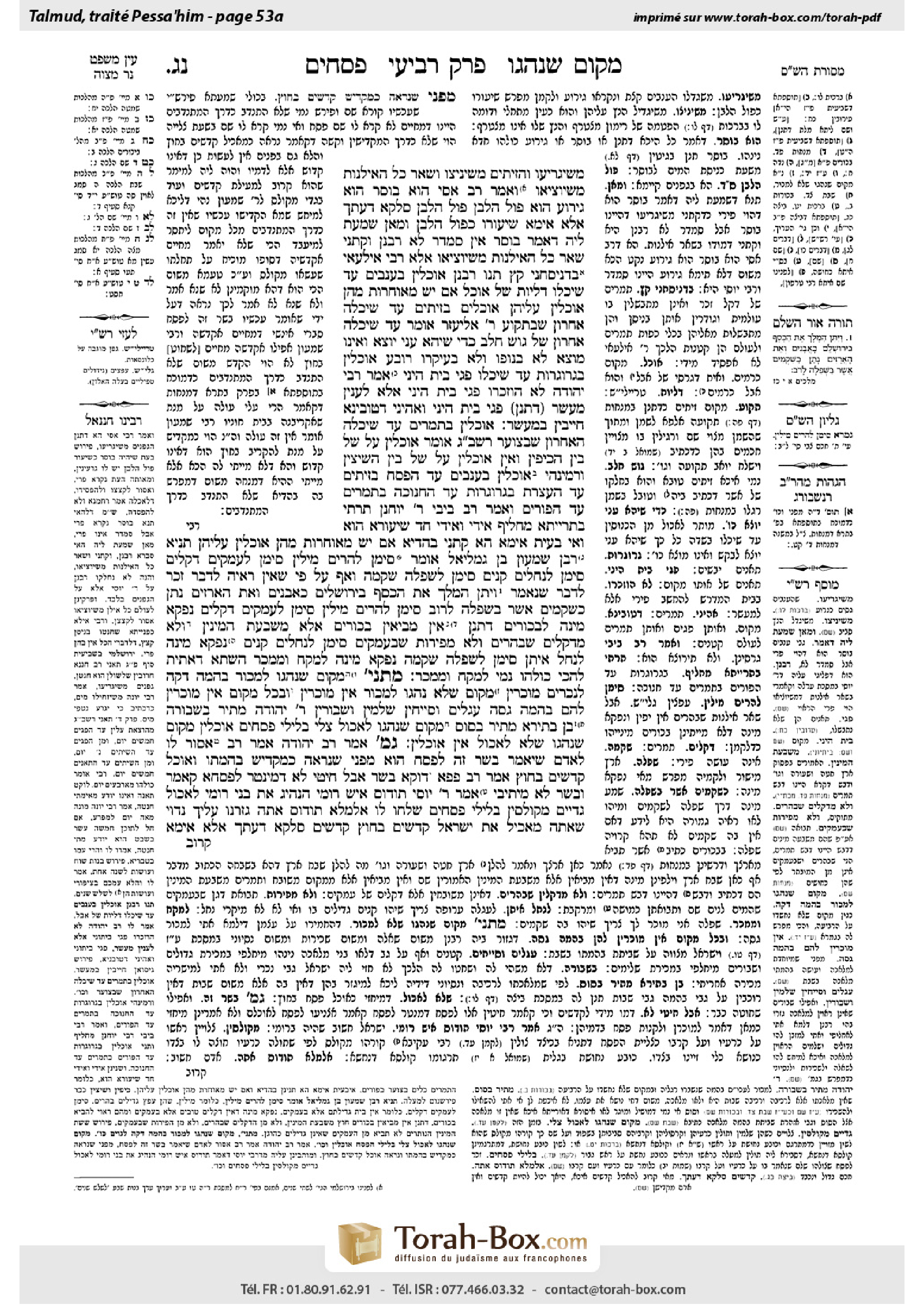
Pesachim 53a: Talmud study for Daf Yomi
Daf Yomi is the daily study of one Talmud folio. Explore 37 tractates with scans, Hebrew text, Sefaria English and AI-generated French translations where annotated.
Passage selection and English or AI-generated French translation are available where the scan has annotations. Daf Study is independent of Torah-Box and Sefaria.
Browse Pesachim · פסחים · All tractatesPesachim 53a text and translations
This page of Pesachim includes the Aramaic text, an English translation and an AI-generated French translation, alongside the scan above.
פסחים נ״ג א · Aramaic and Hebrew text
מִשֶּׁיְּגָרֵיעוּ, וְהַזֵּיתִים מִשֶּׁיָּנֵיצוּ, וּשְׁאָר כׇּל הָאִילָנוֹת מִשֶּׁיּוֹצִיאוּ. וְאָמַר רַב אַסִּי: הוּא בּוֹסֶר, הוּא גֵּירוּעַ, הוּא פּוֹל הַלָּבָן. פּוֹל הַלָּבָן סָלְקָא דַּעְתָּךְ?! אֶלָּא אֵימָא: שִׁיעוּרוֹ כְּפוֹל הַלָּבָן.
וּמַאן שָׁמְעַתְּ לֵיהּ דְּאָמַר בּוֹסֶר אִין, סְמָדַר לָא — רַבָּנַן, וְקָתָנֵי: שְׁאָר כׇּל הָאִילָנוֹת מִשֶּׁיּוֹצִיאוּ! אֶלָּא רַבִּי אִילְעַאי בִּדְנִיסְחָנֵי קַץ.
תָּנוּ רַבָּנַן: אוֹכְלִין בַּעֲנָבִים עַד שֶׁיִּכְלוּ דָּלִיּוֹת שֶׁל אוֹכֵל. אִם יֵשׁ מְאוּחָרוֹת מֵהֶן — אוֹכְלִין עֲלֵיהֶן.
אוֹכְלִים בְּזֵיתִים עַד שֶׁיִּכְלֶה אַחֲרוֹן שֶׁבִּתְקוֹעַ, רַבִּי אֱלִיעֶזֶר אוֹמֵר: עַד שֶׁיִּכְלֶה אַחֲרוֹן שֶׁל גּוּשׁ חָלָב, כְּדֵי שֶׁיְּהֵא עָנִי יוֹצֵא וְאֵינוֹ מוֹצֵא לֹא בְּנוֹפוֹ וְלֹא בְּעִיקָּרוֹ רוֹבַע. אוֹכְלִין בִּגְרוֹגְרוֹת עַד שֶׁיִּכְלוּ פַּגֵּי בֵּית הִינֵי.
אָמַר רַבִּי יְהוּדָה: לֹא הוּזְכְּרוּ פַּגֵּי בֵּית הִינֵי אֶלָּא לְעִנְיַן מַעֲשֵׂר. (דִּתְנַן:) פַּגֵּי בֵּית הִינֵי וַאֲהִינֵי דְטוֹבִינָא — חַיָּיבִין בְּמַעֲשֵׂר.
אוֹכְלִין בִּתְמָרִים עַד שֶׁיִּכְלֶה הָאַחֲרוֹן שֶׁבְּצוֹעַר. רַבָּן שִׁמְעוֹן בֶּן גַּמְלִיאֵל אוֹמֵר: אוֹכְלִין עַל שֶׁל בֵּין הַכִּיפִּין, וְאֵין אוֹכְלִין עַל שֶׁל בֵּין הַשִּׁיצִין.
וּרְמִינְהִי: אוֹכְלִין בַּעֲנָבִים עַד הַפֶּסַח, בְּזֵיתִים עַד הָעֲצֶרֶת, בִּגְרוֹגְרוֹת עַד הַחֲנוּכָּה, בִּתְמָרִים עַד הַפּוּרִים, וְאָמַר רַב בִּיבִי: רַבִּי יוֹחָנָן תַּרְתֵּי בָּתְרָיָיתָא — מַחְלִיף. אִידֵּי וְאִידֵּי חַד שִׁיעוּרָא הוּא. וְאִי בָּעֵית אֵימָא, הָא קָתָנֵי בְּהֶדְיָא: אִם יֵשׁ מְאוּחָרוֹת מֵהֶן — אוֹכְלִין עֲלֵיהֶן.
תַּנְיָא רַבָּן שִׁמְעוֹן בֶּן גַּמְלִיאֵל אוֹמֵר: סִימָן לְהָרִים — מֵילִין. סִימָן לַעֲמָקִים — דְּקָלִים. סִימָן לִנְחָלִים — קָנִים. סִימָן לַשְּׁפֵלָה — שִׁקְמָה. וְאַף עַל פִּי שֶׁאֵין רְאָיָה לְדָבָר, זֵכֶר לַדָּבָר, שֶׁנֶּאֱמַר: ״וַיִּתֵּן הַמֶּלֶךְ אֶת הַכֶּסֶף בִּירוּשָׁלִַים כָּאֲבָנִים וְאֵת הָאֲרָזִים נָתַן כַּשִּׁקְמִים אֲשֶׁר בַּשְּׁפֵלָה לָרוֹב״.
סִימָן לְהָרִים מֵילִין, סִימָן לַעֲמָקִים דְּקָלִים — נָפְקָא מִינַּהּ לְבִכּוּרִים, דִּתְנַן: אֵין מְבִיאִין בִּכּוּרִים אֶלָּא מִשִּׁבְעַת הַמִּינִין, וְלֹא מִדְּקָלִים שֶׁבֶּהָרִים, וְלֹא מִפֵּירוֹת שֶׁבָּעֲמָקִים.
סִימָן לִנְחָלִים קָנִים — נָפְקָא מִינַּהּ לְנַחַל אֵיתָן. סִימָן לַשְּׁפֵלָה שִׁקְמָה — נָפְקָא מִינַּהּ לְמִקָּח וּמִמְכָּר. הַשְׁתָּא דְּאָתֵית לְהָכִי, כּוּלְּהוּ נָמֵי לְמִקָּח וּמִמְכָּר.
מַתְנִי׳ מָקוֹם שֶׁנָּהֲגוּ לִמְכּוֹר בְּהֵמָה דַּקָּה לַגּוֹיִם — מוֹכְרִין, מָקוֹם שֶׁלֹּא נָהֲגוּ לִמְכּוֹר — אֵין מוֹכְרִין. וּבְכׇל מָקוֹם אֵין מוֹכְרִין לָהֶם בְּהֵמָה גַּסָּה, עֲגָלִים וּסְיָיחִין, שְׁלֵמִין וּשְׁבוּרִין. רַבִּי יְהוּדָה מַתִּיר בַּשְּׁבוּרָה. בֶּן בְּתִירָא מַתִּיר בַּסּוּס.
מָקוֹם שֶׁנָּהֲגוּ לֶאֱכוֹל צָלִי בְּלֵילֵי פְסָחִים — אוֹכְלִין, מָקוֹם שֶׁנָּהֲגוּ שֶׁלֹּא לֶאֱכוֹל — אֵין אוֹכְלִין.
גְּמָ׳ אָמַר רַב יְהוּדָה אָמַר רַב: אָסוּר לוֹ לְאָדָם שֶׁיֹּאמַר ״בָּשָׂר זֶה לְפֶסַח הוּא״ — מִפְּנֵי שֶׁנִּרְאֶה כְּמַקְדִּישׁ בְּהֶמְתּוֹ וְאוֹכֵל קָדָשִׁים בַּחוּץ. אָמַר רַב פָּפָּא: דַּוְקָא בָּשָׂר, אֲבָל חִיטֵּי — לָא, דְּמִינְטַר לְפִסְחָא קָאָמַר.
וּבָשָׂר לָא? מֵיתִיבִי אָמַר רַבִּי יוֹסֵי: תּוֹדוֹס אִישׁ רוֹמִי הִנְהִיג אֶת בְּנֵי רוֹמִי לֶאֱכוֹל גְּדָיִים מְקוּלָּסִין בְּלֵילֵי פְּסָחִים. שָׁלְחוּ לוֹ: אִלְמָלֵא תּוֹדוֹס אַתָּה גָּזַרְנוּ עָלֶיךָ נִדּוּי, שֶׁאַתָּה מַאֲכִיל אֶת יִשְׂרָאֵל קָדָשִׁים בַּחוּץ. ״קָדָשִׁים״ סָלְקָא דַּעְתָּךְ! אֶלָּא אֵימָא:
Pesachim 53a · English translation
from when the grapes form kernels and grow slightly; and olive trees, from when they blossom; and all other trees may not be chopped down from when they produce fruit. And Rav Asi said: It is an unripe grape, it is a grape kernel, it is a white bean, i.e., their legal status is the same. Before this is explained, the Gemara expresses astonishment: Does it enter your mind that the grape is at any stage a white bean? Rather, say: The size of an unripe grape is equivalent to the size of a white bean.
In any case, whom did you hear that said: An unripe grape, yes, is considered fruit, while a grape bud, no, it is not considered fruit? Wasn’t it the Rabbis, who disagree with Rabbi Yosei? And it is taught that, according to the Rabbis, it is prohibited to chop down all other trees from when they produce fruit. This indicates that unripe dates have the same status as ordinary dates. Rather, the Gemara retracts its previous answer and explains that Rabbi Elai chopped down a palm tree with stunted dates, which never ripen on the tree. It was permitted to chop down the tree because the dates can be ripened only after they are removed from the tree.
The Sages taught: One may eat grapes during the Sabbatical Year until the grapes on the vine branches in the place called Okhel have ceased. And if there are grapes elsewhere later than those, one may continue eating grapes on their basis, as the Sages’ statement is merely based on the assumption that the grapes in Okhel are the last to remain in the field, but the halakha is not specific to them.
Similarly, one may eat olives until the final olives have ceased on the trees in Tekoa. Rabbi Eliezer says: One may eat olives until the final olives have ceased on the trees in Gush Ḥalav. At what point is the fruit considered to have ceased? At the point that a poor person will go out to search for fruit and find, neither in the tree’s branches nor in the proximity of its trunk, a quarter-kav of olives that have fallen. One may eat dried figs until the unripe figs of Beit Hini have ceased.
Rabbi Yehuda said: The unripe figs of Beit Hini were mentioned only with regard to tithes, not with regard to the Sabbatical Year. As we learned in a mishna: The unripe figs of Beit Hini and the dates of Tovyana, both of which never completely ripen but are nonetheless edible, one is obligated to tithe them.
We learned in the mishna: One may eat dates in all of Judea until the last palm tree in Tzoar has ceased producing dates. Rabban Shimon ben Gamliel says: One may continue eating dates based on those between the palm branches; but one may not continue eating on the basis of those between the thorn branches.
And the Gemara raises a contradiction from that which was taught in a different baraita: One may eat from the grapes until Passover; from the olives, until the festival of Assembly, i.e., Shavuot; from the dried figs, until Hanukkah; and from the dates, until Purim. And Rav Beivai said: Rabbi Yoḥanan transposes the last two. According to his version of the baraita, one may eat dried figs until Purim and dates until Hanukkah. This is inconsistent with the previous statement that dates may be eaten until those in Tzoar have ceased. The Gemara resolves this contradiction: Both this time and that time are one period. The first Sage designated the deadline in terms of the place where dates grow, and Rabban Shimon ben Gamliel designated the deadline in terms of the dates. And if you wish, say instead that it is taught explicitly: And if there are fruits elsewhere later than those, one may continue eating on their basis. This indicates that the places and the times mentioned are merely indicators, but that the prohibition depends on actual conditions in the field.
The Gemara continues: It was taught in a baraita that Rabban Shimon ben Gamliel says: A good sign for mountains is that gallnut oaks, used in the preparation of ink, grow there. A good sign for valleys is palm trees. A good sign for streams is reeds. A good sign for the plain is a sycamore tree. And although there is no proof for these indicators, there is an allusion to the matter in the verse, as it is stated: “And the king made silver to be in Jerusalem like stones, and he made cedars to be as the sycamore trees in the plain” (I Kings 10:27).
The Gemara elaborates on this baraita: A good sign for mountains is gallnut oaks, a good sign for valleys is palm trees. What purpose is served by these signs? The practical difference of these signs pertains to the halakha of first fruits. As we learned in a mishna: One may bring first fruits only from the seven species and only from the highest quality fruit. Therefore, one may not bring first fruits from palm trees that grow in the mountains. Since the mountains are not a suitable location for palm trees, the dates grown there are inferior. Similarly, one does not bring first fruits from produce, i.e., from wheat and barley, that grow in the valleys, because mountain fruits do not grow there properly.
A good sign for streams is reeds. The case where this sign makes a practical halakhic difference is with regard to the rough dried-up stream mentioned in the Torah. When a corpse is found between two towns and the murderer cannot be identified, the Torah states that a calf’s neck is broken in a rough stream. The baraita teaches that growing reeds identify the spot as a stream. A good sign for the plain is a sycamore tree. The Gemara explains that the case where this sign makes a practical difference is with regard to buying and selling. If one stipulates that he is buying land in the plains, it is defined as an area where sycamore trees grow. The Gemara notes: Now that you have arrived at this practical halakhic difference with regard to assessing the quality of land for the purpose of transactions, all the signs can be understood as pertaining to buying and selling as well, to identify valleys and mountainous regions.
MISHNA: Apropos different local customs discussed in the first mishna in this chapter, this mishna discusses various halakhot with regard to which there are different customs. In a place where the people were accustomed to sell small livestock to gentiles, one may sell them. In a place where the people were not accustomed to sell them due to certain concerns and decrees, one may not sell them. However, in every place, one may sell to gentiles neither large livestock, e.g., cows and camels, nor calves or foals, whether these animals are whole or damaged. The Sages prohibited those sales due to the concern lest the transaction be voided or one side reconsider, creating retroactively a situation where a Jew’s animal performed labor for the gentile on Shabbat in violation of an explicit Torah prohibition. Rabbi Yehuda permits the sale of a damaged animal because it is incapable of performing labor. Ben Beteira permits the sale of a horse for riding, because riding a horse on Shabbat is not prohibited by Torah law.
The mishna cites another custom related to Passover. In a place where people were accustomed to eat roasted meat on Passover evenings, outside of Jerusalem or after the Temple was destroyed, one may eat it. In a place where people were accustomed not to eat outside Jerusalem, one may not eat it.
GEMARA: Rav Yehuda said that Rav said that it is prohibited for a person to say in modern times: This meat is for Passover, due to the fact that one appears to be consecrating his animal as his Paschal lamb, and he thereby eats consecrated items outside the permitted area. Rav Pappa said: This prohibition against saying: This is for Passover, applies specifically to meat, which is similar to consecrated meat; however, with regard to wheat, no, it does not apply. In that case, it is clear that one is saying that the flour be watched for Passover.
The Gemara asks: And with regard to meat is that not the case? Is it really prohibited to say that meat is for Passover? The Gemara raises an objection. Rabbi Yosei said: Theodosius [Todos] of Rome, leader of the Jewish community there, instituted the custom for the Roman Jews to eat kids roasted [mekulas] whole with their entrails over their heads on the evenings of Passover, as was the custom in the Temple. The Sages sent a message to him: If you were not Theodosius, an important person, we would have decreed ostracism upon you, as it appears as if you are feeding Israel consecrated food, which may be eaten only in and around the Temple itself, outside the permitted area. The Gemara asks about the terminology used here: Could it enter your mind that this meat was actually consecrated meat? That was certainly not the case. Rather, say instead:
Pesachim 53a · Traduction française (IA)
à partir du moment où les raisins forment leurs pépins et commencent à grossir ; les oliviers, à partir de leur floraison ; et tous les autres arbres, dès qu’ils portent des fruits. Rav Asi a dit : un raisin immature, un pépin de raisin et un haricot blanc, c’est-à-dire qu’ils ont le même statut juridique. Avant d’expliquer cela, la Guemara s’étonne : Peut-on vraiment penser qu’un raisin soit, à un stade quelconque, un haricot blanc ? Il faut plutôt dire que la taille d’un raisin immature équivaut à celle d’un haricot blanc.
Quoi qu’il en soit, qui a-t-on entendu dire qu’un raisin immature est considéré comme un fruit, mais pas un bourgeon de vigne ? N’est-ce pas les Sages, qui sont en désaccord avec Rabbi Yosei ? Or, il est enseigné que, selon les Sages, il est interdit d’abattre tous les autres arbres dès qu’ils portent des fruits. Cela indique que les dattes immatures ont le même statut que les dattes ordinaires. La Guemara revient donc sur sa réponse précédente et explique que Rabbi Elai a abattu un palmier portant des dattes rabougries, qui ne mûrissent jamais sur l’arbre. Il était permis d’abattre l’arbre, car ces dattes ne peuvent mûrir qu’après en avoir été détachées.
Les Sages ont enseigné : Pendant l’année de la Chemita, on peut manger des raisins jusqu’à ce que les raisins des vignes du lieu appelé Okhel aient disparu. S’il en reste ailleurs plus tard dans la saison, on peut continuer à en manger en se fondant sur leur présence ; en effet, la déclaration des Sages repose seulement sur l’hypothèse que les raisins d’Okhel sont les derniers à rester dans les champs, mais la halakha ne leur est pas spécifiquement liée.
De même, on peut manger des olives jusqu’à ce que les dernières olives aient disparu des arbres de Tekoa. Rabbi Eliezer dit : on peut manger des olives jusqu’à ce que les dernières olives aient disparu des arbres de Gush Ḥalav. À quel moment considère-t-on que les fruits ont disparu ? Lorsque le pauvre sort pour chercher des fruits et ne trouve, ni dans les branches de l’arbre ni près de son tronc, un quart de kav d’olives tombées. On peut manger des figues sèches jusqu’à ce que les figues immatures de Beit Hini aient disparu.
Rabbi Yehuda a dit : La mention des figues immatures de Beit Hini concerne uniquement les dîmes, et non l’année de la Chemita. Nous l’avons en effet appris dans une Michna : les figues immatures de Beit Hini et les dattes de Tovyana, qui ne mûrissent jamais complètement mais sont néanmoins comestibles, sont soumises à la dîme.
Nous avons appris dans la Michna : On peut manger des dattes dans toute la Judée jusqu’à ce que le dernier palmier de Tzoar cesse de produire des dattes. Rabban Shimon ben Gamliel dit : on peut continuer à en manger en se fondant sur celles qui se trouvent entre les branches des palmiers ; mais on ne peut pas continuer à en manger en se fondant sur celles qui se trouvent entre les branches épineuses.
La Guemara soulève une contradiction à partir de ce qui a été enseigné dans une autre baraïta : On peut manger des raisins jusqu’à Pessa’h ; des olives, jusqu’à la fête de l’Assemblée, c’est-à-dire Chavouot ; des figues sèches, jusqu’à Hanoucca ; et des dattes, jusqu’à Pourim. Rav Beivai a dit : Rabbi Yoḥanan inverse les deux derniers termes. Selon sa version de la baraïta, on peut manger des figues sèches jusqu’à Pourim et des dattes jusqu’à Hanoucca. Cela contredit l’affirmation précédente selon laquelle on peut manger des dattes jusqu’à ce que celles de Tzoar aient disparu. La Guemara résout cette contradiction : les deux échéances désignent la même période. Le premier Sage a fixé l’échéance en fonction du lieu où poussent les dattes, et Rabban Shimon ben Gamliel l’a fixée en fonction des dattes elles-mêmes. Si tu le souhaites, on peut plutôt dire que cela est enseigné explicitement : s’il y a ailleurs des fruits qui subsistent plus tard, on peut continuer à en manger en se fondant sur leur présence. Cela indique que les lieux et les périodes mentionnés ne sont que des repères, mais que l’interdiction dépend des conditions réelles dans les champs.
La Guemara poursuit : il a été enseigné dans une baraïta que Rabban Shimon ben Gamliel dit : Un bon signe pour les montagnes est la présence de chênes à galles, utilisés dans la préparation de l’encre. Un bon signe pour les vallées est la présence de palmiers. Un bon signe pour les cours d’eau est la présence de roseaux. Un bon signe pour la plaine est la présence d’un sycomore. Bien qu’il n’y ait pas de preuve en faveur de ces indices, le verset y fait allusion, ainsi qu’il est dit : « Le roi fit en sorte qu’il y ait à Jérusalem autant d’argent que de pierres, et autant de cèdres que de sycomores dans la plaine » (I Rois 10,27).
La Guemara développe cette baraïta : un bon signe pour les montagnes est la présence de chênes à galles ; un bon signe pour les vallées, celle de palmiers. À quoi servent ces signes ? Ils ont une conséquence pratique pour la halakha des prémices. Nous l’avons appris dans une Michna : on ne peut apporter les prémices que des sept espèces et uniquement des fruits de la meilleure qualité. Par conséquent, on n’apporte pas les prémices des palmiers qui poussent dans les montagnes. Comme les montagnes ne conviennent pas à la culture des palmiers, les dattes qui y poussent sont de qualité inférieure. De même, on n’apporte pas les prémices des produits agricoles, c’est-à-dire du blé et de l’orge, qui poussent dans les vallées, car les fruits des montagnes n’y poussent pas correctement.
Un bon signe pour les cours d’eau est la présence de roseaux. Ce signe a une conséquence pratique concernant le torrent rocailleux et desséché mentionné dans la Torah. Lorsqu’on trouve un cadavre entre deux villes et qu’on ne peut identifier le meurtrier, la Torah prescrit de briser la nuque d’une génisse dans un torrent rocailleux. La baraïta enseigne que la présence de roseaux identifie l’endroit comme un cours d’eau. Un bon signe pour la plaine est la présence d’un sycomore. La Guemara explique que ce signe a une conséquence pratique pour les transactions. Si quelqu’un stipule qu’il achète un terrain dans la plaine, celle-ci est définie comme une zone où poussent des sycomores. La Guemara note : puisque nous en sommes venus à cette conséquence pratique concernant l’évaluation de la qualité d’un terrain pour une transaction, on peut également comprendre que tous les signes servent à identifier les vallées et les régions montagneuses dans le cadre de transactions.
MICHNA : À propos des différentes coutumes locales évoquées dans la première Michna de ce chapitre, cette Michna traite de diverses halakhot pour lesquelles les coutumes diffèrent. Dans un endroit où les gens avaient coutume de vendre du petit bétail aux non-Juifs, on peut leur en vendre. Dans un endroit où les gens n’avaient pas coutume d’en vendre, en raison de certaines préoccupations et mesures d’interdiction, on ne peut pas leur en vendre. Toutefois, partout, on ne peut vendre aux non-Juifs ni de gros bétail, par exemple des vaches et des chameaux, ni des veaux ou des poulains, que ces animaux soient entiers ou blessés. Les Sages ont interdit ces ventes par crainte que la transaction soit annulée ou que l’une des parties change d’avis, créant rétroactivement une situation dans laquelle l’animal d’un Juif aurait effectué un travail pour un non-Juif pendant Chabbat, en violation d’une interdiction explicite de la Torah. Rabbi Yehuda permet la vente d’un animal blessé, car celui-ci est incapable d’effectuer un travail. Ben Beteira permet la vente d’un cheval destiné à être monté, car monter à cheval pendant Chabbat n’est pas interdit par la Torah.
La Michna cite une autre coutume liée à Pessa’h. Dans un endroit où les gens avaient coutume de manger de la viande rôtie les soirs de Pessa’h, en dehors de Jérusalem ou après la destruction du Temple, on peut en manger. Dans un endroit où les gens avaient coutume de ne pas en manger en dehors de Jérusalem, on ne peut pas en manger.
GUEMARA : Rav Yehuda a dit au nom de Rav qu’à l’époque actuelle, il est interdit de dire : « Cette viande est pour Pessa’h », car cela donne l’impression que l’on consacre son animal comme agneau pascal et que l’on mange ainsi des aliments consacrés hors de la zone autorisée. Rav Pappa a dit : Cette interdiction de dire « Ceci est pour Pessa’h » s’applique précisément à la viande, qui ressemble à de la viande consacrée ; en revanche, elle ne s’applique pas au blé. Dans ce cas, il est clair que la personne veut dire que la farine soit surveillée en vue de Pessa’h.
La Guemara demande : Et pour la viande, n’est-ce pas également le cas ? Est-il vraiment interdit de dire que la viande est destinée à Pessa’h ? La Guemara soulève une objection. Rabbi Yosei a dit : Théodosius [Todos] de Rome, dirigeant de la communauté juive de cette ville, institua pour les Juifs de Rome la coutume de manger, les soirs de Pessa’h, des chevreaux rôtis [mekulas] entiers, leurs entrailles placées au-dessus de leur tête, comme cela se faisait au Temple. Les Sages lui envoyèrent un message : « Si tu n’étais pas Théodosius, un personnage important, nous aurions prononcé l’excommunication contre toi, car cela donne l’impression que tu nourris Israël d’aliments consacrés, qui ne peuvent être consommés que dans le Temple et ses alentours, hors de la zone autorisée. » La Guemara s’interroge sur les termes employés ici : Peut-on penser que cette viande était réellement consacrée ? Ce n’était certainement pas le cas. Il faut plutôt dire :
Traduction française générée par IA à partir de l’édition anglaise de Sefaria. Vérifie toujours un passage avec le texte source.
Text from Sefaria: William Davidson Edition - Vocalized Aramaic (CC BY NC); William Davidson Edition - English (CC BY NC).