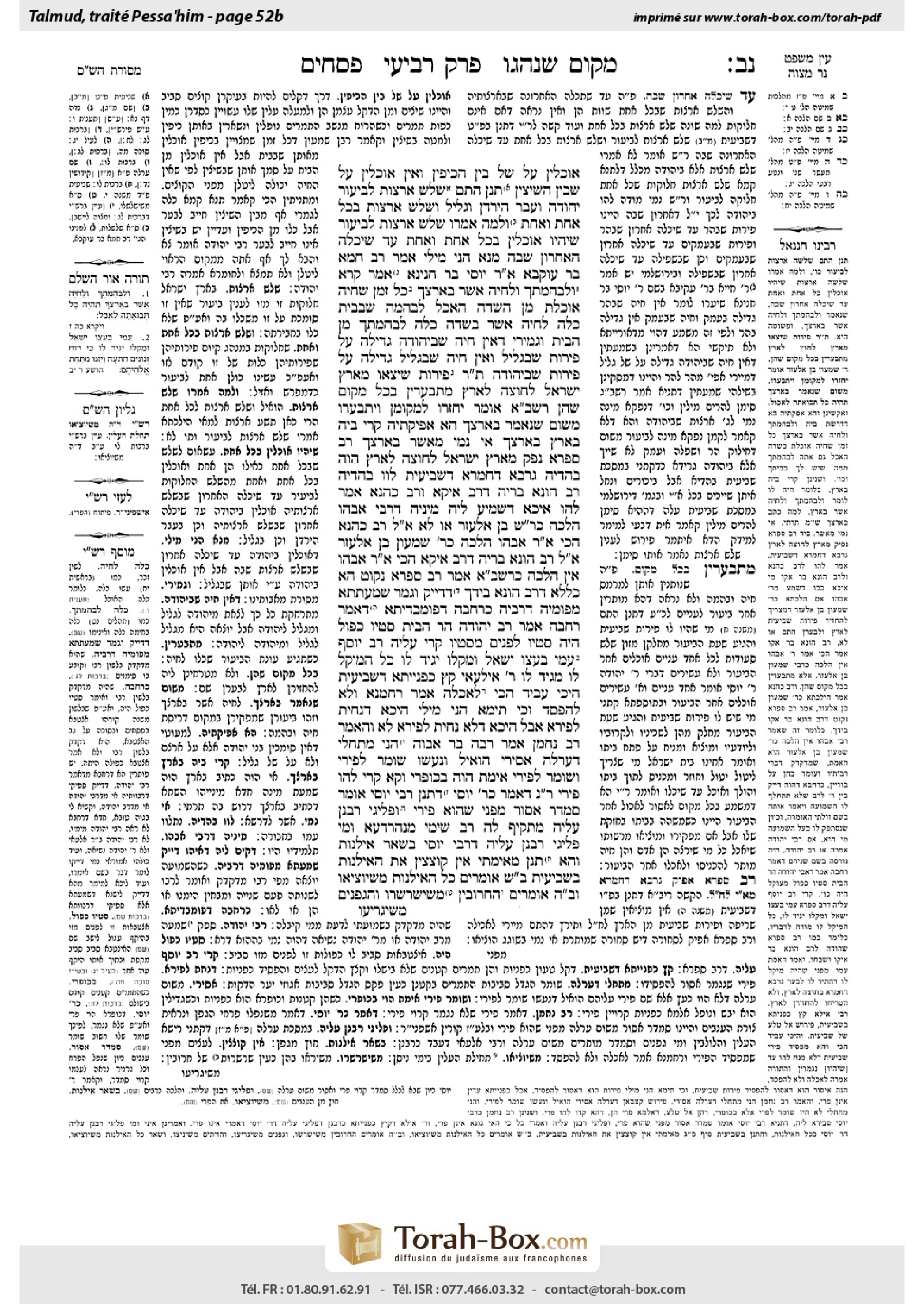
Pesachim 52b: Talmud study for Daf Yomi
Daf Yomi is the daily study of one Talmud folio. Explore 37 tractates with scans, Hebrew text, Sefaria English and AI-generated French translations where annotated.
Passage selection and English or AI-generated French translation are available where the scan has annotations. Daf Study is independent of Torah-Box and Sefaria.
Browse Pesachim · פסחים · All tractatesPesachim 52b text and translations
This page of Pesachim includes the Aramaic text, an English translation and an AI-generated French translation, alongside the scan above.
פסחים נ״ב ב · Aramaic and Hebrew text
אוֹכְלִין עַל שֶׁל בֵּין הַכִּיפִּין, וְאֵין אוֹכְלִין עַל שֶׁבֵּין הַשִּׁיצִין.
תְּנַן הָתָם, שָׁלֹשׁ אֲרָצוֹת לְבִיעוּר: יְהוּדָה, וְעֵבֶר הַיַּרְדֵּן, וְגָלִיל. וְשָׁלֹשׁ אֲרָצוֹת בְּכׇל אַחַת וְאַחַת. וְלָמָה אָמְרוּ שָׁלֹשׁ אֲרָצוֹת לְבִיעוּר? שֶׁיִּהְיוּ אוֹכְלִין בְּכׇל אַחַת וְאַחַת עַד שֶׁיִּכְלֶה הָאַחֲרוֹן שֶׁבָּהּ.
מְנָא הָנֵי מִילֵּי? אָמַר רַב חָמָא בַּר עוּקְבָא אָמַר רַבִּי יוֹסֵי בַּר חֲנִינָא: אָמַר קְרָא ״וְלִבְהֶמְתְּךָ וְלַחַיָּה אֲשֶׁר בְּאַרְצֶךָ״. כׇּל זְמַן שֶׁחַיָּה אוֹכֶלֶת מִן הַשָּׂדֶה — הַאֲכֵל לַבְּהֵמָה שֶׁבַּבַּיִת, כָּלָה לְחַיָּה אֲשֶׁר בַּשָּׂדֶה — כַּלֵּה לִבְהֶמְתְּךָ מִן הַבַּיִת.
וּגְמִירִי: דְּאֵין חַיָּה שֶׁבִּיהוּדָה גְּדֵילָה עַל פֵּירוֹת שֶׁבַּגָּלִיל, וְאֵין חַיָּה שֶׁבַּגָּלִיל גְּדֵילָה עַל פֵּירוֹת שֶׁבִּיהוּדָה.
תָּנוּ רַבָּנַן: פֵּירוֹת שֶׁיָּצְאוּ מֵאֶרֶץ יִשְׂרָאֵל לְחוּצָה לָאָרֶץ — מִתְבַּעֲרִין בְּכׇל מָקוֹם שֶׁהֵן. רַבִּי שִׁמְעוֹן בֶּן אֶלְעָזָר אוֹמֵר: יַחְזְרוּ לִמְקוֹמָן וְיִתְבַּעֲרוּ, מִשּׁוּם שֶׁנֶּאֱמַר: ״בְּאַרְצֶךָ״. הָא אַפֵּיקְתֵּיהּ?
קְרִי בֵּיהּ: ״בָּאָרֶץ״ ״בְּאַרְצֶךָ״, אִי נָמֵי: ״מֵאֲשֶׁר בְּאַרְצֶךָ״.
רַב סָפְרָא נְפַק מֵאֶרֶץ יִשְׂרָאֵל לְחוּצָה לָאָרֶץ. הֲוָה בַּהֲדֵיהּ גַּרְבָּא דְחַמְרָא דִּשְׁבִיעִית, לַוּוֹ בַּהֲדֵיהּ רַב הוּנָא בְּרֵיהּ דְּרַב אִיקָא וְרַב כָּהֲנָא, אָמַר לְהוּ: אִיכָּא דִּשְׁמִיעַ לֵיהּ מִינֵּיהּ דְּרַבִּי אֲבָהוּ הֲלָכָה כְּרַבִּי שִׁמְעוֹן בֶּן אֶלְעָזָר אוֹ לָא? אֲמַר לֵיהּ רַב כָּהֲנָא, הָכִי אָמַר רַבִּי אֲבָהוּ: הֲלָכָה כְּרַבִּי שִׁמְעוֹן בֶּן אֶלְעָזָר. אֲמַר לֵיהּ רַב הוּנָא בְּרֵיהּ דְּרַב אִיקָא, הָכִי אָמַר רַבִּי אֲבָהוּ: אֵין הֲלָכָה כְּרַבִּי שִׁמְעוֹן בֶּן אֶלְעָזָר.
אֲמַר רַב סָפְרָא: נְקוֹט הָא כְּלָלָא דְּרַב הוּנָא בִּידָךְ, דְּדָיֵיק וְגָמַר שְׁמַעְתָּתָא מִפּוּמֵּיהּ דְּרַבֵּיהּ כְּרַחֲבָה דְפוּמְבְּדִיתָא. דְּאָמַר רַחֲבָה אָמַר רַב יְהוּדָה: הַר הַבַּיִת סְטָיו כָּפוּל הָיָה סְטָיו לְפָנִים מִסְּטָיו. קָרֵי עֲלֵיהּ רַב יוֹסֵף: ״עַמִּי בְּעֵצוֹ יִשְׁאָל וּמַקְלוֹ יַגִּיד לוֹ״. כׇּל הַמֵּיקֵל לוֹ — מַגִּיד לוֹ.
רַבִּי אִילְעַאי קַץ כַּפְנְיָיתָא דִשְׁבִיעִית. הֵיכִי עָבֵיד הָכִי?! ״לְאׇכְלָה״ אָמַר רַחֲמָנָא, וְלֹא לְהֶפְסֵד. וְכִי תֵּימָא: הָנֵי מִילֵּי הֵיכָא דְּנָחֵית לְפֵירָא, אֲבָל הֵיכָא דְּלָא נָחֵית לְפֵירָא — לָא. וְהָאָמַר רַב נַחְמָן אָמַר רַבָּה בַּר אֲבוּהּ: הָנֵי מְתַחֲלֵי דְעׇרְלָה — אֲסִירִי, הוֹאִיל וְנַעֲשׂוּ שׁוֹמֵר לְפֵירֵי.
וְשׁוֹמֵר לְפֵירֵי אִימַּת הָוֵה? בְּכוּפְרֵי וְקָא קָרֵי לְהוּ פֵּירֵי! רַב נַחְמָן דְּאָמַר כְּרַבִּי יוֹסֵי. דִּתְנַן, רַבִּי יוֹסֵי אוֹמֵר: סְמָדַר אָסוּר, מִפְּנֵי שֶׁהוּא פֵּירֵי, וּפְלִיגִי רַבָּנַן עֲלֵיהּ.
מַתְקֵיף לַהּ רַב שִׁימִי מִנְּהַרְדְּעָא: וּמִי פְּלִיגִי רַבָּנַן עֲלֵיהּ דְּרַבִּי יוֹסֵי בִּשְׁאָר אִילָנוֹת? וְהָא תְּנַן: מֵאֵימָתַי אֵין קוֹצְצִין אֶת הָאִילָנוֹת בַּשְּׁבִיעִית? בֵּית שַׁמַּאי אוֹמְרִים: כׇּל הָאִילָנוֹת מִשֶּׁיּוֹצִיאוּ, וּבֵית הִלֵּל אוֹמְרִים: הֶחָרוּבִין מִשֶּׁיְּשַׁרְשְׁרוּ, וְהַגְּפָנִים
Pesachim 52b · English translation
One may continue eating dates based on those that have fallen off the tree and are stuck between the palm branches. But one may not continue eating on the basis of the dates that have fallen between the thorn branches, as animals are unable to reach them there. According to the first tanna in the mishna cited, one may continue eating fruit as long as an animal has access to its type, parallel to the opinion of the Rabbis with regard to removal. Rabban Shimon ben Gamliel’s opinion is parallel to the opinion of Rabbi Yehuda: If the fruit from a certain place is not available to all, one is required to remove it.
Since the Gemara discussed the point when Sabbatical Year produce must be removed in different places, it cites a mishna from tractate Shevi’it that deals with a similar topic. We learned there in a mishna: Eretz Yisrael is divided into three separate lands with regard to removal, Judea, Transjordan, and the Galilee. And there are three lands in each and every one of them: The valley, the mountains, and the plains, in which the halakhot of removal differ. And why did the Sages say that there are three lands with regard to removal if those lands themselves are further divided? It is so that people will eat in each and every one until a certain crop ceases from the field in the last of the regions that comprise it. Therefore, even if a certain fruit is no longer available in a particular region within the land, it may still be eaten there as long as it is available in one of the other regions.
The Gemara asks: From where are these matters derived, that it is permitted to continue eating a type of fruit that has ceased from the fields in a region, as long as it has not ceased elsewhere in the land, but that once it has ceased from the fields in the entire land it is prohibited, despite the fact that it has not ceased from the fields in the other lands? Rav Ḥama bar Ukva said that Rabbi Yosei bar Ḥanina said: The verse says with regard to land during the Sabbatical Year: “And for the cattle and the beasts that are in your land, all its produce may be eaten” (Leviticus 25:7), from which it is derived: As long as the undomesticated animals eat a type of produce from the field, one may feed that type to the domesticated animal in his house, as it still remains in the field. Deriving benefit from that type of produce is permitted. However, if that type of produce has ceased for the undomesticated animals in the field, cease providing it to your domesticated animal in the house.
And we learned as a tradition that an undomesticated animal in Judea does not develop on the produce of the Galilee, and an undomesticated animal in the Galilee does not develop on the fruits of Judea. In each region there are conditions uniquely suited to the species that live there (Sefat Emet). Animals wander from region to region within Judea or within the Galilee in search of food, but they do not stray beyond the borders of the land of their habitat.
The Sages taught: Sabbatical Year fruits that left Eretz Yisrael and went to the Diaspora must be removed in any place that they are located. Rabbi Shimon ben Elazar says: That is not so. Rather, the fruits should return to their place of origin in Eretz Yisrael and be removed there. According to his opinion, removal may not be performed outside Eretz Yisrael because it is stated: “In your land,” indicating that this activity may be performed only in Eretz Yisrael. The Gemara asks: Didn’t you derive from this verse that each of the three lands in Eretz Yisrael has a different halakhic status?
The Gemara answers: Read the phrase as both in the land and in your land. It is possible to derive two halakhot from this verse; one halakha is with regard to Eretz Yisrael in general, i.e., one may not perform removal outside of Eretz Yisrael, the land, and one is with regard to the different lands within Eretz Yisrael, your land. Alternatively, the second halakha can be derived from the extraneous words in the expression: “That are in your land,” as the Torah could have sufficed with the phrase: “In your land.”
The Gemara relates: Rav Safra left Eretz Yisrael and went to the Diaspora, and he had with him a jug of Sabbatical Year wine. Rav Huna, son of Rav Ika, and Rav Kahana accompanied him. He said to them: Is there anyone who heard from Rabbi Abbahu whether the halakha is in accordance with the opinion of Rabbi Shimon ben Elazar or not? According to his opinion, Rav Safra would be required to return the wine to Eretz Yisrael. Rav Kahana said to him that this is what Rabbi Abbahu said: The halakha is in accordance with the opinion of Rabbi Shimon ben Elazar, and one is required to return and perform removal of the Sabbatical Year produce in Eretz Yisrael. Rav Huna, son of Rav Ika, said that this is what Rabbi Abbahu said: The halakha is not in accordance with the opinion of Rabbi Shimon ben Elazar, and one may perform removal wherever he may be.
Rav Safra said: Take that principle of Rav Huna in your hand, i.e., rely on it, as he is scrupulous and he learned the halakha well from the mouth of its originator, as the Sage Raḥava from the city of Pumbedita would do. Raḥava was famous for the precision with which he would transmit material that he learned from his teacher. The Gemara cites an example: Raḥava said that Rav Yehuda said: The Temple Mount was a double colonnade [stav], as there was a colonnade within a colonnade there. Here Raḥava used his teacher’s language in describing the structure of the Temple and the rows of columns. He did not employ the common term used for a colonnade, itztaba, but rather stav, using the language he heard from his teacher. With regard to the case where Rav Safra relied on Rav Huna’s opinion and was lenient, Rav Yosef mockingly read the verse: “My nation ask counsel of their stock, and its staff [maklo] tells to them” (Hosea 4:12) and interpreted it homiletically with regard to Rav Safra: Anyone who is lenient [mekel] tells him the halakha. He listens to the opinion of only the Sage who rules leniently.
The Gemara continues to discuss the halakhot of the Sabbatical Year: Rabbi Elai chopped down a palm tree containing unripe dates of the Sabbatical Year. The Gemara asks: How did he do this? The Merciful One says: “And the Sabbatical produce of the land shall be for you to eat” (Leviticus 25:6), from which it is inferred: To eat and not to destroy. It is prohibited to destroy Sabbatical Year produce, and it is permitted only to eat it. And if you say that this restriction applies only in a case where it has reached the status of fruit, but in a case where it has not yet reached the status of fruit, no, it does not apply; didn’t Rav Naḥman say that Rabba bar Avuh said: Those orla date coverings are prohibited like other orla fruit, as their legal status is that of food because they became protection for the fruit? They are not considered part of the tree that may be eaten in the orla years.
The Gemara analyzes this: And when do these coverings serve as protection for the fruit? When the fruit is still young and one nevertheless calls them fruit. Dates are considered fruit even when they are undeveloped. Just as it is prohibited to eat these dates during the orla period, it is similarly prohibited to destroy them during the Sabbatical Year. The Gemara answers: It is Rav Naḥman who stated his opinion in accordance with the individual opinion of Rabbi Yosei, contrary to the majority opinion. As we learned in a mishna that Rabbi Yosei says: The grape bud, i.e., a cluster of grapes in its earliest stage, immediately after the flowers drop from the vine, is prohibited due to orla because it is already considered a fruit. However, the Rabbis disagree with him, explaining that fruit at that stage is not considered fruit.
Rav Shimi of Neharde’a strongly objects to this: Do the Rabbis disagree with Rabbi Yosei with regard to the fruits of all other trees besides grapes, that even in the very first stage of ripening, they are considered fruit? Didn’t we learn in a mishna: From when may one no longer chop down trees during the Sabbatical Year, as he thereby damages the fruit? Beit Shammai say: In the case of all the trees, from when the blossoms fall and fruit begins to emerge in its earliest stage. And Beit Hillel say: There is a distinction between different types of trees. The carob trees may not be chopped down from when they form chains of carobs; and the vines,
Pesachim 52b · Traduction française (IA)
On peut continuer à manger des dattes en se fondant sur celles qui sont tombées de l’arbre et restent coincées entre les branches du palmier. Mais on ne peut pas continuer à manger en se fondant sur les dattes tombées entre les branches épineuses, car les animaux ne peuvent pas les atteindre. Selon le premier tanna de la Michna citée, on peut continuer à manger un fruit tant qu’un animal peut accéder à cette espèce, conformément à l’opinion des Sages concernant l’élimination. L’opinion de Rabban Shimon ben Gamliel correspond à celle de Rabbi Yehuda : si le fruit d’un lieu donné n’est pas accessible à tous, il faut l’éliminer.
Puisque la Guemara a évoqué le moment où les produits de l’année sabbatique doivent être éliminés dans différents endroits, elle cite une Michna du traité Shevi’it qui traite d’un sujet similaire. Nous avons appris dans une Michna : La terre d’Israël est divisée en trois régions pour ce qui est de l’élimination : la Judée, la Transjordanie et la Galilée. Chacune comprend trois zones : la vallée, la montagne et la plaine, où les halakhot de l’élimination diffèrent. Pourquoi les Sages ont-ils dit qu’il y a trois régions pour l’élimination, si ces régions sont elles-mêmes subdivisées ? Afin que l’on puisse manger dans chacune d’elles jusqu’à ce qu’une certaine récolte ait disparu des champs de la dernière des zones qui la composent. Ainsi, même si un fruit donné n’est plus disponible dans une zone particulière de la région, on peut encore le manger dans cette zone tant qu’il reste disponible dans l’une des autres.
La Guemara demande : De quelle source déduit-on ces règles : il est permis de continuer à manger une espèce de fruit qui a disparu des champs dans une région tant qu’elle n’a pas disparu ailleurs dans le pays, mais dès qu’elle a disparu des champs dans tout le pays, il est interdit d’en manger, même si elle n’a pas disparu des champs dans les autres régions ? Rav Ḥama bar Ukva a dit au nom de Rabbi Yosei bar Ḥanina : Le verset dit, à propos de la terre durant l’année sabbatique : « Et pour le bétail et les animaux sauvages qui sont dans ton pays, toute sa récolte pourra être mangée » (Lévitique 25, 7). On en déduit : tant que les animaux sauvages mangent une espèce de produit des champs, on peut en donner à son animal domestique à la maison, puisqu’elle se trouve encore dans les champs. Il est permis de tirer profit de cette espèce de produit. Mais si cette espèce de produit a disparu des champs pour les animaux sauvages, cesse d’en donner à ton animal domestique à la maison.
Nous avons également reçu comme tradition qu’un animal sauvage de Judée ne se nourrit pas des produits de Galilée, et qu’un animal sauvage de Galilée ne se nourrit pas des fruits de Judée. Chaque région présente des conditions propres aux espèces qui y vivent (Sefat Emet). Les animaux se déplacent d’une zone à l’autre en Judée ou en Galilée à la recherche de nourriture, mais ils ne dépassent pas les frontières de leur région d’habitat.
Les Sages ont enseigné : Les fruits de l’année sabbatique qui ont quitté la terre d’Israël pour la diaspora doivent être éliminés là où ils se trouvent. Rabbi Shimon ben Elazar dit : Il n’en est pas ainsi. Au contraire, les fruits doivent retourner à leur lieu d’origine, en terre d’Israël, et y être éliminés. Selon lui, on ne peut pas procéder à l’élimination hors de la terre d’Israël, car il est dit : « Dans ton pays », ce qui indique que cette pratique ne peut avoir lieu qu’en terre d’Israël. La Guemara demande : N’avez-vous pas déduit de ce verset que chacune des trois régions de la terre d’Israël a un statut halakhique différent ?
La Guemara répond : Il faut comprendre l’expression comme disant à la fois « dans le pays » et « dans ton pays ». Il est possible de déduire deux halakhot de ce verset : l’une concerne la terre d’Israël en général, à savoir qu’on ne peut pas procéder à l’élimination hors de la terre d’Israël, le pays ; l’autre concerne les différentes régions à l’intérieur de la terre d’Israël, ton pays. On peut aussi déduire la seconde halakha des mots superflus de l’expression « qui sont dans ton pays », car la Torah aurait pu se contenter de dire : « dans ton pays ».
La Guemara rapporte : Rav Safra quitta la terre d’Israël pour se rendre dans la diaspora, emportant avec lui une cruche de vin de l’année sabbatique. Rav Huna, fils de Rav Ika, et Rav Kahana l’accompagnèrent. Il leur dit : Quelqu’un a-t-il entendu de Rabbi Abbahu si la halakha suit l’opinion de Rabbi Shimon ben Elazar ou non ? Selon cette opinion, Rav Safra aurait dû rapporter le vin en terre d’Israël. Rav Kahana lui dit que voici ce que Rabbi Abbahu avait déclaré : La halakha suit l’opinion de Rabbi Shimon ben Elazar, et il faut rapporter les produits de l’année sabbatique en terre d’Israël pour les y éliminer. Rav Huna, fils de Rav Ika, dit que voici ce que Rabbi Abbahu avait déclaré : La halakha ne suit pas l’opinion de Rabbi Shimon ben Elazar, et l’on peut procéder à l’élimination où que l’on se trouve.
Rav Safra dit : Retenez ce principe de Rav Huna, c’est-à-dire fiez-vous-y, car il est scrupuleux et a appris correctement la halakha de la bouche de celui qui l’a enseignée, comme le faisait le Sage Raḥava, de la ville de Pumbedita. Raḥava était connu pour la précision avec laquelle il transmettait les enseignements reçus de son maître. La Guemara cite un exemple : Raḥava a dit au nom de Rav Yehuda : Le mont du Temple avait une double colonnade [stav], car une colonnade se trouvait à l’intérieur d’une autre. Ici, Raḥava a repris les termes de son maître pour décrire la structure du Temple et ses rangées de colonnes. Il n’a pas employé le terme courant pour désigner une colonnade, itztaba, mais stav, reprenant le mot qu’il avait entendu de son maître. À propos du fait que Rav Safra s’était fié à l’opinion de Rav Huna et avait choisi la position indulgente, Rav Yosef cita avec dérision le verset : « Mon peuple consulte son bois, et son bâton [maklo] lui parle » (Osée 4, 12), et l’interpréta par allusion à Rav Safra : Quiconque est indulgent [mekel] lui indique la halakha. Il n’écoute que l’opinion du Sage qui statue avec indulgence.
La Guemara poursuit l’examen des halakhot de l’année sabbatique : Rabbi Elai abattit un palmier qui portait des dattes encore immatures de l’année sabbatique. La Guemara demande : Comment a-t-il pu faire cela ? Le Miséricordieux dit : « Les produits de l’année sabbatique du pays vous serviront de nourriture » (Lévitique 25, 6), ce dont on déduit : ils sont destinés à être mangés, et non détruits. Il est interdit de détruire les produits de l’année sabbatique ; on ne peut que les manger. Et si tu dis que cette restriction ne s’applique que lorsqu’ils ont atteint le statut de fruits, mais pas avant, Rav Naḥman n’a-t-il pas dit au nom de Rabba bar Avuh : Ces enveloppes de dattes d’orla sont interdites comme les autres fruits d’orla, car elles ont le statut d’aliments puisqu’elles protègent le fruit ? Elles ne sont pas considérées comme une partie de l’arbre qu’il est permis de manger pendant les années d’orla.
La Guemara analyse : À quel moment ces enveloppes protègent-elles le fruit ? Lorsque le fruit est encore jeune et que, pourtant, on les appelle déjà des fruits. Les dattes sont considérées comme des fruits même lorsqu’elles ne sont pas encore développées. De même qu’il est interdit de manger ces dattes pendant la période d’orla, il est interdit de les détruire pendant l’année sabbatique. La Guemara répond : Rav Naḥman a exprimé son opinion conformément à l’opinion individuelle de Rabbi Yosei, à l’encontre de l’opinion majoritaire. En effet, nous avons appris dans une Michna que Rabbi Yosei dit : Le bourgeon de la vigne, c’est-à-dire une grappe à son stade le plus précoce, juste après la chute des fleurs de la vigne, est interdit au titre de l’orla, car il est déjà considéré comme un fruit. Les Sages ne sont toutefois pas d’accord avec lui et expliquent qu’un fruit à ce stade n’est pas considéré comme un fruit.
Rav Shimi de Neharde’a s’oppose vivement à cette explication : Les Sages sont-ils en désaccord avec Rabbi Yosei au sujet des fruits de tous les autres arbres que la vigne, au point de considérer que, même à leur tout premier stade de maturation, ils sont des fruits ? N’avons-nous pas appris dans une Michna : À partir de quand ne peut-on plus abattre les arbres pendant l’année sabbatique, parce qu’on endommagerait ainsi les fruits ? Beit Shammai disent : Pour tous les arbres, dès que les fleurs tombent et que les fruits commencent à apparaître à leur stade le plus précoce. Beit Hillel disent : Il faut distinguer les différentes sortes d’arbres. On ne peut abattre les caroubiers dès qu’ils forment des grappes de caroubes ; et les vignes,
Traduction française générée par IA à partir de l’édition anglaise de Sefaria. Vérifie toujours un passage avec le texte source.
Text from Sefaria: William Davidson Edition - Vocalized Aramaic (CC BY NC); William Davidson Edition - English (CC BY NC).