Pesachim 52a: Talmud study for Daf Yomi
Daf Yomi is the daily study of one Talmud folio. Explore 37 tractates with scans, Hebrew text, Sefaria English and AI-generated French translations where annotated.
Passage selection and English or AI-generated French translation are available where the scan has annotations. Daf Study is independent of Torah-Box and Sefaria.
Browse Pesachim · פסחים · All tractatesPesachim 52a text and translations
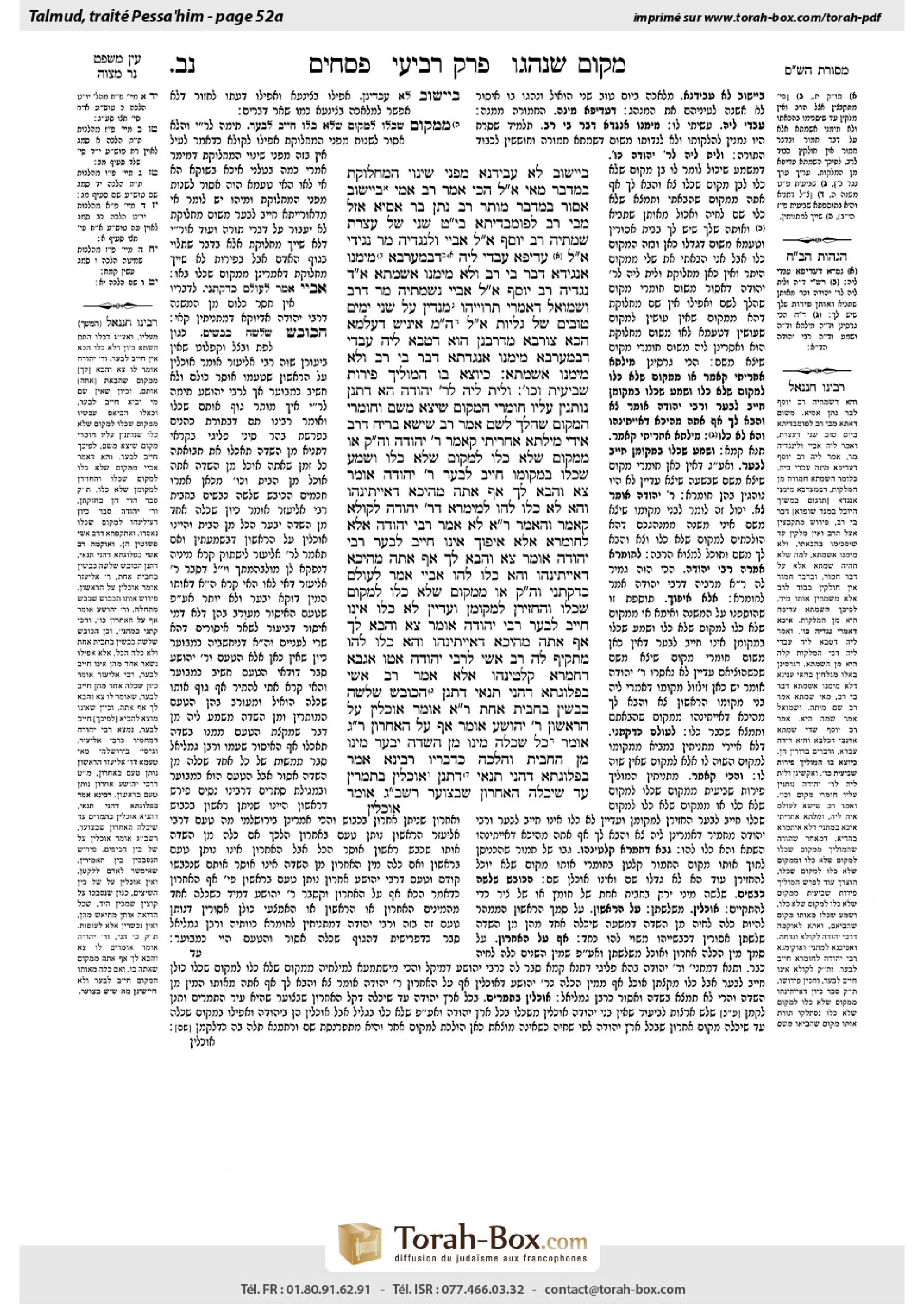
This page of Pesachim includes the Aramaic text, an English translation and an AI-generated French translation, alongside the scan above.
פסחים נ״ב א · Aramaic and Hebrew text
בַּיִּישּׁוּב לָא עָבֵידְנָא מִפְּנֵי שִׁינּוּי הַמַּחְלוֹקֶת. בַּמִּדְבָּר מַאי? אֲמַר לֵיהּ: הָכִי אָמַר רַב אַמֵּי: בַּיִּישּׁוּב אָסוּר, בַּמִּדְבָּר מוּתָּר.
רַב נָתָן בַּר אָסְיָא אֲזַל מִבֵּי רַב לְפוּמְבְּדִיתָא בְּיוֹם טוֹב שֵׁנִי שֶׁל עֲצֶרֶת. שַׁמְתֵּיהּ רַב יוֹסֵף. אֲמַר לֵיהּ אַבָּיֵי: וּלְנַגְּדֵיהּ מָר נַגֹּידֵי! אֲמַר לֵיהּ: עֲדִיפָא עֲבַדִי לֵיהּ, דִּבְמַעְרְבָא מִימְּנוּ אַנִּגְידָּא דְּבַר בֵּי רַב, וְלָא מִימְּנוּ אַשַּׁמְתָּא.
אִיכָּא דְּאָמְרִי: נַגְּדֵיהּ רַב יוֹסֵף. אֲמַר לֵיהּ אַבָּיֵי: נְשַׁמְּתֵיהּ מָר, דְּרַב וּשְׁמוּאֵל דְּאָמְרִי תַּרְוַיְיהוּ מְנַדִּין עַל שְׁנֵי יָמִים טוֹבִים שֶׁל גָּלִיּוֹת! אֲמַר לֵיהּ: הָנֵי מִילֵּי — אִינִישׁ דְּעָלְמָא. הָכָא, צוּרְבָּא מִדְּרַבָּנַן הוּא — דְּטָבָא לֵיהּ עֲבַדִי. דִּבְמַעְרְבָא מִימְּנוּ אַנִּגְדְּתָא דְּבַר בֵּי רַב, וְלָא מִימְּנוּ אַשַּׁמְתָּא.
כַּיּוֹצֵא בּוֹ הַמּוֹלִיךְ פֵּירוֹת שְׁבִיעִית וְכוּ׳. וְלֵית לֵיהּ לְרַבִּי יְהוּדָה הָא דִּתְנַן: נוֹתְנִין עָלָיו חוּמְרֵי הַמָּקוֹם שֶׁיָּצָא מִשָּׁם וְחוּמְרֵי הַמָּקוֹם שֶׁהָלַךְ לְשָׁם?!
אָמַר רַב שִׁישָׁא בְּרֵיהּ דְּרַב אִידִי: מִילְּתָא אַחֲרִיתִי קָאָמַר רַבִּי יְהוּדָה, וְהָכִי קָאָמַר: אוֹ מִמָּקוֹם שֶׁלֹּא כָּלוּ לְמָקוֹם שֶׁלֹּא כָּלוּ, וְשָׁמַע שֶׁכָּלוּ בִּמְקוֹמוֹ — חַיָּיב לְבַעֵר. רַבִּי יְהוּדָה אוֹמֵר: צֵא וְהָבֵא לְךָ אַף אַתָּה מֵהֵיכָא דְּאַיְיתִינְהוּ, וְהָא לָא כָּלוּ לְהוּ.
לְמֵימְרָא דְּרַבִּי יְהוּדָה לְקוּלָּא קָאָמַר? וְהָאָמַר רַבִּי אֶלְעָזָר: לֹא אָמַר רַבִּי יְהוּדָה אֶלָּא לְחוּמְרָא! אֶלָּא אֵיפוֹךְ — אֵינוֹ חַיָּיב לְבַעֵר, רַבִּי יְהוּדָה אוֹמֵר: צֵא וְהָבֵא לְךָ אַף אַתָּה מֵהֵיכָא דְּאַיְיתִינְהוּ, וְהָא כָּלוּ לְהוּ.
אַבָּיֵי אָמַר: לְעוֹלָם כִּדְקָתָנֵי, וְהָכִי קָאָמַר: אוֹ מִמָּקוֹם שֶׁלֹּא כָּלוּ לְמָקוֹם שֶׁכָּלוּ, וְהֶחְזִירָן לִמְקוֹמָן וַעֲדַיִין לֹא כָּלוּ — אֵינוֹ חַיָּיב לְבַעֵר, רַבִּי יְהוּדָה אוֹמֵר: צֵא וְהָבֵא לְךָ אַף אַתָּה מֵהֵיכָא דְּאַיְיתִינְהוּ, וְהָא כָּלוּ לְהוּ.
מַתְקֵיף לַהּ רַב אָשֵׁי: לְרַבִּי יְהוּדָה אַטּוּ אַגַּבָּא דְחַמְרָא קַלְטִינְהוּ?! אֶלָּא אָמַר רַב אָשֵׁי: בִּפְלוּגְתָּא דְהָנֵי תַנָּאֵי, דִּתְנַן: הַכּוֹבֵשׁ שְׁלֹשָׁה כְּבָשִׁין בְּחָבִית אַחַת, רַבִּי אֶלְעָזָר אוֹמֵר: אוֹכְלִין עַל הָרִאשׁוֹן.
רַבִּי יְהוֹשֻׁעַ אוֹמֵר: אַף עַל הָאַחֲרוֹן. רַבָּן גַּמְלִיאֵל אוֹמֵר: כׇּל שֶׁכָּלָה מִינוֹ מִן הַשָּׂדֶה — יְבַעֵר מִינוֹ מִן הֶחָבִית, וַהֲלָכָה כִּדְבָרָיו.
רָבִינָא אָמַר: בִּפְלוּגְתָּא דְהָנֵי תַנָּאֵי, דִּתְנַן: אוֹכְלִין בִּתְמָרִין עַד שֶׁיִּכְלֶה הָאַחֲרוֹן שֶׁבְּצוֹעַר. רַבָּן שִׁמְעוֹן בֶּן גַּמְלִיאֵל אוֹמֵר:
Pesachim 52a · English translation
we do not perform labor in the settled area due to the need to avoid deviation that causes dispute, as it is the custom in the Diaspora to refrain from performance of labor on those days. However, in the desert outside the Jewish community, what is the halakha? He said to him that this is what Rav Ami said: In a settled area it is prohibited; in the desert it is permitted.
Tangentially, it is reported that Rav Natan bar Asya relied upon his knowledge of the calendar and traveled from Rav’s study hall to Pumbedita on the second day of the festival of Assembly, i.e., Shavuot, and thereby desecrated the second day of the Festival by traveling beyond the town limits. Rav Yosef excommunicated him as punishment for this act. Abaye said to Rav Yosef: Let the Master flog Rav Natan bar Asya for this grave sin. Rav Yosef said to him: I punished him more severely, as in Eretz Yisrael they vote to flog a Torah scholar, but do not vote to punish him with excommunication, in deference to the Torah. Apparently, excommunication is a more severe punishment than lashes.
Some say: Rav Yosef ordered the court officer to flog him. Abaye said to Rav Yosef: Let the Master excommunicate him, as it is Rav and Shmuel who both say that one excommunicates for desecration of the second day of the Festival in the Diaspora. Rav Yosef said to him: That applies to an ordinary person. Here, he is a Torah scholar. I did what was best for him, as in Eretz Yisrael they vote to flog a Torah scholar but do not vote to punish him with excommunication. Rav Yosef did not wish to sentence him to so severe a punishment.
We learned in the mishna: Similarly, one who transports Sabbatical Year produce from a place where a crop has ceased in the fields to a place where it has not yet ceased, or from a place where it has not yet ceased to a place where it has already ceased, is obligated to remove the produce from his possession, in accordance with the stringencies of both locations. Rabbi Yehuda says that one need not remove the produce, as he can say to a local resident: You too go out and bring this produce from a place where it remains in the field. Therefore, he may partake of the produce that he brought with him. The Gemara asks: And is Rabbi Yehuda not in agreement with that which we learned in the mishna: The Sages impose upon him the stringencies of both the place from which he left and the stringencies of the place to which he went?
Rav Sheisha, son of Rav Idi, said: Rabbi Yehuda is stating a different matter, and this is what the mishna is saying: Or if one went from a place where a crop has not ceased in the fields to a place where it has also not ceased in the fields, and he heard that it now ceased in the fields in his original location, he is then required to remove the fruits from his possession. Rabbi Yehuda says: He need not remove it and can say to the people of his location of origin: You, too, go out and bring these fruits from a place where they remain in the field, as they have not ceased in the fields here, and I may continue eating this produce.
The Gemara asks: Is that to say that Rabbi Yehuda is stating his opinion as a leniency in his dispute with the Rabbis? Didn’t Rabbi Elazar say: Rabbi Yehuda stated his opinion as a stringency? Rather, reverse the statements in the mishna: If one travels from a place where a crop has not ceased in the fields to another place where it has not ceased in the fields, and hears that it has ceased in the fields in his original location, he is not required to remove that produce from his house. Rabbi Yehuda says: You, too, go out and bring these fruits from the place where I brought them, and the crop has ceased in the fields there, and therefore he is required to remove the produce from his house.
Abaye said: Actually, maintain the dispute in the mishna as it is taught, and this is what the mishna is saying: Or, if he brought it from a place where it has not ceased in the fields to a place where it has ceased in the fields, and he returned the fruits to their original place where they have still not ceased from the fields, he is not required to remove the produce. Rabbi Yehuda says: You, too, go out and bring these fruits from the place where I brought them, and hasn’t the crop ceased from the fields there? When he brought the produce back, he took it from a location where the fruit had ceased to be available, and he is required to remove it.
Rav Ashi strongly objects to this: Is that to say that, according to Rabbi Yehuda, did the back of the donkey absorb these fruits? In other words, should this fruit be prohibited just because he transported the fruits on a donkey’s back through a place where it no longer exists in the field, even though it was neither grown there nor is he eating it there? Rather, Rav Ashi said: The dispute between the Rabbis and Rabbi Yehuda is parallel to the dispute of these tanna’im, as we learned in a mishna: With regard to one who preserves three types of vegetable preserves in one barrel during the Sabbatical Year, Rabbi Eliezer says: One may eat all three vegetables based on the status of the first. One may eat all three only until the date that the first of those vegetables ceases in the field. Thereafter, he is required to remove all the vegetables because they form a mixture of the prohibited and the permitted.
Rabbi Yehoshua says: One may even continue eating all of them based on the status of the final type of those vegetables, until it is no longer present in the field. Rabban Gamliel says: Any of the vegetables whose type has ceased from the field, he will remove its type from the barrel and it may not be eaten; and the halakha is in accordance with his statement. The parallels between the dispute in this mishna and the dispute between the Rabbis and Rabbi Yehuda are: The unattributed opinion in the mishna is parallel to the opinion of Rabbi Yehoshua: As long as there is an element of leniency, it is all permitted. Rabbi Yehuda’s opinion is parallel to the opinion of Rabbi Eliezer: As long as there is an element of stringency, it is all prohibited (Rabbeinu Ḥananel).
Ravina said: The dispute between the Rabbis and Rabbi Yehuda is parallel to the dispute of these tanna’im, as we learned in a mishna: One may eat dates in all of Judea until the last palm tree, which produces the latest dates, in Tzoar, has ceased producing dates. Rabban Shimon ben Gamliel says:
Pesachim 52a · Traduction française (IA)
On n’effectue pas de travail dans une localité habitée, afin d’éviter un écart susceptible de provoquer une dispute, puisque dans la Diaspora, on a coutume de s’abstenir de travailler ces jours-là. Mais quelle est la halakha dans le désert, en dehors de la communauté juive ? Il lui répondit : Rav Ami a dit ceci : dans une localité habitée, c’est interdit ; dans le désert, c’est permis.
À ce propos, on rapporte que Rav Natan bar Asya s’appuya sur sa connaissance du calendrier et se rendit de la maison d’étude de Rav à Poumbedita, le deuxième jour de la fête de l’Assemblée, c’est-à-dire Chavouot. Il profana ainsi le deuxième jour de la fête en voyageant au-delà des limites de la ville. Rav Yossef le mit au ban pour cet acte. Abayé dit à Rav Yossef : « Que le Maître fasse fouetter Rav Natan bar Asya pour cette faute grave. » Rav Yossef lui répondit : « Je l’ai puni plus sévèrement ; car en terre d’Israël, on vote pour faire fouetter un érudit en Torah, mais on ne vote pas pour le punir d’une mise au ban, par déférence pour la Torah. » Il apparaît donc que la mise au ban est une punition plus sévère que les coups de fouet.
Certains disent : Rav Yossef ordonna à l’agent du tribunal de le faire fouetter. Abayé dit à Rav Yossef : « Que le Maître le mette au ban, car Rav et Chmouel disent tous deux qu’on met au ban celui qui profane le deuxième jour de la fête dans la Diaspora. » Rav Yossef lui répondit : « Cela s’applique à une personne ordinaire. Ici, c’est un érudit en Torah. J’ai agi dans son intérêt, car en terre d’Israël, on vote pour faire fouetter un érudit en Torah, mais on ne vote pas pour le punir d’une mise au ban. » Rav Yossef ne souhaitait pas le condamner à une punition aussi sévère.
Nous avons appris dans la Michna : De même, celui qui transporte des produits de l’année sabbatique d’un endroit où les produits ont disparu des champs vers un endroit où ils n’ont pas encore disparu, ou d’un endroit où ils n’ont pas encore disparu vers un endroit où ils ont déjà disparu, doit retirer ces produits de sa possession, conformément aux rigueurs des deux endroits. Rabbi Yehouda dit qu’il n’est pas nécessaire de retirer les produits, car il peut dire à un habitant du lieu : « Toi aussi, sors et apporte ces produits d’un endroit où ils sont encore présents dans les champs. » Il peut donc consommer les produits qu’il a apportés avec lui. La Guemara demande : Rabbi Yehouda n’est-il pas en désaccord avec ce que nous avons appris dans la Michna : les Sages lui imposent les rigueurs à la fois du lieu qu’il a quitté et du lieu où il s’est rendu ?
Rav Cheicha, fils de Rav Idi, dit : Rabbi Yehouda parle d’un autre cas, et voici ce que dit la Michna : ou bien, si quelqu’un est allé d’un endroit où les produits n’ont pas disparu des champs vers un endroit où ils n’ont pas non plus disparu des champs, puis apprend qu’entre-temps, dans son lieu d’origine, les produits ont disparu des champs, il doit alors retirer les fruits de sa possession. Rabbi Yehouda dit : « Il n’est pas nécessaire de les retirer ; il peut dire aux habitants de son lieu d’origine : “Vous aussi, sortez et apportez ces fruits d’un endroit où ils sont encore présents dans les champs”, car ici, ils n’ont pas disparu des champs, et je peux donc continuer à consommer ces produits. »
La Guemara demande : Est-ce à dire que Rabbi Yehouda exprime une opinion indulgente dans son désaccord avec les Rabbins ? Rabbi Elazar n’a-t-il pas dit que Rabbi Yehouda exprimait une opinion rigoureuse ? Il faut plutôt inverser les propos de la Michna : si quelqu’un se rend d’un endroit où les produits n’ont pas disparu des champs vers un autre endroit où ils n’ont pas disparu des champs, et apprend qu’ils ont disparu des champs dans son lieu d’origine, il n’est pas tenu de retirer ces produits de sa maison. Rabbi Yehouda dit : « Vous aussi, sortez et apportez ces fruits de l’endroit d’où je les ai apportés ; les produits y ont disparu des champs. » Il doit donc retirer les produits de sa maison.
Abayé dit : En réalité, maintenez le désaccord de la Michna tel qu’il est enseigné, et voici ce que dit la Michna : ou bien, s’il a apporté les produits d’un endroit où ils n’ont pas disparu des champs vers un endroit où ils ont disparu des champs, puis a rapporté les fruits à leur lieu d’origine, où ils n’ont toujours pas disparu des champs, il n’est pas tenu de retirer les produits. Rabbi Yehouda dit : « Vous aussi, sortez et apportez ces fruits de l’endroit d’où je les ai apportés ; or, les produits y ont disparu des champs. » Lorsqu’il a rapporté les produits, il les a pris dans un endroit où ces fruits n’étaient plus disponibles ; il doit donc les retirer.
Rav Ashi s’y oppose vivement : Est-ce à dire que, selon Rabbi Yehouda, le dos de l’âne a absorbé ces fruits ? Autrement dit, ces fruits devraient-ils être interdits simplement parce qu’il les a transportés sur le dos d’un âne à travers un endroit où ils n’existent plus dans les champs, alors qu’ils n’y ont pas été cultivés et qu’il ne les y consomme pas ? Rav Ashi dit plutôt : Le désaccord entre les Rabbins et Rabbi Yehouda est parallèle au désaccord entre ces tannaim, comme nous l’avons appris dans une Michna : à propos de celui qui conserve trois sortes de légumes au vinaigre dans un même tonneau pendant l’année sabbatique, Rabbi Eliezer dit : on peut consommer les trois légumes en se fondant sur le statut du premier. On peut consommer les trois uniquement jusqu’à la date où le premier de ces légumes disparaît des champs. Après cela, il doit retirer tous les légumes, car ils constituent un mélange d’éléments interdits et permis.
Rabbi Yehoshoua dit : On peut même continuer à consommer tous ces légumes en se fondant sur le statut de la dernière sorte, jusqu’à ce qu’elle ne soit plus présente dans les champs. Rabban Gamliel dit : Pour chaque sorte de légume qui a disparu des champs, il retirera cette sorte du tonneau et ne pourra pas la consommer ; et la halakha suit son avis. Le parallèle entre le désaccord de cette Michna et celui entre les Rabbins et Rabbi Yehouda est le suivant : l’opinion anonyme de la Michna correspond à celle de Rabbi Yehoshoua : tant qu’il y a un élément d’indulgence, tout est permis. L’opinion de Rabbi Yehouda correspond à celle de Rabbi Eliezer : tant qu’il y a un élément de rigueur, tout est interdit (Rabbeinu Ḥananel).
Ravina dit : Le désaccord entre les Rabbins et Rabbi Yehouda est parallèle au désaccord entre ces tannaim, comme nous l’avons appris dans une Michna : on peut consommer les dattes dans toute la Judée jusqu’à ce que le dernier palmier de Tsoar, celui qui produit les dattes les plus tardives, ait cessé d’en produire. Rabban Chimon ben Gamliel dit :
Traduction française générée par IA à partir de l’édition anglaise de Sefaria. Vérifie toujours un passage avec le texte source.
Text from Sefaria: William Davidson Edition - Vocalized Aramaic (CC BY NC); William Davidson Edition - English (CC BY NC).