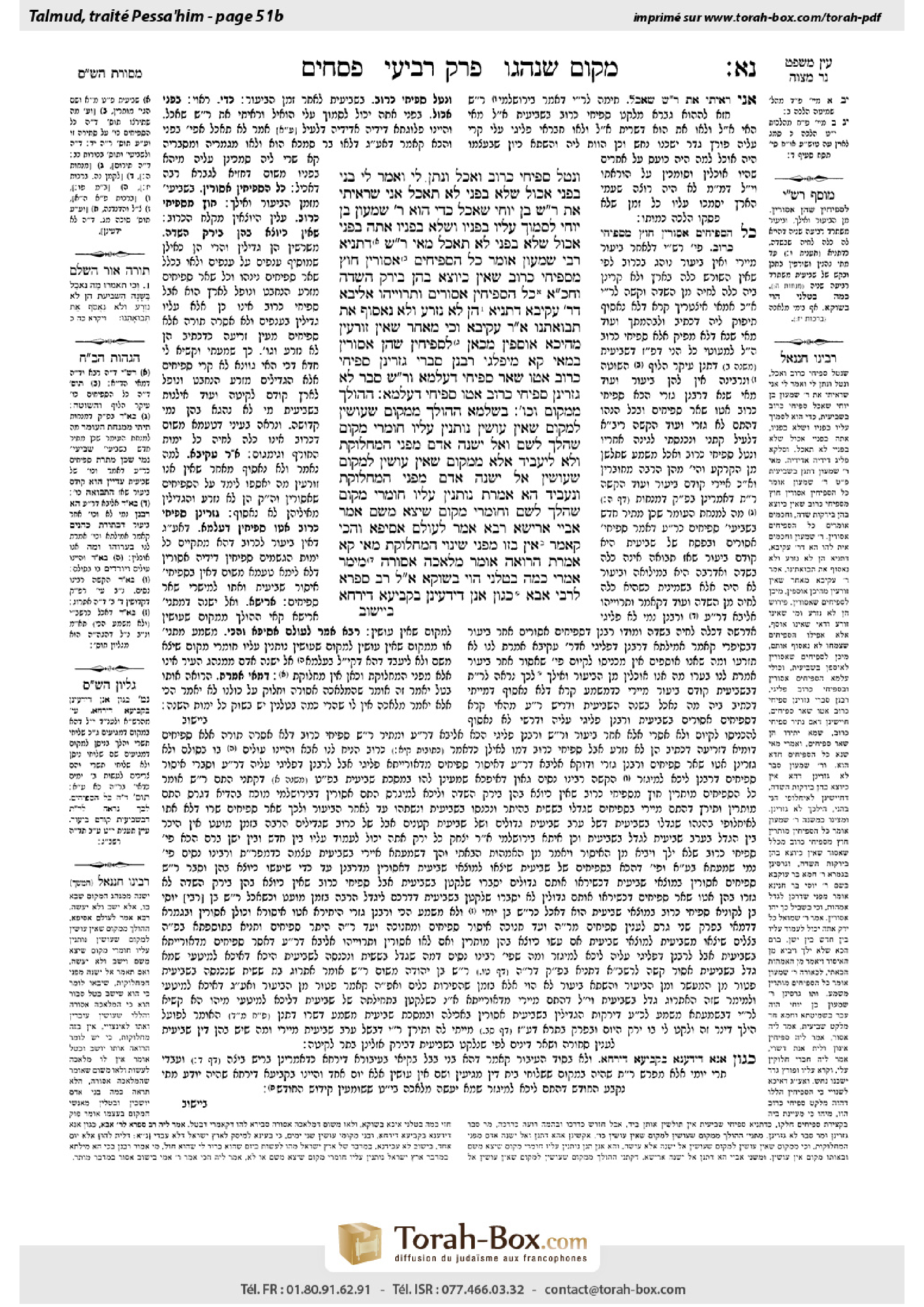
Pesachim 51b: Talmud study for Daf Yomi
Daf Yomi is the daily study of one Talmud folio. Explore 37 tractates with scans, Hebrew text, Sefaria English and AI-generated French translations where annotated.
Passage selection and English or AI-generated French translation are available where the scan has annotations. Daf Study is independent of Torah-Box and Sefaria.
Browse Pesachim · פסחים · All tractatesPesachim 51b text and translations
This page of Pesachim includes the Aramaic text, an English translation and an AI-generated French translation, alongside the scan above.
פסחים נ״א ב · Aramaic and Hebrew text
וְנָטַל סְפִיחֵי כְרוּב וְאָכַל וְנָתַן לִי, וְאָמַר לִי: בְּנִי, בְּפָנַי — אֱכוֹל, שֶׁלֹּא בְּפָנַי — לֹא תֹּאכַל. אֲנִי שֶׁרָאִיתִי אֶת רַבִּי שִׁמְעוֹן בֶּן יוֹחַי שֶׁאָכַל — כְּדַי הוּא רַבִּי שִׁמְעוֹן בֶּן יוֹחַי לִסְמוֹךְ עָלָיו בְּפָנָיו וְשֶׁלֹּא בְּפָנָיו. אַתָּה — בְּפָנַי אֱכוֹל, שֶׁלֹּא בְּפָנַי — לֹא תֹּאכַל.
מַאי רַבִּי שִׁמְעוֹן? דְּתַנְיָא: רַבִּי שִׁמְעוֹן אוֹמֵר: כׇּל הַסְּפִיחִים אֲסוּרִין, חוּץ מִסְּפִיחֵי כְּרוּב, שֶׁאֵין כַּיּוֹצֵא בָּהֶן בְּיָרָק הַשָּׂדֶה. וַחֲכָמִים אוֹמְרִים: כׇּל הַסְּפִיחִין אֲסוּרִים.
וְתַרְוַיְיהוּ אַלִּיבָּא דְּרַבִּי עֲקִיבָא. דְּתַנְיָא: ״הֵן לֹא נִזְרָע וְלֹא נֶאֱסֹף אֶת תְּבוּאָתֵנוּ״, אָמַר רַבִּי עֲקִיבָא: וְכִי מֵאַחַר שֶׁאֵין זוֹרְעִין מֵהֵיכָא אוֹסְפִין? מִכָּאן לַסְּפִיחִין שֶׁהֵן אֲסוּרִין.
בְּמַאי קָא מִיפַּלְגִי? רַבָּנַן סָבְרִי: גָּזְרִינַן סְפִיחֵי כְרוּב אַטּוּ שְׁאָר סְפִיחֵי דְעָלְמָא, וְרַבִּי שִׁמְעוֹן סָבַר: לָא גָּזְרִינַן סְפִיחֵי כְרוּב אַטּוּ סְפִיחֵי דְעָלְמָא.
הַהוֹלֵךְ מִמָּקוֹם וְכוּ׳. בִּשְׁלָמָא הַהוֹלֵךְ מִמָּקוֹם שֶׁעוֹשִׂין לְמָקוֹם שֶׁאֵין עוֹשִׂין — נוֹתְנִין עָלָיו חוּמְרֵי מָקוֹם שֶׁהָלַךְ לְשָׁם, וְאַל יְשַׁנֶּה אָדָם מִפְּנֵי הַמַּחְלוֹקֶת וְלָא לֶיעְבֵּיד.
אֶלָּא מִמָּקוֹם שֶׁאֵין עוֹשִׂין לְמָקוֹם שֶׁעוֹשִׂין, אַל יְשַׁנֶּה אָדָם מִפְּנֵי הַמַּחְלוֹקֶת וְנַעְבֵּיד? הָא אָמְרַתְּ: ״נוֹתְנִין עָלָיו חוּמְרֵי מָקוֹם שֶׁהָלַךְ לְשָׁם וְחוּמְרֵי מָקוֹם שֶׁיָּצָא מִשָּׁם״!
אָמַר אַבָּיֵי: אַרֵישָׁא. רָבָא אָמַר: לְעוֹלָם אַסֵּיפָא, וְהָכִי קָאָמַר: אֵין בָּזוֹ מִפְּנֵי שִׁינּוּי הַמַּחְלוֹקֶת. מַאי קָא אָמְרַתְּ — הָרוֹאֶה אוֹמֵר מְלָאכָה אֲסוּרָה? מֵימָר אָמְרִי: כַּמָּה בַּטְלָנֵי הָוֵי בְּשׁוּקָא.
אֲמַר לֵיהּ רַב סָפְרָא לְרַבִּי אַבָּא: כְּגוֹן אֲנַן דְּיָדְעִינַן בִּקְבִיעָא דְיַרְחָא,
Pesachim 51b · English translation
and he took cabbage after-growths that had grown during the Sabbatical Year, and ate from them and gave some to me. And he said to me: My son, in my presence, you may eat this. But when you are not in my presence, you may not eat cabbage that grew as an after-growth. I, who saw Rabbi Shimon ben Yoḥai eat, can say that Rabbi Shimon ben Yoḥai is worthy for one to rely upon him both in his presence and not in his presence. You, who did not see him eat, in my presence, rely on what I saw and eat; however, not in my presence, do not rely on my testimony and do not eat. In this case, Rabba bar bar Ḥana maintained that one who saw a Sage act in a certain way may rely on what he saw, as may his students when they are in the presence of their teacher.
The Gemara asks: What is that statement of Rabbi Shimon? As it was taught in a baraita that Rabbi Shimon says: All after-growths that grow on their own during the Sabbatical Year are prohibited and may not be eaten, except for the after-growths of cabbage, as there is nothing similar to them among the vegetables in the field. The Sages did not extend the decree prohibiting after-growths to cabbage, because it is unlike other vegetables. Rather, it is like fruit of a tree, which may be eaten if it grows wild during the Sabbatical Year. And the Rabbis say: All after-growths are prohibited, including the after-growths of cabbage.
The Gemara comments: And both Rabbi Shimon and the Rabbis, who disagree in this case, hold in accordance with the opinion of Rabbi Akiva. As it was taught in a baraita: The verse states, “And if you shall say: What shall we eat in the seventh year? Behold, we may not sow, nor gather our crops” (Leviticus 25:20). Rabbi Akiva said: And since they cannot sow, from where would they gather? Why does the verse mention gathering? It is derived from here that gathering after-growths that were not planted but grew on their own is prohibited.
The Gemara asks: With regard to what principle then, do they disagree? The Gemara answers: The Rabbis, who prohibit all after-growths, hold: We issue a decree prohibiting cabbage after-growths due to other after-growths in general. And Rabbi Shimon holds: We do not issue a decree prohibiting cabbage after-growths due to other after-growths in general.
We learned in the mishna with regard to refraining from performance of labor on Passover eve: With regard to one who travels from a place where people perform labor on Passover eve to a place where people do not, or from a place where people do not perform labor on Passover eve to a place where people do, the Sages impose upon him the stringencies of the place from which he left and the stringencies of the place to which he went. The Gemara asks: Granted, in the case of one who travels from a place where people perform labor to a place where they do not perform labor, the Sages impose upon him the stringencies of the place to which he went, and a person should not deviate from the standard practice in that place due to potential dispute, and he should not perform labor.
However, if one traveled from a place where people do not perform labor to a place where they do perform labor, is the ruling there too, that a person should not deviate from the standard practice in that place due to conflict, and perform labor? That cannot be. Didn’t you say: The Sages impose upon him the stringencies of the place to which he went and the stringencies of the place from which he left? He should not perform any labor.
Abaye said: The principle that one should not deviate due to potential dispute is referring to the first clause, that one who arrives at a place where people do not perform labor adopts the local stringency. Rava said: Actually, it is possible to say this halakha is also referring to the latter clause of the mishna, and this is what it is saying: Refraining from labor does not constitute a deviation that causes dispute. What are you saying; one who sees him will say that he is not working because he believes that performing labor is prohibited, contrary to local practice? That is unlikely, as when people see him inactive that will not be their assumption. Instead, they will say: How many idle people there are in the market every day who do not work. In this case, people will assume that this individual was unable to find work that day.
After discussing stringencies resulting from customs, the Gemara elaborates on the second day of a Festival observed in the Diaspora. Rav Safra said to Rabbi Abba: Communities in a situation like us, who, based on calculations, already know the determination of the month and are no longer concerned lest the Festival be observed on the wrong day, clearly, on the second day of a Festival,
Pesachim 51b · Traduction française (IA)
Il prit des repousses de chou qui avaient poussé pendant l’année de jachère, en mangea et m’en donna. Il me dit : « Mon fils, tu peux en manger en ma présence. Mais lorsque tu n’es pas en ma présence, tu ne peux pas manger de chou issu de repousses. » Moi, qui ai vu Rabbi Shimon ben Yoḥai en manger, je peux dire que Rabbi Shimon ben Yoḥai est digne qu’on se fie à lui aussi bien en sa présence qu’en son absence. Toi, qui ne l’as pas vu en manger, fie-toi, en ma présence, à ce que j’ai vu et mange ; mais en mon absence, ne te fie pas à mon témoignage et n’en mange pas. Dans ce cas, Rabba bar bar Ḥana estimait que celui qui a vu un Sage agir d’une certaine manière peut se fier à ce qu’il a vu, tout comme ses élèves lorsqu’ils sont en présence de leur maître.
La Guemara demande : Quelle est cette déclaration de Rabbi Shimon ? Comme il a été enseigné dans une baraïta, Rabbi Shimon dit : Toutes les repousses qui poussent spontanément pendant l’année de jachère sont interdites et ne peuvent être consommées, à l’exception des repousses de chou, car aucun autre légume des champs ne leur ressemble. Les Sages n’ont pas étendu à ces repousses le décret interdisant les repousses, car le chou est différent des autres légumes. Il ressemble plutôt au fruit d’un arbre, qui peut être consommé s’il pousse à l’état sauvage pendant l’année de jachère. Les Sages disent : toutes les repousses sont interdites, y compris les repousses de chou.
La Guemara fait remarquer que Rabbi Shimon et les Sages, qui sont en désaccord dans ce cas, suivent tous deux l’opinion de Rabbi Akiva. Comme il a été enseigné dans une baraïta : Le verset dit : « Et si vous dites : Que mangerons-nous la septième année ? Voici que nous ne pouvons ni semer ni récolter nos produits » (Lévitique 25,20). Rabbi Akiva dit : Puisqu’ils ne peuvent pas semer, d’où récolteraient-ils ? Pourquoi le verset mentionne-t-il la récolte ? On déduit de là qu’il est interdit de récolter les repousses qui n’ont pas été plantées et ont poussé spontanément.
La Guemara demande : Sur quel principe sont-ils donc en désaccord ? La Guemara répond : Les Sages, qui interdisent toutes les repousses, estiment que l’on décrète l’interdiction des repousses de chou en raison des autres repousses en général. Rabbi Shimon, lui, estime que l’on ne décrète pas l’interdiction des repousses de chou en raison des autres repousses en général.
Nous avons appris dans la Michna, au sujet de l’abstention de tout travail la veille de Pessa’h : celui qui se rend d’un endroit où l’on travaille la veille de Pessa’h à un endroit où l’on ne travaille pas, ou d’un endroit où l’on ne travaille pas la veille de Pessa’h à un endroit où l’on travaille, se voit imposer par les Sages les exigences de l’endroit qu’il a quitté et celles de l’endroit où il s’est rendu. La Guemara demande : Dans le cas de celui qui se rend d’un endroit où l’on travaille à un endroit où l’on ne travaille pas, il est logique que les Sages lui imposent les exigences de l’endroit où il est arrivé ; il ne doit pas déroger à la pratique habituelle de cet endroit, par crainte d’une dispute, et il ne doit donc pas travailler.
Mais si quelqu’un s’est rendu d’un endroit où l’on ne travaille pas à un endroit où l’on travaille, la règle est-elle également qu’il ne faut pas déroger à la pratique habituelle de cet endroit, par crainte d’un conflit, et qu’il doit travailler ? Cela ne peut pas être le cas. N’avez-vous pas dit que les Sages lui imposent les exigences de l’endroit où il est arrivé et celles de l’endroit qu’il a quitté ? Il ne doit donc effectuer aucun travail.
Abayé dit : Le principe selon lequel il ne faut pas déroger à la pratique par crainte d’une dispute se rapporte à la première partie, c’est-à-dire au cas de celui qui arrive dans un endroit où l’on ne travaille pas et adopte l’usage local, plus strict. Rava dit : En réalité, on peut dire que cette halakha se rapporte aussi à la dernière partie de la Michna, et voici ce qu’elle signifie : s’abstenir de travailler ne constitue pas une dérogation susceptible de provoquer une dispute. Que dites-vous ? Celui qui le voit dira qu’il ne travaille pas parce qu’il croit que le travail est interdit, contrairement à l’usage local ? C’est peu probable : ceux qui le verront inactif ne tireront pas cette conclusion. Ils diront plutôt : « Combien de gens oisifs ne travaillent pas au marché chaque jour ! » En l’occurrence, les gens supposeront que cet homme n’a pas pu trouver de travail ce jour-là.
Après avoir traité des exigences découlant des usages, la Guemara développe la question du deuxième jour de fête observé dans la Diaspora. Rav Safra dit à Rabbi Abba : « Les communautés dans une situation comme la nôtre, qui, grâce aux calculs, connaissent déjà la détermination du mois et ne craignent donc plus que la fête soit observée le mauvais jour, manifestement, le deuxième jour de fête… »
Traduction française générée par IA à partir de l’édition anglaise de Sefaria. Vérifie toujours un passage avec le texte source.
Text from Sefaria: William Davidson Edition - Vocalized Aramaic (CC BY NC); William Davidson Edition - English (CC BY NC).