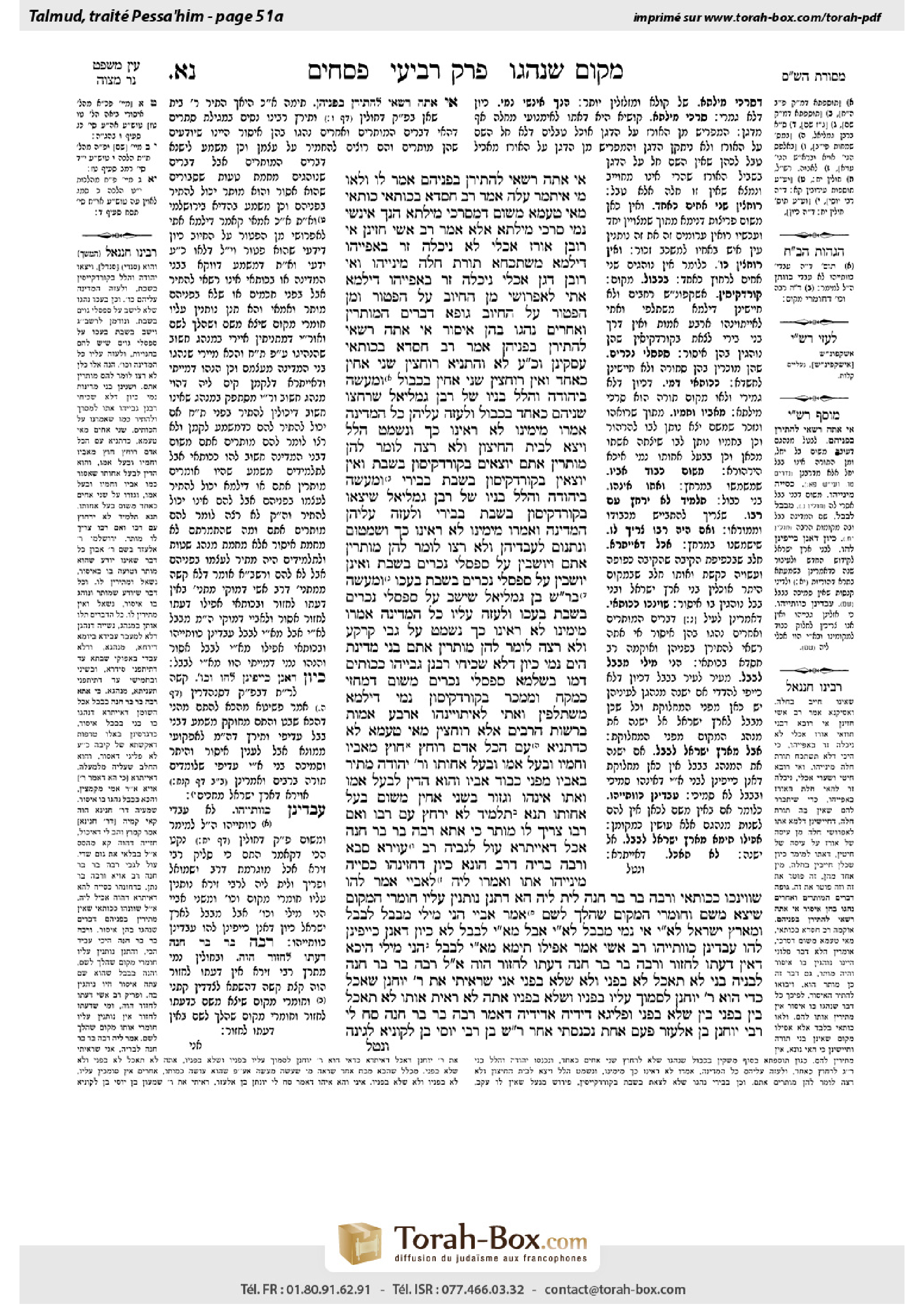
Pesachim 51a: Talmud study for Daf Yomi
Daf Yomi is the daily study of one Talmud folio. Explore 37 tractates with scans, Hebrew text, Sefaria English and AI-generated French translations where annotated.
Passage selection and English or AI-generated French translation are available where the scan has annotations. Daf Study is independent of Torah-Box and Sefaria.
Browse Pesachim · פסחים · All tractatesPesachim 51a text and translations
This page of Pesachim includes the Aramaic text, an English translation and an AI-generated French translation, alongside the scan above.
פסחים נ״א א · Aramaic and Hebrew text
אִי אַתָּה רַשַּׁאי לְהַתִּירָן בִּפְנֵיהֶם. אָמַר לוֹ: וְלָאו מִי אִיתְּמַר עֲלַהּ, אָמַר רַב חִסְדָּא: בְּכוּתָאֵי! כּוּתָאֵי מַאי טַעְמָא — מִשּׁוּם דִּמְסָרְכִי מִילְּתָא, הָנָךְ אִינָשֵׁי נָמֵי סָרְכִי מִילְּתָא.
אֶלָּא אָמַר רַב אָשֵׁי: חָזֵינַן אִי רוּבָּן אוֹרֶז אָכְלִי — לָא נֵיכְלַהּ זָר בְּאַפַּיְיהוּ, דִּילְמָא מִשְׁתַּכְחָא תּוֹרַת חַלָּה מִינַּיְיהוּ. וְאִי רוּבָּן דָּגָן אָכְלִי — נֵיכְלַהּ זָר בְּאַפַּיְיהוּ, דִּילְמָא אָתֵי לְאַפְרוֹשֵׁי מִן הַחִיּוּב עַל הַפְּטוּר, וּמִן הַפְּטוּר עַל הַחִיּוּב.
גּוּפָא, דְּבָרִים הַמּוּתָּרִין וַאֲחֵרִים נָהֲגוּ בָּהֶן אִיסּוּר — אִי אַתָּה רַשַּׁאי לְהַתִּירָן בִּפְנֵיהֶן. אָמַר רַב חִסְדָּא: בְּכוּתָאֵי עָסְקִינַן. וְכוּלֵּי עָלְמָא לָא? וְהָתַנְיָא: רוֹחֲצִין שְׁנֵי אַחִין כְּאֶחָד, וְאֵין רוֹחֲצִין שְׁנֵי אַחִין בְּכָבוּל. וּמַעֲשֶׂה בִּיהוּדָה וְהִלֵּל בָּנָיו שֶׁל רַבָּן גַּמְלִיאֵל שֶׁרָחֲצוּ שְׁנֵיהֶם כְּאֶחָד בְּכָבוּל, וְלָעֲזָה עֲלֵיהֶן כׇּל הַמְּדִינָה, אָמְרוּ: מִיָּמֵינוּ לֹא רָאִינוּ כָּךְ. וְנִשְׁמַט הִלֵּל וְיָצָא לַבַּיִת הַחִיצוֹן, וְלֹא רָצָה לוֹמַר לָהֶן: מוּתָּרִין אַתֶּם.
יוֹצְאִים בְּקוֹרְדָּקֵיסוֹן בַּשַּׁבָּת, וְאֵין יוֹצְאִין בְּקוֹרְדָּקֵיסוֹן בַּשַּׁבָּת בְּבֵירֵי. וּמַעֲשֶׂה בִּיהוּדָה וְהִלֵּל בָּנָיו שֶׁל רַבָּן גַּמְלִיאֵל שֶׁיָּצְאוּ בְּקוֹרְדָּקֵיסוֹן בַּשַּׁבָּת בְּבֵירֵי, וְלָעֲזָה עֲלֵיהֶן הַמְּדִינָה, וְאָמְרוּ: מִיָּמֵינוּ לֹא רָאִינוּ כָּךְ. וּשְׁמָטוּם וּנְתָנוּם לְעַבְדֵיהֶן, וְלֹא רָצוּ לוֹמַר לָהֶן: מוּתָּרִין אַתֶּם.
וְיוֹשְׁבִין עַל סַפְסַלֵּי גּוֹיִם בַּשַּׁבָּת, וְאֵינָן יוֹשְׁבִין עַל סַפְסַלֵּי גוֹיִם בַּשַּׁבָּת בְּעַכּוֹ. וּמַעֲשֶׂה בְּרַבָּן שִׁמְעוֹן בֶּן גַּמְלִיאֵל שֶׁיָּשַׁב עַל סַפְסַלֵּי גוֹיִם בַּשַּׁבָּת בְּעַכּוֹ, וְלָעֲזָה עָלָיו כׇּל הַמְּדִינָה, אָמְרוּ: מִיָּמֵינוּ לֹא רָאִינוּ כָּךְ. נִשְׁמַט עַל גַּבֵּי קַרְקַע, וְלֹא רָצָה לוֹמַר לָהֶן: מוּתָּרִין אַתֶּם. בְּנֵי מְדִינַת הַיָּם נָמֵי, כֵּיוָן דְּלָא שְׁכִיחִי רַבָּנַן גַּבַּיְיהוּ — כְּכוּתִים דָּמוּ.
בִּשְׁלָמָא סַפְסַלֵּי גוֹיִם, מִשּׁוּם דְּמִחֲזֵי כְּמִקָּח וּמִמְכָּר. בְּקוֹרְדָּקֵיסוֹן נָמֵי, דִּילְמָא מִשְׁתַּלְּפִין וְאָתֵי לְאֵיתוֹיִינְהוּ אַרְבַּע אַמּוֹת בִּרְשׁוּת הָרַבִּים.
אֶלָּא רוֹחֲצִין מַאי טַעְמָא לָא? כִּדְתַנְיָא: עִם הַכֹּל אָדָם רוֹחֵץ, חוּץ מֵאָבִיו וְחָמִיו וּבַעַל אִמּוֹ וּבַעַל אֲחוֹתוֹ. וְרַבִּי יְהוּדָה מַתִּיר בְּאָבִיו מִפְּנֵי כְּבוֹד אָבִיו, וְהוּא הַדִּין לְבַעַל אִמּוֹ.
וַאֲתוֹ אִינְהוּ וּגְזוּר בִּשְׁנֵי אַחִין מִשּׁוּם בַּעַל אֲחוֹתוֹ. תָּנָא: תַּלְמִיד לֹא יִרְחַץ עִם רַבּוֹ, וְאִם רַבּוֹ צָרִיךְ לוֹ — מוּתָּר.
כִּי אֲתָא רַבָּה בַּר בַּר חָנָה, אֲכַל דְּאַיִּיתְרָא. עוּל לְגַבֵּיהּ רַב עַוִּירָא סָבָא וְרַבָּה בְּרֵיהּ דְּרַב הוּנָא, כֵּיוָן דַּחֲזִינְהוּ כַּסְּיֵיהּ מִינַּיְיהוּ. אֲתוֹ וַאֲמַרוּ לֵיהּ לְאַבָּיֵי. אֲמַר לְהוּ: שַׁוִוינְכוּ כְּכוּתָאֵי.
וְרַבָּה בַּר בַּר חָנָה לֵית לֵיהּ הָא דִּתְנַן נוֹתְנִין עָלָיו חוּמְרֵי הַמָּקוֹם שֶׁיָּצָא מִשָּׁם וְחוּמְרֵי הַמָּקוֹם שֶׁהָלַךְ לְשָׁם? אָמַר אַבָּיֵי: הָנֵי מִילֵּי מִבָּבֶל לְבָבֶל, וּמֵאֶרֶץ יִשְׂרָאֵל לְאֶרֶץ יִשְׂרָאֵל. אִי נָמֵי, מִבָּבֶל לְאֶרֶץ יִשְׂרָאֵל. אֲבָל מֵאֶרֶץ יִשְׂרָאֵל לְבָבֶל — לָא. כֵּיוָן דַּאֲנַן כַּיְיפִינַן לְהוּ, עָבְדִינַן כְּווֹתַיְיהוּ.
רַב אָשֵׁי אָמַר: אֲפִילּוּ תֵּימָא מֵאֶרֶץ יִשְׂרָאֵל לְבָבֶל, הָנֵי מִילֵּי הֵיכָא דְּאֵין דַּעְתּוֹ לַחֲזוֹר, וְרַבָּה בַּר בַּר חָנָה דַּעְתּוֹ לַחֲזוֹר הֲוָה. אֲמַר לֵיהּ רַבָּה בַּר בַּר חָנָה לִבְנֵיהּ: בְּנִי, לֹא תֹּאכַל לֹא בְּפָנַי וְלֹא שֶׁלֹּא בְּפָנַי. אֲנִי שֶׁרָאִיתִי אֶת רַבִּי יוֹחָנָן שֶׁאָכַל — כְּדַי הוּא רַבִּי יוֹחָנָן לִסְמוֹךְ עָלָיו בְּפָנָיו וְשֶׁלֹּא בְּפָנָיו. אַתָּה לֹא רָאִיתָ אוֹתוֹ, לֹא תֹּאכַל בֵּין בְּפָנַי בֵּין שֶׁלֹּא בְּפָנַי.
ופְלִיגָא דִּידֵיהּ אַדִּידֵיהּ. דְּאָמַר רַבָּה בַּר בַּר חָנָה, סָח לִי רַבִּי יוֹחָנָן בֶּן אֶלְעָזָר: פַּעַם אַחַת נִכְנַסְתִּי אַחַר רַבִּי שִׁמְעוֹן בֶּן רַבִּי יוֹסֵי בֶּן לָקוֹנְיָא לַגִּינָּה,
Pesachim 51a · English translation
you are not allowed to permit these actions in their presence, lest they come to treat other prohibitions lightly, saying: If this previously prohibited activity was permitted, other prohibitions are not particularly stringent either. How did Rav Yosef permit the residents of Ḥozai to eat rice dough? Rav Yosef said to Abaye: And wasn’t it stated about this halakha concerning stringencies that Rav Ḥisda said: This was stated specifically with regard to Samaritans? The Gemara rejects this: What is the reason that this applies to Samaritans? It is due to the fact that they will extend this matter of leniency, and add to it additional, unjustified leniencies. These people of Ḥozai will also extend this matter of leniency, and come to practice additional leniencies in other cases, as they are ignoramuses.
Rather, Rav Ashi said: We see, if the majority of people in that place eat rice, do not let a non-priest eat ḥalla in their presence, lest the halakhic category of ḥalla be forgotten from them. And if most of them eat grain, let a non-priest eat ḥalla separated from rice dough in their presence, lest they separate ḥalla from grain, from which separating ḥalla is a requirement, on behalf of rice from which separating ḥalla is an exemption, in which case the priest eating the ḥalla would be eating bread from which ḥalla was not separated; or from that which is an exemption on behalf of that which is a requirement, in which case the person eating the grain bread would be eating bread from which ḥalla was not separated.
After mentioning halakhot relating to customs, the Gemara returns to discuss the matter itself. If matters are permitted but others were accustomed to treat them as a prohibition, you are not allowed to permit these actions in their presence. Rav Ḥisda said: We are dealing with Samaritans, not with Jews. The Gemara is surprised at this: And doesn’t this apply to everyone? Wasn’t it taught in a baraita to the contrary? Two brothers may bathe together, and there is no concern that doing so is immodest or will lead to sinful thoughts. However, the custom was that two brothers do not bathe together in the city of Kabul (see I Kings 9:13). And there was an incident involving Yehuda and Hillel, sons of Rabban Gamliel, who bathed together in Kabul, and the entire city denounced them and said: In all our days we have never seen that type of conduct. Hillel stole away and went out to the outer chamber and did not want to tell them: You are permitted to do so. He preferred to obey the city residents rather than rule it permitted for two brothers to bathe together.
Similarly, one may go out with wide shoes that resemble slippers on Shabbat; however, one does not go out with wide shoes in the city of Birei. And there was an incident involving Yehuda and Hillel, sons of Rabban Gamliel, who went out with wide shoes in Birei, and the people of the city denounced them and said: In all our days we have never seen that type of conduct. And Yehuda and Hillel removed their shoes, and gave them to their gentile servants, and did not want to tell the residents of the city: You are permitted to go out with wide shoes on Shabbat.
Similarly, one may sit on gentiles’ stools on Shabbat, even though these stools are typically used for displaying merchandise. But one may not sit on gentiles' stools on Shabbat in the city of Akko. And there was an incident involving Rabban Shimon ben Gamliel who sat on gentiles’ stools on Shabbat in the city of Akko, and the entire city denounced him. They said: In all our days we have never seen that type of conduct. Rabban Shimon ben Gamliel moved onto the ground and did not want to tell them: You are permitted to sit on the stools. The Gemara answers: The legal status of people in the cities, since Sages are not found among them, is like that of the Samaritans. Therefore, it is prohibited to tell them that these activities are permitted.
The Gemara proceeds to clarify the reasons for the stringent customs in those communities. Granted, sitting on gentiles’ stools is prohibited because it appears like one is engaged in buying and selling on Shabbat. In the case of wide shoes as well, it is prohibited to wear them due to the concern lest they fall off one’s feet and he come to carry them in his hand four cubits in the public domain, thereby violating a Torah prohibition.
However, what is the reason that two brothers may not bathe together? The Gemara answers: The custom to prohibit doing so is based on that which was taught in a baraita: A person may bathe with anyone except for his father, and his father-in-law, and his mother’s husband, and his sister’s husband. Due to the nature of their relation, one might come to ponder how they came to be related and have prohibited thoughts about intimacy between men and women. And Rabbi Yehuda permits one to bathe with his father, due to the honor that he can accord his father by assisting his father while bathing. The same is true for one’s mother’s husband.
And the people of Kabul came and issued a decree to prohibit bathing together for two brothers, due to their concern that it is similar to bathing with one’s sister’s husband. It was taught in the Tosefta: A student may not bathe with his teacher, since it is disrespectful to see one’s teacher naked. But if his teacher requires his help when bathing, it is permitted.
The Gemara relates: When Rabba bar bar Ḥana came from Eretz Yisrael to Babylonia, he ate the fat found over the straight part of an animal’s stomach. The fat along the stomach consists of two parts: The inner, straight portion, which is shaped like a bowstring, and the outer, rounded portion, which is shaped like a bow. With regard to the fat surrounding the inner, straight portion, the custom in Eretz Yisrael was lenient, whereas in Babylonia it was stringent. Rav Avira the Elder and Rabba, son of Rav Huna, entered to see Rabba bar bar Ḥana. When he saw them coming, he concealed from them what he was eating. They came and told Abaye what had happened, and he said to them: Through his conduct, he rendered you Samaritans, as he could have told you that it is permitted but did not do so.
The Gemara asks: And is Rabba bar bar Ḥana, who was lenient with regard to a matter that is prohibited, not in agreement with that which we learned in the mishna: When one travels from one place to another, the Sages impose upon him the stringencies of the place from which he left and the stringencies of the place to which he went? Abaye said: That applies when one travels from one place in Babylonia to another place in Babylonia, or from one place in Eretz Yisrael to another place in Eretz Yisrael, or alternatively, from Babylonia to Eretz Yisrael. However, when traveling from Eretz Yisrael to Babylonia, no, this principle does not apply. Since we, the residents of Babylonia, are subordinate to them in terms of halakha, we act in accordance with their custom, but a resident of Eretz Yisrael is not required to follow the Babylonian custom.
Rav Ashi said: Even if you say that when one travels from Eretz Yisrael to Babylonia, he is required to act stringently in accordance with the local custom, this applies only when his intent is not to return. One is required to adopt the local customs when permanently settling in a new location. However, as Rabba bar bar Ḥana’s intent was to return to Eretz Yisrael, his point of origin, he continued to follow the custom of Eretz Yisrael. The Gemara relates that Rabba bar bar Ḥana said to his son: My son, you live in Babylonia. Therefore, do not eat this fat, neither when you are in my presence nor when you are not in my presence. I, who saw Rabbi Yoḥanan eat this fat, can say that Rabbi Yoḥanan is worthy for one to rely upon him both in his presence and not in his presence. You did not see him. Therefore, do not eat it, neither when you are in my presence nor when you are not in my presence, since you may not rely upon my opinion alone in this matter.
The Gemara comments: And this statement of his disagrees with another statement of his, as Rabba bar bar Ḥana said: Rabbi Yoḥanan ben Elazar told me: Once I followed Rabbi Shimon ben Rabbi Yosei ben Lakonya into the garden next to his house,
Pesachim 51a · Traduction française (IA)
Il ne vous est pas permis d’autoriser ces pratiques en leur présence, de peur qu’ils ne finissent par traiter à la légère d’autres interdits, en disant : « Si cette pratique jusque-là interdite a été autorisée, les autres interdits ne sont pas particulièrement rigoureux non plus. » Comment Rav Yosef a-t-il pu autoriser les habitants de Ḥozai à manger de la pâte de riz ? Rav Yosef dit à Abaye : « N’a-t-il pas été dit, à propos de cette halakha relative aux pratiques rigoureuses, que Rav Ḥisda a déclaré : “Cela a été dit précisément au sujet des Samaritains” ? » La Guemara rejette cette réponse : Pour quelle raison cela s’applique-t-il aux Samaritains ? Parce qu’ils étendront cette permission et y ajouteront d’autres permissions injustifiées. Les habitants de Ḥozai étendront eux aussi cette permission et finiront par adopter d’autres pratiques indulgentes dans d’autres cas, puisqu’ils sont ignorants.
Rav Ashi dit plutôt : Nous considérons la situation ainsi : si la majorité des habitants de cet endroit mange du riz, ne laissez pas un non-prêtre manger de la ḥalla en leur présence, de peur qu’ils n’oublient la catégorie halakhique de la ḥalla. Et si la plupart d’entre eux mangent des céréales, qu’un non-prêtre mange en leur présence de la ḥalla prélevée sur une pâte de riz, de peur qu’ils ne prélèvent la ḥalla sur des céréales, pour lesquelles le prélèvement de la ḥalla est obligatoire, en faveur du riz, pour lequel ce prélèvement n’est pas obligatoire ; dans ce cas, le prêtre qui mangerait la ḥalla consommerait du pain dont la ḥalla n’a pas été prélevée. Ou bien, de peur qu’ils ne prélèvent ce qui n’est pas soumis à l’obligation en faveur de ce qui y est soumis ; dans ce cas, celui qui mangerait le pain de céréales consommerait du pain dont la ḥalla n’a pas été prélevée.
Après avoir évoqué des halakhot relatives aux coutumes, la Guemara revient au sujet lui-même. Si certaines pratiques sont permises, mais que d’autres ont coutume de les tenir pour interdites, il ne vous est pas permis de les autoriser en leur présence. Rav Ḥisda dit : « Il s’agit des Samaritains, et non des Juifs. » La Guemara s’en étonne : Cela ne s’applique-t-il pas à tous ? N’a-t-on pas enseigné dans une baraïta le contraire ? Deux frères peuvent se baigner ensemble, et il n’y a pas à craindre que cela soit impudique ou suscite des pensées coupables. Toutefois, la coutume était que deux frères ne se baignent pas ensemble dans la ville de Kabul (voir I Rois 9,13). Un jour, Yehuda et Hillel, fils de Rabban Gamliel, se baignèrent ensemble à Kabul ; toute la ville les réprouva en disant : « De toute notre vie, nous n’avons jamais vu un tel comportement. » Hillel se déroba et sortit dans la pièce extérieure, sans vouloir leur dire : « Cela vous est permis. » Il préféra se conformer à la conduite des habitants de la ville plutôt que de statuer qu’il est permis à deux frères de se baigner ensemble.
De même, on peut sortir le Chabbat avec de larges chaussures qui ressemblent à des pantoufles ; toutefois, on ne sort pas avec de larges chaussures dans la ville de Birei. Un jour, Yehuda et Hillel, fils de Rabban Gamliel, sortirent avec de larges chaussures à Birei, et les habitants de la ville les réprouvèrent en disant : « De toute notre vie, nous n’avons jamais vu un tel comportement. » Yehuda et Hillel retirèrent leurs chaussures et les donnèrent à leurs serviteurs non juifs, sans vouloir dire aux habitants de la ville : « Il vous est permis de sortir avec de larges chaussures le Chabbat. »
De même, on peut s’asseoir le Chabbat sur les tabourets des non-Juifs, même si ceux-ci servent généralement à exposer des marchandises. Mais on ne s’assoit pas le Chabbat sur les tabourets des non-Juifs dans la ville d’Akko. Un jour, Rabban Shimon ben Gamliel s’assit le Chabbat sur des tabourets appartenant à des non-Juifs dans la ville d’Akko, et toute la ville le réprouva. Ils dirent : « De toute notre vie, nous n’avons jamais vu un tel comportement. » Rabban Shimon ben Gamliel s’assit à même le sol, sans vouloir leur dire : « Il vous est permis de vous asseoir sur les tabourets. » La Guemara répond : Le statut halakhique des habitants de ces villes, puisque les Sages ne se trouvent pas parmi eux, est celui des Samaritains. Il est donc interdit de leur dire que ces pratiques sont permises.
La Guemara examine ensuite les raisons des coutumes rigoureuses de ces communautés. Certes, il est interdit de s’asseoir sur les tabourets des non-Juifs, car cela donne l’impression que l’on se livre à des achats et à des ventes le Chabbat. De même, il est interdit de porter de larges chaussures, par crainte qu’elles ne tombent des pieds et que l’on ne finisse par les porter à la main sur quatre coudées dans le domaine public, transgressant ainsi un interdit de la Torah.
Cependant, pour quelle raison deux frères ne peuvent-ils pas se baigner ensemble ? La Guemara répond : La coutume qui l’interdit repose sur ce qui a été enseigné dans une baraïta : On peut se baigner avec n’importe qui, sauf avec son père, son beau-père, le mari de sa mère ou le mari de sa sœur. En raison de la nature de leur relation, on pourrait se demander comment ils sont apparentés et avoir des pensées interdites au sujet de relations intimes entre hommes et femmes. Rabbi Yehuda permet à une personne de se baigner avec son père, en raison de l’honneur qu’elle peut lui témoigner en l’aidant à se baigner. Il en va de même pour le mari de sa mère.
Les habitants de Kabul vinrent instaurer un décret interdisant à deux frères de se baigner ensemble, car ils craignaient que cela ne ressemble à un bain avec le mari de sa sœur. Il a été enseigné dans la Tosefta : Un élève ne peut pas se baigner avec son maître, car il est irrespectueux de voir son maître nu. Toutefois, si son maître a besoin de son aide pour se baigner, cela est permis.
La Guemara rapporte : Lorsque Rabba bar bar Ḥana vint d’Eretz Israël en Babylonie, il mangea la graisse qui recouvre la partie rectiligne de l’estomac d’un animal. La graisse de l’estomac comprend deux parties : la partie intérieure, rectiligne, qui a la forme d’une corde d’arc, et la partie extérieure, arrondie, qui a la forme d’un arc. En ce qui concerne la graisse qui recouvre la partie intérieure et rectiligne, la coutume était indulgente en Eretz Israël, tandis qu’elle était rigoureuse en Babylonie. Rav Avira l’Ancien et Rabba, fils de Rav Huna, vinrent rendre visite à Rabba bar bar Ḥana. Lorsqu’il les vit arriver, il leur cacha ce qu’il était en train de manger. Ils vinrent raconter à Abaye ce qui s’était passé, et il leur dit : « Par sa conduite, il vous a traités comme des Samaritains, car il aurait pu vous dire que cela est permis, mais il ne l’a pas fait. »
La Guemara demande : Rabba bar bar Ḥana, qui s’est montré indulgent à propos d’une chose interdite, n’est-il donc pas d’accord avec ce que nous avons appris dans la Michna : « Lorsqu’on va d’un endroit à un autre, les Sages lui imposent les rigueurs de l’endroit qu’il a quitté et celles de l’endroit où il est arrivé » ? Abaye dit : Cela s’applique lorsqu’on va d’un endroit de Babylonie à un autre endroit de Babylonie, d’un endroit d’Eretz Israël à un autre endroit d’Eretz Israël, ou encore de Babylonie en Eretz Israël. Mais lorsqu’on va d’Eretz Israël en Babylonie, non, ce principe ne s’applique pas. Puisque nous, les habitants de Babylonie, leur sommes soumis en matière de halakha, nous suivons leur coutume ; mais un habitant d’Eretz Israël n’est pas tenu de suivre la coutume babylonienne.
Rav Ashi dit : Même si l’on affirme qu’en allant d’Eretz Israël en Babylonie, il faut agir avec rigueur selon la coutume locale, cela ne s’applique que si l’on n’a pas l’intention de revenir. Il faut adopter les coutumes locales lorsqu’on s’installe définitivement dans un nouvel endroit. Cependant, Rabba bar bar Ḥana ayant l’intention de retourner en Eretz Israël, son lieu d’origine, il continua de suivre la coutume d’Eretz Israël. La Guemara rapporte que Rabba bar bar Ḥana dit à son fils : « Mon fils, tu vis en Babylonie. Par conséquent, ne mange pas cette graisse, ni en ma présence ni en mon absence. Moi, qui ai vu Rabbi Yoḥanan manger cette graisse, je peux dire que Rabbi Yoḥanan est digne que l’on s’appuie sur lui, aussi bien en sa présence qu’en son absence. Toi, tu ne l’as pas vu. Par conséquent, ne la mange pas, ni en ma présence ni en mon absence, car tu ne peux pas t’appuyer uniquement sur mon avis en la matière. »
La Guemara commente : Cette déclaration de sa part est en contradiction avec une autre de ses déclarations, car Rabba bar bar Ḥana a dit : « Rabbi Yoḥanan ben Elazar m’a raconté : Un jour, je suivis Rabbi Shimon ben Rabbi Yosei ben Lakonya dans le jardin qui jouxtait sa maison, »
Traduction française générée par IA à partir de l’édition anglaise de Sefaria. Vérifie toujours un passage avec le texte source.
Text from Sefaria: William Davidson Edition - Vocalized Aramaic (CC BY NC); William Davidson Edition - English (CC BY NC).