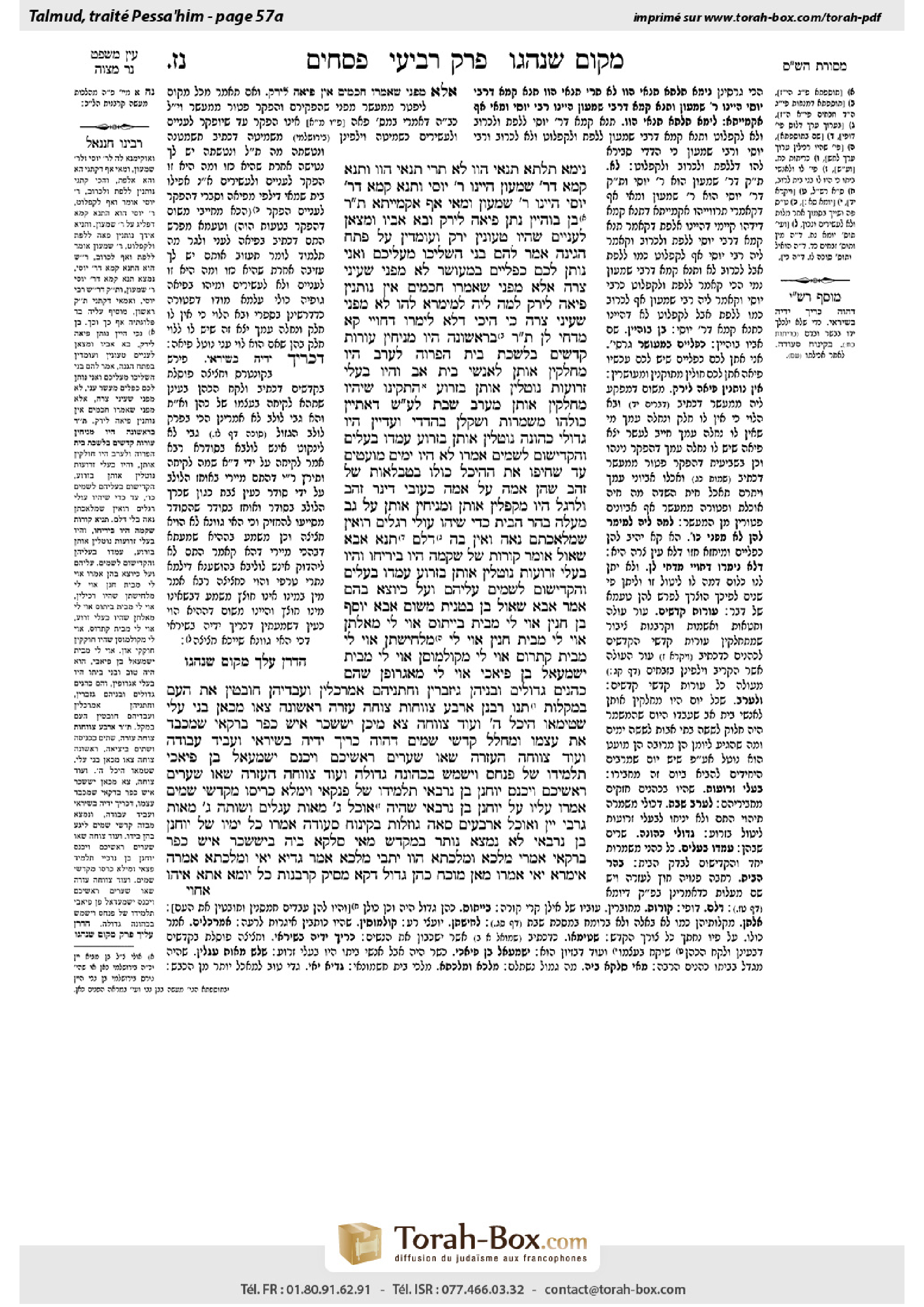
Pesachim 57a: Talmud study for Daf Yomi
Daf Yomi is the daily study of one Talmud folio. Explore 37 tractates with scans, Hebrew text, Sefaria English and AI-generated French translations where annotated.
Passage selection and English or AI-generated French translation are available where the scan has annotations. Daf Study is independent of Torah-Box and Sefaria.
Browse Pesachim · פסחים · All tractatesPesachim 57a text and translations
This page of Pesachim includes the Aramaic text, an English translation and an AI-generated French translation, alongside the scan above.
פסחים נ״ז א · Aramaic and Hebrew text
נֵימָא תְּלָתָא תַּנָּאֵי הֲווֹ? לָא, תְּרֵי תַּנָּאֵי הֲווֹ, וְתַנָּא קַמָּא דְּרַבִּי שִׁמְעוֹן הַיְינוּ רַבִּי יוֹסֵי, וְתַנָּא קַמָּא דְּרַבִּי יוֹסֵי הַיְינוּ רַבִּי שִׁמְעוֹן. וּמַאי ״אַף״ — אַקַּמַּיְיתָא.
תָּנוּ רַבָּנַן: בֶּן בּוּהְיָין נָתַן פֵּיאָה לַיָּרָק, וּבָא אָבִיו וּמְצָאָן לַעֲנִיִּים שֶׁהָיוּ טְעוּנִין יָרָק וְעוֹמְדִין עַל פֶּתַח הַגִּינָּה. אָמַר לָהֶם: בָּנַי, הַשְׁלִיכוּ מֵעֲלֵיכֶם וַאֲנִי נוֹתֵן לָכֶם כִּפְלַיִים בַּמְעוּשָּׂר. לֹא מִפְּנֵי שֶׁעֵינִי צָרָה, אֶלָּא מִפְּנֵי שֶׁאָמְרוּ חֲכָמִים: אֵין נוֹתְנִין פֵּיאָה לַיָּרָק.
לְמָה לֵיהּ לְמֵימְרָא לְהוּ ״לֹא מִפְּנֵי שֶׁעֵינִי צָרָה״? כִּי הֵיכִי דְּלָא לֵימְרוּ: דַּחוֹיֵי קָא מְדַחֵי לַן.
תָּנוּ רַבָּנַן: בָּרִאשׁוֹנָה הָיוּ מַנִּיחִין עוֹרוֹת קָדָשִׁים בְּלִשְׁכַּת בֵּית הַפַּרְוָה, לָעֶרֶב הָיוּ מְחַלְּקִין אוֹתָן לְאַנְשֵׁי בֵּית אָב. וְהָיוּ בַּעֲלֵי זְרוֹעוֹת נוֹטְלִין אוֹתָן בִּזְרוֹעַ. הִתְקִינוּ שֶׁיִּהְיוּ מְחַלְּקִין אוֹתָן מֵעֶרֶב שַׁבָּת לְעֶרֶב שַׁבָּת — דְּאָתְיָין כּוּלְּהוּ מִשְׁמָרוֹת, וְשָׁקְלָן בַּהֲדָדֵי.
וַעֲדַיִין הָיוּ גְּדוֹלֵי כְהוּנָּה נוֹטְלִין אוֹתָן בִּזְרוֹעַ. עָמְדוּ בְּעָלִים וְהִקְדִּישׁוּם לַשָּׁמַיִם.
אָמְרוּ: לֹא הָיוּ יָמִים מוּעָטִים עַד שֶׁחִיפּוּ אֶת הַהֵיכָל כּוּלּוֹ בְּטַבְלָאוֹת שֶׁל זָהָב, שֶׁהֵן אַמָּה עַל אַמָּה כְּעוֹבִי דִּינַר זָהָב, וּלְרֶגֶל הָיוּ מְקַפְּלִין אוֹתָן וּמַנִּיחִין אוֹתָן עַל גַּב מַעֲלָה בְּהַר הַבַּיִת, כְּדֵי שֶׁיְּהוּ עוֹלֵי רְגָלִים רוֹאִין שֶׁמְּלַאכְתָּם נָאָה וְאֵין בָּהּ דֶּלֶם.
תָּנָא, אַבָּא שָׁאוּל אוֹמֵר: קוֹרוֹת שֶׁל שִׁקְמָה הָיוּ בִּירִיחוֹ, וְהָיוּ בַּעֲלֵי זְרוֹעוֹת נוֹטְלִין אוֹתָן בִּזְרוֹעַ, עָמְדוּ בְּעָלִים וְהִקְדִּישׁוּם לַשָּׁמַיִם.
עֲלֵיהֶם וְעַל כַּיּוֹצֵא בָּהֶם אָמַר אַבָּא שָׁאוּל בֶּן בָּטְנִית מִשּׁוּם אַבָּא יוֹסֵף בֶּן חָנִין: אוֹי לִי מִבֵּית בַּיְיתּוֹס — אוֹי לִי מֵאָלָתָן, אוֹי לִי מִבֵּית חָנִין — אוֹי לִי מִלְּחִישָׁתָן, אוֹי לִי מִבֵּית קַתְרוֹס — אוֹי לִי מִקּוּלְמוֹסָן, אוֹי לִי מִבֵּית יִשְׁמָעֵאל בֶּן פִּיאָכִי — אוֹי לִי מֵאֶגְרוֹפָן. שֶׁהֵם כֹּהֲנִים גְּדוֹלִים, וּבְנֵיהֶן גִּיזְבָּרִין, וְחַתְנֵיהֶם אֲמַרְכָּלִין, וְעַבְדֵיהֶן חוֹבְטִין אֶת הָעָם בְּמַקְלוֹת.
תָּנוּ רַבָּנַן: אַרְבַּע צְווֹחוֹת צָוְחָה עֲזָרָה. רִאשׁוֹנָה: צְאוּ מִכָּאן בְּנֵי עֵלִי שֶׁטִּימְּאוּ הֵיכַל ה׳. וְעוֹד צָוְוחָה: צֵא מִיכָּן יִשָּׂשׂכָר אִישׁ כְּפַר בַּרְקַאי שֶׁמְּכַבֵּד אֶת עַצְמוֹ וּמְחַלֵּל קׇדְשֵׁי שָׁמַיִם. דַּהֲוָה כָּרֵיךְ יְדֵיהּ בְּשִׁירָאֵי וְעָבֵיד עֲבוֹדָה.
וְעוֹד צָוְוחָה הָעֲזָרָה: שְׂאוּ שְׁעָרִים רָאשֵׁיכֶם וְיִכָּנֵס יִשְׁמָעֵאל בֶּן פִּיאָכִי תַּלְמִידוֹ שֶׁל פִּנְחָס, וִישַׁמֵּשׁ בִּכְהוּנָּה גְּדוֹלָה. וְעוֹד צָוְוחָה הָעֲזָרָה: שְׂאוּ שְׁעָרִים רָאשֵׁיכֶם וְיִכָּנֵס יוֹחָנָן בֶּן נִרְבַּאי תַּלְמִידוֹ שֶׁל פִּנְקַאי וִימַלֵּא כְּרֵיסוֹ מִקׇּדְשֵׁי שָׁמַיִם.
אָמְרוּ עָלָיו עַל יוֹחָנָן בֶּן נִרְבַּאי שֶׁהָיָה אוֹכֵל שְׁלֹשׁ מֵאוֹת עֲגָלִים, וְשׁוֹתֶה שְׁלֹשׁ מֵאוֹת גַּרְבֵי יַיִן, וְאוֹכֵל אַרְבָּעִים סְאָה גּוֹזָלוֹת בְּקִינּוּחַ סְעוּדָה. אָמְרוּ: כׇּל יָמָיו שֶׁל יוֹחָנָן בֶּן נִרְבַּאי לֹא נִמְצָא נוֹתָר בְּמִקְדָּשׁ. מַאי סְלִקָא בֵּיהּ בְּיִשָּׂשׂכָר אִישׁ כְּפַר בַּרְקַאי? אָמְרִי: מַלְכָּא וּמַלְכְּתָא הֲווֹ יָתְבִי. מַלְכָּא אֲמַר: גַּדְיָא יָאֵי, וּמַלְכְּתָא אָמְרָה: אִימְּרָא יָאֵי. אֲמַרוּ: מַאן מוֹכַח? כֹּהֵן גָּדוֹל, דְּקָא מַסֵּיק קׇרְבָּנוֹת כׇּל יוֹמָא. אֲתָא אִיהוּ,
Pesachim 57a · English translation
Let us say that there are three tanna’im who dispute this point: The two unattributed opinions, each of which is referring to two vegetables, and the opinion common to Rabbi Yosei and Rabbi Shimon that includes all three vegetables. The Gemara rejects this: No, there are only two tanna’im who dispute the point, and the first tanna whose opinion appears before the opinion of Rabbi Shimon is Rabbi Yosei. And the first tanna whose opinion appears before the opinion of Rabbi Yosei is Rabbi Shimon. And what is the meaning of the word even in both their statements? They agree with regard to the first vegetable, turnips; however, they disagree with regard to the second, and replace it with another vegetable.
The Gemara cites an episode from the Tosefta. The Sages taught: The son of a man named Bohayan designated for the poor the produce in the corner in a garden of vegetables, and his father Bohayan found the poor laden with vegetables and standing at the opening of the garden on their way out. He said to them: My sons, cast the vegetables that you have gathered from upon yourselves and I will give you twice the amount in tithed produce, and you will be no worse off. Not because I begrudge you what you have taken. Rather, it is because the Sages say: One does not designate for the poor the produce in the corner in a garden of vegetables. Therefore, the vegetables that you took require tithing.
The Gemara asks: Why was it necessary for him to say to them: Not because I begrudge you what you have taken? It would have been sufficient to offer them tithed produce. The Gemara answers that he said it so they would not say: He is putting us off, taking what we collected now, but later he will not fulfill his commitment.
Apropos the people of Jericho, the Gemara relates that powerful people would steal wood from them. The Sages taught: Initially, the priests would place the hides that were flayed from animals consecrated as offerings of the most sacred order, which were given to the priests, in the Parva chamber. In the evening, they would distribute them to the members of the family of priests serving in the Temple that day. And the powerful priests among them would take them by force before they could be distributed. The Rabbis decreed that they would distribute them each Shabbat eve, because then all the families of both priestly watches came and took their part together. All the families from both the watch that was beginning its service and the one ending its service were together when they divided the hides. The powerful priests were unable to take the hides by force.
Yet still the prominent priests by virtue of their lineage would take them by force. Due to their prominence, the members of the rest of the watch dared not challenge them. When they realized that there was no equitable distribution, the owners of the sacrifices (Me’iri) arose and consecrated the hides to Heaven so the priests could not take them.
The Sages said: Not a few days passed before they had plated the entire sanctuary with golden tablets with the proceeds from the redemption and sale of the hides. These plates were one cubit by one cubit and as thick as a golden dinar. And when the people assembled for the Festival pilgrimage they would remove the tablets and place them on a stair of the Temple Mount so that the pilgrims would see that the craftsmanship of the tablets was beautiful and without flaw [dalam]. Afterward they replaced the tablets in the Sanctuary.
It was similarly taught that Abba Shaul says: There were sycamore tree trunks in Jericho, and powerful people would take them from their owners by force. The owners stood and consecrated these trunks to Heaven. It was with regard to these trunks and the branches that grew from them that the residents of Jericho acted against the will of the Sages.
With regard to the prominent priests and those like them, Abba Shaul ben Batnit said in the name of Abba Yosef ben Ḥanin: Woe is me due to the High Priests of the house of Baitos, woe is me due to their clubs. Woe is me due to the High Priests of the house of Ḥanin; woe is me due to their whispers and the rumors they spread. Woe is me due to the High Priests of the house of Katros; woe is me due to their pens that they use to write lies. Woe is me due to the servants of the High Priests of the house of Yishmael ben Piakhi; woe is me due to their fists. The power of these households stemmed from the fact that the fathers were High Priests, and their sons were the Temple treasurers, and their sons-in-law were Temple overseers [amarkalin]. And their servants strike the people with clubs, and otherwise act inappropriately.
Apropos the critique of several prominent priests, the Gemara relates that the Sages taught: The people in the Temple courtyard all cried four cries, as they were in agreement over various issues (Pardes Rimonim). The first cry was: Leave here, sons of Eli, who defiled God’s Sanctuary (see I Samuel 2:22). Subsequently the priesthood was transferred to the house of Zadok. And an additional cry: Leave here, Yissakhar of Kfar Barkai, who honors himself and desecrates the items consecrated to Heaven. Due to his delicate nature and his disrespect for the Temple service, he would wrap his hands in silk [shirai] and perform the service. This would invalidate the service because the silk was an interposition between his hands and the Temple vessels. Furthermore, his conduct demeaned the Temple service, as he demonstrated that he was unwilling to dirty his hands for it.
And the people in the Temple courtyard cried additionally: Lift your heads, O gates, and let the righteous Yishmael ben Piakhi, the student of Pinehas ben Elazar the priest, enter and serve as High Priest, although the members of this family were violent. And the people in the Temple courtyard cried additionally: Lift your heads, O gates, and let Yoḥanan ben Narbbai, the student of Pinkai, enter and fill his belly with meat of offerings consecrated to Heaven, as he is worthy to eat offerings.
They said about Yoḥanan ben Narbbai that he and his household would eat three hundred calves, and drink three hundred jugs of wine, and eat forty se’a of doves for dessert. They said: Throughout all the days of Yoḥanan ben Narbbai there was no leftover sacrificial meat in the Temple, as he would make certain that someone ate it. The Gemara asks: What ultimately happened to Yissakhar of Kfar Barkai? They said: The king and the queen were sitting and talking. The king said that goat meat is better food, and the queen said lamb meat is better food. They said: Who can prove which one of us is correct? The High Priest can, as he offers sacrifices all day and tastes their meat. The High Priest had the right to take a portion from any sacrifice offered in the Temple, and therefore was well acquainted with the tastes of different meat. Yissakhar of Kfar Barkai came, and when they asked him this question,
Pesachim 57a · Traduction française (IA)
Disons qu’il y a trois tannaïm en désaccord sur ce point : les deux opinions anonymes, dont chacune porte sur deux légumes, et l’opinion commune à Rabbi Yosei et Rabbi Shimon, qui inclut les trois légumes. La Guemara rejette cette hypothèse : non, il n’y a que deux tannaïm en désaccord sur ce point. Le premier tanna dont l’opinion précède celle de Rabbi Shimon est Rabbi Yosei ; et le premier tanna dont l’opinion précède celle de Rabbi Yosei est Rabbi Shimon. Que signifie donc le mot « même » dans chacune de leurs déclarations ? Ils s’accordent au sujet du premier légume, les navets ; toutefois, ils sont en désaccord au sujet du deuxième légume et le remplacent par un autre.
La Guemara rapporte un épisode tiré de la Tosefta. Les Sages ont enseigné : Le fils d’un homme nommé Bohayan avait désigné pour les pauvres le produit du coin d’un jardin potager. Son père, Bohayan, trouva les pauvres chargés de légumes et debout à l’entrée du jardin, sur le point d’en sortir. Il leur dit : « Mes fils, déposez les légumes que vous avez ramassés et je vous donnerai le double en produits déjà soumis à la dîme ; vous n’y perdrez rien. Ce n’est pas parce que je vous envie ce que vous avez pris, mais parce que les Sages disent : on ne désigne pas pour les pauvres le produit du coin dans un jardin potager. Par conséquent, les légumes que vous avez pris doivent être soumis à la dîme. »
La Guemara demande : Pourquoi lui fallait-il leur dire : « Ce n’est pas parce que je vous envie ce que vous avez pris » ? Il aurait suffi de leur proposer des produits déjà soumis à la dîme. La Guemara répond qu’il leur dit cela pour qu’ils ne se disent pas : « Il nous fait patienter : il reprend ce que nous avons ramassé maintenant, mais plus tard, il ne tiendra pas sa promesse. »
À propos des habitants de Jéricho, la Guemara rapporte que des hommes puissants leur volaient du bois. Les Sages ont enseigné : Au début, les prêtres déposaient dans la salle Parva les peaux écorchées des animaux consacrés comme offrandes du plus haut degré de sainteté, qui leur revenaient. Le soir, ils les distribuaient aux membres de la famille sacerdotale qui avait assuré le service au Temple ce jour-là. Les prêtres puissants parmi eux s’en emparaient de force avant qu’elles puissent être distribuées. Les Sages décrétèrent qu’elles seraient distribuées chaque veille de Chabbat, car alors toutes les familles des deux divisions sacerdotales venaient prendre ensemble leur part. Toutes les familles, tant celles de la division qui commençait son service que celles de la division qui le terminait, étaient réunies lorsqu’on partageait les peaux. Les prêtres puissants ne pouvaient pas s’en emparer de force.
Malgré cela, les prêtres éminents par leur ascendance continuaient à s’en emparer de force. En raison de leur prestige, les membres du reste de la division n’osaient pas les défier. Lorsqu’ils comprirent que la répartition n’était pas équitable, les propriétaires des sacrifices (Meïri) se levèrent et consacrèrent les peaux au Ciel, afin que les prêtres ne puissent pas les prendre.
Les Sages dirent : Peu de jours s’écoulèrent avant qu’ils n’aient recouvert tout le Sanctuaire de plaques d’or, grâce au produit du rachat et de la vente des peaux. Ces plaques mesuraient une coudée sur une coudée et avaient l’épaisseur d’un dinar d’or. Lorsque le peuple se rassemblait pour le pèlerinage de fête, on retirait les plaques et on les plaçait sur une marche du mont du Temple, afin que les pèlerins voient que leur facture était belle et sans défaut [dalam]. Ensuite, on remettait les plaques dans le Sanctuaire.
Il fut également enseigné qu’Abba Shaul dit : Il y avait à Jéricho des troncs de sycomores, que des hommes puissants prenaient de force à leurs propriétaires. Ceux-ci se levèrent et consacrèrent ces troncs au Ciel. C’est au sujet de ces troncs et des branches qui en poussaient que les habitants de Jéricho agirent à l’encontre de la volonté des Sages.
Au sujet des prêtres éminents et de ceux qui leur ressemblaient, Abba Shaul ben Batnit dit au nom d’Abba Yosef ben Ḥanin : « Malheur à moi à cause des grands prêtres de la maison de Baitos, malheur à moi à cause de leurs gourdins. Malheur à moi à cause des grands prêtres de la maison de Ḥanin ; malheur à moi à cause de leurs insinuations et des rumeurs qu’ils répandent. Malheur à moi à cause des grands prêtres de la maison de Katros ; malheur à moi à cause de leurs plumes, dont ils se servent pour écrire des mensonges. Malheur à moi à cause des serviteurs des grands prêtres de la maison de Yishmael ben Piakhi ; malheur à moi à cause de leurs poings. » Le pouvoir de ces familles tenait au fait que les pères étaient grands prêtres, les fils trésoriers du Temple et les gendres surveillants du Temple [amarkalin]. Leurs serviteurs frappaient les gens à coups de gourdin et se comportaient par ailleurs de manière inconvenante.
À propos de la critique de plusieurs prêtres éminents, la Guemara rapporte que les Sages ont enseigné : Les gens présents dans la cour du Temple poussèrent quatre cris, car ils s’accordaient sur diverses questions (Pardes Rimonim). Le premier cri fut : « Sortez d’ici, fils d’Éli, vous qui avez profané le Sanctuaire de Dieu » (voir I Samuel 2:22). Par la suite, la prêtrise fut transférée à la maison de Tsadok. Ils poussèrent aussi ce cri : « Sortez d’ici, Yissakhar de Kfar Barkai, toi qui te ménages et profanes les choses consacrées au Ciel. » En raison de sa délicatesse et de son manque de respect pour le service du Temple, il s’enveloppait les mains de soie [shirai] pour accomplir le service. Cela invalidait le service, car la soie faisait écran entre ses mains et les ustensiles du Temple. De plus, son comportement avilissait le service du Temple, puisqu’il montrait qu’il ne voulait pas se salir les mains pour l’accomplir.
Les gens présents dans la cour du Temple crièrent aussi : « Levez la tête, ô portes, et laissez entrer le juste Yishmael ben Piakhi, le disciple de Pinehas ben Elazar le prêtre, afin qu’il serve comme grand prêtre », bien que les membres de cette famille fussent violents. Ils crièrent aussi : « Levez la tête, ô portes, et laissez entrer Yoḥanan ben Narbbai, le disciple de Pinkai, afin qu’il se remplisse le ventre de viande provenant de sacrifices consacrés au Ciel », car il était digne de manger des sacrifices.
On disait de Yoḥanan ben Narbbai que lui et les membres de sa maisonnée mangeaient trois cents veaux, buvaient trois cents cruches de vin et mangeaient quarante séa de colombes en guise de dessert. On disait : Durant toute la vie de Yoḥanan ben Narbbai, il ne resta pas de viande sacrificielle au Temple, car il veillait à ce que quelqu’un la mange. La Guemara demande : Qu’arriva-t-il finalement à Yissakhar de Kfar Barkai ? On raconte que le roi et la reine étaient assis et discutaient. Le roi dit que la viande de chèvre était meilleure, et la reine affirma que la viande d’agneau était meilleure. Ils dirent : « Qui peut prouver lequel de nous a raison ? Le grand prêtre le peut, puisqu’il offre des sacrifices toute la journée et en goûte la viande. » Le grand prêtre avait le droit de prendre une part de tout sacrifice offert au Temple ; il connaissait donc bien le goût des différentes viandes. Yissakhar de Kfar Barkai arriva et, lorsqu’on lui posa cette question,
Traduction française générée par IA à partir de l’édition anglaise de Sefaria. Vérifie toujours un passage avec le texte source.
Text from Sefaria: William Davidson Edition - Vocalized Aramaic (CC BY NC); William Davidson Edition - English (CC BY NC).