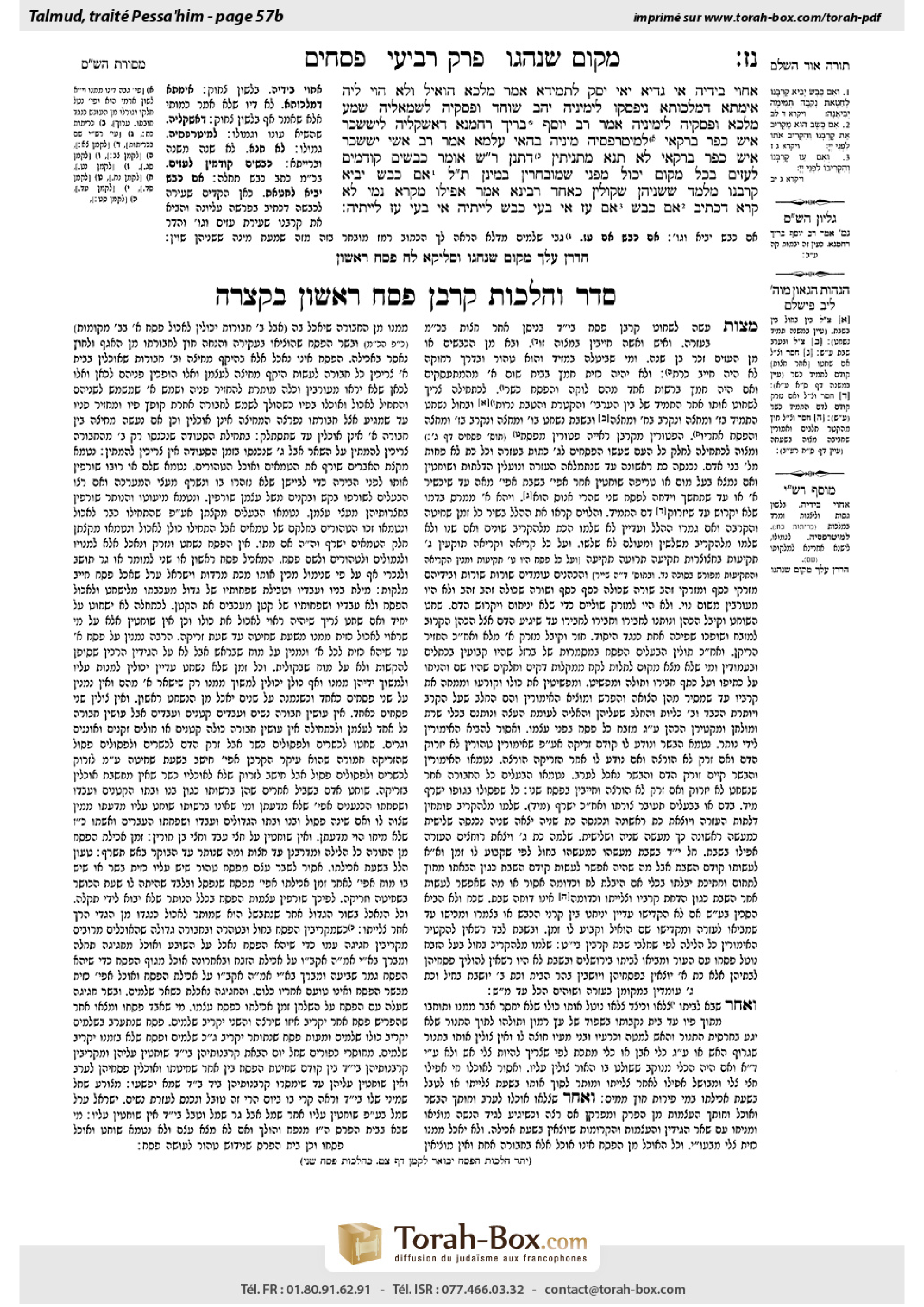
Pesachim 57b: Talmud study for Daf Yomi
Daf Yomi is the daily study of one Talmud folio. Explore 37 tractates with scans, Hebrew text, Sefaria English and AI-generated French translations where annotated.
Passage selection and English or AI-generated French translation are available where the scan has annotations. Daf Study is independent of Torah-Box and Sefaria.
Browse Pesachim · פסחים · All tractatesPesachim 57b text and translations
This page of Pesachim includes the Aramaic text, an English translation and an AI-generated French translation, alongside the scan above.
פסחים נ״ז ב · Aramaic and Hebrew text
אַחְוִי בִּידֵיהּ: אִי גַּדְיָא יָאֵי, יִסַּק לִתְמִידָא. אֲמַר מַלְכָּא: הוֹאִיל וְלָא הֲוֵי לֵיהּ אֵימְתָא דְמַלְכוּתָא, נִיפְסְקוּ לְיַמִּינֵיהּ. יְהַב שׁוֹחַד וּפַסְקֵיהּ לִשְׂמָאלֵיהּ. שְׁמַע מַלְכָּא וּפַסְקֵיהּ לְיַמִּינֵיהּ. אָמַר רַב יוֹסֵף: בְּרִיךְ רַחֲמָנָא דְּאַשְׁקְלֵיהּ לְיִשָּׂשׂכָר אִישׁ כְּפַר בַּרְקַאי לְמִיטְרַפְסֵיהּ מִינֵּיהּ בְּהַאי עָלְמָא.
אָמַר רַב אָשֵׁי: יִשָּׂשׂכָר אִישׁ כְּפַר בַּרְקַאי לָא תְּנָא מַתְנִיתִין. דִּתְנַן, רַבִּי שִׁמְעוֹן אוֹמֵר: כְּבָשִׂים קוֹדְמִים לָעִזִּים בְּכׇל מָקוֹם, יָכוֹל מִפְּנֵי שֶׁמּוּבְחָרִין בְּמִינָן — תַּלְמוּד לוֹמַר: ״אִם כֶּבֶשׂ יָבִיא קׇרְבָּנוֹ״, מְלַמֵּד שֶׁשְּׁנֵיהֶן שְׁקוּלִין כְּאֶחָד. רָבִינָא אָמַר: אֲפִילּוּ מִקְרָא נָמֵי לָא קְרָא, דִּכְתִיב: ״אִם כֶּבֶשׂ״, ״אִם עֵז״, אִי בָּעֵי כֶּבֶשׂ — לַיְיתֵיהּ, אִי בָּעֵי עֵז — לַיְיתֵיהּ.
הַדְרָן עֲלָךְ מָקוֹם שֶׁנָּהֲגוּ וּסְלִיקָא לַהּ פֶּסַח רִאשׁוֹן
Pesachim 57b · English translation
he signaled contemptuously with his hand and said: If goat is better, let it be sacrificed as the daily offering. The daily offering is a lamb, proving that its meat is preferable to that of a goat. The king said: Since he not only disagrees with me but has no reverence for the monarchy, as evident from his contempt, sever his right hand. He gave a bribe and the official severed his left hand. The king heard that Yissakhar had deceived him and had the official sever his right hand as well. Rav Yosef said: Blessed is God Who took retribution [mitarpesei] from Yissakhar of Kfar Barkai in this world and did not wait to punish him more severely in the next world. His punishment fit the crime; because he would not dirty his hands with sacrificial blood and was overzealous in keeping his hands clean, both his hands were severed.
Rav Ashi said: Yissakhar of Kfar Barkai did not study the Mishna and was an ignoramus who did not know that this halakha is stated explicitly in the mishna. As we learned in a mishna: Rabbi Shimon says: Lambs take precedence over goats in every place they are mentioned in the Bible. I might have thought that this is because it is a more select species. Therefore, the verse states: “If he brings a lamb as his offering” (Leviticus 4:32). The Torah passage where bringing a lamb as a sin-offering is discussed appears after the passage describing the sin-offering of a goat. The inconsistent order teaches that both these animals are equal. Ravina said: Yissakhar did not even read the Bible properly, as it is written: “If a lamb” (Leviticus 4:32), “if a goat” (Leviticus 3:12), teaching: If one wishes let him bring a lamb; if one wishes let him bring a goat. There is no clear preference.
Pesachim 57b · Traduction française (IA)
Il fit un geste méprisant de la main et dit : « Si le bouc est meilleur, qu’on le sacrifie comme offrande quotidienne. » Or, l’offrande quotidienne est un agneau, ce qui prouve que sa viande est préférable à celle du bouc. Le roi dit : « Puisqu’il ne se contente pas de me contredire, mais qu’il n’a en outre aucun respect pour la monarchie, comme le montre son mépris, qu’on lui coupe la main droite. » Yissakhar donna un pot-de-vin et le fonctionnaire lui coupa la main gauche. Le roi apprit que Yissakhar l’avait trompé et fit également couper sa main droite par le fonctionnaire. Rav Yosef dit : « Béni soit Dieu, qui a tiré vengeance [mitarpesei] de Yissakhar de Kfar Barkai en ce monde, sans attendre de le punir plus sévèrement dans le monde à venir. Son châtiment était à la mesure de sa faute : parce qu’il ne voulait pas se salir les mains avec le sang des sacrifices et qu’il mettait trop de zèle à les garder propres, on lui coupa les deux mains. »
Rav Ashi dit : Yissakhar de Kfar Barkai n’étudiait pas la Michna ; c’était un ignorant qui ne savait pas que cette halakha est énoncée explicitement dans la Michna. En effet, nous avons appris dans une Michna : Rabbi Shimon dit : « Les agneaux ont la priorité sur les boucs partout où ils sont mentionnés dans la Bible. » J’aurais pu penser que c’est parce qu’il s’agit d’une espèce de meilleure qualité. C’est pourquoi le verset dit : « S’il apporte un agneau comme offrande » (Lévitique 4,32). Le passage de la Torah qui traite de l’apport d’un agneau comme sacrifice expiatoire vient après celui qui décrit le sacrifice expiatoire d’un bouc. Cet ordre différent enseigne que ces deux animaux sont égaux. Ravina dit : Yissakhar ne lisait même pas correctement la Bible, car il est écrit : « Si c’est un agneau » (Lévitique 4,32), « si c’est un bouc » (Lévitique 3,12), ce qui enseigne : si l’on veut, on apporte un agneau ; si l’on veut, on apporte un bouc. Il n’y a aucune préférence nette.
Traduction française générée par IA à partir de l’édition anglaise de Sefaria. Vérifie toujours un passage avec le texte source.
Text from Sefaria: William Davidson Edition - Vocalized Aramaic (CC BY NC); William Davidson Edition - English (CC BY NC).