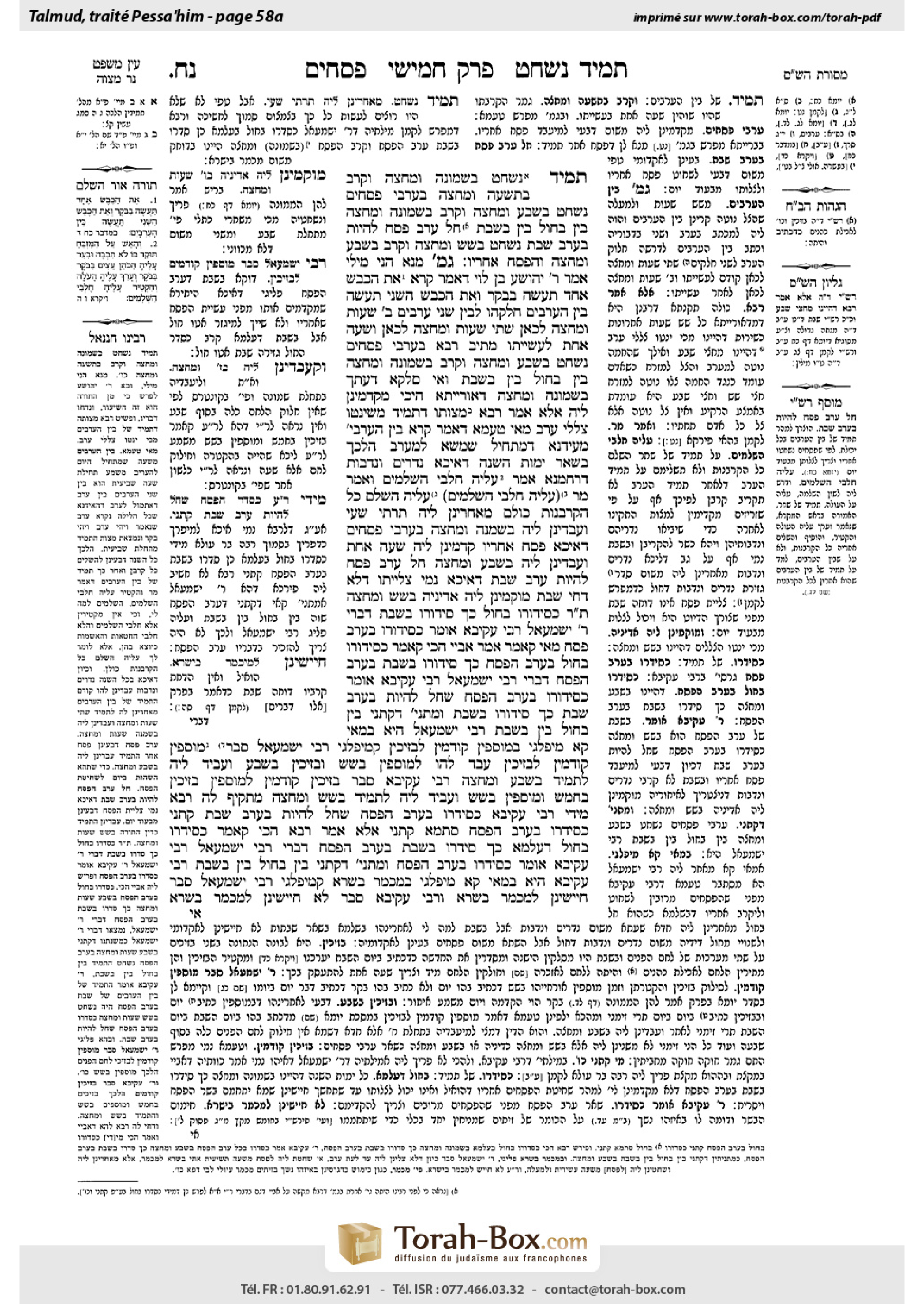
Pesachim 58a: Talmud study for Daf Yomi
Daf Yomi is the daily study of one Talmud folio. Explore 37 tractates with scans, Hebrew text, Sefaria English and AI-generated French translations where annotated.
Passage selection and English or AI-generated French translation are available where the scan has annotations. Daf Study is independent of Torah-Box and Sefaria.
Browse Pesachim · פסחים · All tractatesPesachim 58a text and translations
This page of Pesachim includes the Aramaic text, an English translation and an AI-generated French translation, alongside the scan above.
פסחים נ״ח א · Aramaic and Hebrew text
מַתְנִי׳ תָּמִיד נִשְׁחָט בִּשְׁמוֹנָה וּמֶחְצָה, וְקָרֵב בְּתִשְׁעָה וּמֶחְצָה. בְּעַרְבֵי פְסָחִים נִשְׁחָט בְּשֶׁבַע וּמֶחְצָה, וְקָרֵב בִּשְׁמוֹנֶה וּמֶחְצָה — בֵּין בַּחוֹל בֵּין בְּשַׁבָּת. חָל עֶרֶב פֶּסַח לִהְיוֹת בְּעֶרֶב שַׁבָּת, נִשְׁחָט בְּשֵׁשׁ וּמֶחְצָה, וְקָרֵב בְּשֶׁבַע וּמֶחְצָה, וְהַפֶּסַח אַחֲרָיו.
גְּמָ׳ מְנָא הָנֵי מִילֵּי?
אָמַר רַבִּי יְהוֹשֻׁעַ בֶּן לֵוִי, דְּאָמַר קְרָא: ״אֶת הַכֶּבֶשׂ אֶחָד תַּעֲשֶׂה בַבֹּקֶר וְאֵת הַכֶּבֶשׂ הַשֵּׁנִי תַּעֲשֶׂה בֵּין הָעַרְבָּיִם״, חַלְּקֵהוּ לְבֵין שְׁנֵי עֲרָבִים: שְׁתֵּי שָׁעוֹת וּמֶחְצָה לְכָאן, שְׁתֵּי שָׁעוֹת וּמֶחְצָה לְכָאן, וְשָׁעָה אַחַת לַעֲשִׂיָּיתוֹ.
מֵתִיב רָבָא: בְּעַרְבֵי פְסָחִים נִשְׁחָט בְּשֶׁבַע וּמֶחְצָה, וְקָרֵב בִּשְׁמוֹנֶה וּמֶחְצָה — בֵּין בַּחוֹל בֵּין בְּשַׁבָּת! וְאִי סָלְקָא דַעְתָּךְ בִּשְׁמוֹנֶה וּמֶחְצָה דְּאוֹרָיְיתָא, הֵיכִי מַקְדְּמִינַן לֵיהּ?
אֶלָּא אָמַר רָבָא: מִצְוָתוֹ דְּתָמִיד מִשֶּׁיִּנָּטוּ צִלְלֵי עֶרֶב. מַאי טַעְמָא? דְּאָמַר קְרָא: ״בֵּין הָעַרְבַּיִם״, מֵעִידָּנָא דְּמַתְחֵיל שִׁמְשָׁא לְמִעְרַב.
הִלְכָּךְ, בִּשְׁאָר יְמוֹת הַשָּׁנָה דְּאִיכָּא נְדָרִים וּנְדָבוֹת, דְּרַחֲמָנָא אָמַר: ״עָלֶיהָ חֶלְבֵי הַשְּׁלָמִים״,
וְאָמַר מָר (״עָלֶיהָ חֶלְבֵי הַשְּׁלָמִים״): עָלֶיהָ הַשְׁלֵם כׇּל הַקָּרְבָּנוֹת כּוּלָּם — מְאַחֲרִינַן לֵיהּ תַּרְתֵּי שָׁעֵי, וְעָבְדִינַן לֵיהּ בִּשְׁמוֹנֶה וּמֶחְצָה.
בְּעַרְבֵי פְסָחִים, דְּאִיכָּא פֶּסַח אַחֲרָיו, קָדְמִינַן לֵיהּ שָׁעָה אַחַת, וְעָבְדִינַן לֵיהּ בְּשֶׁבַע וּמֶחְצָה. חָל עֶרֶב פֶּסַח לִהְיוֹת עֶרֶב שַׁבָּת, דְּאִיכָּא נָמֵי צְלִיָּיתוֹ דְּלָא דָּחֵי שַׁבָּת — מוֹקְמִינַן לֵיהּ אַדִּינֵיהּ, בְּשֵׁשׁ וּמֶחְצָה.
תָּנוּ רַבָּנַן: כְּסִידּוּרוֹ בַּחוֹל כָּךְ סִידּוּרוֹ בַּשַּׁבָּת, דִּבְרֵי רַבִּי יִשְׁמָעֵאל. רַבִּי עֲקִיבָא אוֹמֵר: כְּסִידּוּרוֹ בְּעֶרֶב פֶּסַח.
מַאי קָאָמַר? אָמַר אַבָּיֵי, הָכִי קָאָמַר: כְּסִידּוּרוֹ בַּחוֹל בְּעֶרֶב הַפֶּסַח כָּךְ סִידּוּרוֹ בַּשַּׁבָּת בְּעֶרֶב הַפֶּסַח, דִּבְרֵי רַבִּי יִשְׁמָעֵאל. רַבִּי עֲקִיבָא אוֹמֵר: כְּסִידּוּרוֹ בְּעֶרֶב הַפֶּסַח שֶׁחָל לִהְיוֹת בְּעֶרֶב שַׁבָּת כָּךְ סִידּוּרוֹ בַּשַּׁבָּת. וּמַתְנִיתִין דְּקָתָנֵי בֵּין בַּחוֹל בֵּין בַּשַּׁבָּת — רַבִּי יִשְׁמָעֵאל הִיא.
בְּמַאי קָא מִיפַּלְגִי? בְּמוּסָפִין קוֹדְמִין לְבָזִיכִין קָמִיפַּלְגִי. רַבִּי יִשְׁמָעֵאל סָבַר: מוּסָפִין קוֹדְמִין לְבָזִיכִין. עָבֵד לְהוּ לְמוּסָפִין בְּשֵׁשׁ, וּבָזִיכִין בְּשֶׁבַע, וְעָבֵיד לֵיהּ לְתָמִיד בְּשֶׁבַע וּמֶחְצָה. רַבִּי עֲקִיבָא סָבַר: בָּזִיכִין קוֹדְמִין לְמוּסָפִין. בָּזִיכִין בְּחָמֵשׁ, וּמוּסָפִין בְּשֵׁשׁ, וְעָבֵיד לֵיהּ לְתָמִיד בְּשֵׁשׁ וּמֶחְצָה.
מַתְקֵיף לַהּ רָבָא: מִידֵּי רַבִּי עֲקִיבָא ״כְּסִידְרוֹ בְּעֶרֶב הַפֶּסַח שֶׁחָל לִהְיוֹת בְּעֶרֶב שַׁבָּת״ קָתָנֵי?! כְּסִידְרוֹ בְּעֶרֶב הַפֶּסַח סְתָמָא קָתָנֵי. אֶלָּא אָמַר רָבָא, הָכִי קָאָמַר: כְּסִידְרוֹ בְּחוֹל דְּעָלְמָא — כָּךְ סִידְרוֹ בַּשַּׁבָּת בְּעֶרֶב הַפֶּסַח, דִּבְרֵי רַבִּי יִשְׁמָעֵאל. רַבִּי עֲקִיבָא אוֹמֵר: כְּסִידְרוֹ בְּעֶרֶב הַפֶּסַח. וּמַתְנִיתִין דְּקָתָנֵי בֵּין בַּחוֹל בֵּין בַּשַּׁבָּת, רַבִּי עֲקִיבָא הִיא.
בְּמַאי קָא מִיפַּלְגִי? בְּמִכְמַר בִּשְׂרָא קָמִיפַּלְגִי. רַבִּי יִשְׁמָעֵאל סָבַר: חָיְישִׁינַן לְמִכְמַר בִּשְׂרָא. וְרַבִּי עֲקִיבָא סָבַר: לָא חָיְישִׁינַן לְמִכְמַר בִּשְׂרָא.
Pesachim 58a · English translation
MISHNA: The daily afternoon offering is slaughtered at eight and a half hours of the day, which is two and a half hours after midday, and is sacrificed, i.e., its offering on the altar is completed, at nine and a half hours of the day. On the eves of Passover, when the Paschal lamb must be offered after the daily offering, the daily offering is sacrificed earlier; it is slaughtered at seven and a half hours and sacrificed at eight and a half hours, whether it occurs during the week or on Shabbat. If Passover eve occurs on Shabbat eve, when the Paschal lamb must be offered even earlier to ensure that it will be roasted before the onset of Shabbat, the daily offering is slaughtered at six and a half hours and sacrificed at seven and a half hours, and the Paschal lamb is offered thereafter.
GEMARA: The Gemara asks: From where are these matters derived, i.e., that the daily afternoon offering is sacrificed between eight and a half hours of the day and nine and a half hours?
Rabbi Yehoshua ben Levi said: As the verse concerning the daily offering says: “The one lamb you shall offer in the morning and the second lamb you shall offer in the afternoon [bein ha’arbayim]” (Numbers 28:4). He understands this as follows: The term for afternoon in the verse is a Hebrew phrase, the literal meaning of which is “between [bein] the evenings [arbayim].” In this context, it is referring to the period lasting from when the day begins progressing toward the evening, just after midday, until sunset. Divide this period between two evenings. How? Two and a half hours here constitute one evening, and two and a half hours there constitute another evening, and there is one hour in between to perform the ritual of sacrificing the daily offering. Consequently, the time of the daily offering must be during the hour that begins two and a half hours after midday and ends two and a half hours before sunset. That is the time determined in the mishna.
Rava raised an objection: We learned in our mishna that on the eves of Passover the daily offering is slaughtered at seven and a half hours and sacrificed at eight and a half hours, both during the week and on Shabbat. And if it could enter your mind to say that the daily offering must be slaughtered at eight and a half hours by Torah law, how can we do it earlier merely for convenience?
Rather, Rabbi Yehoshua ben Levi’s source is rejected, and instead Rava said: The mitzva of the daily offering is from when the sun begins to descend westward so that the evening shadows slant eastward, shortly after midday. What is the reason for this? It is because the verse states: In the afternoon [bein ha’arbayim], which we understand to mean from the time that the sun begins to descend westward [ma’arav].
Therefore, on the rest of the days of the year, when there are many voluntary vow offerings and free-will offerings that must be sacrificed, these offerings are brought after the daily morning offering. As the Merciful One says with regard to the daily offering: “The fire on the altar shall be kept burning on it, it shall not be extinguished; and the priest shall kindle wood on it every morning; he shall prepare the burnt-offering upon it and shall cause the fats of the peace-offerings to go up in smoke upon it” (Leviticus 6:5).
And the Master said that the phrase: “The fats of the peace-offerings upon it” should be interpreted in the following manner: “Upon it,” i.e., after this daily morning burnt-offering; only then should the priest complete all the other offerings. This teaches that all the other offerings must be sacrificed after the daily morning offering and prior to the daily afternoon offering. Since many offerings must be sacrificed prior to the daily afternoon offering, rather than sacrificing the latter at six and a half hours, as soon as it is permitted to do so, we postpone the offering for two hours, and sacrifice it at eight and a half hours of the day.
On the eves of Passover, on the other hand, when there is the Paschal lamb that must be brought after the daily afternoon offering, and sufficient time must be left for the slaughter of the numerous Paschal lambs, we advance the daily afternoon offering one hour and sacrifice it at seven and a half hours. When Passover eve occurs on Shabbat eve, when there is also the roasting of the Paschal lamb, which does not override the Shabbat prohibitions and therefore must be completed before Shabbat, we establish its sacrifice at the earliest time that its halakha allows, at six and a half hours.
The Sages taught in a baraita: With regard to the daily offering, like its arrangement during the week, so is its arrangement on Shabbat; this is the statement of Rabbi Yishmael. Rabbi Akiva says: Like its arrangement on Passover eve.
The Gemara asks: What is the baraita saying? How is it to be understood? Abaye said: This is what it is saying: With regard to the daily offering, like its arrangement on Passover eve that occurs during the week, when it is slaughtered at seven and a half hours, so is its arrangement on Passover eve that occurs on Shabbat, when it is also slaughtered at seven and a half hours. There is no distinction in this regard between Shabbat and a weekday; this is the statement of Rabbi Yishmael. Rabbi Akiva says: Like its arrangement on Passover eve that occurs on Shabbat eve, when it is slaughtered at six and a half hours, so is its arrangement when Passover eve occurs on Shabbat, when it is also slaughtered at six and a half hours. Therefore, the mishna that teaches that on Passover eve, the daily offering is slaughtered at seven and a half hours and offered at eight and a half hours, both during the week and on Shabbat, is in accordance with the opinion of Rabbi Yishmael.
The Gemara seeks to clarify: According to this explanation, with regard to what principle do these tanna’im disagree? The Gemara answers: They disagree about whether or not the additional offerings of Shabbat precede the bowls of frankincense. On Shabbat, in addition to the regular daily rite, additional Shabbat offerings were sacrificed, and the frankincense that had been placed in bowls on the showbread the previous Shabbat and remained there throughout the week was burned on the altar. The dispute is as follows: Rabbi Yishmael holds that the additional offerings precede the bowls. Therefore, the priest sacrificed the additional offerings at six hours, as everyone agrees that the time to sacrifice the additional offerings is at six hours; and he offered the bowls at seven hours; and then he sacrificed the daily offering at seven and a half hours. Rabbi Akiva holds that the bowls precede the additional offerings. Therefore, the priest offered the bowls at five hours, sacrificed the additional offerings at six hours, and sacrificed the daily offering at six and a half hours.
Rava strongly objects to this explanation. Is Rabbi Akiva teaching: Like its arrangement on Passover eve that occurs on Shabbat eve? He did not formulate his opinion in this manner; he merely teaches: Like its arrangement on Passover eve. Therefore, the above explanation does not correspond to Rabbi Akiva’s formulation. Rather, Rava said an alternative explanation of the dispute. This is what the baraita is saying: Like the arrangement of the daily offering on an ordinary day during the week, so is its arrangement on Shabbat that occurs on Passover eve. The daily offering is sacrificed at eight and a half hours; this is the statement of Rabbi Yishmael. Rabbi Akiva says: Like its arrangement on Passover eve that occurs on a weekday, so is its arrangement on Passover eve that occurs on Shabbat, at seven and a half hours. Therefore, the mishna that teaches that the time to sacrifice the daily offering on Passover eve is the same both during the week and on Shabbat is in accordance with the opinion of Rabbi Akiva.
The Gemara asks: According to this explanation, with regard to what point do they disagree? They disagree with regard to the possibility that the meat will become warm and spoil before it is roasted. Rabbi Yishmael holds that we are concerned lest the meat become warm and spoil. As the daily offering is slaughtered earlier on Shabbat, the Paschal lamb is also slaughtered earlier. Since it is prohibited to roast the meat until the conclusion of Shabbat, the concern is that the meat will spoil with the passage of time. And Rabbi Akiva holds: We are not concerned lest the meat become warm and spoil. Therefore, it is possible to slaughter the Paschal lamb earlier, even when Passover eve occurs on Shabbat.
Pesachim 58a · Traduction française (IA)
MICHNA : L’offrande quotidienne de l’après-midi est égorgée à huit heures et demie du jour, soit deux heures et demie après midi, et son offrande sur l’autel s’achève à neuf heures et demie du jour. Les veilles de Pessa’h, lorsque l’agneau pascal doit être offert après l’offrande quotidienne, celle-ci est offerte plus tôt : elle est égorgée à sept heures et demie et offerte à huit heures et demie, que ce soit en semaine ou le Chabbat. Si la veille de Pessa’h tombe la veille de Chabbat, lorsque l’agneau pascal doit être offert encore plus tôt afin d’assurer qu’il sera rôti avant l’entrée de Chabbat, l’offrande quotidienne est égorgée à six heures et demie et offerte à sept heures et demie, puis l’agneau pascal est offert.
GUEMARA : La Guemara demande : De quoi déduit-on ces règles, à savoir que l’offrande quotidienne de l’après-midi est offerte entre huit heures et demie et neuf heures et demie du jour ?
Rabbi Yehoshua ben Levi dit : Le verset concernant l’offrande quotidienne dit : « Tu offriras l’un des agneaux le matin et tu offriras le second agneau dans l’après-midi [bein ha’arbayim] » (Nombres 28:4). Il comprend ainsi le verset : l’expression hébraïque désignant l’après-midi signifie littéralement « entre [bein] les soirs [arbayim] ». Ici, elle désigne la période allant du moment où le jour commence à décliner vers le soir, juste après midi, jusqu’au coucher du soleil. Il faut diviser cette période entre deux soirs. Comment ? Deux heures et demie d’un côté constituent un soir, et deux heures et demie de l’autre côté constituent un autre soir ; il reste une heure entre les deux pour accomplir le rite de l’offrande quotidienne. Par conséquent, l’offrande quotidienne doit être offerte durant l’heure qui commence deux heures et demie après midi et s’achève deux heures et demie avant le coucher du soleil. C’est l’horaire fixé dans la Michna.
Rava soulève une objection : nous avons appris dans notre Michna que, les veilles de Pessa’h, l’offrande quotidienne est égorgée à sept heures et demie et offerte à huit heures et demie, aussi bien en semaine que le Chabbat. Or, si l’on pouvait penser que, selon la Torah, l’offrande quotidienne doit être égorgée à huit heures et demie, comment pourrait-on l’égorger plus tôt par simple commodité ?
Il faut donc rejeter la source avancée par Rabbi Yehoshua ben Levi. Rava dit alors : la mitsva de l’offrande quotidienne commence au moment où le soleil amorce sa course vers l’ouest et où les ombres du soir s’allongent vers l’est, peu après midi. Pourquoi ? Parce que le verset dit : « dans l’après-midi [bein ha’arbayim] », expression que nous comprenons comme désignant le moment où le soleil commence à décliner vers l’ouest [ma’arav].
Par conséquent, les autres jours de l’année, où de nombreux sacrifices votifs et offrandes volontaires doivent être offerts, ils le sont après l’offrande quotidienne du matin. Car le Miséricordieux, c’est-à-dire la Torah, dit au sujet de l’offrande quotidienne : « Le feu sur l’autel sera entretenu ; il ne s’éteindra pas. Chaque matin, le prêtre y ajoutera du bois, y disposera l’holocauste et y fera fumer les graisses des sacrifices de paix » (Lévitique 6:5).
Et le Maître a dit qu’il faut interpréter ainsi l’expression « les graisses des sacrifices de paix sur lui » : « sur lui », c’est-à-dire après cet holocauste quotidien du matin ; alors seulement le prêtre achèvera d’offrir tous les autres sacrifices. Cela enseigne que tous les autres sacrifices doivent être offerts après l’offrande quotidienne du matin et avant celle de l’après-midi. Puisqu’il faut offrir de nombreux sacrifices avant l’offrande quotidienne de l’après-midi, au lieu de l’offrir à six heures et demie, dès que cela est permis, on la retarde de deux heures et on l’offre à huit heures et demie du jour.
Les veilles de Pessa’h, en revanche, puisqu’il faut offrir l’agneau pascal après l’offrande quotidienne de l’après-midi et laisser suffisamment de temps pour égorger les nombreux agneaux pascals, on avance d’une heure l’offrande quotidienne de l’après-midi et on l’offre à sept heures et demie. Lorsque la veille de Pessa’h tombe la veille de Chabbat, il faut également rôtir l’agneau pascal ; or, cette cuisson ne déroge pas aux interdictions du Chabbat et doit donc être achevée avant Chabbat. On fixe alors l’offrande quotidienne au premier moment permis par sa halakha, à six heures et demie.
Les Sages ont enseigné dans une baraïta : pour l’offrande quotidienne, son ordre en semaine est aussi celui du Chabbat ; telle est l’opinion de Rabbi Yishmael. Rabbi Akiva dit : son ordre est celui de la veille de Pessa’h.
La Guemara demande : Que dit cette baraïta ? Comment faut-il la comprendre ? Abaye dit : voici ce qu’elle veut dire : pour l’offrande quotidienne, son ordre la veille de Pessa’h qui tombe en semaine, où elle est égorgée à sept heures et demie, est aussi celui de la veille de Pessa’h qui tombe Chabbat, où elle est également égorgée à sept heures et demie. À cet égard, il n’y a pas de différence entre Chabbat et un jour de semaine ; telle est l’opinion de Rabbi Yishmael. Rabbi Akiva dit : son ordre la veille de Pessa’h qui tombe la veille de Chabbat, où elle est égorgée à six heures et demie, est aussi celui de la veille de Pessa’h qui tombe Chabbat, où elle est également égorgée à six heures et demie. Par conséquent, la Michna, qui enseigne que la veille de Pessa’h l’offrande quotidienne est égorgée à sept heures et demie et offerte à huit heures et demie, aussi bien en semaine que le Chabbat, est conforme à l’opinion de Rabbi Yishmael.
La Guemara cherche à préciser : selon cette explication, sur quel principe ces tannaïm sont-ils en désaccord ? La Guemara répond : ils discutent de la question de savoir si les offrandes supplémentaires du Chabbat précèdent ou non les coupes d’encens. Le Chabbat, outre le rite quotidien habituel, on offrait les offrandes supplémentaires du Chabbat, et l’encens qui avait été placé dans des coupes sur le pain de proposition le Chabbat précédent et y était resté toute la semaine était brûlé sur l’autel. Voici le désaccord : Rabbi Yishmael estime que les offrandes supplémentaires précèdent les coupes. Le prêtre offrait donc les offrandes supplémentaires à six heures, puisque tous conviennent que leur offrande a lieu à six heures ; puis il offrait les coupes à sept heures, et enfin l’offrande quotidienne à sept heures et demie. Rabbi Akiva estime que les coupes précèdent les offrandes supplémentaires. Le prêtre offrait donc les coupes à cinq heures, les offrandes supplémentaires à six heures, puis l’offrande quotidienne à six heures et demie.
Rava s’oppose vivement à cette explication. Rabbi Akiva enseigne-t-il : « comme son ordre la veille de Pessa’h qui tombe la veille de Chabbat » ? Il n’a pas formulé son opinion ainsi ; il enseigne seulement : « comme son ordre la veille de Pessa’h ». L’explication précédente ne correspond donc pas à la formulation de Rabbi Akiva. Rava propose plutôt une autre explication du désaccord. Voici ce que dit la baraïta : de même que l’offrande quotidienne est organisée un jour ordinaire de semaine, de même l’est-elle un Chabbat qui tombe la veille de Pessa’h : elle est offerte à huit heures et demie ; telle est l’opinion de Rabbi Yishmael. Rabbi Akiva dit : de même que son ordre la veille de Pessa’h qui tombe en semaine, de même est-il la veille de Pessa’h qui tombe Chabbat, à sept heures et demie. Par conséquent, la Michna, qui enseigne que l’heure de l’offrande quotidienne la veille de Pessa’h est la même en semaine et le Chabbat, est conforme à l’opinion de Rabbi Akiva.
La Guemara demande : selon cette explication, sur quel point sont-ils en désaccord ? Ils divergent quant au risque que la viande se réchauffe et se gâte avant d’être rôtie. Rabbi Yishmael estime qu’il faut craindre que la viande se réchauffe et se gâte. Comme l’offrande quotidienne est égorgée plus tôt le Chabbat, l’agneau pascal est lui aussi égorgé plus tôt. Puisqu’il est interdit de rôtir la viande avant la fin du Chabbat, on craint qu’elle ne se gâte avec le temps. Rabbi Akiva, lui, estime qu’il n’y a pas lieu de craindre que la viande se réchauffe et se gâte. Il est donc possible d’égorger l’agneau pascal plus tôt, même lorsque la veille de Pessa’h tombe Chabbat.
Traduction française générée par IA à partir de l’édition anglaise de Sefaria. Vérifie toujours un passage avec le texte source.
Text from Sefaria: William Davidson Edition - Vocalized Aramaic (CC BY NC); William Davidson Edition - English (CC BY NC).