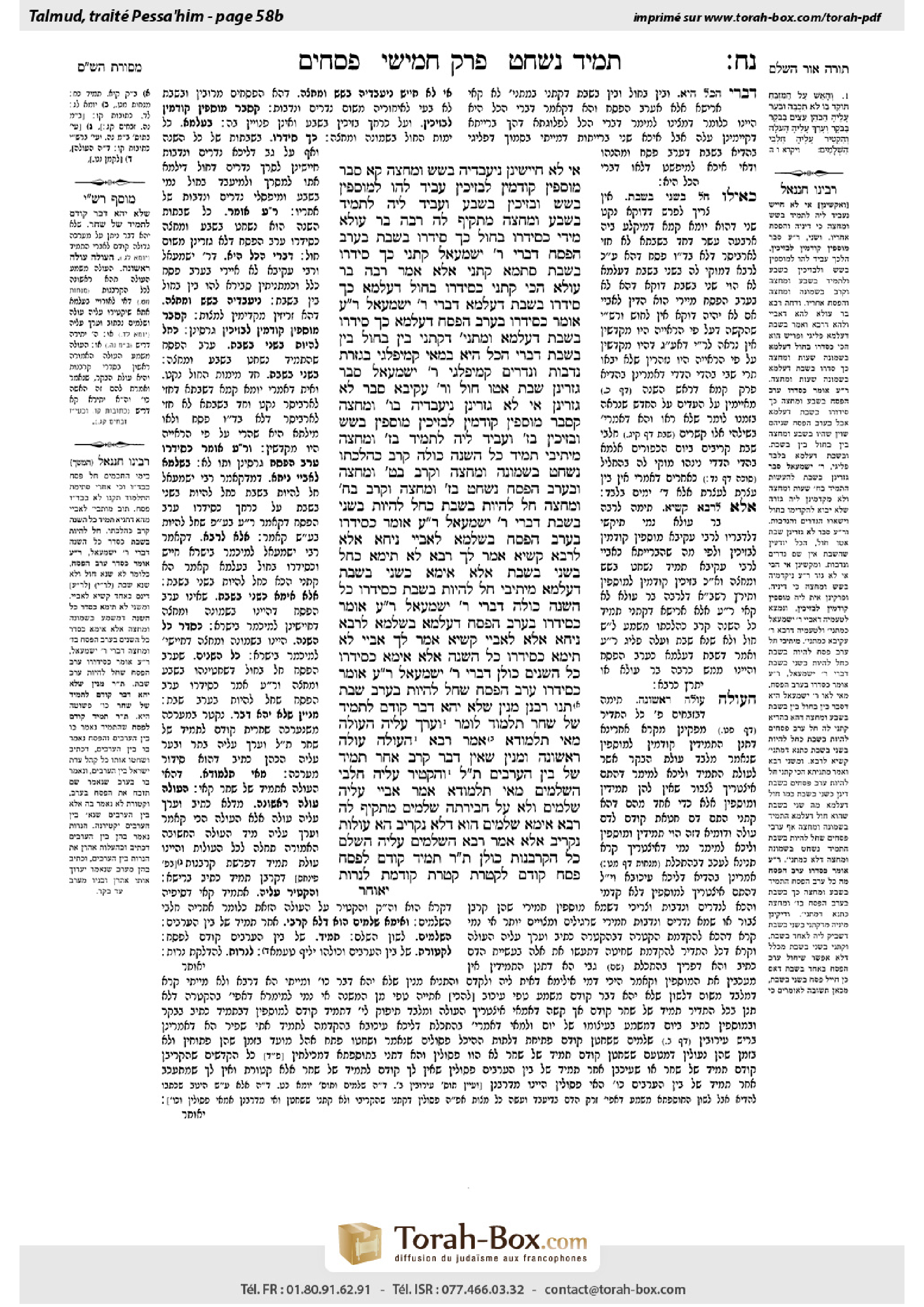
Pesachim 58b: Talmud study for Daf Yomi
Daf Yomi is the daily study of one Talmud folio. Explore 37 tractates with scans, Hebrew text, Sefaria English and AI-generated French translations where annotated.
Passage selection and English or AI-generated French translation are available where the scan has annotations. Daf Study is independent of Torah-Box and Sefaria.
Browse Pesachim · פסחים · All tractatesPesachim 58b text and translations
This page of Pesachim includes the Aramaic text, an English translation and an AI-generated French translation, alongside the scan above.
פסחים נ״ח ב · Aramaic and Hebrew text
אִי לָא חָיְישִׁינַן, נִיעְבְּדֵיהּ בְּשֵׁשׁ וּמֶחְצָה? קָא סָבַר: מוּסָפִין קוֹדְמִין לְבָזִיכִין. עָבֵיד לְהוּ לְמוּסָפִין בְּשֵׁשׁ, וּבָזִיכִין בְּשֶׁבַע, וְעָבֵיד לֵיהּ לְתָמִיד בְּשֶׁבַע וּמֶחְצָה.
מַתְקֵיף לַהּ רַבָּה בַּר עוּלָּא: מִידֵּי ״כְּסִידְרוֹ בַּחוֹל כָּךְ סִידְרוֹ בַּשַּׁבָּת בְּעֶרֶב הַפֶּסַח, דִּבְרֵי רַבִּי יִשְׁמָעֵאל״ קָתָנֵי?! ״כָּךְ סִידְרוֹ בַּשַּׁבָּת״ סְתָמָא קָתָנֵי?
אֶלָּא אָמַר רַבָּה בַּר עוּלָּא, הָכִי קָתָנֵי: כְּסִידְרוֹ בְּחוֹל דְּעָלְמָא — כָּךְ סִידְרוֹ בְּשַׁבָּת דְּעָלְמָא, דִּבְרֵי רַבִּי יִשְׁמָעֵאל.
רַבִּי עֲקִיבָא אוֹמֵר: כְּסִידְרוֹ בְּעֶרֶב הַפֶּסַח דְּעָלְמָא — כָּךְ סִידְרוֹ בְּשַׁבָּת דְּעָלְמָא. וּמַתְנִיתִין דְּקָתָנֵי בֵּין בַּחוֹל בֵּין בַּשַּׁבָּת — דִּבְרֵי הַכֹּל הִיא.
בְּמַאי קָמִיפַּלְגִי? בִּגְזֵרַת נְדָבוֹת וּנְדָרִים קָמִיפַּלְגִי. רַבִּי יִשְׁמָעֵאל סָבַר: גָּזְרִינַן שַׁבָּת אַטּוּ חוֹל, וְרַבִּי עֲקִיבָא סָבַר: לָא גָּזְרִינַן.
אִי לָא גָּזְרִינַן, נִיעְבְּדֵיהּ בְּשֵׁשׁ וּמֶחְצָה! קָסָבַר: מוּסָפִין קוֹדְמִין לְבָזִיכִין. מוּסָפִין בְּשֵׁשׁ, וּבָזִיכִין בְּשֶׁבַע, וְעָבֵיד לֵיהּ לְתָמִיד בְּשֶׁבַע וּמֶחְצָה.
מֵיתִיבִי: תָּמִיד, כׇּל הַשָּׁנָה כּוּלָּהּ קָרֵב כְּהִלְכָתוֹ: נִשְׁחָט בִּשְׁמוֹנֶה וּמֶחְצָה, וְקָרֵב בְּתֵשַׁע וּמֶחְצָה. וּבָעֶרֶב הַפֶּסַח, נִשְׁחָט בְּשֶׁבַע וּמֶחְצָה, וְקָרֵב בִּשְׁמוֹנֶה וּמֶחְצָה. חָל לִהְיוֹת בַּשַּׁבָּת כְּחָל לִהְיוֹת בְּשֵׁנִי בַּשַּׁבָּת, דִּבְרֵי רַבִּי יִשְׁמָעֵאל. רַבִּי עֲקִיבָא אוֹמֵר: כְּסִידְרוֹ בְּעֶרֶב הַפֶּסַח.
בִּשְׁלָמָא לְאַבָּיֵי נִיחָא, אֶלָּא לְרָבָא קַשְׁיָא. אָמַר לָךְ רָבָא: לָא תֵּימָא ״כְּחָל בְּשֵׁנִי בַּשַּׁבָּת״, אֶלָּא אֵימָא: כְּשֵׁנִי בַּשַּׁבָּת דְּעָלְמָא.
מֵיתִיבִי: חָל לִהְיוֹת בַּשַּׁבָּת — כְּסִידְרוֹ כׇּל הַשָּׁנָה כּוּלָּהּ, דִּבְרֵי רַבִּי יִשְׁמָעֵאל. רַבִּי עֲקִיבָא אוֹמֵר: כְּסִידְרוֹ בְּעֶרֶב הַפֶּסַח דְּעָלְמָא. בִּשְׁלָמָא לְרָבָא נִיחָא, אֶלָּא לְאַבָּיֵי קַשְׁיָא!
אָמַר לָךְ אַבָּיֵי: לָא תֵּימָא ״כְּסִידְרוֹ כׇּל הַשָּׁנָה״, אֶלָּא אֵימָא: כְּסִידְרוֹ כׇּל הַשָּׁנִים כּוּלָּן, דִּבְרֵי רַבִּי יִשְׁמָעֵאל. רַבִּי עֲקִיבָא אוֹמֵר: כְּסִידְרוֹ עֶרֶב הַפֶּסַח שֶׁחָל לִהְיוֹת בְּעֶרֶב שַׁבָּת.
תָּנוּ רַבָּנַן: מִנַּיִן שֶׁלֹּא יְהֵא דָּבָר קוֹדֶם לְתָמִיד שֶׁל שַׁחַר, תַּלְמוּד לוֹמַר: ״וְעָרַךְ עָלֶיהָ הָעוֹלָה״. מַאי תַּלְמוּדָא? אָמַר רָבָא: ״הָעוֹלָה״ — עוֹלָה רִאשׁוֹנָה.
וּמִנַּיִן שֶׁאֵין דָּבָר קָרֵב אַחַר תָּמִיד שֶׁל בֵּין הָעַרְבַּיִם, תַּלְמוּד לוֹמַר: ״וְהִקְטִיר עָלֶיהָ חֶלְבֵי הַשְּׁלָמִים״. מַאי תַּלְמוּדָא? אָמַר אַבָּיֵי: ״עָלֶיהָ״ שְׁלָמִים, וְלֹא עַל חֲבֶירְתָּהּ שְׁלָמִים.
מַתְקֵיף לַהּ רָבָא: אֵימָא שְׁלָמִים הוּא דְּלָא נַקְרֵיב, הָא עוֹלוֹת נַקְרֵיב! אֶלָּא אָמַר רָבָא: ״הַשְּׁלָמִים״ — עָלֶיהָ הַשְׁלֵם כׇּל הַקָּרְבָּנוֹת כּוּלָּן.
תָּנוּ רַבָּנַן: תָּמִיד קוֹדֶם לְפֶסַח, פֶּסַח קוֹדֶם לִקְטֹרֶת, קְטֹרֶת קוֹדֶמֶת לְנֵרוֹת.
Pesachim 58b · English translation
The Gemara asks: If, according to the opinion of Rabbi Akiva, we are not concerned that the meat might spoil, let us sacrifice the daily offering at six and a half hours, as there are many Paschal lambs and no voluntary vow or free-will offerings to be sacrificed. Why, then, should they postpone the daily offering? The Gemara responds that Rabbi Akiva holds: The additional offerings precede the bowls and therefore the priest would sacrifice the additional offerings at six hours, and offer the bowls at seven hours, and then sacrifice the daily offering at seven and a half hours.
Rabba bar Ulla strongly objects to this explanation. Does the baraita teach: Like the arrangement of the daily offering during the week, so is its arrangement on Shabbat that occurs on Passover eve; this is the statement of Rabbi Yishmael? The baraita simply teaches: So is its arrangement on Shabbat. Rava’s explanation also fails to correspond to the wording of the baraita.
Rather, Rabba bar Ulla said: The baraita should be understood as referring not to the eve of Passover, but to the rest of the days of the year, and this is what it is teaching: Like its arrangement on an ordinary day during the week, so is its arrangement on an ordinary Shabbat, at eight and a half hours; this is the statement of Rabbi Yishmael, who maintains that there is no distinction at all in this regard between Shabbat and a weekday.
Rabbi Akiva says: Like its arrangement on an ordinary Passover eve that occurs on a weekday, at seven and a half hours, so is its arrangement on an ordinary Shabbat. Since no free-will offerings are offered on Shabbat, the daily offering can be sacrificed earlier. And the mishna, which teaches that the daily offering on Passover eve is slaughtered at the same time, whether during the week or on Shabbat, can be said to be in agreement with all opinions, both that of Rabbi Yishmael and that of Rabbi Akiva.
According to this explanation, with regard to what principle do these tanna’im disagree? They disagree concerning whether a decree should be issued on account of voluntary vows and free-will offerings. Rabbi Yishmael holds that we issue a decree for Shabbat due to weekdays. During the week, the sacrifice of the daily afternoon offering is postponed until eight and a half hours of the day, due to the voluntary offerings that must be sacrificed before the daily offering. The same should be done on Shabbat, so as to avoid distinctions. And Rabbi Akiva holds that we do not issue such a decree.
The Gemara asks: If we do not issue such a decree, why do we postpone the sacrifice of the daily offering until seven and a half hours? Let us sacrifice it at six and a half hours. The Gemara responds: Rabbi Akiva holds that the additional offerings precede the bowls of frankincense. Consequently, the priest sacrifices the additional offerings at six hours, and offers the bowls at seven hours, and sacrifices the daily offering at seven and a half hours.
The Gemara raises an objection with regard to these explanations from another baraita which teaches: The daily offering is sacrificed throughout the entire year in accordance with its law. In other words, it is slaughtered at eight and a half hours and sacrificed at nine and a half hours. And on the eve of Passover it is slaughtered at seven and a half hours and sacrificed at eight and a half hours. If Passover eve occurs on Shabbat it is as if it occurred on a Monday, i.e., it is like an ordinary weekday. This indicates that no distinction is made with regard to the eve of Passover, whether it occurs on Shabbat or during the week; this is the statement of Rabbi Yishmael. Rabbi Akiva says: If the eve of Passover occurs on Shabbat, its arrangement is like its arrangement on the eve of Passover when it is advanced to six and a half hours of the day.
Granted, according to the opinion of Abaye, this baraita works out well, as it is consistent with his explanation of the previous baraita. But according to the opinion of Rava, it is difficult. The Gemara responds: Rava could have said to you: Do not say: It is as if it occurred on a Monday. Rather say: It is like an ordinary Monday, and explain the words as follows: If the eve of Passover occurs on Shabbat, no changes are introduced, and the daily offering is sacrificed at the same time that it is sacrificed on an ordinary weekday, at eight and a half hours of the day.
The Gemara raises an objection from another baraita: If the eve of Passover occurs on Shabbat, the daily offering is sacrificed in accordance with its arrangement all year long, at eight and a half hours of the day; this is the statement of Rabbi Yishmael. Rabbi Akiva says: It is sacrificed in accordance with its arrangement on an ordinary Passover eve. Granted, according to the opinion of Rava, this baraita works out well. But according to the opinion of Abaye, it is difficult.
Abaye can say to you: Do not say according to Rabbi Yishmael’s statement in the baraita: In accordance with its arrangement all year long. Rather, say: In accordance with its arrangement every year; this is the statement of Rabbi Yishmael. In other words, no distinction is made between the eve of Passover that occurs on Shabbat and the eve of Passover that occurs during the week. The daily offering is sacrificed at seven and a half hours. This is consistent with Abaye’s opinion. According to this explanation, Rabbi Akiva says that the halakha is not so. Instead, the daily offering is sacrificed in accordance with its arrangement on Passover eve that occurs on Shabbat eve. This is the way the baraita must conclude according to Abaye.
As the Gemara mentioned previously that the daily morning offering precedes all other sacrifices, it cites a baraita that explains this law. The Sages taught: From where is it derived that no sacrifice shall precede the daily morning offering? The verse states: “And the fire on the altar shall be kept burning on it, it shall not be extinguished; and the priest shall kindle wood upon it every morning, and he shall prepare the burnt-offering upon it and shall cause the fats of the peace-offerings to go up in smoke upon it” (Leviticus 6:5). The Gemara asks: What is the biblical derivation? In other words, how is it derived that the burnt-offering in this verse is referring to the daily morning offering? Rava said: “The burnt-offering,” with the definite article, is referring to the first burnt-offering, i.e., the daily morning offering, which is first both chronologically and in terms of importance.
The baraita continues: And from where is it derived that nothing is sacrificed after the daily afternoon offering? The verse states: “And shall cause the fats of the peace-offerings to go up in smoke upon it.” The Gemara again asks: What is the derivation? Abaye said: “Upon it.” Upon, i.e., after, the first burnt-offering, that is, the daily morning offering, may the peace-offerings, i.e., the voluntary vow and free-will offerings, be sacrificed throughout the day. But peace-offerings may not be sacrificed upon, i.e., after, its counterpart, which is the daily afternoon offering.
Rava strongly objects to this explanation: If so, say it is peace-offerings that we must not sacrifice after the daily afternoon offering, but burnt-offerings we may sacrifice, since this derivation is referring only to peace-offerings. Rather, Rava said: “The peace-offerings [hashelamim] upon it” should be homiletically interpreted to mean that upon the daily morning offering, rather than after the daily afternoon offering, completes [hashlem] the offering of all other sacrifices.
The Sages taught in a baraita: The daily offering precedes the offering of the Paschal lamb, the Paschal lamb precedes the afternoon burning of the incense, and the burning of the incense precedes the lighting of the lamps of the Temple candelabrum.
Pesachim 58b · Traduction française (IA)
La Guemara demande : Si, selon Rabbi Akiva, nous ne craignons pas que la viande se gâte, faisons donc le sacrifice quotidien à six heures et demie, puisqu’il y a de nombreux agneaux pascals et aucune offrande votive ni offrande volontaire à sacrifier. Pourquoi, alors, retarder le sacrifice quotidien ? La Guemara répond que Rabbi Akiva estime que les offrandes supplémentaires précèdent les coupes ; le prêtre sacrifierait donc les offrandes supplémentaires à six heures, offrirait les coupes à sept heures, puis sacrifierait l’offrande quotidienne à sept heures et demie.
Rabba bar Oulla s’oppose vivement à cette explication. La baraïta enseigne-t-elle : « Comme l’ordre du sacrifice quotidien en semaine, ainsi est son ordre le Chabbat qui tombe la veille de Pessa’h » ? La baraïta enseigne simplement : « Ainsi est son ordre le Chabbat. » L’explication de Rava ne correspond pas non plus à la formulation de la baraïta.
Rabba bar Oulla dit plutôt : La baraïta ne se rapporte pas à la veille de Pessa’h, mais aux autres jours de l’année. Voici ce qu’elle enseigne : Comme son ordre un jour ordinaire de semaine, ainsi est son ordre un Chabbat ordinaire, à huit heures et demie ; telle est l’opinion de Rabbi Yishmaël, qui estime qu’il n’y a à cet égard aucune différence entre le Chabbat et un jour de semaine.
Rabbi Akiva dit : Comme son ordre une veille de Pessa’h ordinaire qui tombe un jour de semaine, à sept heures et demie, ainsi est son ordre un Chabbat ordinaire. Comme aucune offrande volontaire n’est offerte le Chabbat, le sacrifice quotidien peut être fait plus tôt. On peut donc dire que la Michna, qui enseigne que l’offrande quotidienne est égorgée à la même heure la veille de Pessa’h, que ce soit en semaine ou le Chabbat, est conforme aux deux opinions, celle de Rabbi Yishmaël comme celle de Rabbi Akiva.
Selon cette explication, sur quel principe ces tannaïm sont-ils en désaccord ? Ils divergent sur la question de savoir s’il faut instituer un décret en raison des offrandes votives et volontaires. Rabbi Yishmaël estime que l’on institue un décret pour le Chabbat en raison des jours de semaine. En semaine, le sacrifice de l’offrande quotidienne de l’après-midi est retardé jusqu’à huit heures et demie, à cause des offrandes volontaires qui doivent être sacrifiées avant l’offrande quotidienne. Il faut faire de même le Chabbat, afin d’éviter toute distinction. Rabbi Akiva, lui, estime qu’on n’institue pas un tel décret.
La Guemara demande : Si l’on n’institue pas un tel décret, pourquoi retarder le sacrifice quotidien jusqu’à sept heures et demie ? Faisons-le à six heures et demie. La Guemara répond que Rabbi Akiva estime que les offrandes supplémentaires précèdent les coupes d’encens. Le prêtre sacrifie donc les offrandes supplémentaires à six heures, offre les coupes à sept heures, puis sacrifie l’offrande quotidienne à sept heures et demie.
La Guemara soulève une objection contre ces explications à partir d’une autre baraïta, qui enseigne : L’offrande quotidienne est sacrifiée toute l’année conformément à sa règle : elle est égorgée à huit heures et demie et sacrifiée à neuf heures et demie. La veille de Pessa’h, elle est égorgée à sept heures et demie et sacrifiée à huit heures et demie. Si la veille de Pessa’h tombe un Chabbat, c’est comme si elle tombait un lundi, c’est-à-dire que son ordre est celui d’un jour de semaine ordinaire. Telle est l’opinion de Rabbi Yishmaël. Cela indique qu’on ne fait aucune distinction quant à la veille de Pessa’h, qu’elle tombe le Chabbat ou en semaine. Rabbi Akiva dit : Si la veille de Pessa’h tombe un Chabbat, son ordre est celui d’une veille de Pessa’h où l’offrande est avancée à six heures et demie.
Cela s’accorde avec l’opinion d’Abayé, puisque cette baraïta est conforme à son explication de la baraïta précédente. Mais l’opinion de Rava pose une difficulté. La Guemara répond : Rava aurait pu te dire : Ne dis pas « c’est comme si elle tombait un lundi », mais plutôt « son ordre est celui d’un lundi ordinaire ». Il faut comprendre ainsi ces mots : si la veille de Pessa’h tombe un Chabbat, aucun changement n’est apporté et l’offrande quotidienne est sacrifiée à la même heure qu’un jour de semaine ordinaire, à huit heures et demie.
La Guemara soulève une objection à partir d’une autre baraïta : Si la veille de Pessa’h tombe un Chabbat, l’offrande quotidienne est sacrifiée selon l’ordre observé toute l’année, à huit heures et demie ; telle est l’opinion de Rabbi Yishmaël. Rabbi Akiva dit : Elle est sacrifiée selon l’ordre observé une veille de Pessa’h ordinaire. Cela s’accorde avec l’opinion de Rava, mais pose une difficulté selon celle d’Abayé.
Abayé peut te répondre : Dans la baraïta, ne fais pas dire à Rabbi Yishmaël « selon l’ordre observé toute l’année », mais « selon l’ordre observé chaque année » ; telle est l’opinion de Rabbi Yishmaël. Autrement dit, on ne fait aucune distinction entre la veille de Pessa’h qui tombe un Chabbat et celle qui tombe en semaine. L’offrande quotidienne est sacrifiée à sept heures et demie. Cela concorde avec l’opinion d’Abayé. Selon cette explication, Rabbi Akiva dit que la halakha n’est pas ainsi ; l’offrande quotidienne est plutôt sacrifiée selon l’ordre observé la veille de Pessa’h qui tombe la veille du Chabbat. C’est ainsi que la baraïta doit se conclure selon Abayé.
Comme la Guemara a mentionné précédemment que l’offrande quotidienne du matin précède tous les autres sacrifices, elle cite une baraïta qui explique cette règle. Les Sages ont enseigné : D’où déduit-on qu’aucun sacrifice ne doit précéder l’offrande quotidienne du matin ? Le verset dit : « Le feu sur l’autel y brûlera, il ne s’éteindra pas ; le prêtre y fera brûler du bois chaque matin, il y disposera l’holocauste et y fera fumer les graisses des sacrifices de paix » (Lévitique 6,5). La Guemara demande : Quelle est la déduction scripturaire ? Autrement dit, comment déduit-on que l’holocauste mentionné dans ce verset désigne l’offrande quotidienne du matin ? Rava dit : « L’holocauste », avec l’article défini, désigne le premier holocauste, c’est-à-dire l’offrande quotidienne du matin, qui vient en premier tant chronologiquement que par importance.
La baraïta poursuit : D’où déduit-on qu’aucun sacrifice ne peut être offert après l’offrande quotidienne de l’après-midi ? Le verset dit : « Et y fera fumer les graisses des sacrifices de paix. » La Guemara demande de nouveau : Quelle est la déduction ? Abayé dit : « Sur elle. » C’est sur, c’est-à-dire après, le premier holocauste — l’offrande quotidienne du matin — que les sacrifices de paix, c’est-à-dire les offrandes votives et volontaires, peuvent être sacrifiés tout au long de la journée. Mais les sacrifices de paix ne peuvent pas être offerts sur, c’est-à-dire après, son équivalent, à savoir l’offrande quotidienne de l’après-midi.
Rava s’oppose vivement à cette explication : Si tel est le cas, dis plutôt que seuls les sacrifices de paix ne doivent pas être offerts après l’offrande quotidienne de l’après-midi, tandis que les holocaustes peuvent l’être, puisque cette déduction ne concerne que les sacrifices de paix. Rava dit plutôt : L’expression « les sacrifices de paix [hashelamim] sur elle » doit être interprétée de façon homilétique comme signifiant que c’est sur l’offrande quotidienne du matin, et non après l’offrande quotidienne de l’après-midi, que s’achève [hashlem] l’offrande de tous les autres sacrifices.
Les Sages ont enseigné dans une baraïta : L’offrande quotidienne précède le sacrifice de l’agneau pascal ; l’agneau pascal précède la combustion de l’encens de l’après-midi, et la combustion de l’encens précède l’allumage des lampes de la ménora du Temple.
Traduction française générée par IA à partir de l’édition anglaise de Sefaria. Vérifie toujours un passage avec le texte source.
Text from Sefaria: William Davidson Edition - Vocalized Aramaic (CC BY NC); William Davidson Edition - English (CC BY NC).