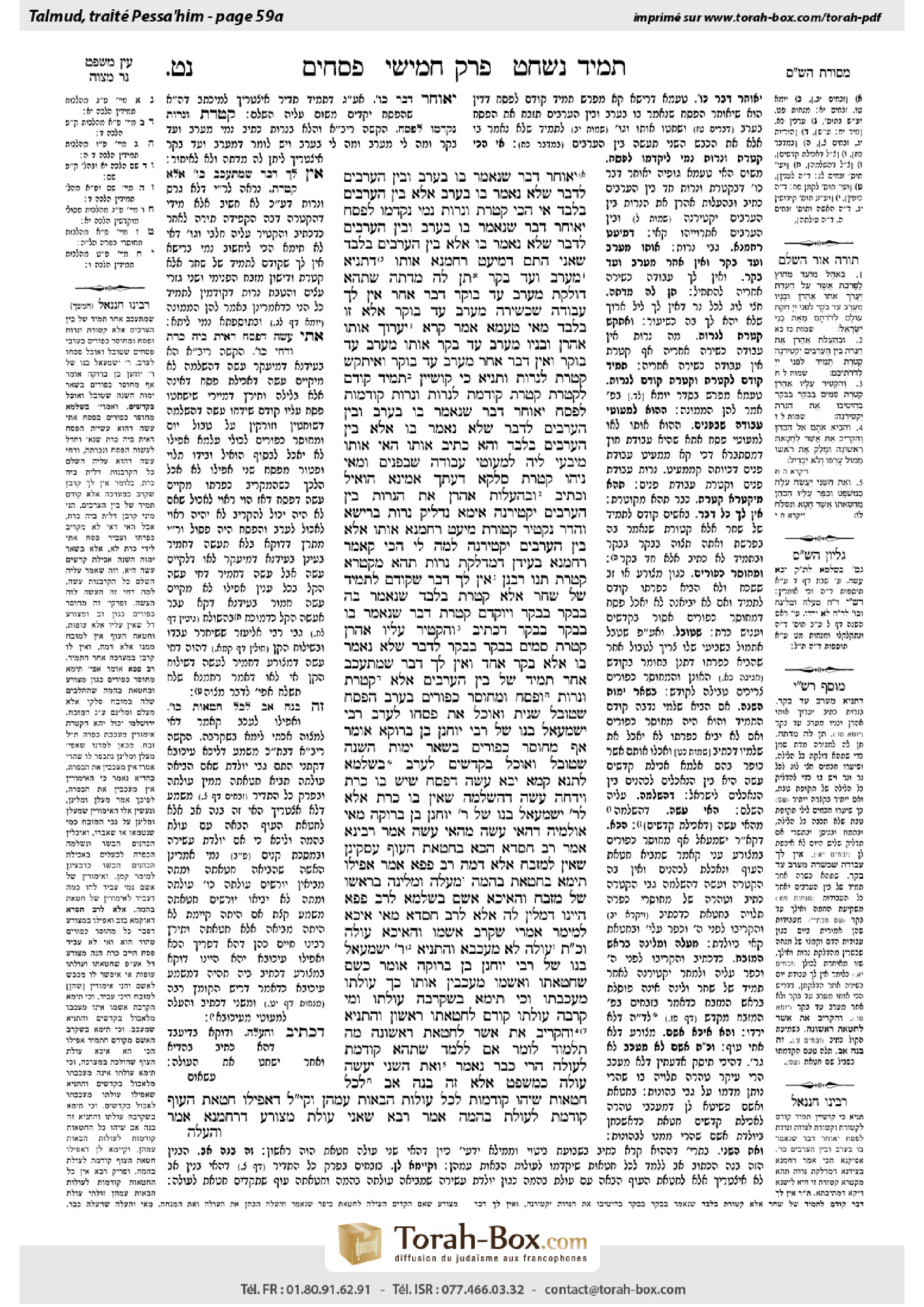
Pesachim 59a: Talmud study for Daf Yomi
Daf Yomi is the daily study of one Talmud folio. Explore 37 tractates with scans, Hebrew text, Sefaria English and AI-generated French translations where annotated.
Passage selection and English or AI-generated French translation are available where the scan has annotations. Daf Study is independent of Torah-Box and Sefaria.
Browse Pesachim · פסחים · All tractatesPesachim 59a text and translations
This page of Pesachim includes the Aramaic text, an English translation and an AI-generated French translation, alongside the scan above.
פסחים נ״ט א · Aramaic and Hebrew text
יְאוּחַר דָּבָר שֶׁנֶּאֱמַר בּוֹ ״בָּעָרֶב״ וּ״בֵין הָעַרְבָּיִם״, לְדָבָר שֶׁלֹּא נֶאֱמַר בּוֹ ״בָּעֶרֶב״, אֶלָּא ״בֵּין הָעַרְבָּיִם״ בִּלְבַד.
אִי הָכִי, קְטֹרֶת וְנֵרוֹת נָמֵי נִקְדְּמוּ לְפֶסַח: יְאוּחַר דָּבָר שֶׁנֶּאֱמַר בּוֹ ״בָּעָרֶב״ וּ״בֵין הָעַרְבָּיִם״, לְדָבָר שֶׁלֹּא נֶאֱמַר בּוֹ אֶלָּא ״בֵּין הָעַרְבָּיִם״ בִּלְבַד!
שָׁאנֵי הָתָם דְּמִיעֵט רַחֲמָנָא ״אֹתוֹ״. דְּתַנְיָא: ״מֵעֶרֶב וְעַד בֹּקֶר״ — תֵּן לָהּ מִדָּתָהּ שֶׁתְּהֵא דּוֹלֶקֶת מֵעֶרֶב עַד בּוֹקֶר.
דָּבָר אַחֵר: אֵין לְךָ עֲבוֹדָה שֶׁכְּשֵׁירָה מֵעֶרֶב עַד בּוֹקֶר אֶלָּא זוֹ בִּלְבַד. מַאי טַעְמָא — אָמַר קְרָא: ״יַעֲרֹךְ אֹתוֹ אַהֲרֹן וּבָנָיו מֵעֶרֶב עַד בֹּקֶר״. אוֹתוֹ מֵעֶרֶב עַד בּוֹקֶר, וְאֵין דָּבָר אַחֵר מֵעֶרֶב עַד בּוֹקֶר.
וְאִיתַּקַּשׁ קְטֹרֶת לְנֵרוֹת.
וְתַנְיָא כִּי קוּשְׁיַין: תָּמִיד קוֹדֶם לִקְטֹרֶת, קְטֹרֶת קוֹדֶמֶת לְנֵרוֹת, וְנֵרוֹת קוֹדְמוֹת לְפֶסַח. יְאוּחַר דָּבָר שֶׁנֶּאֱמַר בּוֹ ״בָּעָרֶב״ וּ״בֵין הָעַרְבָּיִם״, לְדָבָר שֶׁלֹּא נֶאֱמַר בּוֹ אֶלָּא ״בֵּין הָעַרְבָּיִם״ בִּלְבַד.
וְהָא כְּתִיב ״אוֹתוֹ״! הַאי ״אוֹתוֹ״ מִיבְּעֵי לֵיהּ לְמַעוֹטֵי עֲבוֹדָה שֶׁבִּפְנִים, וּמַאי נִיהוּ? קְטֹרֶת. סָלְקָא דַּעְתָּךְ אָמֵינָא הוֹאִיל וּכְתִיב ״וּבְהַעֲלוֹת אַהֲרֹן אֶת הַנֵּרוֹת בֵּין הָעַרְבָּיִם יַקְטִירֶנָּה״, אֵימָא: נַדְלֵיק נֵרוֹת בְּרֵישָׁא וַהֲדַר נַקְטֵיר קְטוֹרֶת, מִיעֵט רַחֲמָנָא ״אוֹתוֹ״.
אֶלָּא, ״בֵּין הָעַרְבַּיִם יַקְטִירֶנָּה״ לְמָה לִי? הָכִי קָאָמַר רַחֲמָנָא: בְּעִידָּן דְּמַדְלְקַתְּ נֵרוֹת תְּהֵא מִקַּטְרָא קְטֹרֶת.
תָּנוּ רַבָּנַן: אֵין לְךָ דָּבָר שֶׁקּוֹדֵם לְתָמִיד שֶׁל שַׁחַר אֶלָּא קְטֹרֶת בִּלְבַד, שֶׁנֶּאֱמַר בָּהּ: ״בַּבֹּקֶר בַּבֹּקֶר״. וְיוּקְדַּם קְטֹרֶת — דָּבָר שֶׁנֶּאֱמַר בּוֹ ״בַּבֹּקֶר בַּבֹּקֶר״, דִּכְתִיב: ״וְהִקְטִיר עָלָיו אַהֲרֹן קְטֹרֶת סַמִּים בַּבֹּקֶר בַּבֹּקֶר״, לְדָבָר שֶׁלֹּא נֶאֱמַר בּוֹ אֶלָּא ״בֹּקֶר״ אֶחָד.
וְאֵין לְךָ דָּבָר שֶׁמִּתְעַכֵּב אַחַר תָּמִיד שֶׁל בֵּין הָעַרְבָּיִם אֶלָּא קְטֹרֶת, וְנֵרוֹת, וּפֶסַח, וּמְחוּסַּר כִּפּוּרִים בְּעֶרֶב הַפֶּסַח — שֶׁטּוֹבֵל שֵׁנִית וְאוֹכֵל אֶת פִּסְחוֹ לָעֶרֶב.
רַבִּי יִשְׁמָעֵאל בְּנוֹ שֶׁל רַבִּי יוֹחָנָן בֶּן בְּרוֹקָא אוֹמֵר: אַף מְחוּסַּר כִּפּוּרִים בִּשְׁאָר יְמוֹת הַשָּׁנָה, שֶׁטּוֹבֵל וְאוֹכֵל בַּקֳּדָשִׁים לָעֶרֶב.
בִּשְׁלָמָא לְתַנָּא קַמָּא, יָבֹא עֲשֵׂה דְפֶסַח שֶׁיֵּשׁ בּוֹ כָּרֵת, וְיִדְחֶה עֲשֵׂה דְהַשְׁלָמָה שֶׁאֵין בּוֹ כָּרֵת. אֶלָּא לְרַבִּי יִשְׁמָעֵאל בְּנוֹ שֶׁל רַבִּי יוֹחָנָן בֶּן בְּרוֹקָא, מַאי אוּלְמֵיהּ דְּהַאי עֲשֵׂה מֵהַאי עֲשֵׂה?!
אָמַר רָבִינָא אָמַר רַב חִסְדָּא: הָכָא בְּחַטַּאת הָעוֹף עָסְקִינַן, שֶׁאֵין לְמִזְבֵּחַ אֶלָּא דָּמָהּ.
רַב פָּפָּא אָמַר: אֲפִילּוּ תֵּימָא בְּחַטַּאת בְּהֵמָה, מַעֲלֶהָ וּמְלִינָהּ בְּרֹאשׁוֹ שֶׁל מִזְבֵּחַ.
וְהָאִיכָּא אָשָׁם. בִּשְׁלָמָא לְרַב פָּפָּא הַיְינוּ דְּמֵלִין לַהּ, אֶלָּא לְרַב חִסְדָּא מַאי אִיכָּא לְמֵימַר? אָמְרִי: שֶׁקָּרַב אֲשָׁמוֹ.
וְהָאִיכָּא עוֹלָה! וְכִי תֵּימָא: עוֹלָה לָא מְעַכְּבָא, וְהָתַנְיָא, רַבִּי יִשְׁמָעֵאל בְּנוֹ שֶׁל רַבִּי יוֹחָנָן בֶּן בְּרוֹקָא אוֹמֵר: כְּשֵׁם שֶׁחַטָּאתוֹ וַאֲשָׁמוֹ מְעַכְּבִין אוֹתוֹ, כָּךְ עוֹלָתוֹ מְעַכַּבְתּוֹ!
וְכִי תֵּימָא בְּשֶׁקָּרְבָה עוֹלָתוֹ, וּמִי קָרְבָה עוֹלָתוֹ קוֹדֶם לְחַטָּאתוֹ רִאשׁוֹן?! וְהָתַנְיָא: ״וְהִקְרִיב אֶת אֲשֶׁר לַחַטָּאת רִאשׁוֹנָה״, מָה תַּלְמוּד לוֹמַר? אִם לְלַמֵּד שֶׁתְּהֵא קוֹדֶמֶת לָעוֹלָה — הֲרֵי כְּבָר נֶאֱמַר: ״וְאֵת הַשֵּׁנִי יַעֲשֶׂה עוֹלָה כַּמִּשְׁפָּט״.
אֶלָּא: זֶה בָּנָה אָב לְכׇל חַטָּאוֹת שֶׁיְּהוּ קוֹדְמוֹת לְכׇל עוֹלוֹת הַבָּאוֹת עִמָּהֶן. וְקַיְימָא לַן דַּאֲפִילּוּ חַטַּאת הָעוֹף קוֹדֶמֶת לְעוֹלַת בְּהֵמָה!
אָמַר רָבָא: שָׁאנֵי עוֹלַת מְצוֹרָע, דְּרַחֲמָנָא אָמַר:
Pesachim 59a · English translation
An item, i.e., the Paschal lamb, about which it is stated: “In the evening” and “in the afternoon,” should be sacrificed after an item, the daily afternoon offering, about which it is not stated “in the evening,” but only “in the afternoon.” With regard to the Paschal lamb, the verse says: “You shall sacrifice the Paschal lamb in the evening, at the going down of the sun, at the season in which you came out of Egypt” (Deuteronomy 16:6), and it also says: “And the whole assembly of the congregation of Israel shall slaughter it in the afternoon” (Exodus 12:6), whereas regarding the daily afternoon offering it only says: “And the second lamb you shall offer in the afternoon” (Numbers 28:4).
The Gemara asks: If that is so, that the halakha that the Paschal lamb is offered after the daily afternoon offering is derived from these verses, then the burning of the incense and the lighting of the lamps of the candelabrum should also precede the offering of the Paschal lamb. The item, the Paschal lamb, about which it is stated “in the evening” and “in the afternoon” should be sacrificed after the item about which it is stated only: “And when Aaron lights the lamps in the afternoon he shall burn it, a perpetual incense before the Lord throughout your generations” (Exodus 30:8), which relates to both the burning of the incense and the lighting of the lamps.
The Gemara answers: It is different there, in the case of lamps, as the Merciful One explicitly excludes in the Torah the possibility that the lamps will be kindled first by means of the word it [oto], which emphasizes that the lamps are kindled later. The Gemara clarifies: As it was taught in a baraita concerning the verse pertaining to the lamps: “In the tent of meeting, outside of the veil, which is before the testimony, Aaron and his sons shall set it in order from evening to morning before the Lord; it shall be a statute forever to their generations on behalf of the children of Israel” (Exodus 27:21). The phrase “from evening to morning” indicates that you shall allocate the candelabrum its measure of oil, so that it will burn from evening until morning.
The baraita continues: Alternatively, the same verse can be interpreted as follows: There is no rite that is valid from evening until morning but this one alone, since all the other rites are performed only during the day. What is the reason that this verse is interpreted to mean that lighting the lamps is the only rite valid from evening until morning? It is because the verse said with regard to the candelabrum: “Aaron and his sons shall set [ya’arokh] it [oto] in order, to burn from evening to morning.” The verse uses the separate word it [oto], rather than a pronominal suffix attached to the word ya’arokh to form the word ya’arkhenu, in order to emphasize that it, the lighting of the candelabrum, is from evening until morning, but no other rite is from evening until morning.
And the Torah juxtaposes the burning of the incense to the kindling of the lamps, as it explicitly states that the incense is burned at the time the lamps are kindled: “And when Aaron lights the lamps in the afternoon, he shall burn it, a perpetual incense” (Exodus 30:8). From this it is derived that no other rite is performed in the Temple after burning the incense and lighting the lamps, not even the Paschal lamb.
That explains the opinion cited in the previous baraita and its sources. It should, however, be noted that it was explicitly taught in a baraita in accordance with our difficulty and contrary to the opinion cited in the previous baraita: The daily afternoon offering precedes the afternoon burning of the incense, the burning of the incense precedes the lighting of the lamps, and the lighting of the lamps precedes the Paschal lamb. This is proof that this is the correct order: An item, the Paschal lamb, about which it is stated “in the evening” and “in the afternoon” should be delayed until after an item, i.e., the incense and lamps, about which it is stated only “in the afternoon.”
The Gemara asks: As already stated, isn’t “it” written in the verse, from which it is derived that lighting the lamps is the final Temple rite of the day? The Gemara answers: This word “it” is necessary, in order to exclude a rite that is performed inside the sanctuary, as opposed to the Paschal lamb, which is sacrificed outside, in the courtyard. The Gemara asks: And what is this rite? The Gemara answers: The burning of the incense. It could have entered your mind to say that since it is written: “And when Aaron lights the lamps in the afternoon he shall burn it” (Exodus 30:8), say that perhaps we should light the lamps first and then we should burn the incense, as the verse does not clearly state which of the two comes first. Therefore, the Merciful One excludes this possibility by use of the word “it,” from which it is derived that no other rite is performed inside the sanctuary after the lamps are kindled.
The Gemara asks: However, if that is the halakha, why do I need the phrase “in the afternoon he shall burn it,” which seems to add nothing? The Gemara answers that this is what the Merciful One is saying: This verse does not come to establish the time for lighting the lamps; it comes to teach that at the time when you light the lamps, the incense should already be burning.
The Sages taught in a baraita: Nothing may precede the daily morning offering but the morning burning of the incense alone, as it is stated about the burning of the incense: “In the morning, in the morning.” And it is derived that the incense, an item about which it is stated: “In the morning, in the morning,” as it is written: “And Aaron shall burn upon it incense of sweet spices; in the morning, in the morning, when he dresses the lamps, he shall burn it” (Exodus 30:7), should precede an item, the daily offering, about which only one morning is stated: “The one lamb you shall offer in the morning” (Numbers 28:4).
And similarly, nothing may be delayed until after the daily afternoon offering but the afternoon burning of the incense, the lighting of the lamps, the offering of the Paschal lamb, and one who lacks atonement on Passover eve, i.e., one who was ritually impure, such as a leper or a zav, and who immersed in a ritual bath to become pure. Such a person is required to bring an offering before he may partake of consecrated food, and he is referred to as one who lacks atonement until he does so. In the event that he neglects to bring his offering before the daily afternoon offering on Passover eve, the Sages instituted a special ordinance to enable him to bring his offering even after the daily offering. He immerses a second time after bringing the offering, thereby becoming fit to eat sacrificial foods, and he eats his Paschal lamb in the evening.
Rabbi Yishmael, son of Rabbi Yoḥanan ben Beroka, says that even one who lacks atonement on the rest of the days of the year brings his offering after the daily afternoon offering, and that he immerses and eats sacrificial food from a voluntary offering that he brought during the day, in the evening.
The Gemara asks: Granted, according to the first tanna, who permits sacrificing offerings after the daily afternoon offering only for one who lacks atonement on Passover eve, there is good reason for this policy: The positive mitzva of the Paschal lamb, which carries with it the punishment of karet for one who is qualified to bring the Paschal lamb and does not do so, will come and override the positive mitzva of completion. There is a positive mitzva to complete all the offerings before the daily afternoon offering. Failure to fulfill this command certainly does not involve karet, and therefore it is overridden by the more stringent mitzva of the Paschal lamb. However, according to the opinion of Rabbi Yishmael, son of Rabbi Yoḥanan ben Beroka, in what way is the strength of this positive mitzva to eat sacrificial meat greater than the strength of that positive mitzva to complete all the offerings of the day before the daily afternoon offering?
Ravina said that Rav Ḥisda said: Here we are dealing with the special case of a bird brought as a sin-offering. This occurs when the person lacking atonement, e.g., an impoverished leper, is required to bring only a bird as a sin-offering, as in that case the altar has only the bird’s blood. Its meat is not brought on the altar at all; it is eaten by the priests. The mitzva to complete all offerings before the daily afternoon offering applies only to burning fats on the altar. Sprinkling blood onto the altar is permitted even after the daily afternoon offering.
Rav Pappa said: Even if you say that we are dealing here with a person lacking atonement who is required to bring an animal sin-offering, it is possible to sacrifice it and still observe the mitzva of completion. How? The sacrificial parts of this sin-offering that are burned on the altar are not burned on the same day. Rather, the priest brings them up and leaves them overnight on the top of the altar. They are then burned the next day after the daily morning offering. If these sacrificial parts are left elsewhere overnight, they become disqualified; however, if they are left overnight on the top of the altar they remain fit. Consequently, it is possible for one to bring his offering and still observe the positive commandment of completion.
The Gemara asks: But isn’t there also a guilt-offering that one who lacks atonement, e.g., a leper or a zav, must bring, and only sheep may be brought as a guilt-offering? Granted, according to Rav Pappa, the solution in the case of the guilt-offering is also for the priest to leave it overnight on the top of the altar. However, according to Rav Ḥisda, what can be said, as sprinkling the blood of the guilt-offering alone does not suffice to achieve atonement? They say: According to the opinion of Rav Ḥisda, Rabbi Yishmael, son of Rabbi Yoḥanan ben Beroka, is referring here to one who lacks atonement and who already sacrificed his guilt-offering. He has only to bring a sin-offering, for which he can sacrifice even a bird, in order to achieve full atonement.
The Gemara asks: But isn’t there also a burnt-offering among the atonement offerings? And if you say that the failure to sacrifice the burnt-offering does not prevent atonement, wasn’t it taught in a baraita: Rabbi Yishmael, son of Rabbi Yoḥanan ben Beroka, himself says: Just as failure to sacrifice his sin-offering and his guilt-offering prevents the leper from achieving full ritual purity, so too does failure to sacrifice his burnt-offering.
And if you say, in an attempt to answer as before, that the baraita here is dealing with a situation in which he already offered his burnt-offering; may his burnt-offering be brought before his sin-offering? Wasn’t it taught in a baraita: It is written concerning one who entered the Temple or ate consecrated food while ritually impure: “And he shall bring them to the priest and he shall offer that which is for the sin-offering first and pinch off its neck close by its head, but shall not divide it” (Leviticus 5:8). To what purpose does the verse state that the sin-offering is first? If it is to teach that this sin-offering should be offered prior to the burnt-offering, it is already stated: “And he shall offer the second as a burnt-offering according to the ordinance” (Leviticus 5:10), and there is no need for two verses.
Rather, this is a paradigm and a foundation for the principle that all sin-offerings should precede all burnt-offerings that come with them. In every case, the sin-offering is sacrificed first. And we maintain that this principle is so weighty that even the sin-offering of a bird precedes a burnt-offering of an animal.
Rava said: The halakha of the burnt-offering of a leper is different from other sin-offerings and burnt-offerings, as the Merciful One says with regard to the halakhot of a leper:
Pesachim 59a · Traduction française (IA)
Un sacrifice, à savoir l’agneau pascal, au sujet duquel il est dit « le soir » et « l’après-midi », doit être offert après un sacrifice, l’offrande quotidienne de l’après-midi, au sujet duquel il n’est pas dit « le soir », mais seulement « l’après-midi ». Au sujet de l’agneau pascal, le verset dit : « Tu sacrifieras l’agneau pascal le soir, au coucher du soleil, à la saison où tu es sorti d’Égypte » (Deutéronome 16, 6), et il dit aussi : « Toute l’assemblée de la communauté d’Israël l’égorgera l’après-midi » (Exode 12, 6), tandis qu’au sujet de l’offrande quotidienne de l’après-midi, il est seulement dit : « Tu offriras le second agneau l’après-midi » (Nombres 28, 4).
La Guemara demande : Si tel est le cas, si la halakha selon laquelle l’agneau pascal est offert après l’offrande quotidienne de l’après-midi est déduite de ces versets, l’offrande de l’encens et l’allumage des lampes du candélabre devraient eux aussi précéder l’offrande de l’agneau pascal. Le sacrifice, à savoir l’agneau pascal, au sujet duquel il est dit « le soir » et « l’après-midi », devrait être offert après le sacrifice au sujet duquel il est seulement dit : « Quand Aaron allumera les lampes l’après-midi, il fera brûler l’encens perpétuel devant le Seigneur au fil de vos générations » (Exode 30, 8), ce qui concerne à la fois l’offrande de l’encens et l’allumage des lampes.
La Guemara répond : Le cas des lampes est différent, car le Miséricordieux exclut explicitement dans la Torah la possibilité qu’elles soient allumées en premier, au moyen du mot oto [lui], qui souligne que les lampes sont allumées plus tard. La Guemara précise : Comme cela a été enseigné dans une baraïta à propos du verset concernant les lampes : « Dans la tente d’assignation, à l’extérieur du voile qui est devant le témoignage, Aaron et ses fils les disposeront du soir au matin devant le Seigneur ; ce sera une loi perpétuelle pour leurs générations, au nom des enfants d’Israël » (Exode 27, 21). L’expression « du soir au matin » indique qu’il faut fournir au candélabre une quantité d’huile suffisante pour qu’il brûle du soir jusqu’au matin.
La baraïta poursuit : Autrement, le même verset peut être interprété ainsi : il n’y a qu’un seul rite qui soit valide du soir au matin, et c’est celui-ci, puisque tous les autres rites ne sont accomplis que pendant le jour. Pourquoi interprète-t-on ce verset comme signifiant que l’allumage des lampes est le seul rite valide du soir au matin ? Parce que le verset dit au sujet du candélabre : « Aaron et ses fils le disposeront [ya’arokh], lui [oto], pour qu’il brûle du soir au matin. » Le verset emploie le mot distinct oto [lui], au lieu d’ajouter un suffixe pronominal au mot ya’arokh pour former ya’arkhenu, afin de souligner que c’est lui, le candélabre, qui brûle du soir au matin, et qu’aucun autre rite ne s’accomplit du soir au matin.
Et la Torah juxtapose l’offrande de l’encens à l’allumage des lampes, puisqu’elle précise explicitement que l’encens est brûlé au moment où les lampes sont allumées : « Quand Aaron allumera les lampes l’après-midi, il fera brûler l’encens perpétuel » (Exode 30, 8). On en déduit qu’aucun autre rite n’est accompli dans le Temple après l’offrande de l’encens et l’allumage des lampes, pas même l’agneau pascal.
Cela explique l’opinion citée dans la baraïta précédente et ses sources. Il faut toutefois noter qu’une baraïta enseigne explicitement une règle conforme à notre difficulté et contraire à l’opinion citée dans la baraïta précédente : l’offrande quotidienne de l’après-midi précède l’offrande de l’encens de l’après-midi, l’offrande de l’encens précède l’allumage des lampes, et l’allumage des lampes précède l’agneau pascal. Cela prouve que cet ordre est le bon : un sacrifice, l’agneau pascal, au sujet duquel il est dit « le soir » et « l’après-midi », doit être différé jusqu’après un sacrifice, à savoir l’encens et les lampes, au sujet duquel il est seulement dit « l’après-midi ».
La Guemara demande : Comme cela a déjà été indiqué, le mot « lui » n’est-il pas écrit dans le verset, d’où l’on déduit que l’allumage des lampes est le dernier rite du jour dans le Temple ? La Guemara répond : Ce mot « lui » est nécessaire pour exclure un rite accompli à l’intérieur du sanctuaire, contrairement à l’agneau pascal, qui est sacrifié à l’extérieur, dans la cour. La Guemara demande : Et de quel rite s’agit-il ? La Guemara répond : De l’offrande de l’encens. On aurait pu penser que, puisqu’il est écrit : « Quand Aaron allumera les lampes l’après-midi, il fera brûler l’encens » (Exode 30, 8), il faudrait peut-être allumer d’abord les lampes, puis faire brûler l’encens, car le verset n’indique pas clairement lequel des deux vient en premier. Le Miséricordieux exclut donc cette possibilité au moyen du mot « lui », d’où l’on déduit qu’aucun autre rite n’est accompli dans le sanctuaire après l’allumage des lampes.
La Guemara demande : Mais, si telle est la halakha, pourquoi ai-je besoin de l’expression « l’après-midi, il fera brûler l’encens », qui semble n’apporter rien ? La Guemara répond que voici ce que dit le Miséricordieux : ce verset ne sert pas à fixer l’heure de l’allumage des lampes ; il enseigne qu’au moment où tu allumes les lampes, l’encens doit déjà brûler.
Les Sages ont enseigné dans une baraïta : Rien ne peut précéder l’offrande quotidienne du matin, hormis la combustion matinale de l’encens, car il est dit à propos de l’offrande de l’encens : « le matin, le matin ». On en déduit que l’encens, au sujet duquel il est dit « le matin, le matin », comme il est écrit : « Aaron y fera brûler de l’encens parfumé ; le matin, le matin, lorsqu’il arrange les lampes, il le fera brûler » (Exode 30, 7), doit précéder un sacrifice, l’offrande quotidienne, au sujet duquel il n’est mentionné qu’un seul matin : « Tu offriras un agneau le matin » (Nombres 28, 4).
De même, rien ne peut être différé jusqu’après l’offrande quotidienne de l’après-midi, hormis l’offrande de l’encens de l’après-midi, l’allumage des lampes, l’offrande de l’agneau pascal et l’offrande de celui qui doit encore obtenir l’expiation la veille de Pessa’h, c’est-à-dire une personne qui était rituellement impure, comme un lépreux ou un zav, et qui s’est immergée dans un bain rituel pour devenir pure. Cette personne doit apporter une offrande avant de pouvoir consommer des aliments consacrés ; on la qualifie de personne qui doit encore obtenir l’expiation jusqu’à ce qu’elle le fasse. Si, la veille de Pessa’h, elle néglige d’apporter son offrande avant l’offrande quotidienne de l’après-midi, les Sages ont instauré une règle particulière lui permettant d’apporter son offrande même après l’offrande quotidienne. Elle s’immerge une seconde fois après avoir apporté l’offrande, devenant ainsi apte à consommer des aliments sacrificiels, puis elle mange son agneau pascal le soir.
Rabbi Yishmaël, fils de Rabbi Yoḥanan ben Beroka, dit que même celui qui doit encore obtenir l’expiation pendant les autres jours de l’année apporte son offrande après l’offrande quotidienne de l’après-midi, puis s’immerge et consomme le soir des aliments sacrificiels provenant d’une offrande volontaire qu’il a apportée pendant la journée.
La Guemara demande : Il est compréhensible que, selon le premier tanna, qui permet de sacrifier des offrandes après l’offrande quotidienne de l’après-midi uniquement pour celui qui doit encore obtenir l’expiation la veille de Pessa’h, cette règle se justifie : la mitsva positive de l’agneau pascal, dont la transgression est passible de karet pour celui qui est apte à l’offrir et ne le fait pas, vient l’emporter sur la mitsva positive d’achèvement. Il existe une mitsva positive d’achever toutes les offrandes avant l’offrande quotidienne de l’après-midi. Le manquement à cette obligation n’entraîne certainement pas karet ; cette mitsva est donc écartée par celle, plus rigoureuse, de l’agneau pascal. Toutefois, selon l’opinion de Rabbi Yishmaël, fils de Rabbi Yoḥanan ben Beroka, en quoi la mitsva positive de consommer de la viande sacrificielle a-t-elle plus de poids que cette mitsva positive consistant à achever toutes les offrandes du jour avant l’offrande quotidienne de l’après-midi ?
Ravina a dit au nom de Rav Ḥisda : Ici, nous parlons du cas particulier d’un oiseau offert comme sacrifice expiatoire. C’est le cas lorsque la personne qui doit encore obtenir l’expiation, par exemple un lépreux indigent, n’est tenue d’apporter qu’un oiseau comme sacrifice expiatoire ; dans ce cas, seul le sang de l’oiseau est présenté sur l’autel. Sa chair n’est pas du tout présentée sur l’autel ; elle est consommée par les prêtres. La mitsva d’achever toutes les offrandes avant l’offrande quotidienne de l’après-midi ne concerne que la combustion des graisses sur l’autel. L’aspersion du sang sur l’autel est permise même après l’offrande quotidienne de l’après-midi.
Rav Pappa a dit : Même si l’on affirme qu’il s’agit ici d’une personne qui doit encore obtenir l’expiation et qui est tenue d’apporter un sacrifice expiatoire animal, il est possible de le sacrifier tout en accomplissant la mitsva d’achèvement. Comment ? Les parties de ce sacrifice expiatoire qui sont brûlées sur l’autel ne le sont pas le même jour. Le prêtre les apporte et les laisse toute la nuit sur le haut de l’autel. Elles sont ensuite brûlées le lendemain, après l’offrande quotidienne du matin. Si ces parties sacrificielles sont laissées ailleurs toute la nuit, elles deviennent impropres ; en revanche, si elles sont laissées toute la nuit sur le haut de l’autel, elles restent aptes. Il est donc possible d’apporter son offrande tout en accomplissant le commandement positif d’achèvement.
La Guemara demande : Mais celui qui doit encore obtenir l’expiation, par exemple un lépreux ou un zav, ne doit-il pas aussi apporter un sacrifice de culpabilité, et seuls des moutons peuvent-ils être offerts comme sacrifices de culpabilité ? Il est compréhensible que, selon Rav Pappa, la solution soit également, dans le cas du sacrifice de culpabilité, que le prêtre le laisse toute la nuit sur le haut de l’autel. Mais, selon Rav Ḥisda, que peut-on répondre, puisque la seule aspersion du sang du sacrifice de culpabilité ne suffit pas à obtenir l’expiation ? Ils répondent : Selon l’opinion de Rav Ḥisda, Rabbi Yishmaël, fils de Rabbi Yoḥanan ben Beroka, parle ici d’une personne qui doit encore obtenir l’expiation et qui a déjà offert son sacrifice de culpabilité. Elle n’a plus qu’à apporter un sacrifice expiatoire, pour lequel elle peut même offrir un oiseau, afin d’obtenir une expiation complète.
La Guemara demande : Mais parmi les sacrifices d’expiation ne figure-t-il pas aussi un holocauste ? Et si l’on dit que le fait de ne pas offrir l’holocauste n’empêche pas l’expiation, n’a-t-on pas enseigné dans une baraïta : Rabbi Yishmaël, fils de Rabbi Yoḥanan ben Beroka, dit lui-même : De même que le fait de ne pas offrir son sacrifice expiatoire et son sacrifice de culpabilité empêche le lépreux d’atteindre une pureté rituelle complète, de même le fait de ne pas offrir son holocauste l’en empêche.
Et si l’on dit, pour tenter de répondre comme précédemment, que la baraïta parle d’une situation où il a déjà offert son holocauste, son holocauste peut-il être offert avant son sacrifice expiatoire ? N’a-t-on pas enseigné dans une baraïta : À propos de celui qui est entré dans le Temple ou a consommé des aliments consacrés alors qu’il était rituellement impur, il est écrit : « Il les apportera au prêtre, et celui-ci offrira d’abord ce qui est destiné au sacrifice expiatoire et lui pincera le cou près de la tête, sans le séparer » (Lévitique 5, 8). Pourquoi le verset précise-t-il que le sacrifice expiatoire vient en premier ? Si c’est pour enseigner que ce sacrifice expiatoire doit être offert avant l’holocauste, cela est déjà dit : « Il offrira le second en holocauste, selon la règle » (Lévitique 5, 10), et deux versets ne sont pas nécessaires.
Au contraire, il s’agit d’un modèle et d’un fondement du principe selon lequel tous les sacrifices expiatoires doivent précéder tous les holocaustes qui les accompagnent. Dans chaque cas, le sacrifice expiatoire est offert en premier. Et nous tenons ce principe pour si important que même le sacrifice expiatoire d’un oiseau précède l’holocauste d’un animal.
Rava a dit : La halakha concernant l’holocauste du lépreux diffère de celle des autres sacrifices expiatoires et holocaustes, car le Miséricordieux dit, au sujet des halakhot du lépreux :
Traduction française générée par IA à partir de l’édition anglaise de Sefaria. Vérifie toujours un passage avec le texte source.
Text from Sefaria: William Davidson Edition - Vocalized Aramaic (CC BY NC); William Davidson Edition - English (CC BY NC).