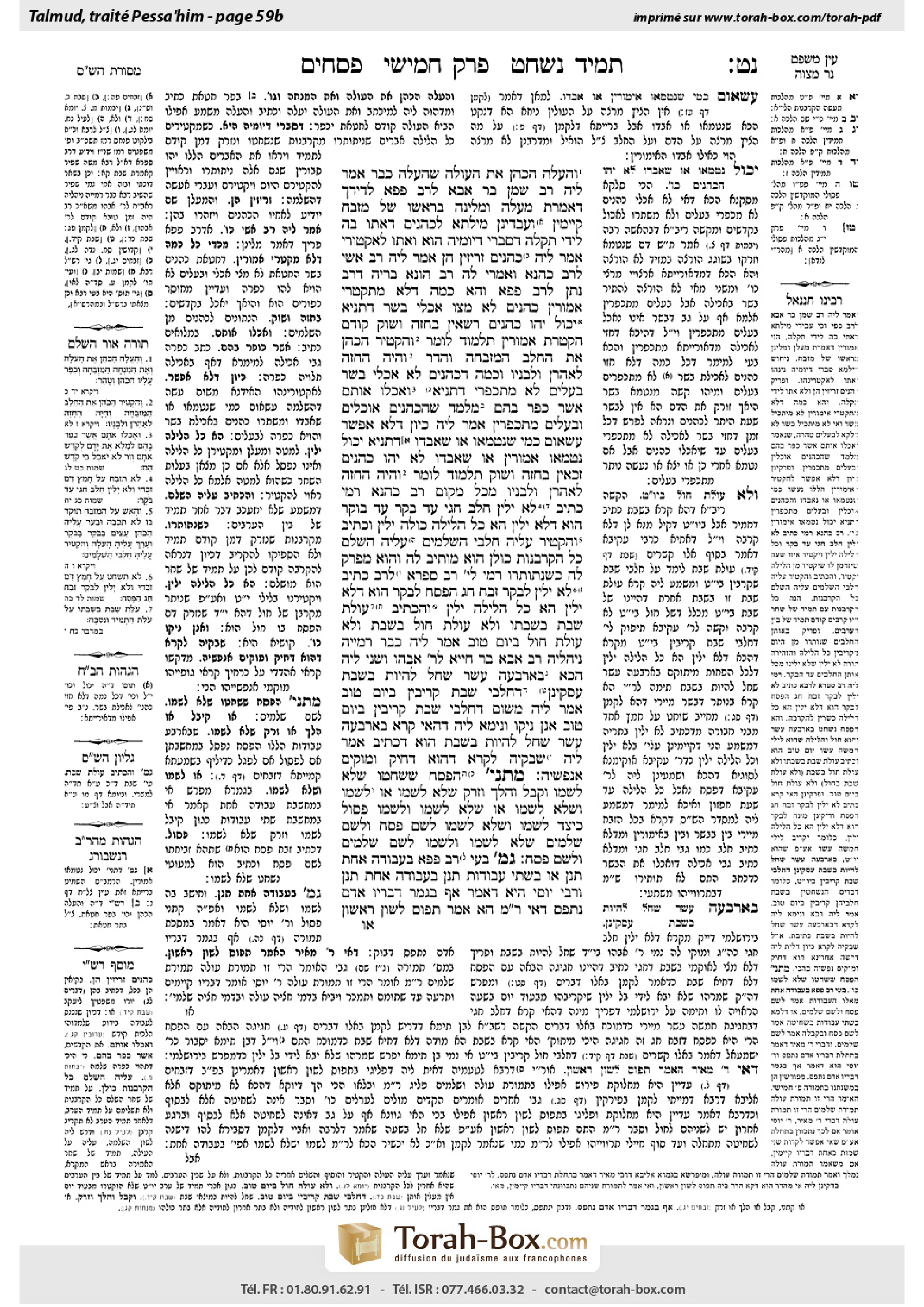
Pesachim 59b: Talmud study for Daf Yomi
Daf Yomi is the daily study of one Talmud folio. Explore 37 tractates with scans, Hebrew text, Sefaria English and AI-generated French translations where annotated.
Passage selection and English or AI-generated French translation are available where the scan has annotations. Daf Study is independent of Torah-Box and Sefaria.
Browse Pesachim · פסחים · All tractatesPesachim 59b text and translations
This page of Pesachim includes the Aramaic text, an English translation and an AI-generated French translation, alongside the scan above.
פסחים נ״ט ב · Aramaic and Hebrew text
״וְהֶעֱלָה הַכֹּהֵן אֶת הָעוֹלָה״ — שֶׁהֶעֱלָהּ כְּבָר.
אֲמַר לֵיהּ רַב שֶׁמֶן בַּר אַבָּא לְרַב פָּפָּא: לְדִידָךְ, דְּאָמְרַתְּ מַעֲלֶהָ וּמְלִינָהּ בְּרֹאשׁוֹ שֶׁל מִזְבֵּחַ, קַיָּימִין וְעָבְדִינַן מִילְּתָא לְכֹהֲנִים דְּאָתוּ בַּהּ לִידֵי תַקָּלָה, דְּסָבְרִי דְּיוֹמֵיהּ הוּא וְאָתוּ לְאַקְטוֹרֵי! אֲמַר לֵיהּ: כֹּהֲנִים זְרִיזִין הֵן.
אֲמַר לֵיהּ רַב אָשֵׁי לְרַב כָּהֲנָא, וְאָמְרִי לַהּ רַב הוּנָא בְּרֵיהּ דְּרַב נָתָן לְרַב פָּפָּא: וְהָא כַּמָּה דְּלָא מִתְקַטְּרִי אֵמוּרִין כֹּהֲנִים לָא מָצוּ אָכְלִי בָּשָׂר, דְּתַנְיָא: יָכוֹל יְהוּ כֹּהֲנִים רַשָּׁאִין בְּחָזֶה וָשׁוֹק קוֹדֶם הַקְטָרַת אֵמוּרִין, תַּלְמוּד לוֹמַר: ״וְהִקְטִיר הַכֹּהֵן אֶת הַחֵלֶב הַמִּזְבֵּחָה״, וַהֲדַר: ״וְהָיָה הֶחָזֶה לְאַהֲרֹן וּלְבָנָיו״.
וְכַמָּה דְּכֹהֲנִים לָא אָכְלִי בָּשָׂר בְּעָלִים לָא מִתְכַּפְּרִי, דְּתַנְיָא: ״וְאָכְלוּ אוֹתָם אֲשֶׁר כֻּפַּר בָּהֶם״, מְלַמֵּד שֶׁהַכֹּהֲנִים אוֹכְלִים וּבְעָלִים מִתְכַּפְּרִין!
אֲמַר לֵיהּ: כֵּיוָן דְּלָא אֶפְשָׁר — עֲשָׁאוּם כְּמִי שֶׁנִּטְמְאוּ אוֹ שֶׁאָבְדוּ. דְּתַנְיָא: יָכוֹל נִטְמְאוּ אֵמוּרִין אוֹ שֶׁאָבְדוּ לֹא יְהוּ כֹּהֲנִים זַכָּאִין בְּחָזֶה וָשׁוֹק — תַּלְמוּד לוֹמַר: ״וְהָיָה הֶחָזֶה לְאַהֲרֹן וּלְבָנָיו״, מִכׇּל מָקוֹם.
רַב כָּהֲנָא רָמֵי: כְּתִיב ״לֹא יָלִין חֵלֶב חַגִּי עַד בֹּקֶר״ — עַד בּוֹקֶר הוּא דְּלָא יָלִין, הָא כׇּל הַלַּיְלָה כּוּלָּהּ יָלִין. וּכְתִיב: ״וְהִקְטִיר עָלֶיהָ חֶלְבֵי הַשְּׁלָמִים״ — עָלֶיהָ הַשְׁלֵם כׇּל הַקָּרְבָּנוֹת כּוּלָּן!
הוּא מוֹתֵיב לַהּ וְהוּא מְפָרֵק לַהּ, כְּשֶׁנִּתּוֹתְרוּ.
רָמֵי לֵיהּ רַב סָפְרָא לְרַב: כְּתִיב ״לֹא יָלִין לַבֹּקֶר זֶבַח חַג הַפָּסַח״ — לַבֹּקֶר הוּא דְּלֹא יָלִין, הָא כׇּל הַלַּיְלָה יָלִין. וְהָכְתִיב: ״עוֹלַת שַׁבָּת בְּשַׁבַּתּוֹ״ — וְלֹא עוֹלַת חוֹל בְּשַׁבָּת, וְלֹא עוֹלַת חוֹל בְּיוֹם טוֹב!
אֲמַר לֵיהּ: כְּבָר רַמְיַיהּ נִיהֲלֵיהּ רַב אַבָּא בַּר חִיָּיא לְרַבִּי אֲבָהוּ, וְשַׁנִּי לֵיהּ: הָכָא בְּאַרְבָּעָה עָשָׂר שֶׁחָל לִהְיוֹת בְּשַׁבָּת עָסְקִינַן, דְּחֶלְבֵי שַׁבָּת קְרֵיבִין בְּיוֹם טוֹב.
אֲמַר לֵיהּ: מִשּׁוּם דְּחֶלְבֵי שַׁבָּת קְרֵיבִין בְּיוֹם טוֹב, אֲנַן נֵיקוּ וְנֵימָא לֵיהּ דְּהַאי קְרָא בְּאַרְבָּעָה עָשָׂר שֶׁחָל לִהְיוֹת בְּשַׁבָּת הוּא דִּכְתִיב? אֲמַר לֵיהּ: שִׁבְקֵיהּ לִקְרָא, דְּהוּא דָּחֵיק וּמוֹקֵים אַנַּפְשֵׁיהּ.
מַתְנִי׳ הַפָּסַח שֶׁשְּׁחָטוֹ שֶׁלֹּא לִשְׁמוֹ, וְקִבֵּל וְהִלֵּךְ וְזָרַק שֶׁלֹּא לִשְׁמוֹ, אוֹ לִשְׁמוֹ וְשֶׁלֹּא לִשְׁמוֹ, אוֹ שֶׁלֹּא לִשְׁמוֹ וְלִשְׁמוֹ — פָּסוּל.
כֵּיצַד לִשְׁמוֹ וְשֶׁלֹּא לִשְׁמוֹ? לְשֵׁם פֶּסַח וּלְשֵׁם שְׁלָמִים. שֶׁלֹּא לִשְׁמוֹ וְלִשְׁמוֹ — לְשֵׁם שְׁלָמִים וּלְשֵׁם פֶּסַח.
גְּמָ׳ בָּעֵי רַב פָּפָּא: בַּעֲבוֹדָה אַחַת תְּנַן, אוֹ בִּשְׁתֵּי עֲבוֹדוֹת תְּנַן?
בַּעֲבוֹדָה אַחַת תְּנַן וְרַבִּי יוֹסֵי הִיא, דְּאָמַר: אַף בִּגְמַר דְּבָרָיו אָדָם נִתְפָּס.
דְּאִי רַבִּי מֵאִיר — הָא אָמַר: תְּפוֹס לָשׁוֹן רִאשׁוֹן,
Pesachim 59b · English translation
“And the priest shall offer the burnt-offering” (Leviticus 14:20); this is interpreted as referring to the burnt-offering that has already been offered. From here it is derived that the leper achieves atonement even if the standard order is reversed and the burnt-offering is brought before the sin-offering.
Rav Shemen bar Abba said to Rav Pappa: According to your opinion, that you said he brings them up and leaves them overnight at the top of the altar, do we stand and perform an action for the priests whereby they may come to a mishap. As they may think that these fats are from offerings brought on that day, and so they may burn them that day, although these fats must be left until the next day. He said to him: Priests are vigilant and may be relied upon to avoid that mistake and to warn their fellow priests to be careful as well.
Rav Ashi said to Rav Kahana, and some say it Rav Huna, son of Rav Natan, said to Rav Pappa: But, isn’t it the case that as long as the sacrificial parts of the sin-offering have not been burned on the altar, the priests may not eat the meat? As it was taught in a baraita with regard to peace-offerings: I might have thought that the priests would be permitted to eat the breast and thigh, which are designated for them from the peace-offering, prior to burning the sacrificial parts of the offering on the altar. Therefore, the verse states: “And the priest shall burn the fat upon the altar, and the breast shall be for Aaron and his sons” (Leviticus 7:31). From here it is derived that the priest is first obligated to burn the fat, and only then: “The breast shall be for Aaron and his sons.
And, in addition, as long as the priests have not eaten the meat of the offering, the owners of the offering have not achieved complete atonement, as it was taught in a baraita that the verse: “And they shall eat those things with which atonement was made to consecrate them, to sanctify them; but a stranger shall not eat of them for they are sacred” (Exodus 29:33), teaches that the priests eat, and consequently the owners of the offerings achieve atonement. If so, how can one who lacks atonement achieve atonement that day when the priests may not eat the meat of his sin-offering until the sacrificial parts are burned the next day?
He said to him: Since it is impossible to complete the offering any other way, due to the positive mitzva of completion, they rendered these sacrificial parts as ones that became ritually impure or were lost. In those cases, it is permitted for priests to eat their portions. As it was taught in a baraita: I might have thought that if the sacrificial parts became ritually impure or were lost, the priests would not be entitled to the breast and thigh, the eating of which ordinarily depends upon burning the sacrificial parts on the altar. Therefore, the verse states: “And the breast shall be for Aaron and his sons” (Leviticus 7:31), which indicates that in any event it is an absolute gift, even if some of the accompanying rites were not performed in the proper manner.
Rav Kahana raised a contradiction: It is written in one verse: “Neither may the fat of My festive-offering remain overnight until morning” (Exodus 23:18), which indicates that the fat may not remain overnight and into the morning hours, but it may remain all through the night. However, in another verse it is written: “And he shall burn upon it the fat of the peace-offerings” (Leviticus 6:5), and it is interpreted: Upon it you shall complete all the offerings, which indicates that the fats of all the offerings brought during the day must be burned before the daily afternoon offering.
Rav Kahana raised the objection and he resolved it: The verse which indicates that the fat may remain all through the night is referring to fats that were left over after the blood was sprinkled during the day, after the daily morning offering, and there was no opportunity to offer them on the altar before the daily afternoon offering. Although ideally they should be offered on the altar before the daily afternoon offering, if they were left over, they may be offered until morning.
Similarly, Rav Safra raised a contradiction before Rav: In one verse it is written: “Neither shall the sacrifice of the feast of Passover be left over until morning” (Exodus 34:25), from which it can be inferred that it may not remain overnight and into the morning hours, but it may remain all through the night. Accordingly, the fats of a Paschal lamb that was slaughtered on a weekday Passover eve may be offered on the altar on the night of the Festival. However, elsewhere it is written: “The burnt-offering of each Shabbat on its own Shabbat in addition to the continual burnt-offering and its libation” (Numbers 28:10), from which it is derived that the burnt-offering of a weekday is not offered on Shabbat, and the burnt-offering of a weekday is not offered on a Festival. Therefore, it should be prohibited to burn the fats of the Paschal lamb on the altar on the Festival, as it is a weekday offering and consequently may not be offered on a Festival.
Rav said to him: Rav Abba bar Ḥiyya already raised this contradiction before Rabbi Abbahu, and he answered him: Here, in the verse that says that the fat may not remain overnight and into the morning hours but it may remain on the altar all through the night, we are dealing with a case where the fourteenth of Nisan occurs on Shabbat, as the fats of a Shabbat offering may be sacrificed on the altar on a Festival. It is only in that specific case that the fats of the Paschal lamb may be burned on the night of the Festival.
He said to him: Because the fats of Shabbat offerings may be sacrificed on a Festival, shall we arise and say that this verse is written exclusively with regard to the special case of the fourteenth of Nisan that occurs on Shabbat, and not with regard to the standard case? He said to him: Leave the interpretation of this verse alone, since it compels itself to be established as referring exclusively to this special case, because the contradiction needs to be resolved in some manner.
MISHNA: The Paschal lamb that the priest slaughtered not for its own purpose, i.e., at the time of slaughter he said that his intent was to slaughter it as a different offering, e.g., a peace-offering or burnt-offering, rather than as a Paschal lamb; or if the priest received the blood, or carried the blood to the altar, or sprinkled the blood on the altar while saying that it was not for the purpose of the Paschal lamb; or if the priest performed the rites both for its own purpose and not for its own purpose; or not for its own purpose and for its own purpose; in all these cases, the Paschal lamb is disqualified.
How does one perform the rites for its own purpose and not for its own purpose? It is in a case where the priest said that his intent is for the purpose of the Paschal lamb and for the purpose of a peace-offering. And how does one perform rites not for its own purpose and for its own purpose? It is in a case where the priest says that the offering is for the purpose of a peace-offering and for the purpose of a Paschal lamb.
GEMARA: Rav Pappa raised a dilemma: The mishna says: For its own purpose and not for its own purpose. Did we learn in the mishna concerning a case where the priest had both intentions while performing one rite, i.e., he stated both intentions while slaughtering? Or, did we learn in the mishna concerning a case where the priest had the two intentions while performing two rites, i.e., during one rite he said that it was for its own purpose and in another of the four rites he said that it was not for its own purpose?
Rav Pappa elaborates on the difference between these two different explanations. Shall we say that we learn in the mishna with regard to one rite, and therefore our mishna is in accordance with the opinion of Rabbi Yosei, who said that a person is held accountable even for the conclusion of his statement? Rabbi Yosei and Rabbi Meir disagree in the case of one who says: This animal is a burnt-offering and a peace-offering. Rabbi Yosei says that not only the beginning but also the conclusion of his statement is significant, and the animal has been consecrated as both a burnt-offering and a peace-offering. It is therefore unfit to be offered on the altar; rather, it must be sold when it develops a defect and the money used to purchase animals for both a burnt-offering and a peace-offering. And similarly in the case of our mishna, where the priest says that his intent is for the purpose of a Paschal lamb and for the purpose of a peace-offering, Rabbi Yosei would say that the animal has been slaughtered for both a Paschal lamb and a peace-offering, and is therefore disqualified.
For if our mishna is in accordance with the opinion of Rabbi Meir, surely he said: Hold one accountable for the first expression, and what he says after that is of no consequence. Rabbi Meir disagrees with Rabbi Yosei about the case of one who says: This animal is a burnt-offering and a peace-offering, for he maintains that the sacrifice has the status of a burnt-offering. Since the first term that he uttered was burnt-offering, the animal is consecrated as a burnt-offering, and it can no longer become a peace-offering. And similarly in the case of our mishna, where the priest says that his intent is for the purpose of a Paschal lamb and for the purpose of a peace-offering, Rabbi Meir would say that the animal has been slaughtered only for a Paschal lamb and the offering is fit.
Pesachim 59b · Traduction française (IA)
« Et le prêtre offrira l’holocauste » (Lévitique 14, 20) : cette expression est interprétée comme désignant l’holocauste qui a déjà été offert. On en déduit que le lépreux obtient l’expiation même si l’ordre habituel est inversé et que l’holocauste est offert avant le sacrifice expiatoire.
Rav Shemen bar Abba dit à Rav Pappa : Selon ton opinion, d’après ce que tu as dit, on les fait monter et on les laisse toute la nuit au sommet de l’autel ; allons-nous donc accomplir un acte susceptible d’amener les prêtres à commettre une erreur ? Ils pourraient penser que ces graisses proviennent de sacrifices offerts ce jour-là et les brûler le jour même, alors qu’elles doivent être laissées jusqu’au lendemain. Il lui répondit : Les prêtres sont vigilants ; on peut compter sur eux pour éviter cette erreur et pour avertir leurs confrères d’être eux aussi prudents.
Rav Ashi dit à Rav Kahana — et certains disent que ce fut Rav Houna, fils de Rav Natan, qui dit à Rav Pappa : Mais n’est-il pas vrai que, tant que les parties sacrificielles du sacrifice expiatoire n’ont pas été brûlées sur l’autel, les prêtres ne peuvent pas manger la viande ? Car il a été enseigné dans une baraïta au sujet des sacrifices de paix : J’aurais pu penser que les prêtres sont autorisés à manger la poitrine et la cuisse qui leur sont réservées dans le sacrifice de paix avant que les parties sacrificielles du sacrifice soient brûlées sur l’autel. C’est pourquoi le verset dit : « Et le prêtre brûlera la graisse sur l’autel, et la poitrine sera pour Aaron et ses fils » (Lévitique 7, 31). On en déduit que le prêtre est d’abord tenu de brûler la graisse, et seulement ensuite : « La poitrine sera pour Aaron et ses fils. »
En outre, tant que les prêtres n’ont pas mangé la viande du sacrifice, les propriétaires de celui-ci n’ont pas obtenu l’expiation complète, comme il a été enseigné dans une baraïta que le verset « Ils mangeront ces choses par lesquelles l’expiation a été faite pour les consacrer, pour les sanctifier ; mais aucun étranger n’en mangera, car elles sont saintes » (Exode 29, 33) enseigne que les prêtres mangent et que, par conséquent, les propriétaires des sacrifices obtiennent l’expiation. Si tel est le cas, comment quelqu’un qui n’a pas encore obtenu l’expiation peut-il l’obtenir ce jour-là, alors que les prêtres ne peuvent pas manger la viande de son sacrifice expiatoire avant que les parties sacrificielles ne soient brûlées le lendemain ?
Il lui répondit : Puisqu’il est impossible d’achever le sacrifice autrement, en raison de la mitsva positive de l’achever, on considère ces parties sacrificielles comme si elles étaient devenues rituellement impures ou avaient été perdues. Dans ces cas, les prêtres sont autorisés à manger leur part. Car il a été enseigné dans une baraïta : J’aurais pu penser que, si les parties sacrificielles devenaient rituellement impures ou étaient perdues, les prêtres n’auraient pas droit à la poitrine et à la cuisse, dont la consommation dépend normalement de la combustion des parties sacrificielles sur l’autel. C’est pourquoi le verset dit : « Et la poitrine sera pour Aaron et ses fils » (Lévitique 7, 31), ce qui indique qu’il s’agit en tout état de cause d’un don absolu, même si certains des rites qui l’accompagnent n’ont pas été accomplis comme il convient.
Rav Kahana souleva une contradiction : Un verset dit : « Que la graisse de ma fête ne reste pas jusqu’au matin » (Exode 23, 18), ce qui indique que la graisse ne peut pas rester jusqu’au matin, mais qu’elle peut rester toute la nuit. Cependant, un autre verset dit : « Il brûlera dessus la graisse des sacrifices de paix » (Lévitique 6, 5), et il est interprété ainsi : « Dessus », tu achèveras tous les sacrifices. Cela indique que les graisses de tous les sacrifices offerts pendant la journée doivent être brûlées avant le sacrifice quotidien de l’après-midi.
Rav Kahana souleva l’objection puis la résolut : Le verset qui indique que la graisse peut rester toute la nuit concerne les graisses qui restaient après que le sang eut été aspergé pendant la journée, après le sacrifice quotidien du matin, et qu’il n’y avait pas eu d’occasion de les offrir sur l’autel avant le sacrifice quotidien de l’après-midi. Bien qu’idéalement elles auraient dû être offertes sur l’autel avant le sacrifice quotidien de l’après-midi, si elles étaient restées, elles peuvent être offertes jusqu’au matin.
De même, Rav Safra souleva une contradiction devant Rav : Un verset dit : « Que le sacrifice de la fête de Pessa’h ne reste pas jusqu’au matin » (Exode 34, 25), d’où l’on peut déduire qu’il ne peut pas rester jusqu’au matin, mais qu’il peut rester toute la nuit. En conséquence, les graisses d’un agneau pascal abattu la veille de Pessa’h, un jour de semaine, peuvent être offertes sur l’autel pendant la nuit de la fête. Cependant, il est écrit ailleurs : « L’holocauste de chaque Chabbat, en son Chabbat, en plus de l’holocauste perpétuel et de sa libation » (Nombres 28, 10), d’où l’on déduit que l’holocauste d’un jour de semaine n’est pas offert le Chabbat, ni un jour de fête. Il devrait donc être interdit de brûler sur l’autel les graisses de l’agneau pascal pendant la fête, puisqu’il s’agit d’un sacrifice d’un jour de semaine et qu’il ne peut par conséquent pas être offert un jour de fête.
Rav lui dit : Rav Abba bar Ḥiyya a déjà soulevé cette contradiction devant Rabbi Abbahu, qui lui répondit : Ici, dans le verset qui dit que la graisse ne peut pas rester jusqu’au matin, mais qu’elle peut rester sur l’autel toute la nuit, il s’agit du cas où le quatorze Nissan tombe un Chabbat, car les graisses d’un sacrifice de Chabbat peuvent être offertes sur l’autel un jour de fête. C’est uniquement dans ce cas particulier que les graisses de l’agneau pascal peuvent être brûlées pendant la nuit de la fête.
Il lui dit : Parce que les graisses des sacrifices de Chabbat peuvent être offertes un jour de fête, allons-nous donc dire que ce verset a été écrit exclusivement à propos du cas particulier où le quatorze Nissan tombe un Chabbat, et non du cas habituel ? Il lui répondit : Laisse de côté l’interprétation de ce verset, puisqu’il impose lui-même qu’on le comprenne comme se rapportant exclusivement à ce cas particulier, car il faut bien résoudre la contradiction d’une manière ou d’une autre.
MICHNA : L’agneau pascal que le prêtre a abattu sans l’intention requise, c’est-à-dire qu’au moment de l’abattage il a déclaré avoir l’intention de l’abattre comme un autre sacrifice, par exemple un sacrifice de paix ou un holocauste, et non comme un agneau pascal ; ou si le prêtre en a recueilli le sang, l’a porté jusqu’à l’autel ou en a aspergé l’autel en déclarant qu’il n’agissait pas dans le but d’offrir un agneau pascal ; ou si le prêtre a accompli les rites à la fois dans le but requis et sans ce but ; ou sans le but requis puis dans le but requis : dans tous ces cas, l’agneau pascal est invalide.
Comment accomplit-on les rites dans le but requis et sans ce but ? C’est le cas où le prêtre déclare avoir l’intention d’offrir l’agneau pascal et un sacrifice de paix. Et comment accomplit-on les rites sans le but requis et dans le but requis ? C’est le cas où le prêtre déclare que le sacrifice est destiné à être un sacrifice de paix et un agneau pascal.
GUEMARA : Rav Pappa souleva une question : La Michna dit : « Dans le but requis et sans ce but. » Avons-nous appris dans la Michna qu’il s’agit du cas où le prêtre a eu les deux intentions pendant un même rite, c’est-à-dire qu’il a exprimé les deux intentions au moment de l’abattage ? Ou bien avons-nous appris dans la Michna qu’il s’agit du cas où le prêtre a eu les deux intentions pendant deux rites, c’est-à-dire que, lors d’un rite, il a dit que c’était dans le but requis, et que, lors d’un autre des quatre rites, il a dit que ce n’était pas dans le but requis ?
Rav Pappa expose la différence entre ces deux interprétations : Allons-nous dire que la Michna parle d’un seul rite et qu’elle suit donc l’opinion de Rabbi Yossei, qui affirme qu’une personne est également liée par la fin de sa déclaration ? Rabbi Yossei et Rabbi Meïr sont en désaccord dans le cas de quelqu’un qui dit : « Cet animal est un holocauste et un sacrifice de paix. » Rabbi Yossei dit que non seulement le début, mais aussi la fin de sa déclaration compte, et que l’animal a été consacré à la fois comme holocauste et comme sacrifice de paix. Il ne peut donc pas être offert sur l’autel ; il doit plutôt être vendu lorsqu’il développe un défaut, et l’argent doit servir à acheter des animaux destinés à un holocauste et à un sacrifice de paix. De même, dans le cas de notre Michna, où le prêtre dit qu’il a l’intention d’offrir un agneau pascal et un sacrifice de paix, Rabbi Yossei dirait que l’animal a été abattu à la fois comme agneau pascal et comme sacrifice de paix, et qu’il est donc invalide.
Car si notre Michna suivait l’opinion de Rabbi Meïr, celui-ci a assurément dit : On tient une personne pour liée par sa première expression, et ce qu’elle dit ensuite n’a aucune conséquence. Rabbi Meïr est en désaccord avec Rabbi Yossei dans le cas de quelqu’un qui dit : « Cet animal est un holocauste et un sacrifice de paix », car il soutient que le sacrifice a le statut d’un holocauste. Puisque le premier terme qu’il a prononcé était « holocauste », l’animal est consacré comme holocauste et ne peut plus devenir un sacrifice de paix. De même, dans le cas de notre Michna, où le prêtre dit qu’il a l’intention d’offrir un agneau pascal et un sacrifice de paix, Rabbi Meïr dirait que l’animal a été abattu uniquement comme agneau pascal et que le sacrifice est valide.
Traduction française générée par IA à partir de l’édition anglaise de Sefaria. Vérifie toujours un passage avec le texte source.
Text from Sefaria: William Davidson Edition - Vocalized Aramaic (CC BY NC); William Davidson Edition - English (CC BY NC).