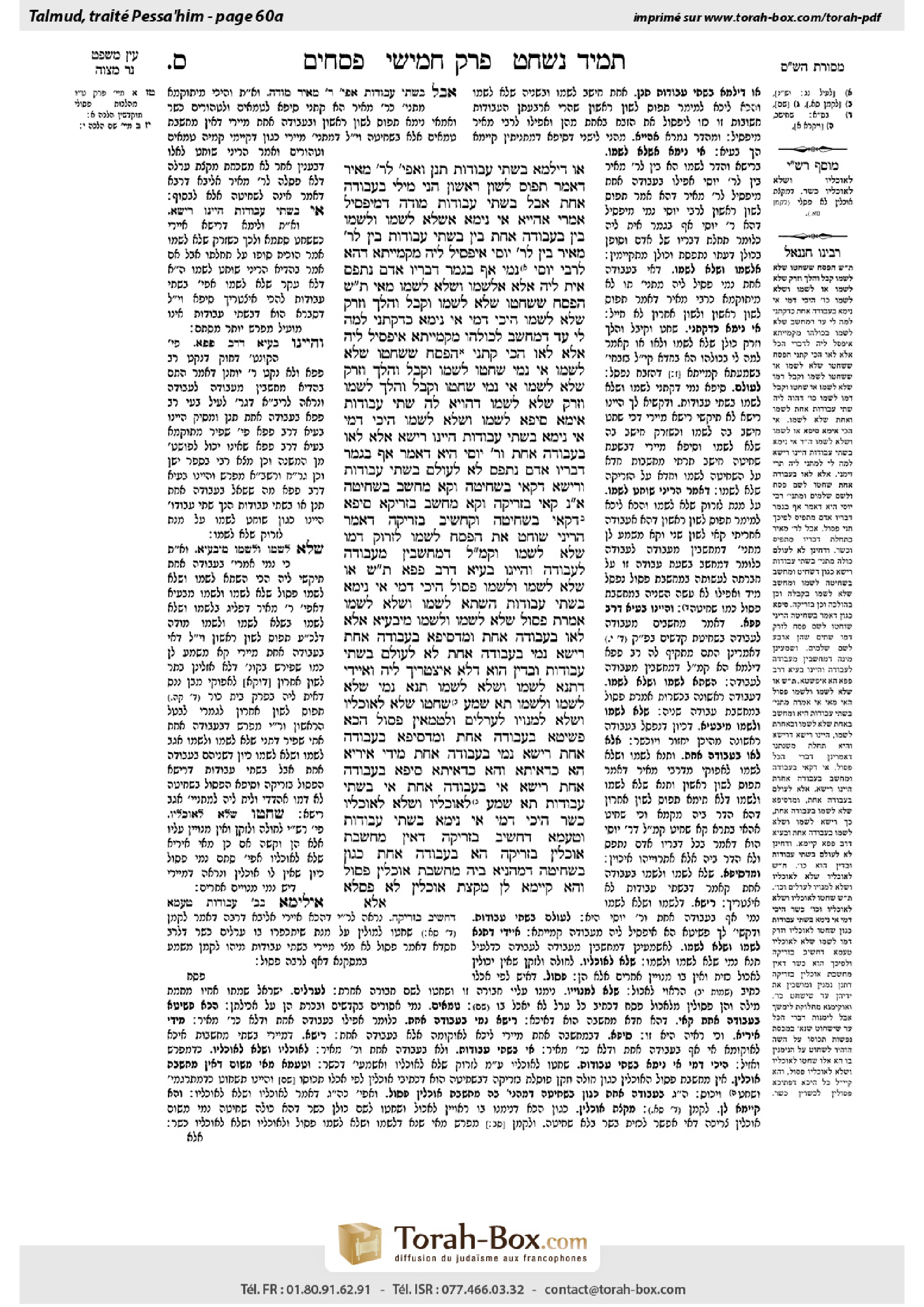
Pesachim 60a: Talmud study for Daf Yomi
Daf Yomi is the daily study of one Talmud folio. Explore 37 tractates with scans, Hebrew text, Sefaria English and AI-generated French translations where annotated.
Passage selection and English or AI-generated French translation are available where the scan has annotations. Daf Study is independent of Torah-Box and Sefaria.
Browse Pesachim · פסחים · All tractatesPesachim 60a text and translations
This page of Pesachim includes the Aramaic text, an English translation and an AI-generated French translation, alongside the scan above.
פסחים ס׳ א · Aramaic and Hebrew text
אוֹ דִילְמָא בִּשְׁתֵּי עֲבוֹדוֹת תְּנַן, וַאֲפִילּוּ לְרַבִּי מֵאִיר דְּאָמַר תְּפוֹס לָשׁוֹן רִאשׁוֹן — הָנֵי מִילֵּי בַּעֲבוֹדָה אַחַת, אֲבָל בִּשְׁתֵּי עֲבוֹדוֹת — מוֹדֶה דְּמִיפְּסִיל.
אָמְרִי: אַהֵיָיא? אִי נֵימָא אַשֶּׁלֹּא לִשְׁמוֹ וְלִשְׁמוֹ, בֵּין בַּעֲבוֹדָה אַחַת בֵּין בִּשְׁתֵּי עֲבוֹדוֹת, בֵּין לְרַבִּי מֵאִיר בֵּין לְרַבִּי יוֹסֵי — אִיפְּסִיל לֵיהּ מִקַּמָּיְיתָא, דְּהָא לְרַבִּי יוֹסֵי נָמֵי, אַף בִּגְמַר דְּבָרָיו אָדָם נִתְפָּס אִית לֵיהּ. אֶלָּא: אַלִּשְׁמוֹ וְשֶׁלֹּא לִשְׁמוֹ — מַאי?
תָּא שְׁמַע: הַפֶּסַח שֶׁשְּׁחָטוֹ שֶׁלֹּא לִשְׁמוֹ, וְקִבֵּל וְהִלֵּךְ וְזָרַק שֶׁלֹּא לִשְׁמוֹ. הֵיכִי דָּמֵי? אִי נֵימָא כִּדְקָתָנֵי, לְמָה לִי עַד דִּמְחַשֵּׁב לְכוּלְּהוּ? מִקַּמָּיְיתָא אִיפְּסִיל לֵיהּ!
אֶלָּא לָאו, הָכִי קָתָנֵי: הַפֶּסַח שֶׁשְּׁחָטוֹ שֶׁלֹּא לִשְׁמוֹ, אִי נָמֵי שְׁחָטוֹ לִשְׁמוֹ וְקִבֵּל וְהִלֵּךְ וְזָרַק שֶׁלֹּא לִשְׁמוֹ. אִי נָמֵי שְׁחָטוֹ וְקִבֵּל וְהִלֵּךְ לִשְׁמוֹ, וְזָרַק שֶׁלֹּא לִשְׁמוֹ. דְּהָוְיָא לַהּ שְׁתֵּי עֲבוֹדוֹת.
אֵימָא סֵיפָא: לִשְׁמוֹ וְשֶׁלֹּא לִשְׁמוֹ, הֵיכִי דָּמֵי? אִי נֵימָא בִּשְׁתֵּי עֲבוֹדוֹת — הַיְינוּ רֵישָׁא! אֶלָּא לָאו, בַּעֲבוֹדָה אַחַת וְרַבִּי יוֹסֵי הִיא, דְּאָמַר: אַף בִּגְמַר דְּבָרָיו אָדָם נִתְפָּס.
לָא, לְעוֹלָם בִּשְׁתֵּי עֲבוֹדוֹת, וְרֵישָׁא — דְּקָאֵי בִּשְׁחִיטָה וְקָא מְחַשֵּׁב בִּשְׁחִיטָה, אִי נָמֵי, קָאֵי בִּזְרִיקָה וְקָא מְחַשֵּׁב בִּזְרִיקָא.
סֵיפָא — דְּקָאֵי בִּשְׁחִיטָה וְקָחָשֵׁיב בִּזְרִיקָה, דְּאָמַר: הֲרֵינִי שׁוֹחֵט אֶת הַפֶּסַח לִשְׁמוֹ לִזְרוֹק דָּמוֹ שֶׁלֹּא לִשְׁמוֹ. וְקָא מַשְׁמַע לַן דִּמְחַשְּׁבִין מֵעֲבוֹדָה לַעֲבוֹדָה, וְהַיְינוּ בַּעְיָא דְּרַב פָּפָּא.
תָּא שְׁמַע: אוֹ שֶׁלֹּא לִשְׁמוֹ וְלִשְׁמוֹ פָּסוּל. הֵיכִי דָּמֵי? אִי נֵימָא בִּשְׁתֵּי עֲבוֹדוֹת, הַשְׁתָּא לִשְׁמוֹ וְשֶׁלֹּא לִשְׁמוֹ אָמְרַתְּ פָּסוּל, שֶׁלֹּא לִשְׁמוֹ וְלִשְׁמוֹ מִיבַּעְיָא?!
אֶלָּא לָאו, בַּעֲבוֹדָה אַחַת. וּמִדְּסֵיפָא בַּעֲבוֹדָה אַחַת — רֵישָׁא נָמֵי בַּעֲבוֹדָה אַחַת!
לָא, לְעוֹלָם בִּשְׁתֵּי עֲבוֹדוֹת, וּבְדִין הוּא דְּלָא אִיצְטְרִיךְ לֵיהּ, וְאַיְּידֵי דִּתְנָא לִשְׁמוֹ וְשֶׁלֹּא לִשְׁמוֹ, תְּנָא נָמֵי שֶׁלֹּא לִשְׁמוֹ וְלִשְׁמוֹ.
תָּא שְׁמַע: שְׁחָטוֹ שֶׁלֹּא לְאוֹכְלָיו, וְשֶׁלֹּא לִמְנוּיָו, לַעֲרֵלִים וְלִטְמֵאִין — פָּסוּל. הָכָא פְּשִׁיטָא בַּעֲבוֹדָה אַחַת, וּמִדְּסֵיפָא בַּעֲבוֹדָה אַחַת — רֵישָׁא נָמֵי בָּעֲבוֹדָה אַחַת!
מִידֵּי אִירְיָא?! הָא כִּדְאִיתָא וְהָא כִּדְאִיתָא: סֵיפָא — בַּעֲבוֹדָה אַחַת, רֵישָׁא — אִי בַּעֲבוֹדָה אַחַת, אִי בִּשְׁתֵּי עֲבוֹדוֹת.
תָּא שְׁמַע: לְאוֹכְלָיו וְשֶׁלֹּא לְאוֹכְלָיו — כָּשֵׁר. הֵיכִי דָּמֵי? אִי נֵימָא בִּשְׁתֵּי עֲבוֹדוֹת, וְטַעְמָא דְּחַשֵּׁיב בִּזְרִיקָה, דְּאֵין מַחְשְׁבֶת אוֹכְלִין בִּזְרִיקָה —
הָא בַּעֲבוֹדָה אַחַת, כְּגוֹן בִּשְׁחִיטָה דְּמַהְנְיָא בַּיהּ מַחְשְׁבֶת אוֹכְלִין — פָּסוּל, וְהָא קַיְימָא לַן מִקְצָת אוֹכְלִין לָא פָּסְלָא!
Pesachim 60a · English translation
Or perhaps the mishna meant to teach a case of two rites. During the first rite, one had a particular intent, and during the second rite he had a different intent. Then, even according to Rabbi Meir, who said that in general we hold one accountable for the first expression, this rule applies only in one rite, but in two rites even he concedes that it disqualifies. Since the second statement was made during a different rite, it too is significant.
They said: To which part of the mishna does this discussion refer? If we say that the discussion pertains to the case in the mishna of slaughtering an offering first for a different purpose and then for its own purpose, then whether these intentions are verbalized during one rite or during two rites, whether according to the opinion of Rabbi Meir or according to the opinion of Rabbi Yosei, the offering is disqualified from the first statement, as also Rabbi Yosei holds that a person is held accountable even for the conclusion of his statement. That does not mean that the final statement is primary but that it too has value and complements the previous one. Therefore, since one initially intended to offer the Paschal lamb for a different purpose, it was immediately disqualified. Rather, the question is concerning the case of slaughtering an animal first for its own purpose and then for a different purpose; what exactly are the parameters of that case?
The Gemara cites a series of sources in order to resolve this question. Come and hear a resolution to the question from what is taught in the mishna: A Paschal lamb that one sacrificed for a different purpose, and he received the blood, and carried it to the altar, and sprinkled it for a different purpose, is disqualified. This needs clarification: What exactly are the circumstances? If we say that the case is exactly as it was taught, that these four rites are all performed for a different purpose, why do I need to say that he intended to perform all of them, i.e., the slaughter, receiving of the blood, carrying the blood to the altar, and sprinkling it upon the altar, for a different purpose? The offering has been disqualified from the first improper intention during slaughter.
Rather, is this not what the mishna is teaching: A Paschal lamb that one slaughtered for a different purpose, or alternatively, he slaughtered it for its own purpose, but received the blood, and carried the blood, and sprinkled the blood for a different purpose, or alternatively, he slaughtered it, and received the blood, and carried the blood for its own purpose, but sprinkled the blood for a different purpose, in all these situations the offering is disqualified? If so, it is a case of different intentions in two rites, and the mishna can also be in accordance with the opinion of Rabbi Meir.
The Gemara asks: If so, say the latter clause of the mishna: For its own purpose and for a different purpose. The Gemara clarifies: What are the circumstances? If we say that one had these two intentions during two different rites, that is precisely the meaning of the first clause and there is no need to repeat it. Rather, must we not say that in this part of the mishna, one had both intentions during one rite, and the mishna is according to the opinion of Rabbi Yosei, who said that a person is held accountable even for the conclusion of his statement?
This proof is refuted: No, actually it is possible to explain that even the latter clause of the mishna is referring to a case in which one has conflicting intentions during two different rites, and the difference between the first clause and the latter clause of the mishna is as follows: The first clause is referring to a case in which one is standing at the time of the slaughter and thinking about slaughtering the animal as a different offering; alternatively, he is standing at the time of the sprinkling of the blood and thinking about sprinkling for a different purpose.
The latter clause of the mishna, on the other hand, is referring to a case in which one is standing at the time of the slaughter and thinking about sprinkling for a different purpose. For example, where he said: I am hereby slaughtering the Paschal lamb for its own purpose, but my intent is to sprinkle its blood for a different purpose. And the mishna teaches us a new halakha, that one can intend from one rite to another rite, meaning that one can disqualify an offering through an improper intention about an upcoming rite while performing an earlier rite. And this was the question raised by Rav Pappa on a different occasion. He asked if intent during one rite concerning the performance of a different rite can disqualify an offering.
Since our question has not been resolved, it is necessary to bring another proof: Come and hear that which is taught in the last clause of the mishna: Or for a different purpose and for its own purpose, the offering is disqualified. The Gemara analyzes this statement: What exactly are the circumstances? If we say that it speaks about two rites, there is a difficulty: Now that you have already said that if the priest first performed a rite while intending that the offering be for its own purpose, and then performed a rite with the intention that it be for a different purpose, the Paschal lamb is disqualified, is it necessary to say that it is disqualified when the priest first performed a rite while intending that the offering be for a different purpose, and then performed a rite with the intention that it be for its own purpose? It is obvious that the offering is disqualified immediately with the first expression of intent.
Rather, isn’t the mishna addressing a case in which the priest has two intentions during one rite? And since the last clause of the mishna talks about one rite, the earlier clause of the mishna must also speak about one rite, and the mishna is according to Rabbi Yosei.
The Gemara refutes this proof: No, actually it is possible to explain that the last clause speaks about two rites, and by right it was not necessary to include this case, as it could have been inferred from the previous case. It was included for stylistic considerations: Since the mishna taught the case in which the rites are performed for its own purpose and for a different purpose, it also taught the case in which the rites are performed for a different purpose and for its own purpose.
The Gemara again attempts to bring a proof: Come and hear that which is taught in a different mishna: If one slaughtered the Paschal lamb with the intent that it be for those who cannot eat it, i.e., for people who physically cannot consume it; or for those who were not registered for it, i.e., for people who did not register in advance for this particular offering; or for uncircumcised or ritually impure people, whom the Torah forbids from consuming the Paschal lamb, it is disqualified. Here, in the mishna cited, it is obvious that one had this intent during one rite, as the mishna explicitly states that he had this intent during the slaughtering. And since the latter clause, which is the next mishna, speaks about one rite, the first clause, which is the current mishna, must also speak about one rite, and it is not in accordance with the opinion of Rabbi Meir.
The Gemara refutes this proof. Are the two cases comparable? Need they be exactly parallel? Perhaps this case is as it is, and that case is as it is. The latter clause, the next mishna, speaks about one rite, whereas the first clause, the current mishna, speaks either about one rite and is not according to Rabbi Meir or about two rites and is even according to Rabbi Meir.
The Gemara further proposes: Come and hear a solution based on what was taught later in that other mishna: If one slaughtered the Paschal lamb with the intent that it be for those who can eat it and for those who cannot eat it, it is valid. This ruling must be clarified: What exactly are the circumstances? If we say that one had two intentions during two different rites, e.g., he slaughtered it for those who can eat it and sprinkled the blood for those who cannot eat it, then the reason that the sacrifice is valid is that he had the disqualifying intention at the time of the sprinkling, which does not invalidate the offering because there is no intent concerning those who can eat it during the sprinkling. That is, intent to feed the Paschal lamb to those who are unable to eat it invalidates the offering only during the slaughter but not during the sprinkling.
But if one had both intentions during one rite, such as the slaughter, during which intent with regard to those who will eat the offering is effective, the sacrifice is disqualified. However, this conclusion is difficult, for we maintain that if only some of those who are to eat the Paschal lamb are unable to do so, such as in this case, the offering is not disqualified.
Pesachim 60a · Traduction française (IA)
Ou peut-être la Michna voulait-elle enseigner le cas de deux rites : lors du premier, on avait une intention particulière, et lors du second, une intention différente. Dans ce cas, même selon Rabbi Meïr, qui dit qu’en règle générale on est tenu pour responsable de sa première déclaration, cette règle ne s’applique que lorsqu’il s’agit d’un seul rite ; mais, lorsqu’il s’agit de deux rites, il reconnaît lui aussi que cela disqualifie l’offrande. Puisque la seconde déclaration a été faite lors d’un rite différent, elle a elle aussi une portée.
Ils dirent : à quelle partie de la Michna cette discussion se rapporte-t-elle ? Si l’on dit qu’elle concerne le cas de la Michna où l’on abat d’abord une offrande dans une intention étrangère, puis dans l’intention qui lui est propre, alors, que ces intentions soient exprimées au cours d’un seul rite ou de deux rites, et que l’on suive l’opinion de Rabbi Meïr ou celle de Rabbi Yossi, l’offrande est disqualifiée dès la première déclaration, car Rabbi Yossi aussi considère qu’une personne est tenue pour responsable même de la conclusion de sa déclaration. Cela ne signifie pas que la déclaration finale prévaut, mais qu’elle a elle aussi une valeur et complète la précédente. Par conséquent, puisque l’on a d’abord eu l’intention d’offrir l’agneau pascal dans une intention étrangère, il a été immédiatement disqualifié. La question porte donc plutôt sur le cas où l’on abat un animal d’abord dans l’intention qui lui est propre, puis dans une intention étrangère : quels sont exactement les paramètres de ce cas ?
La Guemara cite plusieurs sources pour résoudre cette question. Viens et entends une réponse tirée de ce qui est enseigné dans la Michna : un agneau pascal que l’on a sacrifié dans une intention étrangère, dont on a recueilli le sang, que l’on a porté jusqu’à l’autel et dont on a aspergé le sang dans une intention étrangère est disqualifié. Il faut préciser les circonstances exactes. Si l’on dit que le cas est exactement tel qu’il est enseigné, à savoir que ces quatre rites sont tous accomplis dans une intention étrangère, pourquoi préciser que l’on a eu l’intention d’accomplir chacun d’eux — l’abattage, le recueil du sang, son transport jusqu’à l’autel et son aspersion sur l’autel — dans une intention étrangère ? L’offrande a été disqualifiée dès la première intention inadéquate, au moment de l’abattage.
La Michna n’enseigne-t-elle pas plutôt ceci : un agneau pascal que l’on a abattu dans une intention étrangère ; ou bien que l’on a abattu dans l’intention qui lui est propre, mais dont on a recueilli le sang, transporté celui-ci et aspergé celui-ci dans une intention étrangère ; ou encore que l’on a abattu, recueilli le sang et transporté celui-ci dans l’intention qui lui est propre, mais aspergé le sang dans une intention étrangère : dans toutes ces situations, l’offrande est disqualifiée. Si tel est le cas, il s’agit d’intentions différentes lors de deux rites, et la Michna peut aussi être conforme à l’opinion de Rabbi Meïr.
La Guemara demande : si c’est le cas, considère la dernière proposition de la Michna : « dans l’intention qui lui est propre et dans une intention étrangère ». La Guemara précise : quelles sont les circonstances ? Si l’on dit que ces deux intentions ont été exprimées lors de deux rites différents, cela correspond exactement au sens de la première proposition, et il n’était pas nécessaire de répéter ce cas. Ne faut-il pas plutôt dire que, dans cette partie de la Michna, on a eu les deux intentions au cours d’un seul rite, et que la Michna suit l’opinion de Rabbi Yossi, qui dit qu’une personne est tenue pour responsable même de la conclusion de sa déclaration ?
Cette preuve est réfutée : non, en réalité, il est possible d’expliquer que même la dernière proposition de la Michna se rapporte à un cas où l’on a des intentions contradictoires lors de deux rites différents. La différence entre la première proposition et la dernière est la suivante : la première concerne un cas où l’on se tient au moment de l’abattage et où l’on pense à abattre l’animal comme une autre offrande ; ou bien un cas où l’on se tient au moment de l’aspersion du sang et où l’on pense à l’asperger dans une intention étrangère.
La dernière proposition de la Michna, en revanche, concerne un cas où l’on se tient au moment de l’abattage et où l’on pense à asperger le sang dans une intention étrangère. Par exemple, on dit : « Voici que j’abats l’agneau pascal dans l’intention qui lui est propre, mais j’ai l’intention d’asperger son sang dans une intention étrangère. » La Michna nous enseigne ainsi une nouvelle halakha : on peut avoir, lors d’un rite, une intention portant sur un rite à venir, c’est-à-dire disqualifier une offrande en ayant, pendant un rite antérieur, une intention inadéquate concernant un rite ultérieur. C’était la question que Rav Pappa avait posée en une autre occasion. Il avait demandé si une intention formulée pendant un rite au sujet de l’accomplissement d’un autre rite pouvait disqualifier une offrande.
Puisque notre question n’a pas été résolue, il faut apporter une autre preuve. Viens et entends ce qui est enseigné dans la dernière proposition de la Michna : « ou dans une intention étrangère et dans l’intention qui lui est propre », l’offrande est disqualifiée. La Guemara analyse cette déclaration : quelles sont exactement les circonstances ? Si l’on dit qu’elle concerne deux rites, une difficulté se pose : puisque tu as déjà dit que si le prêtre a d’abord accompli un rite avec l’intention que l’offrande soit faite dans l’intention qui lui est propre, puis accompli un rite avec l’intention qu’elle soit faite dans une intention étrangère, l’agneau pascal est disqualifié, faut-il préciser qu’il est disqualifié lorsque le prêtre accomplit d’abord un rite avec l’intention que l’offrande soit faite dans une intention étrangère, puis un rite avec l’intention qu’elle soit faite dans l’intention qui lui est propre ? Il est évident que l’offrande est disqualifiée dès la première expression d’intention.
La Michna ne traite-t-elle pas plutôt d’un cas où le prêtre a deux intentions au cours d’un seul rite ? Et puisque la dernière proposition de la Michna parle d’un seul rite, la proposition précédente doit elle aussi parler d’un seul rite, et la Michna suit l’opinion de Rabbi Yossi.
La Guemara réfute cette preuve : non, en réalité, il est possible d’expliquer que la dernière proposition parle de deux rites et que, à proprement parler, il n’était pas nécessaire d’inclure ce cas, puisqu’on aurait pu le déduire du cas précédent. Il a été inclus pour des raisons de style : puisque la Michna a enseigné le cas où les rites sont accomplis dans l’intention qui leur est propre, puis dans une intention étrangère, elle a aussi enseigné le cas où ils sont accomplis dans une intention étrangère, puis dans l’intention qui leur est propre.
La Guemara tente à nouveau d’apporter une preuve : viens et entends ce qui est enseigné dans une autre Michna : si l’on abat l’agneau pascal avec l’intention qu’il soit destiné à ceux qui ne peuvent pas le manger, c’est-à-dire à des personnes physiquement incapables d’en consommer ; ou à ceux qui n’y ont pas été inscrits, c’est-à-dire à des personnes qui ne se sont pas inscrites à l’avance pour cette offrande particulière ; ou à des incirconcis ou à des personnes en état d’impureté rituelle, à qui la Torah interdit de consommer l’agneau pascal, il est disqualifié. Dans la Michna citée ici, il est évident que cette intention a été exprimée au cours d’un seul rite, puisque la Michna précise explicitement qu’on a eu cette intention au moment de l’abattage. Et puisque la dernière proposition, qui se trouve dans la Michna suivante, parle d’un seul rite, la première proposition, qui se trouve dans la présente Michna, doit elle aussi parler d’un seul rite ; elle n’est donc pas conforme à l’opinion de Rabbi Meïr.
La Guemara réfute cette preuve : les deux cas sont-ils comparables ? Doivent-ils être exactement parallèles ? Peut-être ce cas est-il tel qu’il est, et l’autre cas tel qu’il est. La dernière proposition, dans la Michna suivante, parle d’un seul rite, tandis que la première proposition, dans la présente Michna, parle soit d’un seul rite et n’est pas conforme à l’opinion de Rabbi Meïr, soit de deux rites et est même conforme à son opinion.
La Guemara propose encore : viens et entends une réponse fondée sur ce qui est enseigné plus loin dans cette autre Michna : si l’on abat l’agneau pascal avec l’intention qu’il soit destiné à ceux qui peuvent le manger et à ceux qui ne peuvent pas le manger, il est valide. Il faut préciser cette décision : quelles sont exactement les circonstances ? Si l’on dit qu’on a eu deux intentions lors de deux rites différents, par exemple qu’on l’a abattu pour ceux qui peuvent le manger et qu’on a aspergé le sang pour ceux qui ne peuvent pas le manger, alors la raison pour laquelle le sacrifice est valide est que l’on a eu l’intention disqualifiante au moment de l’aspersion ; cela n’invalide pas l’offrande, car l’intention concernant ceux qui peuvent le manger n’intervient pas au moment de l’aspersion. Autrement dit, l’intention de destiner l’agneau pascal à ceux qui sont incapables de le manger n’invalide l’offrande qu’au moment de l’abattage, et non au moment de l’aspersion.
Mais si l’on a eu les deux intentions au cours d’un seul rite, tel que l’abattage, où l’intention concernant ceux qui mangeront l’offrande est opérante, le sacrifice est disqualifié. Cette conclusion soulève toutefois une difficulté, car nous soutenons que si seuls certains de ceux qui doivent manger l’agneau pascal sont incapables de le faire, comme dans ce cas, l’offrande n’est pas disqualifiée.
Traduction française générée par IA à partir de l’édition anglaise de Sefaria. Vérifie toujours un passage avec le texte source.
Text from Sefaria: William Davidson Edition - Vocalized Aramaic (CC BY NC); William Davidson Edition - English (CC BY NC).