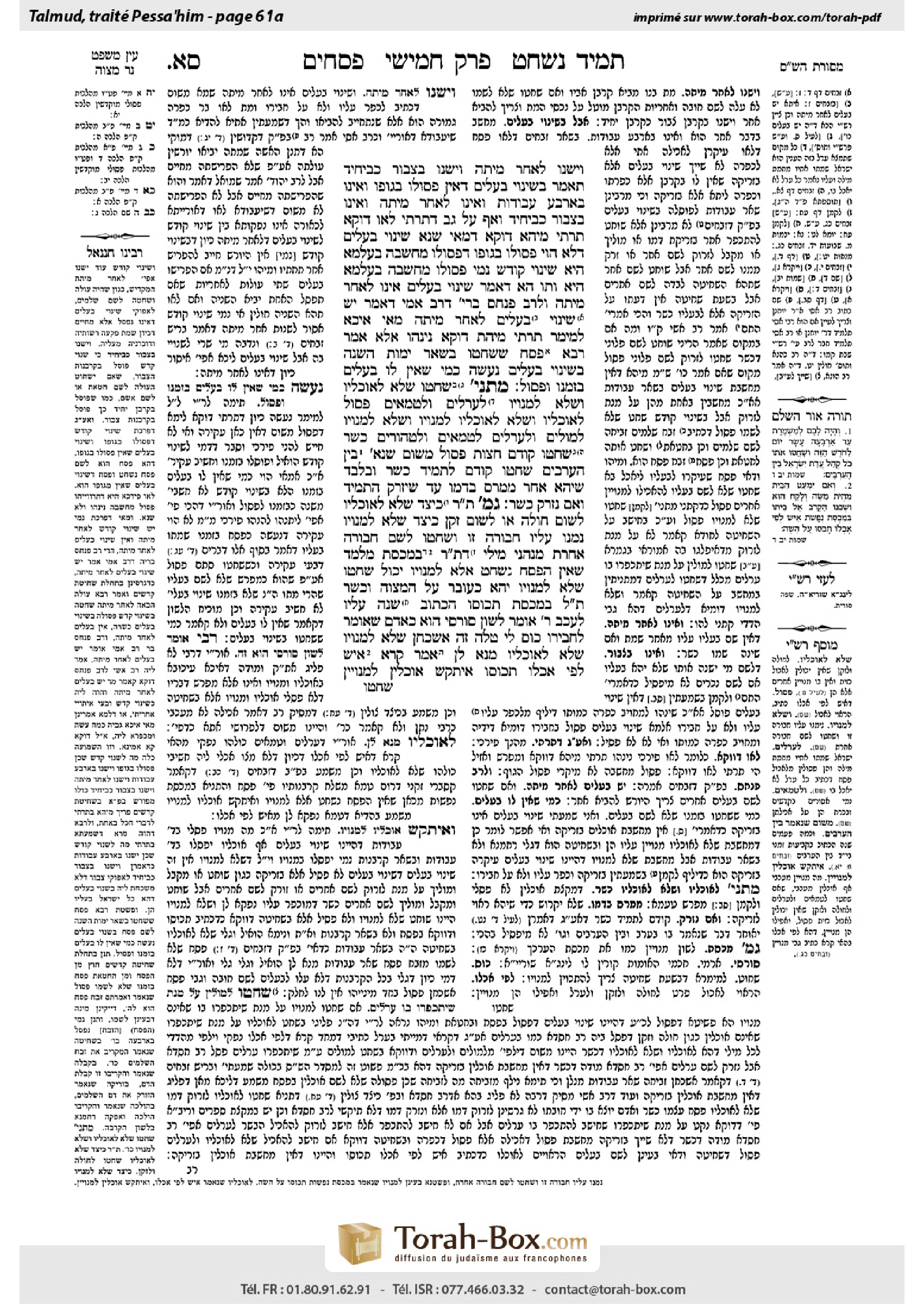
Pesachim 61a: Talmud study for Daf Yomi
Daf Yomi is the daily study of one Talmud folio. Explore 37 tractates with scans, Hebrew text, Sefaria English and AI-generated French translations where annotated.
Passage selection and English or AI-generated French translation are available where the scan has annotations. Daf Study is independent of Torah-Box and Sefaria.
Browse Pesachim · פסחים · All tractatesPesachim 61a text and translations
This page of Pesachim includes the Aramaic text, an English translation and an AI-generated French translation, alongside the scan above.
פסחים ס״א א · Aramaic and Hebrew text
וְיֶשְׁנוֹ לְאַחַר מִיתָה, וְיֶשְׁנוֹ בְּצִבּוּר כְּבַיָּחִיד. תֹּאמַר בְּשִׁינּוּי בְּעָלִים — דְּאֵין פְּסוּלוֹ בְּגוּפוֹ, וְאֵינוֹ בְּאַרְבַּע עֲבוֹדוֹת, וְאֵינוֹ לְאַחַר מִיתָה, וְאֵינוֹ בְּצִבּוּר כְּבַיָּחִיד.
וְאַף עַל גַּב דְּתַרְתֵּי לָאו דַּוְקָא, תַּרְתֵּי מִיהָא דַּוְקָא. דְּמַאי שְׁנָא שִׁינּוּי בְּעָלִים דְּלָא הָוֵי פְּסוּלוֹ בְּגוּפוֹ — דִּפְסוּלוֹ מַחְשָׁבָה בְּעָלְמָא הִיא. שִׁינּוּי קוֹדֶשׁ נָמֵי — פְּסוּלוֹ מַחְשָׁבָה בְּעָלְמָא הִיא.
וְתוּ, הָא דְּאָמַר שִׁינּוּי בְּעָלִים אֵינוֹ לְאַחַר מִיתָה, וּלְרַב פִּנְחָס בְּרֵיהּ דְּרַב אַמֵּי דְּאָמַר יֵשׁ שִׁינּוּי בְּעָלִים לְאַחַר מִיתָה, מַאי אִיכָּא לְמֵימַר? תַּרְתֵּי מִיהַת דַּוְקָא נִינְהוּ.
אֶלָּא, אָמַר רָבָא: פֶּסַח שֶׁשְּׁחָטוֹ בִּשְׁאָר יְמוֹת הַשָּׁנָה בְּשִׁינּוּי בְּעָלִים — נַעֲשָׂה כְּמִי שֶׁאֵין לוֹ בְּעָלִים בִּזְמַנּוֹ, וּפְסוּל.
מַתְנִי׳ שְׁחָטוֹ שֶׁלֹּא לְאוֹכְלָיו, וְשֶׁלֹּא לִמְנוּיָו, לַעֲרֵלִים וְלִטְמֵאִים — פָּסוּל. לְאוֹכְלָיו וְשֶׁלֹּא לְאוֹכְלָיו לִמְנוּיָו וְשֶׁלֹּא לִמְנוּיָו, לְמוּלִים וְלַעֲרֵלִים, לִטְמֵאִים וְלִטְהוֹרִים — כָּשֵׁר.
שְׁחָטוֹ קוֹדֶם חֲצוֹת — פָּסוּל, מִשּׁוּם שֶׁנֶּאֱמַר ״בֵּין הָעַרְבַּיִם״. שְׁחָטוֹ קוֹדֶם לַתָּמִיד — כָּשֵׁר, וּבִלְבַד שֶׁיְּהֵא אַחֵר מְמָרֵס בְּדָמוֹ עַד שֶׁיִּזָּרֵק הַתָּמִיד. וְאִם נִזְרַק — כָּשֵׁר.
גְּמָ׳ תָּנוּ רַבָּנַן: כֵּיצַד שֶׁלֹּא לְאוֹכְלָיו? לְשׁוּם חוֹלֶה אוֹ לְשׁוּם זָקֵן. כֵּיצַד שֶׁלֹּא לִמְנוּיָו? נִמְנוּ עָלָיו חֲבוּרָה זוֹ, וּשְׁחָטוֹ לְשֵׁם חֲבוּרָה אַחֶרֶת.
מְנָהָנֵי מִילֵּי? דְּתָנוּ רַבָּנַן: ״בְּמִכְסַת״ — מְלַמֵּד שֶׁאֵין הַפֶּסַח נִשְׁחָט אֶלָּא לִמְנוּיָו,
יָכוֹל שְׁחָטוֹ שֶׁלֹּא לִמְנוּיָו יְהֵא כְּעוֹבֵר עַל הַמִּצְוָה וְכָשֵׁר — תַּלְמוּד לוֹמַר: ״בְּמִכְסַת ... תָּכֹסּוּ״, הַכָּתוּב שָׁנָה עָלָיו לְעַכֵּב.
רַבִּי אוֹמֵר: לָשׁוֹן סוּרְסִי הוּא, כְּאָדָם שֶׁאוֹמֵר לַחֲבֵירוֹ ״כּוֹס לִי טָלֶה זֶה״.
אַשְׁכְּחַן שֶׁלֹּא לִמְנוּיָו, שֶׁלֹּא לְאוֹכְלָיו מְנָא לַן? אָמַר קְרָא ״אִישׁ לְפִי אׇכְלוֹ תָּכוֹסּוּ״, אִיתַּקַּשׁ אוֹכְלִין לִמְנוּיִין.
Pesachim 61a · English translation
And furthermore, the disqualification following from a change in sanctity applies after death. If one consecrates an offering and dies, his son must bring the offering in his place, and it can be invalidated through a change in sanctity. Moreover, it applies to communal offerings as it does to the offerings of an individual. However, can you necessarily say the same thing with regard to a change in owner that does not have these characteristics? Its disqualification is not in the offering itself; and it does not apply to all four rites but only to the sprinkling of the blood on the altar; and it does not apply after death, for after the owner has died there is no true owner of the offering, and therefore, if the priest intends to offer it for someone else the offering remains valid; and it does not apply to communal offerings as it does to the offerings of an individual, since it is not possible to have in mind a different owner, as it is owned by the whole community.
And even though two of these differences are not fully accurate and can be disputed, as will be explained, two, at least, are accurate. The Gemara explains the lack of accuracy: For what is different about a change in owner that defines its disqualification as not being in the offering itself? Is it that its disqualification is merely due to thought? If so, it is possible to say that a change of sanctity is also merely a disqualification due to thought and not in the offering itself, and therefore there is no real difference.
And furthermore, with regard to that which was said, that a change in owner does not apply after death, there is the following difficulty: According to Rav Pineḥas, son of Rav Ami, who said that the disqualification resulting from a change in owner applies after death, so that if the offering of the deceased was brought for a different person, the son of the deceased must bring another offering in his father’s name, what is there to say? However, at least two of these differences are accurate.
Rather, Rav Pappa’s suggestion should be rejected, and Rava said: A Paschal lamb that one slaughtered on the rest of the days of the year with a change of owner is considered like one that does not have an owner. In other words, it is considered like a Paschal lamb that was slaughtered not for the sake of its owner at its proper time on Passover eve, and it is disqualified.
MISHNA: If one slaughtered the Paschal lamb for people who cannot eat it or for those who did not register in advance to eat it, or if one slaughtered it for people who are uncircumcised or for those who are ritually impure, whom the Torah prohibits from eating the Paschal lamb, it is disqualified. However, if one slaughtered it for those who can eat it and for those who cannot eat it; for those who have registered for it and for those who have not registered for it; for the circumcised and for the uncircumcised; for the ritually impure and for the ritually pure, it is valid, for a partially invalid intent does not disqualify the offering.
If one slaughtered the Paschal lamb before midday it is disqualified, as it is stated: “And the whole assembly of the congregation of Israel shall slaughter it in the afternoon” (Exodus 12:6). If he slaughtered it before the daily afternoon offering it is valid, as long as another person stirs its blood in order to prevent it from congealing until the blood of the daily offering is sprinkled. And if the blood of the Paschal lamb is sprinkled before the blood of the daily offering, it is nonetheless valid, as this change does not disqualify the offering.
GEMARA: The Sages taught in the Tosefta: How so the case of slaughtering the Paschal lamb for those who cannot eat it? It is a case where one slaughtered it for the sake of a sick person or for the sake of an old person who is unable to eat even an olive-sized portion of the Paschal lamb. How so the case of slaughtering the Paschal lamb for those who did not register for it? It is a case where one group registered for it, and one slaughtered it for the sake of a different group.
The Gemara asks: From where are these matters, which are not explicitly written in the Torah, derived? The Gemara answers: As the Sages taught with regard to the verse: “And if the household be too little for a lamb, then he and his neighbor who is close to his house shall take one according to the number of the souls; according to every man’s eating you shall make your count for the lamb” (Exodus 12:4). “According to the number of” teaches that the Paschal lamb is slaughtered only for those who have registered for it. Everything is done according to the number of people who have registered before the slaughtering.
I might have thought that if he slaughtered it for those who did not register for it, he would be considered as one who has violated a commandment, but nonetheless the offering would be valid after the fact. Therefore, the Torah teaches this law with the double formulation of “according to the number” and “you shall make your count”; the verse repeated it to make this requirement indispensable, so that the offering is disqualified if it is slaughtered for those who did not register for it.
Rabbi Yehuda HaNasi says: The term “you shall make your count [takhosu]” is Aramaic [Sursi], like one who says to his fellow: Slaughter [kos] me this lamb, to teach that the registration must take place before the slaughtering.
We have found a source for the halakha that a Paschal lamb slaughtered for those who have not registered for it is disqualified. But from where do we derive the halakha that it is similarly disqualified if it is slaughtered for those who cannot eat it? The Gemara answers that the verse says: “According to every man’s eating you shall make your count”; those who eat it are juxtaposed, and thereby equated, to those who are registered for it. This teaches that just as the offering is disqualified if it is slaughtered for those who did not register for it, it is likewise disqualified if it is slaughtered for those who cannot eat it.
Pesachim 61a · Traduction française (IA)
De plus, la disqualification due à un changement de sainteté s’applique après la mort. Si quelqu’un consacre une offrande puis meurt, son fils doit apporter l’offrande à sa place, et celle-ci peut être invalidée par un changement de sainteté. En outre, cette règle s’applique aux offrandes communautaires comme aux offrandes individuelles. Mais peut-on nécessairement en dire autant d’un changement de propriétaire, qui ne présente pas ces caractéristiques ? La disqualification ne touche pas l’offrande elle-même ; elle ne s’applique pas aux quatre rites, mais seulement à l’aspersion du sang sur l’autel ; elle ne s’applique pas après la mort, car, une fois le propriétaire décédé, l’offrande n’a plus de véritable propriétaire et, par conséquent, si le prêtre a l’intention de l’offrir pour quelqu’un d’autre, elle reste valide ; enfin, elle ne s’applique pas aux offrandes communautaires comme aux offrandes individuelles, puisqu’il est impossible d’avoir l’intention de la destiner à un autre propriétaire, car elle appartient à toute la communauté.
Et même si deux de ces différences ne sont pas tout à fait exactes et peuvent être contestées, comme cela sera expliqué, au moins deux sont exactes. La Guemara explique pourquoi l’une de ces différences n’est pas exacte : en quoi le changement de propriétaire se distingue-t-il, au point que sa disqualification ne touche pas l’offrande elle-même ? Est-ce parce qu’il s’agit simplement d’une disqualification due à une intention ? Si tel est le cas, on peut également dire qu’un changement de sainteté n’entraîne qu’une disqualification due à une intention, et non à l’offrande elle-même ; il n’y a donc pas de véritable différence.
En outre, au sujet de l’affirmation selon laquelle le changement de propriétaire ne s’applique pas après la mort, une difficulté se pose : selon Rav Pineḥas, fils de Rav Ami, qui enseigne que la disqualification due à un changement de propriétaire s’applique après la mort, de sorte que, si l’offrande du défunt a été apportée pour une autre personne, son fils doit en apporter une autre au nom de son père, que peut-on répondre ? Toutefois, au moins deux de ces différences sont exactes.
Il faut donc rejeter la proposition de Rav Pappa. Rava a dit : un agneau pascal abattu pendant les autres jours de l’année avec l’intention de le destiner à un autre propriétaire est considéré comme n’ayant pas de propriétaire. Autrement dit, il est considéré comme un agneau pascal abattu sans être destiné à son propriétaire, au moment où il convient de l’abattre, la veille de Pessa’h ; il est donc disqualifié.
Michna : Si quelqu’un abat l’agneau pascal pour des personnes qui ne peuvent pas le manger ou qui ne s’y sont pas inscrites à l’avance, ou pour des personnes incirconcises ou rituellement impures, auxquelles la Torah interdit de manger l’agneau pascal, celui-ci est disqualifié. Toutefois, s’il l’abat à la fois pour des personnes qui peuvent le manger et pour des personnes qui ne le peuvent pas ; pour des personnes qui s’y sont inscrites et pour des personnes qui ne s’y sont pas inscrites ; pour des circoncis et des incirconcis ; pour des personnes rituellement impures et des personnes rituellement pures, il est valide, car une intention partiellement invalide ne disqualifie pas l’offrande.
Si quelqu’un abat l’agneau pascal avant midi, il est disqualifié, comme il est dit : « Toute l’assemblée de la communauté d’Israël l’abattra au crépuscule » (Exode 12, 6). S’il l’abat avant le sacrifice quotidien de l’après-midi, il est valide, à condition qu’une autre personne remue son sang afin d’éviter qu’il ne coagule jusqu’à ce que le sang du sacrifice quotidien soit aspergé. Et si le sang de l’agneau pascal est aspergé avant celui du sacrifice quotidien, il est néanmoins valide, car cette inversion ne disqualifie pas l’offrande.
Guemara : Les Sages ont enseigné dans la Tosefta : quel est le cas où l’on abat l’agneau pascal pour des personnes qui ne peuvent pas le manger ? C’est le cas où l’on l’a abattu pour un malade ou pour une personne âgée incapable d’en manger même un volume d’olive. Quel est le cas où l’on abat l’agneau pascal pour des personnes qui ne s’y sont pas inscrites ? C’est le cas où un groupe s’y est inscrit, mais où l’on l’a abattu pour un autre groupe.
La Guemara demande : de quelles sources déduit-on ces règles, qui ne sont pas explicitement énoncées dans la Torah ? La Guemara répond : les Sages ont enseigné au sujet du verset : « Si la maisonnée est trop peu nombreuse pour un agneau, lui et son voisin le plus proche de sa maison le prendront selon le nombre des personnes ; vous ferez le compte pour l’agneau d’après ce que chacun peut manger » (Exode 12, 4). L’expression « selon le nombre » enseigne que l’agneau pascal n’est abattu que pour ceux qui s’y sont inscrits. Tout se fait en fonction du nombre de personnes inscrites avant l’abattage.
J’aurais pu penser que, si quelqu’un l’avait abattu pour des personnes qui ne s’y étaient pas inscrites, il serait considéré comme ayant transgressé un commandement, mais que l’offrande resterait néanmoins valide après coup. C’est pourquoi la Torah enseigne cette règle au moyen de la double formulation « selon le nombre » et « vous ferez le compte » : le verset répète cette exigence afin de la rendre indispensable, de sorte que l’offrande est disqualifiée si elle est abattue pour des personnes qui ne s’y sont pas inscrites.
Rabbi Yehuda HaNasi dit : le terme « vous ferez le compte [takhosu] » est araméen [Sursi], comme lorsqu’on dit à son compagnon : « Abats [kos] cet agneau pour moi ». Cela enseigne que l’inscription doit avoir lieu avant l’abattage.
Nous avons trouvé une source pour la halakha selon laquelle un agneau pascal abattu pour des personnes qui ne s’y sont pas inscrites est disqualifié. Mais d’où déduit-on qu’il est également disqualifié s’il est abattu pour des personnes qui ne peuvent pas le manger ? La Guemara répond que le verset dit : « D’après ce que chacun peut manger, vous ferez le compte » ; les personnes qui le mangent sont rapprochées de celles qui s’y sont inscrites et ainsi assimilées à elles. Cela enseigne que, de même que l’offrande est disqualifiée si elle est abattue pour des personnes qui ne s’y sont pas inscrites, elle est également disqualifiée si elle est abattue pour des personnes qui ne peuvent pas la manger.
Traduction française générée par IA à partir de l’édition anglaise de Sefaria. Vérifie toujours un passage avec le texte source.
Text from Sefaria: William Davidson Edition - Vocalized Aramaic (CC BY NC); William Davidson Edition - English (CC BY NC).