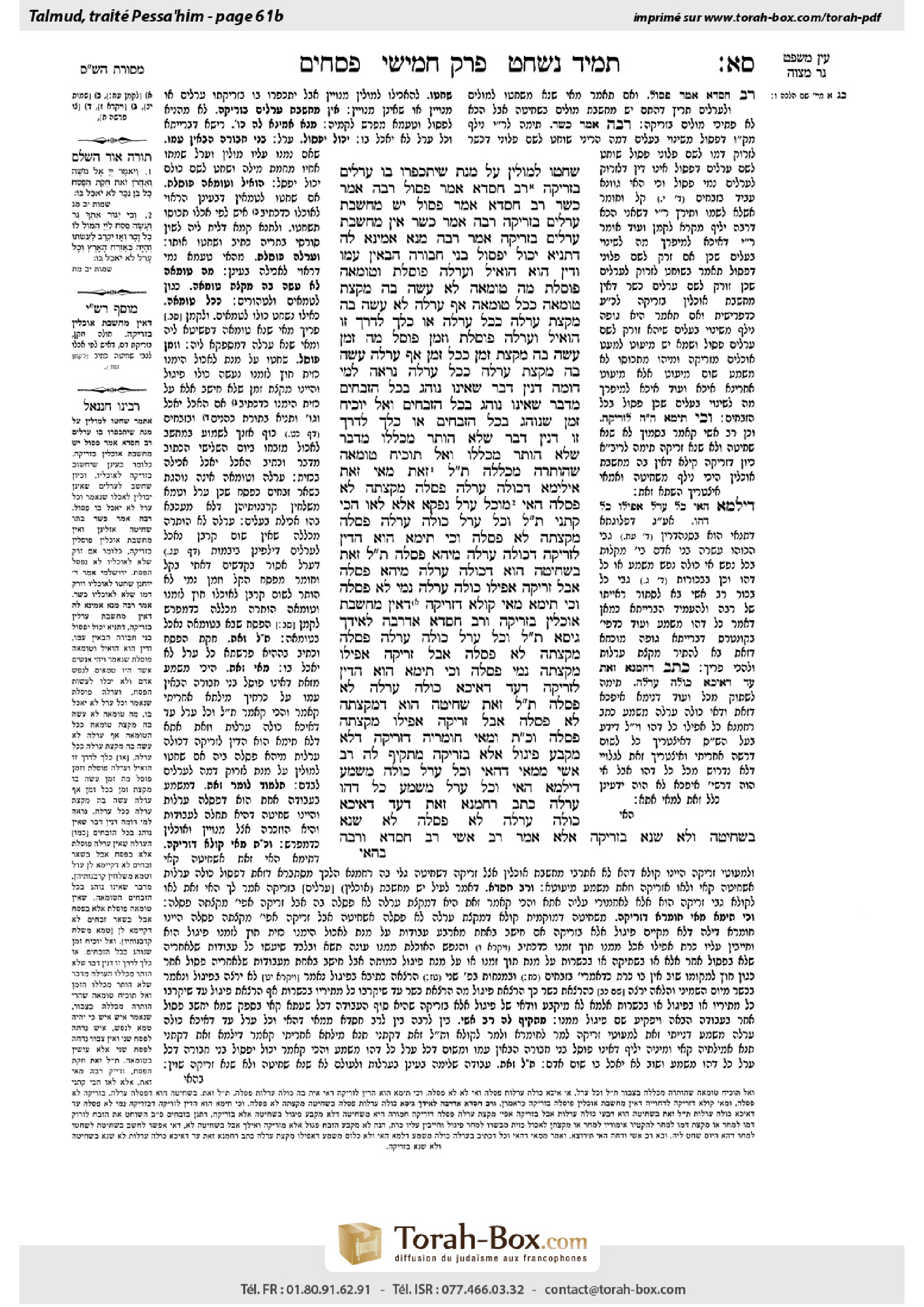
Pesachim 61b: Talmud study for Daf Yomi
Daf Yomi is the daily study of one Talmud folio. Explore 37 tractates with scans, Hebrew text, Sefaria English and AI-generated French translations where annotated.
Passage selection and English or AI-generated French translation are available where the scan has annotations. Daf Study is independent of Torah-Box and Sefaria.
Browse Pesachim · פסחים · All tractatesPesachim 61b text and translations
This page of Pesachim includes the Aramaic text, an English translation and an AI-generated French translation, alongside the scan above.
פסחים ס״א ב · Aramaic and Hebrew text
שְׁחָטוֹ לְמוּלִין, עַל מְנָת שֶׁיִּתְכַּפְּרוּ בּוֹ עֲרֵלִים בִּזְרִיקָה. רַב חִסְדָּא אָמַר: פָּסוּל. רַבָּה אָמַר: כָּשֵׁר. רַב חִסְדָּא אָמַר פָּסוּל — יֵשׁ מַחְשֶׁבֶת עֲרֵלִים בִּזְרִיקָה. רַבָּה אָמַר כָּשֵׁר — אֵין מַחְשֶׁבֶת עֲרֵלִים בִּזְרִיקָה.
אָמַר רַבָּה: מְנָא אָמֵינָא לַהּ? דְּתַנְיָא: יָכוֹל יִפְסוֹל בְּנֵי חֲבוּרָה הַבָּאִין עִמּוֹ? וְדִין הוּא: הוֹאִיל וְעׇרְלָה פּוֹסֶלֶת וְטוּמְאָה פּוֹסֶלֶת, מָה טוּמְאָה לֹא עָשָׂה בָּהּ מִקְצָת טוּמְאָה כְּכׇל טוּמְאָה — אַף עׇרְלָה לֹא עָשָׂה בָּהּ מִקְצָת עׇרְלָה כְּכׇל עׇרְלָה.
אוֹ כַּלֵּךְ לְדֶרֶךְ זוֹ: הוֹאִיל וְעׇרְלָה פּוֹסֶלֶת וּזְמַן פּוֹסֵל, מָה זְמַן — עָשָׂה בָּהּ מִקְצָת זְמַן כְּכׇל זְמַן, אַף עׇרְלָה — עָשָׂה בָּהּ מִקְצָת עׇרְלָה כְּכׇל עׇרְלָה.
נִרְאֶה לְמִי דּוֹמֶה: דָּנִין דָּבָר שֶׁאֵינוֹ נוֹהֵג בְּכׇל הַזְּבָחִים מִדָּבָר שֶׁאֵינוֹ נוֹהֵג בְּכׇל הַזְּבָחִים, וְאַל יוֹכִיחַ זְמַן שֶׁנּוֹהֵג בְּכׇל הַזְּבָחִים.
אוֹ כַּלֵּךְ לְדֶרֶךְ זוֹ: דָּנִין דָּבָר שֶׁלֹּא הוּתַּר מִכְּלָלוֹ מִדָּבָר שֶׁלֹּא הוּתַּר מִכְּלָלוֹ, וְאַל תּוֹכִיחַ טוּמְאָה — שֶׁהוּתְּרָה מִכְּלָלָהּ.
תַּלְמוּד לוֹמַר ״זֹאת״. מַאי ״זֹאת״? אִילֵּימָא דְּכוּלַּהּ עׇרְלָה — פָּסְלָה, מִקְצָתַהּ — לָא פָּסְלָה, הַאי מִ״וְּכׇל עָרֵל״ נָפְקָא!
אֶלָּא לָאו הָכִי קָתָנֵי: תַּלְמוּד לוֹמַר ״וְכׇל עָרֵל״ — כּוּלַּהּ עׇרְלָה פָּסְלָה, מִקְצָתַהּ — לָא פָּסְלָה. וְכִי תֵּימָא הוּא הַדִּין לִזְרִיקָה, דְּכוּלַּהּ עׇרְלָה מִיהָא פָּסְלָה — תַּלְמוּד לוֹמַר ״זֹאת״: בִּשְׁחִיטָה הוּא דְּכוּלַּהּ עׇרְלָה מִיהָא פָּסְלָה, אֲבָל זְרִיקָה — אֲפִילּוּ כּוּלַּהּ עׇרְלָה נָמֵי לָא פָּסְלָה.
וְכִי תֵּימָא מַאי קוּלָּא דִזְרִיקָה? דְּאֵין מַחְשְׁבֶת אוֹכְלִין בִּזְרִיקָה.
וְרַב חִסְדָּא, אַדְּרַבָּה לְאִידַּךְ גִּיסָא: תַּלְמוּד לוֹמַר ״וְכׇל עָרֵל״ — כּוּלַּהּ עׇרְלָה פָּסְלָה, מִקְצָתָהּ — לָא פָּסְלָה. אֲבָל זְרִיקָה — אֲפִילּוּ מִקְצָתָהּ נָמֵי פָּסְלָה. וְכִי תֵּימָא הוּא הַדִּין לִזְרִיקָה, דְּעַד דְּאִיכָּא כּוּלַּהּ עׇרְלָה לָא פָּסְלָה, תַּלְמוּד לוֹמַר ״זֹאת״: שְׁחִיטָה הוּא דְּמִקְצָתַהּ לָא פָּסְלָה, אֲבָל זְרִיקָה — אֲפִילּוּ מִקְצָתַהּ פָּסְלָה.
וְכִי תֵּימָא וּמַאי חוּמְרֵיהּ דִּזְרִיקָה? דְּלָא מִקְּבַע פִּיגּוּל אֶלָּא בִּזְרִיקָה.
מַתְקֵיף לַהּ רַב אָשֵׁי: מִמַּאי דְּהַאי ״וְכׇל עָרֵל״ כּוּלַּהּ מַשְׁמַע? דִּילְמָא הַאי ״וְכׇל עָרֵל״ מַשְׁמַע כׇּל דְּהוּ עׇרְלָה, כְּתַב רַחֲמָנָא ״זֹאת״, דְּעַד דְּאִיכָּא כּוּלַּהּ עׇרְלָה — לָא פָּסְלָה, לָא שְׁנָא בִּשְׁחִיטָה וְלָא שְׁנָא בִּזְרִיקָה. אֶלָּא אָמַר רַב אָשֵׁי: רַב חִסְדָּא וְרַבָּה
Pesachim 61b · English translation
If one slaughtered the Paschal lamb for people who are circumcised on condition that uncircumcised people achieve atonement through the sprinkling of its blood, i.e., although the uncircumcised people are prohibited from eating the Paschal lamb, it was his intention that they achieve atonement through the blood of the offering, Rav Ḥisda said: The offering is disqualified. Rabba said: It is valid. The Gemara explains: Rav Ḥisda said it is disqualified because intent that the offering should be for uncircumcised people has sufficient force to disqualify the offering at the time of the sprinkling. Rabba said that it is valid because intent that the offering should be for uncircumcised people can only disqualify the offering during the slaughter and not during the sprinkling.
Rabba said: From where do I derive to say this halakha? As it was taught in a baraita: I might have thought that an uncircumcised person would disqualify the other fit members of the group who come with him. And it may be inferred logically to the contrary that he does not disqualify the others: Since lack of circumcision disqualifies a Paschal lamb slaughtered for that person, and similarly, ritual impurity disqualifies it, the following can be said: Just as with ritual impurity, partial impurity was not made to be like full impurity, meaning that if one member of the group for which the offering is slaughtered is ritually impure, the offering is not disqualified for the entire group, so too, with lack of circumcision; partial lack of circumcision was not made to be like full lack of circumcision, meaning that if one member of the group is uncircumcised, the offering is not disqualified as it would be if all members of the group were uncircumcised.
Or perhaps go this way and maintain the following: Since lack of circumcision disqualifies the offering, and similarly, intent to eat the offering beyond the allotted time disqualifies the offering, this can be said: Just as if one said at the time of the slaughter that he intended to eat part of the offering beyond the allotted time, partial invalid intent was made to be like intent to eat the entire offering at an invalid time, and the offering is disqualified, so too, with lack of circumcision; partial lack of circumcision was made to be like full lack of circumcision, and the offering is disqualified.
Let us see to which it is similar, i.e., which comparison seems more reasonable: Do we derive a matter, namely, the halakha with regard to uncircumcised males, that does not apply to all offerings, from another matter, namely, the halakha with regard to the ritually impure, that does not apply to all offerings, as when it comes to other offerings, one who is ritually impure may send his offering with a proxy and thereby achieve atonement? And the halakha with regard to intent to eat the offering beyond the allotted time, which applies to all other offerings, should not be used to prove anything about our case.
Or, perhaps, go this way: We derive a matter, namely, the law with regard to uncircumcised males, for which no allowance is made from its rule, from a matter, namely improper intent with regard to the time, for which no allowance is made from its rule, as there are no exceptions for either of these two disqualifications. And the law with regard to ritual impurity should not be used to prove anything, as there are circumstances in which an allowance is made from its rule. Under certain circumstances it is permitted to offer the Paschal lamb while ritually impure, such as when the entire Jewish people is ritually impure.
In order to resolve this issue, the verse states: “This,” as it says: “And the Lord said to Moses and Aaron: This is the ordinance of the Passover: No stranger shall eat of it; but every man’s servant that is bought for money, when you have circumcised him, then shall he eat of it” (Exodus 12:43–44). What is implied from the emphasis of “this”? If you say that it comes to teach that if all the members of the group are uncircumcised the offering is disqualified, but if only part of the group is uncircumcised it is not disqualified, this is derived from the words “and all uncircumcised males,” in the verse: “And all uncircumcised males shall not eat of it” (Exodus 12:48). The amplification indicated by the word all teaches that the offering is invalidated only if all members of the group are uncircumcised.
Rather, is this not what it is teaching: The verse states: “And all uncircumcised males,” to teach that only if all members of the group are uncircumcised is the offering disqualified, but if only part of the group is uncircumcised it is not disqualified. And if you say that the same is true of sprinkling the blood of the offering, i.e., that if it is done for a group whose members are all uncircumcised, the offering is in any event disqualified; therefore the verse states: “This,” to restrict application of this law and teach: It is during slaughter that if all members of a group are uncircumcised, the offering is disqualified; but during sprinkling, even if all members of the group are uncircumcised, it is not disqualified.
And if you say: What is the leniency of sprinkling such that this intent for a group whose members are all uncircumcised disqualifies the offering only during the slaughter but not during the sprinkling? Rabba’s reasoning is that there is no intent concerning those who may eat of the offering during the sprinkling. Intent to feed the Paschal lamb to those who are unable to eat it invalidates the offering only during the slaughter, but not during the sprinkling.
And Rav Ḥisda is of the opinion that, on the contrary, the baraita should be understood in the opposite direction. The verse states: “And all uncircumcised males,” teaching that only if all the members of the group are uncircumcised is the offering disqualified, but if only part of the group is uncircumcised, it is not disqualified. This applies during slaughter; however, during the sprinkling, even if only part of the group is uncircumcised it is disqualified. And if you say that the same is true of sprinkling in that the offering is not disqualified unless all members are uncircumcised; therefore the verse states “this” to restrict the application of this halakha and teach that it is only during slaughter that part of the group does not disqualify the offering, but during the sprinkling even part of the group disqualifies the offering.
And if you say: What is the stringency of sprinkling such that part of the group being uncircumcised disqualifies the offering during the sprinkling, but not during slaughter? The answer is that piggul status is established only during sprinkling. The status of piggul applies to an offering when one performs at least one of the rites with the intent that the offering be consumed outside the allotted time, but only if no rite was performed with some other invalid intent, such as intending that the offering be eaten outside its designated place. This can only be confirmed at the time of the sprinkling, which is the last of the four essential rites. Consequently, sprinkling is the rite most likely to disqualify an offering due to improper intent.
Rav Ashi strongly objects to this method of interpretation: From where do you derive that this expression “and all uncircumcised males” means that all the members of the group are uncircumcised? Perhaps this expression “and all [kol] uncircumcised males” means that any of its members is uncircumcised. Therefore, the Merciful One says in the Torah: “This,” to teach that the offering is not disqualified unless all of its members are uncircumcised, and there is no difference between slaughtering and sprinkling. Therefore, the dispute between Rabba and Rav Ḥisda must be based on some other proof text and issue. Rather, Rav Ashi said: Rav Ḥisda and Rabba
Pesachim 61b · Traduction française (IA)
Si quelqu’un a égorgé l’agneau pascal pour des personnes circoncises, à condition que des personnes incirconcises obtiennent l’expiation par l’aspersion de son sang — c’est-à-dire qu’il avait l’intention que les incirconcis, bien qu’il leur soit interdit de manger l’agneau pascal, obtiennent l’expiation par le sang du sacrifice —, Rav Ḥisda a dit : Le sacrifice est disqualifié. Rabba a dit : Il est valide. La Guemara explique : Rav Ḥisda a dit qu’il est disqualifié, car l’intention de consacrer le sacrifice à des incirconcis suffit à le disqualifier au moment de l’aspersion. Rabba a dit qu’il est valide, car cette intention ne peut disqualifier le sacrifice qu’au moment de l’égorgement, et non au moment de l’aspersion.
Rabba a dit : D’où déduis-je cette halakha ? Car il a été enseigné dans une baraïta : J’aurais pu penser qu’un incirconcis disqualifie les autres membres aptes du groupe qui l’accompagnent. On peut toutefois déduire logiquement le contraire, à savoir qu’il ne disqualifie pas les autres : puisque l’absence de circoncision disqualifie un agneau pascal égorgé pour cette personne, et que l’impureté rituelle le disqualifie également, on peut dire ceci : de même que, dans le cas de l’impureté rituelle, une impureté partielle n’a pas été assimilée à une impureté complète — c’est-à-dire que si l’un des membres du groupe pour lequel le sacrifice est égorgé est rituellement impur, le sacrifice n’est pas disqualifié pour tout le groupe —, de même, dans le cas de l’absence de circoncision, une absence de circoncision partielle n’a pas été assimilée à une absence de circoncision complète. Autrement dit, si un membre du groupe est incirconcis, le sacrifice n’est pas disqualifié comme il le serait si tous les membres du groupe étaient incirconcis.
Ou peut-être faut-il raisonner ainsi : puisque l’absence de circoncision disqualifie le sacrifice, tout comme l’intention de manger le sacrifice après le délai fixé le disqualifie, on peut dire ceci : de même que, si quelqu’un a déclaré au moment de l’égorgement qu’il avait l’intention de manger une partie du sacrifice après le délai fixé, une intention invalide portant sur une partie a été assimilée à l’intention de manger le sacrifice tout entier à un moment où sa consommation est interdite, et le sacrifice est disqualifié, de même, dans le cas de l’absence de circoncision, une absence de circoncision partielle a été assimilée à une absence de circoncision complète, et le sacrifice est disqualifié.
Voyons quelle comparaison paraît la plus raisonnable : déduirons-nous la halakha concernant les hommes incirconcis, qui ne s’applique pas à tous les sacrifices, de celle concernant les personnes rituellement impures, qui ne s’applique pas non plus à tous les sacrifices ? En effet, pour les autres sacrifices, une personne rituellement impure peut envoyer son sacrifice par l’intermédiaire d’un mandataire et obtenir ainsi l’expiation. La halakha concernant l’intention de manger le sacrifice après le délai fixé, qui s’applique à tous les autres sacrifices, ne devrait donc pas servir à tirer une conclusion sur notre cas.
Ou peut-être faut-il raisonner ainsi : déduirons-nous la règle concernant les hommes incirconcis, pour laquelle aucune dérogation n’est prévue, de celle concernant une intention invalide quant au délai, pour laquelle aucune dérogation n’est prévue ? En effet, aucune exception ne s’applique à ces deux motifs de disqualification. La règle concernant l’impureté rituelle ne devrait pas servir à tirer une conclusion, car il existe des circonstances où une dérogation est prévue. Dans certaines circonstances, il est permis d’offrir l’agneau pascal en état d’impureté rituelle, par exemple lorsque tout le peuple juif est rituellement impur.
Pour trancher cette question, le verset dit : « Ceci », comme il est dit : « Le Seigneur dit à Moïse et à Aaron : Voici le statut de Pessaḥ : Aucun étranger n’en mangera ; mais tout esclave acheté à prix d’argent, lorsque tu l’auras circoncis, pourra en manger » (Exode 12, 43-44). Que déduit-on de l’accent mis sur le mot « ceci » ? Si tu dis qu’il vient enseigner que le sacrifice est disqualifié si tous les membres du groupe sont incirconcis, mais qu’il ne l’est pas si seule une partie du groupe est incirconcise, cela se déduit des mots « et tous les hommes incirconcis », dans le verset : « Aucun homme incirconcis n’en mangera » (Exode 12, 48). L’amplification indiquée par le mot « tous » enseigne que le sacrifice n’est invalidé que si tous les membres du groupe sont incirconcis.
Mais n’est-ce pas plutôt cela qu’il enseigne ? Le verset dit : « et tous les hommes incirconcis », pour enseigner que le sacrifice n’est disqualifié que si tous les membres du groupe sont incirconcis, mais qu’il ne l’est pas si seule une partie du groupe est incirconcise. Et si tu dis qu’il en va de même pour l’aspersion du sang du sacrifice, c’est-à-dire que, si elle est faite pour un groupe dont tous les membres sont incirconcis, le sacrifice est de toute façon disqualifié, le verset dit alors : « Ceci », afin de restreindre l’application de cette règle et d’enseigner que le sacrifice est disqualifié au moment de l’égorgement si tous les membres du groupe sont incirconcis ; mais au moment de l’aspersion, même si tous les membres du groupe sont incirconcis, il n’est pas disqualifié.
Et si tu dis : En quoi l’aspersion est-elle plus indulgente, pour que l’intention visant un groupe dont tous les membres sont incirconcis ne disqualifie le sacrifice qu’au moment de l’égorgement, mais pas au moment de l’aspersion ? Selon le raisonnement de Rabba, c’est parce qu’au moment de l’aspersion, il n’y a pas d’intention concernant ceux qui peuvent manger le sacrifice. L’intention de donner l’agneau pascal à manger à ceux qui ne peuvent pas le consommer invalide le sacrifice uniquement au moment de l’égorgement, et non au moment de l’aspersion.
Rav Ḥisda estime, au contraire, que la baraïta doit être comprise dans le sens inverse. Le verset dit : « et tous les hommes incirconcis », pour enseigner que le sacrifice n’est disqualifié que si tous les membres du groupe sont incirconcis, mais qu’il ne l’est pas si seule une partie du groupe est incirconcise. Cela s’applique au moment de l’égorgement ; toutefois, au moment de l’aspersion, le sacrifice est disqualifié même si seule une partie du groupe est incirconcise. Et si tu dis qu’il en va de même pour l’aspersion, à savoir que le sacrifice n’est disqualifié que si tous les membres sont incirconcis, le verset dit alors : « Ceci », afin de restreindre l’application de cette halakha et d’enseigner que seule une partie du groupe ne disqualifie pas le sacrifice au moment de l’égorgement, tandis qu’au moment de l’aspersion, même une partie du groupe suffit à le disqualifier.
Et si tu dis : En quoi l’aspersion est-elle plus rigoureuse, pour que le fait qu’une partie du groupe soit incirconcise disqualifie le sacrifice au moment de l’aspersion, mais pas au moment de l’égorgement ? La réponse est que le statut de piggoul n’est établi qu’au moment de l’aspersion. Le statut de piggoul s’applique à un sacrifice lorsqu’on accomplit au moins l’un des rites avec l’intention que le sacrifice soit consommé après le délai fixé, mais seulement si aucun rite n’a été accompli avec une autre intention invalide, par exemple l’intention que le sacrifice soit mangé en dehors de l’endroit qui lui est assigné. Cela ne peut être confirmé qu’au moment de l’aspersion, qui est le dernier des quatre rites essentiels. Par conséquent, l’aspersion est le rite le plus susceptible de disqualifier un sacrifice en raison d’une intention invalide.
Rav Ashi s’oppose vivement à cette méthode d’interprétation : d’où déduisez-vous que l’expression « et tous les hommes incirconcis » signifie que tous les membres du groupe sont incirconcis ? Peut-être l’expression « et tous [kol] les hommes incirconcis » signifie-t-elle que n’importe lequel de ses membres est incirconcis. Le Miséricordieux dit donc dans la Torah : « Ceci », pour enseigner que le sacrifice n’est disqualifié que si tous ses membres sont incirconcis, et qu’il n’y a aucune différence entre l’égorgement et l’aspersion. La controverse entre Rabba et Rav Ḥisda doit donc reposer sur un autre verset à l’appui et porter sur une autre question. Rav Ashi dit plutôt : Rav Ḥisda et Rabba
Traduction française générée par IA à partir de l’édition anglaise de Sefaria. Vérifie toujours un passage avec le texte source.
Text from Sefaria: William Davidson Edition - Vocalized Aramaic (CC BY NC); William Davidson Edition - English (CC BY NC).