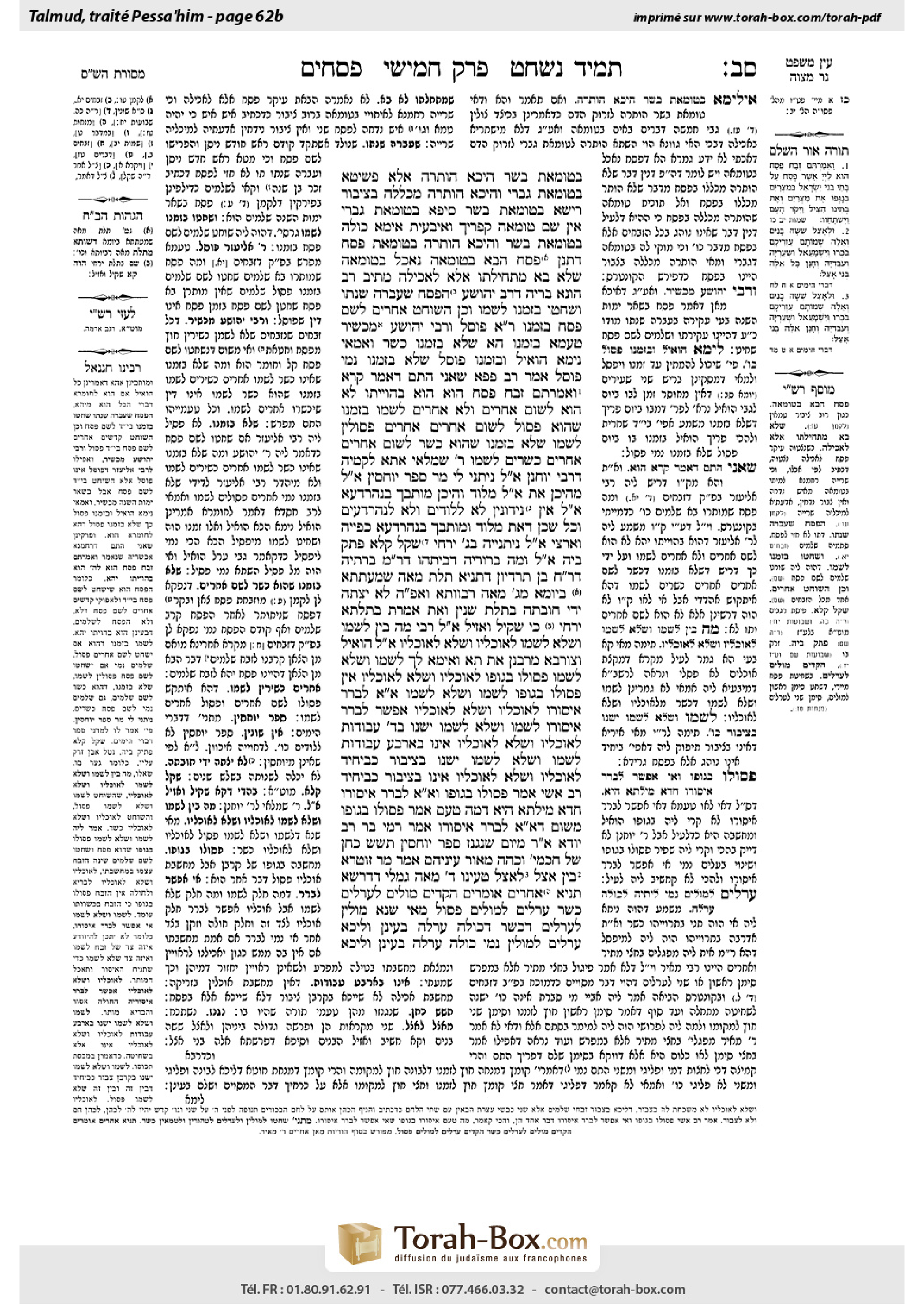
Pesachim 62b: Talmud study for Daf Yomi
Daf Yomi is the daily study of one Talmud folio. Explore 37 tractates with scans, Hebrew text, Sefaria English and AI-generated French translations where annotated.
Passage selection and English or AI-generated French translation are available where the scan has annotations. Daf Study is independent of Torah-Box and Sefaria.
Browse Pesachim · פסחים · All tractatesPesachim 62b text and translations
This page of Pesachim includes the Aramaic text, an English translation and an AI-generated French translation, alongside the scan above.
פסחים ס״ב ב · Aramaic and Hebrew text
בְּטוּמְאַת בָּשָׂר — הֵיכָא הוּתְּרָה? אֶלָּא פְּשִׁיטָא בְּטוּמְאַת גַּבְרֵי, וְהֵיכָא הוּתְּרָה מִכְּלָלָהּ — בְּצִיבּוּר.
רֵישָׁא בְּטוּמְאַת בָּשָׂר, סֵיפָא בְּטוּמְאַת גַּבְרֵי! אִין — שֵׁם טוּמְאָה קָפָרֵיךְ.
וְאִיבָּעֵית אֵימָא: כּוּלַּהּ בְּטוּמְאַת בָּשָׂר, וְהֵיכָא הוּתְּרָה — בְּטוּמְאַת פֶּסַח, דִּתְנַן: פֶּסַח הַבָּא בְּטוּמְאָה — נֶאֱכָל בְּטוּמְאָה, שֶׁלֹּא בָּא מִתְּחִילָּתוֹ אֶלָּא לַאֲכִילָה.
מֵתִיב רַב הוּנָא בְּרֵיהּ דְּרַב יְהוֹשֻׁעַ: הַפֶּסַח שֶׁעָבְרָה שְׁנָתוֹ, וּשְׁחָטוֹ בִּזְמַנּוֹ לִשְׁמוֹ, וְכֵן הַשּׁוֹחֵט אֲחֵרִים לְשֵׁם פֶּסַח בִּזְמַנּוֹ — רַבִּי אֱלִיעֶזֶר פּוֹסֵל, וְרַבִּי יְהוֹשֻׁעַ מַכְשִׁיר.
טַעְמָא בִּזְמַנּוֹ, הָא שֶׁלֹּא בִּזְמַנּוֹ — כָּשֵׁר. וְאַמַּאי? נֵימָא: הוֹאִיל וּבִזְמַנּוֹ פּוֹסֵל, שֶׁלֹּא בִּזְמַנּוֹ נָמֵי פּוֹסֵל!
אָמַר רַב פָּפָּא: שָׁאנֵי הָתָם דְּאָמַר קְרָא ״וַאֲמַרְתֶּם זֶבַח פֶּסַח הוּא״ — הוּא בַּהֲוָיָיתוֹ: לֹא הוּא לְשׁוּם אֲחֵרִים, וְלֹא אֲחֵרִים לִשְׁמוֹ.
בִּזְמַנּוֹ, שֶׁהוּא פָּסוּל לְשׁוּם אֲחֵרִים — אֲחֵרִים פְּסוּלִין לִשְׁמוֹ. שֶׁלֹּא בִּזְמַנּוֹ, שֶׁהוּא כָּשֵׁר לְשׁוּם אֲחֵרִים — אֲחֵרִים כְּשֵׁרִים לִשְׁמוֹ.
רַבִּי שִׂמְלַאי אֲתָא לְקַמֵּיהּ דְּרַבִּי יוֹחָנָן, אֲמַר לֵיהּ: נִיתְנֵי לִי מָר סֵפֶר יוּחֲסִין. אֲמַר לֵיהּ: מֵהֵיכָן אַתְּ? אֲמַר לֵיהּ: מִלּוֹד. וְהֵיכָן מוֹתְבָךְ? בִּנְהַרְדְּעָא. אֲמַר לֵיהּ: אֵין נִידּוֹנִין לֹא לְלוּדִּים וְלֹא לִנְהַרְדְּעִים, וְכׇל שֶׁכֵּן דְּאַתְּ מִלּוֹד וּמוֹתְבָךְ בִּנְהַרְדְּעָא. כַּפְיֵיהּ וְאִרַצִּי.
אֲמַר לֵיהּ: נִיתְנְיֵיהּ בִּתְלָתָא יַרְחֵי. שְׁקַל קָלָא פְּתַק בֵּיהּ, אֲמַר לֵיהּ: וּמָה בְּרוּרְיָה דְּבֵיתְהוּ דְּרַבִּי מֵאִיר בְּרַתֵּיה דְּרַבִּי חֲנַנְיָה בֶּן תְּרַדְיוֹן, דְּתָנְיָא תְּלָת מְאָה שְׁמַעְתָּתָא בְּיוֹמָא מִתְּלָת מְאָה רַבְּווֹתָא, וַאֲפִילּוּ הָכִי לֹא יָצְתָה יְדֵי חוֹבָתָהּ בִּתְלָת שְׁנִין, וְאַתְּ אָמְרַתְּ בִּתְלָתָא יַרְחֵי?!
כִּי שָׁקֵיל וְאָזֵיל אֲמַר לֵיהּ: רַבִּי, מָה בֵּין לִשְׁמוֹ וְשֶׁלֹּא לִשְׁמוֹ, לְאוֹכְלָיו וְשֶׁלֹּא לְאוֹכְלָיו?
אֲמַר לֵיהּ: הוֹאִיל וְצוּרְבָּא מֵרַבָּנַן אַתְּ, תָּא וְאֵימָא לְךָ: לִשְׁמוֹ וְשֶׁלֹּא לִשְׁמוֹ — פְּסוּלוֹ בְּגוּפוֹ, לְאוֹכְלָיו וְשֶׁלֹּא לְאוֹכְלָיו — אֵין פְּסוּלוֹ בְּגוּפוֹ.
לִשְׁמוֹ וְשֶׁלֹּא לִשְׁמוֹ — אִי אֶפְשָׁר לְבָרֵר אִיסּוּרוֹ, לְאוֹכְלָיו וְשֶׁלֹּא לְאוֹכְלָיו — אֶפְשָׁר לְבָרֵר אִיסּוּרוֹ.
לִשְׁמוֹ וְשֶׁלֹּא לִשְׁמוֹ — יֶשְׁנוֹ בְּאַרְבַּע עֲבוֹדוֹת, לְאוֹכְלָיו וְשֶׁלֹּא לְאוֹכְלָיו — אֵינוֹ בְּאַרְבַּע עֲבוֹדוֹת. לִשְׁמוֹ וְשֶׁלֹּא לִשְׁמוֹ — יֶשְׁנוֹ בְּצִיבּוּר כִּבְיָחִיד, לְאוֹכְלָיו וְשֶׁלֹּא לְאוֹכְלָיו — אֵינוֹ בְּצִיבּוּר כִּבְיָחִיד.
רַב אָשֵׁי אָמַר: פְּסוּלוֹ בְּגוּפוֹ וְאִי אֶפְשָׁר לְבָרֵר אִיסּוּרוֹ — חֲדָא מִילְּתָא הִיא, דְּמָה טַעַם אָמַר פְּסוּלוֹ בְּגוּפוֹ? מִשּׁוּם דְּאִי אֶפְשָׁר לְבָרֵר אִיסּוּרוֹ.
אָמַר רָמֵי בַּר רַב יוּדָא אָמַר רַב: מִיּוֹם שֶׁנִּגְנַז סֵפֶר יוּחֲסִין תָּשַׁשׁ כֹּחָן שֶׁל חֲכָמִים וְכָהָה מְאוֹר עֵינֵיהֶם.
אָמַר מָר זוּטְרָא: בֵּין ״אָצֵל״ לְ״אָצַל״ טְעִינוּ אַרְבַּע מְאָה גַּמְלֵי דִּדְרָשָׁא.
תַּנְיָא, אֲחֵרִים אוֹמְרִים: הִקְדִּים מוּלִים לַעֲרֵלִים — כָּשֵׁר, עֲרֵלִים לְמוּלִים — פָּסוּל. מַאי שְׁנָא מוּלִין לַעֲרֵלִים דְּכָשֵׁר — דְּכוּלַּהּ עׇרְלָה בָּעֵינַן, וְלֵיכָּא? עֲרֵלִים לְמוּלִין נָמֵי, כּוּלַּהּ עׇרְלָה בָּעֵינַן, וְלֵיכָּא!
Pesachim 62b · English translation
impurity of the meat, where is it permitted to eat impure sacrificial meat? Rather, it is obvious that the baraita is talking here about impurity of the people. And where is an allowance made from its rule? It is made in the community; when the majority of the community is ritually impure, it is permitted to offer the Paschal lamb and eat it while impure.
The Gemara expresses surprise again: It turns out then that the first clause of the baraita is referring to impurity of the meat, while the latter clause relates to impurity of the people. The Gemara answers: Yes, and there is no difficulty, as the baraita argues from the general category of impurity without necessarily relating to the same type of impurity.
And if you wish, say a different answer: The entire baraita is referring to impurity of the meat, and where is it permitted to eat impure sacrificial meat? It is permitted in a case of the impurity of the Paschal lamb, as we learned in a mishna: A Paschal lamb that comes in impurity, e.g., when the majority of the community is ritually impure and the offering may be brought in impurity, may also be eaten in impurity, as from the very outset it came only to be eaten. This is unlike the law with regard to other offerings that are brought in impurity; their blood is sprinkled on the altar, but their meat may not be eaten. Consequently, even the prohibition to consume impure sacrificial meat is permitted under certain circumstances.
Rav Huna, son of Rav Yehoshua, raised an objection from a baraita that teaches: The Paschal sacrifice may be a young lamb or goat less than one year old. In the case of a Paschal lamb that has passed its first year, so that it has automatically become a peace-offering, if he slaughtered it at its appointed time on Passover eve for its own purpose as a Paschal lamb, and similarly, if he slaughtered another offering, e.g., a lamb that had been sanctified as a peace-offering, for the purpose of a Paschal lamb at its set time, the tanna’im disagree with regard to the status of the offering. Rabbi Eliezer disqualifies the offering; and Rabbi Yehoshua validates it, based on the principle that offerings brought for the purpose of other offerings are valid. The only exception is the Paschal lamb, which when brought for another purpose is invalid. According to Rabbi Yehoshua, in both of these cases the animal is not truly a Paschal lamb; rather, it is a peace-offering brought with the intent that it serve as a Paschal lamb.
The Gemara infers: The reason that the sacrifice is disqualified is that it was brought at its proper time; it is in this case that the tanna’im disagree. But if it was not brought at its proper time, it is valid according to everyone, as it is like any other peace-offering that was slaughtered for a different purpose. But why is this so? Let us say: Since slaughtering another sacrifice for the purpose of a Paschal lamb disqualifies it at its proper time, this should also disqualify it not at its proper time. Consequently, the ruling quoted above is difficult according to the opinion of Rav Ḥisda, who accepts the principle of since for the sake of stringency.
Rav Pappa said: It is different there in the case of another sacrifice slaughtered for the purpose of a Paschal lamb, as the verse said: “And you shall say: It is a Passover sacrifice to the Lord, Who passed over the houses of the children of Israel in Egypt when He smote Egypt, and delivered our houses. And the people bowed the head and prostrated themselves” (Exodus 12:27). The word “it” indicates that the Paschal lamb must be brought as it is, according to its details, without any change. It, the Paschal lamb, must not be offered for the purpose of other sacrifices; and other sacrifices must not be offered for its purpose, i.e., as a Paschal lamb. In both of these cases, the offering is disqualified.
It may now be inferred: At its proper time, on Passover eve, when the Paschal lamb is disqualified if it is brought for the purpose of other sacrifices, other sacrifices are disqualified according to Rabbi Eliezer if they are brought for its purpose, i.e., as a Paschal lamb. But not at its proper time, when a Paschal lamb offered for the purpose of other sacrifices is valid, other sacrifices offered for its purpose as a Paschal lamb are also valid. Since the verse’s use of the word “it” links the disqualifications of a Paschal lamb offered as a different sacrifice and any other sacrifice offered for the purpose of a Paschal lamb, the principle of since does not apply.
There is a fundamental problem in the mishna that was clarified during the course of a particular incident: Rabbi Simlai came before Rabbi Yoḥanan. He said to him: Would the Master teach me the Book of Genealogies? The Book of Genealogies was a collection of tannaitic teachings that formed a midrash on the book of Chronicles. Rabbi Yoḥanan said to him: Where are you from? He said to him: From Lod. Rabbi Yoḥanan further asked: And where is your present place of residence? He said to him: In Neharde’a. Rabbi Yoḥanan said to him: I have a tradition that we teach these subjects neither to Lodites nor to Neharde’ans, and certainly not to you who comes from Lod and your residence is in Neharde’a, such that you have both shortcomings. Rabbi Simlai pressured Rabbi Yoḥanan until he agreed to teach him.
Rabbi Simlai said to him: Teach me the Book of Genealogies in three months. Rabbi Yoḥanan took a clod of dirt, threw it at him, and said to him: Berurya, wife of Rabbi Meir and daughter of Rabbi Ḥananya ben Teradyon, was so sharp and had such a good memory that she learned three hundred halakhot in one day from three hundred Sages, and nonetheless she did not fulfill her responsibility to properly learn the Book of Genealogies in three years because it is especially long and difficult. And you say that I should teach it to you in three months? After your inappropriate request, I am not inclined to teach you at all.
When Rabbi Simlai was taking leave to go, he said to Rabbi Yoḥanan: Even so, my teacher, as I have already come, let me ask you a question: What is the difference between one who offers a Paschal lamb both for its own purpose and for a different purpose, in which case the offering is disqualified, and one who offers the sacrifice with the intent that it be both for those who can eat it and for those who cannot eat it, in which case the offering is not disqualified?
He said to him: Since I understand from your question that you are a Torah scholar, come and I will tell you the answer: When one sacrifices an offering for its own purpose and for a different purpose, the disqualification is in the offering itself; that is, the disqualifying intention relates to the sacrifice itself. In contrast, when one sacrifices an offering for those who can eat it and for those who cannot eat it, the disqualification is not in the offering itself, as the disqualifying intent relates to the people who are to eat from it.
Furthermore, when one sacrifices an offering for its own purpose and for a different purpose, it is impossible to identify its prohibition; that is, there is no way to differentiate between valid and invalid parts of the offering. In contrast, when one sacrifices an offering for those who can eat it and for those who cannot eat it, it is possible to identify its prohibition. If some of the people may eat it and some may not, it is possible to distribute the offering to each group and thereby determine which part of the offering is invalid.
Furthermore, the intent that the offering be for its own purpose and for a different purpose applies and can disqualify the offering in all four rites, namely: Slaughtering, receiving the blood, carrying the blood to the altar, and sprinkling it on the altar; however, the intent that it be for those who can eat it and for those who cannot eat it does not apply during all four rites, as it has no effect during the time of the sprinkling. Moreover, the intent that the offering be for its own purpose and for a different purpose is a disqualification that applies to communal sacrifices as it does to individual sacrifices; in contrast, the intent that it be for those who can eat it and those who cannot eat it does not apply to the community as it does to an individual.
Rav Ashi said that careful analysis of these answers demonstrates the following: The argument that its disqualification is in the offering itself and the argument that it is impossible to identify its prohibition are one and the same thing; they are not two separate reasons. As, what is the reason that Rabbi Yoḥanan says that when one brings an offering for a different purpose, its disqualification is in the offering itself? It is because it is impossible to identify its prohibition, and therefore the prohibition applies to the offering itself.
Having mentioned the Book of Genealogies, the Gemara notes that Rami bar Rav Yuda said that Rav said the following about it: From the day the Book of Genealogies was hidden and no longer available to the Sages, the strength of the Sages has been weakened, and the light of their eyes has been dimmed, as the book contained the reasons for many Torah laws and lists of genealogies that are now lost.
Mar Zutra said: The Book of Genealogies’ exposition of Chronicles was so extensive that it was said, in exaggeration, that the verses from the word Azel mentioned in the verse: “And Azel had six sons and these are their names: Azrikam, Bocru, and Ishmael and Sheariah and Obadia and Hanan; all these were the sons of Azel” (I Chronicles 8:38), to the word Azel mentioned in a different verse with the identical wording: “And Azel had six sons and these are their names: Azrikam, Bocru, and Ishmael and Sheariah and Obadia and Hanan; these were the sons of Azel” (I Chronicles 9:44), bore four hundred camels of expositions written about these verses.
It was taught in a baraita that Aḥerim say: If one sacrifices a Paschal lamb for both circumcised and uncircumcised people and had in mind first the circumcised people and then the uncircumcised people, the offering is valid. But if he had in mind first the uncircumcised people and then the circumcised people, it is disqualified. The Gemara asks: What is different about having in mind first the circumcised people and then the uncircumcised people, such that the offering is valid? One might say that in order to disqualify the sacrifice, we require that all the people he has in mind be uncircumcised, and this is not the case here, as some of them are circumcised. But if this is so, when he has in mind first the uncircumcised people and then the circumcised people, we should also say that in order to disqualify the sacrifice we require that all the people he has in mind be uncircumcised, and this is not the case here. What, then, is the difference between the two cases?
Pesachim 62b · Traduction française (IA)
… l’impureté de la viande : mais où est-il permis de manger de la viande sacrificielle impure ? Il est donc évident que la baraïta parle ici de l’impureté des personnes. Et dans quel cas une dérogation à cette règle est-elle accordée ? Dans le cas de la collectivité : lorsque la majorité de la collectivité est rituellement impure, il est permis d’offrir le sacrifice pascal et de le manger en état d’impureté.
La Guemara exprime de nouveau son étonnement : il s’avère donc que la première partie de la baraïta se rapporte à l’impureté de la viande, tandis que la dernière partie concerne l’impureté des personnes. La Guemara répond : oui, et il n’y a pas de difficulté, car la baraïta raisonne à partir de la catégorie générale de l’impureté, sans nécessairement se rapporter à un seul et même type d’impureté.
Et si tu le souhaites, donne une autre réponse : toute la baraïta se rapporte à l’impureté de la viande. Mais dans quel cas est-il permis de manger de la viande sacrificielle impure ? Lorsque l’impureté concerne le sacrifice pascal, comme nous l’avons appris dans une Michna : un sacrifice pascal offert en état d’impureté — par exemple, lorsque la majorité de la collectivité est rituellement impure et que l’offrande peut être apportée en état d’impureté — peut également être mangé en état d’impureté, puisqu’il a été apporté dès le départ uniquement pour être mangé. Cela diffère de la règle concernant les autres offrandes apportées en état d’impureté : leur sang est aspergé sur l’autel, mais leur viande ne peut pas être mangée. Par conséquent, même l’interdiction de consommer de la viande sacrificielle impure connaît des dérogations dans certaines circonstances.
Rav Houna, fils de Rav Yehoshoua, souleva une objection à partir d’une baraïta qui enseigne : le sacrifice pascal peut être un jeune agneau ou un chevreau âgé de moins d’un an. Dans le cas d’un sacrifice pascal qui a dépassé sa première année, si bien qu’il est automatiquement devenu une offrande de paix, s’il l’a égorgé au moment fixé, la veille de Pessa’h, avec l’intention de l’offrir comme sacrifice pascal, et de même, s’il a égorgé une autre offrande — par exemple, un agneau consacré comme offrande de paix — avec l’intention de l’offrir comme sacrifice pascal au moment fixé, les tannaïm sont en désaccord sur le statut de l’offrande. Rabbi Éliézer l’invalide, tandis que Rabbi Yehoshoua la valide, selon le principe que les offrandes apportées avec l’intention d’être offertes comme d’autres offrandes sont valides. La seule exception est le sacrifice pascal, qui est invalide lorsqu’il est offert avec l’intention de servir à une autre fin. Selon Rabbi Yehoshoua, dans ces deux cas, l’animal n’est pas véritablement un sacrifice pascal ; c’est plutôt une offrande de paix apportée avec l’intention qu’elle serve de sacrifice pascal.
La Guemara en déduit que la raison de l’invalidité de l’offrande est qu’elle a été apportée au moment qui lui est propre ; c’est dans ce cas que les tannaïm sont en désaccord. Mais si elle n’a pas été apportée au moment qui lui est propre, elle est valide selon tous, puisqu’elle est comme toute autre offrande de paix égorgée avec une intention différente. Mais pourquoi en est-il ainsi ? Ne devrait-on pas dire que, puisque le fait d’égorger une autre offrande avec l’intention d’en faire un sacrifice pascal l’invalide au moment qui lui est propre, cela devrait également l’invalider en dehors de ce moment ? Par conséquent, la règle citée plus haut est difficile à concilier avec l’opinion de Rav Ḥisda, qui accepte le principe du « puisque » pour adopter une position plus stricte.
Rav Pappa dit : le cas d’une autre offrande égorgée avec l’intention de servir de sacrifice pascal est différent, car le verset dit : « Et vous direz : C’est le sacrifice de Pessa’h pour l’Éternel, qui passa par-dessus les maisons des enfants d’Israël en Égypte, lorsqu’il frappa l’Égypte et épargna nos maisons. Et le peuple inclina la tête et se prosterna » (Exode 12, 27). Le mot « c’est » indique que le sacrifice pascal doit être offert tel quel, conformément à ses modalités, sans aucune modification. Le sacrifice pascal ne doit pas être offert avec l’intention de servir à d’autres sacrifices, et d’autres sacrifices ne doivent pas être offerts avec l’intention de servir de sacrifice pascal. Dans les deux cas, l’offrande est invalide.
On peut maintenant en déduire que, au moment qui lui est propre, la veille de Pessa’h, lorsque le sacrifice pascal est invalide s’il est offert avec l’intention de servir à d’autres sacrifices, les autres sacrifices sont invalides, selon Rabbi Éliézer, lorsqu’ils sont offerts avec l’intention de servir de sacrifice pascal. Mais en dehors du moment qui lui est propre, lorsqu’un sacrifice pascal offert avec l’intention de servir à d’autres sacrifices est valide, les autres sacrifices offerts avec l’intention de servir de sacrifice pascal sont également valides. Puisque l’emploi du mot « c’est » dans le verset relie l’invalidité d’un sacrifice pascal offert comme un autre sacrifice à celle de toute autre offrande apportée avec l’intention de servir de sacrifice pascal, le principe du « puisque » ne s’applique pas.
Un problème fondamental concernant la Michna fut éclairci à l’occasion d’un incident particulier : Rabbi Simlaï se présenta devant Rabbi Yoḥanan. Il lui dit : « Maître, voudrais-tu m’enseigner le Livre des généalogies ? » Le Livre des généalogies était un recueil d’enseignements tannaïtiques qui constituait un midrach sur le livre des Chroniques. Rabbi Yoḥanan lui demanda : « D’où viens-tu ? » Il lui répondit : « De Lod. » Rabbi Yoḥanan lui demanda encore : « Et où résides-tu actuellement ? » Il lui répondit : « À Nehardea. » Rabbi Yoḥanan lui dit : « J’ai reçu la tradition selon laquelle nous n’enseignons pas ces sujets aux habitants de Lod ni à ceux de Nehardea, et certainement pas à toi, qui viens de Lod et résides à Nehardea, de sorte que tu cumules les deux défauts. » Rabbi Simlaï insista auprès de Rabbi Yoḥanan jusqu’à ce que celui-ci accepte de lui enseigner.
Rabbi Simlaï lui dit : « Enseigne-moi le Livre des généalogies en trois mois. » Rabbi Yoḥanan prit une motte de terre, la lui lança et lui dit : « Berourya, épouse de Rabbi Meïr et fille de Rabbi Ḥananya ben Teradyon, était si perspicace et avait une si bonne mémoire qu’elle apprit trois cents halakhot en un jour auprès de trois cents Sages ; et pourtant, elle ne parvint pas à s’acquitter correctement de son devoir d’étudier le Livre des généalogies en trois ans, tant il est long et difficile. Et toi, tu dis que je devrais te l’enseigner en trois mois ? Après cette demande déplacée, je ne suis pas disposé à t’enseigner quoi que ce soit. »
Alors que Rabbi Simlaï prenait congé pour partir, il dit à Rabbi Yoḥanan : « Malgré tout, mon maître, puisque je suis déjà venu, permets-moi de te poser une question : quelle différence y a-t-il entre celui qui offre un sacrifice pascal à la fois avec l’intention qui lui est propre et avec une intention différente — auquel cas l’offrande est invalide — et celui qui offre le sacrifice avec l’intention qu’il soit destiné à la fois à ceux qui peuvent le manger et à ceux qui ne le peuvent pas — auquel cas l’offrande n’est pas invalide ? »
Il lui répondit : « Puisque je comprends, à partir de ta question, que tu es un érudit en Torah, viens, et je vais te donner la réponse : lorsqu’on offre un sacrifice avec l’intention qui lui est propre et avec une intention différente, l’invalidité concerne l’offrande elle-même ; autrement dit, l’intention invalidante porte sur le sacrifice lui-même. En revanche, lorsqu’on offre un sacrifice pour ceux qui peuvent le manger et pour ceux qui ne le peuvent pas, l’invalidité ne concerne pas l’offrande elle-même, car l’intention invalidante porte sur les personnes qui doivent en manger. »
En outre, lorsqu’on offre un sacrifice avec l’intention qui lui est propre et avec une intention différente, il est impossible d’identifier la partie interdite ; autrement dit, il n’y a aucun moyen de distinguer les parties valides des parties invalides de l’offrande. En revanche, lorsqu’on offre un sacrifice pour ceux qui peuvent le manger et pour ceux qui ne le peuvent pas, il est possible d’identifier la partie interdite. Si certaines personnes peuvent en manger et d’autres non, il est possible de répartir l’offrande entre les deux groupes et de déterminer ainsi quelle partie de l’offrande est invalide.
En outre, l’intention d’offrir le sacrifice avec l’intention qui lui est propre et avec une intention différente s’applique et peut invalider l’offrande lors des quatre rites, à savoir : l’égorgement, la réception du sang, son transport jusqu’à l’autel et son aspersion sur l’autel. En revanche, l’intention de l’offrir pour ceux qui peuvent le manger et pour ceux qui ne le peuvent pas ne s’applique pas aux quatre rites, car elle n’a aucun effet au moment de l’aspersion. De plus, l’intention d’offrir le sacrifice avec l’intention qui lui est propre et avec une intention différente est une cause d’invalidité qui s’applique aux sacrifices collectifs comme aux sacrifices individuels ; en revanche, l’intention de l’offrir pour ceux qui peuvent le manger et pour ceux qui ne le peuvent pas ne s’applique pas de la même manière à la collectivité et à un individu.
Rav Ashi dit qu’une analyse minutieuse de ces réponses montre ce qui suit : l’argument selon lequel l’invalidité concerne l’offrande elle-même et celui selon lequel il est impossible d’identifier la partie interdite n’en sont qu’un seul et même argument ; ce ne sont pas deux raisons distinctes. En effet, pourquoi Rabbi Yoḥanan dit-il que, lorsqu’on apporte une offrande avec une intention différente, l’invalidité concerne l’offrande elle-même ? Parce qu’il est impossible d’identifier la partie interdite ; l’interdiction s’applique donc à l’offrande elle-même.
À propos du Livre des généalogies, la Guemara relève que Rami bar Rav Yuda a dit au nom de Rav ce qui suit : depuis le jour où le Livre des généalogies fut caché et ne fut plus accessible aux Sages, leur force s’est affaiblie et la lumière de leurs yeux s’est ternie, car ce livre contenait les raisons de nombreuses lois de la Torah ainsi que des listes généalogiques désormais perdues.
Mar Zutra dit : l’interprétation des Chroniques dans le Livre des généalogies était si développée que l’on disait, par exagération, que les versets allant du mot « Azel » dans le verset « Azel eut six fils, et voici leurs noms : Azrikam, Bocru, Ishmaël, Sheariah, Obadia et Hanan ; tous ceux-ci étaient les fils d’Azel » (I Chroniques 8, 38) jusqu’au mot « Azel » dans un autre verset formulé de manière identique — « Azel eut six fils, et voici leurs noms : Azrikam, Bocru, Ishmaël, Sheariah, Obadia et Hanan ; ceux-ci étaient les fils d’Azel » (I Chroniques 9, 44) — avaient suscité quatre cents chameaux chargés de commentaires écrits sur ces versets.
Il est enseigné dans une baraïta qu’Aḥerim disent : si quelqu’un offre un sacrifice pascal pour des personnes circoncises et non circoncises, et qu’il pense d’abord aux personnes circoncises, puis aux personnes non circoncises, l’offrande est valide. Mais s’il pense d’abord aux personnes non circoncises, puis aux personnes circoncises, elle est invalide. La Guemara demande : en quoi le fait de penser d’abord aux personnes circoncises, puis aux personnes non circoncises, diffère-t-il, pour que l’offrande soit valide ? On pourrait dire que, pour invalider le sacrifice, il faut que toutes les personnes auxquelles il pense soient non circoncises, ce qui n’est pas le cas ici, puisque certaines d’entre elles sont circoncises. Mais s’il en est ainsi, lorsqu’il pense d’abord aux personnes non circoncises, puis aux personnes circoncises, ne devrait-on pas également dire que, pour invalider le sacrifice, il faut que toutes les personnes auxquelles il pense soient non circoncises, ce qui n’est pas le cas ici ? Quelle est donc la différence entre les deux cas ?
Traduction française générée par IA à partir de l’édition anglaise de Sefaria. Vérifie toujours un passage avec le texte source.
Text from Sefaria: William Davidson Edition - Vocalized Aramaic (CC BY NC); William Davidson Edition - English (CC BY NC).