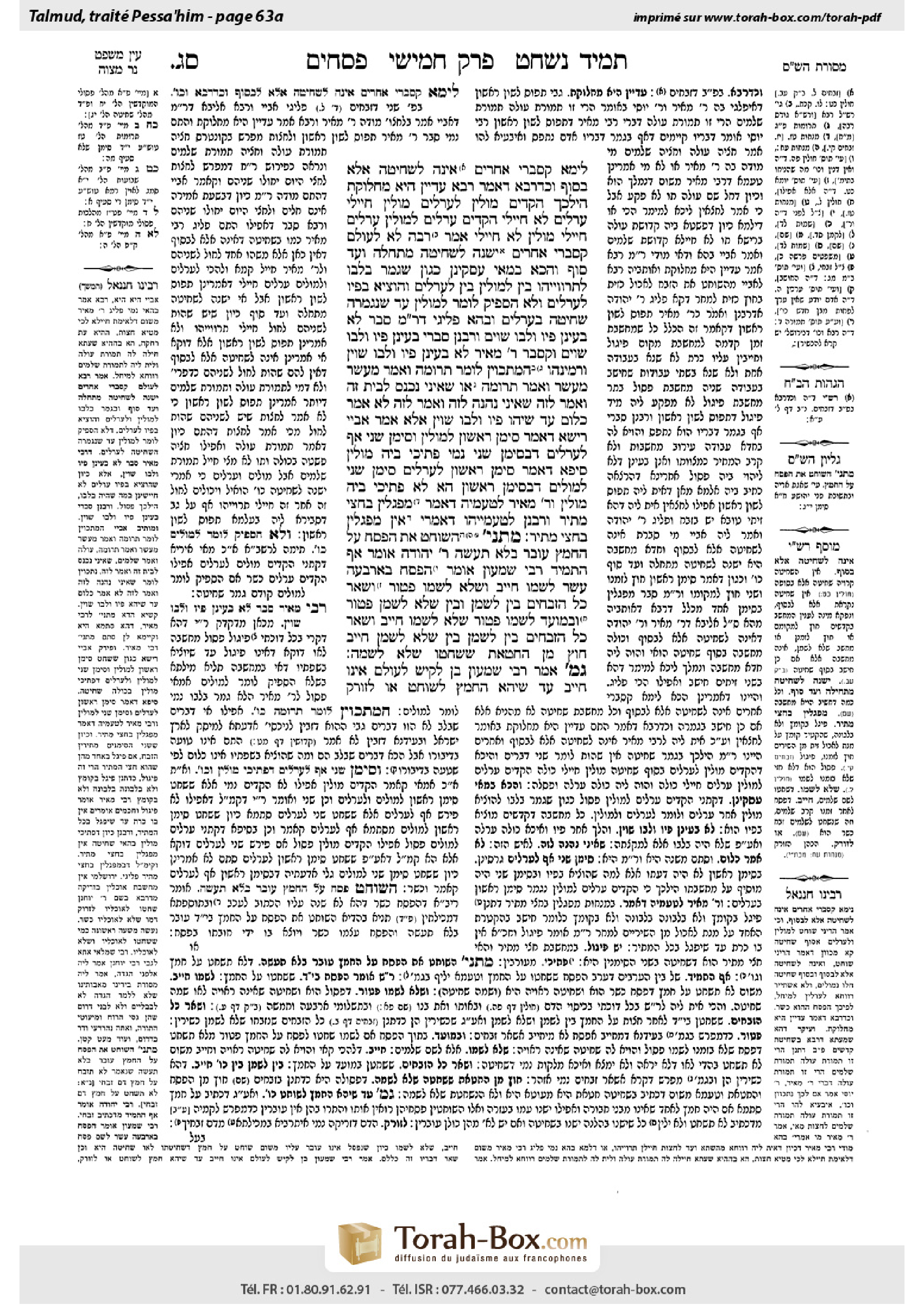
Pesachim 63a: Talmud study for Daf Yomi
Daf Yomi is the daily study of one Talmud folio. Explore 37 tractates with scans, Hebrew text, Sefaria English and AI-generated French translations where annotated.
Passage selection and English or AI-generated French translation are available where the scan has annotations. Daf Study is independent of Torah-Box and Sefaria.
Browse Pesachim · פסחים · All tractatesPesachim 63a text and translations
This page of Pesachim includes the Aramaic text, an English translation and an AI-generated French translation, alongside the scan above.
פסחים ס״ג א · Aramaic and Hebrew text
לֵימָא קָסָבְרִי אֲחֵרִים אֵינָהּ לִשְׁחִיטָה אֶלָּא בַּסּוֹף, וְכִדְרָבָא. דְּאָמַר רָבָא: עֲדַיִין הִיא מַחֲלוֹקֶת.
הִילְכָּךְ: הִקְדִּים מוּלִין לַעֲרֵלִים — מוּלִין חָיְילִי, עֲרֵלִים לָא חָיְילִי. הִקְדִּים עֲרֵלִים לְמוּלִין — עֲרֵלִים חָיְילִי, מוּלִין לָא חָיְילִי.
אָמַר רַבָּה: לָא, לְעוֹלָם קָסָבְרִי אֲחֵרִים יֶשְׁנָהּ לִשְׁחִיטָה מִתְּחִלָּה וְעַד סוֹף, וְהָכָא בְּמַאי עָסְקִינַן — כְּגוֹן שֶׁגָּמַר בְּלִבּוֹ לְתַרְוַויְיהוּ, בֵּין לְמוּלִין בֵּין לַעֲרֵלִים, וְהוֹצִיא בְּפִיו ״לַעֲרֵלִים״, וְלֹא הִסְפִּיק לוֹמַר ״לְמוּלִין״ עַד שֶׁנִּגְמְרָה שְׁחִיטָה בַּ״עֲרֵלִים״. וּבְהָא פְּלִיגִי, דְּרַבִּי מֵאִיר סָבַר: לָא בָּעֵינַן פִּיו וְלִבּוֹ שָׁוִים. וְרַבָּנַן סָבְרִי בָּעֵינַן פִּיו וְלִבּוֹ שָׁוִים.
וְקָסָבַר רַבִּי מֵאִיר לָא בָּעֵינַן פִּיו וְלִבּוֹ שָׁוִין? וּרְמִינְהוּ: הַמִּתְכַּוֵּין לוֹמַר ״תְּרוּמָה״, וְאָמַר ״מַעֲשֵׂר״; ״מַעֲשֵׂר״, וְאָמַר ״תְּרוּמָה״. אוֹ: ״שֶׁאֵינִי נִכְנָס לְבַיִת זֶה״, וְאָמַר ״לָזֶה״; ״שֶׁאֵינִי נֶהֱנֶה לָזֶה״, וְאָמַר ״לָזֶה״ — לֹא אָמַר כְּלוּם עַד שֶׁיְּהוּ פִּיו וְלִבּוֹ שָׁוִין.
אֶלָּא אָמַר אַבָּיֵי: רֵישָׁא, דְּאָמַר ״סִימָן רִאשׁוֹן לְמוּלִין, וְסִימָן שֵׁנִי אַף לַעֲרֵלִים״ — דִּבְסִימָן שֵׁנִי נָמֵי פְּתִיכִי בֵּיהּ מוּלִין. סֵיפָא, דְּאָמַר ״סִימָן רִאשׁוֹן לַעֲרֵלִים, סִימָן שֵׁנִי לְמוּלִים״ — דִּבְסִימָן רִאשׁוֹן הָא לָא פְּתִיכִי בֵּיהּ מוּלִין.
וְרַבִּי מֵאִיר לְטַעְמֵיהּ, דְּאָמַר: מְפַגְּלִין בַּחֲצִי מַתִּיר. וְרַבָּנַן לְטַעְמַיְיהוּ, דְּאָמְרִי: אֵין מְפַגְּלִין בַּחֲצִי מַתִּיר.
מַתְנִי׳ הַשּׁוֹחֵט אֶת הַפֶּסַח עַל הֶחָמֵץ — עוֹבֵר בְּלֹא תַעֲשֶׂה. רַבִּי יְהוּדָה אוֹמֵר: אַף הַתָּמִיד. רַבִּי שִׁמְעוֹן אוֹמֵר: הַפֶּסַח בְּאַרְבָּעָה עָשָׂר לִשְׁמוֹ — חַיָּיב, וְשֶׁלֹּא לִשְׁמוֹ — פָּטוּר. וּשְׁאָר כׇּל הַזְּבָחִים, בֵּין לִשְׁמָן וּבֵין שֶׁלֹּא לִשְׁמָן — פָּטוּר.
וּבַמּוֹעֵד, לִשְׁמוֹ — פָּטוּר. שֶׁלֹּא לִשְׁמוֹ — חַיָּיב. וּשְׁאָר כׇּל הַזְּבָחִים, בֵּין לִשְׁמָן בֵּין שֶׁלֹּא לִשְׁמָן — חַיָּיב. חוּץ מִן הַחַטָּאת שֶׁשְּׁחָטוֹ שֶׁלֹּא לִשְׁמָהּ.
גְּמָ׳ אָמַר רַבִּי שִׁמְעוֹן בֶּן לָקִישׁ: לְעוֹלָם אֵינוֹ חַיָּיב עַד שֶׁיְּהֵא הֶחָמֵץ לַשּׁוֹחֵט אוֹ לַזּוֹרֵק
Pesachim 63a · English translation
The Gemara asks: Let us say that Aḥerim hold that slaughter is not legally significant until the end, meaning that the slaughter is considered to take place only at the end of the rite and not during the time it takes to perform the act of slaughter, in accordance with the opinion of Rava in a different context. As Rava said: It is still a dispute, meaning that the disagreement whether one is held accountable only for his first expression or also for the conclusion of his statement applies even when it is one’s clear intention that the status he wishes to confer should apply only at a particular time, e.g., if one says that an animal should be consecrated as a burnt-offering until midday and from then on as a peace-offering (Rabbeinu Ḥananel). The opinion of Rabbi Meir, referred to here as Aḥerim, is that one is held accountable only for his first expression.
Therefore, based on these two assumptions, if one put the circumcised people before the uncircumcised people, his statement with regard to circumcised people applies but his statement with regard to uncircumcised people does not apply. If the slaughter is legally considered to take effect in a single instant, and if one said that his intention is for circumcised people at that moment, his statement takes effect. In the reverse case, if one put the uncircumcised people before the circumcised people, his statement with regard to uncircumcised people applies, but his statement with regard to circumcised people does not apply.
Rabba said: No, we should not say this. Actually, Aḥerim hold that slaughter is legally significant from beginning to end, and with what are we dealing here? We are dealing with a case where one decided in his mind to slaughter the offering for both of them, both circumcised and uncircumcised people, and he verbally expressed his intention with the phrase: For uncircumcised people, but did not have a chance to say: For circumcised people, before the slaughter was already finished as he was saying: For uncircumcised people. And it is with regard to this point that they disagree: Rabbi Meir, who is Aḥerim, holds that we do not require that one’s mouth and heart be the same; what is legally significant is his verbal expression. Since he said: For uncircumcised people, he has disqualified the offering. And the Rabbis hold that we require that his mouth and heart be the same. Since he wanted to express his intent for both circumcised and uncircumcised people, he has not disqualified the offering.
The Gemara expresses surprise: But does Rabbi Meir hold that we require that his mouth and heart be the same? The Gemara raises a contradiction based on a mishna in tractate Terumot that states: With regard to one who intended to say that the produce he has designated should be teruma, but he mistakenly said the word tithe; or he intended to say tithe but mistakenly said teruma; or he intended to vow: I will not enter this house, but mistakenly said: That house, i.e., he mistakenly referred to a different house; or he intended to vow: I will not derive benefit from this person, but he said: From that person, i.e., he mistakenly referred to someone else; he has not said anything until his mouth and heart are the same. This is an unattributed mishna, and unattributed mishnayot are presumed to be authored by Rabbi Meir.
Rather, Abaye said the following explanation: We are dealing with a case where the person expressed two different intentions within the act of slaughter itself, as valid slaughter involves cutting most of both the windpipe and the esophagus of the animal. The first clause is referring to a case where he said: I cut the first organ for circumcised people and the second organ even for uncircumcised people, so that in the second organ even circumcised people are included. Consequently, he had circumcised people in mind at each stage of the slaughtering. The latter clause is referring to a case where he said: I cut the first organ for uncircumcised people and the second organ for circumcised people, so that in the first organ circumcised people are not included, and his intent during that stage is solely for uncircumcised people.
And Rabbi Meir follows his own line of reasoning, as he says that piggul status can be conferred upon an offering at half of what renders it permitted. In other words, piggul status applies not only when one has a disqualifying intent during the entire act that renders the animal permitted, e.g., while slaughtering both the windpipe and the esophagus, but even if one has the disqualifying intent during half of the act that renders the animal permitted, e.g., while slaughtering one of those two organs. And the Rabbis also follow their regular line of reasoning, as they say that piggul status cannot be conferred at half of what permits it. Since he expressed his intent for both uncircumcised and circumcised people over the course of the entire act of slaughter, the offering is not disqualified.
MISHNA: One who slaughters the Paschal lamb with leavened bread still in his possession violates a negative commandment, as the Torah states: “You shall not offer the blood of My sacrifice with leavened bread; neither shall the sacrifice of the festival of Passover be left until the morning” (Exodus 34:25). Rabbi Yehuda says: Even one who slaughters the daily afternoon offering on Passover eve with leaven in his possession violates the commandment. Rabbi Shimon says: One who slaughters the Paschal lamb on the fourteenth of Nisan for its own purpose with leaven in his possession is liable; but if he slaughtered it for a different purpose he is exempt. And for all other offerings that one slaughters on Passover eve, when owning leaven is prohibited, whether he slaughtered them for their own purpose or he slaughtered them for a different purpose, he is exempt.
And during the festival of Passover, if one slaughtered the Paschal lamb for its own purpose he is exempt. Since a Paschal lamb that is slaughtered for its own purpose at an improper time is disqualified, it is not an offering at all and there is no violation of the commandment: “You shall not offer the blood of My sacrifice with leavened bread.” However, if he slaughtered it for a different purpose and thereby validated the sacrifice as a peace-offering, he is liable for having sacrificed it with leaven in his possession. And for all other offerings that one slaughters on Passover, when it is prohibited to slaughter with leaven in one’s possession, whether he slaughtered them for their own purpose or he slaughtered them for a different purpose, he is liable. This is with the exception of a sin-offering that he slaughtered for a different purpose with leaven in his possession. Unlike other offerings, a sin-offering is disqualified if it is slaughtered for a different purpose, and therefore one does not violate the prohibition of “You shall not offer the blood of My sacrifice with leavened bread.”
GEMARA: Rabbi Shimon ben Lakish said: One is never liable for having violated the commandment: “You shall not offer the blood of My sacrifice with leavened bread” unless the leavened bread belongs to the one who slaughters the Paschal lamb, or to the one who sprinkles its blood,
Pesachim 63a · Traduction française (IA)
La Guemara demande : Ne devrait-on pas dire que les Aḥerim considèrent que l’égorgement n’a de portée juridique qu’à son terme, c’est-à-dire qu’il n’est réputé avoir lieu qu’à la fin du rite, et non pendant le temps que dure l’acte d’égorgement, conformément à l’opinion de Rava dans un autre contexte ? En effet, Rava a dit : La controverse demeure. Cela signifie que le désaccord sur la question de savoir si l’on est tenu par sa première expression seulement ou également par la conclusion de sa déclaration s’applique même lorsque l’on entend clairement que le statut que l’on souhaite conférer ne prenne effet qu’à un moment précis, par exemple si l’on dit qu’un animal sera consacré comme holocauste jusqu’à midi, puis comme sacrifice de paix à partir de ce moment-là (Rabbeinu Ḥananel). Rabbi Meir, désigné ici sous le nom d’Aḥerim, considère que l’on est tenu par sa première expression seulement.
Par conséquent, selon ces deux hypothèses, si quelqu’un a placé les personnes circoncises avant les personnes incirconcises, sa déclaration concernant les personnes circoncises prend effet, mais celle concernant les personnes incirconcises ne prend pas effet. Si l’égorgement est réputé prendre effet en un seul instant et que l’on a dit que son intention visait alors les personnes circoncises, sa déclaration prend effet. Dans le cas inverse, s’il a placé les personnes incirconcises avant les personnes circoncises, sa déclaration concernant les personnes incirconcises prend effet, mais celle concernant les personnes circoncises ne prend pas effet.
Rabba dit : Non, il ne faut pas dire cela. En réalité, les Aḥerim considèrent que l’égorgement a une portée juridique du début à la fin. De quel cas s’agit-il donc ici ? D’un cas où la personne avait décidé intérieurement d’égorger le sacrifice pour les deux groupes, les personnes circoncises et les personnes incirconcises, et avait exprimé verbalement son intention par ces mots : « Pour les personnes incirconcises », sans avoir eu le temps de dire : « Pour les personnes circoncises », avant que l’égorgement ne soit déjà achevé, alors qu’elle prononçait les mots : « Pour les personnes incirconcises ». C’est sur ce point qu’ils sont en désaccord : Rabbi Meir, c’est-à-dire l’un des Aḥerim, considère qu’il n’est pas nécessaire que la bouche et le cœur concordent ; seule l’expression verbale a une portée juridique. Puisqu’elle a dit : « Pour les personnes incirconcises », elle a invalidé le sacrifice. Les Rabbins, eux, considèrent que la bouche et le cœur doivent concorder. Puisqu’elle voulait exprimer son intention pour les personnes circoncises comme pour les personnes incirconcises, elle n’a pas invalidé le sacrifice.
La Guemara s’étonne : Mais Rabbi Meir considère-t-il qu’il faut que la bouche et le cœur concordent ? La Guemara soulève une contradiction à partir d’une Michna du traité Teroumot, qui enseigne : Si quelqu’un voulait dire que les produits qu’il avait désignés devaient être de la terouma, mais a prononcé par erreur le mot « dîme » ; ou s’il voulait dire « dîme », mais a prononcé par erreur « terouma » ; ou s’il voulait faire le vœu : « Je n’entrerai pas dans cette maison », mais a dit par erreur : « cette autre maison », c’est-à-dire qu’il a désigné une autre maison ; ou s’il voulait faire le vœu : « Je ne tirerai aucun profit de cette personne », mais a dit : « de cette autre personne », c’est-à-dire qu’il a désigné quelqu’un d’autre ; il n’a rien dit tant que sa bouche et son cœur ne concordent pas. Il s’agit d’une Michna anonyme, et l’on présume que les Michnayot anonymes sont de Rabbi Meir.
Abaye donne plutôt l’explication suivante : il s’agit d’un cas où la personne a exprimé deux intentions différentes au cours même de l’acte d’égorgement, car un égorgement valide consiste à trancher la majeure partie de la trachée et de l’œsophage de l’animal. La première partie traite d’un cas où elle a dit : « J’ai tranché le premier organe pour les personnes circoncises, et le second organe même pour les personnes incirconcises », de sorte que les personnes circoncises sont également incluses dans l’intention concernant le second organe. Par conséquent, elle a eu les personnes circoncises à l’esprit à chaque étape de l’égorgement. La dernière partie traite d’un cas où elle a dit : « J’ai tranché le premier organe pour les personnes incirconcises, et le second organe pour les personnes circoncises », de sorte que les personnes circoncises ne sont pas incluses dans l’intention concernant le premier organe et que, durant cette étape, son intention vise uniquement les personnes incirconcises.
Et Rabbi Meir suit sa propre logique, puisqu’il affirme que le statut de piggoul peut être conféré à un sacrifice pendant la moitié de l’acte qui le rend permis. Autrement dit, le statut de piggoul s’applique non seulement lorsqu’on a une intention invalidante pendant tout l’acte qui rend l’animal permis, par exemple en égorgeant à la fois la trachée et l’œsophage, mais aussi lorsqu’on a cette intention invalidante pendant la moitié de cet acte, par exemple en égorgeant l’un de ces deux organes. Les Rabbins suivent eux aussi leur logique habituelle, puisqu’ils affirment que le statut de piggoul ne peut pas être conféré pendant la moitié de l’acte qui rend le sacrifice permis. Puisqu’il a exprimé son intention pour les personnes incirconcises comme pour les personnes circoncises au cours de l’ensemble de l’acte d’égorgement, le sacrifice n’est pas invalidé.
MICHNA : Celui qui égorge l’agneau pascal alors qu’il a encore du levain en sa possession enfreint un commandement négatif, comme le dit la Torah : « Tu n’offriras pas le sang de mon sacrifice avec du pain levé ; et le sacrifice de la fête de Pessaḥ ne sera pas laissé jusqu’au matin » (Exode 34,25). Rabbi Yehouda dit : Celui qui égorge l’offrande quotidienne de l’après-midi la veille de Pessaḥ alors qu’il a du levain en sa possession enfreint lui aussi le commandement. Rabbi Shimon dit : Celui qui égorge l’agneau pascal le 14 nissan pour l’intention qui lui est propre alors qu’il a du levain en sa possession est passible ; mais s’il l’a égorgé avec une autre intention, il est exempt. Quant à toutes les autres offrandes qu’on égorge la veille de Pessaḥ, alors qu’il est interdit de posséder du levain, on est exempt, qu’on les ait égorgées pour l’intention qui leur est propre ou avec une autre intention.
Pendant la fête de Pessaḥ, si quelqu’un a égorgé l’agneau pascal pour l’intention qui lui est propre, il est exempt. Puisqu’un agneau pascal égorgé pour l’intention qui lui est propre à un moment inapproprié est invalidé, il ne constitue pas du tout une offrande et il n’y a donc pas d’infraction au commandement : « Tu n’offriras pas le sang de mon sacrifice avec du pain levé. » Toutefois, s’il l’a égorgé avec une autre intention et a ainsi rendu le sacrifice valide comme sacrifice de paix, il est passible pour l’avoir offert alors qu’il avait du levain en sa possession. Quant à toutes les autres offrandes qu’on égorge pendant Pessaḥ, alors qu’il est interdit d’égorger avec du levain en sa possession, on est passible, qu’on les ait égorgées pour l’intention qui leur est propre ou avec une autre intention. La seule exception est le sacrifice expiatoire égorgé avec une autre intention alors qu’on a du levain en sa possession. Contrairement aux autres offrandes, un sacrifice expiatoire est invalidé s’il est égorgé avec une autre intention ; on n’enfreint donc pas l’interdiction : « Tu n’offriras pas le sang de mon sacrifice avec du pain levé. »
GUEMARA : Rabbi Shimon ben Lakish a dit : On n’est jamais passible d’avoir enfreint le commandement : « Tu n’offriras pas le sang de mon sacrifice avec du pain levé », à moins que le pain levé n’appartienne à celui qui égorge l’agneau pascal ou à celui qui en asperge le sang,
Traduction française générée par IA à partir de l’édition anglaise de Sefaria. Vérifie toujours un passage avec le texte source.
Text from Sefaria: William Davidson Edition - Vocalized Aramaic (CC BY NC); William Davidson Edition - English (CC BY NC).