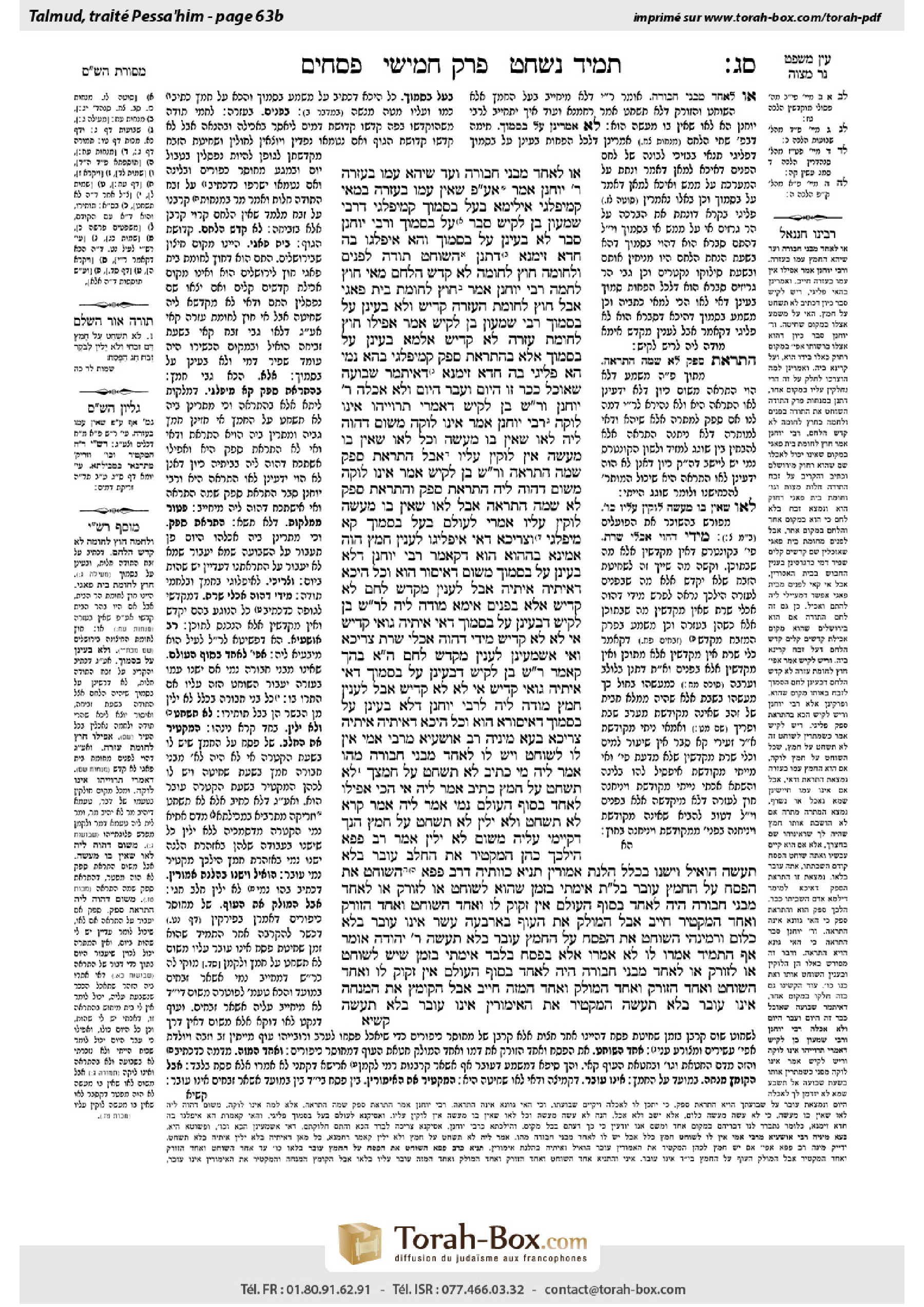
Pesachim 63b: Talmud study for Daf Yomi
Daf Yomi is the daily study of one Talmud folio. Explore 37 tractates with scans, Hebrew text, Sefaria English and AI-generated French translations where annotated.
Passage selection and English or AI-generated French translation are available where the scan has annotations. Daf Study is independent of Torah-Box and Sefaria.
Browse Pesachim · פסחים · All tractatesPesachim 63b text and translations
This page of Pesachim includes the Aramaic text, an English translation and an AI-generated French translation, alongside the scan above.
פסחים ס״ג ב · Aramaic and Hebrew text
אוֹ לְאֶחָד מִבְּנֵי חֲבוּרָה, וְעַד שֶׁיְּהֵא עִמּוֹ בָּעֲזָרָה. רַבִּי יוֹחָנָן אָמַר: אַף עַל פִּי שֶׁאֵין עִמּוֹ בַּעֲזָרָה. בְּמַאי קָמִיפַּלְגִי? אִילֵּימָא בְּ״עַל״ בְּסָמוּךְ קָמִיפַּלְגִי, דְּרַבִּי שִׁמְעוֹן בֶּן לָקִישׁ סָבַר: ״עַל״ בְּסָמוּךְ, וְרַבִּי יוֹחָנָן סָבַר: לָא בָּעֵינַן ״עַל״ בְּסָמוּךְ. וְהָא אִיפְּלִגוּ בַּהּ חֲדָא זִימְנָא!
דִּתְנַן: הַשּׁוֹחֵט תּוֹדָה לִפְנִים וְלַחְמָהּ חוּץ לַחוֹמָה — לֹא קָדַשׁ הַלֶּחֶם.
מַאי חוּץ לַחוֹמָה? רַבִּי יוֹחָנָן אָמַר: חוּץ לְחוֹמַת בֵּית פָּאגֵי, אֲבָל חוּץ לְחוֹמַת הָעֲזָרָה — קָדֵישׁ, וְלָא בָּעֵינַן ״עַל״ בְּסָמוּךְ. רַבִּי שִׁמְעוֹן בֶּן לָקִישׁ אָמַר: אֲפִילּוּ חוּץ לְחוֹמַת עֲזָרָה לָא קָדֵישׁ. אַלְמָא בָּעֵינַן ״עַל״ בְּסָמוּךְ.
אֶלָּא בְּהַתְרָאַת סָפֵק קָמִיפַּלְגִי. בְּהָא נָמֵי הָא פְּלִיגִי בַהּ חֲדָא זִימְנָא!
דְּאִיתְּמַר: ״שְׁבוּעָה שֶׁאוֹכַל כִּכָּר זוֹ הַיּוֹם״, וְעָבַר הַיּוֹם וְלֹא אֲכָלָהּ, רַבִּי יוֹחָנָן וְרַבִּי שִׁמְעוֹן בֶּן לָקִישׁ דְּאָמְרִי תַּרְוַיְיהוּ — אֵינוֹ לוֹקֶה. רַבִּי יוֹחָנָן אָמַר: אֵינוֹ לוֹקֶה, מִשּׁוּם דְּהָוֵה לֵיהּ לָאו שֶׁאֵין בּוֹ מַעֲשֶׂה, וְכׇל לָאו שֶׁאֵין בּוֹ מַעֲשֶׂה — אֵין לוֹקִין עָלָיו. אֲבָל הַתְרָאַת סָפֵק — שְׁמָהּ הַתְרָאָה.
וְרַבִּי שִׁמְעוֹן בֶּן לָקִישׁ אָמַר: אֵינוֹ לוֹקֶה, מִשּׁוּם דְּהָוֵה לֵיהּ הַתְרָאַת סָפֵק, וְהַתְרָאַת סָפֵק — לֹא שְׁמָהּ הַתְרָאָה. אֲבָל לָאו שֶׁאֵין בּוֹ מַעֲשֶׂה — לוֹקִין עָלָיו.
אָמְרִי: לְעוֹלָם בְּ״עַל״ בְּסָמוּךְ קָא מִיפַּלְגִי, וּצְרִיכָא, דְּאִי אִיפְּלִיגוּ לְעִנְיַן חָמֵץ, הֲוָה אָמֵינָא: בְּהָהוּא הוּא דְּקָאָמַר רַבִּי יוֹחָנָן דְּלָא בָּעֵינַן ״עַל״ בְּסָמוּךְ — מִשּׁוּם דְּאִיסּוּר הוּא, וְכֹל הֵיכָא דְּאִיתֵיהּ — אִיתֵיהּ.
אֲבָל לְעִנְיַן מִקְדָּשׁ לֶחֶם — לָא קָדֵישׁ אֶלָּא בִּפְנִים, אֵימָא מוֹדֶה לֵיהּ לְרַבִּי שִׁמְעוֹן בֶּן לָקִישׁ דְּבָעֵינַן ״עַל״ בְּסָמוּךְ, דְּאִי אִיתֵיהּ גַּוַּאי — קָדֵישׁ, אִי לָא — לָא קָדֵישׁ, מִידֵּי דְּהָוֵה אַכְּלֵי שָׁרֵת. צְרִיכָא.
וְאִי אַשְׁמְעִינַן לְעִנְיַן מִקְדָּשׁ לֶחֶם, הֲוָה אָמֵינָא: בְּהָךְ קָאָמַר רַבִּי שִׁמְעוֹן בֶּן לָקִישׁ דְּבָעֵינַן ״עַל״ בְּסָמוּךְ, דְּאִי אִיתֵיהּ גַּוַּאי — קָדֵישׁ, אִי לָא — לָא קָדֵישׁ, אֲבָל לְעִנְיַן חָמֵץ מוֹדֶה לֵיהּ לְרַבִּי יוֹחָנָן דְּלָא בָּעֵינַן ״עַל״ בְּסָמוּךְ, דְּאִיסּוּרָא הוּא, וְכֹל הֵיכָא דְּאִיתֵיהּ — אִיתֵיהּ, צְרִיכָא.
בְּעָא מִינֵּיהּ רַב אוֹשַׁעְיָא מֵרַבִּי אַמֵּי: אֵין לוֹ לַשּׁוֹחֵט, וְיֵשׁ לוֹ לְאֶחָד מִבְּנֵי חֲבוּרָה מַהוּ? אֲמַר לֵיהּ: מִי כְּתִיב ״לֹא תִשְׁחַט עַל חֲמֵצְךָ״? ״לֹא תִשְׁחַט עַל חָמֵץ״ כְּתִיב.
אֲמַר לֵיהּ: אִי הָכִי, אֲפִילּוּ לְאֶחָד בְּסוֹף הָעוֹלָם נָמֵי? אֲמַר לֵיהּ: אָמַר קְרָא ״לֹא תִשְׁחַט ... וְלֹא יָלִין״ — ״לֹא תִשְׁחַט עַל חָמֵץ״ — הָנָךְ דְּקָיְימִי עֲלֵיהּ מִשּׁוּם ״לֹא יָלִין״.
אָמַר רַב פָּפָּא: הִילְכָּךְ כֹּהֵן הַמַּקְטִיר אֶת הַחֵלֶב — עוֹבֵר בְּלֹא תַעֲשֶׂה, הוֹאִיל וְיֶשְׁנוֹ בִּכְלַל הֲלָנַת אֵמוּרִין.
תַּנְיָא כְּווֹתֵיהּ דְּרַב פָּפָּא: הַשּׁוֹחֵט אֶת הַפֶּסַח עַל הֶחָמֵץ — עוֹבֵר בְּלֹא תַעֲשֶׂה. אֵימָתַי? בִּזְמַן שֶׁהוּא לַשּׁוֹחֵט אוֹ לַזּוֹרֵק אוֹ לְאֶחָד מִבְּנֵי חֲבוּרָה. הָיָה לְאֶחָד בְּסוֹף הָעוֹלָם — אֵין זָקוּק לוֹ. וְאֶחָד הַשּׁוֹחֵט וְאֶחָד הַזּוֹרֵק וְאֶחָד הַמַּקְטִיר — חַיָּיב. אֲבָל הַמּוֹלֵק אֶת הָעוֹף בְּאַרְבָּעָה עָשָׂר — אֵינוֹ עוֹבֵר בְּלֹא כְּלוּם.
וּרְמִינְהִי: הַשּׁוֹחֵט אֶת הַפֶּסַח עַל הֶחָמֵץ — עוֹבֵר בְּלֹא תַעֲשֶׂה. רַבִּי יְהוּדָה אוֹמֵר: אַף הַתָּמִיד. אָמְרוּ לוֹ: לֹא אָמְרוּ אֶלָּא בְּפֶסַח בִּלְבַד. אֵימָתַי? בִּזְמַן שֶׁיֵּשׁ לַשּׁוֹחֵט אוֹ לַזּוֹרֵק אוֹ לְאֶחָד מִבְּנֵי חֲבוּרָה. הָיָה לְאֶחָד בְּסוֹף הָעוֹלָם — אֵין זָקוּק לוֹ.
וְאֶחָד הַשּׁוֹחֵט וְאֶחָד הַזּוֹרֵק וְאֶחָד הַמּוֹלֵק וְאֶחָד הַמַּזֶּה — חַיָּיב. אֲבָל הַקּוֹמֵץ אֶת הַמִּנְחָה — אֵינוֹ עוֹבֵר בְּלֹא תַעֲשֶׂה. הַמַּקְטִיר אֶת הָאֵימוּרִין — אֵינוֹ עוֹבֵר בְּלֹא תַעֲשֶׂה.
Pesachim 63b · English translation
or to one of the members of the group; and he is liable only if the leaven is with him in the Temple courtyard itself. Rabbi Yoḥanan said: He is liable even if the leaven is not with him in the Temple courtyard. With regard to what principle do they disagree? If you say that they disagree with regard to whether the expression “with” indicates next to, namely, that Rabbi Shimon ben Lakish holds that “with” always indicates next to, and therefore “You shall not offer the blood of My sacrifice with leavened bread” means that the leaven must not be next to the one slaughtering the sacrifice, in the Temple courtyard itself, and Rabbi Yoḥanan holds that when the verse says “with,” we do not require that the leaven be next to the slaughterer in order to transgress, then this is difficult, because they have already disagreed about this once before.
As we learned in a mishna: With regard to one who slaughters a thanks-offering inside the Temple courtyard while its bread, namely the forty loaves that are brought together with the offering, is outside the wall, the bread has not become sanctified, as the verse states: “And he shall offer with the thanks-offering unleavened cakes.” (Leviticus 7:12).
A question was raised with regard to this mishna: What is the meaning of the phrase outside the wall? Rabbi Yoḥanan said: It means outside the wall of Beit Pagei, the outermost wall around Jerusalem, but if the bread was merely outside the wall of the Temple courtyard, it has been sanctified, as we do not require that the bread, described as “with” the offering, be next to it in order to be sanctified. Rabbi Shimon ben Lakish disagreed and said: Even if the bread was merely outside the wall of the Temple courtyard, it has not been sanctified. Apparently, he holds that we require that the bread described as “with” the offering be next to it in order to be sanctified. Since Rabbi Yoḥanan and Rabbi Shimon ben Lakish have already disputed this issue, they presumably did not repeat this same dispute in other contexts.
Rather, say that they disagree about an uncertain warning. There is a general rule that the courts only administer corporal punishment if the transgressor was warned before he committed the transgression. The question arises as to whether punishments are administered after an uncertain warning, i.e., when it is unclear at the time of the warning whether or not the person being warned will actually transgress. It is possible to explain that this is the basis of the dispute with regard to leaven: If the leaven is outside the Temple courtyard, the one issuing the warning cannot be certain that the person he is warning actually has leaven in his possession at the time of the slaughter. The Gemara suggests that such a warning is considered an uncertain warning, and Rabbi Yoḥanan holds that an uncertain warning is a valid warning while Rabbi Shimon ben Lakish disagrees. However, this is difficult, as they also disagreed about this once before.
As it was stated that if a person said: I take an oath that I will eat this loaf today, and the day passed and he did not eat it, Rabbi Yoḥanan and Rabbi Shimon ben Lakish both said that he is not flogged even though he violated his oath and thereby transgressed the prohibition of: “You shall not take the name of the Lord your God in vain” (Exodus 19:7). However, they disagree about the reason for this law. Rabbi Yoḥanan said: He is not flogged because it is a prohibition whose transgression does not involve an action, as his transgression was in failing to eat the loaf, and there is a principle that for any prohibition whose transgression does not involve an action one is not flogged; however, an uncertain warning is considered a valid warning.
And Rabbi Shimon ben Lakish said: He is not flogged because it is an uncertain warning, and an uncertain warning is not considered a warning. For example, if he is warned in the middle of the day that if he does not eat the loaf he will be flogged, the warning is uncertain because even if he does not eat the loaf at that moment he still has time to eat it later. But for a prohibition whose transgression does not involve an action one is flogged. Thus, Rabbi Yoḥanan and Rabbi Shimon ben Lakish have already disagreed with regard to this issue as well, and there would have been no reason for them to repeat their dispute.
They say in answer to this: Actually, we can explain that they disagree about whether “with” indicates next to, and it is necessary to teach that they disagree about the case involving the leaven in addition to the case of the loaves of the thanks-offering, because the cases are not entirely comparable. As, if they disagreed only with regard to leaven, I would have said that it is only with regard to that case that Rabbi Yoḥanan said that when the verse says “with,” we do not require that the slaughterer have the leaven next to him in order to transgress, because it is a prohibition, and wherever it is, it is. On the eve of Passover in the afternoon one is prohibited to possess leaven anywhere.
However, with regard to sanctification of the bread, it becomes sanctified only inside the Temple courtyard. Consequently, say that in that case Rabbi Yoḥanan concedes to Rabbi Shimon ben Lakish that we require that the bread described as “with” the offering be next to it. Therefore, if it is inside, it is sanctified; and if not, it is not sanctified. This is just as it is with regard to a vessel used in the Temple service, which sanctifies a meal-offering only when the meal is inside it and not when the meal is outside of it. Therefore, it is necessary to teach that the dispute applies in both cases.
And had we been taught the dispute only with regard to sanctification of the bread, I would have said that only in this case did Rabbi Shimon ben Lakish say that we require that the bread described as “with” the sacrifice be next to it, such that if it is inside the Temple courtyard, it is sanctified; and if not, it is not sanctified. But with regard to leavened bread, he concedes to Rabbi Yoḥanan that when the verse says “with,” we do not require that the slaughterer have the leaven next to him in order to transgress, for it is a prohibition and wherever it is, it is. Therefore, it is necessary to say that they argued in both cases.
Rav Oshaya asked Rabbi Ami the following question: If the slaughterer does not have leaven in his possession but one of the members of the group does have, what is the halakha? Rabbi Ami said to him: Is it written: You shall not offer the blood of My sacrifice with your leavened bread, meaning you may not slaughter the Paschal lamb with the leaven of the slaughterer? It is written: “You shall not offer with leavened bread” (Exodus 34:25), meaning you may not slaughter it with anyone’s leaven and not necessarily leaven that belongs to the slaughterer.
Rav Oshaya said to Rav Ashi: If so, even if someone at the end of the world has leaven it should also be a violation. Since there is no limitation to this prohibition, it should apply even if the leaven belongs to someone who is not associated in any way with this Paschal lamb. Rav Ashi said to him that the verse says: “You shall not offer,” and the end of the verse states: “Neither shall the sacrifice of the festival of Passover be left until the morning.” The verse equates the two prohibitions, from which the following may be derived: “You shall not offer with leavened bread” applies to those who are governed by the prohibition of “neither shall be left over,” namely, the members of the group that registered for this Paschal lamb. People who are not part of this group are not obligated to ensure that the Paschal lamb does not remain until the morning; similarly, they are not taken into account with regard to the prohibition against sacrificing the offering while in possession of leaven.
Rav Pappa said: Therefore, based on this reason, the priest who burns the fats of the Paschal lamb transgresses the negative commandment of “You shall not offer” if he has leaven in his possession. Since he is included in the prohibition of leaving over sacrificial parts of the offering, he is also included in the prohibition against sacrificing the offering with leaven, although he is not one of the people who will eat this Paschal lamb.
The Gemara points out that it was taught in a baraita in accordance with the opinion of Rav Pappa: One who slaughters the Paschal lamb with leavened bread in his possession transgresses a negative commandment. When? When the leaven belongs to the slaughterer, or to the one who sprinkles the blood, or to one of the members of the group. If leaven belonged to someone at the end of the world, he is not bound to him, meaning that the slaughterer need not take him into account. And whether he slaughters the animal, or he sprinkles the blood, or he burns the fats, he is liable. But one who pinches the neck of a bird, which is not a Paschal offering but a burnt-offering or sin-offering, if he does so with leaven in his possession on the fourteenth of Nisan, after the prohibition against owning leaven has taken effect, he does not transgress anything.
The Gemara raises a contradiction from another baraita: One who slaughters the Paschal lamb with leavened bread in his possession transgresses a negative commandment. Rabbi Yehuda says: Even one who slaughters the daily afternoon offering on the eve of Passover with leavened bread in his possession violates the prohibition. They said to him: They stated this prohibition only with regard to the Paschal lamb. When does one transgress the prohibition? When the slaughterer, or the one who sprinkles the blood, or one of the members of the group has leaven in his possession. If someone at the end of the world had leaven, he is not bound to him.
The baraita continues: And whether he slaughters the animal, or he sprinkles the blood, or he pinches a bird-offering, or he sprinkles the blood of the bird-offering onto the altar, he is liable. But one who scoops a handful of flour from a meal-offering while in possession of leaven does not transgress a negative commandment, because a meal-offering is not included in the prohibition, which is phrased “You shall not offer the blood of My sacrifice.” One who burns the sacrificial parts of the Paschal lamb or any other sacrifice on the fourteenth of Nisan with leaven in his possession does not transgress a negative commandment.
Pesachim 63b · Traduction française (IA)
ou à l’un des membres du groupe ; il n’est passible que si le levain se trouve avec lui dans la cour du Temple même. Rabbi Yoḥanan a dit : Il est passible même si le levain ne se trouve pas avec lui dans la cour du Temple. Sur quel principe sont-ils en désaccord ? Si l’on dit qu’ils sont en désaccord sur la question de savoir si le terme « avec » signifie « à côté de » — Rabbi Shimon ben Lakish estimant que « avec » signifie toujours « à côté de », de sorte que « Tu n’offriras pas le sang de Mon sacrifice avec du pain levé » signifie que le levain ne doit pas se trouver à côté de celui qui abat le sacrifice, dans la cour du Temple même, tandis que Rabbi Yoḥanan estime que, lorsque le verset dit « avec », il n’est pas nécessaire que le levain se trouve à côté de celui qui abat pour qu’il y ait transgression — cela pose difficulté, car ils ont déjà été en désaccord sur ce point auparavant.
Comme nous l’avons appris dans une Michna : si quelqu’un abat un sacrifice de reconnaissance dans la cour du Temple alors que le pain qui l’accompagne — c’est-à-dire les quarante pains apportés avec le sacrifice — se trouve à l’extérieur de l’enceinte, ce pain n’est pas sanctifié, comme le dit le verset : « Et il offrira avec le sacrifice de reconnaissance des galettes sans levain » (Lévitique 7, 12).
Une question a été soulevée au sujet de cette Michna : que signifie l’expression « à l’extérieur de l’enceinte » ? Rabbi Yoḥanan a dit : cela signifie à l’extérieur de l’enceinte de Beit Pagei, la muraille la plus extérieure autour de Jérusalem. En revanche, si le pain se trouvait seulement à l’extérieur de la cour du Temple, il était sanctifié, car nous n’exigeons pas que le pain, décrit comme étant « avec » le sacrifice, se trouve à côté de celui-ci pour être sanctifié. Rabbi Shimon ben Lakish a contesté cette opinion et a dit : même si le pain se trouvait seulement à l’extérieur de la cour du Temple, il n’était pas sanctifié. Il estime donc apparemment que le pain décrit comme étant « avec » le sacrifice doit se trouver à côté de celui-ci pour être sanctifié. Puisque Rabbi Yoḥanan et Rabbi Shimon ben Lakish ont déjà débattu de cette question, ils n’auraient vraisemblablement pas répété le même désaccord dans d’autres contextes.
Il faut plutôt dire qu’ils sont en désaccord au sujet d’un avertissement incertain. Selon une règle générale, les tribunaux n’infligent de châtiment corporel que si le transgresseur a été averti avant de commettre la transgression. La question se pose de savoir si un châtiment est infligé après un avertissement incertain, c’est-à-dire lorsque, au moment de l’avertissement, il n’est pas certain que la personne avertie commettra effectivement la transgression. On peut expliquer que tel est le fondement du désaccord au sujet du levain : si le levain se trouve à l’extérieur de la cour du Temple, celui qui donne l’avertissement ne peut pas être certain que la personne avertie possède effectivement du levain au moment de l’abattage. La Guemara suggère qu’un tel avertissement est considéré comme un avertissement incertain, et que Rabbi Yoḥanan estime qu’un avertissement incertain est valable, tandis que Rabbi Shimon ben Lakish n’est pas d’accord. Mais cela pose difficulté, car ils ont déjà été en désaccord sur ce point auparavant.
Car il a été enseigné que si quelqu’un dit : « Je jure que je mangerai ce pain aujourd’hui », mais que la journée s’achève sans qu’il l’ait mangé, Rabbi Yoḥanan et Rabbi Shimon ben Lakish ont tous deux dit qu’il n’est pas flagellé, bien qu’il ait violé son serment et ainsi transgressé l’interdiction : « Tu ne prononceras pas le nom de l’Éternel, ton Dieu, en vain » (Exode 20, 7). Toutefois, ils sont en désaccord sur la raison de cette règle. Rabbi Yoḥanan a dit : il n’est pas flagellé parce qu’il s’agit d’une interdiction dont la transgression n’implique pas d’acte, puisque sa transgression consiste à ne pas manger le pain ; or, selon un principe, on ne flagelle pas pour une interdiction dont la transgression n’implique pas d’acte. Cependant, un avertissement incertain est considéré comme valable.
Et Rabbi Shimon ben Lakish a dit : il n’est pas flagellé parce qu’il s’agit d’un avertissement incertain, et qu’un avertissement incertain n’est pas considéré comme un avertissement. Par exemple, s’il est averti au milieu de la journée qu’il sera flagellé s’il ne mange pas le pain, l’avertissement est incertain, car même s’il ne mange pas le pain à ce moment-là, il lui reste du temps pour le manger plus tard. Mais on flagelle pour une interdiction dont la transgression n’implique pas d’acte. Ainsi, Rabbi Yoḥanan et Rabbi Shimon ben Lakish ont déjà été en désaccord sur cette question également, et il n’y aurait eu aucune raison pour eux de répéter leur désaccord.
Ils répondent : en réalité, on peut expliquer qu’ils sont en désaccord sur la question de savoir si « avec » signifie « à côté de », et il faut enseigner leur désaccord au sujet du levain en plus de celui des pains du sacrifice de reconnaissance, car les deux cas ne sont pas tout à fait comparables. En effet, si leur désaccord ne portait que sur le levain, j’aurais dit que Rabbi Yoḥanan a affirmé uniquement dans ce cas que, lorsque le verset dit « avec », il n’est pas nécessaire que celui qui abat ait le levain à côté de lui pour qu’il y ait transgression, car il s’agit d’une interdiction et, où qu’il se trouve, cela reste une interdiction. La veille de Pessaḥ, dans l’après-midi, il est interdit de posséder du levain où que ce soit.
En revanche, pour que le pain soit sanctifié, il faut qu’il se trouve dans la cour du Temple. Par conséquent, on pourrait dire que, dans ce cas, Rabbi Yoḥanan reconnaît à Rabbi Shimon ben Lakish qu’il faut que le pain décrit comme étant « avec » le sacrifice se trouve à côté de celui-ci. Ainsi, s’il se trouve à l’intérieur, il est sanctifié ; sinon, il ne l’est pas. Il en va comme pour un récipient utilisé dans le service du Temple, qui sanctifie une offrande végétale seulement lorsque celle-ci se trouve à l’intérieur, et non lorsqu’elle est à l’extérieur. Il faut donc enseigner que le désaccord porte sur les deux cas.
Et si le désaccord ne nous avait été enseigné qu’au sujet de la sanctification du pain, j’aurais dit que Rabbi Shimon ben Lakish a affirmé uniquement dans ce cas qu’il faut que le pain décrit comme étant « avec » le sacrifice se trouve à côté de celui-ci, de sorte que, s’il se trouve dans la cour du Temple, il est sanctifié, et que, sinon, il ne l’est pas. Mais, au sujet du pain levé, il reconnaît à Rabbi Yoḥanan que, lorsque le verset dit « avec », il n’est pas nécessaire que celui qui abat ait le levain à côté de lui pour qu’il y ait transgression, car il s’agit d’une interdiction et, où que le levain se trouve, cela reste une interdiction. Il faut donc dire qu’ils ont débattu des deux cas.
Rav Oshaya posa la question suivante à Rabbi Ami : si celui qui abat ne possède pas de levain, mais que l’un des membres du groupe en possède, quelle est la halakha ? Rabbi Ami lui répondit : Est-il écrit : « Tu n’offriras pas le sang de Mon sacrifice avec ton pain levé », ce qui signifierait que l’on ne peut pas abattre l’agneau pascal avec le levain de celui qui l’abat ? Il est écrit : « Tu n’offriras pas avec du pain levé » (Exode 34, 25), ce qui signifie qu’on ne peut pas l’abattre avec le levain de qui que ce soit, et pas nécessairement avec celui qui appartient à celui qui abat.
Rav Oshaya dit à Rav Ashi : dans ce cas, même si quelqu’un à l’autre bout du monde possède du levain, il devrait aussi y avoir transgression. Puisque cette interdiction n’est assortie d’aucune limite, elle devrait s’appliquer même si le levain appartient à quelqu’un qui n’a aucun lien avec cet agneau pascal. Rav Ashi lui répondit que le verset dit : « Tu n’offriras pas », et que la fin du verset ajoute : « Et le sacrifice de la fête de Pessaḥ ne sera pas laissé jusqu’au matin. » Le verset met les deux interdictions en équivalence, d’où l’on peut déduire que l’interdiction « Tu n’offriras pas avec du pain levé » s’applique à ceux qui sont soumis à l’interdiction « ne sera pas laissé », à savoir les membres du groupe inscrits pour cet agneau pascal. Les personnes qui ne font pas partie de ce groupe ne sont pas tenues de veiller à ce que l’agneau pascal ne reste pas jusqu’au matin ; de même, elles ne sont pas prises en compte pour l’interdiction d’offrir le sacrifice alors qu’on possède du levain.
Rav Pappa a dit : par conséquent, selon cette raison, le prêtre qui brûle les graisses de l’agneau pascal transgresse le commandement négatif « Tu n’offriras pas » s’il possède du levain. Puisqu’il est soumis à l’interdiction de laisser les parties du sacrifice en surplus, il est également soumis à l’interdiction d’offrir le sacrifice avec du levain, bien qu’il ne fasse pas partie de ceux qui mangeront cet agneau pascal.
La Guemara signale qu’une baraïta a été enseignée conformément à l’opinion de Rav Pappa : celui qui abat l’agneau pascal alors qu’il possède du pain levé transgresse un commandement négatif. Dans quels cas ? Lorsque le levain appartient à celui qui abat, à celui qui asperge le sang ou à l’un des membres du groupe. Si le levain appartient à quelqu’un à l’autre bout du monde, celui-ci n’a aucun lien avec lui, c’est-à-dire que celui qui abat n’a pas à en tenir compte. Qu’il abat l’animal, asperge le sang ou brûle les graisses, il est passible. Mais celui qui pince la nuque d’un oiseau — qui n’est pas un sacrifice pascal, mais un holocauste ou un sacrifice expiatoire — alors qu’il possède du levain le quatorze Nisan, après que l’interdiction de posséder du levain est entrée en vigueur, ne transgresse rien.
La Guemara soulève une contradiction à partir d’une autre baraïta : celui qui abat l’agneau pascal alors qu’il possède du pain levé transgresse un commandement négatif. Rabbi Yehuda dit : même celui qui abat l’offrande quotidienne de l’après-midi, la veille de Pessaḥ, alors qu’il possède du pain levé, viole l’interdiction. On lui répondit : cette interdiction n’a été énoncée qu’au sujet de l’agneau pascal. Quand transgresse-t-on l’interdiction ? Lorsque celui qui abat, celui qui asperge le sang ou l’un des membres du groupe possède du levain. Si quelqu’un à l’autre bout du monde possède du levain, il n’a aucun lien avec lui.
La baraïta poursuit : qu’il abat l’animal, asperge le sang, pince la nuque d’un oiseau destiné à un sacrifice ou asperge sur l’autel le sang de l’oiseau, il est passible. Mais celui qui prélève une poignée de farine d’une offrande végétale alors qu’il possède du levain ne transgresse pas de commandement négatif, car l’offrande végétale n’est pas incluse dans l’interdiction, formulée ainsi : « Tu n’offriras pas le sang de Mon sacrifice. » Celui qui brûle les parties sacrificielles de l’agneau pascal ou de tout autre sacrifice le quatorze Nisan alors qu’il possède du levain ne transgresse pas de commandement négatif.
Traduction française générée par IA à partir de l’édition anglaise de Sefaria. Vérifie toujours un passage avec le texte source.
Text from Sefaria: William Davidson Edition - Vocalized Aramaic (CC BY NC); William Davidson Edition - English (CC BY NC).