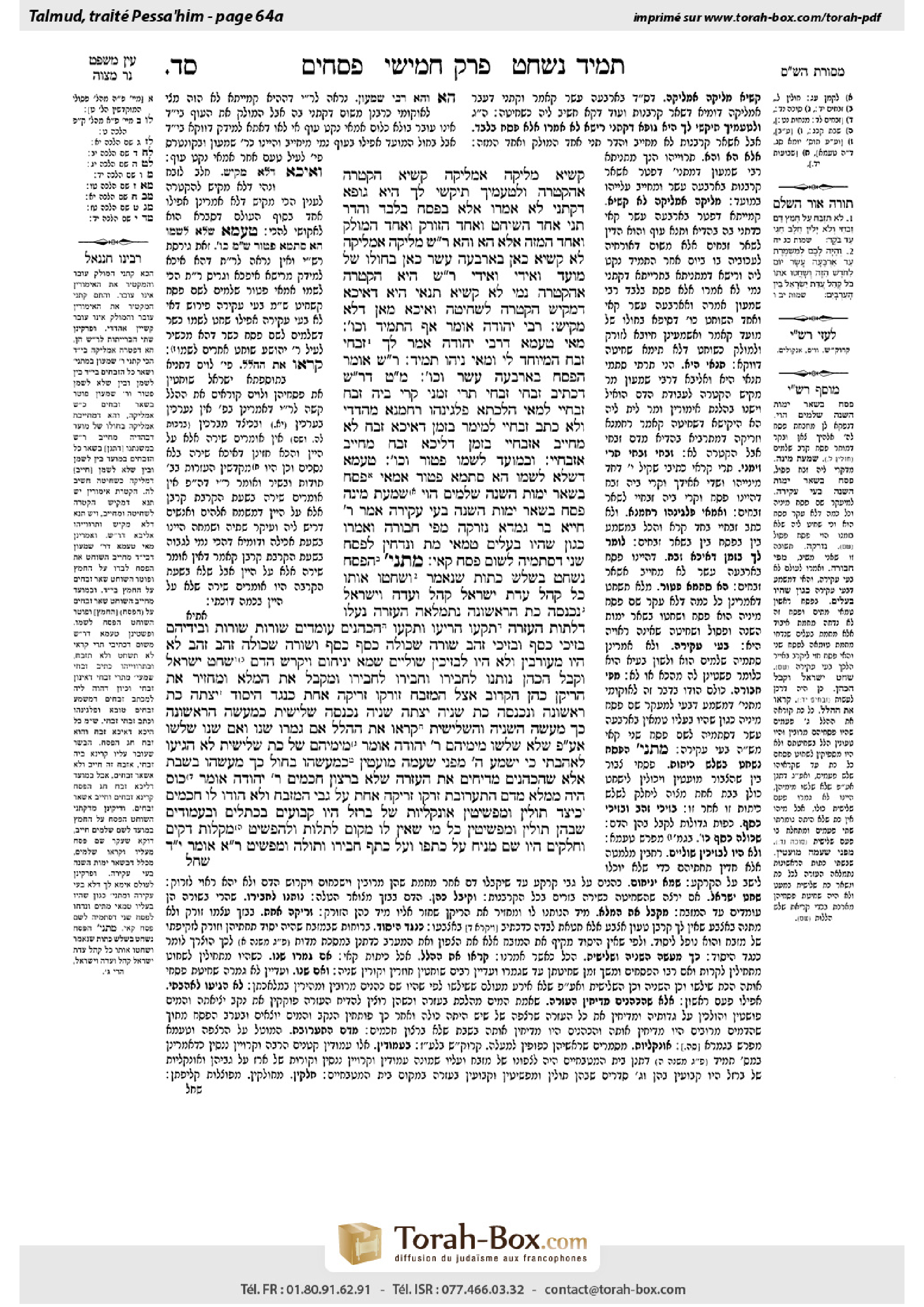
Pesachim 64a: Talmud study for Daf Yomi
Daf Yomi is the daily study of one Talmud folio. Explore 37 tractates with scans, Hebrew text, Sefaria English and AI-generated French translations where annotated.
Passage selection and English or AI-generated French translation are available where the scan has annotations. Daf Study is independent of Torah-Box and Sefaria.
Browse Pesachim · פסחים · All tractatesPesachim 64a text and translations
This page of Pesachim includes the Aramaic text, an English translation and an AI-generated French translation, alongside the scan above.
פסחים ס״ד א · Aramaic and Hebrew text
קַשְׁיָא מְלִיקָה אַמְּלִיקָה, קַשְׁיָא הַקְטָרָה אַהַקְטָרָה!
וּלְטַעְמָיךְ, תִּיקְשֵׁי לָךְ הִיא גּוּפָא. דְּקָתָנֵי: לֹא אָמְרוּ אֶלָּא בְּפֶסַח בִּלְבַד, וַהֲדַר תָּנֵי: אֶחָד הַשּׁוֹחֵט וְאֶחָד הַזּוֹרֵק וְאֶחָד הַמּוֹלֵק וְאֶחָד הַמַּזֶּה!
אֶלָּא: הָא וְהָא רַבִּי שִׁמְעוֹן. מְלִיקָה אַמְּלִיקָה לָא קַשְׁיָא: כָּאן — בְּאַרְבָּעָה עָשָׂר, כָּאן — בְּחוּלּוֹ שֶׁל מוֹעֵד. וְאִידֵּי וְאִידֵּי רַבִּי שִׁמְעוֹן הִיא.
הַקְטָרָה אַהַקְטָרָה נָמֵי לָא קַשְׁיָא — תַּנָּאֵי הִיא. דְּאִיכָּא דְּמַקֵּישׁ הַקְטָרָה לִשְׁחִיטָה, וְאִיכָּא מַאן דְּלָא מַקֵּישׁ.
רַבִּי יְהוּדָה אוֹמֵר: אַף הַתָּמִיד וְכוּ׳. מַאי טַעְמָא דְּרַבִּי יְהוּדָה? אָמַר לָךְ: ״זִבְחִי״ — זֶבַח הַמְיוּחָד לִי, וּמַאי נִיהוּ? תָּמִיד.
רַבִּי שִׁמְעוֹן אוֹמֵר: הַפֶּסַח בְּאַרְבָּעָה עָשָׂר וְכוּ׳. מַאי טַעְמָא דְּרַבִּי שִׁמְעוֹן? דִּכְתִיב ״זִבְחִי״ ״זִבְחִי״ תְּרֵי זִמְנֵי, קְרִי בֵּיהּ: ״זֶבַח, זְבָחַיי״.
לְמַאי הִלְכְתָא פַּלְגִינְהוּ רַחֲמָנָא מֵהֲדָדֵי וְלָא כְּתַב ״זְבָחַיי״? לְמֵימַר: בִּזְמַן דְּאִיכָּא זֶבַח — לָא מִחַיַּיב אַזְּבָחַיי. בִּזְמַן דְּלֵיכָּא זֶבַח — מִחַיַּיב אַזְּבָחַיי.
וּבַמּוֹעֵד לִשְׁמוֹ פָּטוּר וְכוּ׳. טַעְמָא דְּשֶׁלֹּא לִשְׁמוֹ, הָא סְתָמָא — פָּטוּר.
אַמַּאי? פֶּסַח בִּשְׁאָר יְמוֹת הַשָּׁנָה שְׁלָמִים הָוֵי! שָׁמְעַתְּ מִינַּהּ פֶּסַח בִּשְׁאָר יְמוֹת הַשָּׁנָה בָּעֵי עֲקִירָה!
אָמַר רַבִּי חִיָּיא בַּר גַּמְדָּא: נִזְרְקָה מִפִּי חֲבוּרָה, וְאָמְרוּ: כְּגוֹן שֶׁהָיוּ בְּעָלִים טְמֵאֵי מֵת, וְנִדְחִין לְפֶסַח שֵׁנִי, דִּסְתָמֵיהּ לְשׁוּם פֶּסַח קָאֵי.
מַתְנִי׳ הַפֶּסַח נִשְׁחַט בְּשָׁלֹשׁ כִּתּוֹת, שֶׁנֶּאֱמַר: ״וְשָׁחֲטוּ אוֹתוֹ כֹּל קְהַל עֲדַת יִשְׂרָאֵל״, קָהָל, וְעֵדָה, וְיִשְׂרָאֵל. נִכְנְסָה כַּת הָרִאשׁוֹנָה, נִתְמַלְּאָה הָעֲזָרָה, נָעֲלוּ דַּלְתוֹת הָעֲזָרָה, תָּקְעוּ הֵרִיעוּ וְתָקְעוּ,
הַכֹּהֲנִים עוֹמְדִים שׁוּרוֹת שׁוּרוֹת, וּבִידֵיהֶם בְּזִיכִי כֶסֶף וּבְזִיכֵי זָהָב. שׁוּרָה שֶׁכּוּלָּהּ כֶּסֶף כֶּסֶף, וְשׁוּרָה שֶׁכּוּלָּהּ זָהָב זָהָב, לֹא הָיוּ מְעוֹרָבִין. וְלֹא הָיוּ לַבָּזִיכִין שׁוּלַיִים, שֶׁמָּא יַנִּיחוּם וְיִקָּרֵשׁ הַדָּם.
שָׁחַט יִשְׂרָאֵל, וְקִבֵּל הַכֹּהֵן. נוֹתְנוֹ לַחֲבֵירוֹ, וַחֲבֵירוֹ לַחֲבֵירוֹ. וּמְקַבֵּל אֶת הַמָּלֵא, וּמַחֲזִיר אֶת הָרֵיקָן. כֹּהֵן הַקָּרוֹב אֵצֶל הַמִּזְבֵּחַ זוֹרְקוֹ זְרִיקָה אַחַת כְּנֶגֶד הַיְּסוֹד.
יָצְתָה כַּת רִאשׁוֹנָה, וְנִכְנְסָה כַּת שְׁנִיָּה. יָצְתָה שְׁנִיָּה, נִכְנְסָה שְׁלִישִׁית. כְּמַעֲשֵׂה הָרִאשׁוֹנָה כָּךְ מַעֲשֵׂה הַשְּׁנִיָּה וְהַשְּׁלִישִׁית. קָרְאוּ אֶת הַהַלֵּל. אִם גָּמְרוּ — שָׁנוּ, וְאִם שָׁנוּ — שִׁלֵּשׁוּ, אַף עַל פִּי שֶׁלֹּא שִׁלְּשׁוּ מִימֵיהֶם. רַבִּי יְהוּדָה אוֹמֵר: מִימֵיהֶם שֶׁל כַּת שְׁלִישִׁית לֹא הִגִּיעוּ לְ״אָהַבְתִּי כִּי יִשְׁמַע ה׳״, מִפְּנֵי שֶׁעַמָּהּ מוּעָטִין.
כְּמַעֲשֵׂהוּ בַּחוֹל כָּךְ מַעֲשֵׂהוּ בַּשַּׁבָּת, אֶלָּא שֶׁהַכֹּהֲנִים מְדִיחִים אֶת הָעֲזָרָה שֶׁלֹּא בִּרְצוֹן חֲכָמִים. רַבִּי יְהוּדָה אוֹמֵר: כּוֹס הָיָה מְמַלֵּא מִדַּם הַתַּעֲרוֹבֶת, זְרָקוֹ זְרִיקָה אַחַת עַל גַּבֵּי הַמִּזְבֵּחַ. וְלֹא הוֹדוּ לוֹ חֲכָמִים.
כֵּיצַד תּוֹלִין וּמַפְשִׁיטִין? אוּנְקְלָיוֹת שֶׁל בַּרְזֶל הָיוּ קְבוּעִים בַּכְּתָלִים וּבָעַמּוּדִים שֶׁבָּהֶן תּוֹלִין וּמַפְשִׁיטִין. כׇּל מִי שֶׁאֵין לוֹ מָקוֹם לִתְלוֹת וּלְהַפְשִׁיט — מַקְלוֹת דַּקִּים וַחֲלָקִים הָיוּ שָׁם, מַנִּיחַ עַל כְּתֵפוֹ וְעַל כֶּתֶף חֲבֵירוֹ, וְתוֹלֶה וּמַפְשִׁיט. רַבִּי אֱלִיעֶזֶר אוֹמֵר: אַרְבָּעָה עָשָׂר
Pesachim 64a · English translation
There seems to be a contradiction between the ruling in the first baraita with regard to pinching and the ruling in the second baraita with regard to pinching. In addition, there seems to be a contradiction between the ruling in the first baraita with regard to burning and the ruling in the second baraita with regard to burning. The first baraita rules that one who burns the sacrificial parts is included in the prohibition but that one who pinches the neck of a bird-offering is not, and the second baraita says the opposite.
The Gemara responds: And according to your reasoning that both baraitot refer to the same issue, ask about the baraita itself, as first it teaches: They said that this prohibition applies only to the Paschal lamb, and then it teaches that whether he slaughters the animal or he sprinkles the blood, or he pinches a bird-offering, or he sprinkles the blood of the bird-offering onto the altar, he is liable. Pinching and sprinkling the bird’s blood apply to bird-offerings but not to the Paschal lamb.
Rather, say instead that both this baraita and that baraita express the opinion of Rabbi Shimon. And there is no contradiction between the ruling in the first baraita about pinching and the ruling in the second baraita about pinching: Here, where it says that one who pinches does not transgress, it is referring to the fourteenth of Nisan, while there, where it says that one who pinches does transgress, it is talking about the intermediate days of the festival of Passover. And both this baraita and that baraita express the opinion of Rabbi Shimon, who maintains that the prohibition does not apply to other sacrifices on the fourteenth of Nisan but does apply to them during the intermediate days of Passover, as explained in the mishna.
There is also no contradiction between the ruling in the first baraita about burning and the ruling in the second baraita about burning, as the matter is the subject of a dispute between tanna’im with regard to the opinion of Rabbi Shimon: There is one who compares burning to slaughtering, as Rav Pappa did, and there is one who does not compare them.
It was stated in the mishna that Rabbi Yehuda says: One is liable even for slaughtering the daily afternoon offering on the eve of Passover with leaven in his possession. What is the reason for Rabbi Yehuda’s opinion? The Gemara answers: He could have said to you that the verse states: “You shall not offer the blood of My sacrifice with leavened bread” (Exodus 34:25). “My sacrifice” indicates the sacrifice that is designated to Me; and what is it? This is referring to the daily offering, which is a burnt-offering brought each day as part of the Temple service.
It was further stated in the mishna that Rabbi Shimon says: On the fourteenth of Nisan one is liable for sacrificing the Paschal lamb with leaven in his possession, but he is not liable for sacrificing other offerings with leaven; however, during the Festival one is liable for sacrificing any offering with leaven in his possession. The Gemara asks: What is the reason for Rabbi Shimon’s opinion? The Gemara answers: As it is written: “My sacrifice [zivḥi],” “My sacrifice [zivḥi],” two times, as first it is written: “You shall not offer the blood of My sacrifice [zivḥi] with leavened bread” (Exodus 23:18) and then it is written again: “You shall not offer the blood of My sacrifice [zivḥi] with leavened bread” (Exodus 34:25). If the two instances of the word zivḥi are combined, their letters may be rearranged to read: A sacrifice [zevaḥ], and: My sacrifices [zevaḥai]. This indicates that the law applies both to the Paschal lamb and to the rest of the sacrifices.
To teach what halakha does the Merciful One divide them from one another and not explicitly write: My sacrifices? It was to say that at the time when there is a sacrifice, meaning at the time of the Paschal lamb, as mentioned in the continuation of the verse, one is not liable for My sacrifices. On the eve of Passover, when the Paschal lamb is brought, there is no liability for offering other sacrifices with leaven. However, at a time when there is no sacrifice, during the festival of Passover, one is liable for slaughtering any of My sacrifices with leaven in his possession.
It was taught in the mishna that according to Rabbi Shimon, if one sacrificed a Paschal lamb during the intermediate days of the Festival for its own purpose as a Paschal lamb, one is exempt from liability if he had leaven in his possession during the time of the slaughter, as it is an invalid offering. However, if he sacrificed it for a different purpose, he is liable, because a Paschal lamb that is slaughtered at a time other than Passover eve is valid as a peace-offering. The Gemara analyzes this ruling: The reason he is liable is that he slaughtered it explicitly for a different purpose; but had he slaughtered it without specific intent he would be exempt, because the offering would be disqualified. Unless he specifically states otherwise, the animal retains its status as a Paschal lamb and is subsequently disqualified because it is not the proper time to sacrifice a Paschal lamb.
The Gemara expresses surprise: Why must he expressly state that he is sacrificing it as a different offering? Isn’t a Paschal lamb sacrificed during the rest of the days of the year presumed to be a peace-offering? There should be no need to state explicitly that it is a different offering. Learn from this that a Paschal lamb sacrificed on the rest of the days of the year requires uprooting, i.e., one must explicitly declare that he is sacrificing the offering as a peace-offering, and not as a Paschal lamb.
Rabbi Ḥiyya bar Gamda said: A group of scholars were studying this issue and it emerged from the group, that is, one of the scholars made a statement with which the rest of them agreed, and it was subsequently forgotten who had made the statement, and they said as follows: We are dealing here with a case where the owners of the offering were ritually impure with impurity imparted by a corpse during the first Passover, and they were deferred to the second Passover. A person who was ritually impure or on a distant journey and therefore failed to bring the Paschal lamb at its proper time on the fourteenth of Nisan must compensate by bringing the offering on the fourteenth of Iyyar. In such a situation, the offering presumably stands to be sacrificed as a Paschal lamb, and it does not automatically become a peace-offering unless its owners explicitly declare it as such. However, this would not be true of other Paschal lambs after the time to offer the Paschal lamb has passed.
MISHNA: The Paschal lamb was slaughtered in three groups, meaning those bringing the offering were divided into three separate sets, as it is stated: “And the whole assembly of the congregation of Israel shall slaughter it in the afternoon” (Exodus 12:6). The verse is interpreted as referring to three groups: Assembly, congregation, and Israel. The procedure for sacrificing the offering was as follows: The first group of people sacrificing the offering entered, and when the Temple courtyard became filled with them they closed the doors of the Temple courtyard. They sounded uninterrupted, broken, and uninterrupted trumpet blasts, as was done while sacrificing any offering.
The priests stood in rows from the place of slaughter to the altar, and in their hands they held bowls [bezikhin] of silver and bowls of gold in order to receive the blood of the offerings. There was a row entirely composed of priests holding silver bowls, and a row entirely composed of priests holding gold bowls, as the gold and silver bowls were not mixed in the same row. The bowls did not have flat bases that would allow them to be put down, out of concern that perhaps the priests would set them down and forget about them and in the meantime the blood would congeal and become disqualified for sprinkling on the altar.
An Israelite would slaughter the sacrifice, and a priest would receive the blood and immediately hand it to another priest standing next to him, and the other priest would pass it to another. Each priest would receive a full bowl of blood from the priest next to him and return to him an empty bowl being passed in the opposite direction, the contents of which had already been sprinkled on the altar. The priest who was closest to the altar would sprinkle a single sprinkling of blood against the base of the altar, i.e., against the north and west sides of the altar, where there was a base.
The first group exited upon completion of the rite, and the second group entered; the second group left upon completion of its rite, and the third group entered. As it was done by the first group, so was it done by the second and third groups. All the people standing in the Temple courtyard while the Paschal lambs were being slaughtered would recite hallel. If they finished reciting it before all the offerings were slaughtered, they recited it a second time, and if they finished reciting it a second time, they recited it a third time, although in practice they never recited it a third time, as the priests worked efficiently and finished the rite before this became necessary. Rabbi Yehuda says: The third group never reached even once the opening verse of the fourth chapter of hallel: “I love that the Lord hears the voice of my supplications” (Psalms 116:1), because its people were few and the slaughtering of all the offerings was completed during the recitation of the first three chapters.
As it was done during the week, so was it done on Shabbat; only that on Shabbat the priests would rinse the Temple courtyard, cleaning away the blood, contrary to the wishes of the Sages, as the priests did not want to veer from the weekday procedure in this regard. Rabbi Yehuda says: Before the floor was rinsed, a priest would fill a cup with the blood of the many offerings brought that day that was now mixed together on the floor and then sprinkle it with a single sprinkling upon the altar. But the Rabbis did not agree with Rabbi Yehuda with regard to this point.
How would one suspend and flay the Paschal lamb in the Temple? Iron hooks [unkelayot] were secured into the walls and pillars, and upon them one would suspend the offering and flay it. If anyone lacked a place among the hooks in the Temple courtyard to suspend and flay the offering, there were thin, smooth rods there, which he would place on his own shoulder and on another’s shoulder, and from it he would suspend the offering and flay it. Rabbi Eliezer says: When the fourteenth of Nisan
Pesachim 64a · Traduction française (IA)
Il semble y avoir une contradiction entre la décision de la première baraïta concernant la mélika et celle de la seconde baraïta à ce sujet. De plus, il semble y avoir une contradiction entre la décision de la première baraïta concernant la combustion et celle de la seconde baraïta à ce sujet. La première baraïta statue que celui qui brûle les parties sacrificielles tombe sous le coup de l’interdiction, mais que celui qui pratique la mélika sur une offrande d’oiseau ne l’enfreint pas ; la seconde baraïta dit le contraire.
La Guemara répond : Si l’on suit votre raisonnement selon lequel les deux baraïtot traitent de la même question, interrogez-vous sur la baraïta elle-même : elle enseigne d’abord : « Ils ont dit que cette interdiction ne s’applique qu’au sacrifice pascal », puis elle enseigne que, qu’il égorge l’animal, qu’il asperge le sang, qu’il pratique la mélika sur une offrande d’oiseau ou qu’il asperge sur l’autel le sang de l’oiseau, il est passible. Or, la mélika et l’aspersion du sang de l’oiseau concernent les offrandes d’oiseaux, mais pas le sacrifice pascal.
Il faut plutôt dire que cette baraïta et cette autre baraïta expriment toutes deux l’opinion de Rabbi Shimon. Il n’y a pas de contradiction entre la décision de la première baraïta concernant la mélika et celle de la seconde baraïta à ce sujet : ici, lorsqu’il est dit que celui qui pratique la mélika ne transgresse pas, il s’agit du quatorze Nissan ; là, lorsqu’il est dit que celui qui pratique la mélika transgresse, il s’agit des jours intermédiaires de la fête de Pessa’h. Ces deux baraïtot expriment l’opinion de Rabbi Shimon, qui soutient que l’interdiction ne s’applique pas aux autres sacrifices le quatorze Nissan, mais qu’elle s’applique à ceux-ci pendant les jours intermédiaires de Pessa’h, comme l’explique la Michna.
Il n’y a pas non plus de contradiction entre la décision de la première baraïta concernant la combustion et celle de la seconde baraïta à ce sujet, car la question fait l’objet d’une controverse entre les tannaïm au sujet de l’opinion de Rabbi Shimon : certains assimilent la combustion à l’égorgement, comme l’a fait Rav Pappa, tandis que d’autres ne les assimilent pas.
Il a été enseigné dans la Michna que Rabbi Yehuda dit : on est passible même si l’on égorge l’offrande quotidienne de l’après-midi, la veille de Pessa’h, alors que l’on possède du hamets. Quelle est la raison de l’opinion de Rabbi Yehuda ? La Guemara répond : il aurait pu te dire que le verset énonce : « Tu n’offriras pas le sang de mon sacrifice avec du pain levé » (Exode 34,25). « Mon sacrifice » désigne le sacrifice qui m’est consacré. Et lequel est-ce ? Il s’agit de l’offrande quotidienne, un holocauste offert chaque jour dans le cadre du service du Temple.
Il a également été enseigné dans la Michna que Rabbi Shimon dit : le quatorze Nissan, on est passible si l’on offre le sacrifice pascal alors que l’on possède du hamets, mais on n’est pas passible si l’on offre d’autres sacrifices avec du hamets ; toutefois, pendant la fête, on est passible si l’on offre n’importe quel sacrifice alors que l’on possède du hamets. La Guemara demande : quelle est la raison de l’opinion de Rabbi Shimon ? La Guemara répond : car il est écrit « mon sacrifice [zivḥi] », « mon sacrifice [zivḥi] », deux fois : d’abord, il est écrit « Tu n’offriras pas le sang de mon sacrifice [zivḥi] avec du pain levé » (Exode 23,18), puis il est écrit à nouveau : « Tu n’offriras pas le sang de mon sacrifice [zivḥi] avec du pain levé » (Exode 34,25). Si l’on combine les deux occurrences du mot zivḥi, on peut en réarranger les lettres pour lire : un sacrifice [zevaḥ] et mes sacrifices [zevaḥai]. Cela indique que la loi s’applique aussi bien au sacrifice pascal qu’aux autres sacrifices.
Quelle halakha le Miséricordieux veut-il enseigner en les séparant l’un de l’autre, au lieu d’écrire explicitement « mes sacrifices » ? C’est pour enseigner qu’au moment où il y a un sacrifice, c’est-à-dire au moment du sacrifice pascal, comme le mentionne la suite du verset, on n’est pas passible pour mes sacrifices. La veille de Pessa’h, quand on offre le sacrifice pascal, on n’est pas passible pour l’offrande d’autres sacrifices avec du hamets. En revanche, au moment où il n’y a pas de sacrifice, pendant la fête de Pessa’h, on est passible si l’on égorge n’importe lequel de mes sacrifices alors que l’on possède du hamets.
Il a été enseigné dans la Michna que, selon Rabbi Shimon, si l’on a offert un sacrifice pascal pendant les jours intermédiaires de la fête dans l’intention de l’offrir comme sacrifice pascal, on n’est pas passible si l’on possédait du hamets au moment de l’égorgement, car il s’agit d’un sacrifice invalide. Toutefois, si on l’a offert dans une autre intention, on est passible, car un sacrifice pascal égorgé à un moment autre que la veille de Pessa’h est valide comme sacrifice de paix. La Guemara examine cette décision : la raison pour laquelle on est passible est qu’on l’a égorgé explicitement dans une autre intention ; mais si on l’avait égorgé sans intention précise, on n’aurait pas été passible, car le sacrifice aurait été disqualifié. À moins qu’on ne déclare expressément le contraire, l’animal conserve son statut de sacrifice pascal et est ensuite disqualifié, car ce n’est pas le moment approprié pour offrir un sacrifice pascal.
La Guemara exprime son étonnement : pourquoi doit-il déclarer explicitement qu’il le sacrifie comme une autre offrande ? Un sacrifice pascal sacrifié durant les autres jours de l’année n’est-il pas présumé être un sacrifice de paix ? Il ne devrait donc pas être nécessaire de déclarer explicitement qu’il s’agit d’une autre offrande. Apprenons-en qu’un sacrifice pascal offert durant les autres jours de l’année doit faire l’objet d’un changement d’affectation, c’est-à-dire qu’il faut déclarer explicitement qu’on le sacrifie comme un sacrifice de paix et non comme un sacrifice pascal.
Rabbi Ḥiyya bar Gamda dit : Un groupe de sages étudia cette question, et une conclusion émergea de leur discussion : l’un des sages formula une déclaration à laquelle les autres acquiescèrent, puis on oublia qui l’avait formulée. Ils dirent ainsi : Nous traitons ici d’un cas où les propriétaires de l’offrande étaient rituellement impurs, ayant contracté une impureté transmise par un cadavre, lors du premier Pessa’h, et où ils furent reportés au second Pessa’h. Une personne rituellement impure ou en voyage dans un lieu éloigné, qui n’a donc pas apporté le sacrifice pascal à la date prévue, le quatorze Nissan, doit compenser en apportant l’offrande le quatorze Iyar. Dans une telle situation, l’offrande est présumée devoir être sacrifiée comme un sacrifice pascal et ne devient pas automatiquement un sacrifice de paix, à moins que ses propriétaires ne la désignent explicitement comme telle. Toutefois, cela ne s’appliquerait pas aux autres sacrifices pascals une fois passé le moment prévu pour offrir le sacrifice pascal.
MICHNA : Le sacrifice pascal était égorgé en trois groupes, c’est-à-dire que ceux qui apportaient l’offrande étaient répartis en trois groupes distincts, comme il est dit : « Toute l’assemblée de la communauté d’Israël l’égorgera vers le soir » (Exode 12,6). Le verset est interprété comme faisant référence à trois groupes : assemblée, communauté et Israël. La procédure du sacrifice était la suivante : le premier groupe de personnes apportant l’offrande entra et, lorsque la cour du Temple en fut remplie, on en ferma les portes. On sonna des trompettes par des sonneries continues, brisées, puis continues, comme on le faisait lors du sacrifice de toute offrande.
Les prêtres se tenaient en rangées, depuis le lieu de l’égorgement jusqu’à l’autel, tenant dans leurs mains des bols [bezikhin] d’argent et des bols d’or pour recueillir le sang des offrandes. Une rangée était entièrement composée de prêtres tenant des bols d’argent, et une autre, de prêtres tenant des bols d’or, car les bols d’or et d’argent n’étaient pas mélangés au sein d’une même rangée. Les bols n’avaient pas de fond plat qui aurait permis de les poser, de crainte que les prêtres ne les déposent et ne les oublient ; entre-temps, le sang pourrait coaguler et devenir impropre à l’aspersion sur l’autel.
Un Israélite égorgeait le sacrifice, un prêtre en recueillait le sang et le remettait aussitôt à un autre prêtre qui se tenait à côté de lui, lequel le transmettait à un autre. Chaque prêtre recevait du prêtre à côté de lui un bol plein de sang et lui rendait un bol vide qui circulait en sens inverse, après que son contenu avait été aspergé sur l’autel. Le prêtre le plus proche de l’autel faisait une seule aspersion de sang contre la base de l’autel, c’est-à-dire contre les côtés nord et ouest de l’autel, où se trouvait une base.
Le premier groupe sortait une fois le rite achevé et le deuxième groupe entrait ; le deuxième sortait à la fin de son rite et le troisième entrait. Ce qui avait été fait par le premier groupe l’était également par les deuxième et troisième groupes. Tous ceux qui se tenaient dans la cour du Temple pendant l’égorgement des sacrifices pascals récitaient le Hallel. S’ils avaient fini de le réciter avant que toutes les offrandes aient été égorgées, ils le récitaient une deuxième fois ; s’ils avaient fini une deuxième fois, ils le récitaient une troisième fois. En pratique, toutefois, ils ne le récitaient jamais une troisième fois, car les prêtres travaillaient efficacement et achevaient le rite avant que cela ne devienne nécessaire. Rabbi Yehuda dit : Le troisième groupe n’arrivait jamais à réciter ne serait-ce que le verset d’ouverture du quatrième chapitre du Hallel : « J’aime que le Seigneur entende la voix de mes supplications » (Psaumes 116,1), car ses membres étaient peu nombreux et l’égorgement de toutes les offrandes s’achevait pendant la récitation des trois premiers chapitres.
Ce qui se faisait pendant la semaine se faisait également le Chabbat ; seulement, le Chabbat, les prêtres rinçaient la cour du Temple pour en nettoyer le sang, contre la volonté des Sages, car ils ne voulaient pas s’écarter à cet égard de la procédure des jours de semaine. Rabbi Yehuda dit : Avant que le sol ne soit rincé, un prêtre remplissait une coupe du sang des nombreuses offrandes apportées ce jour-là, désormais mêlé sur le sol, puis en faisait une seule aspersion sur l’autel. Mais les Sages n’étaient pas d’accord avec Rabbi Yehuda sur ce point.
Comment suspendait-on et dépouillait-on le sacrifice pascal dans le Temple ? Des crochets de fer [unkelayot] étaient fixés dans les murs et les piliers ; on y suspendait l’offrande pour la dépouiller. Si quelqu’un ne trouvait pas de place parmi les crochets de la cour du Temple pour suspendre et dépouiller son offrande, il y avait là de fines perches lisses ; il en plaçait une sur son épaule et sur celle d’un autre, puis y suspendait l’offrande pour la dépouiller. Rabbi Eliezer dit : Lorsque le quatorze Nissan
Traduction française générée par IA à partir de l’édition anglaise de Sefaria. Vérifie toujours un passage avec le texte source.
Text from Sefaria: William Davidson Edition - Vocalized Aramaic (CC BY NC); William Davidson Edition - English (CC BY NC).