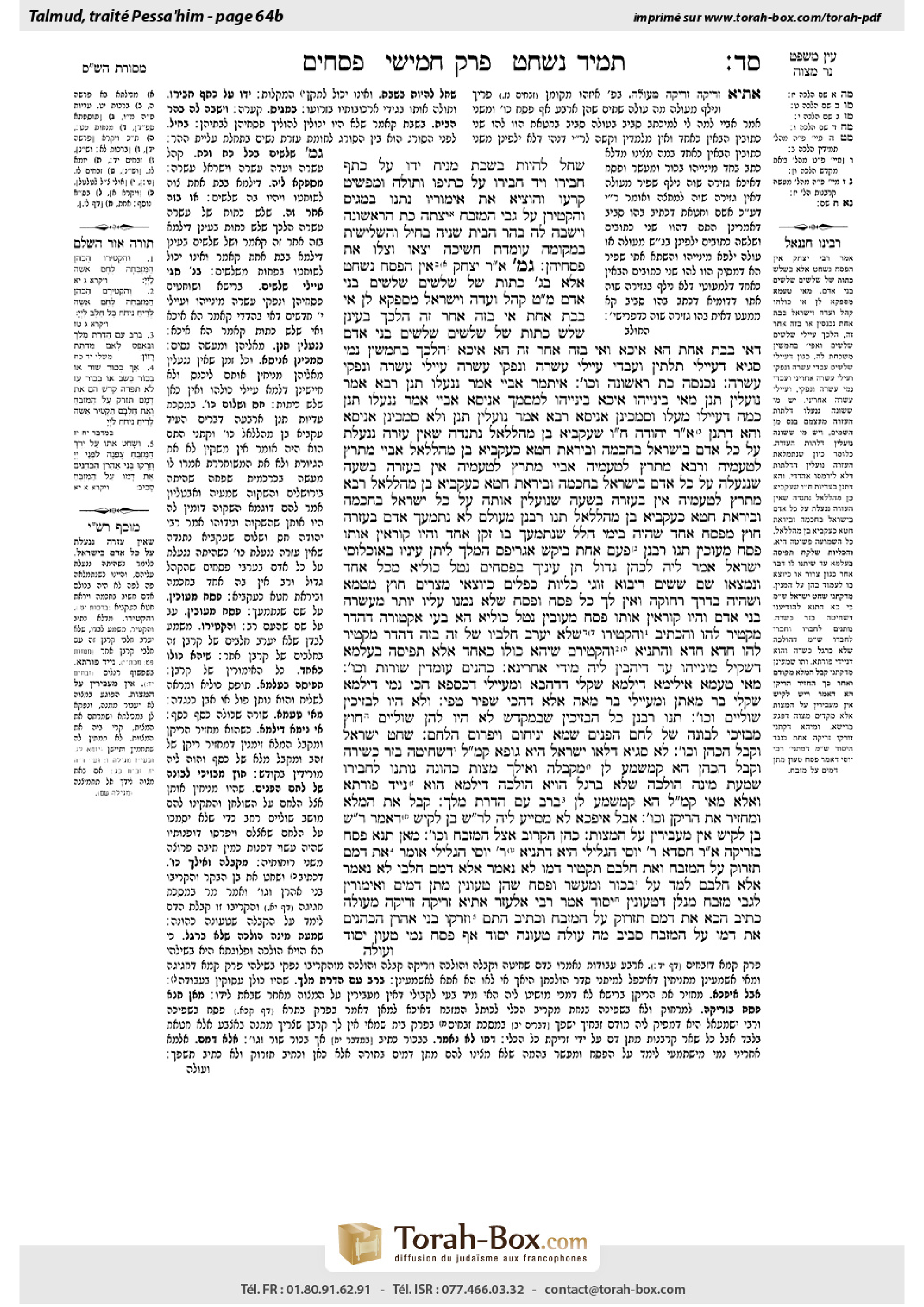
Pesachim 64b: Talmud study for Daf Yomi
Daf Yomi is the daily study of one Talmud folio. Explore 37 tractates with scans, Hebrew text, Sefaria English and AI-generated French translations where annotated.
Passage selection and English or AI-generated French translation are available where the scan has annotations. Daf Study is independent of Torah-Box and Sefaria.
Browse Pesachim · פסחים · All tractatesPesachim 64b text and translations
This page of Pesachim includes the Aramaic text, an English translation and an AI-generated French translation, alongside the scan above.
פסחים ס״ד ב · Aramaic and Hebrew text
שֶׁחָל לִהְיוֹת בַּשַּׁבָּת, מַנִּיחַ יָדוֹ עַל כֶּתֶף חֲבֵירוֹ, וְיַד חֲבֵירוֹ עַל כְּתֵיפוֹ, וְתוֹלֶה וּמַפְשִׁיט. קְרָעוֹ, וְהוֹצִיא אֶת אֵימוּרָיו. נְתָנוֹ בְּמָגֵיס, וְהִקְטִירָן עַל גַּבֵּי הַמִּזְבֵּחַ.
יָצְתָה כַּת הָרִאשׁוֹנָה וְיָשְׁבָה לָהּ בְּהַר הַבַּיִת. שְׁנִיָּה בַּחֵיל, וְהַשְּׁלִישִׁית בִּמְקוֹמָהּ עוֹמֶדֶת. חָשֵׁיכָה — יָצְאוּ וְצָלוּ אֶת פִּסְחֵיהֶן.
גְּמָ׳ אָמַר רַבִּי יִצְחָק: אֵין הַפֶּסַח נִשְׁחָט אֶלָּא בְּשָׁלֹשׁ כִּתּוֹת שֶׁל שְׁלֹשִׁים שְׁלֹשִׁים בְּנֵי אָדָם. מַאי טַעְמָא? ״קָהָל״ וְ״עֵדָה״ וְ״יִשְׂרָאֵל״. מְסַפְּקָא לַן אִי בְּבַת אַחַת אִי בְּזֶה אַחַר זֶה,
הִלְכָּךְ בָּעֵינַן שָׁלֹשׁ כִּתּוֹת שֶׁל שְׁלֹשִׁים שְׁלֹשִׁים בְּנֵי אָדָם. דְּאִי בְּבַת אַחַת — הָא אִיכָּא, וְאִי בָּזֶה אַחַר זֶה — הָא אִיכָּא, הִלְכָּךְ בְּחַמְשִׁין נָמֵי סַגִּיא, דְּעָיְילִי תְּלָתִין וְעָבְדִי, עָיְילִי עַשְׂרָה וְנָפְקִי עַשְׂרָה, עָיְילִי עַשְׂרָה וְנָפְקִי עַשְׂרָה.
נִכְנְסָה כַּת רִאשׁוֹנָה וְכוּ׳. אִיתְּמַר, אַבָּיֵי אָמַר: נִנְעֲלוּ תְּנַן. רָבָא אָמַר: נוֹעֲלִין תְּנַן.
מַאי בֵּינַיְיהוּ? אִיכָּא בֵּינַיְיהוּ לְמִסְמַךְ אַנִּיסָּא. אַבָּיֵי אָמַר: נִנְעֲלוּ תְּנַן, כַּמָּה דַּעֲיַילוּ מְעַלּוּ, וְסָמְכִינַן אַנִּיסָּא. רָבָא אָמַר: נוֹעֲלִין תְּנַן, וְלָא סָמְכִינַן אַנִּיסָּא.
וְהָא דִּתְנַן, אָמַר רַבִּי יְהוּדָה: חַס וְשָׁלוֹם שֶׁעֲקַבְיָא בֶּן מַהֲלַלְאֵל נִתְנַדָּה, שֶׁאֵין עֲזָרָה נִנְעֶלֶת עַל כׇּל אָדָם בְּיִשְׂרָאֵל בְּחׇכְמָה וּבְיִרְאַת חֵטְא כַּעֲקַבְיָא בֶּן מַהֲלַלְאֵל. אַבָּיֵי מְתָרֵץ לְטַעְמֵיהּ, וְרָבָא מְתָרֵץ לְטַעְמֵיהּ. אַבָּיֵי מְתָרֵץ לְטַעְמֵיהּ: אֵין בָּעֲזָרָה בְּשָׁעָה שֶׁנִּנְעֲלָה עַל כׇּל אָדָם בְּיִשְׂרָאֵל בְּחׇכְמָה וּבְיִרְאַת חֵטְא כַּעֲקַבְיָא בֶּן מַהֲלַלְאֵל: רָבָא מְתָרֵץ לְטַעְמֵיהּ: אֵין בָּעֲזָרָה בְּשָׁעָה שֶׁנּוֹעֲלִין אוֹתָהּ עַל כׇּל יִשְׂרָאֵל בְּחׇכְמָה וּבְיִרְאַת חֵטְא כַּעֲקַבְיָא בֶּן מַהֲלַלְאֵל.
תָּנוּ רַבָּנַן: מֵעוֹלָם לָא נִתְמַעֵךְ אָדָם בָּעֲזָרָה, חוּץ מִפֶּסַח אֶחָד שֶׁהָיָה בִּימֵי הִלֵּל, שֶׁנִּתְמַעֵךְ בּוֹ זָקֵן אֶחָד, וְהָיוּ קוֹרְאִין אוֹתוֹ ״פֶּסַח מְעוּכִין״.
תָּנוּ רַבָּנַן: פַּעַם אַחַת בִּיקֵּשׁ אַגְרִיפַּס הַמֶּלֶךְ לִיתֵּן עֵינָיו בְּאוּכְלוּסֵי יִשְׂרָאֵל. אֲמַר לֵיהּ לְכֹהֵן גָּדוֹל: תֵּן עֵינֶיךָ בַּפְּסָחִים. נָטַל כּוּלְיָא מִכׇּל אֶחָד, וְנִמְצְאוּ שָׁם שִׁשִּׁים רִיבּוֹא זוּגֵי כְלָיוֹת כִּפְלַיִם כְּיוֹצְאֵי מִצְרַיִם. חוּץ מִטָּמֵא וְשֶׁהָיָה בְּדֶרֶךְ רְחוֹקָה. וְאֵין לָךְ כׇּל פֶּסַח וּפֶסַח שֶׁלֹּא נִמְנוּ עָלָיו יוֹתֵר מֵעֲשָׂרָה בְּנֵי אָדָם. וְהָיוּ קוֹרְאִין אוֹתוֹ ״פֶּסַח מְעוּבִּין״.
נָטַל כּוּלְיָא? הָא בָּעֵי אַקְטוּרַהּ! דַּהֲדַר מַקְטֵיר לְהוּ. וְהָכְתִיב: ״וְהִקְטִירוֹ״, שֶׁלֹּא יְעָרֵב חֲלָבָיו שֶׁל זֶה בָּזֶה!
דַּהֲדַר מַקְטֵיר לְהוּ חֲדָא חֲדָא. וְהָתַנְיָא ״וְהִקְטִירָם״, שֶׁיְּהֵא כּוּלּוֹ כְּאֶחָד! אֶלָּא: תְּפִיסָה בְּעָלְמָא, דְּשָׁקֵיל מִינַּיְיהוּ עַד דְּיָהֲבִין לֵיהּ מִידֵּי אַחֲרִינָא.
כֹּהֲנִים עוֹמְדִין שׁוּרוֹת וְכוּ׳. מַאי טַעְמָא? אִילֵּימָא דִּילְמָא שָׁקְלִי דְּדַהֲבָא וּמְעַיְּילִי דְּכַסְפָּא — הָכִי נָמֵי, דִּילְמָא שָׁקְלִי בַּר מָאתַן וּמְעַיְּילִי בַּר מְאָה! אֶלָּא, דְּהָכִי שַׁפִּיר טְפֵי.
וְלֹא הָיוּ לַבָּזִיכִין שׁוּלַיִים וְכוּ׳. תָּנוּ רַבָּנַן: כׇּל הַבָּזִיכִין שֶׁבַּמִּקְדָּשׁ לֹא הָיוּ לָהֶן שׁוּלַיִים, חוּץ מִבְּזִיכֵי לְבוֹנָה שֶׁל לֶחֶם הַפָּנִים — שֶׁמָּא יַנִּיחוּם וְיִפְרוֹס הַלֶּחֶם.
שָׁחַט יִשְׂרָאֵל וְקִבֵּל הַכֹּהֵן וְכוּ׳. לָא סַגִּיא דְּלָאו יִשְׂרָאֵל?! הִיא גּוּפָא קָא מַשְׁמַע לַן, דִּשְׁחִיטָה בְּזָר כְּשֵׁירָה. וְקִבֵּל הַכֹּהֵן. הָא קָמַשְׁמַע לַן, מִקַּבָּלָה וְאֵילָךְ מִצְוַת כְּהוּנָּה.
נוֹתְנוֹ לַחֲבֵירוֹ. שָׁמְעַתְּ מִינַּהּ הוֹלָכָה שֶׁלֹּא בָּרֶגֶל — הָוְיָא הוֹלָכָה! דִּילְמָא הוּא נָיֵיד פּוּרְתָּא. וְאֶלָּא מַאי קָא מַשְׁמַע לַן? הָא קָמַשְׁמַע לַן: ״בְּרׇב עָם הַדְרַת מֶלֶךְ״.
קִבֵּל אֶת הַמָּלֵא וּמַחְזִיר אֶת הָרֵיקָן וְכוּ׳. אֲבָל אִיפְּכָא לָא — מְסַיַּיע לֵיהּ לְרַבִּי שִׁמְעוֹן בֶּן לָקִישׁ, דְּאָמַר רַבִּי שִׁמְעוֹן בֶּן לָקִישׁ: אֵין מַעֲבִירִין עַל הַמִּצְוֹת.
כֹּהֵן הַקָּרוֹב אֵצֶל הַמִּזְבֵּחַ וְכוּ׳. מַאן תָּנָא פֶּסַח בִּזְרִיקָה? אָמַר רַב חִסְדָּא: רַבִּי יוֹסֵי הַגְּלִילִי הִיא.
דְּתַנְיָא, רַבִּי יוֹסֵי הַגְּלִילִי אוֹמֵר: ״אֶת דָּמָם תִּזְרוֹק עַל הַמִּזְבֵּחַ וְאֶת חֶלְבָּם תַּקְטִיר״ — ״דָּמוֹ״ לֹא נֶאֱמַר, אֶלָּא ״דָּמָם״. ״חֶלְבּוֹ״ לֹא נֶאֱמַר, אֶלָּא ״חֶלְבָּם״. לִמֵּד עַל בְּכוֹר וּמַעֲשֵׂר וּפֶסַח, שֶׁהֵן טְעוּנִין מַתַּן דָּמִים וְאֵימוּרִין לְגַבֵּי מִזְבֵּחַ.
מְנָלַן דִּטְעוּנִין יְסוֹד? אָמַר רַבִּי אֶלְעָזָר: אָתְיָא ״זְרִיקָה״ ״זְרִיקָה״ מֵעוֹלָה. כְּתִיב הָכָא: ״אֶת דָּמָם תִּזְרוֹק עַל הַמִּזְבֵּחַ״, וּכְתִיב הָתָם: ״וְזָרְקוּ בְּנֵי אַהֲרֹן הַכֹּהֲנִים אֶת דָּמוֹ עַל הַמִּזְבֵּחַ סָבִיב״, מָה עוֹלָה טְעוּנָה יְסוֹד — אַף פֶּסַח נָמֵי טָעוּן יְסוֹד.
Pesachim 64b · English translation
occurred on Shabbat, when moving the rods is prohibited (Rambam), he would rest his hand on another’s shoulder and the other’s hand on his own shoulder and suspend the offering and flay it. He would tear open the flesh of the offering and remove its sacrificial parts, i.e., the fats and other parts offered on the altar. He would place the sacrificial parts in a large basin [mageis] and burn them on the altar.
If this took place on Shabbat, when carrying is prohibited, the first group would exit and remain on the Temple Mount; the second group would remain within the rampart, which was an area outside the women’s courtyard; and the third group would stand in its place in the Temple. They would wait there until nightfall, and as soon as it became dark, they would all go out and roast their Paschal lambs, everyone in his own place.
GEMARA: Rabbi Yitzḥak said: The Paschal lamb is slaughtered only in three groups of at least thirty people each. What is the reason for this rule? The verse says: Assembly, congregation, and Israel, and each of these terms refers to a group of no fewer than ten people. We are uncertain as to whether this means that we need three groups of ten people at the same time or one after another.
Therefore, in order to satisfy both possible interpretations, we require three groups of thirty people each. As, if you say we need all thirty at the same time, we have that, and if we need them one after another, we have that as well. Therefore, in pressing circumstances when there are not enough people present, even fifty people suffice. How so? Thirty enter and perform the necessary rite, ten others enter and ten of the original group leave so that those present are considered a new group, and then ten others enter and ten more leave so that those present now comprise a third group. In this way the Paschal lamb is slaughtered in three groups of thirty people each, although the total number of people involved is only fifty.
The mishna teaches that the first group entered, after which they closed the doors to the Temple courtyard. It was stated that the amora’im disagreed about the precise wording of the mishna. Abaye said: We learned in the mishna that the doors of the Temple courtyard miraculously closed by themselves. Rava said: We learned in the mishna that people would close the doors of the Temple courtyard at the appropriate time.
What is the practical difference between them? The practical difference between them is with regard to whether we rely on a miracle. Abaye said: We learned in the mishna that the doors closed by themselves; as many people as entered, entered, and we rely on a miracle to close the doors so that an excessive number of people not enter and thus create a danger (Rabbeinu Ḥananel). Rava said: We learned in the mishna that people would close the doors, and we do not rely on a miracle to ensure that the courtyard not become overly crowded.
And that which we learned elsewhere in a mishna with regard to the ban placed upon Akavya ben Mahalalel for having spoken harshly about Shemaya and Avtalyon, that Rabbi Yehuda said: Heaven forbid that Akavya ben Mahalalel was banned; it must have been someone else, as even when the entire Jewish people would come to Jerusalem for the Festival, the Temple courtyard would not close on any man from Israel as full of wisdom and fear of sin as Akavya ben Mahalalel; Abaye can explain this statement according to his opinion, and Rava can also explain it according to his opinion. Abaye can explain it according to his opinion as follows: No man from Israel was in the Temple courtyard when it closed by itself who was as full of wisdom and fear of sin as Akavya ben Mahalalel. Rava, too, can explain it according to his opinion as follows: No man from Israel was in the Temple courtyard when they closed it who was as full of wisdom and fear of sin as Akavya ben Mahalalel.
The Sages taught: No one was ever crushed by the great throngs of people in the Temple courtyard, except for one Passover in the days of Hillel when an old man was crushed, and they called that Passover the Passover of the crushed.
The Sages taught: Once, King Agrippa wished to set his eyes on the multitudes [ukhlosin] of Israel to know how many they were. He said to the High Priest: Set your eyes on the Paschal lambs; count how many animals are brought in order to approximate the number of people. The High Priest took a kidney from each one, as the kidneys are burned on the altar, and six hundred thousand pairs of kidneys were found there, double the number of those who left Egypt. This did not reflect the sum total of the Jewish people, as it excluded those who were ritually impure or at a great distance, who did not come to offer the sacrifice. Furthermore, this was a count of the Paschal lambs and not of the people, and there was not a single Paschal lamb that did not have more than ten people registered for it. They called that Passover the Passover of the crowded, due to the large number of people.
The Gemara questions one of the details of this story: How could the High Priest take a kidney? Didn’t he have to burn it on the altar? The Gemara answers: He first took the kidneys for the count, and subsequently he burned them. The Gemara asks: Isn’t it written: “And the priest shall burn it on the altar; it is the food of the offering made by fire to the Lord” (Leviticus 3:11)? The singular “it” apparently indicates that he must not mix the fats of this sacrifice with those of another; rather, he must burn each set separately.
The Gemara answers: He subsequently burned them one by one and not all together. The Gemara asks further: Wasn’t it taught in a baraita that the plural “them” in the verse: “And the priest shall burn them upon the altar; it is the food of the offering made by fire for a satisfying aroma; all the fat is the Lord’s” (Leviticus 3:16) indicates that all the sacrificial parts of a sacrifice must be offered at the same time? Rather, it must be that when the High Priest took a kidney for counting, it was merely momentary seizure; that is, he took it from them until they brought him something else with which to keep track of the numbers, and it was this other item that was counted afterward.
It was stated in the mishna that the priests stood in rows and that there were rows of priests holding silver bowls and rows of priests holding gold bowls, but that in no rows were there both gold and silver bowls. What is the reason that there was no intermingling of gold and silver bowls? If you say that it was due to concern that perhaps a priest would take a gold bowl to keep for himself and then return a silver one in its place, the solution described in the mishna does not alleviate this concern. Here, too, in a row where everyone is holding gold bowls, there is concern that perhaps a priest would take a two-hundred-dinar bowl, keep it for himself, and then return a one-hundred-dinar bowl in its place (Rid). Rather, the reason is that this arrangement, where all the bowls in each row are of the same color, is aesthetically more attractive.
It was further stated in the mishna that the bowls did not have flat bases. The Gemara adds that the Sages taught a baraita that states: None of the bowls in the Temple had flat bases for the same reason, so that they should not be put down, which would allow the blood to congeal. This was with the exception of the bowls of frankincense that would be placed on the showbread, which did have flat bases. They could not have sharp bottoms out of concern that perhaps the priests would rest them on the bread and the bread would break. The showbread had an intricate and delicate shape, and a bowl with a sharp bottom could pierce or break the bread.
It was taught in the mishna: An Israelite would slaughter the offering and a priest would receive the blood and pass it to other priests. The Gemara asks: Is it not sufficient if someone who is not an Israelite slaughters the offering? Must the ritual slaughter be performed specifically by an Israelite, and not by a priest or a Levite? The Gemara answers: The mishna teaches us this halakha itself, that even if the slaughter is performed by a non-priest it is valid. And that which was stated in the mishna that the priest receives the blood comes to teach us that from receiving and onward the rite is a commandment cast upon the priesthood, and a non-priest may not perform it.
It was also taught in the mishna that the priest would pass the bowl of blood to another priest. The Gemara suggests: Learn from this that carrying without walking, i.e., transporting the blood to the altar by passing it from hand to hand without actually walking with it to the altar, is considered a valid act of carrying the blood of a sacrifice to the altar, one of the four rites involved in the offering of a sacrifice. This would resolve the same unanswered question in tractate Zevaḥim. The Gemara rejects this proof: Perhaps the priest would move a little with his feet as he passed the bowl to the next priest, in order to fulfill the requirement to walk with the blood to the altar. Rather, what does this account of how they transported the blood to the altar teach us? The Gemara answers: It teaches us that the priests were arranged in rows in order to increase the number of people involved in the rite and fulfill the principle that “in the multitude of people is the king’s glory” (Proverbs 14:28).
It was further stated in the mishna that each priest would receive a full bowl of blood and return an empty one. The Gemara infers: But the opposite was not done; the priest would not first return an empty bowl and then receive a full one. This supports the opinion of Rabbi Shimon ben Lakish, as Rabbi Shimon ben Lakish said: One must not postpone the performance of mitzvot. When one is presented with the opportunity to fulfill a mitzva, he must do so immediately and not delay for any reason. In this case, since bringing the blood to the altar is a mitzva, the priest should first fulfill the mitzva at hand and receive the full bowl of blood, and only then should he return the empty bowl.
It was also stated in the mishna that the priest who was closest to the altar would sprinkle the blood upon the altar. Who is the tanna who holds that the blood of the Paschal lamb requires sprinkling from afar upon the altar, and that pouring the blood directly from the bowl onto the altar does not suffice? Rav Ḥisda said: It is Rabbi Yosei HaGelili.
As it was taught in a baraita that Rabbi Yosei HaGelili says: The verse states: “But the firstborn of an ox, or the firstborn of a sheep, or the firstborn of a goat, you shall not redeem, they are sacred; you shall sprinkle their blood upon the altar and you shall burn their fat for an offering made by fire, for a satisfying aroma to the Lord” (Numbers 18:17). It is not stated: Its blood, but rather “their blood.” Similarly, it is not stated: Its fat, but rather “their fat.” This teaches with regard to the firstborn animal, which is mentioned explicitly in the verse, as well as the tithed animal and the Paschal lamb, which have a level of sanctity similar to a firstborn animal, that they all require placement of their blood and sacrificial parts on the altar, although the Torah does not give explicit instructions with regard to this aspect of the rite for a tithed animal or Paschal lamb.
The Gemara asks: From where do we derive that their blood requires sprinkling upon the altar on a side that has a base? Rabbi Elazar said: This is derived by way of a verbal analogy between the word sprinkling used here and the word sprinkling used with regard to a burnt-offering. Here, it is written: “You shall sprinkle their blood upon the altar;” there, it is written with regard to a burnt-offering: “And he shall slaughter it on the side of the altar northward before the Lord; and the sons of Aaron, the priests, shall sprinkle its blood round about upon the altar” (Leviticus 1:11). Just as the blood of a burnt-offering must be sprinkled on the altar in a place where there is a base, so too, the blood of a Paschal lamb must be sprinkled in a place where there is a base.
Pesachim 64b · Traduction française (IA)
Si cela avait lieu pendant Chabbat, où déplacer les barres est interdit (Rambam), il posait sa main sur l’épaule d’un autre, qui posait à son tour sa main sur son épaule, puis ils suspendaient l’offrande et l’écorchaient. Il ouvrait la chair de l’offrande et en retirait les parties sacrificielles, c’est-à-dire les graisses et les autres parties offertes sur l’autel. Il plaçait les parties sacrificielles dans un grand bassin [mageis] et les brûlait sur l’autel.
Si cela avait lieu pendant Chabbat, où porter est interdit, le premier groupe sortait et restait sur le mont du Temple ; le deuxième groupe restait à l’intérieur de l’enceinte, dans une zone située à l’extérieur du parvis des femmes ; et le troisième groupe restait à sa place dans le Temple. Ils attendaient là jusqu’à la tombée de la nuit et, dès qu’il faisait nuit, ils sortaient tous et faisaient rôtir leurs agneaux pascals, chacun à sa place.
GUEMARA : Rabbi Yitsḥak dit : L’agneau pascal n’est égorgé qu’en trois groupes d’au moins trente personnes chacun. Quelle est la raison de cette règle ? Le verset dit : « Assemblée, congrégation et Israël », et chacun de ces termes désigne un groupe d’au moins dix personnes. Nous ne savons pas s’il faut comprendre qu’il faut trois groupes de dix personnes simultanément ou successivement.
Par conséquent, afin de satisfaire les deux interprétations possibles, il faut trois groupes de trente personnes chacun. Car, si l’on dit qu’il faut les trente personnes simultanément, nous les avons ; et s’il les faut successivement, nous les avons également. Par conséquent, dans des circonstances pressantes où il n’y a pas assez de personnes présentes, cinquante personnes suffisent. Comment cela ? Trente entrent et accomplissent le rite requis ; dix autres entrent et dix personnes du groupe initial sortent, de sorte que les personnes présentes constituent un nouveau groupe ; puis dix autres entrent et dix autres sortent, de sorte que les personnes présentes constituent alors un troisième groupe. Ainsi, l’agneau pascal est égorgé en trois groupes de trente personnes chacun, bien que le nombre total de personnes concernées ne soit que de cinquante.
La Michna enseigne que le premier groupe entrait, après quoi on fermait les portes du parvis du Temple. Les amoraïm étaient en désaccord sur le libellé précis de la Michna. Abayé dit : Nous avons appris dans la Michna que les portes du parvis du Temple se fermaient miraculeusement d’elles-mêmes. Autant de personnes qu’il en entrait, entraient, et les portes se fermaient d’elles-mêmes. Rava dit : Nous avons appris dans la Michna que des personnes fermaient les portes du parvis du Temple au moment approprié.
Quelle est la différence pratique entre eux ? Elle concerne la question de savoir si l’on compte sur un miracle. Abayé dit : Nous avons appris dans la Michna que les portes se fermaient d’elles-mêmes ; autant de personnes qu’il en entrait, entraient, et l’on comptait sur un miracle pour fermer les portes, afin qu’un nombre excessif de personnes n’entre pas et ne provoque ainsi un danger (Rabbenou Ḥananel). Rava dit : Nous avons appris dans la Michna que des personnes fermaient les portes, et l’on ne comptait pas sur un miracle pour empêcher le parvis de devenir trop bondé.
Et à propos de ce que nous avons appris ailleurs dans une Michna concernant l’interdit prononcé contre Akavya ben Mahalalel pour avoir parlé durement de Chemaya et Avtalyon : Rabbi Yehouda a dit : « À Dieu ne plaise qu’Akavya ben Mahalalel ait été frappé d’interdit ; il devait s’agir de quelqu’un d’autre. En effet, même lorsque tout le peuple juif venait à Jérusalem pour la fête, le parvis du Temple ne se serait pas fermé sur un homme d’Israël aussi rempli de sagesse et de crainte du péché qu’Akavya ben Mahalalel. » Abayé peut expliquer cette déclaration selon son opinion, et Rava peut également l’expliquer selon la sienne. Abayé peut l’expliquer ainsi : Aucun homme d’Israël présent dans le parvis du Temple au moment où celui-ci se fermait de lui-même n’était aussi rempli de sagesse et de crainte du péché qu’Akavya ben Mahalalel. Rava aussi peut l’expliquer ainsi : Aucun homme d’Israël présent dans le parvis du Temple au moment où on le fermait n’était aussi rempli de sagesse et de crainte du péché qu’Akavya ben Mahalalel.
Les Sages enseignèrent : Jamais personne ne fut écrasé par la foule immense dans le parvis du Temple, à l’exception d’un seul Pessaḥ, à l’époque de Hillel, où un vieillard fut écrasé ; on appela ce Pessaḥ le Pessaḥ de l’écrasé.
Les Sages enseignèrent : Un jour, le roi Agrippa voulut voir les multitudes [ukhlosin] d’Israël pour savoir combien elles étaient. Il dit au grand prêtre : « Examine les agneaux pascals ; compte combien d’animaux sont amenés afin d’estimer le nombre de personnes. » Le grand prêtre prit un rein de chacun d’eux, car les reins sont brûlés sur l’autel, et on y trouva six cent mille paires de reins, soit deux fois le nombre de ceux qui étaient sortis d’Égypte. Cela ne représentait pas le nombre total du peuple juif, puisque ce décompte excluait ceux qui étaient rituellement impurs ou très éloignés, qui n’étaient pas venus offrir le sacrifice. De plus, il s’agissait d’un décompte des agneaux pascals et non des personnes, et il n’y avait pas un seul agneau pascal qui ne comptât plus de dix personnes inscrites pour lui. On appela ce Pessaḥ le Pessaḥ de la foule, en raison du grand nombre de personnes.
La Guemara interroge un détail de ce récit : Comment le grand prêtre pouvait-il prendre un rein ? Ne devait-il pas le brûler sur l’autel ? La Guemara répond : Il prit d’abord les reins pour les compter, puis les brûla. La Guemara demande : N’est-il pas écrit : « Le prêtre le brûlera sur l’autel ; c’est la nourriture de l’offrande consumée par le feu pour le Seigneur » (Lévitique 3:11) ? Le singulier « le » semble indiquer qu’il ne doit pas mélanger les graisses de ce sacrifice avec celles d’un autre ; il doit plutôt brûler chaque ensemble séparément.
La Guemara répond : Il les brûla ensuite un par un et non tous ensemble. La Guemara demande encore : N’a-t-on pas enseigné dans une baraïta que le pluriel « les » dans le verset « Le prêtre les brûlera sur l’autel ; c’est la nourriture de l’offrande consumée par le feu, d’odeur agréable ; toute la graisse appartient au Seigneur » (Lévitique 3:16) indique que toutes les parties sacrificielles d’un sacrifice doivent être offertes en même temps ? Il faut plutôt dire que, lorsque le grand prêtre prit un rein pour le décompte, il ne s’agissait que d’une prise momentanée : il le prit jusqu’à ce qu’on lui apporte autre chose pour tenir le compte, et c’est cet autre élément qui fut ensuite compté.
Il était indiqué dans la Michna que les prêtres se tenaient en rangées : certaines rangées de prêtres tenaient des bassins d’argent et d’autres des bassins d’or, mais aucune rangée ne comprenait à la fois des bassins d’or et d’argent. Pourquoi ne mélangeait-on pas les bassins d’or et d’argent ? Si l’on dit que c’était par crainte qu’un prêtre ne prenne un bassin d’or pour le garder, puis n’en remette un d’argent à la place, la disposition décrite dans la Michna ne dissipe pas cette crainte. Ici aussi, dans une rangée où tous tiennent des bassins d’or, on peut craindre qu’un prêtre ne prenne un bassin de deux cents dinars pour le garder, puis n’en remette un de cent dinars à la place (Rid). Il faut plutôt dire que cette disposition, où tous les bassins de chaque rangée sont de la même couleur, est plus esthétique.
Il était également indiqué dans la Michna que les bassins n’avaient pas de fond plat. La Guemara ajoute que les Sages enseignèrent dans une baraïta qu’aucun des bassins du Temple n’avait de fond plat, pour la même raison : afin qu’on ne les pose pas, ce qui permettrait au sang de coaguler. Seuls les bassins d’encens placés sur le pain de proposition avaient un fond plat. Ils ne pouvaient pas avoir de fond pointu, de crainte que les prêtres ne les posent sur le pain et que celui-ci ne se brise. Le pain de proposition avait une forme complexe et délicate, et un bassin à fond pointu aurait pu le percer ou le briser.
La Michna enseigne : Un Israélite égorgeait l’offrande, puis un prêtre en recueillait le sang et le transmettait à d’autres prêtres. La Guemara demande : Ne suffit-il pas que l’offrande soit égorgée par quelqu’un qui n’est pas prêtre ? L’égorgement rituel doit-il être effectué spécifiquement par un Israélite, et non par un prêtre ou un lévite ? La Guemara répond : La Michna nous enseigne précisément cette halakha, à savoir que l’égorgement effectué par un non-prêtre est également valide. Quant à ce qui est indiqué dans la Michna, à savoir que le prêtre recueille le sang, cela vient nous enseigner qu’à partir du recueil du sang, le rite est un commandement confié à la prêtrise et qu’un non-prêtre ne peut pas l’accomplir.
Il est également enseigné dans la Michna que le prêtre transmettait le bassin de sang à un autre prêtre. On pourrait en déduire que porter sans marcher, c’est-à-dire transporter le sang jusqu’à l’autel en le faisant passer de main en main sans marcher effectivement avec lui jusqu’à l’autel, est considéré comme un transport valide du sang d’un sacrifice jusqu’à l’autel, l’un des quatre rites liés à l’offrande d’un sacrifice. Cela résoudrait la même question restée sans réponse dans le traité Zevaḥim. La Guemara rejette cette preuve : Peut-être le prêtre avançait-il légèrement en passant le bassin au prêtre suivant, afin de satisfaire à l’obligation de marcher avec le sang jusqu’à l’autel. Que nous enseigne donc le récit de la manière dont ils transportaient le sang jusqu’à l’autel ? La Guemara répond : Il nous enseigne que les prêtres étaient disposés en rangées afin d’augmenter le nombre de personnes participant au rite et d’accomplir le principe selon lequel « dans le grand nombre du peuple réside la gloire du roi » (Proverbes 14:28).
Il était également indiqué dans la Michna que chaque prêtre recevait un bassin plein de sang et en rendait un vide. La Guemara en déduit que l’inverse ne se faisait pas : le prêtre ne rendait pas d’abord un bassin vide pour ensuite en recevoir un plein. Cela appuie l’opinion de Rabbi Shimon ben Lakish, car Rabbi Shimon ben Lakish a dit : Il ne faut pas différer l’accomplissement des mitsvot. Lorsqu’une occasion d’accomplir une mitsva se présente, il faut le faire immédiatement et ne pas retarder son accomplissement pour quelque raison que ce soit. Dans ce cas, puisque porter le sang jusqu’à l’autel est une mitsva, le prêtre doit d’abord accomplir la mitsva qui se présente à lui en recevant le bassin plein de sang, et seulement ensuite rendre le bassin vide.
Il était également indiqué dans la Michna que le prêtre le plus proche de l’autel aspergeait le sang sur l’autel. Qui est le tanna qui soutient que le sang de l’agneau pascal doit être aspergé sur l’autel depuis une certaine distance, et que verser directement le sang du bassin sur l’autel ne suffit pas ? Rav Ḥisda dit : C’est Rabbi Yossei HaGelili.
Car une baraïta enseigne que Rabbi Yossei HaGelili dit : Le verset énonce : « Mais le premier-né d’un bœuf, le premier-né d’une brebis ou le premier-né d’une chèvre, tu ne les rachèteras pas ; ils sont sacrés ; tu aspergeras leur sang sur l’autel et tu brûleras leur graisse en offrande consumée par le feu, d’odeur agréable pour le Seigneur » (Nombres 18:17). Il n’est pas écrit « son sang », mais « leur sang ». De même, il n’est pas écrit « sa graisse », mais « leur graisse ». Cela enseigne que l’animal premier-né, mentionné explicitement dans le verset, ainsi que l’animal soumis à la dîme et l’agneau pascal, dont le degré de sainteté est semblable à celui du premier-né, exigent tous que leur sang et leurs parties sacrificielles soient placés sur l’autel, bien que la Torah ne donne pas d’instructions explicites concernant cet aspect du rite pour l’animal soumis à la dîme ou l’agneau pascal.
La Guemara demande : D’où savons-nous que leur sang doit être aspergé sur l’autel, du côté où se trouve une base ? Rabbi Elazar dit : Cela se déduit par une analogie verbale entre le terme « asperger » employé ici et le terme « asperger » employé à propos d’un holocauste. Ici, il est écrit : « Tu aspergeras leur sang sur l’autel » ; là, à propos d’un holocauste, il est écrit : « Il l’égorgera du côté nord de l’autel, devant le Seigneur ; et les fils d’Aaron, les prêtres, aspergeront son sang tout autour sur l’autel » (Lévitique 1:11). De même que le sang d’un holocauste doit être aspergé sur l’autel à un endroit où se trouve une base, de même le sang d’un agneau pascal doit être aspergé à un endroit où se trouve une base.
Traduction française générée par IA à partir de l’édition anglaise de Sefaria. Vérifie toujours un passage avec le texte source.
Text from Sefaria: William Davidson Edition - Vocalized Aramaic (CC BY NC); William Davidson Edition - English (CC BY NC).