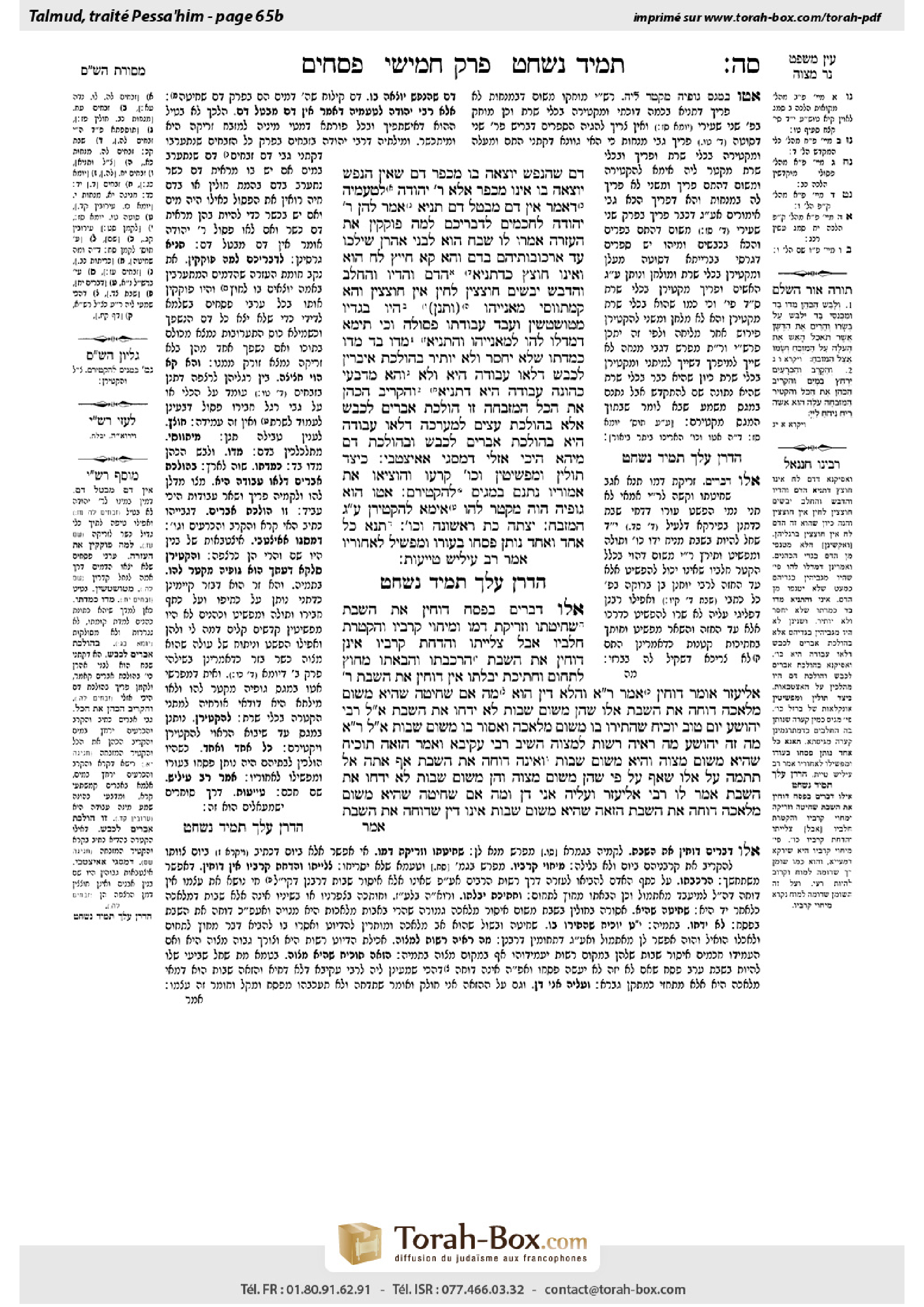
Pesachim 65b: Talmud study for Daf Yomi
Daf Yomi is the daily study of one Talmud folio. Explore 37 tractates with scans, Hebrew text, Sefaria English and AI-generated French translations where annotated.
Passage selection and English or AI-generated French translation are available where the scan has annotations. Daf Study is independent of Torah-Box and Sefaria.
Browse Pesachim · פסחים · All tractatesPesachim 65b text and translations
This page of Pesachim includes the Aramaic text, an English translation and an AI-generated French translation, alongside the scan above.
פסחים ס״ה ב · Aramaic and Hebrew text
דָּם שֶׁהַנֶּפֶשׁ יוֹצְאָה בּוֹ — מְכַפֵּר. דָּם שֶׁאֵין הַנֶּפֶשׁ יוֹצְאָה בּוֹ — אֵינוֹ מְכַפֵּר. אֶלָּא רַבִּי יְהוּדָה לְטַעְמֵיהּ, דְּאָמַר: אֵין דָּם מְבַטֵּל דָּם.
תַּנְיָא, אָמַר לָהֶן רַבִּי יְהוּדָה לַחֲכָמִים: לְדִבְרֵיכֶם, לָמָּה פּוֹקְקִין אֶת הָעֲזָרָה? אָמְרוּ לוֹ: שֶׁבַח הוּא לִבְנֵי אַהֲרֹן שֶׁיֵּלְכוּ עַד אַרְכּוּבּוֹתֵיהֶם בְּדָם.
וְהָא קָא חָיֵיץ?! לַח הוּא וְאֵינוֹ חוֹצֵץ. כִּדְתַנְיָא: הַדָּם וְהַדְּיוֹ וְהֶחָלָב וְהַדְּבַשׁ, יְבֵשִׁים — חוֹצְצִין, לַחִין — אֵין חוֹצְצִין.
וְהָא קָמִתַּוְּוסִי מָאנַיְיהוּ, (וּתְנַן) הָיוּ בְּגָדָיו מְטוּשְׁטָשִׁין וְעָבַד — עֲבוֹדָתוֹ פְּסוּלָה! וְכִי תֵּימָא דִּמְדַלּוּ לְהוּ לְמָאנַיְיהוּ, וְהָתַנְיָא: ״מִדּוֹ בַּד״ — מִדּוֹ כְּמִדָּתוֹ, שֶׁלֹּא יְחַסֵּר וְלֹא יוֹתִיר! בְּהוֹלָכַת אֵיבָרִין לַכֶּבֶשׁ — דְּלָאו עֲבוֹדָה הִיא.
וְלָא? וְהָא מִדְּבָעֵי כְּהוּנָּה — עֲבוֹדָה הִיא! דְּתַנְיָא: ״וְהִקְרִיב הַכֹּהֵן אֶת הַכֹּל הַמִּזְבֵּחָה״, זוֹ הוֹלָכַת אֵבָרִים לַכֶּבֶשׁ! אֶלָּא: בְּהוֹלָכַת עֵצִים לַמַּעֲרָכָה, דְּלָאו עֲבוֹדָה הִיא.
בְּהוֹלָכַת אֵבָרִים לַכֶּבֶשׁ וּבְהוֹלָכַת דָּם, מִיהָא הֵיכִי אָזְלִי? דִּמְסַגִּי אַאִיצְטְבֵי.
כֵּיצַד תּוֹלִין וּמַפְשִׁיטִין וְכוּ׳. קְרָעוֹ, וְהוֹצִיאוּ אֶת אֵמוּרָיו. נְתָנָם בְּמָגֵיס לְהַקְטִירָם. אַטּוּ הוּא גּוּפֵיהּ הֲוָה מַקְטַר לְהוּ? אֵימָא: לְהַקְטִירָן עַל גַּבֵּי הַמִּזְבֵּחַ.
יָצְתָה כַּת רִאשׁוֹנָה וְכוּ׳. תָּנָא: כׇּל אֶחָד וְאֶחָד נוֹתֵן פִּסְחוֹ בְּעוֹרוֹ, וּמַפְשִׁיל לַאֲחוֹרָיו. אָמַר רַב עִילִישׁ: טַיָּיעוּת.
הֲדַרַן עֲלָךְ תָּמִיד נִשְׁחָט
מַתְנִי׳ אֵלּוּ דְּבָרִים בַּפֶּסַח דּוֹחִין אֶת הַשַּׁבָּת: שְׁחִיטָתוֹ, וּזְרִיקַת דָּמוֹ, וּמִיחוּי קְרָבָיו, וְהַקְטָרַת חֲלָבָיו. אֲבָל צְלִיָּיתוֹ וַהֲדָחַת קְרָבָיו — אֵינָן דּוֹחִין אֶת הַשַּׁבָּת. הַרְכָּבָתוֹ, וַהֲבָאָתוֹ מִחוּץ לַתְּחוּם, וַחֲתִיכַת יַבַּלְתּוֹ — אֵין דּוֹחִין אֶת הַשַּׁבָּת. רַבִּי אֱלִיעֶזֶר אוֹמֵר: דּוֹחִין.
אָמַר רַבִּי אֱלִיעֶזֶר: וַהֲלֹא דִּין הוּא: מָה אִם שְׁחִיטָה שֶׁהִיא מִשּׁוּם מְלָאכָה — דּוֹחָה אֶת הַשַּׁבָּת, אֵלּוּ, שֶׁהֵן מִשּׁוּם שְׁבוּת — לֹא יִדְחוּ אֶת הַשַּׁבָּת? אֲמַר לֵיהּ רַבִּי יְהוֹשֻׁעַ: יוֹם טוֹב יוֹכִיחַ, שֶׁהִתִּירוּ בּוֹ מִשּׁוּם מְלָאכָה, וְאָסוּר בּוֹ מִשּׁוּם שְׁבוּת.
אֲמַר לֵיהּ רַבִּי אֱלִיעֶזֶר: מָה זֶה יְהוֹשֻׁעַ?! מָה רְאָיָה רְשׁוּת לְמִצְוָה? הֵשִׁיב רַבִּי עֲקִיבָא, וְאָמַר: הַזָּאָה תּוֹכִיחַ, שֶׁהִיא מִשּׁוּם מִצְוָה, וְהִיא מִשּׁוּם שְׁבוּת, וְאֵינָהּ דּוֹחָה אֶת הַשַּׁבָּת. אַף אַתָּה אַל תִּתְמַהּ עַל אֵלּוּ, שֶׁאַף עַל פִּי שֶׁהֵן מִשּׁוּם מִצְוָה, וְהֵן מִשּׁוּם שְׁבוּת, לֹא יִדְחוּ אֶת הַשַּׁבָּת.
אָמַר לוֹ רַבִּי אֱלִיעֶזֶר, וְעָלֶיהָ אֲנִי דָּן: וּמָה אִם שְׁחִיטָה שֶׁהִיא מִשּׁוּם מְלָאכָה — דּוֹחָה אֶת הַשַּׁבָּת, הַזָּאָה שֶׁהִיא מִשּׁוּם שְׁבוּת — אֵינוֹ דִּין שֶׁדּוֹחָה אֶת הַשַּׁבָּת?
Pesachim 65b · English translation
This verse indicates that blood with which life leaves the animal, meaning blood that spurts immediately upon slaughter, makes atonement when it is sprinkled on the altar; however, blood with which life does not leave the animal, meaning blood that drains out after the initial spurt, does not make atonement. In that case, even Rabbi Yehuda should be concerned that the blood collected in the cup contains blood squeezed from an animal after the initial spurt concluded. Rather, Rabbi Yehuda conforms to his line of reasoning, as he said: Blood does not nullify blood. The small amount of blood in the cup that is fit for sprinkling on the altar is not nullified even if most of the blood in the cup is blood squeezed from an animal after the initial spurt concluded. Therefore, it may still be sprinkled upon the altar and make atonement.
It was taught in a baraita that Rabbi Yehuda said to the Rabbis: According to your statement that there is no need to fill a cup of blood from the floor, why did they plug the drains of the Temple courtyard on Passover eve and not let the blood flow immediately into the drainage pipes? They said to him: It is praiseworthy of the sons of Aaron, the priests, to walk in blood up to their ankles, thereby demonstrating their love for the Temple rite.
The Gemara asks: How could they walk in blood up to their ankles? Doesn’t the blood interpose between the feet of the priests and the floor of the Temple and thereby invalidate the rite? The Gemara answers: The blood is moist and therefore it does not interpose. As it was taught in a baraita: With regard to blood, ink, milk, and honey, when they are dry, they interpose with respect to ritual immersion and other matters; when they are moist, they do not interpose.
The Gemara asks further: But don’t their garments become soiled? And we learned in a mishna: If the priest’s garments were soiled and he performed the Temple rite while wearing them, his rite is invalid, because the priestly garments must be fine and beautiful. And if you say that they raised their garments so that the garments would stay clean, there is a difficulty. Wasn’t it taught in a different baraita that explicates the verse: “And the priest shall put on his linen garment [middo]” (Leviticus 6:3), that the verse uses the word middo to teach that the garments must be according to his measure [kemiddato], fitted to his size, not too short and not too long? If the priest raises his garments, they will no longer be exactly his size. The Gemara answers that the priests would walk in the blood while carrying the sacrificial limbs to the ramp of the altar, which is not actually a rite, but only preparation for a rite.
The Gemara asks: And is it not one of the rites? But from the fact that this task requires priesthood, as it can be performed only by a priest, the implication is that it is considered a rite. As it was taught in a baraita with regard to the verse: “And the priest shall bring it all and burn it upon the altar; it is a burnt-offering, an offering made by fire, of a satisfying aroma to the Lord” (Leviticus 1:13), that this is referring to the carrying of the limbs to the ramp. Rather, we must say that the priests would walk in the blood while carrying wood to the wood pile on the altar, which is not a rite.
The Gemara asks: But if the floor of the Temple was full of blood, how did they walk without soiling their garments while carrying the limbs to the ramp and while carrying the blood to the altar? The Gemara answers: They would walk on platforms raised above the floor and thereby avoid soiling their clothes.
It was taught in the mishna how one would suspend and flay the Paschal lamb, and that after the flaying he would tear it open and remove its sacrificial parts and then place them in a large basin in order to burn them. The Gemara asks: Is that to say that he himself, the priest who placed the sacrificial parts in the basin and no one else, would burn them? The Gemara answers: Correct the wording of the mishna to say: In order to burn them on the altar, meaning that he would place them in a large basin as preparation for their being burned on the altar, but not that he himself would necessarily burn them.
It was also stated in the mishna: The first group exited the Temple courtyard with their Paschal lambs. It was taught in a baraita: Each and every one would place his Paschal lamb in its hide and cast it over his shoulder behind him and carry it home that way. Rav Ilish said: They carried it home in the manner of Arab merchants [tayya’ut].
MISHNA: These are the matters related to the Paschal lamb that override Shabbat, when the eve of Passover occurs on Shabbat: Its slaughter, the sprinkling of its blood, the cleaning of its intestines and the burning of its fats on the altar, all of which are services that must be performed on Passover eve while it is still day. However, its roasting and the washing of its intestines, which need not be done by day, do not override Shabbat; rather, one waits until after Shabbat to perform these tasks. Carrying the Paschal lamb through a public domain does not override Shabbat. The Paschal offering consisted of either a lamb or a goat, sometimes quite young and unable to walk the entire way, so that it had to be carried on a person’s shoulders. Similarly, bringing it from outside the Shabbat limit and cutting off its wart do not override Shabbat, as all these tasks could have been performed before Shabbat. A wart is considered a blemish that disqualifies the animal from being brought as an offering, but once the wart is removed, the animal is fit to be sacrificed on the altar. Rabbi Eliezer says: All of these procedures override Shabbat.
Rabbi Eliezer said: Could this not be derived through an a fortiori inference? If slaughter, which is ordinarily forbidden on Shabbat as a biblically prohibited labor, nonetheless overrides Shabbat when performed for the sake of the Paschal lamb, then these activities, namely carrying the animal, bringing it from outside the Shabbat limit, and the like, which are prohibited due to rabbinic decree, should they not override Shabbat? Rabbi Yehoshua said to him: The law governing a Festival proves otherwise, for the Torah permitted on it acts that are normally prohibited as labor, such as slaughtering, cooking, and baking, and yet it is forbidden to do on it acts that are prohibited due to rabbinic decree. Thus, we cannot derive policy with regard to rabbinic prohibitions from the rules that govern Torah laws.
Rabbi Eliezer said to him: What is this, Yehoshua? How can you suggest such a weak proof? What proof can be deduced from optional activities that would apply to a mitzva? How does the fact that rabbinic decrees remain in effect on a Festival with respect to optional activities prove that one is also forbidden to transgress a rabbinic decree in order to fulfill the mitzva of offering the Paschal lamb? Rabbi Akiva responded and said in defense of Rabbi Yehoshua’s opinion: Sprinkling the purifying water of a red heifer upon someone who had contracted ritual impurity through contact with a corpse proves the matter, for it is done for the sake of a mitzva, in order to allow the person to offer the Paschal lamb, and it is prohibited only due to rabbinic decree, and nonetheless it does not override Shabbat, for the purification rite is not performed on the eve of Passover that falls on Shabbat. So, too, you should not be surprised about these activities, namely carrying the animal, bringing it from outside the Shabbat limit, and cutting off its wart, that although they are performed for the sake of a mitzva and they are prohibited only due to rabbinic decree, they do not override Shabbat.
Rabbi Eliezer said to him: I do not accept this proof. With regard to this sprinkling itself, I infer that it, too, is permitted for the same reason: If slaughter, which is a biblically prohibited labor, overrides Shabbat, is it not right that sprinkling the purifying water of a red heifer, which is prohibited only due to rabbinic decree, should override Shabbat? You cannot challenge me based on a premise with which I disagree.
Pesachim 65b · Traduction française (IA)
Ce verset indique que le sang par lequel la vie quitte l’animal, c’est-à-dire le sang qui jaillit immédiatement lors de l’abattage, procure l’expiation lorsqu’il est aspergé sur l’autel ; en revanche, le sang par lequel la vie ne quitte pas l’animal, c’est-à-dire le sang qui s’écoule après le premier jaillissement, ne procure pas l’expiation. Dans ce cas, même Rabbi Yehouda devrait craindre que le sang recueilli dans la coupe contienne du sang exprimé de l’animal après que le premier jaillissement a cessé. Il faut plutôt dire que Rabbi Yehouda s’en tient à son raisonnement, car il a dit : le sang n’annule pas le sang. La petite quantité de sang contenue dans la coupe, qui peut être aspergée sur l’autel, n’est pas annulée, même si la majeure partie du sang de la coupe est du sang exprimé de l’animal après que le premier jaillissement a cessé. On peut donc encore l’asperger sur l’autel et obtenir l’expiation.
Il a été enseigné dans une baraïta que Rabbi Yehouda dit aux Sages : Selon votre affirmation, selon laquelle il n’est pas nécessaire de remplir une coupe de sang prélevé sur le sol, pourquoi bouchait-on les conduits de la cour du Temple la veille de Pessa’h, au lieu de laisser le sang s’écouler immédiatement dans les canalisations ? Ils lui répondirent : Il est louable que les fils d’Aaron, les prêtres, marchent dans le sang jusqu’aux chevilles, démontrant ainsi leur amour pour le service du Temple.
La Guemara demande : Comment pouvaient-ils marcher dans le sang jusqu’aux chevilles ? Le sang ne s’interposait-il pas entre les pieds des prêtres et le sol du Temple, invalidant ainsi le service ? La Guemara répond : Le sang est humide et ne fait donc pas obstacle. Car il a été enseigné dans une baraïta : le sang, l’encre, le lait et le miel, lorsqu’ils sont secs, font obstacle à l’immersion rituelle et à d’autres égards ; lorsqu’ils sont humides, ils ne font pas obstacle.
La Guemara demande encore : Mais leurs vêtements ne se salissaient-ils pas ? Or, nous avons appris dans une Michna : si les vêtements du prêtre étaient salis et qu’il accomplissait le service du Temple en les portant, son service est invalide, car les vêtements sacerdotaux doivent être beaux et raffinés. Et si tu dis qu’ils relevaient leurs vêtements pour les garder propres, une difficulté se pose. N’a-t-il pas été enseigné dans une autre baraïta, qui explique le verset : « Le prêtre revêtira sa tunique de lin [middo] » (Lévitique 6, 3), que le mot middo enseigne que les vêtements doivent être à sa mesure [kemiddato], ajustés à sa taille, ni trop courts ni trop longs ? Si le prêtre relève ses vêtements, ils ne sont plus exactement à sa mesure. La Guemara répond que les prêtres marchaient dans le sang en portant les membres sacrificiels jusqu’à la rampe de l’autel, ce qui n’est pas à proprement parler un service, mais seulement une préparation au service.
La Guemara demande : N’est-ce donc pas l’un des services ? Mais puisque cette tâche requiert la prêtrise, car seul un prêtre peut l’accomplir, cela implique qu’elle est considérée comme un service. Car il a été enseigné dans une baraïta, à propos du verset : « Le prêtre apportera le tout et le fera brûler sur l’autel ; c’est un holocauste, une offrande consumée par le feu, d’odeur agréable pour le Seigneur » (Lévitique 1, 13), que celui-ci fait référence au transport des membres jusqu’à la rampe. Il faut donc plutôt dire que les prêtres marchaient dans le sang en portant du bois jusqu’au tas de bois sur l’autel, ce qui n’est pas un service.
La Guemara demande : Mais si le sol du Temple était couvert de sang, comment pouvaient-ils marcher sans salir leurs vêtements en portant les membres jusqu’à la rampe et en portant le sang jusqu’à l’autel ? La Guemara répond : Ils marchaient sur des estrades surélevées au-dessus du sol et évitaient ainsi de salir leurs vêtements.
La Michna enseignait comment on suspendait et dépouillait l’agneau pascal, puis comment, après l’avoir dépouillé, on l’ouvrait, en retirait les parties sacrificielles et les plaçait dans un grand bassin afin de les brûler. La Guemara demande : Faut-il comprendre que c’était lui-même, le prêtre qui avait placé les parties sacrificielles dans le bassin, et personne d’autre, qui les brûlait ? La Guemara répond : Il faut corriger le texte de la Michna et lire : « afin de les brûler sur l’autel ». Cela signifie qu’il les plaçait dans un grand bassin en vue de leur combustion sur l’autel, et non qu’il était nécessairement celui qui les brûlait lui-même.
La Michna disait également : Le premier groupe sortait de la cour du Temple avec ses agneaux pascals. Il a été enseigné dans une baraïta que chacun plaçait son agneau pascal dans sa peau, le jetait par-dessus son épaule, derrière lui, et le portait ainsi jusqu’à chez lui. Rav Ilish a dit : Ils le portaient chez eux à la manière des marchands arabes [tayya’ut].
MICHNA : Voici les actes liés à l’agneau pascal qui l’emportent sur le Chabbat lorsque la veille de Pessa’h tombe un Chabbat : son abattage, l’aspersion de son sang, le nettoyage de ses intestins et la combustion de ses graisses sur l’autel ; tous ces services doivent être accomplis la veille de Pessa’h, pendant qu’il fait encore jour. En revanche, sa cuisson au feu et le lavage de ses intestins, qui n’ont pas besoin d’être faits de jour, ne l’emportent pas sur le Chabbat ; on attend plutôt la fin du Chabbat pour accomplir ces tâches. Le transport de l’agneau pascal dans le domaine public ne l’emporte pas sur le Chabbat. L’offrande pascale était soit un agneau, soit un chevreau, parfois très jeune et incapable de parcourir tout le chemin, de sorte qu’il fallait le porter sur les épaules. De même, l’amener d’au-delà de la limite du Chabbat et lui couper sa verrue ne l’emportent pas sur le Chabbat, puisque toutes ces tâches auraient pu être accomplies avant le Chabbat. Une verrue est considérée comme un défaut qui disqualifie l’animal pour être offert en sacrifice ; mais une fois la verrue retirée, l’animal peut être sacrifié sur l’autel. Rabbi Éliézer dit : Toutes ces opérations l’emportent sur le Chabbat.
Rabbi Éliézer dit : Ne peut-on pas le déduire a fortiori ? Si l’abattage, qui est normalement interdit le Chabbat comme travail prohibé par la Torah, l’emporte néanmoins sur le Chabbat lorsqu’il est accompli pour l’agneau pascal, alors ces actes — à savoir transporter l’animal, l’amener d’au-delà de la limite du Chabbat, et les actes semblables —, qui sont interdits en vertu d’un décret rabbinique, ne devraient-ils pas l’emporter sur le Chabbat ? Rabbi Yehochoua lui dit : La loi relative à une fête démontre le contraire, car la Torah y a permis des actes normalement interdits comme travaux, tels que l’abattage, la cuisson et la pâtisserie, et pourtant, les actes interdits par décret rabbinique y restent prohibés. On ne peut donc pas déduire la règle concernant les interdits rabbiniques des règles qui régissent les lois de la Torah.
Rabbi Éliézer lui dit : Qu’est-ce donc, Yehochoua ? Comment peux-tu proposer une preuve aussi faible ? Quelle preuve peut-on tirer d’activités facultatives qui s’appliquerait à une mitsva ? Le fait que les décrets rabbiniques restent en vigueur pendant une fête pour les activités facultatives ne prouve pas qu’il soit également interdit d’enfreindre un décret rabbinique afin d’accomplir la mitsva d’offrir l’agneau pascal. Rabbi Akiva intervint et prit la défense de l’opinion de Rabbi Yehochoua : l’aspersion de l’eau de purification d’une vache rousse sur quelqu’un qui a contracté une impureté rituelle par contact avec un cadavre en apporte la preuve. Elle est accomplie pour une mitsva, afin de permettre à cette personne d’offrir l’agneau pascal ; elle n’est interdite qu’en vertu d’un décret rabbinique, et pourtant elle ne l’emporte pas sur le Chabbat, car le rite de purification n’est pas accompli la veille de Pessa’h lorsque celle-ci tombe un Chabbat. De même, il ne faut pas s’étonner que ces actes — à savoir transporter l’animal, l’amener d’au-delà de la limite du Chabbat et lui couper sa verrue —, bien qu’accomplis pour une mitsva et interdits uniquement en vertu d’un décret rabbinique, ne l’emportent pas sur le Chabbat.
Rabbi Éliézer lui dit : Je n’accepte pas cette preuve. Quant à cette aspersion elle-même, j’en déduis qu’elle aussi est permise pour la même raison : si l’abattage, qui est un travail interdit par la Torah, l’emporte sur le Chabbat, n’est-il pas d’autant plus juste que l’aspersion de l’eau de purification d’une vache rousse, qui n’est interdite qu’en vertu d’un décret rabbinique, l’emporte sur le Chabbat ? Tu ne peux pas me contester en t’appuyant sur une prémisse avec laquelle je ne suis pas d’accord.
Traduction française générée par IA à partir de l’édition anglaise de Sefaria. Vérifie toujours un passage avec le texte source.
Text from Sefaria: William Davidson Edition - Vocalized Aramaic (CC BY NC); William Davidson Edition - English (CC BY NC).