Pesachim 66a: Talmud study for Daf Yomi
Daf Yomi is the daily study of one Talmud folio. Explore 37 tractates with scans, Hebrew text, Sefaria English and AI-generated French translations where annotated.
Passage selection and English or AI-generated French translation are available where the scan has annotations. Daf Study is independent of Torah-Box and Sefaria.
Browse Pesachim · פסחים · All tractatesPesachim 66a text and translations
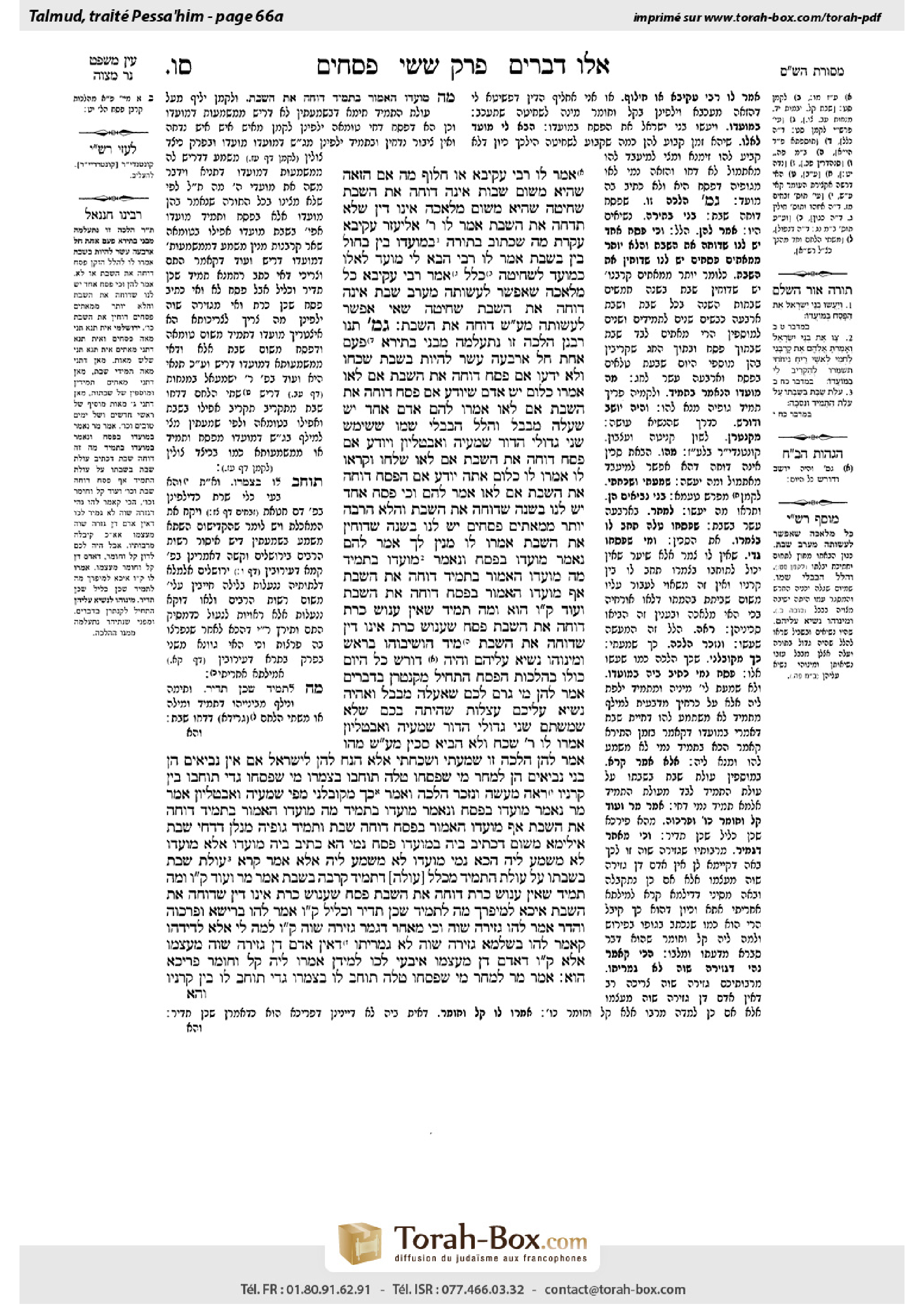
This page of Pesachim includes the Aramaic text, an English translation and an AI-generated French translation, alongside the scan above.
פסחים ס״ו א · Aramaic and Hebrew text
אָמַר לוֹ רַבִּי עֲקִיבָא, אוֹ חִלּוּף: מָה אִם הַזָּאָה שֶׁהִיא מִשּׁוּם שְׁבוּת — אֵינָהּ דּוֹחָה אֶת הַשַּׁבָּת, שְׁחִיטָה שֶׁהִיא מִשּׁוּם מְלָאכָה — אֵינוֹ דִּין שֶׁלֹּא תִּדְחֶה אֶת הַשַּׁבָּת?! אָמַר לוֹ רַבִּי אֱלִיעֶזֶר: עֲקִיבָא, עָקַרְתָּ מַה שֶּׁכָּתוּב בַּתּוֹרָה: ״בְּמוֹעֲדוֹ״, בֵּין בַּחוֹל בֵּין בַּשַּׁבָּת.
אָמַר לוֹ: רַבִּי, הָבֵא לִי מוֹעֵד לְאֵלּוּ, כְּמוֹעֵד לַשְּׁחִיטָה. כְּלָל אָמַר רַבִּי עֲקִיבָא: כׇּל מְלָאכָה שֶׁאֶפְשָׁר לַעֲשׂוֹתָהּ מֵעֶרֶב שַׁבָּת — אֵינָהּ דּוֹחָה אֶת הַשַּׁבָּת. שְׁחִיטָה, שֶׁאִי אֶפְשָׁר לַעֲשׂוֹתָהּ מֵעֶרֶב שַׁבָּת — דּוֹחָה אֶת הַשַּׁבָּת.
גְּמָ׳ תָּנוּ רַבָּנַן: הֲלָכָה זוֹ נִתְעַלְּמָה מִבְּנֵי בְתִירָא. פַּעַם אַחַת חָל אַרְבָּעָה עָשָׂר לִהְיוֹת בְּשַׁבָּת, שָׁכְחוּ וְלֹא יָדְעוּ אִם פֶּסַח דּוֹחֶה אֶת הַשַּׁבָּת אִם לָאו. אָמְרוּ: כְּלוּם יֵשׁ אָדָם שֶׁיּוֹדֵעַ אִם פֶּסַח דּוֹחֶה אֶת הַשַּׁבָּת אִם לָאו? אָמְרוּ לָהֶם: אָדָם אֶחָד יֵשׁ שֶׁעָלָה מִבָּבֶל וְהִלֵּל הַבַּבְלִי שְׁמוֹ, שֶׁשִּׁימֵּשׁ שְׁנֵי גְּדוֹלֵי הַדּוֹר שְׁמַעְיָה וְאַבְטַלְיוֹן, וְיוֹדֵעַ אִם פֶּסַח דּוֹחֶה אֶת הַשַּׁבָּת אִם לָאו. שָׁלְחוּ וְקָרְאוּ לוֹ, אָמְרוּ לוֹ: כְּלוּם אַתָּה יוֹדֵעַ אִם הַפֶּסַח דּוֹחֶה אֶת הַשַּׁבָּת אִם לָאו? אָמַר לָהֶם: וְכִי פֶּסַח אֶחָד יֵשׁ לָנוּ בַּשָּׁנָה שֶׁדּוֹחֶה אֶת הַשַּׁבָּת? וַהֲלֹא הַרְבֵּה יוֹתֵר מִמָּאתַיִם פְּסָחִים יֵשׁ לָנוּ בַּשָּׁנָה שֶׁדּוֹחִין אֶת הַשַּׁבָּת.
אָמְרוּ לוֹ: מִנַּיִן לְךָ? אָמַר לָהֶם: נֶאֱמַר ״מוֹעֲדוֹ״ בַּפֶּסַח, וְנֶאֱמַר ״מוֹעֲדוֹ״ בַּתָּמִיד: מָה ״מוֹעֲדוֹ״ הָאָמוּר בַּתָּמִיד דּוֹחֶה אֶת הַשַּׁבָּת, אַף ״מוֹעֲדוֹ״ הָאָמוּר בַּפֶּסַח דּוֹחֶה אֶת הַשַּׁבָּת.
וְעוֹד, קַל וָחוֹמֶר הוּא: וּמָה תָּמִיד שֶׁאֵין עָנוּשׁ כָּרֵת דּוֹחֶה אֶת הַשַּׁבָּת, פֶּסַח שֶׁעָנוּשׁ כָּרֵת — אֵינוֹ דִּין שֶׁדּוֹחֶה אֶת הַשַּׁבָּת.
מִיָּד הוֹשִׁיבוּהוּ בָּרֹאשׁ, וּמִינּוּהוּ נָשִׂיא עֲלֵיהֶם, וְהָיָה דּוֹרֵשׁ כׇּל הַיּוֹם כּוּלּוֹ בְּהִלְכוֹת הַפֶּסַח. הִתְחִיל מְקַנְטְרָן בִּדְבָרִים. אָמַר לָהֶן: מִי גָּרַם לָכֶם שֶׁאֶעְלֶה מִבָּבֶל וְאֶהְיֶה נָשִׂיא עֲלֵיכֶם — עַצְלוּת שֶׁהָיְתָה בָּכֶם, שֶׁלֹּא שִׁמַּשְׁתֶּם שְׁנֵי גְּדוֹלֵי הַדּוֹר, שְׁמַעְיָה וְאַבְטַלְיוֹן.
אָמְרוּ לוֹ: רַבִּי, שָׁכַח וְלֹא הֵבִיא סַכִּין מֵעֶרֶב שַׁבָּת, מַהוּ? אָמַר לָהֶן: הֲלָכָה זוֹ שָׁמַעְתִּי וְשָׁכַחְתִּי, אֶלָּא הַנַּח לָהֶן לְיִשְׂרָאֵל, אִם אֵין נְבִיאִים הֵן — בְּנֵי נְבִיאִים הֵן.
לְמָחָר, מִי שֶׁפִּסְחוֹ טָלֶה — תּוֹחֲבוֹ בְּצַמְרוֹ, מִי שֶׁפִּסְחוֹ גְּדִי — תּוֹחֲבוֹ בֵּין קַרְנָיו. רָאָה מַעֲשֶׂה וְנִזְכַּר הֲלָכָה, וְאָמַר: כָּךְ מְקוּבְּלַנִי מִפִּי שְׁמַעְיָה וְאַבְטַלְיוֹן.
אָמַר מָר: נֶאֱמַר ״מוֹעֲדוֹ״ בַּפֶּסַח, וְנֶאֱמַר ״מוֹעֲדוֹ״ בְּתָמִיד, מָה ״מוֹעֲדוֹ״ הָאָמוּר בַּתָּמִיד דּוֹחֶה אֶת הַשַּׁבָּת, אַף ״מוֹעֲדוֹ״ הָאָמוּר בַּפֶּסַח דּוֹחֶה שַׁבָּת. וְתָמִיד גּוּפֵיהּ מְנָלַן דְּדָחֵי שַׁבָּת? אִילֵּימָא מִשּׁוּם דִּכְתִיב בֵּיהּ ״בְּמוֹעֲדוֹ״ — פֶּסַח נָמֵי הָא כְּתִיב בֵּיהּ ״מוֹעֲדוֹ״!
אֶלָּא ״מוֹעֲדוֹ״ לָא מַשְׁמַע לֵיהּ. הָכָא נָמֵי ״מוֹעֲדוֹ״ לָא מַשְׁמַע לֵיהּ. אֶלָּא אָמַר קְרָא: ״עוֹלַת שַׁבָּת בְּשַׁבַּתּוֹ עַל עוֹלַת הַתָּמִיד״ — מִכְּלָל [עוֹלָה] דְּתָמִיד קְרֵבָה בְּשַׁבָּת.
אָמַר מָר: וְעוֹד קַל וָחוֹמֶר, וּמָה תָּמִיד שֶׁאֵין עָנוּשׁ כָּרֵת דּוֹחֶה אֶת הַשַּׁבָּת, פֶּסַח שֶׁעָנוּשׁ כָּרֵת — אֵינוֹ דִּין שֶׁדּוֹחֶה אֶת הַשַּׁבָּת. אִיכָּא לְמִיפְרַךְ: מָה לְתָמִיד שֶׁכֵּן תָּדִיר וְכָלִיל. קַל וָחוֹמֶר אֲמַר לְהוּ בְּרֵישָׁא וּפַרְכוּהּ, וַהֲדַר אֲמַר לְהוּ גְּזֵירָה שָׁוָה.
וְכִי מֵאַחַר דְּגָמַר גְּזֵירָה שָׁוָה, קַל וָחוֹמֶר לְמָה לִי? אֶלָּא לְדִידְהוּ קָאָמַר לְהוּ: בִּשְׁלָמָא גְּזֵירָה שָׁוָה לָא גָּמְרִיתוּ, דְּאֵין אָדָם דָּן גְּזֵירָה שָׁוָה מֵעַצְמוֹ. אֶלָּא קַל וָחוֹמֶר, דְּאָדָם דָּן מֵעַצְמוֹ, אִיבְּעִי לְכוּ לְמֵידָן! אֲמַרוּ לֵיהּ: קַל וָחוֹמֶר פְּרִיכָא הוּא.
אָמַר מָר: לְמָחָר מִי שֶׁפִּסְחוֹ טָלֶה — תּוֹחֵב לוֹ בְּצַמְרוֹ, גְּדִי — תּוֹחֵב לוֹ בֵּין קַרְנָיו.
Pesachim 66a · English translation
Rabbi Akiva said to Rabbi Eliezer: Or perhaps we can reverse the order of your argument and say the opposite: If, as we know by accepted tradition, sprinkling the purifying water on Shabbat, which is prohibited only due to rabbinic decree, does not override Shabbat, then with regard to slaughter, which is prohibited as a biblically prohibited labor, is it not right that it should not override Shabbat? Therefore, it should be prohibited to slaughter the Paschal lamb when the eve of Passover occurs on Shabbat. Rabbi Eliezer said to him: Akiva, how can you say this? You have thus uprooted what is written in the Torah: “Let the children of Israel offer the Paschal lamb in its appointed time” (Numbers 9:2); the phrase “at its appointed time” indicates that the offering must be brought on that day, whether it is a weekday or Shabbat.
Rabbi Akiva said to Rabbi Eliezer: My teacher, bring me an appointed time stated in the Torah for these tasks, namely, carrying the animal or bringing it from outside the Shabbat limits, like the appointed time stated with respect to slaughter. The Paschal lamb must be slaughtered on the fourteenth of Nisan, but there is no fixed time when the animal must be brought to the Temple, and it is therefore possible to transport it before Shabbat. Rabbi Akiva stated a principle: Any prohibited labor required for the offering of the sacrifice that can be performed on the eve of Shabbat does not override Shabbat; slaughter, which cannot be performed on the eve of Shabbat, overrides Shabbat.
GEMARA: The Sages taught a baraita with regard to the basic halakha governing the eve of Passover that occurs on Shabbat: This law was forgotten by the sons of Beteira, who were the leaders of their generation. The fourteenth of Nisan once occurred on Shabbat, and they forgot and did not know whether the Paschal lamb overrides Shabbat or not. They said: Is there any person who knows whether the Paschal lamb overrides Shabbat or not? They said to them: There is a certain man in Jerusalem who came up from Babylonia, and Hillel the Babylonian is his name. At one point, he served the two most eminent scholars of the generation, Shemaya and Avtalyon, and he certainly knows whether the Paschal lamb overrides Shabbat or not. The sons of Beteira sent messengers and called for him. They said to him: Do you know whether the Paschal lamb overrides Shabbat or not? He said to them: Have we but one Paschal lamb during the year that overrides Shabbat? Do we not have many more than two hundred Paschal lambs, i.e., sacrifices, during the year that override Shabbat?
They said to him: From where do you know this? He said to them: “Its appointed time” is stated with regard to the Paschal lamb and “its appointed time” is also stated with regard to the daily offering, for the verse says: “Command the children of Israel and say to them, My offering, the provision of My sacrifice made with fire, for a sweet savor to Me, shall you observe to offer Me at its appointed time” (Numbers 28:2). From here we learn that the daily offering is brought even on Shabbat. Thus, the daily morning and afternoon offerings are brought on more than fifty Shabbatot over the course of the year, and two sheep are offered every Shabbat as additional offerings, for a total of more than two hundred sacrifices a year that override Shabbat. Just as the expression “its appointed time,” which is stated with regard to the daily offering, indicates that it overrides Shabbat, so too “its appointed time,” which is stated with regard to the Paschal lamb, indicates that it overrides Shabbat.
And furthermore, it is an a fortiori inference: If the daily offering, the neglect of which is not punishable by karet, overrides Shabbat, is it not right that the Paschal lamb, the neglect of which is punishable by karet, should override Shabbat?
After Hillel brought these proofs, they immediately seated him at the head and appointed him Nasi over them, and he expounded the laws of Passover that entire day. In the course of his teaching, he began rebuking them [mekanteran] them with words. He said to them: What caused this to happen to you, that I should come up from Babylonia and become Nasi over you? It was the laziness in you that you did not serve the two most eminent scholars of the generation living in Eretz Yisrael, Shemaya and Avtalyon.
They said to Hillel: Our teacher, if one forgot and did not bring a knife on the eve of Shabbat and cannot slaughter his Paschal lamb, what is the law? Since he could have brought the knife before Shabbat, he cannot bring it on Shabbat; but what should he do in this situation? He said to them: I once heard this halakha from my teachers but I have forgotten it. But leave it to the Jewish people; if they are not prophets to whom God has revealed His secrets, they are the sons of prophets, and will certainly do the right thing on their own.
The next day, on Shabbat that was the eve of Passover, one whose Paschal offering was a lamb took the knife and stuck it in its wool; and one whose Paschal offering was a goat, which does not have wool, stuck it between its horns. Hillel saw the incident and remembered the halakha that he had once learned and said: This is the tradition I received from the mouths of Shemaya and Avtalyon, meaning that this is in fact the proper course of action. This concludes the text of the baraita and the Gemara will begin to elucidate it.
The Master said above: “Its appointed time” is stated with regard to the Paschal lamb and “its appointed time” is stated with regard to the daily offering. Just as “its appointed time,” which is stated with regard to the daily offering, indicates that it overrides Shabbat, so too “its appointed time,” which is stated with regard to the Paschal lamb, indicates that it overrides Shabbat. And from where do we derive that the daily offering itself overrides Shabbat? If we say because “in its appointed time” is written in its regard, “in its appointed time” is also written with regard to the Paschal lamb. Were it possible to derive from this expression that the sacrifice is offered even on Shabbat, it would not be necessary to derive the law governing the Paschal lamb from a verbal analogy between the daily offering and the Paschal lamb.
Rather, you must conclude that the expression “its appointed time,” which is stated with regard to the Paschal lamb, does not indicate to Hillel that the Torah was so particular about the timing of the Paschal lamb that its slaughter overrides Shabbat. Here too, with regard to the daily offering, you must say that “its appointed time” does not indicate to him that it is brought on Shabbat, and so this expression is not the source of this law. Rather, the law is derived from the verse that states: “The burnt-offering of Shabbat on its Shabbat, beside the continual burnt-offering and its libation” (Numbers 28:10), from which it may be inferred that the daily burnt-offering is brought even on Shabbat.
The Gemara raises another question: The Master said in that same baraita: And furthermore, it is an a fortiori inference: If the daily offering, the neglect of which is not punishable by karet, overrides Shabbat, is it not right that the Paschal lamb, the neglect of which is punishable by karet, should override Shabbat? The Gemara points out that there is room to refute the logic of this argument: What is unique about the daily offering that enables it to override Shabbat? That it is frequent, and something that is frequent always takes precedence; and also that it is totally consumed on the altar, unlike the Paschal lamb, most of which is eaten by human beings. The Gemara explains that this is what happened: Hillel first told them the a fortiori inference, but they refuted it and proved that it was not reliable, as explained above; and then he told them the verbal analogy, and a verbal analogy is based on an oral tradition originating from Moses at Sinai and must be accepted.
The Gemara asks: But since Hillel learned this verbal analogy from his teachers, why do I need an a fortiori inference? Why did he add a logical argument of his own if he had an explicit verbal tradition that this was the halakha? The Gemara answers: Rather, he said it for them, to show that they had not sufficiently exerted themselves in clarifying this halakha: Granted, you did not learn the verbal analogy on your own, because you acted according to the principle that one may not expound a verbal analogy on one’s own. Since there is no limit to the laws that one can extract using this method of derivation, such a derivation is only legitimate if it has been transmitted as part of the oral tradition, and apparently they did not learn this verbal analogy from their teachers. But an a fortiori inference, which one can derive on one’s own, you should have derived and you would then have known how to resolve this question. They said to him: It is a faulty a fortiori inference, as we have shown that it can be easily refuted.
The Master said further in the baraita: The next day, one whose Paschal offering was a lamb stuck the knife in its wool, and one whose Paschal offering was a goat stuck it between its horns so as to avoid carrying the knife on Shabbat.
Pesachim 66a · Traduction française (IA)
Rabbi Akiva dit à Rabbi Eliezer : Ou peut-être pouvons-nous inverser votre raisonnement et soutenir le contraire : si, comme nous le savons par tradition, l’aspersion de l’eau purificatrice, qui n’est interdite le Chabbat qu’en vertu d’un décret rabbinique, ne repousse pas Chabbat, alors, s’agissant de l’abattage rituel, interdit par la Torah, n’est-il pas à plus forte raison évident qu’il ne repousse pas Chabbat ? Il faudrait donc interdire l’abattage de l’agneau pascal lorsque la veille de Pessa’h tombe un Chabbat. Rabbi Eliezer lui dit : Akiva, comment peux-tu dire cela ? Tu as ainsi déraciné ce qui est écrit dans la Torah : « Que les enfants d’Israël offrent le sacrifice pascal en son temps fixé » (Nombres 9, 2). L’expression « en son temps fixé » indique que l’offrande doit être apportée ce jour-là, qu’il s’agisse d’un jour de semaine ou de Chabbat.
Rabbi Akiva dit à Rabbi Eliezer : Mon maître, indique-moi un temps fixé dans la Torah pour ces opérations, à savoir le transport de l’animal ou son acheminement depuis l’extérieur du périmètre du Chabbat, comme le temps fixé mentionné à propos de l’abattage rituel. L’agneau pascal doit être abattu le quatorze nissan, mais aucun moment précis n’est fixé pour acheminer l’animal au Temple ; il est donc possible de le transporter avant Chabbat. Rabbi Akiva énonça un principe : tout travail interdit nécessaire à l’offrande du sacrifice qui peut être accompli la veille de Chabbat ne repousse pas Chabbat ; l’abattage rituel, qui ne peut pas être accompli la veille de Chabbat, repousse Chabbat.
GUEMARA : Les Sages enseignèrent dans une baraïta la halakha fondamentale concernant la veille de Pessa’h qui tombe un Chabbat : cette loi avait été oubliée par les fils de Beteira, qui étaient les dirigeants de leur génération. Une année, le quatorze nissan tomba un Chabbat ; ils oublièrent et ne savaient pas si l’agneau pascal repoussait Chabbat ou non. Ils dirent : Y a-t-il quelqu’un qui sache si l’agneau pascal repousse Chabbat ou non ? On leur dit : Il y a à Jérusalem un homme venu de Babylonie, nommé Hillel le Babylonien. Il avait autrefois servi les deux plus éminents sages de la génération, Shemaya et Avtalyon, et savait certainement si l’agneau pascal repoussait Chabbat ou non. Les fils de Beteira envoyèrent des messagers pour le faire venir. Ils lui demandèrent : Sais-tu si l’agneau pascal repousse Chabbat ou non ? Il leur répondit : N’avons-nous qu’un seul agneau pascal dans l’année qui repousse Chabbat ? N’avons-nous pas bien plus de deux cents agneaux pascals, c’est-à-dire des sacrifices, au cours de l’année, qui repoussent Chabbat ?
Ils lui demandèrent : D’où le sais-tu ? Il leur répondit : L’expression « son temps fixé » est employée à propos de l’agneau pascal, et cette même expression est employée à propos de l’offrande quotidienne, comme le dit le verset : « Ordonne aux enfants d’Israël et dis-leur : Mon offrande, l’aliment de mes sacrifices consumés par le feu, d’agréable odeur pour moi, vous veillerez à me l’offrir en son temps fixé » (Nombres 28, 2). Nous apprenons de là que l’offrande quotidienne est apportée même le Chabbat. Ainsi, les offrandes quotidiennes du matin et de l’après-midi sont apportées pendant plus de cinquante Chabbat au cours de l’année, et deux moutons sont offerts chaque Chabbat comme offrandes supplémentaires, soit au total plus de deux cents sacrifices par an qui repoussent Chabbat. De même que l’expression « son temps fixé », employée à propos de l’offrande quotidienne, indique qu’elle repousse Chabbat, de même cette expression, employée à propos de l’agneau pascal, indique qu’il repousse Chabbat.
En outre, il s’agit d’un raisonnement a fortiori : si l’offrande quotidienne, dont l’omission n’est pas punissable de karet, repousse Chabbat, n’est-il pas à plus forte raison évident que l’agneau pascal, dont l’omission est punissable de karet, repousse Chabbat ?
Après qu’Hillel eut apporté ces preuves, ils le firent immédiatement asseoir à leur tête et le nommèrent nassi ; il exposa les lois de Pessa’h pendant toute cette journée. Au cours de son enseignement, il se mit à les réprimander [mekanteran] en paroles. Il leur dit : Qu’est-ce qui vous a conduits à cette situation, au point que je sois venu de Babylonie et que je sois devenu votre nassi ? C’est votre paresse : vous n’avez pas servi les deux plus éminents sages de la génération qui vivaient en terre d’Israël, Shemaya et Avtalyon.
Ils dirent à Hillel : Notre maître, si quelqu’un a oublié d’apporter un couteau la veille de Chabbat et ne peut donc pas abattre rituellement son agneau pascal, quelle est la halakha ? Puisqu’il aurait pu apporter le couteau avant Chabbat, il ne peut pas le transporter pendant Chabbat ; que doit-il faire dans cette situation ? Il leur répondit : J’ai autrefois entendu cette halakha de mes maîtres, mais je l’ai oubliée. Cependant, laissons faire le peuple juif : même s’ils ne sont pas des prophètes auxquels Dieu a révélé ses secrets, ils sont les fils de prophètes et feront certainement ce qu’il faut d’eux-mêmes.
Le lendemain, le Chabbat qui était la veille de Pessa’h, celui dont l’offrande pascale était un agneau prit le couteau et le glissa dans sa laine ; celui dont l’offrande pascale était un bouc, qui n’a pas de laine, le glissa entre ses cornes. Hillel vit cela et se souvint de la halakha qu’il avait apprise autrefois. Il dit : Telle est la tradition que j’ai reçue de Shemaya et d’Avtalyon ; c’est bien là la conduite appropriée. Ainsi s’achève le texte de la baraïta, et la Guemara va maintenant l’expliquer.
Le maître a dit plus haut : L’expression « son temps fixé » est employée à propos de l’agneau pascal et à propos de l’offrande quotidienne. De même que cette expression, employée à propos de l’offrande quotidienne, indique qu’elle repousse Chabbat, de même, employée à propos de l’agneau pascal, elle indique qu’il repousse Chabbat. Et d’où déduisons-nous que l’offrande quotidienne elle-même repousse Chabbat ? Si nous disons que c’est parce que l’expression « en son temps fixé » est écrite à son sujet, cette expression est également écrite à propos de l’agneau pascal. S’il était possible de déduire de cette expression que le sacrifice est offert même le Chabbat, il ne serait pas nécessaire de déduire la loi concernant l’agneau pascal d’une analogie verbale entre l’offrande quotidienne et l’agneau pascal.
Il faut plutôt en conclure que l’expression « son temps fixé », employée à propos de l’agneau pascal, n’indique pas à Hillel que la Torah a tellement insisté sur le moment de l’offrande pascale que son abattage rituel repousse Chabbat. De même, à propos de l’offrande quotidienne, il faut dire que cette expression ne lui indique pas qu’elle est apportée le Chabbat ; elle n’est donc pas la source de cette loi. Celle-ci se déduit plutôt du verset : « L’holocauste du Chabbat, chaque Chabbat, en plus de l’holocauste perpétuel et de sa libation » (Nombres 28, 10), d’où l’on peut déduire que l’holocauste quotidien est apporté même le Chabbat.
La Guemara soulève une autre question : le maître a dit dans cette même baraïta : « En outre, il s’agit d’un raisonnement a fortiori : si l’offrande quotidienne, dont l’omission n’est pas punissable de karet, repousse Chabbat, n’est-il pas à plus forte raison évident que l’agneau pascal, dont l’omission est punissable de karet, repousse Chabbat ? » La Guemara fait remarquer qu’il est possible de réfuter le raisonnement : qu’est-ce qui distingue l’offrande quotidienne et lui permet de repousser Chabbat ? Sa fréquence : ce qui est fréquent a toujours priorité. De plus, elle est entièrement consumée sur l’autel, contrairement à l’agneau pascal, dont la majeure partie est consommée par les hommes. La Guemara explique ce qui s’est passé : Hillel leur exposa d’abord le raisonnement a fortiori, mais ils le réfutèrent et démontrèrent qu’il n’était pas concluant, comme cela a été expliqué plus haut. Il leur exposa ensuite l’analogie verbale, qui repose sur une tradition orale remontant à Moïse au Sinaï et doit être acceptée.
La Guemara demande : Mais puisque Hillel avait appris cette analogie verbale de ses maîtres, pourquoi avait-il besoin d’un raisonnement a fortiori ? Pourquoi ajouta-t-il un argument logique de son propre chef, alors qu’il disposait d’une tradition explicite selon laquelle telle était la halakha ? La Guemara répond : Il le leur exposa pour leur montrer qu’ils ne s’étaient pas suffisamment appliqués à clarifier cette halakha. Certes, vous n’avez pas appris l’analogie verbale par vous-mêmes, car vous avez suivi le principe selon lequel on ne peut pas élaborer de sa propre initiative une analogie verbale. Puisqu’il n’existe aucune limite aux lois que l’on peut déduire au moyen de cette méthode, une telle déduction n’est légitime que si elle a été transmise dans le cadre de la tradition orale ; manifestement, vous n’avez pas appris cette analogie verbale de vos maîtres. Mais vous auriez dû déduire un raisonnement a fortiori, que l’on peut élaborer de soi-même, et vous auriez alors su comment résoudre cette question. Ils lui dirent : Ce raisonnement a fortiori est défectueux, comme nous l’avons montré : on peut le réfuter facilement.
Le maître a encore dit dans la baraïta : Le lendemain, celui dont l’offrande pascale était un agneau glissa le couteau dans sa laine, et celui dont l’offrande pascale était un bouc le glissa entre ses cornes, afin d’éviter de transporter le couteau pendant Chabbat.
Traduction française générée par IA à partir de l’édition anglaise de Sefaria. Vérifie toujours un passage avec le texte source.
Text from Sefaria: William Davidson Edition - Vocalized Aramaic (CC BY NC); William Davidson Edition - English (CC BY NC).