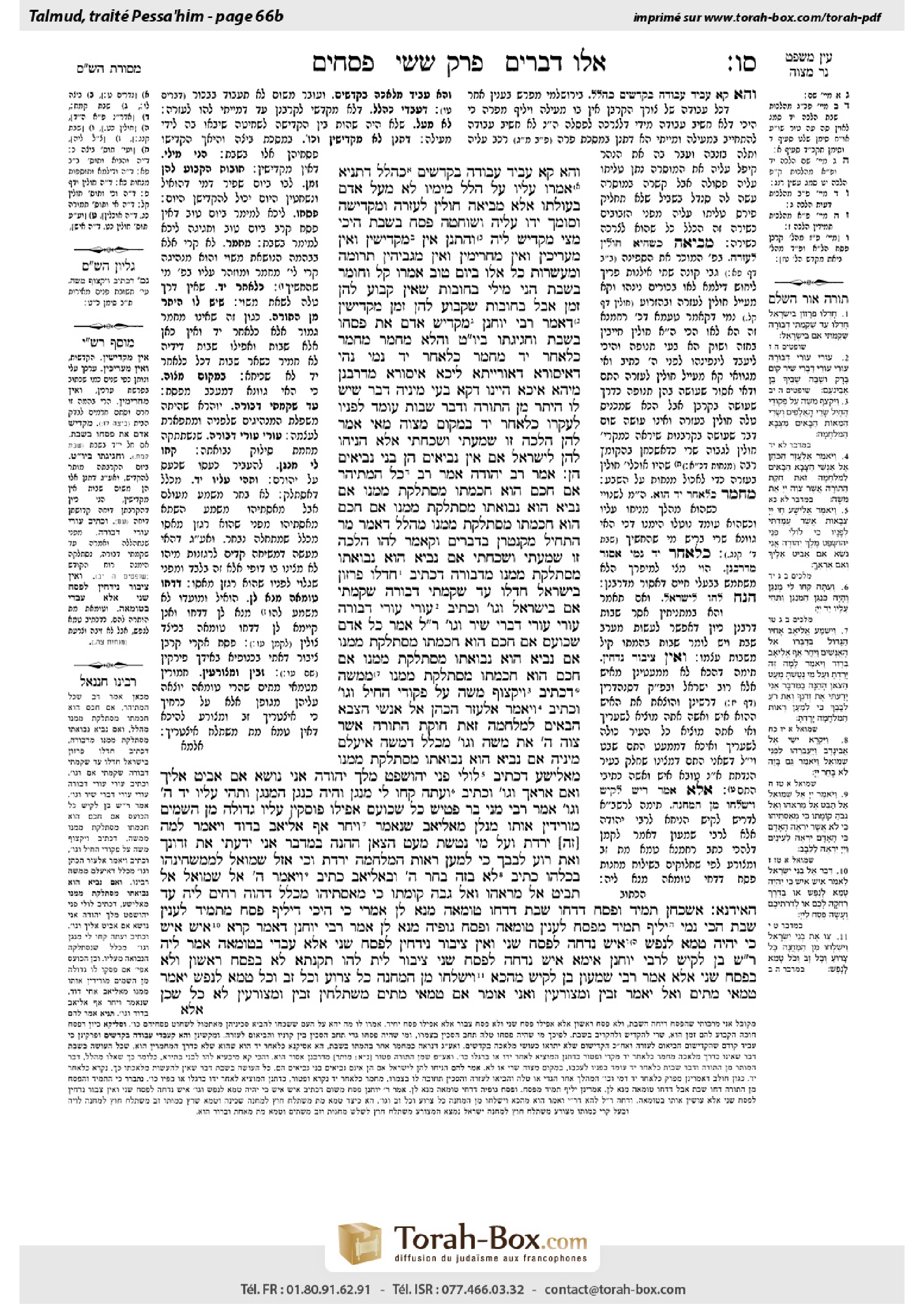
Pesachim 66b: Talmud study for Daf Yomi
Daf Yomi is the daily study of one Talmud folio. Explore 37 tractates with scans, Hebrew text, Sefaria English and AI-generated French translations where annotated.
Passage selection and English or AI-generated French translation are available where the scan has annotations. Daf Study is independent of Torah-Box and Sefaria.
Browse Pesachim · פסחים · All tractatesPesachim 66b text and translations
This page of Pesachim includes the Aramaic text, an English translation and an AI-generated French translation, alongside the scan above.
פסחים ס״ו ב · Aramaic and Hebrew text
וְהָא קָא עָבֵיד עֲבוֹדָה בְּקָדָשִׁים! כְּהִלֵּל. דְּתַנְיָא, אָמְרוּ עָלָיו עַל הִלֵּל: מִיָּמָיו לֹא מָעַל אָדָם בְּעוֹלָתוֹ. אֶלָּא מְבִיאָהּ חוּלִּין לָעֲזָרָה וּמַקְדִּישָׁהּ, וְסוֹמֵךְ יָדוֹ עָלֶיהָ וְשׁוֹחֲטָהּ.
פֶּסַח בְּשַׁבָּת הֵיכִי מָצֵי מַקְדֵּישׁ לֵיהּ, וְהָתְנַן: אֵין מַקְדִּישִׁין וְאֵין מַעֲרִיכִין וְאֵין מַחְרִימִין וְאֵין מַגְבִּיהִין תְּרוּמָה וּמַעַשְׂרוֹת. כׇּל אֵלּוּ בְּיוֹם טוֹב אָמְרוּ, קַל וָחוֹמֶר בַּשַּׁבָּת!
הָנֵי מִילֵּי בְּחוֹבוֹת שֶׁאֵין קָבוּעַ לָהֶן זְמַן. אֲבָל בְּחוֹבוֹת שֶׁקָּבוּעַ לָהֶן זְמַן — מַקְדִּישִׁין. דְּאָמַר רַבִּי יוֹחָנָן: מַקְדִּישׁ אָדָם אֶת פִּסְחוֹ בְּשַׁבָּת וַחֲגִיגָתוֹ בְּיוֹם טוֹב.
וַהֲלֹא מְחַמֵּר! מְחַמֵּר כִּלְאַחַר יָד: מְחַמֵּר כִּלְאַחַר יָד נָמֵי נְהִי דְּאִיסּוּרָא דְּאוֹרָיְיתָא לֵיכָּא אִיסּוּרָא מִדְּרַבָּנַן מִיהָא אִיכָּא.
הַיְינוּ דְּקָא בָּעֵי מִינֵּיהּ: דָּבָר שֶׁיֵּשׁ לוֹ הֶיתֵּר מִן הַתּוֹרָה, וּדְבַר שְׁבוּת עוֹמֵד לְפָנָיו, לְעׇקְרוֹ כִּלְאַחַר יָד בִּמְקוֹם מִצְוָה מַאי? אָמַר לָהֶן: הֲלָכָה זוֹ שָׁמַעְתִּי וְשָׁכַחְתִּי, אֶלָּא הַנִּיחוּ לָהֶן לְיִשְׂרָאֵל, אִם אֵין נְבִיאִים הֵן — בְּנֵי נְבִיאִים הֵן.
אָמַר רַב יְהוּדָה אָמַר רַב: כׇּל הַמִּתְיַהֵר, אִם חָכָם הוּא — חׇכְמָתוֹ מִסְתַּלֶּקֶת מִמֶּנּוּ, אִם נָבִיא הוּא — נְבוּאָתוֹ מִסְתַּלֶּקֶת מִמֶּנּוּ. אִם חָכָם הוּא חׇכְמָתוֹ מִסְתַּלֶּקֶת מִמֶּנּוּ — מֵהִלֵּל, דְּאָמַר מָר הִתְחִיל מְקַנְטְרָן בִּדְבָרִים, וְקָאָמַר לְהוּ: הֲלָכָה זוֹ שָׁמַעְתִּי וְשָׁכַחְתִּי. אִם נָבִיא הוּא נְבוּאָתוֹ מִסְתַּלֶּקֶת מִמֶּנּוּ — מִדְּבוֹרָה, דִּכְתִיב: ״חָדְלוּ פְרָזוֹן בְּיִשְׂרָאֵל חָדֵלּוּ עַד שַׁקַּמְתִּי דְּבוֹרָה שַׁקַּמְתִּי אֵם בְּיִשְׂרָאֵל וְגוֹ׳״, וּכְתִיב: ״עוּרִי עוּרִי דְּבוֹרָה עוּרִי עוּרִי דַּבְּרִי שִׁיר וְגוֹ׳״.
רֵישׁ לָקִישׁ אָמַר: כׇּל אָדָם שֶׁכּוֹעֵס, אִם חָכָם הוּא — חׇכְמָתוֹ מִסְתַּלֶּקֶת מִמֶּנּוּ, אִם נָבִיא הוּא — נְבוּאָתוֹ מִסְתַּלֶּקֶת מִמֶּנּוּ. אִם חָכָם הוּא חׇכְמָתוֹ מִסְתַּלֶּקֶת מִמֶּנּוּ — מִמֹּשֶׁה, דִּכְתִיב: ״וַיִּקְצוֹף מֹשֶׁה עַל פְּקוּדֵי הֶחָיִל וְגוֹ׳״, וּכְתִיב: ״וַיֹּאמֶר אֶלְעָזָר הַכֹּהֵן אֶל אַנְשֵׁי הַצָּבָא הַבָּאִים לַמִּלְחָמָה זֹאת חֻקַּת הַתּוֹרָה אֲשֶׁר צִוָּה ה׳ אֶת מֹשֶׁה וְגוֹ׳״, מִכְּלָל דְּמֹשֶׁה אִיעֲלַם מִינֵּיהּ.
אִם נָבִיא הוּא נְבוּאָתוֹ מִסְתַּלֶּקֶת מִמֶּנּוּ — מֵאֱלִישָׁע, דִּכְתִיב: ״לוּלֵי פְּנֵי יְהוֹשָׁפָט מֶלֶךְ יְהוּדָה אֲנִי נוֹשֵׂא אִם אַבִּיט אֵלֶיךָ וְאִם אֶרְאֶךָּ וְגוֹ׳״, וּכְתִיב: ״וְעַתָּה קְחוּ לִי מְנַגֵּן וְהָיָה כְּנַגֵּן הַמְנַגֵּן וַתְּהִי עָלָיו יַד ה׳ וְגוֹ׳״.
אָמַר רַבִּי מָנִי בַּר פַּטִּישׁ: כׇּל שֶׁכּוֹעֵס, אֲפִילּוּ פּוֹסְקִין עָלָיו גְּדוּלָּה מִן הַשָּׁמַיִם — מוֹרִידִין אוֹתוֹ. מְנָלַן? מֵאֱלִיאָב, שֶׁנֶּאֱמַר: ״וַיִּחַר אַף אֱלִיאָב בְּדָוִד וַיֹּאמֶר לָמָּה [זֶּה] יָרַדְתָּ וְעַל מִי נָטַשְׁתָּ מְעַט הַצֹּאן הָהֵנָּה בַּמִּדְבָּר אֲנִי יָדַעְתִּי אֶת זְדֹנְךָ וְאֵת רוֹעַ לְבָבֶךָ כִּי לְמַעַן רְאוֹת הַמִּלְחָמָה יָרָדְתָּ״. וְכִי אֲזַל שְׁמוּאֵל לְמִמְשְׁחִינְהוּ, בְּכֻלְּהוּ כְּתִיב: ״לֹא בָּזֶה בָחַר ה׳״, וּבֶאֱלִיאָב כְּתִיב: ״וַיֹּאמֶר ה׳ אֶל שְׁמוּאֵל אַל תַּבֵּיט אֶל מַרְאֵהוּ וְאֶל גְּבֹהַּ קוֹמָתוֹ כִּי מְאַסְתִּיהוּ״, מִכְּלָל דַּהֲוָה רָחֵים לֵיהּ עַד הָאִידָּנָא.
אַשְׁכְּחַן תָּמִיד וּפֶסַח דְּדָחוּ שַׁבָּת, דְּדָחוּ טוּמְאָה מְנָא לַן? אָמְרִי: כִּי הֵיכִי דְּיָלֵיף פֶּסַח מִתָּמִיד לְעִנְיַן שַׁבָּת, הָכִי נָמֵי יָלֵיף תָּמִיד מִפֶּסַח לְעִנְיַן טוּמְאָה.
וּפֶסַח גּוּפֵיהּ מְנָא לַן? אָמַר רַבִּי יוֹחָנָן: דְּאָמַר קְרָא ״אִישׁ אִישׁ כִּי יִהְיֶה טָמֵא לָנֶפֶשׁ״. אִישׁ נִדְחֶה לְפֶסַח שֵׁנִי, וְאֵין צִיבּוּר נִידְחִין לְפֶסַח שֵׁנִי, אֶלָּא עָבְדִי בְּטוּמְאָה.
אֲמַר לֵיהּ רַבִּי שִׁמְעוֹן בֶּן לָקִישׁ לְרַבִּי יוֹחָנָן: אֵימָא, אִישׁ נִדְחֶה לְפֶסַח שֵׁנִי, צִיבּוּר לֵית לְהוּ תַּקַּנְתָּא לָא בְּפֶסַח רִאשׁוֹן וְלָא בְּפֶסַח שֵׁנִי!
אֶלָּא אָמַר רַבִּי שִׁמְעוֹן בֶּן לָקִישׁ, מֵהָכָא: ״וִישַׁלְּחוּ מִן הַמַּחֲנֶה כׇּל צָרוּעַ וְכׇל זָב וְכֹל טָמֵא לָנָפֶשׁ״, יֵאָמֵר טְמֵאֵי מֵתִים וְאַל יֵאָמֵר זָבִין וּמְצוֹרָעִין, וַאֲנִי אוֹמֵר: אִם טְמֵאֵי מֵתִים, מִשְׁתַּלְחִין, זָבִין וּמְצוֹרָעִין — לֹא כׇּל שֶׁכֵּן?
Pesachim 66b · English translation
But surely he did work with consecrated animals, using the lambs and goats that had been consecrated as sacrifices to transport the knife, and it is forbidden to make use of consecrated animals. The Gemara answers that the person acted here in accordance with the opinion of Hillel, as it was taught in a baraita: They said about Hillel that no one ever misused his burnt-offering. How did he ensure this? He was careful not to consecrate the animal in advance, but rather he would bring it in an unconsecrated state to the Temple courtyard and there he would consecrate it, and then immediately he would place his hand on its head and slaughter it. On that day, those who used their Paschal lambs and goats to transport knives consecrated their animals only after they arrived in the Temple courtyard.
The Gemara asks: If so, how could they consecrate the Paschal offerings that year when Passover eve occurred on Shabbat? Didn’t we learn in a mishna: One may not consecrate animals, take a valuation vow, consecrate objects for use by the priests or the Temple, or separate terumot and tithes. They stated all of these prohibitions with regard to a Festival, and it is an a fortiori inference that these activities are prohibited on Shabbat as well, for the Sages decreed that one should not engage in these activities because they are similar to business transactions and weekday activities.
The Gemara answers: This prohibition of consecrating an animal as a sacrifice on Shabbat or a Festival applies only to obligatory sacrifices that do not have a set time to be brought. But obligatory sacrifices that have a set time, such as the Paschal lamb, one may consecrate even on Shabbat. For Rabbi Yoḥanan said: A person may consecrate his Paschal lamb on Shabbat and his Festival peace-offering on the Festival. Since these sacrifices must be brought on a specific day, they may be consecrated on that day even when it is Shabbat or a Festival, as the Sages did not uphold their decree in this circumstance.
The Gemara asks: But is he not driving a laden animal? One who leads a lamb that is carrying a knife is considered as one who is driving a laden animal, which is prohibited on Shabbat. The Gemara answers: It is driving a laden animal in an unusual manner, as a lamb is not typically used to carry loads. The Gemara asks: Even driving a laden animal in an unusual manner is problematic; granted that there is no prohibition by Torah law, but there is at least a rabbinic prohibition. When one performs a prohibited act on Shabbat in an unusual manner, he does not transgress a Torah prohibition, but nonetheless, he violates a rabbinic prohibition.
The Gemara answers: This is precisely what the sons of Beteira asked Hillel: If there is an act that is permitted by Torah law, and a rabbinic decree stands before it and disallows it, what is the law with regard to the permissibility of uprooting the rabbinic decree in an unusual manner, in a situation in which one does so in order to fulfill a mitzva? Bringing the sacrifice is a mitzva, whereas leading the animal while it carries a knife is an unusual way of violating a rabbinic prohibition. Is this permitted? Hillel said to them: I once heard this halakha but I have forgotten it. But leave it to the Jewish people and rely on them to come up with a solution on their own, for if they are not prophets, they are the sons of prophets.
With regard to the incident with Hillel, Rav Yehuda said that Rav said: Anyone who acts haughtily, if he is a Torah scholar, his wisdom departs from him; and if he is a prophet, his prophecy departs from him. The Gemara explains: That if he is a Torah scholar, his wisdom departs from him is learned from Hillel, for the Master said in this baraita: Hillel began to rebuke them with words. Because he acted haughtily, he ended up saying to them: I once heard this halakha, but I have forgotten it, as he was punished for his haughtiness by forgetting the law. That if he is a prophet his prophecy departs from him is learned from Deborah, as it is written: “The villagers ceased, they ceased in Israel, until I, Deborah, arose, I arose a mother in Israel” (Judges 5:7). For these words of self-glorification, Deborah was punished with a loss of her prophetic spirit, as it is written later that it was necessary to say to her: “Awake, awake, Deborah; awake, awake, utter a song” (Judges 5:12), because her prophecy had left her.
Similarly, Reish Lakish said: Any person who becomes angry, if he is a Torah scholar, his wisdom departs from him, and if he is a prophet, his prophecy departs from him. The Gemara explains: That if he is a Torah scholar his wisdom departs from him is learned from Moses, as it is written: “And Moses became angry with the officers of the host, the captains over thousands and the captains over hundreds, who came from the battle” (Numbers 31:14). And what was his punishment? As it is written afterward: “And Elazar the priest said to the men of war who went to the battle: This is the statute of the law, which the Lord commanded Moses” (Numbers 31:21), which proves by inference that this law had become hidden from Moses due to his anger.
And that if he is a prophet, his prophecy departs from him, we learn from Elisha, as it is written that he became angry with the king of Israel and said to him: “Were it not that I have regard for the presence of Jehoshaphat the king of Judea, I would not look toward you, nor see you” (II Kings 3:14), and it is afterward written: “But now bring me a minstrel; and it came to pass when the minstrel played that the hand of the Lord came upon him” (II Kings 3:15). Because Elisha became angry with the king of Israel, his prophetic spirit departed from him and a minstrel was needed to rouse it anew.
Rabbi Mani bar Patish said: Whoever becomes angry, even if greatness has been apportioned to him from heaven, he is lowered from his greatness. From where do we derive this? From Eliab, David’s older brother, as it is stated: “And Eliab’s anger burned against David and he said: Why did you come down, and with whom have you left those few sheep in the wilderness? I know your insolence and the evil of your heart, for you have come down to see the battle” (I Samuel 17:28); we see that Eliab became angry. And when Samuel went to anoint him after God had told him that one of Yishai’s sons was to be the king, concerning all of the other brothers it is written: “The Lord has not chosen this one” (I Samuel 16:8), whereas with regard to Eliab it is written: “And the Lord said to Samuel: Look not at his appearance, nor at the height of his stature, for I have rejected him” (I Samuel 16:7). This proves by inference that until now He had loved him, and it was only at this point that Eliab was rejected. Had it not been for his anger, Eliab would have been fit for greatness; but owing to this shortcoming, God rejected him.
The Gemara raises an additional question incidental to the previous discussion proving that the Paschal lamb overrides Shabbat: We have found proofs that the daily offering and the Paschal lamb override Shabbat. From where do we derive that they also override ritual impurity? For we have a tradition that if the entire community is ritually impure, they nonetheless offer the communal sacrifices and the Paschal lamb. They say: Just as the law governing the Paschal lamb is derived from the law governing the daily offering in regard to the overriding of Shabbat, so too the law concerning the daily offering is derived from the law concerning the Paschal lamb in regard to ritual impurity; just as the Paschal lamb overrides communal impurity, so does the daily offering.
The Gemara asks: And with regard to the Paschal lamb itself, from where do we derive that if most of the nation is ritually impure, the sacrifice is offered anyway? Rabbi Yoḥanan said: For the verse states: “Speak to the children of Israel, saying: Any man of you or your generations who shall be impure by reason of a corpse, or on a distant journey, he shall keep the Passover to the Lord. On the fourteenth day of the second month at evening they shall keep it, and eat it with matzot and bitter herbs” (Numbers 9:10–11). We can infer from here that a single individual or a group of individuals are deferred to the second Pesaḥ if they are ritually impure, but the entire community or the majority thereof is not deferred to the second Pesaḥ; rather, they observe the first Pesaḥ in a state of ritual impurity.
Rabbi Shimon ben Lakish said to Rabbi Yoḥanan: This verse cannot serve as proof, for you can say that it is to be understood as follows: A single individual or a group of individuals is deferred to the second Pesaḥ, but the community has no remedy, neither on the first Pesaḥ nor on the second Pesaḥ.
Rather, Rabbi Shimon ben Lakish rejected this proof and said that a different proof may be brought from here: “Command the children of Israel that they send out from the camp any leper and any zav and anyone impure by reason of a corpse” (Numbers 5:2). Let the verse say only that they are to send out those who are ritually impure due to a corpse, and not say anything about zavin and lepers, and I would say this law on my own through an a fortiori inference: If those ritually impure due to a corpse, whose impurity is not so severe as it is contracted from an external source, are sent out from the camp, with regard to zavin and lepers who are the source of their own impurity, all the more so is it not clear that they should be sent out? Thus, the verse contains unnecessary information.
Pesachim 66b · Traduction française (IA)
Mais n’a-t-il pas bel et bien fait usage d’animaux consacrés, en utilisant les agneaux et les chèvres consacrés comme sacrifices pour transporter le couteau ? Or, il est interdit de faire usage d’animaux consacrés. La Guemara répond que cet homme a agi conformément à l’opinion de Hillel, car il a été enseigné dans une baraïta : On disait de Hillel que jamais personne n’avait fait un usage profane de son holocauste. Comment s’y prenait-il ? Il veillait à ne pas consacrer l’animal à l’avance ; il l’amenait plutôt dans le parvis du Temple alors qu’il n’était pas consacré, et c’est là qu’il le consacrait. Puis, aussitôt, il posait la main sur sa tête et l’égorgeait. Ce jour-là, ceux qui utilisèrent leurs agneaux et leurs chèvres pascals pour transporter des couteaux ne consacrèrent leurs animaux qu’après leur arrivée dans le parvis du Temple.
La Guemara demande : Si tel est le cas, comment ont-ils pu consacrer les sacrifices pascals cette année-là, lorsque la veille de Pessa'h tombait un Chabbat ? N’avons-nous pas appris dans une Michna : Il est interdit de consacrer des animaux, de faire un vœu d’évaluation, de consacrer des objets destinés aux prêtres ou au Temple, ou de prélever les teroumot et les dîmes. Toutes ces interdictions ont été énoncées à propos d’un jour de fête ; a fortiori, ces activités sont également interdites le Chabbat, car les Sages ont décrété qu’on ne devait pas s’y livrer, puisqu’elles ressemblent à des transactions commerciales et à des activités profanes.
La Guemara répond : L’interdiction de consacrer un animal comme sacrifice le Chabbat ou un jour de fête ne s’applique qu’aux sacrifices obligatoires dont le moment de l’offrande n’est pas fixé. En revanche, on peut consacrer même le Chabbat les sacrifices obligatoires dont le moment est fixé, comme l’agneau pascal. Rabbi Yoḥanan a en effet dit : On peut consacrer son agneau pascal le Chabbat et son sacrifice de paix de fête le jour de fête. Puisque ces sacrifices doivent être offerts un jour précis, on peut les consacrer ce jour-là, même si c’est le Chabbat ou un jour de fête, car dans ce cas les Sages n’ont pas maintenu leur décret.
La Guemara demande : Mais ne conduit-il pas un animal chargé ? Celui qui mène un agneau portant un couteau est considéré comme conduisant un animal chargé, ce qui est interdit le Chabbat. La Guemara répond : Il conduit un animal chargé d’une manière inhabituelle, car on n’utilise généralement pas un agneau pour porter des charges. La Guemara demande : Mais même conduire un animal chargé d’une manière inhabituelle pose problème. Certes, cela ne constitue pas une transgression de la Torah écrite, mais il reste au moins une interdiction rabbinique. Lorsqu’on accomplit de manière inhabituelle un acte interdit le Chabbat, on ne transgresse pas une interdiction de la Torah écrite, mais on enfreint néanmoins une interdiction rabbinique.
La Guemara répond : C’est précisément ce que les fils de Beteira ont demandé à Hillel : lorsqu’un acte est permis par la Torah écrite, mais qu’un décret rabbinique s’y oppose et l’interdit, quelle est la halakha quant à la possibilité d’écarter ce décret rabbinique en agissant d’une manière inhabituelle, lorsqu’on agit ainsi afin d’accomplir une mitsva ? L’offrande du sacrifice est une mitsva, tandis que mener l’animal portant un couteau constitue une manière inhabituelle d’enfreindre une interdiction rabbinique. Cela est-il permis ? Hillel leur dit : J’ai entendu cette halakha autrefois, mais je l’ai oubliée. Mais laissez le peuple juif s’en charger et comptez sur lui pour trouver de lui-même une solution, car s’ils ne sont pas des prophètes, ils sont les fils de prophètes.
À propos de l’incident concernant Hillel, Rav Yehuda a dit au nom de Rav : Quiconque se comporte avec arrogance, s’il est un érudit de la Torah, sa sagesse le quitte ; et s’il est prophète, sa prophétie le quitte. La Guemara explique que l’on apprend de Hillel que la sagesse quitte l’érudit de la Torah, car le maître a dit dans cette baraïta : Hillel commença à les réprimander. Parce qu’il s’était comporté avec arrogance, il finit par leur dire : « J’ai entendu cette halakha autrefois, mais je l’ai oubliée », car il fut puni de son arrogance par l’oubli de la loi. Que la prophétie quitte le prophète, on l’apprend de Déborah, comme il est écrit : « Les habitants des villages avaient cessé, ils avaient cessé en Israël, jusqu’à ce que moi, Déborah, je me lève, que je me lève comme une mère en Israël » (Juges 5:7). Pour ces paroles d’autoglorification, Déborah fut punie par la perte de son esprit prophétique, comme il est écrit plus loin qu’il fallut lui dire : « Réveille-toi, réveille-toi, Déborah ; réveille-toi, réveille-toi, entonne un chant » (Juges 5:12), car sa prophétie l’avait quittée.
De même, Reish Lakish a dit : Quiconque se met en colère, s’il est un érudit de la Torah, sa sagesse le quitte ; et s’il est prophète, sa prophétie le quitte. La Guemara explique que l’on apprend de Moïse que la sagesse quitte l’érudit de la Torah, comme il est écrit : « Moïse se mit en colère contre les officiers de l’armée, les chefs de milliers et les chefs de centaines, qui revenaient du combat » (Nombres 31:14). Et quelle fut sa punition ? Il est écrit ensuite : « Le prêtre Éléazar dit aux hommes de guerre qui étaient revenus du combat : Voici la règle de la loi que l’Éternel a ordonnée à Moïse » (Nombres 31:21), ce qui permet de déduire que cette loi avait échappé à Moïse à cause de sa colère.
Que la prophétie quitte le prophète, on l’apprend d’Élisée : il est écrit qu’il se mit en colère contre le roi d’Israël et lui dit : « Si je n’avais égard à la présence de Josaphat, roi de Juda, je ne te regarderais pas et je ne te verrais pas » (II Rois 3:14). Puis il est écrit : « Mais maintenant, amenez-moi un musicien ; et il arriva, tandis que le musicien jouait, que la main de l’Éternel vint sur lui » (II Rois 3:15). Parce qu’Élisée s’était mis en colère contre le roi d’Israël, son esprit prophétique l’avait quitté et il fallut un musicien pour le ranimer.
Rabbi Mani bar Patish a dit : Quiconque se met en colère, même si une grandeur lui a été attribuée par le Ciel, est rabaissé de sa grandeur. D’où le déduisons-nous ? D’Éliab, le frère aîné de David, comme il est dit : « La colère d’Éliab s’enflamma contre David, et il dit : Pourquoi es-tu descendu, et à qui as-tu laissé ces quelques moutons dans le désert ? Je connais ton insolence et la méchanceté de ton cœur, car tu es descendu pour voir le combat » (I Samuel 17:28). Nous voyons qu’Éliab s’est mis en colère. Lorsque Samuel vint l’oindre, après que Dieu lui eut dit que l’un des fils de Jessé serait roi, il est écrit au sujet de chacun des autres frères : « L’Éternel n’a pas choisi celui-ci » (I Samuel 16:8), tandis qu’au sujet d’Éliab, il est écrit : « L’Éternel dit à Samuel : Ne regarde pas son apparence ni la hauteur de sa taille, car je l’ai rejeté » (I Samuel 16:7). Cela permet de déduire que jusqu’alors Il l’avait aimé et que ce n’est qu’à ce moment-là qu’Éliab fut rejeté. Si sa colère n’avait pas été là, Éliab aurait été digne d’accéder à la grandeur ; mais à cause de cette faiblesse, Dieu le rejeta.
La Guemara soulève incidemment une question supplémentaire dans le cadre de la discussion précédente, qui établissait que l’agneau pascal l’emporte sur le Chabbat : nous avons trouvé des preuves que l’offrande quotidienne et l’agneau pascal l’emportent sur le Chabbat. D’où déduisons-nous qu’ils l’emportent également sur l’impureté rituelle ? En effet, nous avons une tradition selon laquelle, si toute la communauté est rituellement impure, elle offre néanmoins les sacrifices communautaires et l’agneau pascal. On dit : de même que la règle concernant l’agneau pascal est déduite de celle concernant l’offrande quotidienne pour ce qui est de l’emporter sur le Chabbat, de même la règle concernant l’offrande quotidienne est déduite de celle concernant l’agneau pascal pour ce qui est de l’impureté rituelle. De même que l’agneau pascal l’emporte sur l’impureté de la communauté, l’offrande quotidienne l’emporte elle aussi sur cette impureté.
La Guemara demande : Et concernant l’agneau pascal lui-même, d’où déduisons-nous que si la majorité du peuple est rituellement impure, le sacrifice est néanmoins offert ? Rabbi Yoḥanan a dit : Car le verset dit : « Parle aux enfants d’Israël en ces termes : Si quelqu’un parmi vous ou parmi vos générations est impur à cause d’un mort, ou en voyage lointain, il célébrera la Pâque pour l’Éternel. Le quatorzième jour du deuxième mois, au soir, ils la célébreront et la mangeront avec des matsot et des herbes amères » (Nombres 9:10–11). Nous pouvons en déduire qu’un individu ou un groupe d’individus sont reportés à la seconde Pâque s’ils sont rituellement impurs, mais que toute la communauté ou sa majorité n’est pas reportée à la seconde Pâque ; elle célèbre plutôt la première Pâque en état d’impureté rituelle.
Rabbi Shimon ben Lakish dit à Rabbi Yoḥanan : Ce verset ne peut servir de preuve, car on peut le comprendre ainsi : un individu ou un groupe d’individus sont reportés à la seconde Pâque, mais la communauté ne dispose d’aucun recours, ni lors de la première Pâque ni lors de la seconde Pâque.
Rabbi Shimon ben Lakish rejeta donc cette preuve et dit qu’on peut en apporter une autre à partir de ce verset : « Ordonne aux enfants d’Israël de faire sortir du camp tout lépreux, tout zav et quiconque est impur à cause d’un mort » (Nombres 5:2). Que le verset dise seulement de faire sortir ceux qui sont rituellement impurs à cause d’un mort, sans rien dire des zavin et des lépreux ; j’aurais alors déduit cette loi de moi-même par un raisonnement a fortiori : si ceux qui sont rituellement impurs à cause d’un mort, dont l’impureté n’est pas aussi grave puisqu’elle leur vient d’une source extérieure, sont renvoyés du camp, à combien plus forte raison est-il évident qu’il faut renvoyer les zavin et les lépreux, qui sont eux-mêmes la source de leur impureté ? Le verset contient donc une information superflue.
Traduction française générée par IA à partir de l’édition anglaise de Sefaria. Vérifie toujours un passage avec le texte source.
Text from Sefaria: William Davidson Edition - Vocalized Aramaic (CC BY NC); William Davidson Edition - English (CC BY NC).