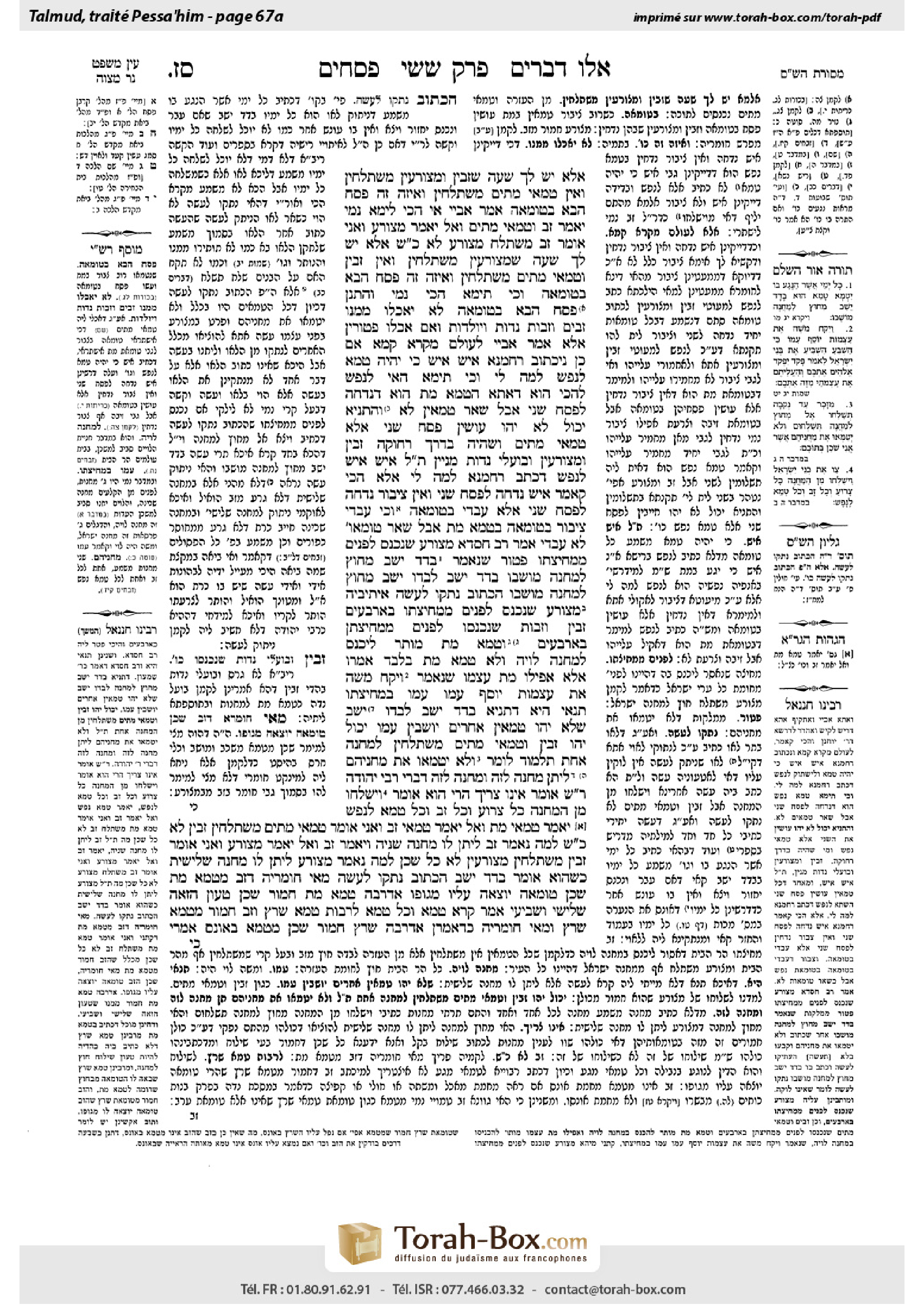
Pesachim 67a: Talmud study for Daf Yomi
Daf Yomi is the daily study of one Talmud folio. Explore 37 tractates with scans, Hebrew text, Sefaria English and AI-generated French translations where annotated.
Passage selection and English or AI-generated French translation are available where the scan has annotations. Daf Study is independent of Torah-Box and Sefaria.
Browse Pesachim · פסחים · All tractatesPesachim 67a text and translations
This page of Pesachim includes the Aramaic text, an English translation and an AI-generated French translation, alongside the scan above.
פסחים ס״ז א · Aramaic and Hebrew text
אֶלָּא יֵשׁ לְךָ שָׁעָה שֶׁזָּבִין וּמְצוֹרָעִין מִשְׁתַּלְּחִין וְאֵין טְמֵאֵי מֵתִים מִשְׁתַּלְּחִין, וְאֵיזֶה זֶה — פֶּסַח הַבָּא בְּטוּמְאָה.
אָמַר אַבָּיֵי: אִי הָכִי, לֵימָא נָמֵי: יֵאָמֵר זָב וּטְמֵאֵי מֵתִים, וְאַל יֵאָמֵר מְצוֹרָע, וַאֲנִי אוֹמֵר: זָב מִשְׁתַּלֵּחַ, מְצוֹרָע — לֹא כׇּל שֶׁכֵּן. אֶלָּא: יֵשׁ לְךָ שָׁעָה שֶׁמְּצוֹרָעִין מִשְׁתַּלְּחִין, וְאֵין זָבִין וּטְמֵאֵי מֵתִים מִשְׁתַּלְּחִין, וְאֵיזֶה זֶה — פֶּסַח הַבָּא בְּטוּמְאָה.
וְכִי תֵּימָא הָכִי נָמֵי, וְהָתְנַן: פֶּסַח הַבָּא בְּטוּמְאָה לֹא יֹאכְלוּ מִמֶּנּוּ זָבִים וְזָבוֹת נִדּוֹת וְיוֹלְדוֹת, וְאִם אָכְלוּ — פְּטוּרִין.
אֶלָּא אָמַר אַבָּיֵי: לְעוֹלָם מִקְּרָא קַמָּא. אִם כֵּן, נִיכְתּוֹב רַחֲמָנָא: ״אִישׁ אִישׁ כִּי יִהְיֶה טָמֵא״, ״לָנֶפֶשׁ״ לְמָה לִי?
וְכִי תֵּימָא הַאי ״לָנֶפֶשׁ״ לְהָכִי הוּא דַּאֲתָא: הַטְּמֵא מֵת הוּא דְּנִדְחֶה לְפֶסַח שֵׁנִי, אֲבָל שְׁאָר טְמֵאִין לָא. וְהָתַנְיָא: יָכוֹל לֹא יְהוּ עוֹשִׂין פֶּסַח שֵׁנִי אֶלָּא טְמֵאֵי מֵתִים וְשֶׁהָיָה בְּדֶרֶךְ רְחוֹקָה, זָבִין וּמְצוֹרָעִין וּבוֹעֲלֵי נִדּוֹת מִנַּיִין? תַּלְמוּד לוֹמַר: ״אִישׁ אִישׁ״, ״לָנֶפֶשׁ״ דִּכְתַב רַחֲמָנָא לְמָה לִי?
אֶלָּא הָכִי קָאָמַר: אִישׁ נִדְחֶה לְפֶסַח שֵׁנִי, וְאֵין צִיבּוּר נִדְחֶה לְפֶסַח שֵׁנִי, אֶלָּא עָבְדִי בְּטוּמְאָה. וְכִי עָבְדִי צִיבּוּר בְּטוּמְאָה — בִּטְמֵא מֵת, אֲבָל שְׁאָר טוּמְאוֹת — לָא עָבְדִי.
אָמַר רַב חִסְדָּא: מְצוֹרָע שֶׁנִּכְנַס לְפָנִים מִמְּחִיצָתוֹ פָּטוּר, שֶׁנֶּאֱמַר: ״בָּדָד יֵשֵׁב מִחוּץ לַמַּחֲנֶה מוֹשָׁבוֹ״.
״בָּדָד יֵשֵׁב״ — לְבַדּוֹ יֵשֵׁב. ״מִחוּץ לַמַּחֲנֶה מוֹשָׁבוֹ״, הַכָּתוּב נִתְּקוֹ לַעֲשֵׂה.
אֵיתִיבֵיהּ: מְצוֹרָע שֶׁנִּכְנַס לִפְנִים מִמְּחִיצָתוֹ — בְּאַרְבָּעִים. זָבִין וְזָבוֹת שֶׁנִּכְנְסוּ לִפְנִים מִמְּחִיצָתָן — בְּאַרְבָּעִים. וּטְמֵא מֵת מוּתָּר לִיכָּנֵס לְמַחֲנֵה לְוִיָּה.
וְלֹא טְמֵא מֵת בִּלְבַד אָמְרוּ, אֶלָּא אֲפִילּוּ מֵת עַצְמוֹ, שֶׁנֶּאֱמַר: ״וַיִּקַּח מֹשֶׁה אֶת עַצְמוֹת יוֹסֵף עִמּוֹ״ — ״עִמּוֹ״ בִּמְחִיצָתוֹ!
תַּנָּאֵי הִיא, דְּתַנְיָא: ״בָּדָד יֵשֵׁב״ — לְבַדּוֹ יֵשֵׁב, שֶׁלֹּא יְהוּ טְמֵאִין אֲחֵרִים יוֹשְׁבִין עִמּוֹ. יָכוֹל יְהוּ זָבִין וּטְמֵאֵי מֵתִים מִשְׁתַּלְּחִין לְמַחֲנֶה אַחַת — תַּלְמוּד לוֹמַר: ״וְלֹא יְטַמְּאוּ אֶת מַחֲנֵיהֶם״, לִיתֵּן מַחֲנֶה לָזֶה וּמַחֲנֶה לָזֶה, דִּבְרֵי רַבִּי יְהוּדָה.
רַבִּי שִׁמְעוֹן אוֹמֵר: אֵינוֹ צָרִיךְ, הֲרֵי הוּא אוֹמֵר: ״וִישַׁלְּחוּ מִן הַמַּחֲנֶה כׇּל צָרוּעַ וְכׇל זָב וְכֹל טָמֵא לָנֶפֶשׁ״, יֵאָמֵר טְמֵאֵי מֵת וְאַל יֵאָמֵר טְמֵאֵי זָב, וַאֲנִי אוֹמֵר: טְמֵאֵי מֵתִים מִשְׁתַּלְּחִין, זָבִין — לֹא כׇּל שֶׁכֵּן. לָמָּה נֶאֱמַר זָב — לִיתֵּן לוֹ מַחֲנֶה שְׁנִיָּה.
וְיֵאָמֵר זָב וְאַל יֵאָמֵר מְצוֹרָע, וַאֲנִי אוֹמֵר: זָבִין מִשְׁתַּלְּחִין, מְצוֹרָעִין לֹא כׇּל שֶׁכֵּן? לָמָּה נֶאֱמַר מְצוֹרָע — לִיתֵּן לוֹ מַחֲנֶה שְׁלִישִׁית, כְּשֶׁהוּא אוֹמֵר ״בָּדָד יֵשֵׁב״ — הַכָּתוּב נִתְּקוֹ לַעֲשֵׂה.
מַאי חוּמְרֵיהּ דְּזָב מִטְּמֵא מֵת? שֶׁכֵּן טוּמְאָה יוֹצְאָה עָלָיו מִגּוּפוֹ. אַדְּרַבָּה: טְמֵא מֵת חָמוּר, שֶׁכֵּן טָעוּן הַזָּאָה שְׁלִישִׁי וּשְׁבִיעִי.
אָמַר קְרָא ״טָמֵא״ ״וְכֹל טָמֵא״, לְרַבּוֹת טְמֵא שֶׁרֶץ. וְזָב חָמוּר מִטְּמֵא שֶׁרֶץ.
וּמַאי חוּמְרֵיהּ? כְּדַאֲמַרַן. אַדְּרַבָּה: שֶׁרֶץ חָמוּר, שֶׁכֵּן מְטַמֵּא בְּאוֹנֶס! אָמְרִי:
Pesachim 67a · English translation
Rather, it teaches you that you have a time when zavin and lepers are sent out from the camp, but those who are ritually impure due to contact with a corpse are not sent out. And what is this time? When a Paschal lamb is brought in impurity, when those impure due to contact with a corpse are permitted to participate, but a zav and a leper may not. From here we learn that when most of the nation is ritually impure due to contact with a corpse, the Paschal lamb is brought anyway in a state of ritual impurity.
Abaye said: If so, that this is how the verse is to be interpreted, let us also say that the verse should only say zav and those ritually impure due to a corpse and not say leper, and I would say this law on my own through an a fortiori inference: If a zav is sent out, then with regard to a leper, whose ritual impurity is more severe than that of a zav, all the more so is it not clear that he should be sent out? Rather, the seemingly unnecessary mention of a leper teaches that you have a time when only lepers are sent out, but zavin and those ritually impure due to contact with a corpse are not sent out. And what is this time? When a Paschal offering is brought in impurity, when zavin and those impure due to contact with a corpse are permitted to participate, but a leper may not.
And if you say that it is indeed so that even a zav may participate when the Paschal lamb is brought in a state of impurity, there is a difficulty, for didn’t we learn in a mishna: When a Paschal lamb is brought in a state of ritual impurity, zavim and zavot, menstruating women and women after childbirth, whose impurity is comparable to that of a zav, may not eat from it; but if they ate, they are exempt from karet. This demonstrates that the verse cannot be explained in accordance with Reish Lakish’s inference.
Rather, Abaye said: Actually, the law can be derived from the first verse quoted by Rabbi Yoḥanan: “Any man who shall be impure by reason of a corpse.” And the derivation should be understood as follows: If so, that the verse comes to teach that only an individual can rectify his situation on the second Pesaḥ, but not the community, the Merciful One should have written: “Any man who shall be impure.” Why do I need the words “by reason of a corpse”?
And if you say that these words “by reason of a corpse” come for this reason, to teach us that it is only one who is ritually impure due to contact with a corpse that is deferred to the second Pesaḥ but the rest of those who are impure are not deferred to the second Pesaḥ, there is a difficulty. For wasn’t it taught otherwise in the following baraita: One might have thought that only those ritually impure due to contact with a corpse and those on a distant journey observe the second Pesaḥ. From where do we derive that even zavin, lepers and those who had relations with menstruating women may participate in the second Pesaḥ? Therefore, the verse states: “Any man,” to include even people with these types of impurity. If so, why do I need the words “by reason of a corpse” that the Merciful One writes, as it would seem that they teach us nothing?
Rather, this is what the verse is saying: A single individual or a group of individuals are deferred to the second Pesaḥ, but the entire community or the majority thereof is not deferred to the second Pesaḥ; rather, they observe the first Pesaḥ in a state of ritual impurity. And when we say that the community observes it in a state of impurity, that is only when they are ritually impure due to contact with a corpse, as indicated by the expression “by reason of a corpse,” but when they are impure with other types of impurity, they do not observe it in a state of impurity, even if the majority of the community is impure.
Having cited verses dealing with the requirement to send out the ritually impure from the camp, the Gemara addresses several halakhot relevant to that topic. Rav Ḥisda said: A leper, who must be sent out from all of the camps including the Israelite camp, who went in beyond his boundary, that is, he entered an area that is prohibited to him, is nonetheless exempt from the punishment of lashes. With regard to the ritually impure, the Torah states: “Both male and female shall you send out, outside the camp shall you send them, and they shall defile not their camps in the midst of which I dwell” (Numbers 5:3), from which we learn that an impure person who enters the camp is liable to receive lashes for having violated the prohibition of “they shall not defile.” A leper, however, is exempt, as it is stated: “All the days that the plague shall be in him he shall be impure; he is impure, he shall dwell in isolation, his dwelling shall be outside the camp” (Leviticus 13:46).
The Gemara explains that the verse is explicated in the following manner: “He shall dwell in isolation” means he shall dwell alone, without even the company of others who are impure. “His dwelling shall be outside the camp” teaches that the verse has transmuted the negative precept into a positive mitzva. In other words, the verse establishes that if a leper entered an area that is prohibited to him, he is commanded to leave, and fulfilling this command removes the full force of the prohibition he has already violated. The rule is that lashes are not administered for the violation of a prohibition, if that violation can be rectified by the fulfillment of a positive commandment.
An objection was raised against Rav Ḥisda from a baraita: A leper, who may not even enter the Israelite camp, who went in beyond his boundary, is punished with forty lashes like one who violates a regular Torah prohibition. Similarly, zavin and zavot, who are prohibited from entering the Levite camp, who went in beyond their boundaries, are punished with forty lashes. And one who is ritually impure due to contact with a corpse is permitted to enter even the Levite camp.
And not only did they say that one who is ritually impure due to a corpse may enter this area, but even a corpse itself may be brought into the Levite camp, as it is stated: “And Moses took the bones of Joseph with him” (Exodus 13:19), the words “with him” implying that the bones were taken within his boundary, i.e., that Joseph’s coffin was found in the same area in which Moses dwelled. Since Moses was a Levite and lived in the Levite camp, it follows that even a corpse may be brought into the Levite camp. In any event, we see from the first clause of the baraita that a leper does in fact receive lashes for entering an area prohibited to him, against Rav Ḥisda.
The Gemara answers: This is a matter that is subject to dispute between tanna’im, for it was taught in a different baraita: “He shall dwell in isolation” indicates that he shall dwell alone, meaning that other ritually impure people, such as zavin and those who are ritually impure due to contact with a corpse, should not dwell with him. One might have thought that zavin and those who are ritually impure due to contact with a corpse are sent to one camp, meaning that the laws governing which camps they may or may not enter are the same for both. Therefore, the verse states: “Both male and female shall you send out, outside the camp shall you send them out, and they shall defile not their camps in the midst of which I dwell” (Numbers 5:3). The plural term “camps” teaches that there are multiple camps for those who are ritually impure, so that we give a camp for this one and a camp for that one; this is the statement of Rabbi Yehuda. Thus, in his opinion, there are three camps: One which a leper may not enter, one which a zav may not enter, and one which even someone ritually impure due to contact with a corpse may not enter.
Rabbi Shimon says: It is not necessary to derive this law from the plural term “camps,” for surely the verse says: “Command the children of Israel that they send out from the camp any leper and any zav and anyone impure by reason of a corpse” (Numbers 5:2). The verse includes an unnecessary phrase: Let the verse say only that they are to send out those who are ritually impure due to a corpse, and not say anything about those impure as a zav, and I would say on my own that a zav is obviously included in this law: If those ritually impure due to a corpse are sent out from the camp, all the more so is it not clear that zavin should be sent out? If so, why is a zav stated? To give him a second camp, that is, to teach us that the law governing a zav is more severe than the law relating to one who is impure due to a corpse and there is an additional camp that he may not enter.
And furthermore: Let the verse say only that they are to send out a zav, and not say anything about a leper, and I would say on my own that a leper is obviously included in this law as well: If zavin are sent out, all the more so is it not clear that lepers should be sent out? Why then is a leper stated? To give him a third camp that he may not enter. When the verse says with regard to a leper: “He shall dwell alone,” the verse has transmuted the negative precept into a positive command. This teaches us that a leper who enters a camp that is prohibited to him does not receive lashes for his violation of a negative commandment, which is consistent with the ruling of Rav Ḥisda.
The Gemara questions the opinion of Rabbi Shimon: We see from the discussion cited above that it was clear to Rabbi Shimon that the impurity of a zav is more severe than that of one who is ritually impure due to contact with a corpse, and that the impurity of a leper is even more severe than that of a zav. What is the stringency of a zav over one who is ritually impure due to a corpse? That the impurity of the zav issues out upon him from his own body, rather than coming from an external source, as is the case when impurity is contracted from a corpse. But on the contrary, it may be argued that the legal status of one who is ritually impure due to a corpse is more severe, as he requires sprinkling of the purifying waters on the third and seventh days of his purification process, whereas a zav, who is also impure for seven days, does not require such sprinkling.
The Gemara answers: Therefore, the verse states not just “impure” but “and anyone impure.” The additional words come to include one who is ritually impure due to contact with a creeping animal. He, too, is sent out from the camp like one who is impure due to contact with a corpse, and it is clear that the legal status of a zav is more severe than one who is ritually impure due to contact with a creeping animal.
The Gemara asks: And what is his stringency? In what way is a zav more stringent than one who has contracted ritual impurity from a creeping animal? The Gemara answers: As we have said, that his impurity issues out upon him from his own body, unlike one who has contracted impurity from a creeping animal. But on the contrary, it is possible to say that the legal status a creeping animal is more severe, for it imparts ritual impurity even through an accident. A zav only becomes impure when it is clear that his discharge did not result from sickness or some other accident, but a person who comes into contact with a creeping animal contracts ritual impurity regardless of the circumstances of that contact. They say in answer to this question:
Pesachim 67a · Traduction française (IA)
Au contraire, cela t’enseigne qu’il existe un moment où les zavim et les lépreux sont renvoyés hors du camp, tandis que ceux qui sont rituellement impurs par contact avec un cadavre ne le sont pas. Quel est ce moment ? Lorsque l’agneau pascal est offert en état d’impureté : ceux qui sont impurs par contact avec un cadavre sont alors autorisés à y prendre part, mais ni un zav ni un lépreux ne le peuvent. Nous apprenons de là que, lorsque la majorité du peuple est rituellement impure par contact avec un cadavre, l’agneau pascal est tout de même offert en état d’impureté rituelle.
Abayé dit : Si tel est le cas, si le verset doit être interprété ainsi, qu’il mentionne seulement le zav et ceux qui sont rituellement impurs par contact avec un cadavre, sans mentionner le lépreux ; j’aurais déduit cette loi de moi-même par raisonnement a fortiori : si un zav est renvoyé hors du camp, à plus forte raison un lépreux, dont l’impureté rituelle est plus grave que celle d’un zav, doit-il l’être. Au contraire, la mention apparemment superflue du lépreux t’enseigne qu’il existe un moment où seuls les lépreux sont renvoyés hors du camp, tandis que les zavim et ceux qui sont rituellement impurs par contact avec un cadavre ne le sont pas. Quel est ce moment ? Lorsque l’offrande pascale est apportée en état d’impureté : les zavim et ceux qui sont impurs par contact avec un cadavre sont alors autorisés à y prendre part, mais pas les lépreux.
Et si tu dis qu’il en est effectivement ainsi, qu’un zav peut lui aussi prendre part au sacrifice lorsque l’agneau pascal est offert en état d’impureté, une difficulté se pose. N’avons-nous pas appris dans une Michna : lorsque l’agneau pascal est offert en état d’impureté rituelle, les zavim et les zavot, les femmes menstruées et les femmes en période post-partum, dont l’impureté est comparable à celle d’un zav, ne peuvent pas en manger ; mais s’ils en ont mangé, ils sont exempts de karet ? Cela montre que le verset ne peut pas être expliqué conformément à la déduction de Reish Lakish.
Au contraire, Abayé dit : En réalité, la loi peut être déduite du premier verset cité par Rabbi Yoḥanan : « Tout homme qui sera impur à cause d’un cadavre. » La déduction doit être comprise ainsi : si le verset vient enseigner que seul un individu peut remédier à sa situation lors du second Pessaḥ, mais pas la communauté, le Miséricordieux aurait dû écrire : « Tout homme qui sera impur. » Pourquoi les mots « à cause d’un cadavre » sont-ils nécessaires ?
Et si tu dis que les mots « à cause d’un cadavre » sont là pour nous enseigner que seul celui qui est rituellement impur par contact avec un cadavre est reporté au second Pessaḥ, tandis que les autres personnes impures ne le sont pas, une difficulté se pose. N’a-t-on pas enseigné le contraire dans la baraïta suivante : on aurait pu penser que seuls ceux qui sont rituellement impurs par contact avec un cadavre et ceux qui sont en voyage lointain observent le second Pessaḥ. D’où déduit-on que les zavim, les lépreux et ceux qui ont eu des relations avec des femmes menstruées peuvent eux aussi prendre part au second Pessaḥ ? Le verset dit donc : « Tout homme », afin d’inclure également les personnes présentant ces types d’impureté. Dans ce cas, pourquoi le Miséricordieux a-t-il écrit les mots « à cause d’un cadavre », puisqu’il semblerait qu’ils ne nous enseignent rien ?
Au contraire, voici ce que dit le verset : un individu ou un groupe d’individus est reporté au second Pessaḥ, mais la communauté entière ou sa majorité ne l’est pas ; elle observe plutôt le premier Pessaḥ en état d’impureté rituelle. Lorsque nous disons que la communauté l’observe en état d’impureté, cela ne vaut que lorsqu’elle est rituellement impure par contact avec un cadavre, comme l’indique l’expression « à cause d’un cadavre ». En revanche, si elle est impure d’un autre type d’impureté, elle n’observe pas le Pessaḥ en état d’impureté, même si la majorité de la communauté est impure.
Après avoir cité des versets concernant l’obligation d’éloigner les personnes rituellement impures du camp, la Guemara aborde plusieurs halakhot liées à ce sujet. Rav Ḥisda dit : un lépreux, qui doit être éloigné de tous les camps, y compris du camp d’Israël, mais qui a franchi sa limite, c’est-à-dire qui est entré dans une zone qui lui est interdite, est néanmoins exempt de la peine de flagellation. Au sujet des personnes rituellement impures, la Torah dit : « Vous renverrez les hommes et les femmes ; vous les renverrez hors du camp, afin qu’ils ne souillent pas leurs camps, au milieu desquels Je réside » (Nombres 5:3). Nous apprenons de là qu’une personne impure qui entre dans le camp est passible de flagellation pour avoir transgressé l’interdit « qu’ils ne souillent pas ». Un lépreux, cependant, en est exempt, comme il est dit : « Tous les jours où la plaie sera sur lui, il sera impur ; il est impur, il demeurera isolé, sa demeure sera hors du camp » (Lévitique 13:46).
La Guemara explique que le verset s’interprète ainsi : « Il demeurera isolé » signifie qu’il demeurera seul, sans même la compagnie d’autres personnes impures. « Sa demeure sera hors du camp » enseigne que le verset a transformé l’interdit négatif en mitsva positive. Autrement dit, le verset établit que si un lépreux entre dans une zone qui lui est interdite, il lui est ordonné d’en sortir ; l’accomplissement de cet ordre lève entièrement l’interdit qu’il a déjà transgressé. Selon la règle, on n’inflige pas de flagellation pour la transgression d’un interdit si celle-ci peut être réparée par l’accomplissement d’un commandement positif.
Une objection est soulevée contre Rav Ḥisda à partir d’une baraïta : un lépreux, qui ne peut même pas entrer dans le camp d’Israël, mais qui a franchi sa limite, est puni de quarante coups de flagellation, comme celui qui transgresse un interdit ordinaire de la Torah. De même, les zavim et les zavot, à qui il est interdit d’entrer dans le camp des Lévites, mais qui ont franchi leurs limites, sont punis de quarante coups de flagellation. Quant à celui qui est rituellement impur par contact avec un cadavre, il est autorisé à entrer même dans le camp des Lévites.
Et on n’a pas seulement dit que celui qui est rituellement impur par contact avec un cadavre peut entrer dans cette zone : un cadavre lui-même peut même être amené dans le camp des Lévites, comme il est dit : « Moïse prit avec lui les ossements de Joseph » (Exode 13:19). Les mots « avec lui » impliquent que les ossements furent pris dans son périmètre, c’est-à-dire que le cercueil de Joseph se trouvait dans la même zone que celle où résidait Moïse. Puisque Moïse était un Lévite et vivait dans le camp des Lévites, il s’ensuit qu’un cadavre peut lui aussi être amené dans ce camp. Quoi qu’il en soit, la première partie de la baraïta montre qu’un lépreux reçoit effectivement des coups de flagellation pour être entré dans une zone qui lui est interdite, contrairement à l’avis de Rav Ḥisda.
La Guemara répond : cette question fait l’objet d’une controverse entre des tannaïm, car une autre baraïta a été enseignée : « Il demeurera isolé » indique qu’il demeurera seul, c’est-à-dire que d’autres personnes rituellement impures, comme les zavim et ceux qui sont rituellement impurs par contact avec un cadavre, ne doivent pas demeurer avec lui. On aurait pu penser que les zavim et ceux qui sont rituellement impurs par contact avec un cadavre sont envoyés dans un seul et même camp, c’est-à-dire que les règles déterminant les camps dans lesquels ils peuvent ou ne peuvent pas entrer sont identiques pour les uns et les autres. Le verset dit donc : « Vous renverrez les hommes et les femmes ; vous les renverrez hors du camp, afin qu’ils ne souillent pas leurs camps, au milieu desquels Je réside » (Nombres 5:3). Le terme pluriel « camps » enseigne qu’il existe plusieurs camps pour les personnes rituellement impures : un camp est attribué à celui-ci, un autre à celui-là. Telle est la déclaration de Rabbi Yehuda. Selon son opinion, il existe donc trois camps : un dans lequel un lépreux ne peut pas entrer, un dans lequel un zav ne peut pas entrer, et un dans lequel même celui qui est rituellement impur par contact avec un cadavre ne peut pas entrer.
Rabbi Shimon dit : il n’est pas nécessaire de déduire cette loi du terme pluriel « camps », car le verset dit clairement : « Ordonne aux enfants d’Israël d’expulser du camp tout lépreux, tout zav et toute personne impure à cause d’un cadavre » (Nombres 5:2). Le verset contient une expression superflue : qu’il se contente de dire d’expulser ceux qui sont rituellement impurs par contact avec un cadavre, sans rien dire au sujet de ceux qui sont impurs comme un zav ; j’aurais déduit de moi-même qu’un zav est évidemment inclus dans cette loi. Si ceux qui sont rituellement impurs par contact avec un cadavre sont renvoyés hors du camp, à plus forte raison les zavim doivent-ils l’être. Pourquoi, dès lors, mentionner un zav ? Pour lui attribuer un deuxième camp, c’est-à-dire nous enseigner que la loi applicable à un zav est plus stricte que celle qui concerne une personne impure par contact avec un cadavre, et qu’il existe un camp supplémentaire dans lequel il ne peut pas entrer.
Et de plus : que le verset se contente de mentionner l’expulsion d’un zav, sans rien dire au sujet d’un lépreux ; j’aurais déduit de moi-même qu’un lépreux est lui aussi évidemment inclus dans cette loi. Si les zavim sont renvoyés hors du camp, à plus forte raison les lépreux doivent-ils l’être. Pourquoi, dès lors, mentionner un lépreux ? Pour lui attribuer un troisième camp dans lequel il ne peut pas entrer. Lorsque le verset dit au sujet d’un lépreux : « Il demeurera seul », il a transformé l’interdit négatif en commandement positif. Cela nous enseigne qu’un lépreux qui entre dans un camp qui lui est interdit ne reçoit pas de coups de flagellation pour avoir transgressé un commandement négatif, ce qui concorde avec la décision de Rav Ḥisda.
La Guemara remet en question l’opinion de Rabbi Shimon : d’après la discussion citée plus haut, il était clair pour Rabbi Shimon que l’impureté d’un zav est plus grave que celle d’une personne rituellement impure par contact avec un cadavre, et que l’impureté d’un lépreux est encore plus grave que celle d’un zav. En quoi l’impureté d’un zav est-elle plus grave que celle d’une personne rituellement impure par contact avec un cadavre ? Elle émane de son propre corps, plutôt que de provenir d’une source extérieure, comme c’est le cas lorsqu’on contracte l’impureté au contact d’un cadavre. Mais on peut au contraire soutenir que le statut juridique de celui qui est rituellement impur par contact avec un cadavre est plus strict, car il doit recevoir l’aspersion des eaux purificatrices aux troisième et septième jours de son processus de purification, tandis qu’un zav, bien qu’il soit lui aussi impur pendant sept jours, n’a pas besoin de cette aspersion.
La Guemara répond : le verset ne dit donc pas seulement « impur », mais « et toute personne impure ». Ces mots supplémentaires viennent inclure celui qui est rituellement impur par contact avec un animal rampant. Lui aussi est renvoyé hors du camp, comme celui qui est impur par contact avec un cadavre, et il est clair que le statut juridique d’un zav est plus strict que celui d’une personne rituellement impure par contact avec un animal rampant.
La Guemara demande : en quoi consiste cette rigueur ? En quoi un zav est-il soumis à une règle plus stricte qu’une personne qui a contracté l’impureté rituelle par contact avec un animal rampant ? La Guemara répond : comme nous l’avons dit, son impureté émane de son propre corps, contrairement à celle de quelqu’un qui a contracté l’impureté par contact avec un animal rampant. Mais on peut au contraire soutenir que le statut juridique de l’impureté contractée par contact avec un animal rampant est plus strict, car elle se transmet même en cas de contact accidentel. Un zav ne devient impur que lorsqu’il est établi que son écoulement ne résulte pas d’une maladie ni d’un autre accident, tandis qu’une personne qui entre en contact avec un animal rampant contracte l’impureté rituelle quelles que soient les circonstances de ce contact. Ils répondent à cette question :
Traduction française générée par IA à partir de l’édition anglaise de Sefaria. Vérifie toujours un passage avec le texte source.
Text from Sefaria: William Davidson Edition - Vocalized Aramaic (CC BY NC); William Davidson Edition - English (CC BY NC).