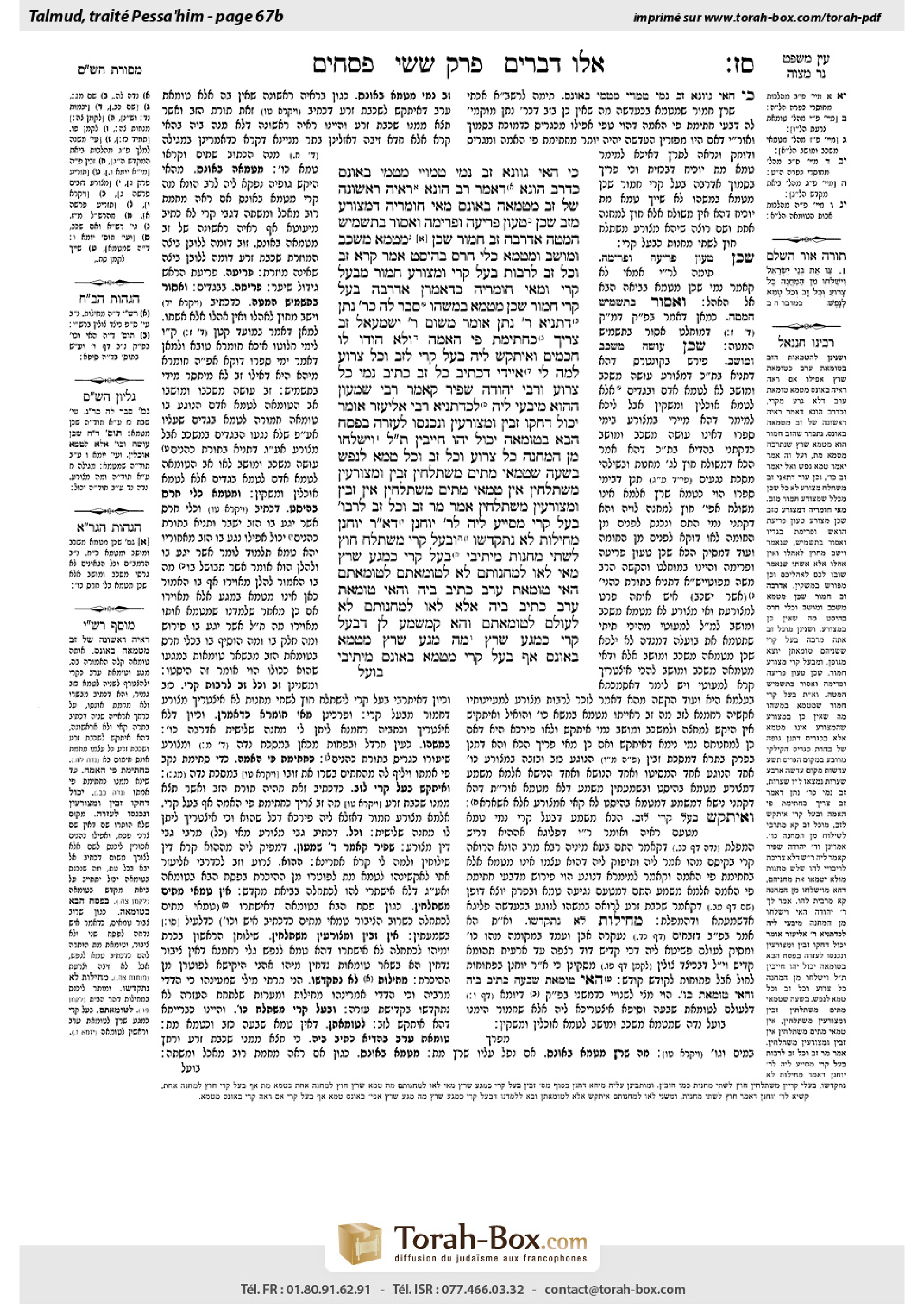
Pesachim 67b: Talmud study for Daf Yomi
Daf Yomi is the daily study of one Talmud folio. Explore 37 tractates with scans, Hebrew text, Sefaria English and AI-generated French translations where annotated.
Passage selection and English or AI-generated French translation are available where the scan has annotations. Daf Study is independent of Torah-Box and Sefaria.
Browse Pesachim · פסחים · All tractatesPesachim 67b text and translations
This page of Pesachim includes the Aramaic text, an English translation and an AI-generated French translation, alongside the scan above.
פסחים ס״ז ב · Aramaic and Hebrew text
כִּי הַאי גַוְונָא — זָב נָמֵי טַמּוֹיֵי מְטַמֵּי בְּאוֹנֶס כִּדְרַב הוּנָא. דְּאָמַר רַב הוּנָא: רְאִיָּה רִאשׁוֹנָה שֶׁל זָב מְטַמְּאָה בְּאוֹנֶס.
מַאי חוּמְרֵיהּ דִּמְצוֹרָע מִזָּב? שֶׁכֵּן טָעוּן פְּרִיעָה וּפְרִימָה, וְאָסוּר בְּתַשְׁמִישׁ הַמִּטָּה. אַדְּרַבָּה זָב חָמוּר, שֶׁכֵּן מְטַמֵּא מִשְׁכָּב וּמוֹשָׁב, וּמְטַמֵּא כְּלִי חֶרֶס בְּהֶיסֵּט.
אָמַר קְרָא ״זָב״, ״וְכׇל זָב״, לְרַבּוֹת בַּעַל קֶרִי. וּמְצוֹרָע חָמוּר מִבַּעַל קֶרִי.
וּמַאי חוּמְרֵיהּ — כְּדַאֲמַרַן. אַדְּרַבָּה: בַּעַל קֶרִי חָמוּר, שֶׁכֵּן מְטַמֵּא בְּמַשֶּׁהוּ!
סָבַר לַהּ כְּרַבִּי נָתָן. דְּתַנְיָא: רַבִּי נָתָן אוֹמֵר מִשּׁוּם רַבִּי יִשְׁמָעֵאל: זָב צָרִיךְ כַּחֲתִימַת פִּי הָאַמָּה, וְלֹא הוֹדוּ לוֹ חֲכָמִים. וְאִיתַּקַּשׁ לֵיהּ בַּעַל קֶרִי לְזָב.
״וְכׇל צָרוּעַ״ לְמָה לִי? אַיְּידֵי דִּכְתִיב ״כׇּל זָב״, כְּתִיב נָמֵי ״כׇּל צָרוּעַ״.
וְרַבִּי יְהוּדָה, שַׁפִּיר קָאָמַר רַבִּי שִׁמְעוֹן?
הַהוּא מִיבְּעֵי לֵיהּ לְכִדְתַנְיָא, רַבִּי אֱלִיעֶזֶר אוֹמֵר: יָכוֹל דָּחֲקוּ זָבִין וּמְצוֹרָעִין וְנִכְנְסוּ לָעֲזָרָה בְּפֶסַח הַבָּא בְּטוּמְאָה, יָכוֹל יְהוּ חַיָּיבִין, תַּלְמוּד לוֹמַר: ״וִישַׁלְּחוּ מִן הַמַּחֲנֶה כׇּל צָרוּעַ וְכׇל זָב וְכֹל טָמֵא לָנֶפֶשׁ״. בְּשָׁעָה שֶׁטְּמֵאֵי מֵתִים מִשְׁתַּלְּחִין — זָבִין וּמְצוֹרָעִין מִשְׁתַּלְּחִין, אֵין טְמֵאֵי מֵתִים מִשְׁתַּלְּחִין — אֵין זָבִין וּמְצוֹרָעִין מִשְׁתַּלְּחִין.
אָמַר מָר: ״זָב״, ״וְכׇל זָב״ — לְרַבּוֹת בַּעַל קֶרִי. מְסַיַּיע לֵיהּ לְרַבִּי יוֹחָנָן. דְּאָמַר רַבִּי יוֹחָנָן: מְחִילּוֹת לֹא נִתְקַדְּשׁוּ, וּבַעַל קֶרִי מִשְׁתַּלֵּחַ חוּץ לִשְׁתֵּי מַחֲנוֹת.
מֵיתִיבִי: בַּעַל קֶרִי כְּמַגַּע שֶׁרֶץ, מַאי לָאו לְמַחֲנוֹתָם? לֹא, לְטוּמְאָתָם.
לְטוּמְאָתָם?! הַאי טוּמְאַת עֶרֶב כְּתִיב בֵּיהּ, וְהַאי טוּמְאַת עֶרֶב כְּתִיב בֵּיהּ! אֶלָּא לָאו, לְמַחֲנוֹתָם!
לָא, לְעוֹלָם לְטוּמְאָתָם, וְהָא קָמַשְׁמַע לַן דְּבַעַל קֶרִי כְּמַגַּע שֶׁרֶץ: מָה מַגַּע שֶׁרֶץ מְטַמֵּא בְּאוֹנֶס — אַף בַּעַל קֶרִי מְטַמֵּא בְּאוֹנֶס.
מֵיתִיבִי:
Pesachim 67b · English translation
In a case like this, meaning, if we compare the two cases in this way, a zav also becomes impure through an accident, in accordance with the opinion of Rav Huna, for Rav Huna said: The first sighting of a zav establishes ritual impurity even through an accident. In order to contract the more severe ritual impurity of a zav that lasts seven days, a man must experience at least two zav discharges. If he has only a single discharge, he contracts a less severe ritual impurity that lasts until evening, like one who experienced a seminal emission. This first discharge establishes impurity even if it results from some accident, and no effort is made to attribute it to some other factor.
The Gemara asks further: What is the stringency of a leper over a zav? That a confirmed leper is required to let his hair grow and rend his garments and he is prohibited from marital relations, none of which applies to a zav. But on the contrary, there is room to say that the legal status of a zav is more severe, for a zav imparts ritual impurity to that upon which he lies or sits even if he does not come into direct contact with it, and he imparts ritual impurity to an earthenware vessel through movement. If he causes an earthenware vessel to move, it becomes ritually impure even if he touches it on the outside, and even if he does not touch the vessel at all. Ordinarily, an earthenware vessel becomes impure only through contact on the inside of the vessel.
The Gemara answers: The verse states not just “zav” but “and any zav,” and this inclusive expression “any” comes to include a person who experienced a seminal emission, whose impurity is of the same type as a zav, and it is clear that the legal status of a leper is more severe than a person who experienced a seminal emission. We can therefore derive through an a fortiori inference that if one who experienced a seminal emission is prohibited from entering a certain camp, a leper is certainly prohibited from entering that camp.
The Gemara asks: And what is his stringency? In what way is the legal status of a leper more severe than one who experienced a seminal emission? As we said, that he must let his hair grow and rend his garments and he is prohibited to engage in marital relations. But we may ask: On the contrary, there is room to say that the legal status of one who experienced a seminal emission is more severe, for he becomes ritually impure even with any amount. For the Torah did not specify an amount of semen that must be emitted in order to become impure, and one therefore becomes impure upon emitting even a minute amount, whereas leprous signs do have a minimum measure.
The Gemara answers: He holds in accordance with the opinion of Rabbi Natan, as it was taught in a baraita: Rabbi Natan says in the name of Rabbi Yishmael: In order for a zav to become ritually impure, he needs to experience a discharge substantial enough to cause a blockage of the tip of the male organ. But the Rabbis did not agree with him. Thus, according to Rabbi Natan, a zav only becomes ritually impure if he experiences a discharge of a particular amount. And one who experienced a seminal emission is compared to a zav and therefore the same amount of discharge is required in order to cause ritual impurity. Therefore, the ritual impurity of a leper is more severe than that of one who experienced a seminal emission, and the original a fortiori inference applies.
The Gemara asks: The expressions “any zav” and “anyone impure” teach that their respective categories are more inclusive than one would otherwise have thought. But why do I need the inclusive expression “and any leper”? What does the word “any” include? The Gemara explains: Since it is written “any zav,” it is also written “any leper,” so that the wording of the verse will be consistent.
The Gemara challenges the opinion of Rabbi Yehuda quoted above: Rabbi Shimon spoke well when he derived the three camps from which the three different classes of people are sent out from the verse: “That they send out from the camp any leper and any zav and anyone impure by reason of a corpse.” How does Rabbi Yehuda counter this argument?
The Gemara answers: He needs that verse for that which was taught in a different baraita: Rabbi Eliezer says: One might have thought that if zavin and lepers pushed and entered the Temple courtyard during the offering of a Paschal lamb that is brought in a state of impurity, when the majority of the nation are ritually impure due to contact with a corpse, that perhaps they would be liable for punishment for having violated the prohibition of entering the Temple while ritually impure. They are prohibited from entering even under such circumstances. Therefore the verse states: “That they send out from the camp any leper and any zav and anyone impure by reason of a corpse” (Numbers 5:2), which teaches us that at a time when those impure due to a corpse are sent out, zavin and lepers are sent out and are liable to karet for entering the Temple; but when those impure due to a corpse are not sent out, zavin and lepers are not sent out, meaning, they are not liable to receive karet for entering the Temple.
The Master said above: The fact that the verse does not just say “zav” but rather the inclusive expression “and any zav” comes to include a person who experienced a seminal emission. The Gemara notes: This exposition supports the opinion of Rabbi Yoḥanan, for Rabbi Yoḥanan said: The tunnels under the Temple were not sanctified with the sanctity of the Temple; and a person who experienced a seminal emission is sent outside the two camps just like a zav. The exposition quoted above supports this second ruling of Rabbi Yoḥanan.
The Gemara raises an objection based on what we learned in a mishna: The law governing a person who experienced a seminal emission is like the law governing someone who became ritually impure through contact with a creeping animal. What, is the intent not to compare them with regard to their respective camps, that one who experienced a seminal emission is prohibited from the same camps that are prohibited to one who touched a creeping animal? Thus, it follows that a person who experienced a seminal emission is permitted to enter the Levite camp. The Gemara answers: No, they are compared with regard to their impurity, in that each is impure only until the evening.
The Gemara expresses surprise: Why did the mishna need to teach that they are comparable with regard to their impurity? Impurity until evening is explicitly written in the Torah about this one, meaning that one who came into contact with a creeping animal is impure until the evening and then must undergo ritual immersion in order to become pure, as it states: “And for these you shall be unclean; whoever touches the carcass of them shall be unclean until evening” (Leviticus 11:24). And impurity until evening is explicitly written about that one, one who experienced a seminal emission, as it states: “And if semen goes out from a man, then shall he bathe all his flesh in water and be unclean until evening” (Leviticus 15:16). Rather, is it not that they are compared with regard to their camps, which is not explicit in the Torah?
The Gemara answers: No, actually it is possible to say that the comparison relates to their impurity, and it teaches us that a person who experienced seminal emission is governed by the same law as someone who became ritually impure through contact with a creeping animal in another regard: Just as contact with a creeping animal imparts ritual impurity through an accident, even when the contact is unintentional, so too a person who experienced a seminal emission becomes ritually impure through an accident, even when the emission of semen is unintentional, unlike the law governing a zav.
The Gemara raises an objection:
Pesachim 67b · Traduction française (IA)
Dans un cas comme celui-ci, c’est-à-dire si l’on compare ainsi les deux cas, un zav devient lui aussi impur à la suite d’un accident, conformément à l’opinion de Rav Houna. En effet, Rav Houna a dit : La première émission d’un zav entraîne l’impureté rituelle même lorsqu’elle résulte d’un accident. Pour contracter l’impureté rituelle plus grave d’un zav, qui dure sept jours, un homme doit connaître au moins deux émissions de zav. S’il n’en connaît qu’une seule, il contracte une impureté rituelle moins grave, qui dure jusqu’au soir, comme celui qui a connu une émission de sperme. Cette première émission entraîne l’impureté même si elle résulte d’un accident, sans qu’on cherche à l’attribuer à un autre facteur.
La Guemara demande encore : En quoi le statut d’un lépreux est-il plus rigoureux que celui d’un zav ? Un lépreux déclaré tel doit laisser pousser ses cheveux, déchirer ses vêtements et s’abstenir de relations conjugales, ce qui ne s’applique pas à un zav. Mais, au contraire, on peut soutenir que le statut d’un zav est plus rigoureux, car il transmet l’impureté rituelle à ce sur quoi il se couche ou s’assoit, même sans contact direct, et il transmet l’impureté rituelle à un récipient en terre cuite par le mouvement. S’il fait bouger un récipient en terre cuite, celui-ci devient rituellement impur même s’il le touche par l’extérieur, voire sans le toucher du tout. Ordinairement, un récipient en terre cuite ne devient impur que par un contact avec son intérieur.
La Guemara répond : Le verset ne dit pas seulement « zav », mais « et tout zav ». Cette expression inclusive, « tout », vient inclure celui qui a connu une émission de sperme, dont l’impureté est du même type que celle d’un zav ; il est clair que le statut d’un lépreux est plus rigoureux que celui d’une personne qui a connu une émission de sperme. Nous pouvons donc déduire par raisonnement a fortiori que si celui qui a connu une émission de sperme n’a pas le droit d’entrer dans un certain camp, un lépreux n’a certainement pas le droit d’y entrer.
La Guemara demande : Et en quoi son statut est-il plus rigoureux ? En quoi le statut d’un lépreux est-il plus rigoureux que celui d’une personne qui a connu une émission de sperme ? Comme nous l’avons dit : il doit laisser pousser ses cheveux, déchirer ses vêtements et s’abstenir de relations conjugales. Mais on peut demander : Au contraire, on peut soutenir que le statut de celui qui a connu une émission de sperme est plus rigoureux, puisqu’il devient impur rituellement quelle que soit la quantité émise. En effet, la Torah n’a pas fixé de quantité de sperme à émettre pour entraîner l’impureté ; on devient donc impur même en émettant une quantité infime, tandis que les signes de lèpre ont, eux, une mesure minimale.
La Guemara répond : Il suit l’opinion de Rabbi Natan, comme il a été enseigné dans une baraïta : Rabbi Natan dit au nom de Rabbi Yishmaël : Pour qu’un zav devienne impur rituellement, il faut qu’il connaisse une émission assez importante pour obstruer l’extrémité du membre viril. Mais les Sages ne sont pas d’accord avec lui. Ainsi, selon Rabbi Natan, un zav ne devient impur rituellement que s’il connaît une émission d’une certaine quantité. Celui qui a connu une émission de sperme étant comparé à un zav, une émission de la même quantité est donc requise pour entraîner l’impureté rituelle. Par conséquent, l’impureté rituelle d’un lépreux est plus grave que celle de celui qui a connu une émission de sperme, et le raisonnement a fortiori initial s’applique.
La Guemara demande : Les expressions « tout zav » et « toute personne impure » enseignent que leurs catégories respectives sont plus inclusives qu’on ne l’aurait pensé. Mais pourquoi ai-je besoin de l’expression inclusive « et tout lépreux » ? Qu’inclut le mot « tout » ? La Guemara explique : Puisqu’il est écrit « tout zav », il est également écrit « tout lépreux », afin que la formulation du verset soit cohérente.
La Guemara conteste l’opinion de Rabbi Yehouda citée plus haut : Rabbi Shimon a bien raisonné en déduisant les trois camps d’où sont renvoyées les trois différentes catégories de personnes à partir du verset : « Qu’ils renvoient du camp tout lépreux, tout zav et toute personne impure à cause d’un mort. » Comment Rabbi Yehouda répond-il à cet argument ?
La Guemara répond : Il a besoin de ce verset pour l’enseignement d’une autre baraïta : Rabbi Eliezer dit : On aurait pu penser que si des zavin et des lépreux forçaient le passage et entraient dans la cour du Temple pendant l’offrande d’un agneau pascal apporté en état d’impureté, alors que la majorité du peuple est rituellement impure à la suite d’un contact avec un mort, ils seraient peut-être passibles d’une peine pour avoir transgressé l’interdiction d’entrer dans le Temple en état d’impureté rituelle. Il leur est interdit d’y entrer même dans de telles circonstances. Le verset dit donc : « Qu’ils renvoient du camp tout lépreux, tout zav et toute personne impure à cause d’un mort » (Nombres 5:2). Cela nous enseigne que lorsque ceux qui sont impurs à cause d’un mort sont renvoyés, les zavin et les lépreux le sont aussi et sont passibles de karet pour être entrés dans le Temple ; mais lorsque ceux qui sont impurs à cause d’un mort ne sont pas renvoyés, les zavin et les lépreux ne le sont pas non plus, c’est-à-dire qu’ils ne sont pas passibles de karet pour être entrés dans le Temple.
Le Maître a dit plus haut : Le verset ne dit pas seulement « zav », mais emploie l’expression inclusive « et tout zav », qui vient inclure celui qui a connu une émission de sperme. La Guemara remarque : Cet enseignement étaye l’opinion de Rabbi Yoḥanan, car Rabbi Yoḥanan a dit : Les tunnels sous le Temple n’ont pas été sanctifiés de la sainteté du Temple ; et celui qui a connu une émission de sperme est renvoyé hors des deux camps, comme un zav. L’enseignement cité plus haut étaye cette seconde affirmation de Rabbi Yoḥanan.
La Guemara soulève une objection à partir de ce que nous avons appris dans une Michna : La loi qui régit celui qui a connu une émission de sperme est semblable à celle qui régit celui qui est devenu impur rituellement par contact avec un animal rampant. L’intention n’est-elle pas de les comparer quant aux camps respectifs auxquels ils sont soumis, de sorte que celui qui a connu une émission de sperme soit interdit dans les mêmes camps que celui qui a touché un animal rampant ? Il s’ensuit donc que celui qui a connu une émission de sperme a le droit d’entrer dans le camp des Lévites. La Guemara répond : Non, ils sont comparés quant à leur impureté, en ce que chacun n’est impur que jusqu’au soir.
La Guemara s’étonne : Pourquoi la Michna devait-elle enseigner qu’ils sont comparables quant à leur impureté ? L’impureté jusqu’au soir est explicitement indiquée dans la Torah pour le premier, c’est-à-dire celui qui a touché un animal rampant : il est impur jusqu’au soir et doit ensuite se tremper rituellement pour devenir pur, comme il est dit : « Ceux-ci vous rendront impurs ; quiconque touchera leur cadavre sera impur jusqu’au soir » (Lévitique 11:24). L’impureté jusqu’au soir est également explicitement indiquée pour l’autre, celui qui a connu une émission de sperme, comme il est dit : « Si du sperme sort d’un homme, il baignera tout son corps dans l’eau et sera impur jusqu’au soir » (Lévitique 15:16). Ne faut-il pas plutôt dire qu’ils sont comparés quant aux camps auxquels ils sont soumis, ce qui n’est pas explicite dans la Torah ?
La Guemara répond : Non, en réalité, on peut dire que la comparaison porte sur leur impureté, et elle nous enseigne que celui qui a connu une émission de sperme est soumis à la même loi que celui qui est devenu impur rituellement par contact avec un animal rampant sous un autre rapport : de même que le contact avec un animal rampant entraîne l’impureté rituelle à la suite d’un accident, même si le contact est involontaire, de même celui qui a connu une émission de sperme devient impur rituellement à la suite d’un accident, même si l’émission de sperme est involontaire, contrairement à la loi qui régit un zav.
La Guemara soulève une objection :
Traduction française générée par IA à partir de l’édition anglaise de Sefaria. Vérifie toujours un passage avec le texte source.
Text from Sefaria: William Davidson Edition - Vocalized Aramaic (CC BY NC); William Davidson Edition - English (CC BY NC).