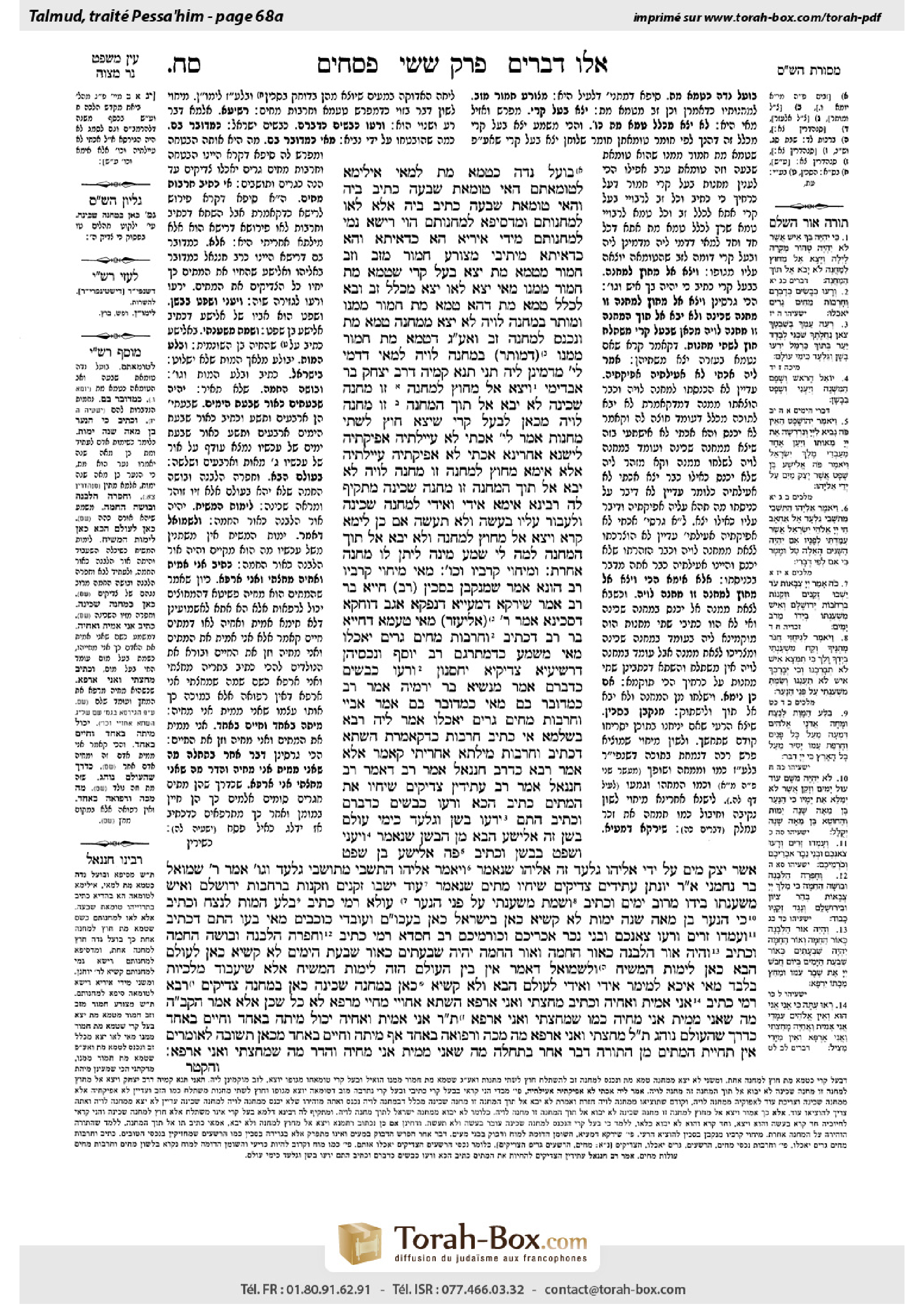
Pesachim 68a: Talmud study for Daf Yomi
Daf Yomi is the daily study of one Talmud folio. Explore 37 tractates with scans, Hebrew text, Sefaria English and AI-generated French translations where annotated.
Passage selection and English or AI-generated French translation are available where the scan has annotations. Daf Study is independent of Torah-Box and Sefaria.
Browse Pesachim · פסחים · All tractatesPesachim 68a text and translations
This page of Pesachim includes the Aramaic text, an English translation and an AI-generated French translation, alongside the scan above.
פסחים ס״ח א · Aramaic and Hebrew text
בּוֹעֵל נִדָּה כִּטְמֵא מֵת. לְמַאי? אִילֵימָא לְטוּמְאָתָם, הַאי טוּמְאַת שִׁבְעָה כְּתִיב בֵּיהּ, וְהַאי טוּמְאַת שִׁבְעָה כְּתִיב בֵּיהּ.
אֶלָּא לָאו, לְמַחֲנוֹתָם. וּמִדְּסֵיפָא לְמַחֲנוֹתָם הָוֵי — רֵישָׁא נָמֵי לְמַחֲנוֹתָם! מִידֵּי אִירְיָא?! הָא כִּדְאִיתָא וְהָא כִּדְאִיתָא.
מֵיתִיבִי: מְצוֹרָע חָמוּר מִזָּב, וְזָב חָמוּר מִטְּמֵא מֵת, יָצָא בַּעַל קֶרִי שֶׁטְּמֵא מֵת חָמוּר מִמֶּנּוּ.
מַאי יָצָא? לָאו: יָצָא מִכְּלַל זָב וּבָא לִכְלַל טְמֵא מֵת, דְּהָא טְמֵא מֵת חָמוּר מִמֶּנּוּ — וּמוּתָּר בְּמַחֲנֵה לְוִיָּה!
לֹא, יָצָא מִמַּחֲנֵה טְמֵא מֵת וְנִכְנַס לְמַחֲנֵה זָב, וְאַף עַל גַּב דִּטְמֵא מֵת חָמוּר מִמֶּנּוּ (דְּמוּתָּר) בְּמַחֲנֵה לְוִיָּה — לְמַאי דְּדָמֵי לֵיהּ מְדַמֵּינַן לֵיהּ.
תָּנֵי תַּנָּא קַמֵּיהּ דְּרַב יִצְחָק בַּר אַבְדִּימִי: ״וְיָצָא אֶל מִחוּץ לַמַּחֲנֶה״ — זוֹ מַחֲנֵה שְׁכִינָה. ״לֹא יָבֹא אֶל תּוֹךְ הַמַּחֲנֶה״ — זוֹ מַחֲנֵה לְוִיָּה. מִכָּאן לְבַעַל קֶרִי שֶׁיֵּצֵא חוּץ לִשְׁתֵּי מַחֲנוֹת.
אֲמַר לֵיהּ: אַכַּתִּי לָא עַיֵּילְתֵּיהּ, אַפֵּיקְתֵּיהּ. לִישָּׁנָא אַחֲרִינָא: אַכַּתִּי לָא אַפֵּיקְתֵּיהּ, עַיֵּילְתֵּיהּ. אֶלָּא אֵימָא: ״מִחוּץ לַמַּחֲנֶה״ — זוֹ מַחֲנֵה לְוִיָּה. ״לָא יָבֹא אֶל תּוֹךְ הַמַּחֲנֶה״ — זוֹ מַחֲנֵה שְׁכִינָה.
מַתְקֵיף לַהּ רָבִינָא: אֵימָא אִידֵּי וְאִידֵּי לְמַחֲנֵה שְׁכִינָה, וְלַעֲבוֹר עָלָיו בַּעֲשֵׂה וְלֹא תַעֲשֶׂה! אִם כֵּן, לֵימָא קְרָא: ״וְיָצָא אֶל מִחוּץ לַמַּחֲנֶה וְלֹא יָבֹא אֶל תּוֹךְ״, ״הַמַּחֲנֶה״ לְמָה לִי? שְׁמַע מִינַּהּ לִיתֵּן לוֹ מַחֲנֶה אַחֶרֶת.
וּמִיחוּי קְרָבָיו וְכוּ׳. מַאי מִיחוּי קְרָבָיו? רַב הוּנָא אָמַר: שֶׁמְּנַקְּבָן בְּסַכִּין. (רַב) חִיָּיא בַּר רַב אָמַר: שִׁירְקָא דִמְעִיָּיא דְּנָפְקָא אַגַּב דּוּחְקָא דְסַכִּינָא.
אָמַר רַבִּי (אֱלִיעֶזֶר): מַאי טַעְמָא דְּחִיָּיא בַּר רַב? דִּכְתִיב: ״וְחׇרְבוֹת מֵחִים גָּרִים יֹאכֵלוּ״, מַאי מַשְׁמַע? כְּדִמְתַרְגֵּם רַב יוֹסֵף ״וְנִכְסֵיהֹן דְּרַשִּׁיעַיָּא צַדִּיקַיָּא יַחְסְנוּן״.
״וְרָעוּ כְבָשִׂים כְּדׇבְרָם״, אָמַר מְנַשְּׁיָא בַּר יִרְמְיָה אָמַר רַב: כַּמְדוּבָּר בָּם. מַאי כַּמְדוּבָּר בָּם? אָמַר אַבָּיֵי: ״וְחׇרְבוֹת מֵחִים גָּרִים יֹאכֵלוּ״. אֲמַר לֵיהּ רָבָא: בִּשְׁלָמָא אִי כְּתִיב ״חׇרְבוֹת״ — כִּדְקָאָמְרַתְּ, הַשְׁתָּא דִּכְתִיב ״וְחׇרְבוֹת״, מִילְּתָא אַחֲרִיתִי קָאָמַר.
אֶלָּא אָמַר רָבָא: כִּדְרַב חֲנַנְאֵל אָמַר רַב. דְּאָמַר רַב חֲנַנְאֵל אָמַר רַב: עֲתִידִין צַדִּיקִים שֶׁיְּחַיּוּ אֶת הַמֵּתִים. כְּתִיב הָכָא: ״וְרָעוּ כְבָשִׂים כְּדׇבְרָם״, וּכְתִיב הָתָם: ״יִרְעוּ בָשָׁן וְגִלְעָד כִּימֵי עוֹלָם״.
בָּשָׁן — זֶה אֱלִישָׁע הַבָּא מִן הַבָּשָׁן, שֶׁנֶּאֱמַר: ״וְיַעְנַי וְשָׁפָט בַּבָּשָׁן״, וּכְתִיב: ״פֹּה אֱלִישָׁע בֶּן שָׁפָט אֲשֶׁר יָצַק מַיִם עַל יְדֵי אֵלִיָּהוּ״. גִּלְעָד — זֶה אֵלִיָּהוּ, שֶׁנֶּאֱמַר: ״וַיֹּאמֶר אֵלִיָּהוּ הַתִּשְׁבִּי מִתּוֹשָׁבֵי גִלְעָד וְגוֹ׳״.
אָמַר רַבִּי שְׁמוּאֵל בַּר נַחְמָנִי אָמַר רַבִּי יוֹנָתָן: עֲתִידִים צַדִּיקִים שֶׁיְּחַיּוּ מֵתִים, שֶׁנֶּאֱמַר: ״עוֹד יֵשְׁבוּ זְקֵנִים וּזְקֵנוֹת בִּרְחֹבוֹת יְרוּשָׁלִָים וְאִישׁ מִשְׁעַנְתּוֹ בְּיָדוֹ מֵרֹב יָמִים״, וּכְתִיב: ״וְשַׂמְתָּ מִשְׁעַנְתִּי עַל פְּנֵי הַנָּעַר״.
עוּלָּא רָמֵי, כְּתִיב: ״בִּלַּע הַמָּוֶת לָנֶצַח״, וּכְתִיב: ״כִּי הַנַּעַר בֶּן מֵאָה שָׁנָה יָמוּת״! לָא קַשְׁיָא: כָּאן בְּיִשְׂרָאֵל, כָּאן בַּגּוֹיִם. וְגוֹיִם מַאי בָּעוּ הָתָם? דִּכְתִיב: ״וְעָמְדוּ זָרִים וְרָעוּ צֹאנְכֶם וּבְנֵי נֵכָר אִכָּרֵיכֶם וְכֹרְמֵיכֶם״.
רַב חִסְדָּא רָמֵי, כְּתִיב: ״וְחָפְרָה הַלְּבָנָה וּבוֹשָׁה הַחַמָּה״, וּכְתִיב: ״וְהָיָה אוֹר הַלְּבָנָה כְּאוֹר הַחַמָּה וְאוֹר הַחַמָּה יִהְיֶה שִׁבְעָתַיִם כְּאוֹר שִׁבְעַת הַיָּמִים״! לָא קַשְׁיָא: כָּאן לָעוֹלָם הַבָּא, כָּאן לִימוֹת הַמָּשִׁיחַ.
וְלִשְׁמוּאֵל דְּאָמַר: אֵין בֵּין הָעוֹלָם הַזֶּה לִימוֹת הַמָּשִׁיחַ אֶלָּא שִׁיעְבּוּד מַלְכִיּוֹת בִּלְבַד, מַאי אִיכָּא לְמֵימַר? אִידֵּי וְאִידֵּי לָעוֹלָם הַבָּא, וְלָא קַשְׁיָא: כָּאן — בְּמַחֲנֵה שְׁכִינָה, כָּאן — בְּמַחֲנֵה צַדִּיקִים.
רָבָא רָמֵי, כְּתִיב: ״אֲנִי אָמִית וַאֲחַיֶּה״, וּכְתִיב: ״מָחַצְתִּי וַאֲנִי אֶרְפָּא״. הַשְׁתָּא אַחוֹיֵי מַחֲיֵי, מְרַפֵּא לֹא כׇּל שֶׁכֵּן! אֶלָּא, אָמַר הַקָּדוֹשׁ בָּרוּךְ הוּא: מָה שֶׁאֲנִי מֵמִית — אֲנִי מְחַיֶּה, כְּמוֹ שֶׁמָּחַצְתִּי — וַאֲנִי אֶרְפָּא.
תָּנוּ רַבָּנַן: ״אֲנִי אָמִית וַאֲחַיֶּה״ יָכוֹל מִיתָה בְּאֶחָד וְחַיִּים בְּאֶחָד, כְּדֶרֶךְ שֶׁהָעוֹלָם נוֹהֵג, תַּלְמוּד לוֹמַר: ״מָחַצְתִּי וַאֲנִי אֶרְפָּא״, מָה מַכָּה וּרְפוּאָה בְּאֶחָד, אַף מִיתָה וְחַיִּים בְּאֶחָד. מִכָּאן תְּשׁוּבָה לָאוֹמְרִים אֵין תְּחִיַּית הַמֵּתִים מִן הַתּוֹרָה. דָּבָר אַחֵר: בַּתְּחִלָּה מַה שֶּׁאֲנִי מֵמִית אֲנִי מְחַיֶּה, וַהֲדַר מַה שֶּׁמָּחַצְתִּי וַאֲנִי אֶרְפָּא.
Pesachim 68a · English translation
We learned in the continuation of the previously cited mishna that the law governing one who had relations with a menstruating woman is like the law governing one who is ritually impure due to a corpse. With regard to what did they formulate this comparison? If we say they made the comparison with regard to their impurity, that they are both impure for seven days, impurity for seven days is explicitly written about this one, someone who had relations with a menstruating woman, and impurity for seven days is explicitly written about that one, someone who is impure due to a corpse, and so there would be no need for the mishna to inform us of these laws.
Rather, is it not that they are compared with regard to their camps, to teach that one who had relations with a menstruating woman is sent out from the same camp as someone ritually impure due to a corpse? And from the fact that the comparison in the latter clause of the mishna relates to their camps, it stands to reason that the comparison in the earlier clause of that same mishna between one who experienced a seminal emission and one who became ritually impure through contact with a creeping animal also relates to their camps, and not as we explained it earlier. The Gemara rejects this argument: Are the cases comparable? This case is as it is, and that case is as it is; each part of the mishna formulates its own comparison.
The Gemara raises an objection from that which was taught: The legal status of a leper is more severe than a zav and the legal status of a zav is more severe than one who is ritually impure with impurity imparted by a corpse, with regard to which camps they are prohibited to enter; to the exclusion of a person who experienced a seminal emission, for the legal status of one who is ritually impure with impurity imparted by a corpse is more severe than his status.
The Gemara wishes to clarify this enigmatic statement: What is the meaning of the words, to the exclusion of a person who experienced a seminal emission? Is the intent not that he is excluded from the category of a zav and enters the category of one who is ritually impure with impurity imparted by a corpse, for the legal status of one who is ritually impure with impurity imparted by a corpse is more severe than his status, as his impurity lasts for seven days, and nonetheless he is permitted in the Levite camp. We should therefore learn from here that someone who experienced a seminal emission is also permitted in the Levite camp.
The Gemara rejects this proof: No, the intent is that one who experienced a seminal emission is excluded from the camp of one who is ritually impure with impurity imparted by a corpse, and he enters the camp of a zav, meaning that he is excluded from the Levite camp, just like a zav. And although the legal status of one who is ritually impure with impurity imparted by a corpse is more severe than his status and he is permitted in the Levite camp, and so it would seem that one who experienced a seminal emission should similarly be permitted, nonetheless, we compare him to that to which he is similar. The ritual impurity of one who experienced a seminal emission is fundamentally similar to that of a zav, and different from that of one who is ritually impure due to a corpse.
A tanna taught a baraita before Rav Yitzḥak bar Avdimi: “If there be among you a man that is impure by reason of a nocturnal occurrence, he shall go outside the camp, he shall not come within the camp” (Deuteronomy 23:11). This verse may be expounded as follows: “He shall go outside the camp,” this is the camp of the Divine Presence. “He shall not come within the camp,” this is the Levite camp. From here we derive that a person who experienced a seminal emission must go out from two camps.
Rav Yitzḥak said to the tanna: Something is amiss in the wording of this baraita: You have not yet brought him in and you already send him out? In other words, in order to say that the words “he shall not come within the camp” teach that a person who experienced a seminal emission must leave the Levite camp, you must first prove that he was there to begin with. Another version, which differs from the previous one only in formulation but not in substance: You have not yet sent him out and you already bring him in? In other words, how can you say that the words “he shall not come within the camp” refer to the Levite camp if we have not yet learned that he must leave that camp in the first place? Rather, emend the baraita and say that it reads as follows: “Outside the camp,” this is the Levite camp. “He shall not come within the camp,” this is the camp of the Divine Presence.
Ravina strongly objects to this exposition of the verse: Say that both this and that refer to the camp of the Divine Presence, that he must leave the camp of the Divine Presence and may not enter it; and the repetition comes to teach that he violates a positive command to leave the camp and a negative command barring entry into the camp. The Gemara answers: If so, let the verse say only: “He shall go outside the camp, he shall not come within,” or “within it.” Why do I need the repetition of the word “the camp”? Conclude from this that it is to give him a different camp; it refers not to the same camp that he left but rather to a different one.
We learned in the mishna that cleaning the intestines of the Paschal lamb overrides Shabbat. The Gemara asks: What is meant by cleaning the intestines? Rav Huna said: It means that he punctures them with a knife allowing the excrement to exit. Rav Ḥiyya bar Rav said: It refers to the removal of the secretions of the intestine, which come out through the pressure of the knife and would ruin the entire sacrifice and cause it to become putrid were they allowed to remain in the intestines.
Rabbi Eliezer said: What is Ḥiyya bar Rav’s reason for explaining the term in this manner? As it is written: “Then shall the lambs feed as in their pasture, and the ruins of the fat ones [meḥim] shall wanderers eat” (Isaiah 5:17). From where may it be inferred that this verse is in any way connected to our discussion? As Rav Yosef translates this verse: “And the righteous shall inherit the possessions of the wicked.” This indicates that the word meḥim, understood by Rav Yosef as referring to the wicked, is a term of degradation. This led Ḥiyya bar Rav to interpret the mishna’s clause with regard to cleaning [miḥui] the intestines as referring to removing the repulsive matter inside.
Having explained the latter part of the verse in Isaiah, the Gemara turns to the beginning of that same verse. “Then shall the lambs feed as in their pasture [kedavram].” Menashya bar Yirmeya said that Rav said: As was said about them [kamedubar bam], i.e., as the prophet promised. To what prophecy does the verse refer with the expression “as was said about them”? Abaye said: It is referring to the continuation of the verse: “And the ruins of the fat ones shall wanderers eat.” Rava said to him that this cannot be: Granted, were it written only “the ruins of the fat ones,” it would be possible to explain as you said. Now that it is written “and the ruins,” with the addition of the word “and,” this indicates that it states something else, and the verse contains two separate prophecies.
Rather, Rava said: This verse should be understood in accordance with what Rav Ḥananel said that Rav said. For Rav Ḥananel said that Rav said: In the future, the righteous will resurrect the dead. It is written here: “Then shall the lambs feed [vera’u] as in their pasture,” the lambs serving as an allusion to the righteous, and it is written there: “Tend your people with your staff, the flock of your heritage, who dwell alone in the wood, in the midst of Carmel; let them feed [yiru] in Bashan and Gilad as in the days of old” (Micah 7:14).
“Bashan” is an allusion to the prophet Elisha, who came from the Bashan. How do we know that Elisha came from Bashan? As it is stated: “Joel the chief, and Shafam the next, and Yanai and Shafat in the Bashan” (I Chronicles 5:12), and it is written: “Here is Elisha ben Shafat who poured water on the hands of Elijah” (II Kings 3:11). “Gilad” is an allusion to Elijah, as it is stated: “And Elijah the Tishbite, who was of the inhabitants of Gilad, said” (I Kings 17:1). Based on the similarity of the verses and the verbal analogy between the two instances of the word “feed,” we learn that in the future the righteous will be like Elijah and Elisha, who resurrected the dead.
This idea is derived from a different source as well. Rabbi Shmuel bar Naḥmani said that Rabbi Yonatan said: In the future the righteous will resurrect the dead, as it is stated: “Old men and old women shall yet again dwell in the streets of Jerusalem, and every man with his staff in his hand for very age” (Zechariah 8:4). And the staff will then be used as it was used by Gehazi when Elisha sent him to bring the son of the Shunamite woman back to life, as it is written: “And you shall lay my staff on the face of the child” (II Kings 4:29).
As we have been discussing the world of the future and the resurrection of the dead, the Gemara cites additional statements on these topics. Ulla raised a contradiction between two verses: In one verse it is written: “He will destroy death forever, and the Lord God will wipe away tears from off all faces, and the insult of His people shall He take away from off all the earth; for the Lord has spoken” (Isaiah 25:8). And in another verse it is written: “There shall be no more there an infant who lives a few days, nor an old man who has not filled his days; for the youngest shall die a hundred years old” (Isaiah 65:20), implying that people will live long lives, but death will not be totally eradicated. Ulla answers: This is not difficult: Here, in the first verse, it is referring to Jews, who will not die at all, while there, in the second verse, it is referring to gentiles, who will live exceedingly long lives but eventually die. The Gemara asks: What are gentiles doing there in the future world? The Gemara answers: As it is written: “And strangers shall stand and feed your flocks, and the sons of the alien shall be your plowmen and your vineyard workers” (Isaiah 61:5).
Rav Ḥisda raised a contradiction between two verses: In one verse it is written: “Then the moon shall be confounded and the sun ashamed, when the Lord of Hosts shall reign in Mount Zion and in Jerusalem, and before His elders will be His glory” (Isaiah 24:23), which indicates that in the future there will be no light at all from the sun or the moon. And elsewhere it is written: “Moreover the light of the moon shall be as the light of the sun, and the light of the sun shall be sevenfold, as the light of seven days, on the day that the Lord binds up the breach of His people and heals the stroke of their wound blow” (Isaiah 30:26), which indicates that the light of the sun and moon will be even brighter than before. The Gemara answers: This is not difficult: Here, where it says that the sun and the moon will be ashamed before the glow of the Divine Presence, it is referring to the World-to-Come, which is an entirely different world; while there, where it says that their light will increase, it is referring to the days of the Messiah.
The Gemara asks: And according to the opinion of Shmuel, who said that there is no difference between this world and the days of the Messiah except for subjugation to foreign kingdoms, but in all other ways, including the illumination of the celestial bodies, the world order will remain unchanged, what is there to say to reconcile these verses? The Gemara answers: This and that refer to the World-to-Come, and it is not difficult: Here, where it says that the sun and the moon will be totally ashamed, it refers to the camp of the Divine Presence; while there, where it says that the light of the sun and moon will be greatly magnified, it refers to the camp of the righteous.
Rava raised a contradiction between two parts of a verse. It is written: “I put to death and I make live” (Deuteronomy 32:39) and in that same verse it is written: “I wound and I heal.” Now once it says that He gives life to the dead, all the more so is it not clear that He can heal those who are still alive? What then does the second clause add to the first? Rather, the second clause clarifies the first one: The Holy One, Blessed be He, said: Those same people whom I put to death I will bring to life, just as those people whom I wounded I will heal. In other words, the verse means to say that just as God will heal the same people He wounded, so will He revive those He put to death; and not, as the verse might otherwise have been understood, that He puts some people to death and gives life to others.
Similarly, the Sages taught in a baraita: “I put to death and I make live”; one might have thought that this refers to death for one person and life, i.e., birth, for another person, in the customary manner of the world. Therefore, the verse states: “I wound and I heal”; just as the wounding and the healing mentioned here clearly refer to the same person, so too death and life refer to the same person. From this verse, there is a refutation to those who say that there is no Torah source for the resurrection of the dead, for it is explicitly mentioned in this verse. Alternatively, the verse can be explained as follows: At first, those whom I put to death I will bring to life, but they will be revived with the same injuries that they had when they died; and subsequently, those whom I wounded I will heal, meaning that their injuries will be healed after they are resurrected.
Pesachim 68a · Traduction française (IA)
Nous avons appris dans la suite de la Michna précédemment citée que la loi concernant celui qui a eu des relations avec une femme menstruée est semblable à celle qui s’applique à celui qui est impur à cause d’un cadavre. Sur quel point cette comparaison a-t-elle été établie ? Si nous disons qu’elle porte sur leur impureté, puisqu’ils sont tous deux impurs pendant sept jours, la Torah précise explicitement que celui-ci, celui qui a eu des relations avec une femme menstruée, est impur pendant sept jours, et que celui-là, celui qui est impur à cause d’un cadavre, l’est également pendant sept jours. La Michna n’aurait donc pas eu besoin de nous enseigner ces lois.
Mais n’est-ce pas plutôt qu’ils sont comparés quant aux camps, afin d’enseigner que celui qui a eu des relations avec une femme menstruée est renvoyé du même camp que celui qui est impur à cause d’un cadavre ? Et puisque la comparaison dans la dernière partie de la Michna porte sur leurs camps, il est logique que la comparaison, dans la première partie de cette même Michna, entre celui qui a eu une émission séminale et celui qui est devenu impur par contact avec un animal rampant, porte elle aussi sur leurs camps, et non comme nous l’avions expliqué précédemment. La Guemara rejette cet argument : ces cas sont-ils comparables ? Chaque cas est différent ; chaque partie de la Michna établit sa propre comparaison.
La Guemara soulève une objection à partir de ce qui a été enseigné : le statut d’un lépreux est plus strict que celui d’un zav, et le statut d’un zav est plus strict que celui d’une personne impure par l’impureté transmise par un cadavre, en ce qui concerne les camps dans lesquels ils ne peuvent pas entrer ; cela exclut celui qui a eu une émission séminale, car le statut de celui qui est impur par l’impureté transmise par un cadavre est plus strict que le sien.
La Guemara souhaite éclaircir cette affirmation énigmatique : que signifient les mots « cela exclut celui qui a eu une émission séminale » ? Ne faut-il pas comprendre qu’il est exclu de la catégorie du zav et entre dans celle de la personne impure par l’impureté transmise par un cadavre, car le statut de cette dernière est plus strict que le sien — son impureté dure sept jours — et que, malgré cela, elle est autorisée dans le camp des Lévites ? Nous devrions donc en déduire que celui qui a eu une émission séminale est lui aussi autorisé dans le camp des Lévites.
La Guemara rejette cette preuve : non, l’intention est que celui qui a eu une émission séminale est exclu du camp de celui qui est impur par l’impureté transmise par un cadavre et entre dans la catégorie du zav, c’est-à-dire qu’il est exclu du camp des Lévites, comme le zav. Et bien que le statut de celui qui est impur par l’impureté transmise par un cadavre soit plus strict que le sien et que cette personne soit autorisée dans le camp des Lévites, de sorte qu’il semblerait que celui qui a eu une émission séminale devrait, lui aussi, y être autorisé, nous le comparons néanmoins à ce à quoi il ressemble. L’impureté rituelle de celui qui a eu une émission séminale est fondamentalement semblable à celle d’un zav, et différente de celle de celui qui est impur à cause d’un cadavre.
Un tanna enseigna une baraïta devant Rav Yitzḥak bar Avdimi : « S’il se trouve parmi vous un homme impur à cause d’un événement nocturne, il sortira du camp ; il ne rentrera pas dans le camp » (Deutéronome 23:11). On peut interpréter ce verset ainsi : « Il sortira du camp » désigne le camp de la Présence divine. « Il ne rentrera pas dans le camp » désigne le camp des Lévites. Nous en déduisons qu’une personne qui a eu une émission séminale doit sortir de deux camps.
Rav Yitzḥak dit au tanna : la formulation de cette baraïta est défectueuse : tu ne l’as pas encore fait entrer que tu le fais déjà sortir ? Autrement dit, pour affirmer que les mots « il ne rentrera pas dans le camp » enseignent qu’une personne qui a eu une émission séminale doit quitter le camp des Lévites, il faut d’abord prouver qu’elle s’y trouvait. Selon une autre version, qui diffère de la précédente uniquement dans la formulation et non dans le fond : tu ne l’as pas encore fait sortir que tu le fais déjà entrer ? Autrement dit, comment peux-tu dire que les mots « il ne rentrera pas dans le camp » désignent le camp des Lévites, si nous n’avons pas encore appris qu’il doit d’abord quitter ce camp ? Il faut plutôt corriger la baraïta et dire qu’elle se lit ainsi : « À l’extérieur du camp » désigne le camp des Lévites. « Il ne rentrera pas dans le camp » désigne le camp de la Présence divine.
Ravina s’oppose vivement à cette interprétation du verset : disons que les deux expressions désignent le camp de la Présence divine, et qu’il doit quitter ce camp et ne peut pas y entrer ; la répétition enseigne alors qu’il transgresse un commandement positif lui enjoignant de quitter le camp et un commandement négatif lui interdisant d’y entrer. La Guemara répond : dans ce cas, que le verset dise seulement : « Il sortira du camp, il ne rentrera pas » ou « il ne rentrera pas à l’intérieur ». Pourquoi le mot « camp » est-il répété ? Déduis-en que cette répétition lui attribue un autre camp : il ne s’agit pas du même camp que celui qu’il a quitté, mais d’un autre.
Nous avons appris dans la Michna que le nettoyage des intestins de l’agneau pascal repousse le Chabbat. La Guemara demande : que signifie le nettoyage des intestins ? Rav Huna dit : cela signifie qu’il les perce avec un couteau pour permettre aux excréments de sortir. Rav Ḥiyya bar Rav dit : il s’agit du retrait des sécrétions intestinales, qui sortent sous la pression du couteau et qui gâcheraient tout le sacrifice et le feraient se putréfier si on les laissait dans les intestins.
Rabbi Eliezer dit : quelle est la raison de Ḥiyya bar Rav pour expliquer ce terme de cette manière ? Car il est écrit : « Alors les agneaux paîtront comme dans leur pâturage, et les ruines des gras [meḥim] seront la pâture des nomades » (Isaïe 5:17). En quoi peut-on déduire de ce verset qu’il a un rapport avec notre discussion ? Rav Yosef traduit ainsi ce verset : « Et les justes hériteront des biens des méchants. » Cela montre que le mot meḥim, que Rav Yosef comprend comme désignant les méchants, est un terme de dénigrement. C’est ce qui a conduit Ḥiyya bar Rav à interpréter la clause de la Michna sur le nettoyage [miḥui] des intestins comme désignant le retrait des matières répugnantes qui s’y trouvent.
Après avoir expliqué la dernière partie du verset d’Isaïe, la Guemara revient au début de ce même verset : « Alors les agneaux paîtront comme dans leur pâturage [kedavram]. » Menashya bar Yirmeya dit au nom de Rav : « Comme cela a été dit à leur sujet [kamedubar bam] », c’est-à-dire conformément à la promesse du prophète. À quelle prophétie le verset fait-il allusion par l’expression « comme cela a été dit à leur sujet » ? Abaye dit qu’elle se rapporte à la suite du verset : « Et les ruines des gras seront la pâture des nomades. » Rava lui dit que cela ne peut pas être : s’il était écrit seulement « les ruines des gras », il serait possible de l’expliquer comme tu l’as fait. Mais puisqu’il est écrit « et les ruines », avec l’ajout du mot « et », cela indique qu’il s’agit d’autre chose et que le verset contient deux prophéties distinctes.
Rava dit plutôt : ce verset doit être compris conformément à ce que Rav Ḥananel a dit au nom de Rav. Car Rav Ḥananel a dit au nom de Rav : dans l’avenir, les justes ressusciteront les morts. Il est écrit ici : « Alors les agneaux paîtront [vera’u] comme dans leur pâturage », les agneaux faisant allusion aux justes ; et il est écrit là : « Fais paître ton peuple avec ton bâton, le troupeau de ton héritage, qui habite isolé dans la forêt, au milieu du Carmel ; qu’il paîsse [yiru] en Bashan et en Galaad comme aux jours d’autrefois » (Michée 7:14).
« Bashan » fait allusion au prophète Élisée, qui venait du Bashan. Comment savons-nous qu’Élisée venait du Bashan ? Car il est dit : « Joël, le chef, Shafam, le suivant, et Yanai et Shafat dans le Bashan » (I Chroniques 5:12), et il est écrit : « Voici Élisée ben Shafat, qui versait de l’eau sur les mains d’Élie » (II Rois 3:11). « Galaad » fait allusion à Élie, comme il est dit : « Et Élie le Tishbite, qui était parmi les habitants de Galaad, dit » (I Rois 17:1). En raison de la similitude des versets et de l’analogie verbale entre les deux occurrences du mot « paître », nous apprenons que, dans l’avenir, les justes seront comme Élie et Élisée, qui ont ressuscité les morts.
Cette idée est également déduite d’une autre source. Rabbi Shmuel bar Naḥmani dit au nom de Rabbi Yonatan : dans l’avenir, les justes ressusciteront les morts, comme il est dit : « Des vieillards et des vieilles femmes habiteront de nouveau dans les rues de Jérusalem, chacun avec son bâton à la main à cause du grand âge » (Zacharie 8:4). Ce bâton sera alors utilisé comme celui de Gué’hazi, qu’Élisée envoya pour ramener à la vie le fils de la femme de Shounem, comme il est écrit : « Tu poseras mon bâton sur le visage de l’enfant » (II Rois 4:29).
Puisque nous parlions du monde futur et de la résurrection des morts, la Guemara cite d’autres enseignements sur ces sujets. Ulla soulève une contradiction entre deux versets : dans l’un, il est écrit : « Il anéantira la mort à jamais, et le Seigneur Dieu essuiera les larmes de tous les visages, et il fera disparaître de toute la terre l’opprobre de son peuple ; car le Seigneur a parlé » (Isaïe 25:8). Dans l’autre, il est écrit : « Il n’y aura plus là d’enfant qui ne vive que quelques jours, ni de vieillard qui n’ait accompli ses jours ; car le plus jeune mourra à cent ans » (Isaïe 65:20), ce qui implique que les gens vivront longtemps, mais que la mort ne sera pas entièrement éradiquée. Ulla répond : il n’y a pas de difficulté. Le premier verset concerne les Juifs, qui ne mourront pas du tout ; le second concerne les non-Juifs, qui vivront extrêmement longtemps, mais finiront par mourir. La Guemara demande : que font les non-Juifs dans le monde futur ? La Guemara répond : comme il est écrit : « Des étrangers se tiendront là et feront paître vos troupeaux, et les fils de l’étranger seront vos laboureurs et vos vignerons » (Isaïe 61:5).
Rav Ḥisda soulève une contradiction entre deux versets : dans l’un, il est écrit : « Alors la lune sera confondue et le soleil honteux, lorsque le Seigneur des armées régnera sur le mont Sion et à Jérusalem, et que sa gloire sera devant ses anciens » (Isaïe 24:23), ce qui indique que, dans l’avenir, le soleil et la lune ne donneront plus du tout de lumière. Ailleurs, il est écrit : « La lumière de la lune sera comme la lumière du soleil, et la lumière du soleil sera sept fois plus forte, comme la lumière de sept jours, au jour où le Seigneur bandera la brèche de son peuple et guérira le coup de sa blessure » (Isaïe 30:26), ce qui indique que la lumière du soleil et de la lune sera encore plus éclatante qu’auparavant. La Guemara répond : il n’y a pas de difficulté. Le premier verset, selon lequel le soleil et la lune auront honte devant l’éclat de la Présence divine, concerne le Monde futur, qui est un monde entièrement différent ; l’autre, selon lequel leur lumière augmentera, concerne les jours du Messie.
La Guemara demande : et selon l’opinion de Shmuel, qui a dit qu’il n’y a pas de différence entre ce monde et les jours du Messie, si ce n’est l’assujettissement aux royaumes étrangers, tandis que, pour tout le reste, notamment la lumière des corps célestes, l’ordre du monde restera inchangé, que peut-on répondre pour concilier ces versets ? La Guemara répond : les deux versets concernent le Monde futur, et il n’y a pas de difficulté. Là où il est dit que le soleil et la lune auront complètement honte, il s’agit du camp de la Présence divine ; là où il est dit que la lumière du soleil et de la lune augmentera considérablement, il s’agit du camp des justes.
Rava soulève une contradiction entre deux parties d’un verset. Il est écrit : « Je fais mourir et je fais vivre » (Deutéronome 32:39), et dans ce même verset, il est écrit : « Je blesse et je guéris. » Or, dès lors qu’il est dit qu’Il rend la vie aux morts, n’est-il pas d’autant plus évident qu’Il peut guérir ceux qui sont encore vivants ? Que rajoute donc la seconde partie à la première ? La seconde partie vient plutôt éclairer la première : le Saint, béni soit-Il, a dit : ceux-là mêmes que Je fais mourir, Je les ramènerai à la vie, tout comme ceux-là mêmes que Je blesse, Je les guérirai. Autrement dit, le verset signifie que, de même que Dieu guérira ceux qu’Il a blessés, Il ressuscitera ceux qu’Il a fait mourir ; et non, comme on pourrait autrement le comprendre, qu’Il fait mourir certaines personnes et en fait vivre d’autres.
De même, les Sages ont enseigné dans une baraïta : « Je fais mourir et je fais vivre » ; on aurait pu penser que cela désigne la mort pour une personne et la vie, c’est-à-dire la naissance, pour une autre, conformément à l’ordre habituel du monde. Le verset dit donc : « Je blesse et je guéris » ; de même que la blessure et la guérison mentionnées ici concernent clairement la même personne, de même la mort et la vie concernent la même personne. Ce verset réfute ceux qui prétendent qu’il n’existe aucune source dans la Torah pour la résurrection des morts, car celle-ci y est explicitement mentionnée. On peut également expliquer le verset ainsi : d’abord, Je ramènerai à la vie ceux que J’ai fait mourir, mais ils ressusciteront avec les mêmes blessures qu’ils avaient au moment de leur mort ; ensuite, Je guérirai ceux que J’ai blessés, c’est-à-dire que leurs blessures seront guéries après leur résurrection.
Traduction française générée par IA à partir de l’édition anglaise de Sefaria. Vérifie toujours un passage avec le texte source.
Text from Sefaria: William Davidson Edition - Vocalized Aramaic (CC BY NC); William Davidson Edition - English (CC BY NC).