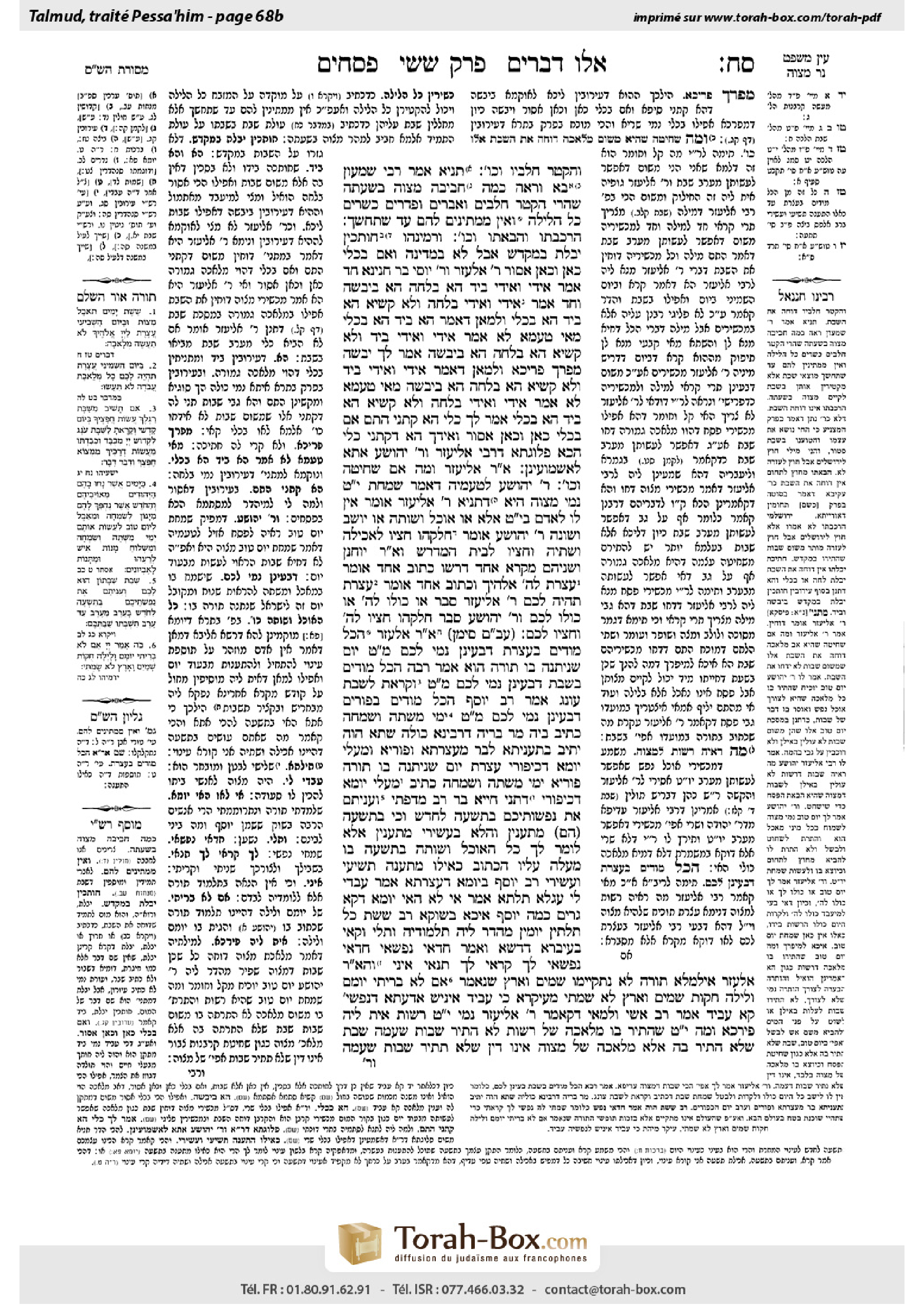
Pesachim 68b: Talmud study for Daf Yomi
Daf Yomi is the daily study of one Talmud folio. Explore 37 tractates with scans, Hebrew text, Sefaria English and AI-generated French translations where annotated.
Passage selection and English or AI-generated French translation are available where the scan has annotations. Daf Study is independent of Torah-Box and Sefaria.
Browse Pesachim · פסחים · All tractatesPesachim 68b text and translations
This page of Pesachim includes the Aramaic text, an English translation and an AI-generated French translation, alongside the scan above.
פסחים ס״ח ב · Aramaic and Hebrew text
וְהֶקְטֵר חֲלָבָיו וְכוּ׳. תַּנְיָא אָמַר רַבִּי שִׁמְעוֹן: בֹּא וּרְאֵה כַּמָּה חֲבִיבָה מִצְוָה בִּשְׁעָתָהּ, שֶׁהֲרֵי הֶקְטֵר חֲלָבִים וְאֵבָרִים וּפְדָרִים כְּשֵׁרִים כׇּל הַלַּיְלָה, וְאֵין מַמְתִּינִים לָהֶם עַד שֶׁתֶּחְשַׁךְ.
הַרְכָּבָתוֹ וַהֲבָאָתוֹ וְכוּ׳. וּרְמִינְהוּ: חוֹתְכִין יַבֶּלֶת בַּמִּקְדָּשׁ, אֲבָל לֹא בַּמְּדִינָה. וְאִם בִּכְלִי — כָּאן וְכָאן אָסוּר.
רַבִּי אֶלְעָזָר וְרַבִּי יוֹסֵי בַּר חֲנִינָא, חַד אָמַר: אִידֵּי וְאִידֵּי בַּיָּד; הָא בְּלַחָה, הָא בִּיבֵשָׁה. וְחַד אָמַר: אִידֵּי וְאִידֵּי בְּלַחָה, וְלָא קַשְׁיָא: הָא בַּיָּד, הָא בִּכְלִי.
וּלְמַאן דְּאָמַר: הָא בַּיָּד, הָא בִּכְלִי — מַאי טַעְמָא לָא אָמַר: אִידֵּי וְאִידֵּי בַּיָּד, וְלָא קַשְׁיָא: הָא בְּלַחָה הָא בִּיבֵשָׁה? אָמַר לָךְ: יְבֵשָׁה — מִפְרָךְ פְּרִיכָא.
וּלְמַאן דְּאָמַר: אִידֵּי וְאִידֵּי בַּיָּד, וְלָא קַשְׁיָא: הָא בְּלַחָה, הָא בִּיבֵשָׁה — מַאי טַעְמָא לָא אָמַר: אִידֵּי וְאִידֵּי בְּלַחָה, וְלָא קַשְׁיָא: הָא בַּיָּד, הָא בִּכְלִי? אָמַר לָךְ: כְּלִי — הָא קָתָנֵי הָתָם: אִם בִּכְלִי, כָּאן וְכָאן אָסוּר.
וְאִידַּךְ? הָא דְּקָתָנֵי כְּלִי הָכָא, פְּלוּגְתָּא דְּרַבִּי אֱלִיעֶזֶר וְרַבִּי יְהוֹשֻׁעַ אֲתָא לְאַשְׁמוֹעִינַן.
אָמַר רַבִּי אֱלִיעֶזֶר וּמָה אִם שְׁחִיטָה וְכוּ׳. רַבִּי יְהוֹשֻׁעַ לְטַעְמֵיהּ דְּאָמַר שִׂמְחַת יוֹם טוֹב נָמֵי מִצְוָה הִיא.
דְּתַנְיָא, רַבִּי אֱלִיעֶזֶר אוֹמֵר: אֵין לוֹ לְאָדָם בְּיוֹם טוֹב אֶלָּא, אוֹ אוֹכֵל וְשׁוֹתֶה, אוֹ יוֹשֵׁב וְשׁוֹנֶה. רַבִּי יְהוֹשֻׁעַ אוֹמֵר: חַלְּקֵהוּ, חֶצְיוֹ לַאֲכִילָה וּשְׁתִיָּה, וְחֶצְיוֹ לְבֵית הַמִּדְרָשׁ.
וְאָמַר רַבִּי יוֹחָנָן: וּשְׁנֵיהֶם מִקְרָא אֶחָד דָּרְשׁוּ, כָּתוּב אֶחָד אוֹמֵר: ״עֲצֶרֶת לַה׳ אֱלֹהֶיךָ״, וְכָתוּב אֶחָד אוֹמֵר: ״עֲצֶרֶת תִּהְיֶה לָכֶם״. רַבִּי אֱלִיעֶזֶר סָבַר: אוֹ כּוּלּוֹ לַה׳, אוֹ כּוּלּוֹ לָכֶם. וְרַבִּי יְהוֹשֻׁעַ סָבַר: חַלְּקֵהוּ, חֶצְיוֹ לַה׳ וְחֶצְיוֹ לָכֶם.
(עב״ם סִימָן) אָמַר רַבִּי אֶלְעָזָר: הַכֹּל מוֹדִים בַּעֲצֶרֶת דְּבָעֵינַן נָמֵי לָכֶם. מַאי טַעְמָא? יוֹם שֶׁנִּיתְּנָה בּוֹ תּוֹרָה הוּא. אָמַר רַבָּה: הַכֹּל מוֹדִים בְּשַׁבָּת דְּבָעֵינַן נָמֵי לָכֶם. מַאי טַעְמָא? ״וְקָרָאתָ לַשַּׁבָּת עוֹנֶג״. אָמַר רַב יוֹסֵף: הַכֹּל מוֹדִים בְּפוּרִים דְּבָעֵינַן נָמֵי לָכֶם. מַאי טַעְמָא? ״יְמֵי מִשְׁתֶּה וְשִׂמְחָה״ כְּתִיב בֵּיהּ.
מָר בְּרֵיהּ דְּרָבִינָא כּוּלַּהּ שַׁתָּא הֲוָה יָתֵיב בְּתַעֲנִיתָא, לְבַר מֵעֲצַרְתָּא, וּפוּרְיָא, וּמַעֲלֵי יוֹמָא דְכִיפּוּרֵי. עֲצֶרֶת — יוֹם שֶׁנִּיתְּנָה בּוֹ תּוֹרָה. פּוּרְיָא — ״יְמֵי מִשְׁתֶּה וְשִׂמְחָה״ כְּתִיב. מַעֲלֵי יוֹמָא דְכִיפּוּרֵי — דְּתָנֵי חִיָּיא בַּר רַב מִדִּפְתִּי: ״וְעִנִּיתֶם אֶת נַפְשׁוֹתֵיכֶם בְּתִשְׁעָה לַחֹדֶשׁ״, וְכִי בְּתִשְׁעָה (הֵם) מִתְעַנִּין? וַהֲלֹא בַּעֲשִׂירִי מִתְעַנִּין! אֶלָּא לוֹמַר לְךָ: כׇּל הָאוֹכֵל וְשׁוֹתֶה בְּתִשְׁעָה בּוֹ — מַעֲלֶה עָלָיו הַכָּתוּב כְּאִילּוּ מִתְעַנֶּה תְּשִׁיעִי וַעֲשִׂירִי.
רַב יוֹסֵף בְּיוֹמָא דַעֲצַרְתָּא אָמַר: עָבְדִי לִי עִגְלָא תִּלְתָּא. אָמַר, אִי לָא הַאי יוֹמָא דְּקָא גָרֵים — כַּמָּה יוֹסֵף אִיכָּא בְּשׁוּקָא.
רַב שֵׁשֶׁת כׇּל תְּלָתִין יוֹמִין מְהַדַּר לֵיהּ תַּלְמוּדֵיהּ, וְתָלֵי וְקָאֵי בְּעִיבְרָא דְּדַשָּׁא, וַאֲמַר: חֲדַאי נַפְשַׁאי, חֲדַאי נַפְשַׁאי, לָךְ קְרַאי לָךְ תְּנַאי. אִינִי? וְהָאָמַר רַבִּי אֶלְעָזָר: אִילְמָלֵא תּוֹרָה לֹא נִתְקַיְּימוּ שָׁמַיִם וָאָרֶץ, שֶׁנֶּאֱמַר: ״אִם לֹא בְרִיתִי יוֹמָם וָלָיְלָה חֻקּוֹת שָׁמַיִם וָאָרֶץ לֹא שָׂמְתִּי״! מֵעִיקָּרָא כִּי עָבֵיד אִינִישׁ — אַדַּעְתָּא דְּנַפְשֵׁיהּ קָא עָבֵיד.
אָמַר רַב אָשֵׁי: וּלְמַאי דְּקָאָמַר רַבִּי אֱלִיעֶזֶר נָמֵי יוֹם טוֹב רְשׁוּת, אִית לֵיהּ פִּירְכָא: וּמָה יוֹם טוֹב שֶׁהִתִּיר בּוֹ מְלָאכָה שֶׁל רְשׁוּת, לֹא הִתִּיר שְׁבוּת שֶׁעִמָּהּ. שַׁבָּת שֶׁלֹּא הִתִּיר בָּהּ אֶלָּא מְלָאכָה שֶׁל מִצְוָה — אֵינוֹ דִּין שֶׁלֹּא תַּתִּיר שְׁבוּת שֶׁעִמָּהּ!
Pesachim 68b · English translation
We learned in the mishna that when the eve of Passover occurs on Shabbat, burning the fats of the Paschal lamb overrides Shabbat. The Gemara notes that it was taught in the Tosefta: Rabbi Shimon said: Come and see how dear is a mitzva performed in its proper time. For burning the fats and limbs and inner fats is valid all night and it would have been possible to wait until the conclusion of Shabbat and burn them at night, but nonetheless we do not wait with them until nightfall; rather, we burn them immediately, even on Shabbat.
The mishna also taught that carrying the Paschal lamb through a public domain, bringing it from outside the Shabbat limit and cutting off its wart do not override Shabbat. The Gemara raises a contradiction from another mishna in tractate Eiruvin, which teaches: One may cut off a wart by hand on Shabbat in the Temple but not in the rest of the country outside the Temple. And if the wart is to be removed with an instrument, it is forbidden both here, in the Temple, and there, outside the Temple. From here we see that in the Temple cutting off a wart, at least by hand, is permitted.
Two amora’im, Rabbi Elazar and Rabbi Yosei bar Ḥanina, disagreed about how to resolve this contradiction. One of them said: Both this mishna in Pesaḥim and that mishna in Eiruvin speak of cutting off the wart by hand. This mishna that forbids cutting it off refers to a moist wart, which is considered like the flesh of the animal. It is therefore prohibited by rabbinic decree to cut off the wart; and since it could have been removed before Shabbat, the decree applies even in the Temple, where rabbinic decrees are generally not applicable. That mishna that permits cutting it off refers to a dry wart, which breaks apart by itself, and so there is no prohibition even by rabbinic decree to cut it off. And the other one said: Both this mishna and that mishna speak of cutting off a moist wart, and it is not difficult. This mishna that says it is permitted talks about removing the wart by hand, which is prohibited only by a rabbinic decree that was not applied to the Temple; whereas that mishna that says it is prohibited talks about removing the wart with an instrument, which is prohibited by Torah law and forbidden everywhere.
The Gemara asks: And according to the one who says that this mishna speaks about cutting off the wart by hand and that mishna speaks about cutting it off with an instrument, what is the reason that he did not state like the other amora that this and that talk about cutting off the wart by hand, and it is not difficult; this mishna speaks of a moist wart, while that mishna speaks of a dry wart? The Gemara answers that he could have said to you: A dry wart breaks apart by itself, and so there would be no need to teach us that it may be removed. Both mishnayot must therefore refer to a moist wart, and the difference between them is whether the wart is being removed by hand or with an instrument.
The Gemara reverses the question: And according to the one who says that both this mishna and that mishna talk about removing the wart by hand, and it is not difficult; this speaks of a moist wart while that speaks of a dry wart. What is the reason that he did not state like the other amora that this and that are discussing a moist wart and it is not difficult; this mishna in Eiruvin speaks about cutting off the wart by hand and that mishna in Pesaḥim speaks about cutting it off with an instrument? The Gemara answers that he could have said to you: The case of cutting off the wart with an instrument is taught there in Eiruvin in that very same mishna: If the wart is to be removed with an instrument, it is forbidden both here, in the Temple, and there, outside the Temple. Therefore, there would be no reason to repeat the same halakha here in this mishna, as it is stated explicitly in the other mishna.
The Gemara asks: And the other amora, how does he account for the repetition according to his explanation? The mishna here teaches the law with regard to an instrument because it comes to teach us the dispute between Rabbi Eliezer and Rabbi Yehoshua; for according to our mishna, Rabbi Eliezer permits cutting off a moist wart even with an instrument in order to render the animal fit to be brought as a Paschal offering.
We learned in the mishna that Rabbi Eliezer said that if slaughter, which is ordinarily forbidden on Shabbat as a biblically prohibited labor, nevertheless overrides Shabbat when performed for the sake of the Paschal lamb, then activities that are prohibited by rabbinic decree should certainly override Shabbat when performed for that purpose. Rabbi Yehoshua disagreed, arguing that the law governing a Festival proves otherwise. Rabbi Eliezer countered that the law governing an optional activity, such as preparing food on a Festival, cannot be brought as proof with regard to the mitzva of offering the Paschal lamb. The Gemara notes that Rabbi Yehoshua follows his regular line of reasoning, for he said that rejoicing on a Festival is also a mitzva, and therefore whatever one does in order to enhance one’s enjoyment of the Festival is considered an act performed for the sake of a mitzva, just like the offering of a sacrifice.
For it was taught in a baraita that these two tanna’im disagreed about this matter: Rabbi Eliezer says: A person has nothing but to choose on a Festival; he either eats and drinks or sits and learns the entire day, but there is no specific mitzva to eat on the Festival. Rabbi Yehoshua, on the other hand, says: Divide the day, half of it for eating and drinking and half of it for the study hall, for he holds that eating and drinking are obligatory on the Festival.
And Rabbi Yoḥanan said: And both of them derived their opinions from one verse, i.e., the two of them addressed the same textual difficulty, resolving it in different ways. For one verse says: “It shall be an assembly for the Lord your God; you shall do no labor” (Deuteronomy 16:8), which indicates that the day is set aside for Divine service, and another verse says: “It shall be an assembly for you; you shall do no servile labor” (Numbers 29:35), which indicates a celebratory assembly for the Jewish people. Rabbi Eliezer holds that the two verses should be understood as offering a choice: The day is to be either entirely for God or entirely for you. And Rabbi Yehoshua holds that it is possible to fulfill both verses: Split the day into two, half of it for God and half of it for you.
Ayin, beit, mem is a mnemonic consisting of the first letter of Atzeret, the middle letter of Shabbat and the final letter of Purim. Rabbi Elazar said: All agree with regard to Atzeret, the holiday of Shavuot, that we require that it be also “for you,” meaning that it is a mitzva to eat, drink, and rejoice on that day. What is the reason? It is the day on which the Torah was given, and one must celebrate the fact that the Torah was given to the Jewish people. Rabba said: All agree with regard to Shabbat that we require that it be also “for you.” What is the reason? Because the verse states: “If you proclaim Shabbat a delight, the sacred day of God honored” (Isaiah 58:13). Rav Yosef said: All agree with regard to Purim that we require that it be also “for you.” What is the reason? Because it is written: “To observe them as days of feasting and gladness” (Esther 9:22).
The Gemara relates: Mar, son of Ravina, would spend the entire year fasting during the day and eating only sparsely at night, except for Shavuot, Purim, and the eve of Yom Kippur. He made these exceptions for the following reasons: Shavuot because it is the day on which the Torah was given and there is a mitzva to demonstrate one’s joy on that day; Purim because “days of feasting and gladness” is written about it; the eve of Yom Kippur, as Ḥiyya bar Rav of Difti taught: “And you shall afflict your souls on the ninth day of the month in the evening, from evening to evening you shall keep your Sabbath” (Leviticus 23:32). But does one fast on the ninth of Tishrei? Doesn’t one fast on the tenth of Tishrei? Rather, this comes to tell you: One who eats and drinks on the ninth, the verse ascribes him credit as if he fasted on both the ninth and the tenth of Tishrei.
The Gemara relates that Rav Yosef, on the day of Shavuot, would say: Prepare me a choice third-born calf. He said: If not for this day on which the Torah was given that caused the Jewish people to have the Torah, how many Yosefs would there be in the market? It is only due to the importance of Torah study that I have become a leader of the Jewish people, and I therefore have a special obligation to rejoice on this day.
A somewhat similar story is told about Rav Sheshet, that every thirty days he would review his studies that he had learned over the previous month, and he would stand and lean against the bolt of the door and say: Rejoice my soul, rejoice my soul, for you I have read Scripture, for you I have studied Mishna. The Gemara asks: Is that so, that Torah study is beneficial only for the soul of the person who has studied? But didn’t Rabbi Elazar say: If not for the Torah and its study, heaven and earth would not be sustained, as it is stated: “If not for My covenant by day and by night, I would not have set up the laws of heaven and earth” (Jeremiah 33:25). It is the Torah, the eternal covenant that is studied day and night, that justifies the continued existence of the world. The Gemara answers: This is indeed correct, but at the outset when a person does this mitzva, he does it for himself, and only afterward does he have in mind the benefit that will be brought to the entire world.
Rav Ashi said: And even according to what Rabbi Eliezer said, that rejoicing on a Festival is optional, there is a refutation: If on a Festival, when a biblically prohibited labor, such as slaughtering, baking, or cooking, is permitted even when it is performed for an optional activity, nonetheless a rabbinic decree that is with it is not permitted, and we do not say that since they permitted an optional activity they permitted everything associated with it; how much more so on Shabbat, when a biblically prohibited labor is only permitted when it is performed for a mitzva, isn’t it right not to permit a rabbinic decree that is with it? Activities that are forbidden due to a rabbinic decree should thus be prohibited on Shabbat even for the purpose of a mitzva, against the opinion of Rabbi Eliezer.
Pesachim 68b · Traduction française (IA)
Nous avons appris dans la Michna que lorsque la veille de Pessa’h tombe un Chabbat, la combustion des graisses de l’agneau pascal repousse le Chabbat. La Guemara relève qu’il a été enseigné dans la Tosefta : Rabbi Shimon a dit : « Venez voir combien est chère une mitsva accomplie en son temps. » En effet, la combustion des graisses, des membres et des suifs est valable toute la nuit ; il aurait donc été possible d’attendre la fin du Chabbat pour les brûler pendant la nuit. Pourtant, nous n’attendons pas la nuit tombée : nous les brûlons immédiatement, même le Chabbat.
La Michna enseigne également que transporter l’agneau pascal dans le domaine public, le faire venir de l’extérieur du périmètre sabbatique et couper sa verrue ne repoussent pas le Chabbat. La Guemara soulève une contradiction à partir d’une autre Michna du traité Erouvin, qui enseigne : On peut couper une verrue à la main le Chabbat dans le Temple, mais pas dans le reste du pays, hors du Temple. Si la verrue doit être retirée à l’aide d’un instrument, cela est interdit aussi bien ici, dans le Temple, que là, hors du Temple. Il ressort de là que, dans le Temple, couper une verrue est permis, du moins à la main.
Deux amoraïm, Rabbi Elazar et Rabbi Yosei bar Ḥanina, sont en désaccord sur la manière de résoudre cette contradiction. L’un d’eux dit : Cette Michna de Pessa’him et celle d’Erouvin parlent toutes deux d’une verrue coupée à la main. Cette Michna, qui interdit de la couper, concerne une verrue humide, considérée comme faisant partie de la chair de l’animal. La couper est donc interdite par décret rabbinique ; et puisqu’elle aurait pu être retirée avant le Chabbat, ce décret s’applique même dans le Temple, où, en général, les décrets rabbiniques ne s’appliquent pas. La Michna qui autorise à la couper concerne une verrue sèche, qui se détache d’elle-même ; la couper n’est donc interdite par aucun décret rabbinique. L’autre amora dit : Cette Michna et celle-là parlent toutes deux d’une verrue humide, et il n’y a pas de difficulté. La Michna qui dit que c’est permis parle du retrait de la verrue à la main, interdit uniquement par décret rabbinique, décret qui ne s’applique pas au Temple ; tandis que la Michna qui dit que c’est interdit parle du retrait de la verrue à l’aide d’un instrument, interdit par la Torah et prohibé partout.
La Guemara demande : Selon celui qui dit que cette Michna parle d’une verrue coupée à la main et que cette Michna-là parle d’une verrue coupée à l’aide d’un instrument, pourquoi n’a-t-il pas dit, comme l’autre amora, que les deux parlent d’une verrue coupée à la main, sans qu’il y ait de difficulté : cette Michna parle d’une verrue humide, tandis que celle-là parle d’une verrue sèche ? La Guemara répond qu’il aurait pu lui dire : Une verrue sèche se détache d’elle-même ; il n’était donc pas nécessaire de nous enseigner qu’on peut la retirer. Les deux Michnayot doivent donc concerner une verrue humide, et leur différence tient à ce que la verrue est retirée à la main ou à l’aide d’un instrument.
La Guemara inverse la question : Selon celui qui dit que cette Michna et celle-là parlent toutes deux du retrait de la verrue à la main, sans qu’il y ait de difficulté — l’une concerne une verrue humide, l’autre une verrue sèche — pourquoi n’a-t-il pas dit, comme l’autre amora, que les deux concernent une verrue humide, sans qu’il y ait de difficulté : cette Michna d’Erouvin parle d’une verrue coupée à la main, et celle de Pessa’him d’une verrue coupée à l’aide d’un instrument ? La Guemara répond qu’il aurait pu lui dire : Le cas où la verrue est coupée à l’aide d’un instrument est enseigné là, dans cette même Michna d’Erouvin : si la verrue doit être retirée à l’aide d’un instrument, cela est interdit aussi bien ici, dans le Temple, que là, hors du Temple. Il n’y aurait donc aucune raison de répéter ici, dans cette Michna, la même halakha, puisqu’elle est explicitement énoncée dans l’autre Michna.
La Guemara demande : Et l’autre amora, comment explique-t-il cette répétition selon son interprétation ? La Michna d’ici enseigne la loi concernant un instrument parce qu’elle vient nous apprendre le désaccord entre Rabbi Eliezer et Rabbi Yehoshua : selon notre Michna, Rabbi Eliezer permet de couper une verrue humide même à l’aide d’un instrument, afin de rendre l’animal apte à être offert comme sacrifice pascal.
Nous avons appris dans la Michna que Rabbi Eliezer a dit que si l’abattage, qui est normalement un travail interdit par la Torah le Chabbat, repousse néanmoins le Chabbat lorsqu’il est effectué pour le sacrifice pascal, alors les activités interdites par décret rabbinique devraient, à plus forte raison, repousser le Chabbat lorsqu’elles sont accomplies dans ce but. Rabbi Yehoshua n’était pas d’accord : il soutenait que la loi relative à un jour de fête prouve le contraire. Rabbi Eliezer rétorqua qu’on ne peut invoquer comme preuve la loi relative à une activité facultative, telle que la préparation de nourriture un jour de fête, pour ce qui concerne la mitsva d’offrir le sacrifice pascal. La Guemara relève que Rabbi Yehoshua suit sa position habituelle, car il a dit que se réjouir un jour de fête est également une mitsva ; par conséquent, tout ce qu’on fait pour accroître la joie de la fête est considéré comme accompli en vue d’une mitsva, tout comme l’offrande d’un sacrifice.
En effet, il a été enseigné dans une baraïta que ces deux tannaïm étaient en désaccord sur ce sujet. Rabbi Eliezer dit : Un homme n’a qu’à choisir un jour de fête : soit il mange et boit, soit il reste assis à étudier toute la journée ; mais il n’y a pas de mitsva particulière de manger un jour de fête. Rabbi Yehoshua, en revanche, dit : Partage la journée, une moitié pour manger et boire et l’autre moitié pour la maison d’étude, car il considère que manger et boire sont obligatoires un jour de fête.
Et Rabbi Yoḥanan a dit : Tous deux ont tiré leurs avis d’un même verset, c’est-à-dire qu’ils ont abordé la même difficulté textuelle et l’ont résolue différemment. Un verset dit : « Ce sera une assemblée pour le Seigneur ton Dieu ; tu ne feras aucun travail » (Deutéronome 16, 8), ce qui indique que la journée est réservée au service divin ; un autre verset dit : « Ce sera une assemblée pour vous ; vous ne ferez aucun travail servile » (Nombres 29, 35), ce qui indique une assemblée festive pour le peuple juif. Rabbi Eliezer considère que les deux versets offrent un choix : la journée doit être entièrement consacrée soit à Dieu, soit à vous. Rabbi Yehoshua, lui, considère qu’il est possible d’accomplir les deux versets : partagez la journée en deux, une moitié pour Dieu et l’autre pour vous.
Ayin, beit, mem est un moyen mnémotechnique formé par la première lettre de Atzeret, la lettre médiane de Chabbat et la dernière lettre de Pourim. Rabbi Elazar a dit : Tous sont d’accord, au sujet d’Atzeret, la fête de Chavouot, qu’il faut aussi qu’elle soit « pour vous », c’est-à-dire qu’il est une mitsva de manger, de boire et de se réjouir ce jour-là. Pourquoi ? C’est le jour où la Torah a été donnée, et il faut célébrer le fait que la Torah a été donnée au peuple juif. Rabba a dit : Tous sont d’accord, au sujet du Chabbat, qu’il faut aussi qu’il soit « pour vous ». Pourquoi ? Car le verset dit : « Si tu proclames le Chabbat délice, le saint jour de Dieu, honoré » (Isaïe 58, 13). Rav Yosef a dit : Tous sont d’accord, au sujet de Pourim, qu’il faut aussi qu’il soit « pour vous ». Pourquoi ? Car il est écrit : « Pour en faire des jours de festin et de joie » (Esther 9, 22).
La Guemara rapporte : Mar, fils de Ravina, jeûnait toute la journée durant toute l’année et ne mangeait que très peu le soir, à l’exception de Chavouot, de Pourim et de la veille de Yom Kippour. Il faisait ces exceptions pour les raisons suivantes : Chavouot, parce que c’est le jour où la Torah a été donnée et qu’il y a une mitsva d’exprimer sa joie ce jour-là ; Pourim, parce qu’il est écrit à son sujet : « jours de festin et de joie » ; et la veille de Yom Kippour, comme l’a enseigné Ḥiyya bar Rav de Difti : « Vous affligerez vos âmes le neuvième jour du mois, le soir ; du soir au soir, vous observerez votre Chabbat » (Lévitique 23, 32). Mais jeûne-t-on le neuf Tichri ? N’est-ce pas le dix Tichri que l’on jeûne ? Cela vient plutôt nous apprendre que celui qui mange et boit le neuf, le verset lui en attribue le mérite comme s’il avait jeûné les neuf et dix Tichri.
La Guemara rapporte que Rav Yosef, le jour de Chavouot, disait : « Faites-moi préparer un veau de premier choix, âgé de trois ans. » Il disait : « Sans ce jour où la Torah a été donnée, ce qui a permis au peuple juif de recevoir la Torah, combien de Yosef y aurait-il au marché ? » C’est uniquement grâce à l’importance de l’étude de la Torah que je suis devenu un dirigeant du peuple juif ; j’ai donc une obligation particulière de me réjouir ce jour-là.
Une histoire quelque peu semblable est rapportée au sujet de Rav Sheshet : tous les trente jours, il révisait les enseignements qu’il avait étudiés au cours du mois précédent, puis il se levait, appuyé contre le verrou de la porte, et disait : « Réjouis-toi, mon âme, réjouis-toi, mon âme ; c’est pour toi que j’ai lu l’Écriture, c’est pour toi que j’ai étudié la Michna. » La Guemara demande : Est-il vrai que l’étude de la Torah n’est bénéfique qu’à l’âme de celui qui l’a étudiée ? Rabbi Elazar n’a-t-il pas dit : Sans la Torah et son étude, le ciel et la terre ne seraient pas maintenus, comme il est dit : « Si ce n’était mon alliance jour et nuit, je n’aurais pas établi les lois du ciel et de la terre » (Jérémie 33, 25). C’est la Torah, l’alliance éternelle étudiée jour et nuit, qui justifie la pérennité du monde. La Guemara répond : C’est bien exact, mais au début, lorsqu’une personne accomplit cette mitsva, elle le fait pour elle-même ; ce n’est qu’ensuite qu’elle prend en compte le bénéfice qui en découlera pour le monde entier.
Rav Ashi a dit : Même selon Rabbi Eliezer, qui a dit que se réjouir un jour de fête est facultatif, il y a une réfutation : un jour de fête, alors qu’un travail interdit par la Torah, comme l’abattage, la cuisson au four ou la cuisson, est permis même lorsqu’il est accompli pour une activité facultative, un décret rabbinique associé à ce travail n’est pourtant pas permis ; nous ne disons pas que, puisqu’on a permis une activité facultative, on a tout permis de ce qui s’y rattache. À plus forte raison le Chabbat, où un travail interdit par la Torah n’est permis que lorsqu’il est accompli pour une mitsva : ne faut-il pas alors, à plus forte raison, ne pas permettre un décret rabbinique associé à ce travail ? Les activités interdites par décret rabbinique devraient donc être interdites le Chabbat même dans le cadre d’une mitsva, contrairement à l’avis de Rabbi Eliezer.
Traduction française générée par IA à partir de l’édition anglaise de Sefaria. Vérifie toujours un passage avec le texte source.
Text from Sefaria: William Davidson Edition - Vocalized Aramaic (CC BY NC); William Davidson Edition - English (CC BY NC).