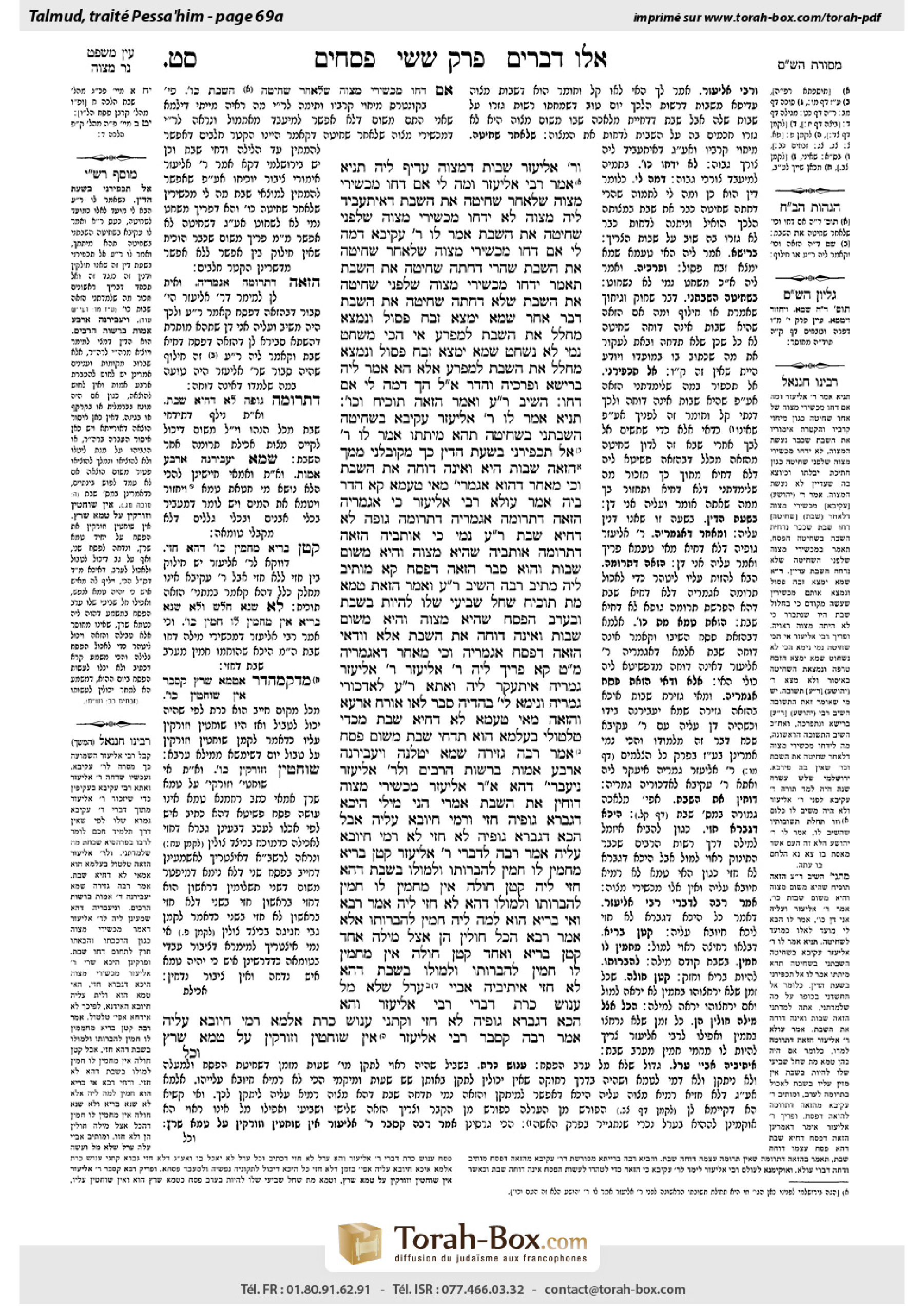
Pesachim 69a: Talmud study for Daf Yomi
Daf Yomi is the daily study of one Talmud folio. Explore 37 tractates with scans, Hebrew text, Sefaria English and AI-generated French translations where annotated.
Passage selection and English or AI-generated French translation are available where the scan has annotations. Daf Study is independent of Torah-Box and Sefaria.
Browse Pesachim · פסחים · All tractatesPesachim 69a text and translations
This page of Pesachim includes the Aramaic text, an English translation and an AI-generated French translation, alongside the scan above.
פסחים ס״ט א · Aramaic and Hebrew text
וְרַבִּי אֱלִיעֶזֶר, שְׁבוּת דְּמִצְוָה עֲדִיף לֵיהּ.
תַּנְיָא אָמַר רַבִּי אֱלִיעֶזֶר: וּמָה לִי אִם דָּחוּ מַכְשִׁירֵי מִצְוָה שֶׁלְּאַחַר שְׁחִיטָה אֶת הַשַּׁבָּת, דְּאִיתְעֲבִיד לֵיהּ מִצְוָה — לֹא יִדְחוּ מַכְשִׁירֵי מִצְוָה שֶׁלִּפְנֵי שְׁחִיטָה אֶת הַשַּׁבָּת!
אָמַר לוֹ רַבִּי עֲקִיבָא: דְּמָה לִי אִם דָּחוּ מַכְשִׁירֵי מִצְוָה שֶׁלְּאַחַר שְׁחִיטָה אֶת הַשַּׁבָּת, שֶׁהֲרֵי דָּחֲתָה שְׁחִיטָה אֶת הַשַּׁבָּת, תֹּאמַר יִדְחוּ מַכְשִׁירֵי מִצְוָה שֶׁלִּפְנֵי שְׁחִיטָה אֶת הַשַּׁבָּת — שֶׁלֹּא דָּחֲתָה שְׁחִיטָה אֶת הַשַּׁבָּת. דָּבָר אַחֵר: שֶׁמָּא יִמָּצֵא זֶבַח פָּסוּל, וְנִמְצָא מְחַלֵּל אֶת הַשַּׁבָּת לְמַפְרֵעַ.
אִי הָכִי — מִשְׁחָט נָמֵי לָא נִשְׁחֹט, שֶׁמָּא יִמָּצֵא זֶבַח פָּסוּל, וְנִמְצָא מְחַלֵּל אֶת הַשַּׁבָּת לְמַפְרֵעַ. אֶלָּא: הָא אֲמַר לֵיהּ בְּרֵישָׁא וּפַרְכֵיהּ, וַהֲדַר אֲמַר לֵיהּ הָךְ דְּמָה לִי אִם דָּחוּ.
הֵשִׁיב רַבִּי עֲקִיבָא וְאָמַר: הַזָּאָה תּוֹכִיחַ וְכוּ׳. תַּנְיָא, אָמַר לוֹ רַבִּי אֱלִיעֶזֶר: עֲקִיבָא, בִּשְׁחִיטָה הֱשַׁבְתַּנִי, בִּשְׁחִיטָה תְּהֵא מִיתָתוֹ. אָמַר לוֹ: רַבִּי, אַל תַּכְפִּירֵנִי בִּשְׁעַת הַדִּין, כָּךְ מְקוּבְּלַנִי מִמְּךָ: הַזָּאָה שְׁבוּת הִיא, וְאֵינָהּ דּוֹחָה אֶת הַשַּׁבָּת.
וְכִי מֵאַחַר דְּהוּא אַגְמְרֵיהּ, מַאי טַעְמָא קָא הָדַר בֵּיהּ? אָמַר עוּלָּא: רַבִּי אֱלִיעֶזֶר כִּי אַגְמְרֵיהּ, הַזָּאָה דִתְרוּמָה אַגְמְרֵיהּ — דִּתְרוּמָה גּוּפַהּ לָא דָּחֲיָא שַׁבָּת.
רַבִּי עֲקִיבָא נָמֵי כִּי אוֹתְבֵיהּ — הַזָּאָה דִּתְרוּמָה אוֹתְבֵיהּ, שֶׁהִיא מִצְוָה וְהִיא מִשּׁוּם שְׁבוּת! וְהוּא סָבַר: הַזָּאָה דְּפֶסַח קָא מוֹתֵיב לֵיהּ.
מֵתִיב רַבָּה: הֵשִׁיב רַבִּי עֲקִיבָא וְאָמַר: הַזָּאַת טְמֵא מֵת תּוֹכִיחַ, שֶׁחָל שְׁבִיעִי שֶׁלּוֹ לִהְיוֹת בַּשַּׁבָּת, וּבְעֶרֶב הַפֶּסַח שֶׁהִיא מִצְוָה, וְהִיא מִשּׁוּם שְׁבוּת — וְאֵינָהּ דּוֹחָה אֶת הַשַּׁבָּת.
אֶלָּא, וַודַּאי הַזָּאָה דְפֶסַח אַגְמְרֵיהּ. וְכִי מֵאַחַר דְּאַגְמְרֵיהּ, מַאי טַעְמָא קָא פָּרֵיךְ לֵיהּ רַבִּי אֱלִיעֶזֶר? רַבִּי אֱלִיעֶזֶר גְּמָרֵיהּ אִיתְעֲקַר לֵיהּ, וַאֲתָא רַבִּי עֲקִיבָא לְאַדְכּוֹרֵי גְּמָרֵיהּ. וְנֵימָא לֵיהּ בְּהֶדְיָה! סָבַר, לָאו אוֹרַח אַרְעָא.
וְהַזָּאָה מַאי טַעְמָא לָא דָּחֲיָא שַׁבָּת? מִכְּדֵי טַלְטוֹלֵי בְּעָלְמָא הוּא, תִּדְּחֵי שַׁבָּת מִשּׁוּם פֶּסַח! אָמַר רַבָּה: גְּזֵירָה שֶׁמָּא יִטְּלֶנָּה וְיַעֲבִירֶנָּה אַרְבַּע אַמּוֹת בִּרְשׁוּת הָרַבִּים.
וּלְרַבִּי אֱלִיעֶזֶר נַיעְבְּרֵיהּ! דְּהָא אָמַר רַבִּי אֱלִיעֶזֶר: מַכְשִׁירֵי מִצְוָה דּוֹחִין אֶת הַשַּׁבָּת! אָמְרִי: הָנֵי מִילֵּי הֵיכָא דְּגַבְרָא גּוּפֵיהּ חֲזֵי וּרְמֵי חִיּוּבָא עֲלֵיהּ. אֲבָל הָכָא, דְּגַבְרָא גּוּפֵיהּ לָא חֲזֵי — לָא רְמֵי חִיּוּבָא עֲלֵיהּ.
אָמַר רַבָּה: לְדִבְרֵי רַבִּי אֱלִיעֶזֶר, קָטָן בָּרִיא — מְחַמִּין לוֹ חַמִּין לְהַבְרוֹתוֹ וּלְמוּלוֹ בְּשַׁבָּת, דְּהָא חֲזֵי לֵיהּ. קָטָן חוֹלֶה — אֵין מְחַמִּין לוֹ חַמִּין לְהַבְרוֹתוֹ וּלְמוּלוֹ, דְּהָא לָא חֲזֵי לֵיהּ.
אָמַר רָבָא: וְאִי בָּרִיא הוּא לְמָה לֵיהּ חַמִּין לְהַבְרוֹתוֹ? אֶלָּא אָמַר רָבָא: הַכֹּל חוֹלִין הֵן אֵצֶל מִילָּה, אֶחָד קָטָן בָּרִיא וְאֶחָד קָטָן חוֹלֶה אֵין מְחַמִּין לוֹ חַמִּין לְהַבְרוֹתוֹ וּלְמוּלוֹ בְּשַׁבָּת, דְּהָא לָא חֲזֵי.
אֵיתִיבֵיהּ אַבָּיֵי: עָרֵל שֶׁלֹּא מָל עָנוּשׁ כָּרֵת, דִּבְרֵי רַבִּי אֱלִיעֶזֶר. וְהָא הָכָא דְּגַבְרָא גּוּפֵיהּ לָא חֲזֵי, וְקָתָנֵי עָנוּשׁ כָּרֵת, אַלְמָא: רְמֵי חִיּוּבָא עֲלֵיהּ!
אָמַר רַבָּה: קָסָבַר רַבִּי אֱלִיעֶזֶר, אֵין שׁוֹחֲטִין וְזוֹרְקִין עַל טְמֵא שֶׁרֶץ.
Pesachim 69a · English translation
And Rabbi Eliezer rejects this refutation because, in his opinion, permitting a rabbinic decree for the sake of a mitzva is preferable. We cannot derive through an a fortiori inference that since rabbinic decrees were not permitted for optional activities associated with rejoicing on festivals, they must not be permitted for the purpose of a mitzva on Shabbat. This is because it is possible that they permitted rabbinic decrees for mitzva purposes due to the importance of the mitzva.
It was taught in a baraita: Rabbi Eliezer said: What reason do I have? If actions that facilitate the performance of the mitzva and are done after the slaughter, such as cleaning the intestines which is permitted according all opinions, override Shabbat even though the mitzva has already been done, is it possible to say that actions that facilitate the performance of the mitzva and must be done before the slaughter do not also override Shabbat?
Rabbi Akiva said to him: What reason do I have to reject this comparison? If actions that facilitate the performance of the mitzva that are done after the slaughter override Shabbat, that is because slaughter has already overridden Shabbat and therefore an action that violates a rabbinic decree is performed, after Shabbat has already been overridden; can you say that actions that facilitate the performance of the mitzva and are done before the slaughter should override Shabbat even though slaughter has not yet overridden Shabbat? Alternatively, Rabbi Akiva has another reason: Perhaps the offering will be found to be disqualified due to a blemish and the person will be found to have violated Shabbat retroactively when he slaughtered the animal without fulfilling a mitzva.
Rabbi Eliezer rejects this argument: If so, if you are concerned about this possibility, it should also not be slaughtered; for perhaps the offering will be found to be invalid and the person will be found to have violated Shabbat retroactively. Rather, the course of the discussion must have gone as follows: Rabbi Akiva said this last reason to Rabbi Eliezer at the beginning and he refuted it as explained above; and then Rabbi Akiva said to him this other reason of: What reason do I have to reject this comparison? If actions that facilitate the performance of the mitzva override, etc.
We learned in the mishna that Rabbi Akiva responded and said to Rabbi Eliezer that the law governing the sprinkling of the purifying water of a red heifer proves that actions prohibited by a rabbinic decree, even when they are performed for the sake of a mitzva, do not override Shabbat. He then goes on to argue that we can reverse the order of the argument and conclude by way of an a fortiori inference that even slaughter does not override Shabbat. It was taught in a baraita that Rabbi Eliezer said to him about this: Akiva, you have lightheartedly responded to me with a faulty a fortiori inference with regard to slaughter. His death will be with slaughter; meaning, as punishment for this disrespect you will be slaughtered by other people. Rabbi Akiva said to him: My teacher, do not deny my contention at the time we are discussing this inference, for this is the tradition I received from you: Sprinkling is forbidden by rabbinic decree and does not override Shabbat.
The Gemara asks: Seeing that Rabbi Eliezer taught Rabbi Akiva this halakha that sprinkling purifying water does not override Shabbat, what is the reason he retracted his opinion? Ulla said: When Rabbi Eliezer taught him this halakha, he taught it to him with respect to sprinkling that is performed in order to enable a ritually impure priest to partake of teruma. This sprinkling does not override Shabbat because even separating teruma itself does not override Shabbat. But he never taught Rabbi Akiva this halakha with respect to sprinkling that is performed in order enable someone to eat of the Paschal lamb.
The Gemara notes that Rabbi Akiva as well, when he challenged Rabbi Eliezer, challenged him with regard to the halakha of sprinkling for teruma, and his objection should be understood as follows: Eating teruma is a mitzva, and sprinkling purifying water on someone who is ritually impure is only prohibited due to a rabbinic decree; nevertheless, sprinkling purifying water on a ritually impure priest, in order to enable him to eat teruma, is prohibited on Shabbat. Thus it follows by a fortiori inference that slaughter, which is a biblically prohibited labor, should certainly be forbidden on Shabbat, even when performed for the sake of a mitzva. And Rabbi Eliezer thought Rabbi Akiva was challenging him with regard to the halakha of sprinkling that is performed in order to enable someone to eat of the Paschal lamb; that is why he said that he disagreed about sprinkling as well.
Rabba raised an objection to Ulla’s explanation, based on a different baraita which states: Rabbi Akiva responded and said: The sprinkling of purifying water on someone who is ritually impure due to contact with a corpse proves the matter when his seventh day of impurity occurs on Shabbat and it is also the eve of Passover, for it is done for the sake of a mitzva, in order to allow the person to eat of the Paschal lamb, and it is prohibited only due to a rabbinic decree, and nonetheless it does not override Shabbat. From this baraita it is clear that Rabbi Akiva challenged Rabbi Eliezer with regard to the halakha of sprinkling that is performed in order to enable someone to eat the Paschal lamb.
Rather, we must reject Ulla’s explanation and say instead that Rabbi Eliezer certainly taught Rabbi Akiva about sprinkling that is performed in order to enable someone to eat of the Paschal lamb. And with regard to the question that seeing that Rabbi Eliezer himself taught him this halakha, what is the reason that Rabbi Eliezer refutes it, the Gemara answers: Rabbi Eliezer forgot his own teaching and Rabbi Akiva came to remind him of his teaching by drawing an a fortiori inference that would cause Rabbi Eliezer to remember what he himself had taught. The Gemara asks: If so, then let Rabbi Akiva say explicitly that this is what Rabbi Eliezer himself had taught him. The Gemara answers: He thought that it would not be proper to tell his teacher that he had forgotten his teaching, and therefore his initial attempt was to remind him indirectly.
The Gemara questions the reason for the halakha under discussion. What is the reason that the sprinkling of purifying water does not override Shabbat? Since it involves the mere moving of the liquid from the utensil in his hand to the body of the person seeking purification, why should it be forbidden on Shabbat? Let it at least override Shabbat on account of the mitzva of the Paschal lamb. Rabba said: The prohibition against sprinkling is a rabbinic decree that was instituted lest one take the utensil containing the purifying water and carry it a distance of four cubits in the public domain, thus violating an actual Torah prohibition. This is consistent with Rabba’s opinion in several other places in the Talmud that the Sages forbade the fulfillment of certain mitzvot due to a similar concern about carrying in the public domain.
The Gemara asks: At least according to Rabbi Eliezer, let us carry the purifying water even in the public domain, for Rabbi Eliezer said as a general rule that actions that facilitate the performance of a mitzva override Shabbat, even if they are not mitzvot themselves and involve transgression of Torah prohibitions. They say that there is room to distinguish between different situations: The rule that actions necessary to facilitate a mitzva override Shabbat only applies when the person himself is fit to fulfill the mitzva and the obligation to fulfill it is incumbent upon him. But here where the person himself is not fit to eat the Paschal lamb, as he is presently ritually impure, the obligation to fulfill the mitzva is not incumbent upon him, and therefore actions that would enable him to fulfill the mitzva do not override Shabbat.
Rabba said: According to the statement of Rabbi Eliezer that when a person is unfit no obligation is incumbent upon him, in the case of a healthy baby, one may heat water for him to strengthen him even further in order to circumcise him on Shabbat, as he is already now fit to be circumcised. But in the case of a sickly baby, one may not heat water for him to strengthen him in order to circumcise him, for owing to his sickliness he is not presently fit for the mitzva, and acts that facilitate a mitzva do not override Shabbat if the person is not currently fit for the mitzva.
Rava said: But if the baby is healthy, why does he need hot water to strengthen him? Rather, Rava said: All babies are considered sickly with respect to circumcision, as they all need to be washed with hot water. Therefore, both in the case of a healthy baby and in the case of a sickly baby, one may not heat water for him to strengthen him in order to circumcise him on Shabbat, even according to Rabbi Eliezer, as he is not presently fit for the mitzva.
Abaye raised an objection to Rabba’s distinction between someone who is currently fit for the mitzva and someone who is not, based on what was taught elsewhere in a baraita: An uncircumcised adult who did not circumcise himself before Passover is liable to the punishment of karet for having intentionally violated the mitzva to bring the Paschal lamb, as an uncircumcised person may not eat of the offering; this is the statement of Rabbi Eliezer. But here the person himself is not fit, for as long as he is uncircumcised he is not obligated to bring the Paschal lamb, and nonetheless the baraita is teaching that he is punished with karet. Apparently, the obligation is incumbent upon him even though he is presently unfit to perform the mitzva.
Rabba said in answer to this objection: Rabbi Eliezer holds that one may not slaughter the Paschal lamb or sprinkle its blood for someone who is ritually impure due to contact with a creeping animal because he is currently impure, even though he can immerse in a ritual bath and become pure by the night of Passover.
Pesachim 69a · Traduction française (IA)
Rabbi Eliezer rejette cette réfutation car, selon lui, il est préférable d’autoriser une dérogation à un décret rabbinique pour les besoins d’une mitsva. On ne peut pas déduire par raisonnement a fortiori que, puisque les décrets rabbiniques n’ont pas été écartés pour des activités facultatives liées aux réjouissances des fêtes, ils ne doivent pas non plus l’être pour les besoins d’une mitsva le Chabbat. En effet, il est possible que les Sages aient écarté les décrets rabbiniques pour les besoins d’une mitsva, en raison de son importance.
Il a été enseigné dans une baraïta : Rabbi Eliezer dit : « Quelle est ma raison ? Si les actes qui facilitent l’accomplissement de la mitsva et sont effectués après l’abattage, tels que le nettoyage des intestins, qui est permis selon toutes les opinions, repoussent le Chabbat, alors même que la mitsva a déjà été accomplie, peut-on dire que les actes qui facilitent l’accomplissement de la mitsva et doivent être effectués avant l’abattage ne repoussent pas eux aussi le Chabbat ? »
Rabbi Akiva lui dit : « Quelle raison ai-je de rejeter cette comparaison ? Si les actes qui facilitent l’accomplissement de la mitsva et sont effectués après l’abattage repoussent le Chabbat, c’est parce que l’abattage a déjà repoussé le Chabbat : un acte qui enfreint un décret rabbinique est alors accompli après que le Chabbat a déjà été repoussé. Mais peut-on dire que les actes qui facilitent l’accomplissement de la mitsva et sont effectués avant l’abattage doivent repousser le Chabbat, alors que l’abattage ne l’a pas encore repoussé ? » Rabbi Akiva avance peut-être un autre argument : l’offrande pourrait se révéler invalide en raison d’un défaut, et l’homme se trouverait alors avoir enfreint le Chabbat rétroactivement en abattant l’animal sans avoir accompli de mitsva.
Rabbi Eliezer rejette cet argument : « Si c’est le cas, si tu crains cette éventualité, il ne faudrait pas non plus procéder à l’abattage, car l’offrande pourrait se révéler invalide et l’homme se trouverait alors avoir enfreint le Chabbat rétroactivement. » Il faut donc plutôt comprendre que la discussion s’est déroulée ainsi : Rabbi Akiva a d’abord avancé à Rabbi Eliezer ce dernier argument, qu’il a réfuté comme expliqué plus haut ; puis Rabbi Akiva lui a présenté cet autre argument : « Quelle raison ai-je de rejeter cette comparaison ? Si les actes qui facilitent l’accomplissement de la mitsva repoussent le Chabbat, etc. »
Nous avons appris dans la Michna que Rabbi Akiva répondit à Rabbi Eliezer que la règle relative à l’aspersion de l’eau de purification d’une vache rousse prouve que les actes interdits par décret rabbinique, même lorsqu’ils sont accomplis pour les besoins d’une mitsva, ne repoussent pas le Chabbat. Il poursuit en affirmant que l’on peut inverser l’ordre du raisonnement et conclure, par raisonnement a fortiori, que même l’abattage ne repousse pas le Chabbat. Il a été enseigné dans une baraïta que Rabbi Eliezer lui dit à ce sujet : « Akiva, tu m’as répondu avec légèreté par un raisonnement a fortiori fallacieux au sujet de l’abattage. Sa mort sera par abattage », c’est-à-dire qu’en punition de ce manque de respect, tu seras abattu par d’autres. Rabbi Akiva lui dit : « Mon maître, ne rejette pas mon argument au moment où nous examinons ce raisonnement, car voici la tradition que j’ai reçue de toi : l’aspersion est interdite par décret rabbinique et ne repousse pas le Chabbat. »
La Guemara demande : puisque Rabbi Eliezer a enseigné à Rabbi Akiva cette halakha selon laquelle l’aspersion de l’eau de purification ne repousse pas le Chabbat, pourquoi a-t-il rétracté son opinion ? Oulla dit : lorsque Rabbi Eliezer lui a enseigné cette halakha, c’était à propos de l’aspersion effectuée pour permettre à un prêtre rituellement impur de consommer de la terouma. Cette aspersion ne repousse pas le Chabbat, car même la séparation de la terouma ne le repousse pas. Mais Rabbi Eliezer n’a jamais enseigné à Rabbi Akiva cette halakha à propos de l’aspersion effectuée pour permettre à quelqu’un de consommer l’agneau pascal.
La Guemara fait remarquer que Rabbi Akiva, lui aussi, a contesté Rabbi Eliezer à propos de la halakha de l’aspersion en vue de la terouma ; son objection doit être comprise ainsi : consommer de la terouma est une mitsva, et l’aspersion de l’eau de purification sur une personne rituellement impure n’est interdite qu’en vertu d’un décret rabbinique ; néanmoins, il est interdit le Chabbat d’asperger d’eau de purification un prêtre rituellement impur pour lui permettre de consommer de la terouma. Il s’ensuit donc, par raisonnement a fortiori, que l’abattage, travail interdit par la Torah écrite, doit à plus forte raison être interdit le Chabbat, même lorsqu’il est accompli pour les besoins d’une mitsva. Rabbi Eliezer, lui, pensait que Rabbi Akiva le contestait au sujet de la halakha de l’aspersion effectuée pour permettre à quelqu’un de consommer l’agneau pascal ; c’est pourquoi il a dit qu’il était également en désaccord au sujet de l’aspersion.
Rabba objecte à l’explication d’Oulla en s’appuyant sur une autre baraïta, qui enseigne : « Rabbi Akiva répondit : le cas de l’aspersion de l’eau de purification sur une personne rituellement impure à la suite d’un contact avec un cadavre prouve la règle lorsque son septième jour d’impureté tombe un Chabbat et que c’est également la veille de Pessa’h. En effet, l’aspersion est effectuée pour les besoins d’une mitsva, afin de permettre à cette personne de consommer l’agneau pascal, et elle n’est interdite qu’en vertu d’un décret rabbinique ; pourtant, elle ne repousse pas le Chabbat. » Cette baraïta montre clairement que Rabbi Akiva contestait Rabbi Eliezer au sujet de la halakha de l’aspersion effectuée pour permettre à quelqu’un de consommer l’agneau pascal.
Il faut donc rejeter l’explication d’Oulla et dire plutôt que Rabbi Eliezer a certainement enseigné à Rabbi Akiva la règle relative à l’aspersion effectuée pour permettre à quelqu’un de consommer l’agneau pascal. Quant à la question de savoir pourquoi Rabbi Eliezer réfute cette halakha alors qu’il la lui avait lui-même enseignée, la Guemara répond : Rabbi Eliezer avait oublié son propre enseignement, et Rabbi Akiva entreprit de le lui rappeler au moyen d’un raisonnement a fortiori qui devait lui faire retrouver ce qu’il avait lui-même enseigné. La Guemara demande : dans ce cas, que Rabbi Akiva dise explicitement que Rabbi Eliezer le lui avait lui-même enseigné. La Guemara répond : il pensait qu’il ne convenait pas de dire à son maître qu’il avait oublié son enseignement ; il tenta donc d’abord de le lui rappeler indirectement.
La Guemara s’interroge sur la raison de la halakha en question. Pourquoi l’aspersion de l’eau de purification ne repousse-t-elle pas le Chabbat ? Puisqu’il s’agit seulement de déplacer le liquide du récipient qu’il tient dans sa main vers le corps de la personne qui cherche à se purifier, pourquoi cela serait-il interdit le Chabbat ? Qu’elle repousse au moins le Chabbat au titre de la mitsva de l’agneau pascal ! Rabba dit : l’interdiction d’asperger est un décret rabbinique institué de crainte qu’on ne prenne le récipient contenant l’eau de purification et qu’on ne le transporte sur une distance de quatre coudées dans le domaine public, enfreignant ainsi une véritable interdiction de la Torah. Cela correspond à l’opinion de Rabba, exprimée en plusieurs autres endroits du Talmud, selon laquelle les Sages ont interdit l’accomplissement de certaines mitsvot par crainte d’un transport semblable dans le domaine public.
La Guemara demande : du moins selon Rabbi Eliezer, que l’on transporte l’eau de purification, même dans le domaine public, car Rabbi Eliezer a posé comme règle générale que les actes facilitant l’accomplissement d’une mitsva repoussent le Chabbat, même s’ils ne constituent pas eux-mêmes des mitsvot et impliquent la transgression d’interdictions de la Torah. On répond qu’il y a lieu de distinguer les situations : la règle selon laquelle les actes nécessaires pour faciliter une mitsva repoussent le Chabbat ne s’applique que lorsque la personne elle-même est apte à accomplir la mitsva et que l’obligation de l’accomplir lui incombe. Mais ici, la personne elle-même n’est pas apte à manger l’agneau pascal, puisqu’elle est actuellement rituellement impure ; l’obligation d’accomplir la mitsva ne lui incombe donc pas, et les actes qui lui permettraient de l’accomplir ne repoussent par conséquent pas le Chabbat.
Rabba dit : selon l’enseignement de Rabbi Eliezer, d’après lequel aucune obligation n’incombe à une personne qui n’est pas apte, on peut chauffer de l’eau pour un bébé en bonne santé afin de le fortifier davantage en vue de sa circoncision le Chabbat, puisqu’il est déjà apte à être circoncis. En revanche, on ne peut pas chauffer de l’eau pour fortifier un bébé fragile en vue de sa circoncision, car, du fait de sa fragilité, il n’est pas actuellement apte à accomplir la mitsva, et les actes facilitant une mitsva ne repoussent pas le Chabbat si la personne n’est pas alors apte à l’accomplir.
Rava dit : mais si le bébé est en bonne santé, pourquoi aurait-il besoin d’eau chaude pour être fortifié ? Rava dit plutôt : tous les bébés sont considérés comme fragiles en ce qui concerne la circoncision, car ils doivent tous être lavés à l’eau chaude. Par conséquent, qu’il s’agisse d’un bébé en bonne santé ou d’un bébé fragile, on ne peut pas chauffer de l’eau pour le fortifier en vue de sa circoncision le Chabbat, même selon Rabbi Eliezer, puisqu’il n’est pas actuellement apte à accomplir la mitsva.
Abayé objecte à la distinction de Rabba entre une personne actuellement apte à accomplir la mitsva et une personne qui ne l’est pas, en s’appuyant sur ce qui a été enseigné ailleurs dans une baraïta : « Un adulte incirconcis qui ne s’est pas fait circoncire avant Pessa’h est passible de karet pour avoir intentionnellement transgressé la mitsva d’apporter l’agneau pascal, car une personne incirconcise ne peut pas consommer l’offrande ; telle est l’opinion de Rabbi Eliezer. » Or, dans ce cas, la personne elle-même n’est pas apte, car tant qu’elle n’est pas circoncise, elle n’est pas tenue d’apporter l’agneau pascal ; pourtant, la baraïta enseigne qu’elle est punie de karet. Il semble donc que l’obligation lui incombe même si elle n’est pas actuellement apte à accomplir la mitsva.
Rabba répondit à cette objection : Rabbi Eliezer estime qu’on ne peut ni abattre l’agneau pascal ni en asperger le sang pour une personne rituellement impure à la suite d’un contact avec un reptile, parce qu’elle est actuellement impure, même si elle peut s’immerger dans un bain rituel et devenir pure le soir de Pessa’h.
Traduction française générée par IA à partir de l’édition anglaise de Sefaria. Vérifie toujours un passage avec le texte source.
Text from Sefaria: William Davidson Edition - Vocalized Aramaic (CC BY NC); William Davidson Edition - English (CC BY NC).