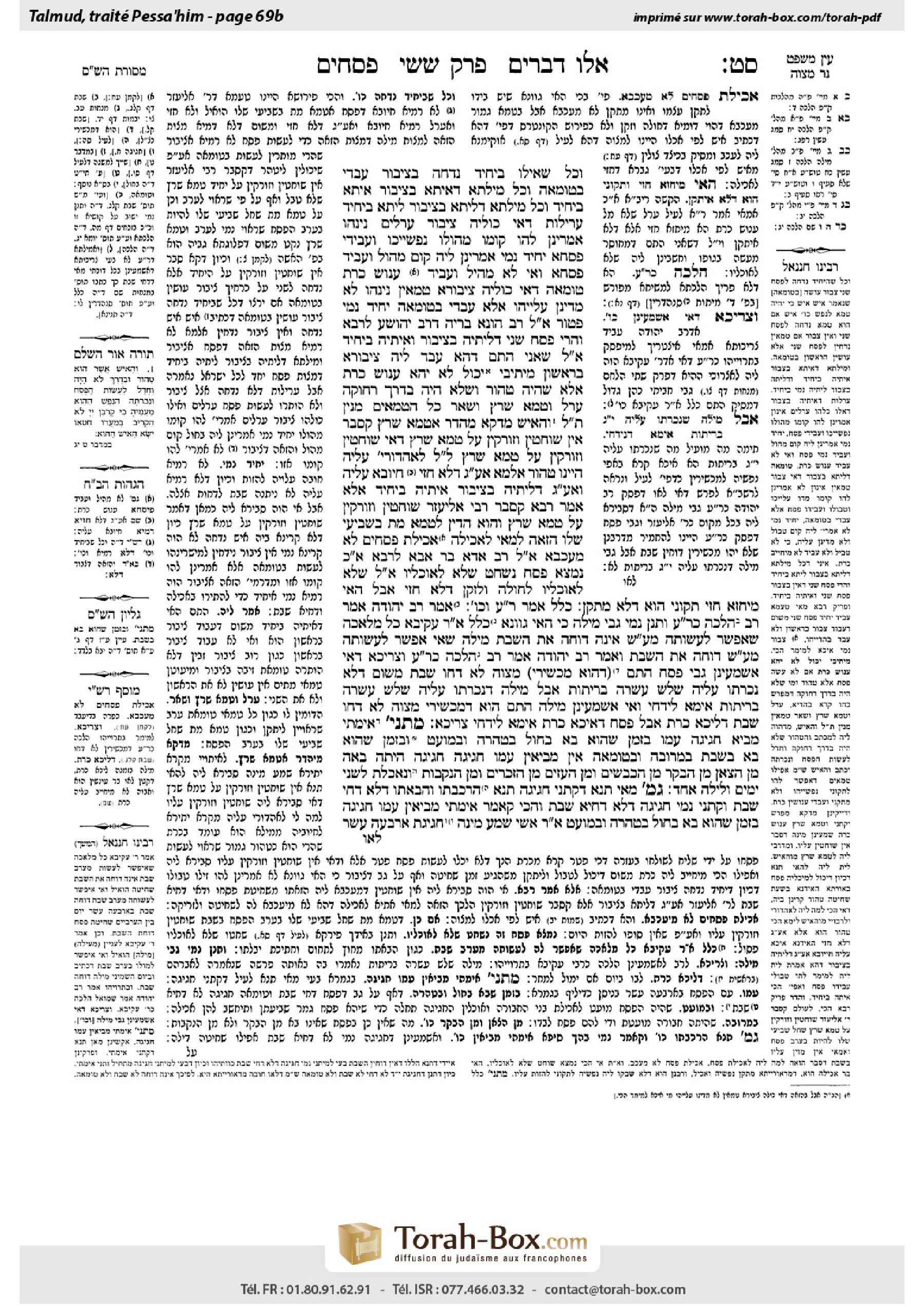
Pesachim 69b: Talmud study for Daf Yomi
Daf Yomi is the daily study of one Talmud folio. Explore 37 tractates with scans, Hebrew text, Sefaria English and AI-generated French translations where annotated.
Passage selection and English or AI-generated French translation are available where the scan has annotations. Daf Study is independent of Torah-Box and Sefaria.
Browse Pesachim · פסחים · All tractatesPesachim 69b text and translations
This page of Pesachim includes the Aramaic text, an English translation and an AI-generated French translation, alongside the scan above.
פסחים ס״ט ב · Aramaic and Hebrew text
וְכׇל שֶׁאִילּוּ בְּיָחִיד נִדְחֶה, בְּצִיבּוּר עָבְדִי בְּטוּמְאָה. וְכׇל מִילְּתָא דְּאִיתָא בְּצִיבּוּר, אִיתָא בְּיָחִיד. וְכׇל מִילְּתָא דְּלֵיתָא בְּצִיבּוּר, לֵיתָא בְּיָחִיד.
עֲרֵילוּת, דְּאִי כּוּלֵּיהּ צִיבּוּר עֲרֵלִים נִינְהוּ, אָמְרִינַן לְהוּ: קוּמוּ מְהוּלוּ נַפְשַׁיְיכוּ וַעֲבִידֵי פִּסְחָא. יָחִיד נָמֵי, אָמְרִינַן לֵיהּ: קוּם מְהוֹל וַעֲבֵיד פִּסְחָא. וְאִי לָא מָהֵיל וְעָבֵיד — עָנוּשׁ כָּרֵת.
טוּמְאָה, דְּאִי כּוּלֵּיהּ צִיבּוּרָא טְמֵאִין נִינְהוּ — לָא מַדֵּינַן עֲלַיְיהוּ, אֶלָּא עָבְדִי בְּטוּמְאָה, יָחִיד נָמֵי פָּטוּר.
אֲמַר לֵיהּ רַב הוּנָא בְּרֵיהּ דְּרַב יְהוֹשֻׁעַ לְרָבָא: וַהֲרֵי פֶּסַח שֵׁנִי, דְּלֵיתֵיהּ בְּצִיבּוּר וְאִיתֵיהּ בְּיָחִיד! אֲמַר לֵיהּ: שָׁאנֵי הָתָם דְּהָא עֲבַד לֵיהּ צִיבּוּרָא בְּרִאשׁוֹן.
מֵיתִיבִי: יָכוֹל לֹא יְהֵא עָנוּשׁ כָּרֵת אֶלָּא שֶׁהָיָה טָהוֹר וְשֶׁלֹּא הָיָה בְּדֶרֶךְ רְחוֹקָה. עָרֵל וּטְמֵא שֶׁרֶץ וּשְׁאָר כׇּל הַטְּמֵאִים מִנַּיִן? תַּלְמוּד לוֹמַר: ״וְהָאִישׁ״.
מִדְּקָא מְהַדַּר אַטְּמֵא שֶׁרֶץ, קָסָבַר: אֵין שׁוֹחֲטִין וְזוֹרְקִין עַל טְמֵא שֶׁרֶץ, דְּאִי שׁוֹחֲטִין וְזוֹרְקִין עַל טְמֵא שֶׁרֶץ — לְמָה לֵיהּ לְאַהֲדוֹרֵי עֲלֵיהּ, הַיְינוּ טָהוֹר. אַלְמָא: אַף עַל גַּב דְּלָא חֲזֵי — חִיּוּבָא עֲלֵיהּ, וְאַף עַל גַּב דְּלֵיתֵיהּ בְּצִיבּוּר — אִיתֵיהּ בְּיָחִיד.
אֶלָּא אָמַר רָבָא: קָסָבַר רַבִּי אֱלִיעֶזֶר שׁוֹחֲטִין וְזוֹרְקִין עַל טְמֵא שֶׁרֶץ, וְהוּא הַדִּין לִטְמֵא מֵת בִּשְׁבִיעִי שֶׁלּוֹ. הַזָּאָה לְמַאי? לַאֲכִילָה אֲכִילַת פְּסָחִים לָא מְעַכְּבָא!
אֲמַר לֵיהּ רַב אַדָּא בַּר אַבָּא לְרָבָא: אִם כֵּן, נִמְצָא פֶּסַח נִשְׁחָט שֶׁלֹּא לְאוֹכְלָיו. אֲמַר לֵיהּ: שֶׁלֹּא לְאוֹכְלָיו — לְחוֹלֶה וּלְזָקֵן, דְּלָא חֲזֵי. אֲבָל הַאי — מִיחְזֵא חֲזֵי, תַּקּוֹנֵי הוּא דְּלָא מְתַקַּן.
כְּלָל אָמַר רַבִּי עֲקִיבָא וְכוּ׳. אָמַר רַב יְהוּדָה אָמַר רַב: הֲלָכָה כְּרַבִּי עֲקִיבָא. וּתְנַן נָמֵי גַּבֵּי מִילָה כִּי הַאי גַּוְונָא, כְּלָל אָמַר רַבִּי עֲקִיבָא: כׇּל מְלָאכָה שֶׁאֶפְשָׁר לַעֲשׂוֹתָהּ מֵעֶרֶב שַׁבָּת — אֵינָהּ דּוֹחָה אֶת הַשַּׁבָּת, מִילָה שֶׁאִי אֶפְשָׁר לַעֲשׂוֹתָהּ מֵעֶרֶב שַׁבָּת — דּוֹחָה אֶת הַשַּׁבָּת. וְאָמַר רַב יְהוּדָה אָמַר רַב: הֲלָכָה כְּרַבִּי עֲקִיבָא.
וּצְרִיכָא, דְּאִי אַשְׁמְעִינַן גַּבֵּי פֶסַח: הָתָם (דְּהוּא מַכְשִׁירֵי) מִצְוָה לָא דָּחוּ שַׁבָּת, מִשּׁוּם דְּלֹא נִכְרְתוּ עָלֶיהָ שְׁלֹשׁ עֶשְׂרֵה בְּרִיתוֹת. אֲבָל מִילָה, דְּנִכְרְתוּ עָלֶיהָ שְׁלֹשׁ עֶשְׂרֵה בְּרִיתוֹת, אֵימָא לִידְחֵי.
וְאִי אַשְׁמְעִינַן מִילָה: הָתָם הוּא דְּמַכְשִׁירֵי מִצְוָה לָא דָּחוּ שַׁבָּת, דְּלֵיכָּא כָּרֵת, אֲבָל פֶּסַח דְּאִיכָּא כָּרֵת, אֵימָא לִידְחֵי. צְרִיכָא.
מַתְנִי׳ אֵימָתַי מֵבִיא חֲגִיגָה עִמּוֹ? בִּזְמַן שֶׁהוּא בָּא בַּחוֹל, בְּטָהֳרָה וּבְמוּעָט. וּבִזְמַן שֶׁהוּא בָּא בְּשַׁבָּת, בִּמְרוּבֶּה וּבְטוּמְאָה — אֵין מְבִיאִין עִמּוֹ חֲגִיגָה.
חֲגִיגָה הָיְתָה בָּאָה מִן הַצֹּאן מִן הַבָּקָר, מִן הַכְּבָשִׂים וּמִן הָעִזִּים, מִן הַזְּכָרִים וּמִן הַנְּקֵבוֹת, וְנֶאֱכֶלֶת לִשְׁנֵי יָמִים וְלַיְלָה אֶחָד.
גְּמָ׳ מַאי תַּנָּא דְּקָתָנֵי חֲגִיגָה? תָּנָא הַרְכָּבָתוֹ וַהֲבָאָתוֹ דְּלָא דָּחֵי שַׁבָּת, וְקָתָנֵי נָמֵי חֲגִיגָה דְּלָא דָּחֲיָא שַׁבָּת. וְהָכִי קָאָמַר: אֵימָתַי מְבִיאִין עִמּוֹ חֲגִיגָה — בִּזְמַן שֶׁהוּא בָּא בְּחוֹל, בְּטׇהֳרָה וּבְמוּעָט.
אָמַר רַב אָשֵׁי: שְׁמַע מִינַּהּ חֲגִיגַת אַרְבָּעָה עָשָׂר
Pesachim 69b · English translation
And Rabbi Eliezer further maintains with regard to any form of impurity due to which an individual is deferred to the second Pesaḥ, that if the entire community is afflicted with it, they observe the first Pesaḥ in a state of ritual impurity. And he accepts yet another principle: Anything that applies to the community applies to an individual, and anything that does not apply to the community does not apply to an individual.
On the basis of these principles, we can say as follows: With regard to lack of circumcision, if the entire community is uncircumcised we say to them: Arise, and circumcise yourselves, and offer the Paschal lamb, and we do not allow them to offer the sacrifice while uncircumcised. Therefore, with regard to an individual as well, we say to him: Arise, and circumcise yourself, and offer the Paschal lamb; and if he does not circumcise himself and offer the Paschal lamb, he is liable to the punishment of karet.
With regard to impurity, however, if the whole community is impure we do not sprinkle the purifying water on them; rather, they offer the Paschal lamb in a state of ritual impurity. Therefore, an individual, as well, is exempt from sprinkling; and since he is exempt, sprinkling does not override Shabbat. A distinction may be drawn between the two cases: An uncircumcised person must circumcise himself, but a person who is ritually impure need not undergo purification.
Rav Huna, son of Rav Yehoshua, said to Rava: Are these principles really correct? But there is the second Pesaḥ, which does not apply to the community and yet it applies to an individual. Rava said to Rav Huna: It is different there, as the community already offered the Paschal lamb on the first Pesaḥ in a state of ritual impurity, and therefore the second Pesaḥ can apply to individuals although it does not apply to the community.
The Gemara raises an objection from a baraita in which it was taught: One might have thought that only one who was pure and not on a distant journey is punishable by karet for having neglected to offer the Paschal lamb, as the Torah explicitly states that a person who was ritually impure or on a distant journey is exempt from the first Pesaḥ and obligated in the second Pesaḥ. But as for one who was uncircumcised or ritually impure from a creeping animal and all the others who are ritually impure not from a corpse, and they did not undergo circumcision or purification before Passover, from where do we know that they are also liable to receive karet? The verse states: “But the man that is clean, and is not on a journey, and fails to keep the Passover, then that person shall be cut off from his people” (Numbers 9:13); the expression “but the man” comes to include anyone who can become pure and fit to participate in the Paschal lamb, but fails to do so.
The Gemara infers from this baraita: From the fact that he searches for a source to include one who is ritually impure from a creeping animal, it is clear that he holds that one may not slaughter the Paschal lamb or sprinkle its blood for someone who is ritually impure from a creeping animal. For if one may slaughter and sprinkle for someone impure from a creeping animal, why did he search for a source to include it? He is the same as anyone who is pure and did not offer the Paschal lamb, for he could have sent his offering with someone else and eaten from it in the evening after having undergone ritual immersion. Rather, it is clear that one may not slaughter or sprinkle for him; and, nonetheless, if he neglected the mitzva of the Paschal lamb, he is liable to receive karet. Apparently then, although he was not fit at that time to offer the Paschal lamb, the obligation is nonetheless incumbent upon him to render himself fit. And although this does not apply to the community, for a community that is impure with the impurity of a creeping animal brings the Paschal lamb in a state of impurity, it does apply to an individual.
Rather, Rava said that we should reject the previous statement and say instead that Rabbi Eliezer holds that one may slaughter the Paschal lamb and sprinkle its blood for someone who is ritually impure from a creeping animal, and the same is true with regard to someone who is ritually impure from a corpse on his seventh day of impurity. If so, for what purpose is the sprinkling of the purifying water? If it is possible to slaughter the Paschal lamb and sprinkle its blood on this person’s behalf even when he is impure, the only reason to sprinkle the purifying water is for the purpose of eating the Paschal lamb. However, eating of the Paschal lamb is not essential for the fulfillment of the mitzva, for if the blood of the sacrifice is sprinkled in a permitted fashion on someone’s behalf and afterward he is unable to eat the meat of the sacrifice, e.g., it became impure or was lost, he has fulfilled his obligation and is not liable to receive karet. This being the case, sprinkling the purifying waters is not an act that is necessary to facilitate a mitzva and does not override Shabbat even according to Rabbi Eliezer.
Rav Adda bar Abba said to Rava: If it is so, that one may slaughter the Paschal lamb for someone who is ritually impure from a creeping animal, it turns out that the Paschal lamb is slaughtered for people who cannot eat it, and it is stated elsewhere that such a sacrifice is disqualified. Rava said to him: When it says that a Paschal lamb that is slaughtered for people who cannot eat is disqualified, this refers to a case where it is slaughtered for a sick or elderly person who is not at all fit to eat the sacrifice. But this person is essentially fit to eat the sacrifice but has not yet been made ready to actually eat it. He himself is regarded as fit to eat the sacrifice, and it is only some external factor that prevents him from doing so.
We learned in the mishna that Rabbi Akiva stated a principle that any prohibited labor required for the offering of the sacrifice that can be performed before Shabbat does not override Shabbat; whereas slaughter, which cannot be performed on the eve of Shabbat, overrides Shabbat.Rav Yehuda said that Rav said: The halakha is in accordance with the opinion of Rabbi Akiva with regard to the Paschal lamb. The Gemara points out that we also learned something similar to this in another mishna with regard to circumcision: Rabbi Akiva stated a principle: Any prohibited labor required for circumcision that can be performed on the eve of Shabbat because it need not be done specifically on the day of the circumcision does not override Shabbat; the circumcision itself, which cannot be performed on the eve of Shabbat, since it is not yet time to perform the circumcision, overrides Shabbat. And Rav Yehuda said that Rav said: The halakha is in accordance with the opinion of Rabbi Akiva with regard to circumcision.
The Gemara comments: And it is necessary to state this ruling in both cases, for had Rav taught us that the halakha is in accordance with the opinion of Rabbi Akiva only with regard to the Paschal lamb, the conclusion would have been: It is specifically there that the facilitators of a mitzva that can be performed the day before do not override Shabbat because thirteen covenants were not established upon the Paschal lamb, and it is therefore not so significant. But with regard to circumcision, upon which thirteen covenants were established, as is evidenced by the fact that the word covenant appears thirteen times in the chapter relating to circumcision (Genesis 17), which serves as a covenant between God and the Jewish nation, I would say that even facilitating actions that could have been performed on Shabbat eve should override Shabbat.
And had Rav taught us that the halakha is in accordance with the opinion of Rabbi Akiva only with regard to circumcision, the conclusion would have been: It is specifically there that the facilitators of a mitzva that can be performed before Shabbat do not override Shabbat, as there is no punishment of karet if the circumcision is delayed, since liability for karet only applies when the child becomes obligated in mitzvot and chooses not to circumcise himself. But with regard to the Paschal lamb, where there is karet for one who fails to offer the sacrifice at its proper time, I would say that such facilitators should override Shabbat. It is therefore necessary to teach that the halakha is in accordance with the opinion of Rabbi Akiva in both cases.
MISHNA: When does one bring a Festival peace-offering with the Paschal lamb? A special offering is brought on the fourteenth of Nisan together with the Paschal lamb when the Paschal lamb comes on a weekday rather than on Shabbat, and when it comes in a state of ritual purity as opposed to when it is brought in a state of impurity because most of the community is impure, and when many people are registered for the Paschal lamb so that each person will receive only a small portion from it. When these three conditions are met, the Festival peace-offering is eaten first and the Paschal lamb is eaten afterward. When, however, the Paschal lamb comes on Shabbat, or when few people are registered for it so that each person will receive a large portion, or when it is brought in a state of ritual impurity, one does not bring a Festival peace-offering with it.
With regard to the extra offering itself, the Festival peace-offering would come from the flock, from the herd, from sheep or from goats, from males or from females, as the Festival peace-offering is not bound by the limitations governing the Paschal offering, which must be specifically a young male sheep or goat. And the Festival peace-offering is eaten for two days and one night like other peace-offerings.
GEMARA: The Gemara questions why this halakha is recorded here: What did the mishna previously teach that made it relevant to teach this halakha with regard to a Festival peace-offering despite the fact that it seems to be unconnected to the previous mishnayot? The Gemara answers: Since it taught that carrying the Paschal lamb through a public domain and bringing it from outside the Shabbat limit do not override Shabbat, it also taught with regard to the halakha of a Festival peace-offering, that it does not override Shabbat. And this is what the mishna is saying: When does one bring a Festival peace-offering with the Paschal lamb? When it comes on a weekday, in a state of ritual purity, and when each person’s portion is small.
Rav Ashi said: Learn from this that the Festival peace-offering of the fourteenth of Nisan, which comes with the Paschal lamb and is the subject of our mishna, as opposed to the Festival peace-offering that is brought on the first day of Passover and is called the Festival peace-offering of the fifteenth,
Pesachim 69b · Traduction française (IA)
Rabbi Eliezer soutient en outre que, pour toute forme d’impureté qui conduit un individu à être ajourné au second Pessaḥ, si toute la communauté en est atteinte, elle célèbre le premier Pessaḥ en état d’impureté rituelle. Il accepte également un autre principe : tout ce qui s’applique à la communauté s’applique à un individu, et tout ce qui ne s’applique pas à la communauté ne s’applique pas à un individu.
Sur la base de ces principes, on peut dire ce qui suit : en ce qui concerne l’absence de circoncision, si toute la communauté n’est pas circoncise, on lui dit : « Levez-vous, circoncisez-vous et offrez l’agneau pascal », et on ne lui permet pas d’offrir le sacrifice sans être circoncise. Par conséquent, on dit également à un individu : « Lève-toi, circoncis-toi et offre l’agneau pascal » ; s’il ne se circoncit pas et n’offre pas l’agneau pascal, il est passible de karet.
En revanche, en ce qui concerne l’impureté, si toute la communauté est impure, on ne l’asperge pas avec l’eau purificatrice ; elle offre plutôt l’agneau pascal en état d’impureté rituelle. Par conséquent, un individu est lui aussi dispensé de l’aspersion ; puisqu’il en est dispensé, l’aspersion ne repousse pas le Chabbat. On peut établir une distinction entre les deux cas : une personne non circoncise doit se faire circoncire, mais une personne rituellement impure n’a pas à se faire purifier.
Rav Houna, fils de Rav Yehoshoua, dit à Rava : « Ces principes sont-ils vraiment corrects ? Pourtant, il y a le second Pessaḥ, qui ne s’applique pas à la communauté et s’applique néanmoins à un individu. » Rava lui répondit : « Ce cas est différent, car la communauté a déjà offert l’agneau pascal lors du premier Pessaḥ en état d’impureté rituelle ; le second Pessaḥ peut donc s’appliquer à des individus bien qu’il ne s’applique pas à la communauté. »
La Guemara soulève une objection à partir d’une baraïta où il est enseigné : On aurait pu penser que seul celui qui était pur et ne se trouvait pas en voyage lointain est passible de karet pour avoir négligé d’offrir l’agneau pascal, puisque la Torah précise qu’une personne rituellement impure ou en voyage lointain est dispensée du premier Pessaḥ et tenue d’accomplir le second Pessaḥ. Mais pour celui qui n’était pas circoncis, ou qui était rituellement impur à cause d’un animal rampant, ainsi que pour tous les autres qui sont rituellement impurs autrement qu’à cause d’un mort, et qui ne se sont pas fait circoncire ou purifier avant Pessaḥ, d’où savons-nous qu’ils sont eux aussi passibles de karet ? Le verset dit : « Mais l’homme qui est pur et n’est pas en voyage, et qui néglige de célébrer Pessaḥ, cette personne sera retranchée de son peuple » (Nombres 9, 13). L’expression « mais l’homme » vient inclure quiconque peut devenir pur et apte à participer à l’agneau pascal, mais ne le fait pas.
La Guemara déduit de cette baraïta que, puisqu’elle cherche une source pour inclure celui qui est rituellement impur à cause d’un animal rampant, il est clair qu’elle considère qu’on ne peut ni égorger l’agneau pascal ni en asperger le sang pour une personne rituellement impure à cause d’un animal rampant. En effet, si l’on pouvait égorger l’agneau pascal et en asperger le sang pour une personne impure à cause d’un animal rampant, pourquoi chercher une source pour l’inclure ? Elle serait comme toute personne pure qui n’a pas offert l’agneau pascal, puisqu’elle aurait pu envoyer son sacrifice avec quelqu’un d’autre et en manger le soir, après s’être immergée rituellement. Il est donc clair qu’on ne peut ni égorger l’agneau pascal ni en asperger le sang pour elle ; pourtant, si elle a négligé la mitsva de l’agneau pascal, elle est passible de karet. Il semble donc que, bien qu’elle n’ait pas été apte à offrir l’agneau pascal à ce moment-là, elle reste tenue de se rendre apte. Et bien que cela ne s’applique pas à la communauté — car une communauté impure de l’impureté due à un animal rampant offre l’agneau pascal en état d’impureté —, cela s’applique à un individu.
Rava dit plutôt qu’il faut rejeter l’énoncé précédent et dire que, selon Rabbi Eliezer, on peut égorger l’agneau pascal et en asperger le sang pour une personne rituellement impure à cause d’un animal rampant ; il en va de même pour une personne rituellement impure à cause d’un mort, le septième jour de son impureté. Si tel est le cas, à quoi sert l’aspersion de l’eau purificatrice ? S’il est possible d’égorger l’agneau pascal et d’en asperger le sang pour cette personne même lorsqu’elle est impure, la seule raison d’asperger l’eau purificatrice est de permettre la consommation de l’agneau pascal. Toutefois, la consommation de l’agneau pascal n’est pas essentielle à l’accomplissement de la mitsva : si le sang du sacrifice est aspergé de manière permise pour quelqu’un et que, par la suite, celui-ci ne peut pas manger la viande du sacrifice, par exemple parce qu’elle est devenue impure ou qu’elle a été perdue, il a accompli son obligation et n’est pas passible de karet. Par conséquent, l’aspersion des eaux purificatrices n’est pas un acte nécessaire à l’accomplissement d’une mitsva et ne repousse pas le Chabbat, même selon Rabbi Eliezer.
Rav Adda bar Abba dit à Rava : « Si tel est le cas, si l’on peut égorger l’agneau pascal pour une personne rituellement impure à cause d’un animal rampant, il s’ensuit que l’agneau pascal est égorgé pour des personnes qui ne peuvent pas le manger ; or, il est dit ailleurs qu’un tel sacrifice est invalide. » Rava lui répondit : « Lorsqu’il est dit qu’un agneau pascal égorgé pour des personnes qui ne peuvent pas le manger est invalide, cela désigne le cas où il est égorgé pour une personne malade ou âgée qui n’est absolument pas apte à manger le sacrifice. Mais cette personne est, par essence, apte à manger le sacrifice ; elle n’est simplement pas encore en état de le manger effectivement. Elle-même est considérée comme apte à manger le sacrifice, et seul un facteur extérieur l’en empêche. »
Nous avons appris dans la Michna que Rabbi Akiva énonçait le principe suivant : tout travail interdit requis pour l’offrande du sacrifice, qui peut être effectué avant le Chabbat, ne repousse pas le Chabbat ; en revanche, l’égorgement, qui ne peut pas être effectué la veille du Chabbat, repousse le Chabbat. Rav Yehouda a dit au nom de Rav : la halakha suit l’opinion de Rabbi Akiva concernant l’agneau pascal. La Guemara fait remarquer que nous avons également appris une règle semblable dans une autre Michna, à propos de la circoncision : Rabbi Akiva énonçait le principe suivant : tout travail interdit requis pour la circoncision, qui peut être effectué la veille du Chabbat puisqu’il n’a pas besoin d’être accompli précisément le jour de la circoncision, ne repousse pas le Chabbat ; la circoncision elle-même, qui ne peut pas être pratiquée la veille du Chabbat puisqu’il n’est pas encore temps de la pratiquer, repousse le Chabbat. Rav Yehouda a dit au nom de Rav : la halakha suit l’opinion de Rabbi Akiva concernant la circoncision.
La Guemara fait remarquer qu’il est nécessaire d’énoncer cette décision dans les deux cas : si Rav nous avait enseigné que la halakha suit l’opinion de Rabbi Akiva uniquement concernant l’agneau pascal, on aurait conclu que c’est précisément dans ce cas que les préparatifs d’une mitsva pouvant être accomplis la veille ne repoussent pas le Chabbat, parce que treize alliances n’ont pas été établies au sujet de l’agneau pascal, lequel n’a donc pas une importance aussi grande. Mais concernant la circoncision, au sujet de laquelle treize alliances ont été établies, comme l’atteste le fait que le mot « alliance » apparaît treize fois dans le chapitre relatif à la circoncision (Genèse 17), qui sert de pacte entre Dieu et le peuple juif, j’aurais dit que même les actes préparatoires qui auraient pu être accomplis la veille du Chabbat devraient repousser le Chabbat.
Et si Rav nous avait enseigné que la halakha suit l’opinion de Rabbi Akiva uniquement concernant la circoncision, on aurait conclu que c’est précisément dans ce cas que les préparatifs d’une mitsva pouvant être accomplis avant le Chabbat ne repoussent pas le Chabbat, puisqu’il n’y a pas de peine de karet si la circoncision est retardée : la responsabilité passible de karet ne s’applique que lorsque l’enfant devient tenu d’accomplir les mitsvot et choisit de ne pas se circoncire. Mais concernant l’agneau pascal, pour lequel celui qui omet d’offrir le sacrifice au moment prescrit est passible de karet, j’aurais dit que de tels préparatifs devraient repousser le Chabbat. Il est donc nécessaire d’enseigner que la halakha suit l’opinion de Rabbi Akiva dans les deux cas.
MICHNA : Quand apporte-t-on un sacrifice de paix de fête avec l’agneau pascal ? Une offrande spéciale est apportée le quatorze nissan avec l’agneau pascal lorsque celui-ci tombe un jour de semaine plutôt que le Chabbat, lorsqu’il est offert en état de pureté rituelle plutôt qu’en état d’impureté parce que la majorité de la communauté est impure, et lorsque de nombreuses personnes sont inscrites pour l’agneau pascal, de sorte que chacune n’en reçoit qu’une petite part. Lorsque ces trois conditions sont réunies, le sacrifice de paix de fête est mangé en premier, puis l’agneau pascal. En revanche, lorsque l’agneau pascal tombe le Chabbat, que peu de personnes y sont inscrites, de sorte que chacune en reçoit une grande part, ou qu’il est offert en état d’impureté rituelle, on n’apporte pas de sacrifice de paix de fête avec lui.
Quant à l’offrande supplémentaire elle-même, le sacrifice de paix de fête provenait du petit ou du gros bétail, parmi les moutons ou les chèvres, mâles ou femelles, car il n’était pas soumis aux restrictions régissant l’offrande pascale, qui devait être précisément un jeune mâle, mouton ou chevreau. Le sacrifice de paix de fête se mangeait pendant deux jours et une nuit, comme les autres sacrifices de paix.
GUEMARA : La Guemara s’interroge sur la raison pour laquelle cette halakha est consignée ici : qu’a enseigné précédemment la Michna qui rendait pertinent l’enseignement de cette halakha concernant un sacrifice de paix de fête, alors qu’elle semble sans rapport avec les michnayot précédentes ? La Guemara répond : puisqu’elle a enseigné que porter l’agneau pascal à travers un domaine public et le faire venir d’au-delà du périmètre du Chabbat ne repoussent pas le Chabbat, elle a également enseigné que, selon la halakha du sacrifice de paix de fête, celui-ci ne repousse pas le Chabbat. Et voici ce que dit la Michna : quand apporte-t-on un sacrifice de paix de fête avec l’agneau pascal ? Lorsqu’il tombe un jour de semaine, qu’il est offert en état de pureté rituelle et que la part de chacun est petite.
Rav Ashi dit : « Apprends de là que le sacrifice de paix de fête du quatorze nissan, qui accompagne l’agneau pascal et fait l’objet de notre Michna, par opposition au sacrifice de paix de fête apporté le premier jour de Pessaḥ et appelé sacrifice de paix de fête du quinze, »
Traduction française générée par IA à partir de l’édition anglaise de Sefaria. Vérifie toujours un passage avec le texte source.
Text from Sefaria: William Davidson Edition - Vocalized Aramaic (CC BY NC); William Davidson Edition - English (CC BY NC).