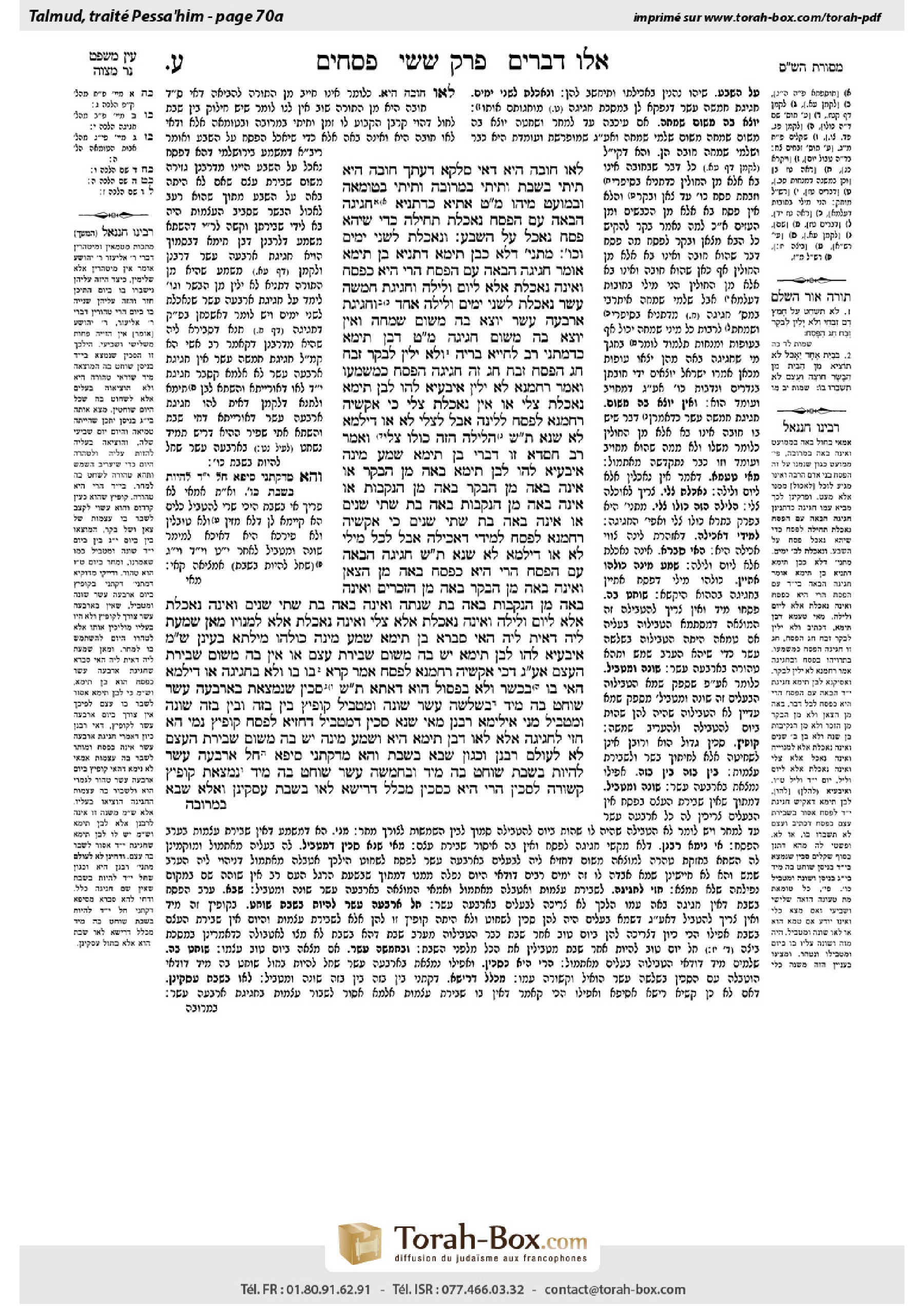
Pesachim 70a: Talmud study for Daf Yomi
Daf Yomi is the daily study of one Talmud folio. Explore 37 tractates with scans, Hebrew text, Sefaria English and AI-generated French translations where annotated.
Passage selection and English or AI-generated French translation are available where the scan has annotations. Daf Study is independent of Torah-Box and Sefaria.
Browse Pesachim · פסחים · All tractatesPesachim 70a text and translations
This page of Pesachim includes the Aramaic text, an English translation and an AI-generated French translation, alongside the scan above.
פסחים ע׳ א · Aramaic and Hebrew text
לָאו חוֹבָה הִיא. דְּאִי סָלְקָא דַעְתָּךְ חוֹבָה הִיא — תֵּיתֵי בְּשַׁבָּת, וְתֵיתֵי בִּמְרוּבֶּה, וְתֵיתֵי בְּטוּמְאָה.
וּבְמוּעָט מִיהוּ מַאי טַעְמָא אַתְיָא? כִּדְתַנְיָא: חֲגִיגָה הַבָּאָה עִם הַפֶּסַח נֶאֱכֶלֶת תְּחִילָּה, כְּדֵי שֶׁיְּהֵא פֶּסַח נֶאֱכָל עַל הַשָּׂבָע.
וְנֶאֱכֶלֶת לִשְׁנֵי יָמִים וְכוּ׳. מַתְנִיתִין דְּלָא כְּבֶן תֵּימָא. דְּתַנְיָא, בֶּן תֵּימָא אוֹמֵר: חֲגִיגָה הַבָּאָה עִם הַפֶּסַח הֲרֵי הִיא כַּפֶּסַח, וְאֵינָהּ נֶאֱכֶלֶת אֶלָּא לְיוֹם וָלַיְלָה. וַחֲגִיגַת חֲמִשָּׁה עָשָׂר — נֶאֱכֶלֶת לִשְׁנֵי יָמִים וְלַיְלָה אֶחָד.
וַחֲגִיגַת אַרְבָּעָה עָשָׂר יוֹצֵא בָּהּ מִשּׁוּם שִׂמְחָה, וְאֵין יוֹצֵא בָּהּ מִשּׁוּם חֲגִיגָה.
מַאי טַעְמָא דְּבֶן תֵּימָא? כִּדְמַתְנֵי רַב לְחִיָּיא בְּרֵיהּ: ״וְלֹא יָלִין לַבֹּקֶר זֶבַח חַג הַפָּסַח״, ״זֶבַח חַג״ — זֶה חֲגִיגָה, ״הַפָּסַח״ — כְּמַשְׁמָעוֹ, וְאָמַר רַחֲמָנָא: ״לֹא יָלִין״.
אִיבַּעְיָא לְהוּ: לְבֶן תֵּימָא נֶאֱכֶלֶת צָלִי אוֹ אֵין נֶאֱכֶלֶת צָלִי? כִּי אַקְּשֵׁיהּ רַחֲמָנָא לְפֶסַח — לְלִינָה, אֲבָל לְצָלִי — לָא, אוֹ דִילְמָא לָא שְׁנָא?
תָּא שְׁמַע: הַלַּיְלָה הַזֶּה כּוּלּוֹ צָלִי. וְאָמַר רַב חִסְדָּא: זוֹ דִּבְרֵי בֶּן תֵּימָא. שְׁמַע מִינַּהּ.
אִיבַּעְיָא לְהוּ לְבֶן תֵּימָא: בָּאָה מִן הַבָּקָר אוֹ אֵינָהּ בָּאָה מִן הַבָּקָר, בָּאָה מִן הַנְּקֵבוֹת אוֹ אֵינָהּ בָּאָה מִן הַנְּקֵבוֹת, בָּאָה בַּת שְׁתֵּי שָׁנִים אוֹ אֵינָהּ בָּאָה בַּת שְׁתֵּי שָׁנִים?
כִּי אַקְּשֵׁיהּ רַחֲמָנָא לְפֶסַח — לְמִידֵּי דַאֲכִילָה, אֲבָל לְכׇל מִילֵּי — לָא, אוֹ דִילְמָא לָא שְׁנָא.
תָּא שְׁמַע: חֲגִיגָה הַבָּאָה עִם הַפֶּסַח הֲרֵי הִיא כְּפֶסַח, בָּאָה מִן הַצֹּאן וְאֵינָהּ בָּאָה מִן הַבָּקָר, בָּאָה מִן הַזְּכָרִים וְאֵינָהּ בָּאָה מִן הַנְּקֵבוֹת, בָּאָה בַּת שְׁנָתָהּ וְאֵינָהּ בָּאָה בַּת שְׁתֵּי שָׁנִים, וְאֵינָהּ נֶאֱכֶלֶת אֶלָּא לְיוֹם וָלַיְלָה, וְאֵינָהּ נֶאֱכֶלֶת אֶלָּא צָלִי, וְאֵינָהּ נֶאֱכֶלֶת אֶלָּא לִמְנוּיָו.
מַאן שָׁמְעַתְּ לֵיהּ דְּאִית לֵיהּ הַאי סְבָרָא — בֶּן תֵּימָא, שְׁמַע מִינַּהּ כּוּלְּהוּ מִילְּתָא בָּעֵינַן, שְׁמַע מִינַּהּ.
אִיבַּעְיָא לְהוּ לְבֶן תֵּימָא: יֵשׁ בָּהּ מִשּׁוּם שְׁבִירַת עֶצֶם, אוֹ אֵין בָּהּ מִשּׁוּם שְׁבִירַת הָעֶצֶם? אַף עַל גַּב דְּכִי אַקְּשֵׁיהּ רַחֲמָנָא לְפֶסַח, אָמַר קְרָא: ״בּוֹ״. ״בּוֹ״ — וְלֹא בַּחֲגִיגָה. אוֹ דִילְמָא, הַאי ״בּוֹ״ — בְּכָשֵׁר וְלֹא בְּפָסוּל הוּא דַּאֲתָא.
תָּא שְׁמַע: סַכִּין שֶׁנִּמְצֵאת בְּאַרְבָּעָה עָשָׂר — שׁוֹחֵט בָּהּ מִיָּד. בִּשְׁלֹשָׁה עָשָׂר — שׁוֹנֶה וּמַטְבִּיל. קוֹפִיץ בֵּין בָּזֶה וּבֵין בָּזֶה — שׁוֹנֶה וּמַטְבִּיל.
מַנִּי? אִילֵּימָא רַבָּנַן, מַאי שְׁנָא סַכִּין דְּמַטְבִּיל — דְּחַזְיָא לְפֶסַח, קוֹפִיץ נָמֵי — הָא חֲזֵי לַחֲגִיגָה.
אֶלָּא לָאו, דְּבֶן תֵּימָא הִיא, וּשְׁמַע מִינַּהּ יֵשׁ בָּהּ מִשּׁוּם שְׁבִירַת הָעֶצֶם.
לָא, לְעוֹלָם רַבָּנַן, וּכְגוֹן שֶׁבָּא בַּשַּׁבָּת.
וְהָא מִדְּקָתָנֵי סֵיפָא: חָל אַרְבָּעָה עָשָׂר לִהְיוֹת בְּשַׁבָּת — שׁוֹחֵט בָּהּ מִיָּד, וּבַחֲמִשָּׁה עָשָׂר — שׁוֹחֵט בָּהּ מִיָּד. נִמְצֵאת קוֹפִיץ קְשׁוּרָה לְסַכִּין — הֲרֵי הִיא כַּסַּכִּין. מִכְּלָל דְּרֵישָׁא לָאו בְּשַׁבָּת עָסְקִינַן.
וְאֶלָּא שֶׁבָּא
Pesachim 70a · English translation
is not an obligation, meaning there is no Torah obligation to bring this offering. For if it should enter your mind to say that it is an obligation, it should come even on Shabbat, and it should come even when each member of the group will receive a large portion of the Paschal lamb, and it should come even in a state of ritual impurity.
The Gemara asks: If there is no obligation to bring this offering, what is the reason that it nevertheless comes when each person’s portion of the Paschal lamb is small? The Gemara explains that the reason is as it was taught in a baraita: The Festival peace-offering that comes with the Paschal lamb is eaten first; the reason for this is so that the Paschal lamb will be eaten when one is already satiated. The Paschal lamb should not be eaten in a needy manner, but rather in joy and when one is already filled to satisfaction.
The mishna taught that the Festival peace-offering of the fourteenth is eaten for two days and the intervening night. The Gemara notes that the mishna is not in accordance with the opinion of ben Teima, for it was taught in a baraita that ben Teima says: The Festival peace-offering that comes with the Paschal lamb on the fourteenth of Nisan is like the Paschal lamb and is eaten for only a day and a night, whereas the Festival peace-offering of the fifteenth, i.e., the Festival peace-offering brought on the first day of Passover, just as it is brought on the first day of each of the other Festivals, is treated like a regular peace-offering and is eaten for two days and one, i.e., the intervening, night.
And if one consecrated an animal to be used as a Festival peace-offering of the fourteenth, but it was not slaughtered on that day, on the next day he can fulfill with it his obligation to bring a peace-offering of rejoicing, as it is stated: “And you shall rejoice on your Festival,” but he cannot fulfill with it his obligation to bring a Festival peace-offering of the fifteenth.
The Gemara asks: What is the reason and scriptural basis for ben Teima’s opinion? The Gemara explains: As Rav taught his son Ḥiyya based on the following verse: “Neither shall the offering of the feast of the Passover be left to the morning” (Exodus 34:25). “The offering of the feast,” this is referring to the Festival peace-offering; “the Passover,” as per its plain meaning, i.e., this is referring to the Paschal lamb itself. And with regard to both sacrifices, the Merciful One states in the Torah: “It shall not be left to the morning.” This proves that the Festival peace-offering may be eaten for only a day and a night.
A dilemma was raised before the Sages: According to the opinion of ben Teima, is the Festival peace-offering that is brought with the Paschal lamb eaten roasted like the Paschal lamb itself or is it not eaten roasted? The possible considerations are as follows: When the Merciful One compares the Festival peace-offering to the Paschal lamb in the Torah, was that only with regard to leaving it over until the morning, but with regard to the mitzva of roasting, no such comparison is made? Or perhaps there is no difference; the comparison was complete, and the Festival peace-offering is roasted just like the Paschal lamb.
The Gemara suggests: Come and hear a solution from what was taught in a mishna: In the time of the Temple, one of the questions that the children would ask on the night of Passover was: How is this night different from all other nights? For on all other nights we eat meat that is roasted, stewed, or boiled, whereas on this night it is all roasted. And Rav Ḥisda said: This is the statement of ben Teima, indicating that even the Festival peace-offering of the fourteenth must be roasted. The Gemara concludes: Learn from this that the Festival peace-offering must be roasted just like the Paschal lamb.
Another dilemma was raised before the Sages: According to the opinion of ben Teima, does the Festival peace-offering of the fourteenth come from the herd or does it not come from the herd, like the Paschal offering, which must be brought from the flock? Does it come even from females or does it not come from females, just like the Paschal offering comes only from males? Does it come even from a two-year-old animal or does it not come from a two-year-old animal, but rather only from a one-year-old animal, like the Paschal offering itself?
The Gemara explains that this dilemma is based on a fundamental question similar to the one raised earlier: When the Merciful One compares the Festival peace-offering to the Paschal lamb in the Torah, was that only with regard to matters pertaining to eating and the time during which the Paschal lamb must be eaten, but for everything else there is no comparison? Or perhaps there is no difference and the Torah compared these two offerings in every way.
Come and hear an answer to these questions from what was taught in a baraita: The Festival peace-offering that comes with the Paschal offering on the fourteenth of Nisan is like the Paschal offering in every respect. It comes from the flock and does not come from the herd, it comes from males and does not come from females, it comes from an animal that is a year old and does not come from an animal that is two years old, and it is eaten for only a day and a night, and it is eaten only roasted, and it is eaten only by those who registered for it in advance.
The Gemara explains how this baraita answers the questions raised above: Who have you heard adopts this reasoning, comparing the Paschal offering and the Festival peace-offering of the fourteenth? Surely it is ben Teima. Learn from this that we require everything, that the Festival peace-offering of the fourteenth must parallel the Paschal offering in all its details. The Gemara concludes: Indeed, learn from this that they are comparable in every way.
Yet another dilemma was raised before the Sages: According to the opinion of ben Teima, is the Festival peace-offering of the fourteenth subject to the prohibition against breaking a bone, as is the Paschal lamb, with regard to which the Torah explicitly states: “And you shall not break a bone in it” (Exodus 12:46), or is it not subject to the prohibition against breaking a bone? The possible considerations are as follows: Do we say that even though the Merciful One compares the Festival peace-offering to the Paschal lamb, the verse that teaches the prohibition against breaking a bone says “in it,” and these words serve as a qualifying statement, indicating that the prohibition applies only in it, the Paschal lamb, and not in the Festival peace-offering that comes with it? Or perhaps this term, “in it,” teaches that the prohibition applies only to a fit Paschal lamb but not to a disqualified one.
The Gemara proposes: Come and hear a solution based on the following mishna: If a slaughtering knife was found on the fourteenth day of Nisan in Jerusalem, one may slaughter with it immediately without concern that perhaps it is ritually impure, for presumably any knife that is valid for slaughtering had already been immersed on the previous day so that it could be used for slaughtering the Paschal lamb. But if it was found on the thirteenth day of Nisan, he must immerse it again due to the possibility that it had not yet been immersed and purified.As for a cleaver [kofitz], a large knife that is used primarily for chopping bones, whether it was found on this day, the fourteenth, or on the other day, the thirteenth, he must immerse it again.
The Gemara clarifies: Whose opinion is taught in this mishna? If you say it is the opinion of the Rabbis, who permit breaking the bones of the Festival peace-offering of the fourteenth, what is different about a slaughtering knife found on the fourteenth that we say its owner presumably immersed it on the previous day? Is it because it is fit for slaughtering the Paschal lamb? If so, a cleaver found on the fourteenth should also not require immersion before being used, for presumably its owner already immersed it, as it is fit for chopping the bones of the Festival peace-offering.
Rather, is it not the opinion of ben Teima, and learn from this that even the Festival peace-offering of the fourteenth is subject to the prohibition against breaking a bone, and therefore a cleaver must be immersed again even if it was found on the fourteenth. Since no bones may be broken on the fourteenth of Nisan, neither those of the Paschal lamb nor those of the Festival peace-offering, it is possible that the knife was not immersed in preparation for the Festival.
The Gemara rejects this proof: No, actually one can explain that the mishna reflects the opinion of the Rabbis, and it is referring to a case where the time to slaughter the Paschal lamb comes on Shabbat. In this circumstance, all agree that the Festival peace-offering of the fourteenth is not sacrificed. Since there is no need for a cleaver, there is no reason to assume that the knife had been immersed in preparation for the Festival.
The Gemara asks: But from the fact that the latter clause of that same mishna teaches that if the fourteenth of Nisan occurred on Shabbat he may slaughter with the knife immediately, without immersing it, and similarly, if he found it on the fifteenth, i.e., on the first day of the Festival, he may slaughter with it immediately, as it was certainly immersed the day before, and if a cleaver was found tied to a slaughtering knife, then even if it was found on the fourteenth on a weekday, it is like the slaughtering knife, as they were certainly immersed together, it follows by inference that in the first clause of the mishna we are not dealing with a case where the fourteenth of Nisan occurred on Shabbat.
Rather, this understanding must be rejected and instead we should say that the mishna is talking about a case where the Paschal lamb came
Pesachim 70a · Traduction française (IA)
n’est pas une obligation, c’est-à-dire qu’il n’existe aucune obligation de la Torah d’apporter cette offrande. Car si l’on pouvait penser qu’il s’agit d’une obligation, elle devrait être apportée même le Chabbat, même lorsque chaque membre du groupe reçoit une grande part de l’agneau pascal, et même en état d’impureté rituelle.
La Guemara demande : S’il n’y a pas d’obligation d’apporter cette offrande, pourquoi l’apporte-t-on néanmoins lorsque la part d’agneau pascal de chacun est petite ? La Guemara explique que c’est pour la raison enseignée dans une baraïta : l’offrande de paix du pèlerinage apportée avec l’agneau pascal est consommée en premier, afin que l’agneau pascal soit mangé alors que l’on est déjà rassasié. L’agneau pascal ne doit pas être mangé dans le dénuement, mais plutôt dans la joie et après s’être rassasié.
La Michna enseignait que l’offrande de paix du pèlerinage du quatorze est consommée pendant deux jours et la nuit intermédiaire. La Guemara relève que la Michna ne suit pas l’opinion de ben Teima, car une baraïta enseigne que ben Teima dit : « L’offrande de paix du pèlerinage apportée avec l’agneau pascal le quatorze nissan est comme l’agneau pascal et n’est consommée que pendant un jour et une nuit. En revanche, l’offrande de paix du pèlerinage du quinze, c’est-à-dire celle apportée le premier jour de Pessa’h, tout comme celle apportée le premier jour de chacune des autres fêtes, est traitée comme une offrande de paix ordinaire et est consommée pendant deux jours et une nuit, c’est-à-dire la nuit intermédiaire. »
Et si quelqu’un avait consacré un animal comme offrande de paix du pèlerinage du quatorze, mais ne l’avait pas abattu ce jour-là, il peut, le lendemain, s’acquitter grâce à lui de son obligation d’apporter une offrande de paix de réjouissance, comme il est dit : « Tu te réjouiras lors de ta fête », mais il ne peut pas s’acquitter grâce à lui de son obligation d’apporter une offrande de paix du pèlerinage du quinze.
La Guemara demande : Quel est le motif et le fondement scripturaire de l’opinion de ben Teima ? La Guemara explique : Rav enseigna à son fils Ḥiyya le verset suivant : « Que l’offrande du sacrifice de la fête de Pessa’h ne soit pas laissée jusqu’au matin » (Exode 34:25). « L’offrande du sacrifice de la fête » désigne l’offrande de paix du pèlerinage ; « de Pessa’h », selon son sens littéral, désigne l’agneau pascal lui-même. Au sujet de ces deux sacrifices, le Miséricordieux dit dans la Torah : « Qu’elle ne soit pas laissée jusqu’au matin. » Cela prouve que l’offrande de paix du pèlerinage ne peut être consommée que pendant un jour et une nuit.
Une question fut posée aux Sages : Selon l’opinion de ben Teima, l’offrande de paix du pèlerinage apportée avec l’agneau pascal doit-elle être mangée rôtie, comme l’agneau pascal lui-même, ou non ? Les possibilités sont les suivantes : Lorsque le Miséricordieux assimile dans la Torah l’offrande de paix du pèlerinage à l’agneau pascal, cette assimilation concerne-t-elle uniquement l’interdiction de la laisser jusqu’au matin, sans s’étendre à la mitsva de la rôtir ? Ou bien l’assimilation est-elle complète, de sorte que l’offrande de paix du pèlerinage doit être rôtie comme l’agneau pascal ?
La Guemara suggère : « Viens et écoute » une réponse tirée de ce qui est enseigné dans une Michna : À l’époque du Temple, l’une des questions que les enfants posaient le soir de Pessa’h était : « En quoi cette nuit diffère-t-elle de toutes les autres nuits ? Car toutes les autres nuits, nous mangeons de la viande rôtie, mijotée ou bouillie, tandis que cette nuit, elle est entièrement rôtie. » Rav Ḥisda dit : « C’est l’enseignement de ben Teima », ce qui indique que même l’offrande de paix du pèlerinage du quatorze doit être rôtie. La Guemara conclut : Apprends-en que l’offrande de paix du pèlerinage doit être rôtie comme l’agneau pascal.
Une autre question fut posée aux Sages : Selon l’opinion de ben Teima, l’offrande de paix du pèlerinage du quatorze provient-elle du gros bétail ou non, comme l’offrande pascale, qui doit provenir du petit bétail ? Peut-elle aussi provenir de femelles ou non, alors que l’offrande pascale ne provient que de mâles ? Peut-elle aussi provenir d’un animal âgé de deux ans ou non, mais seulement d’un animal âgé d’un an, comme l’offrande pascale elle-même ?
La Guemara explique que cette question repose sur une interrogation fondamentale semblable à celle soulevée précédemment : Lorsque le Miséricordieux assimile dans la Torah l’offrande de paix du pèlerinage à l’agneau pascal, cette assimilation concerne-t-elle uniquement les règles relatives à la consommation et à la période pendant laquelle l’agneau pascal doit être mangé, sans s’étendre à tout le reste ? Ou bien le rapprochement est-il complet et la Torah a-t-elle assimilé ces deux offrandes à tous égards ?
« Viens et écoute » la réponse à ces questions, tirée de ce qui est enseigné dans une baraïta : « L’offrande de paix du pèlerinage apportée avec l’offrande pascale le quatorze nissan est semblable à l’offrande pascale à tous égards. Elle provient du petit bétail et non du gros bétail ; elle provient de mâles et non de femelles ; elle provient d’un animal âgé d’un an et non d’un animal âgé de deux ans ; elle n’est consommée que pendant un jour et une nuit, uniquement rôtie, et uniquement par ceux qui s’y sont inscrits à l’avance. »
La Guemara explique en quoi cette baraïta répond aux questions soulevées précédemment : Qui, parmi les tannaïm, as-tu entendu adopter ce raisonnement, en assimilant l’offrande pascale à l’offrande de paix du pèlerinage du quatorze ? C’est ben Teima. Apprends-en que toutes ces règles s’appliquent : l’offrande de paix du pèlerinage du quatorze doit correspondre à l’offrande pascale dans tous ses détails. La Guemara conclut : En effet, apprends-en qu’elles sont assimilées à tous égards.
Une autre question fut posée aux Sages : Selon l’opinion de ben Teima, l’offrande de paix du pèlerinage du quatorze est-elle soumise à l’interdiction de briser un os, comme l’agneau pascal, au sujet duquel la Torah dit explicitement : « Vous n’en briserez aucun os » (Exode 12:46), ou n’y est-elle pas soumise ? Les possibilités sont les suivantes : Bien que le Miséricordieux assimile l’offrande de paix du pèlerinage à l’agneau pascal, peut-on considérer que le verset qui enseigne l’interdiction de briser un os dit « en lui », et que ces mots constituent une restriction indiquant que l’interdiction ne s’applique qu’à l’agneau pascal lui-même et non à l’offrande de paix du pèlerinage apportée avec lui ? Ou peut-être l’expression « en lui » enseigne-t-elle que l’interdiction ne s’applique qu’à un agneau pascal valide, mais non à un agneau pascal disqualifié ?
La Guemara propose : « Viens et écoute » une réponse fondée sur la Michna suivante : Si l’on trouvait à Jérusalem, le quatorze nissan, un couteau d’abattage, on pouvait s’en servir immédiatement sans craindre qu’il soit rituellement impur, car on présumait que tout couteau apte à l’abattage avait déjà été immergé la veille afin de pouvoir servir à l’abattage de l’agneau pascal. Mais s’il était trouvé le treize nissan, il fallait l’immerger de nouveau, car il était possible qu’il n’ait pas encore été immergé et purifié. Quant à un couperet [kofitz], grand couteau principalement utilisé pour couper des os, qu’il ait été trouvé ce jour-ci, le quatorze, ou l’autre jour, le treize, il fallait l’immerger de nouveau.
La Guemara précise : De qui est l’opinion enseignée dans cette Michna ? Si tu dis qu’il s’agit de l’opinion des Rabbins, qui autorisent à briser les os de l’offrande de paix du pèlerinage du quatorze, en quoi le couteau d’abattage trouvé le quatorze diffère-t-il, pour que nous disions que son propriétaire l’avait vraisemblablement immergé la veille ? Est-ce parce qu’il convient à l’abattage de l’agneau pascal ? Dans ce cas, un couperet trouvé le quatorze ne devrait pas non plus nécessiter d’immersion avant d’être utilisé, car son propriétaire l’avait vraisemblablement déjà immergé, puisqu’il convient pour couper les os de l’offrande de paix du pèlerinage.
Ne s’agit-il pas plutôt de l’opinion de ben Teima ? Apprends-en que même l’offrande de paix du pèlerinage du quatorze est soumise à l’interdiction de briser un os ; c’est pourquoi il faut immerger de nouveau un couperet même s’il a été trouvé le quatorze. Puisqu’il est interdit de briser des os le quatorze nissan, qu’il s’agisse de ceux de l’agneau pascal ou de ceux de l’offrande de paix du pèlerinage, il est possible que le couperet n’ait pas été immergé en prévision de la fête.
La Guemara rejette cette preuve : Non, on peut en réalité expliquer que la Michna reflète l’opinion des Rabbins et qu’elle traite d’un cas où le moment d’abattre l’agneau pascal tombe un Chabbat. Dans ces circonstances, tous conviennent que l’offrande de paix du pèlerinage du quatorze n’est pas sacrifiée. Comme il n’est pas nécessaire d’avoir un couperet, rien ne permet de supposer qu’il avait été immergé en prévision de la fête.
La Guemara demande : Mais puisque la dernière partie de cette même Michna enseigne que, si le quatorze nissan tombe un Chabbat, on peut se servir immédiatement du couteau pour l’abattage, sans l’immerger, et que de même, si on le trouve le quinze, c’est-à-dire le premier jour de la fête, on peut s’en servir immédiatement pour l’abattage, car il a certainement été immergé la veille ; et puisqu’elle enseigne que si l’on trouve un couperet attaché à un couteau d’abattage, alors, même s’il est trouvé le quatorze en semaine, il est comme le couteau d’abattage, puisqu’ils ont certainement été immergés ensemble, il s’ensuit, par déduction, que dans la première partie de la Michna, nous ne traitons pas d’un cas où le quatorze nissan tombe un Chabbat.
Il faut donc rejeter cette interprétation et dire plutôt que la Michna parle d’un cas où l’agneau pascal est arrivé
Traduction française générée par IA à partir de l’édition anglaise de Sefaria. Vérifie toujours un passage avec le texte source.
Text from Sefaria: William Davidson Edition - Vocalized Aramaic (CC BY NC); William Davidson Edition - English (CC BY NC).