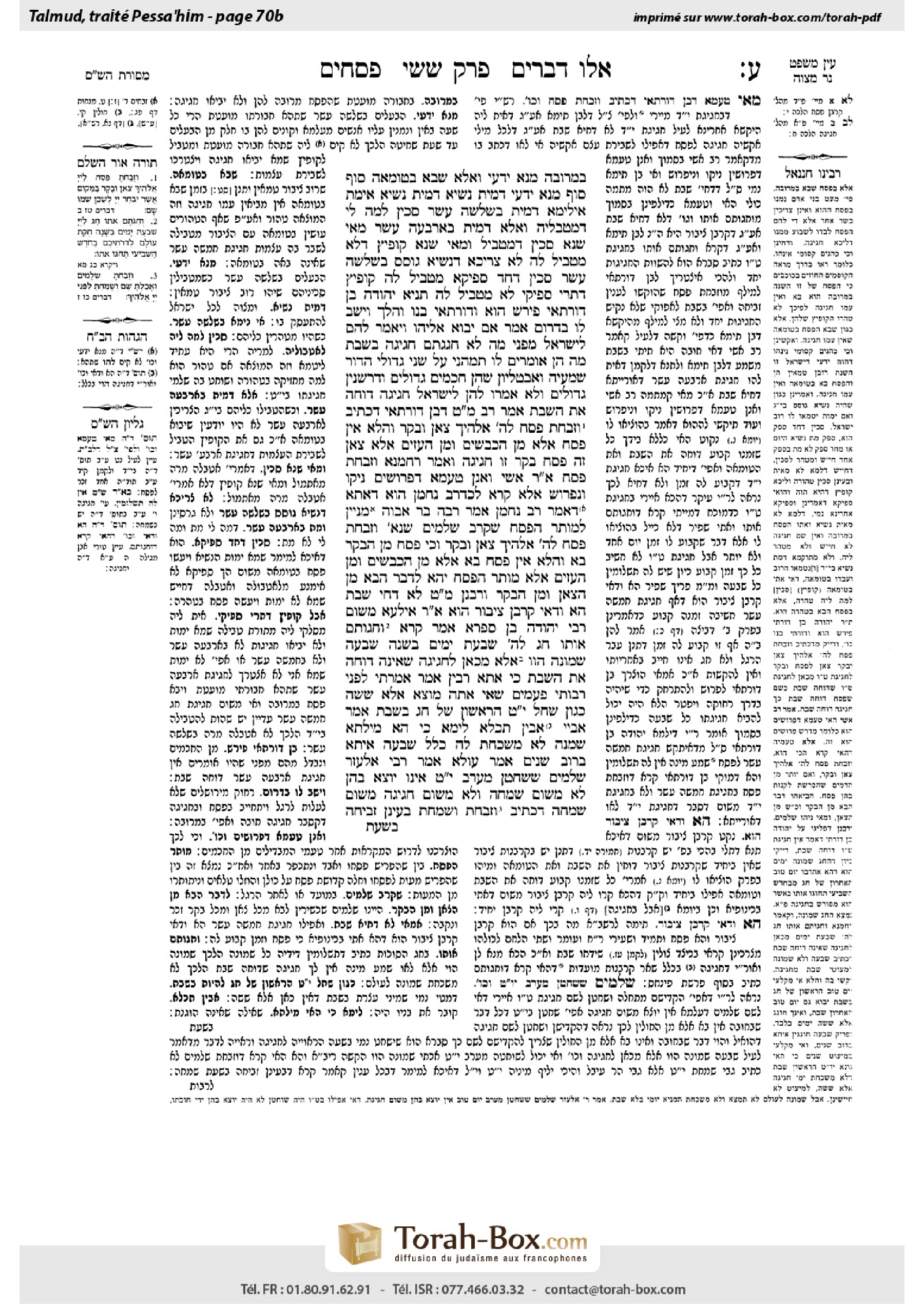
Pesachim 70b: Talmud study for Daf Yomi
Daf Yomi is the daily study of one Talmud folio. Explore 37 tractates with scans, Hebrew text, Sefaria English and AI-generated French translations where annotated.
Passage selection and English or AI-generated French translation are available where the scan has annotations. Daf Study is independent of Torah-Box and Sefaria.
Browse Pesachim · פסחים · All tractatesPesachim 70b text and translations
This page of Pesachim includes the Aramaic text, an English translation and an AI-generated French translation, alongside the scan above.
פסחים ע׳ ב · Aramaic and Hebrew text
בִּמְרוּבֶּה. מְנָא יָדְעִי?
וְאֶלָּא שֶׁבָּא בְּטוּמְאָה. סוֹף סוֹף, מְנָא יָדְעִי?
דְּמִית נָשִׂיא. דְּמִית נָשִׂיא אֵימַת? אִילֵּימָא דְּמִית בִּשְׁלֹשָׁה עָשָׂר — סַכִּין לְמָה לִי דְּמַטְבְּלֵיהּ? וְאֶלָּא דְּמִית בְּאַרְבָּעָה עָשָׂר. מַאי שְׁנָא סַכִּין דְּמַטְבֵּיל, וּמַאי שְׁנָא קוֹפִיץ דְּלָא מַטְבֵּיל לֵהּ?
לָא צְרִיכָא, דְּנָשִׂיא גּוֹסֵס בִּשְׁלֹשָׁה עָשָׂר. סַכִּין, דְּחַד סְפֵיקָא — מַטְבֵּיל לֵהּ. קוֹפִיץ, דִּתְרֵי סְפֵיקֵי — לָא מַטְבֵּיל לֵהּ.
תַּנְיָא, יְהוּדָה בֶּן דּוֹרְתַאי פֵּירַשׁ הוּא וְדוֹרְתַאי בְּנוֹ, וְהָלַךְ וְיָשַׁב לוֹ בַּדָּרוֹם. אָמַר: אִם יָבוֹא אֵלִיָּהוּ וְיֹאמַר לָהֶם לְיִשְׂרָאֵל: מִפְּנֵי מָה לֹא חֲגַגְתֶּם חֲגִיגָה בַּשַּׁבָּת, מָה הֵן אוֹמְרִים לוֹ? תְּמֵהַנִי עַל שְׁנֵי גְּדוֹלֵי הַדּוֹר שְׁמַעְיָה וְאַבְטַלְיוֹן שֶׁהֵן חֲכָמִים גְּדוֹלִים וְדַרְשָׁנִין גְּדוֹלִים, וְלֹא אָמְרוּ לָהֶן לְיִשְׂרָאֵל חֲגִיגָה דּוֹחָה אֶת הַשַּׁבָּת.
אָמַר רַב: מַאי טַעְמָא דְּבֶן דּוֹרְתַאי, דִּכְתִיב: ״וְזָבַחְתָּ פֶּסַח לַה׳ אֱלֹהֶיךָ צֹאן וּבָקָר״, וַהֲלֹא אֵין פֶּסַח אֶלָּא מִן הַכְּבָשִׂים וּמִן הָעִזִּים! אֶלָּא: ״צֹאן״ — זֶה פֶּסַח, ״בָּקָר״ — זוֹ חֲגִיגָה, וְאָמַר רַחֲמָנָא ״וְזָבַחְתָּ פֶּסַח״!
אָמַר רַב אָשֵׁי: וַאֲנַן טַעְמָא דִּפְרוּשִׁים נֵיקוּ וְנִפְרוֹשׁ? אֶלָּא קְרָא לְכִדְרַב נַחְמָן הוּא דַּאֲתָא, דְּאָמַר רַב נַחְמָן אָמַר רַבָּה בַּר אֲבוּהּ: מִנַּיִין לְמוֹתַר הַפֶּסַח שֶׁקָּרֵב שְׁלָמִים —
שֶׁנֶּאֱמַר: ״וְזָבַחְתָּ פֶּסַח לַה׳ אֱלֹהֶיךָ צֹאן וּבָקָר״. וְכִי פֶּסַח מִן הַבָּקָר בָּא? וַהֲלֹא אֵין פֶּסַח בָּא אֶלָּא מִן הַכְּבָשִׂים וּמִן הָעִזִּים! אֶלָּא מוֹתַר הַפֶּסַח יְהֵא לְדָבָר הַבָּא מִן הַצֹּאן וּמִן הַבָּקָר.
וְרַבָּנַן, מַאי טַעְמָא לָא דָּחֵי שַׁבָּת? הָא וַדַּאי קׇרְבַּן צִיבּוּר הוּא!
אָמַר רַבִּי אִילְעָא מִשּׁוּם רַבִּי יְהוּדָה בֶּן סָפְרָא, אָמַר קְרָא: ״וְחַגֹּתֶם אֹתוֹ חַג לַה׳ שִׁבְעַת יָמִים בַּשָּׁנָה״. שִׁבְעָה? שְׁמוֹנָה הֲווֹ! אֶלָּא מִכָּאן לַחֲגִיגָה שֶׁאֵינָהּ דּוֹחָה אֶת הַשַּׁבָּת.
כִּי אֲתָא רָבִין אָמַר: אָמַרְתִּי לִפְנֵי רַבּוֹתַי: פְּעָמִים שֶׁאִי אַתָּה מוֹצֵא אֶלָּא שִׁשָּׁה, כְּגוֹן שֶׁחָל יוֹם טוֹב הָרִאשׁוֹן שֶׁל חַג בַּשַּׁבָּת! אֲמַר אַבָּיֵי: אָבִין תַּכָּלָא לֵימָא כִּי הָא מִילְּתָא? שְׁמֹנָה לָא מַשְׁכַּחַתְּ לַהּ כְּלָל, שִׁבְעָה אִיתָא בְּרוֹב שָׁנִים.
אָמַר עוּלָּא אָמַר רַבִּי אֶלְעָזָר: שְׁלָמִים שֶׁשְּׁחָטָן מֵעֶרֶב יוֹם טוֹב, אֵינוֹ יוֹצֵא בָּהֶן לֹא מִשּׁוּם שִׂמְחָה וְלֹא מִשּׁוּם חֲגִיגָה. מִשּׁוּם שִׂמְחָה, דִּכְתִיב: ״וְזָבַחְתָּ ... וְשָׂמַחְתָּ״ — בָּעֵינַן זְבִיחָה
Pesachim 70b · English translation
with few people registered for it, so that each person receives a large portion of the offering. Therefore, there is no need for a Festival peace-offering or for a cleaver. The Gemara questions this answer: How do the owners know already on the thirteenth that only a small number of people will be registered for the Paschal lamb? Perhaps more people will register for the offering before it is slaughtered, in which case we should assume that the cleaver was immersed, as it might be necessary to bring a Festival peace-offering together with the Paschal lamb.
Rather, we must say that we are talking about a Paschal lamb that came in a state of ritual impurity, in which case a Festival peace-offering is not brought, and consequently there is no need for a cleaver. The Gemara asks: Ultimately, how do the owners know already on the thirteenth when they are immersing their knives that the Paschal lamb will be brought in ritual impurity, so that they need not immerse their chopping knives? Perhaps it will turn out that most of the community is ritually pure.
The Gemara answers that we are talking about a situation where the Nasi died, in which case all of Israel must defile themselves in order to participate in his burial. The Gemara asks: When did the Nasi die? If you say that he died on the thirteenth and everyone became ritually impure as a result, why do I need to immerse the slaughtering knife to begin with? It will become ritually impure again in any event. Rather, he died on the fourteenth and they did not know in advance that the Paschal lamb would be brought in a state of impurity. But if so, what is different about the slaughtering knife that he immerses it and what is different about the cleaver that he does not immerse it?
The Gemara answers: It was necessary to teach this halakha only in a case where the Nasi was in a dying state on the thirteenth. With regard to a slaughtering knife, about which there is only one doubt, that perhaps the Nasi will die before the Festival and the Paschal lamb will be brought in a state of ritual impurity, he immerses it, for if the Nasi does not die he will need a ritually pure knife to slaughter his Paschal lamb. With regard to a cleaver, about which there are two doubts, that perhaps the Nasi will die and a ritually pure knife will not be needed, and that even if he does not die, perhaps the meat of the Paschal lamb will be plentiful and the Festival peace-offering will not be brought, he does not immerse it.
It was taught in a baraita: Yehuda ben Dortai separated himself from the other Rabbis, he and Dortai his son, and went and settled in the south so that he would not be obligated to bring the Paschal lamb, seeing that he was at a great distance from Jerusalem. He did this because he disagreed with the Rabbis with regard to the Festival peace-offering of the fourteenth, which in their view does not override Shabbat. He said: If Elijah will come and say to the Jewish people: For what reason did you not sacrifice the Festival peace-offering on Shabbat, what will they say to him? I am astounded at the two most eminent scholars of the generation, Shemaya and Avtalyon, who are great sages and great expositors of the Torah, and yet they did not tell the Jewish people that even the Festival peace-offering of the fourteenth overrides Shabbat.
Rav said: What is ben Dortai’s reason? As it is written: “And you shall slaughter the Paschal offering to the Lord your God from the flock and from the herd, in the place which the Lord shall choose to rest His name there” (Deuteronomy 16:2). A question must be asked: Does the Paschal offering come from the herd, i.e., from cattle? Doesn’t the Paschal offering come from only the sheep and from the goats, as commanded in the book of Exodus (12:5)? Rather, the verse should be understood as follows. “Flock”; this is referring to the Paschal offering. “Herd”; this is referring to the Festival peace-offering that is brought along with it. And the Merciful One says: “And you shall slaughter the Paschal offering,” thus teaching that the two offerings are sacrificed together. From here ben Dortai derived that the Festival peace-offering of the fourteenth is like the Paschal offering in every way, and so it too overrides Shabbat.
Rav Ashi said: Need we arise and explain the reason of those who separated themselves from the other Rabbis? Ben Dortai and his son broke away from all the other sages of the Jewish people, and we need not occupy ourselves with the opinions of such people. Rather, the verse comes to explain the opinion of Rav Naḥman, for Rav Naḥman said that Rabba bar Avuh said: From where is it derived that a leftover Paschal offering is sacrificed as a peace-offering? A leftover Paschal offering is an animal that had been consecrated as a Paschal offering but was subsequently lost and later found after a different animal had already been sacrificed in its place. Alternatively, if one set aside and consecrated money for the purchase of a Paschal lamb and then the price of livestock dropped so that there was money left over after the purchase was made, the extra money has the status of a leftover Paschal lamb.
As it is stated: “And you shall slaughter the Paschal offering to the Lord your God from the flock and from the herd.” Does the Paschal offering come from the herd? Doesn’t it come from only the sheep and from the goats? Rather, the verse comes to teach that a leftover Paschal offering shall be brought as something that comes from the flock and from the herd, that is, as a peace-offering, which may be brought from all types of flock and cattle, including both males and females.
The Gemara asks about the crux of the matter: And according to the opinion of the Rabbis, what is the reason that the Festival peace-offering does not override Shabbat? It is certainly a communal offering, and all communal offerings override Shabbat.
Rabbi Ile’a said in the name of Rabbi Yehuda ben Safra: The verse said with regard to the festival of Sukkot: “And you shall celebrate it as a Festival for the Lord, seven days in the year; it shall be a statute forever in your generations; you shall celebrate it in the seventh month” (Leviticus 23:41). Now is the festival of Sukkot seven days? They are eight days, as the Eighth Day of Assembly is always celebrated at the conclusion of Sukkot. Rather, from here we derive that the Festival peace-offering [ḥagiga], about which the verse states: “And you shall celebrate [veḥagotem] it,” does not override Shabbat. Since every eight-day period contains a Shabbat, the Torah said that the Festival [ḥag] is celebrated, i.e., the Festival peace-offering [ḥagiga] can be brought the entire seven days of the Festival.
When Ravin came from Eretz Yisrael to Babylonia, he said: I said before my teachers, pointing out the following difficulty with regard to this source: There are times when you find only six days on which the Festival peace-offering can be brought, for example, when the first day of the Festival occurs on Shabbat, in which case the Eighth Day of Assembly also falls on Shabbat, and so there are only six days on which the Festival peace-offering may be brought. Abaye said: Would the bereaved Avin, another name for Ravin, say such a thing and be so careless as to ask an unfounded question? There is a big difference: Eight you do not find at all; the eight days of the Festival cannot possibly pass without a Shabbat. But seven days on which the Festival peace-offering can be brought are in fact found in most years.
Ulla said that Rabbi Elazar said: With regard to peace-offerings that one slaughtered on the eve of the Festival, one fulfills with them neither the mitzva to bring peace-offerings of rejoicing nor the mitzva to bring a Festival peace-offering. The mitzva of bringing peace-offerings of rejoicing is not fulfilled, as it is written: “And you shall slaughter peace-offerings and eat there, and you shall rejoice before the Lord your God” (Deuteronomy 27:7). Based on this verse, we require that the slaughter be
Pesachim 70b · Traduction française (IA)
avec peu de personnes inscrites pour y participer, de sorte que chacune reçoit une grande part de l’offrande. Il n’est donc nécessaire ni d’apporter un sacrifice de paix de fête ni d’utiliser un couperet. La Guemara conteste cette réponse : comment les propriétaires peuvent-ils savoir dès le treize qu’il n’y aura que peu de personnes inscrites pour l’agneau pascal ? Peut-être que d’autres personnes s’inscriront avant son abattage ; dans ce cas, il faudrait supposer que le couperet a été immergé, car il pourrait être nécessaire d’apporter un sacrifice de paix de fête avec l’agneau pascal.
Il faut plutôt dire que nous parlons d’un agneau pascal apporté dans un état d’impureté rituelle ; dans ce cas, on n’apporte pas de sacrifice de paix de fête et il n’est donc pas nécessaire d’utiliser un couperet. La Guemara demande : après tout, comment les propriétaires peuvent-ils savoir dès le treize, au moment où ils immergent leurs couteaux, que l’agneau pascal sera apporté dans un état d’impureté rituelle, de sorte qu’ils n’ont pas besoin d’immerger leurs couperets ? Peut-être s’avérera-t-il que la majorité de la communauté est rituellement pure.
La Guemara répond que nous parlons d’une situation où le Nassi est mort ; dans ce cas, tout Israël doit se rendre impur afin de participer à son enterrement. La Guemara demande : quand le Nassi est-il mort ? Si tu dis qu’il est mort le treize et que tous sont devenus rituellement impurs de ce fait, pourquoi faudrait-il immerger le couteau d’abattage ? Il redeviendra de toute façon rituellement impur. Il faut plutôt dire qu’il est mort le quatorze et qu’ils ne savaient pas à l’avance que l’agneau pascal serait apporté dans un état d’impureté rituelle. Mais alors, en quoi le couteau d’abattage diffère-t-il du couperet ? Pourquoi immerger le premier et ne pas immerger le second ?
La Guemara répond : cette halakha n’était nécessaire que dans le cas où le Nassi était à l’agonie le treize. Pour le couteau d’abattage, au sujet duquel il n’y a qu’un seul doute — peut-être le Nassi mourra-t-il avant la fête et l’agneau pascal sera-t-il apporté dans un état d’impureté rituelle —, on l’immerge, car si le Nassi ne meurt pas, il faudra un couteau rituellement pur pour abattre son agneau pascal. Quant au couperet, au sujet duquel il y a deux doutes — peut-être le Nassi mourra-t-il et n’aura-t-on pas besoin d’un couteau rituellement pur, et, même s’il ne meurt pas, peut-être la viande de l’agneau pascal sera-t-elle abondante et n’apportera-t-on pas de sacrifice de paix de fête —, on ne l’immerge pas.
Il a été enseigné dans une baraïta : Yehuda ben Dortai se sépara des autres rabbins, lui et son fils Dortai, et alla s’installer dans le sud afin de ne pas être tenu d’apporter l’agneau pascal, puisqu’il se trouvait très loin de Jérusalem. Il agit ainsi parce qu’il était en désaccord avec les rabbins au sujet du sacrifice de paix de fête du quatorze, qui, selon eux, ne repousse pas le Chabbat. Il dit : « Si Élie vient et demande au peuple juif : “Pourquoi n’avez-vous pas sacrifié le sacrifice de paix de fête le Chabbat ?”, que lui répondront-ils ? Je suis stupéfait que les deux plus éminents sages de la génération, Shemaya et Avtalyon, qui sont de grands sages et de grands interprètes de la Torah, n’aient pourtant pas dit au peuple juif que même le sacrifice de paix de fête du quatorze repousse le Chabbat. »
Rav dit : Quelle est la raison de ben Dortai ? Car il est écrit : « Tu sacrifieras l’offrande pascale à l’Éternel ton Dieu, du petit et du gros bétail, dans le lieu que l’Éternel choisira pour y faire résider Son nom » (Deutéronome 16:2). Il faut poser la question : l’offrande pascale provient-elle du gros bétail, c’est-à-dire des bovins ? Ne provient-elle pas uniquement des ovins et des caprins, comme cela est prescrit dans le livre de l’Exode (12:5) ? Il faut plutôt comprendre le verset ainsi : « Petit bétail » désigne l’offrande pascale ; « gros bétail » désigne le sacrifice de paix de fête qui l’accompagne. Et le Miséricordieux dit : « Tu sacrifieras l’offrande pascale », enseignant ainsi que les deux offrandes sont sacrifiées ensemble. Ben Dortai en déduit que le sacrifice de paix de fête du quatorze est semblable à l’offrande pascale à tous égards, et qu’il repousse donc lui aussi le Chabbat.
Rav Ashi dit : Faut-il donc nous mettre à expliquer la raison de ceux qui se sont séparés des autres rabbins ? Ben Dortai et son fils se sont détachés de tous les autres sages du peuple juif ; nous n’avons pas à nous occuper des opinions de tels hommes. Le verset vient plutôt expliquer l’opinion de Rav Naḥman, car Rav Naḥman a dit au nom de Rabba bar Avuh : D’où apprend-on qu’un agneau pascal restant est offert comme sacrifice de paix ? Un agneau pascal restant est un animal qui avait été consacré comme offrande pascale, mais qui avait ensuite été perdu puis retrouvé après qu’un autre animal eut déjà été sacrifié à sa place. Autre cas : quelqu’un avait mis à part et consacré de l’argent pour acheter un agneau pascal, puis le prix du bétail a baissé, si bien qu’il est resté de l’argent après l’achat ; cet excédent a le statut d’un agneau pascal restant.
Car il est dit : « Tu sacrifieras l’offrande pascale à l’Éternel ton Dieu, du petit et du gros bétail. » L’offrande pascale provient-elle du gros bétail ? Ne provient-elle pas uniquement des ovins et des caprins ? Le verset vient plutôt enseigner qu’un agneau pascal restant doit être offert comme une offrande provenant du petit et du gros bétail, c’est-à-dire comme un sacrifice de paix, qui peut être offert parmi toutes les espèces de petit et de gros bétail, mâles comme femelles.
La Guemara pose la question centrale : selon l’opinion des rabbins, pour quelle raison le sacrifice de paix de fête ne repousse-t-il pas le Chabbat ? C’est assurément une offrande communautaire, et toutes les offrandes communautaires repoussent le Chabbat.
Rabbi Ile’a a dit au nom de Rabbi Yehuda ben Safra : Le verset dit au sujet de la fête de Souccot : « Vous la célébrerez comme une fête pour l’Éternel pendant sept jours dans l’année ; ce sera une loi perpétuelle dans vos générations ; vous la célébrerez au septième mois » (Lévitique 23:41). Or, la fête de Souccot dure-t-elle sept jours ? Elle en dure huit, puisque le Huitième Jour d’Assemblée est toujours célébré à la fin de Souccot. Il faut plutôt déduire de là que le sacrifice de paix de fête [ḥagiga], au sujet duquel le verset dit : « Vous célébrerez [veḥagotem] », ne repousse pas le Chabbat. Puisque toute période de huit jours comprend un Chabbat, la Torah a dit que la fête [ḥag] est célébrée, c’est-à-dire que le sacrifice de paix de fête [ḥagiga] peut être offert pendant les sept jours de la fête.
Lorsque Ravin arriva d’Eretz Yisrael en Babylonie, il dit : « J’ai signalé à mes maîtres la difficulté suivante à propos de cette source : il arrive que l’on ne trouve que six jours où le sacrifice de paix de fête peut être offert, par exemple lorsque le premier jour de la fête tombe un Chabbat ; dans ce cas, le Huitième Jour d’Assemblée tombe également un Chabbat, si bien qu’il ne reste que six jours où le sacrifice de paix de fête peut être offert. » Abaye dit : « Le malheureux Avin — autre nom de Ravin — aurait-il dit une telle chose et posé avec tant de légèreté une question sans fondement ? Il y a une grande différence : on ne trouve jamais huit jours ; les huit jours de la fête ne peuvent pas s’écouler sans qu’il y ait un Chabbat. En revanche, il y a bien, la plupart des années, sept jours où le sacrifice de paix de fête peut être offert. »
Oulla a dit que Rabbi Elazar a dit : Pour les sacrifices de paix que l’on a abattus la veille de la fête, on ne s’acquitte ni de la mitsva d’apporter des sacrifices de paix de réjouissance ni de la mitsva d’apporter un sacrifice de paix de fête. On ne s’acquitte pas de la mitsva d’apporter des sacrifices de paix de réjouissance, car il est écrit : « Tu sacrifieras des sacrifices de paix, tu mangeras là-bas et tu te réjouiras devant l’Éternel ton Dieu » (Deutéronome 27:7). Sur la base de ce verset, nous exigeons que l’abattage ait lieu
Traduction française générée par IA à partir de l’édition anglaise de Sefaria. Vérifie toujours un passage avec le texte source.
Text from Sefaria: William Davidson Edition - Vocalized Aramaic (CC BY NC); William Davidson Edition - English (CC BY NC).