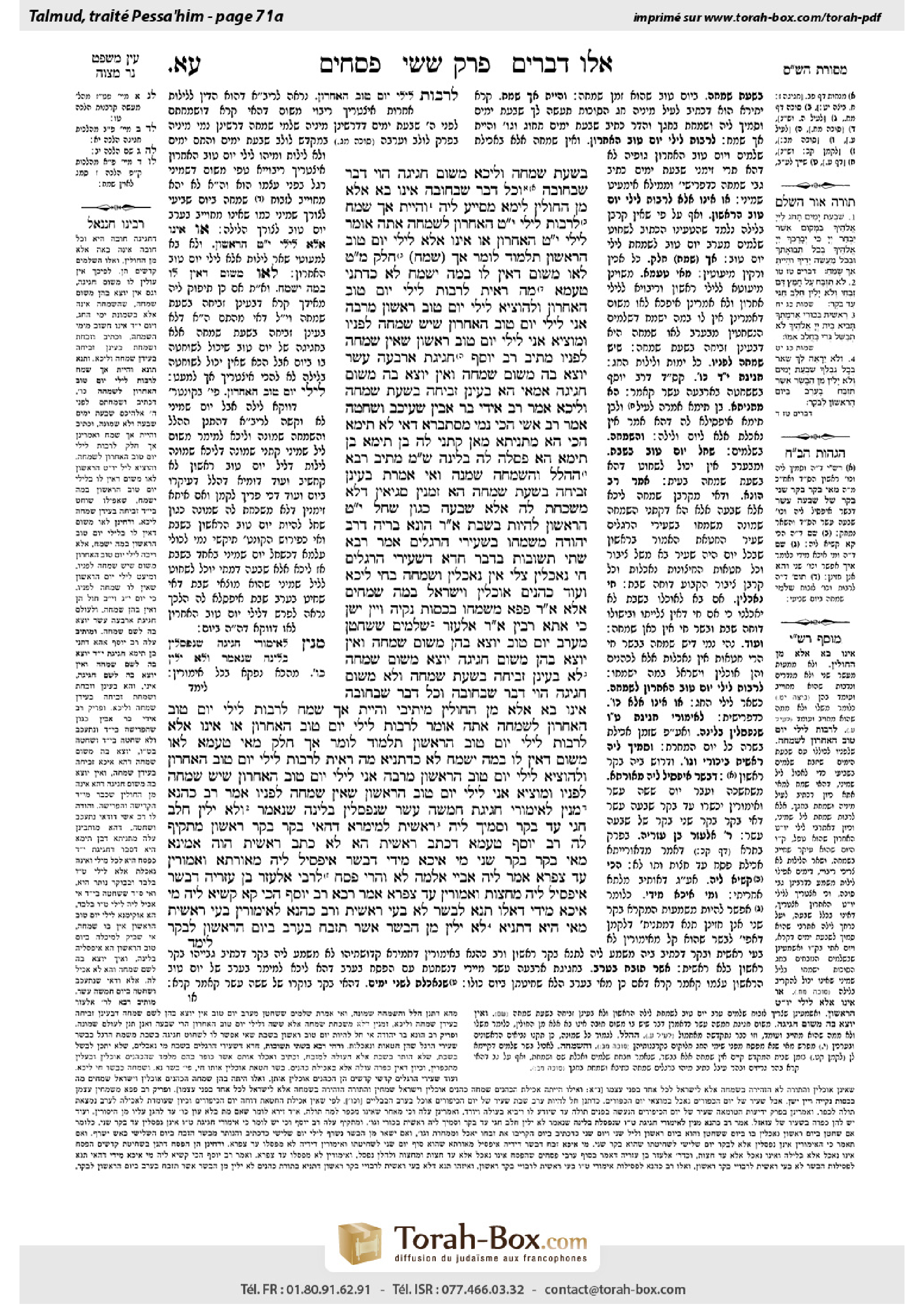
Pesachim 71a: Talmud study for Daf Yomi
Daf Yomi is the daily study of one Talmud folio. Explore 37 tractates with scans, Hebrew text, Sefaria English and AI-generated French translations where annotated.
Passage selection and English or AI-generated French translation are available where the scan has annotations. Daf Study is independent of Torah-Box and Sefaria.
Browse Pesachim · פסחים · All tractatesPesachim 71a text and translations
This page of Pesachim includes the Aramaic text, an English translation and an AI-generated French translation, alongside the scan above.
פסחים ע״א א · Aramaic and Hebrew text
בִּשְׁעַת שִׂמְחָה, וְלֵיכָּא. מִשּׁוּם חֲגִיגָה: הָוֵי דָּבָר שֶׁבְּחוֹבָה, וְכׇל דָּבָר שֶׁבְּחוֹבָה אֵינוֹ בָּא אֶלָּא מִן הַחוּלִּין.
לֵימָא מְסַיַּיע לֵיהּ: ״וְהָיִיתָ אַךְ שָׂמֵחַ״ — לְרַבּוֹת לֵילֵי יוֹם טוֹב הָאַחֲרוֹן לְשִׂמְחָה. אַתָּה אוֹמֵר לֵילֵי יוֹם טוֹב הָאַחֲרוֹן, אוֹ אֵינוֹ אֶלָּא לֵילֵי יוֹם טוֹב הָרִאשׁוֹן? תַּלְמוּד לוֹמַר: ״אַךְ (שָׂמֵחַ)״ — חָלַק.
מַאי טַעְמָא? לָאו מִשּׁוּם דְּאֵין לוֹ בַּמֶּה יִשְׂמַח!
לָא, כִּדְתָנֵי טַעְמָא: מָה רָאִיתָ לְרַבּוֹת לֵילֵי יוֹם טוֹב הָאַחֲרוֹן וּלְהוֹצִיא לֵילֵי יוֹם טוֹב רִאשׁוֹן? מְרַבֶּה אֲנִי לֵילֵי יוֹם טוֹב הָאַחֲרוֹן שֶׁיֵּשׁ שִׂמְחָה לְפָנָיו, וּמוֹצִיא אֲנִי לֵילֵי יוֹם טוֹב רִאשׁוֹן שֶׁאֵין שִׂמְחָה לְפָנָיו.
מֵתִיב רַב יוֹסֵף: חֲגִיגַת אַרְבָּעָה עָשָׂר יוֹצֵא בָּהּ מִשּׁוּם שִׂמְחָה, וְאֵין יוֹצֵא בָּהּ מִשּׁוּם חֲגִיגָה. אַמַּאי? הָא בָּעֵינַן זְבִיחָה בִּשְׁעַת שִׂמְחָה, וְלֵיכָּא! אָמַר רַב אִידִי בַּר אָבִין: שֶׁעִיכֵּב וּשְׁחָטָהּ.
אָמַר רַב אָשֵׁי: הָכִי נָמֵי מִסְתַּבְּרָא, דְּאִי לָא תֵּימָא הָכִי, הָא מַתְנִיתָא מַאן קָתָנֵי לַהּ? בֶּן תֵּימָא — בֶּן תֵּימָא הָא פָּסְלָה לַהּ בְּלִינָה! שְׁמַע מִינַּהּ.
מֵתִיב רָבָא: הַהַלֵּל וְהַשִּׂמְחָה שְׁמֹנָה. וְאִי אָמְרַתְּ בָּעֵינַן זְבִיחָה בִּשְׁעַת שִׂמְחָה, הָא זִמְנִין סַגִּיאִין דְּלָא מַשְׁכַּחַתְּ לַהּ אֶלָּא שִׁבְעָה, כְּגוֹן שֶׁחָל יוֹם טוֹב הָרִאשׁוֹן לִהְיוֹת בְּשַׁבָּת! אָמַר רַב הוּנָא בְּרֵיהּ דְּרַב יְהוּדָה: מְשַׂמְּחוֹ בִּשְׂעִירֵי הָרְגָלִים.
אָמַר רָבָא, שְׁתֵּי תְּשׁוּבוֹת בַּדָּבָר: חֲדָא, דִּשְׂעִירֵי הָרְגָלִים חַי נֶאֱכָלִין צָלִי אֵין נֶאֱכָלִין, וְשִׂמְחָה בְּחַי לֵיכָּא. וְעוֹד, כֹּהֲנִים אוֹכְלִין וְיִשְׂרָאֵל בַּמֶּה שְׂמֵחִים? אֶלָּא אָמַר רַב פָּפָּא: מְשַׂמְּחוֹ בִּכְסוּת נְקִיָּה וְיַיִן יָשָׁן.
כִּי אֲתָא רָבִין אָמַר רַבִּי אֶלְעָזָר: שְׁלָמִים שֶׁשְּׁחָטָן מֵעֶרֶב יוֹם טוֹב יוֹצֵא בָּהֶן מִשּׁוּם שִׂמְחָה וְאֵין יוֹצֵא בָּהֶן מִשּׁוּם חֲגִיגָה. יוֹצֵא מִשּׁוּם שִׂמְחָה — לָא בָּעֵינַן זְבִיחָה בִּשְׁעַת שִׂמְחָה. וְלָא מִשּׁוּם חֲגִיגָה — הָוֵי דָּבָר שֶׁבְּחוֹבָה, וְכׇל דָּבָר שֶׁבְּחוֹבָה אֵינוֹ בָּא אֶלָּא מִן הַחוּלִּין.
מֵיתִיבִי: ״וְהָיִיתָ אַךְ שָׂמֵחַ״ — לְרַבּוֹת לֵילֵי יוֹם טוֹב הָאַחֲרוֹן לְשִׂמְחָה. אַתָּה אוֹמֵר לְרַבּוֹת לֵילֵי יוֹם טוֹב הָאַחֲרוֹן, אוֹ אֵינוֹ אֶלָּא לְרַבּוֹת לֵילֵי יוֹם טוֹב הָרִאשׁוֹן? תַּלְמוּד לוֹמַר ״אַךְ״ — חָלַק.
מַאי טַעְמָא? לָאו מִשּׁוּם דְּאֵין לוֹ בַּמֶּה יִשְׂמַח! לֹא, כִּדְתַנְיָא: מָה רָאִיתָ לְרַבּוֹת לֵילֵי יוֹם טוֹב הָאַחֲרוֹן וּלְהוֹצִיא לֵילֵי יוֹם טוֹב הָרִאשׁוֹן? מְרַבֶּה אֲנִי לֵילֵי יוֹם טוֹב הָאַחֲרוֹן שֶׁיֵּשׁ שִׂמְחָה לְפָנָיו, וּמוֹצִיא אֲנִי לֵילֵי יוֹם טוֹב הָרִאשׁוֹן שֶׁאֵין שִׂמְחָה לְפָנָיו.
אָמַר רַב כָּהֲנָא: מִנַּיִן לְאֵימוּרֵי חֲגִיגַת חֲמִשָּׁה עָשָׂר שֶׁנִּפְסָלִין בְּלִינָה? שֶׁנֶּאֱמַר: ״וְלֹא יָלִין חֵלֶב חַגִּי עַד בֹּקֶר״, וּסְמִיךְ לֵיהּ ״רֵאשִׁית״ לְמֵימְרָא דְּהַאי בֹּקֶר — בֹּקֶר רִאשׁוֹן.
מַתְקֵיף לַהּ רַב יוֹסֵף: טַעְמָא דִּכְתַב ״רֵאשִׁית״, הָא לָא כְּתַב ״רֵאשִׁית״ הֲוָה אָמֵינָא מַאי בֹּקֶר — בֹּקֶר שֵׁנִי. מִי אִיכָּא מִידֵּי דְּבָשָׂר אִיפְּסִיל לֵיהּ מֵאוּרְתָּא, וְאֵמוּרִין עַד צַפְרָא?
אֲמַר לֵיהּ אַבָּיֵי: אַלְּמָה לָא? וַהֲרֵי פֶּסַח לְרַבִּי אֶלְעָזָר בֶּן עֲזַרְיָה, דְּבָשָׂר אִיפְּסִיל לֵיהּ מֵחֲצוֹת, וְאֵמוּרִין עַד צַפְרָא!
אָמַר רָבָא, רַב יוֹסֵף הָכִי קָא קַשְׁיָא לֵיהּ: מִי אִיכָּא מִידֵּי דְּאִלּוּ תַּנָּא לְבָשָׂר לָא בָּעֵי ״רֵאשִׁית״, וְרַב כָּהֲנָא לְאֵימוּרִין בָּעֵי ״רֵאשִׁית״?
מַאי הִיא? דְּתַנְיָא: ״לֹא יָלִין מִן הַבָּשָׂר אֲשֶׁר תִּזְבַּח בָּעֶרֶב בַּיּוֹם הָרִאשׁוֹן לַבֹּקֶר״,
Pesachim 71a · English translation
at the time of rejoicing, on the Festival itself, and if it was slaughtered on the fourteenth it is not. The mitzva to bring a Festival peace-offering is also not fulfilled, for it is something that is an obligation, as everyone is obligated to bring this offering, and the principle is that anything that is an obligation must come only from that which is unconsecrated, meaning that one cannot bring an obligatory offering from an animal that has already been consecrated for another purpose.
The Gemara proposes: Let us say that a baraita supports him. The verse states: “Seven days shall you celebrate to the Lord your God in the place that the Lord shall choose, for the Lord your God shall bless you in all your produce and in all the work of your hands, and you shall be but joyous” (Deuteronomy 16:15). This verse seems superfluous, as it was already stated in the previous verse: “And you shall rejoice in your Festival.” The baraita expounds: “And you shall be but joyous” comes to include the last night of the Festival. Even then you must make sure there is rejoicing by eating the appropriate peace-offerings. The baraita considers: Do you say that the verse comes to include the last night of the Festival? Or perhaps it comes to include only the first night of the Festival. Therefore, the verse states: “And you shall be but joyous”; the word “but” restricts this mitzva, meaning that there is not always a mitzva to be joyous.
The Gemara clarifies how this baraita supports Ulla: What is the reason that we learn from this expression that it is specifically on the first night that there is no mitzva of rejoicing? Is it not because on the first night he has nothing with which to rejoice? As Ulla said, one cannot fulfill the mitzva of rejoicing with a peace-offering that was slaughtered on the eve of the Festival, because it was not slaughtered at the time of rejoicing. On the last night of the Festival, on the other hand, one can rejoice with a peace-offering that was slaughtered the previous day, i.e., the last intermediate day of the Festival, which is also a time of rejoicing.
The Gemara rejects this support: No, it is not for this reason, but rather for the reason taught in the continuation of the baraita: What did you see to include the last night of the Festival in the mitzva of rejoicing and to exclude the first night of the Festival, a distinction that is not even hinted at in the verse? The baraita explains: I include the last night of the Festival in the mitzva of rejoicing, for there is rejoicing on the days of the Festival preceding it, and I exclude the first night of the Festival, for there is no day of rejoicing preceding it. Thus, no support for Ulla can be deduced from the baraita.
Rav Yosef raised an objection against the opinion of Ulla: It was taught in a baraita with regard to the Festival peace-offering of the fourteenth that one fulfills with it the mitzva to bring peace-offerings of rejoicing, but one does not fulfill with it the mitzva to bring a Festival peace-offering. We can ask, why? Surely, according to Ulla, we require that the slaughter be performed at a time of rejoicing, and this requirement is not fulfilled in this case. The Gemara answers: Rav Idi bar Avin said that the baraita is referring here to a case where he delayed and slaughtered it only on the fifteenth, i.e., on the Festival, which is a time of rejoicing.
Rav Ashi said: So too, it is reasonable to understand the baraita in this manner, for if you do not say so, but rather that the Festival peace-offering was slaughtered on the fourteenth, there is a difficulty, for who taught this baraita? Is it not ben Teima who taught it? According to ben Teima, however, he has disqualified it by leaving it overnight, for in his view this Festival peace-offering is similar to a Paschal lamb and may not be eaten the following day. Learn from this that the baraita must be referring to a case where the Festival peace-offering was slaughtered not on the fourteenth, but on the fifteenth.
Rava raised an objection against the opinion of Ulla: It was taught in a baraita that the hallel is recited and the mitzva of rejoicing with the peace-offerings of rejoicing is observed on the festival of Sukkot for eight days. Now if you say we require that the slaughter be performed at a time of rejoicing, many times you find that the mitzva of rejoicing is observed for only seven days, such as when the first day of the Festival occurs on Shabbat, when a peace-offering of rejoicing may not be slaughtered. Rav Huna, son of Rav Yehuda, said: One rejoices with the male goats of the Festivals. That is to say, in such a situation the mitzva of rejoicing can be fulfilled with the meat of the goats that are brought on the Festivals as sin-offerings, as these offerings, being communal offerings, may be slaughtered even on Shabbat.
Rava said: There are two possible responses to refute this. One is that the male goats of the Festivals are eaten raw and are not eaten roasted. Being a non-essential part of the service, roasting the meat is forbidden on Shabbat. Therefore, the meat can be eaten only raw, and there is no rejoicing with raw meat. And furthermore, only the priests eat of the meat of these sin-offerings. With what then do ordinary Israelites rejoice? Rather, Rav Pappa said: In such a situation, one rejoices with clean clothes and old wine.
When Ravin came from Eretz Yisrael to Babylonia, he related a different version of what Rabbi Elazar said: With regard to peace-offerings that one slaughtered on the eve of the Festival, one fulfills with them the mitzva to bring peace-offerings of rejoicing, but one does not fulfill with them the mitzva to bring a Festival peace-offering. He explains: One fulfills the mitzva of rejoicing, because we do not require that the slaughter be performed at the time of rejoicing as long as the offering is eaten at the time of rejoicing. But one does not fulfill the mitzva of the Festival peace-offering, because the Festival peace-offering is something that is an obligation, and the principle is that anything that is an obligation must come only from unconsecrated animals.
The Gemara raises an objection against Ravin from the baraita that was taught above: “And you shall be but joyous” comes to include the last night of the Festival in the mitzva of rejoicing. The baraita considers: Do you say that the verse comes to include the last night in the mitzva of rejoicing? Or perhaps it comes to include only the first night of the Festival? Therefore, the verse states: “And you shall be but joyous”; the word “but” restricts this mitzva, meaning that there is not always a mitzva to be joyous.
The Gemara explains how this baraita is difficult according to Ravin: What is the reason that we learn from here that it is specifically on the first night that there is no mitzva of rejoicing? Is it not because on the first night he has nothing with which to rejoice, as one cannot fulfill the mitzva of rejoicing with peace-offerings slaughtered not at a time of rejoicing? The Gemara rejects this argument: No, the reason is as it was taught in the continuation of the baraita: What did you see to include the last night of the Festival in the mitzva of rejoicing and to exclude the first night of the Festival? The baraita explains: I include the last night of the Festival, for there is rejoicing on the days of the Festival preceding it, and I exclude the first night of the Festival, for there is no day of rejoicing preceding it.
Rav Kahana said: From where is it derived that the sacrificial parts of the Festival peace-offering of the fifteenth of Nisan, i.e., those portions of the offering that are consumed on the altar, are disqualified when left overnight on the first night after the offering is slaughtered, despite the fact that the meat of the offering may be consumed for an additional day? As it is stated: “You shall not offer the blood of My offering with leaven; neither shall the fat of my Festival offering be left over until morning” (Exodus 23:18), and, juxtaposed with it is the word first, in the verse: “The first of the first fruits of your land you shall bring to the house of the Lord your God” (Exodus 23:19). This comes to say to us that the morning mentioned in the first verse is the first morning after the offering has been sacrificed.
Rav Yosef strongly objects to this proof: The reason is that it wrote the word first. But had it not written the word first, I would have said: What is the meaning of the term morning? The second morning after it was sacrificed. This raises a question: Is there anything like this where the meat of an offering that is to be eaten is disqualified already from the evening, as the meat of a Festival peace-offering may be eaten only for two days and the night between them, while the sacrificial parts to be consumed on the altar are permitted until the next morning?
Abaye said to him: Why not? For there is the Paschal offering according to the opinion of Rabbi Elazar ben Azarya, who holds that the meat that is to be eaten is disqualified already from midnight and may no longer be eaten after that time, while the sacrificial parts to be consumed on the altar may be offered until morning.
Rava said: This is what was difficult to Rav Yosef: Is there anything like this, i.e., that the tanna does not need the word “first” to teach us that the word “morning,” written with regard to the meat of an offering, is referring to the first morning, whereas Rav Kahana requires the word “first” to teach us that the word “morning,” written with regard to the sacrificial portions to be consumed on the altar, is referring to the first morning? This is despite the fact that the latter, owing to their greater sanctity, are obviously more easily disqualified than the former.
The Gemara asks: What is this source alluded to by Rava? The Gemara explains: As it was taught in a baraita with regard to the verse: “Nor shall any of the meat that you sacrifice on the first day at evening remain overnight until the morning” (Deuteronomy 16:4),
Pesachim 71a · Traduction française (IA)
au moment de la réjouissance, le jour même de la fête ; mais si elle a été abattue le quatorze, elle ne l’est pas. On ne s’acquitte pas non plus de la mitsva d’apporter un sacrifice de paix de fête, car il s’agit d’une obligation, puisque chacun est tenu d’apporter ce sacrifice. Or, le principe veut que tout sacrifice obligatoire ne provienne que d’un animal non consacré, c’est-à-dire qu’on ne peut pas apporter un sacrifice obligatoire avec un animal déjà consacré à une autre fin.
La Guemara propose : Disons qu’une baraïta vient à l’appui de son opinion. Le verset dit : « Tu célébreras sept jours pour le Seigneur ton Dieu, au lieu que le Seigneur choisira, car le Seigneur ton Dieu te bénira dans toute ta récolte et dans tout le travail de tes mains, et tu ne seras que joyeux » (Deutéronome 16,15). Ce verset semble superflu, car il a déjà été dit dans le verset précédent : « Et tu te réjouiras lors de ta fête. » La baraïta interprète ainsi : « Et tu ne seras que joyeux » vient inclure la dernière nuit de la fête. Même alors, tu dois veiller à te réjouir en mangeant les sacrifices de paix appropriés. La baraïta examine la question : Dis-tu que le verset vient inclure la dernière nuit de la fête ? Ou peut-être vient-il inclure uniquement la première nuit de la fête ? Le verset dit donc : « Et tu ne seras que joyeux » ; le mot « que » restreint cette mitsva, ce qui signifie qu’il n’y a pas toujours de mitsva de se réjouir.
La Guemara précise en quoi cette baraïta appuie l’opinion d’Ulla : Pour quelle raison déduisons-nous de cette expression que c’est précisément la première nuit qu’il n’y a pas de mitsva de réjouissance ? N’est-ce pas parce que, la première nuit, il n’a rien avec quoi se réjouir ? En effet, comme l’a dit Ulla, on ne peut pas accomplir la mitsva de réjouissance avec un sacrifice de paix abattu la veille de la fête, car il n’a pas été abattu au moment de la réjouissance. En revanche, la dernière nuit de la fête, on peut se réjouir avec un sacrifice de paix abattu la veille, c’est-à-dire le dernier jour intermédiaire de la fête, qui est lui aussi un moment de réjouissance.
La Guemara rejette cet appui : Non, ce n’est pas pour cette raison, mais plutôt pour celle enseignée dans la suite de la baraïta : Qu’as-tu vu pour inclure la dernière nuit de la fête dans la mitsva de réjouissance et en exclure la première nuit, distinction qui n’est même pas suggérée dans le verset ? La baraïta explique : J’inclus la dernière nuit de la fête dans la mitsva de réjouissance, car les jours de fête qui la précèdent sont des jours de réjouissance, et j’exclus la première nuit de la fête, car aucun jour de réjouissance ne la précède. On ne peut donc tirer de la baraïta aucun appui à l’opinion d’Ulla.
Rav Yossef soulève une objection contre l’opinion d’Ulla : Il a été enseigné dans une baraïta, au sujet du sacrifice de paix de fête du quatorze, qu’on s’acquitte grâce à lui de la mitsva d’apporter des sacrifices de paix de réjouissance, mais non de la mitsva d’apporter un sacrifice de paix de fête. On peut demander : pourquoi ? Selon Ulla, il faut certainement que l’abattage ait lieu au moment de la réjouissance, condition qui n’est pas remplie dans ce cas. La Guemara répond : Rav Idi bar Avin a dit que la baraïta parle ici d’un cas où il a tardé et ne l’a abattu que le quinze, c’est-à-dire le jour de la fête, qui est un moment de réjouissance.
Rav Ashi dit : Il est également raisonnable de comprendre la baraïta de cette manière, car, si tu ne l’admets pas et que tu supposes plutôt que le sacrifice de paix de fête a été abattu le quatorze, une difficulté se pose : qui est l’auteur de cette baraïta ? N’est-ce pas ben Teima qui l’a enseignée ? Or, selon ben Teima, il l’a rendu impropre en le laissant passer la nuit, car, à son avis, ce sacrifice de paix de fête ressemble à un agneau pascal et ne peut être mangé le lendemain. Apprends-en que la baraïta parle nécessairement d’un cas où le sacrifice de paix de fête a été abattu non pas le quatorze, mais le quinze.
Rava soulève une objection contre l’opinion d’Ulla : Il a été enseigné dans une baraïta que le Hallel est récité et que la mitsva de se réjouir avec les sacrifices de paix de réjouissance est observée pendant huit jours à Soukkot. Or, si tu dis qu’il faut que l’abattage ait lieu au moment de la réjouissance, il arrive souvent que la mitsva de réjouissance ne soit observée que pendant sept jours, par exemple lorsque le premier jour de la fête tombe un Chabbat, jour où il est interdit d’abattre un sacrifice de paix de réjouissance. Rav Houna, fils de Rav Yehouda, dit : On se réjouit avec les boucs des fêtes. Autrement dit, dans une telle situation, on peut accomplir la mitsva de réjouissance avec la viande des boucs apportés lors des fêtes en sacrifices expiatoires, car ces sacrifices, étant des sacrifices communautaires, peuvent être abattus même le Chabbat.
Rava dit : Il y a deux réponses possibles pour réfuter cela. Premièrement, les boucs des fêtes sont mangés crus et non rôtis. Comme rôtir la viande n’est pas indispensable au service, il est interdit de le faire le Chabbat. La viande ne peut donc être mangée que crue, et il n’y a pas de réjouissance avec de la viande crue. En outre, seuls les prêtres mangent la viande de ces sacrifices expiatoires. Avec quoi les Israélites ordinaires se réjouiraient-ils alors ? Rav Pappa dit plutôt : Dans une telle situation, on se réjouit avec des vêtements propres et du vin vieux.
Lorsque Ravin arriva de la terre d’Israël en Babylonie, il rapporta une autre version de ce que Rabbi Elazar avait dit : Pour les sacrifices de paix abattus la veille de la fête, on s’acquitte de la mitsva d’apporter des sacrifices de paix de réjouissance, mais non de la mitsva d’apporter un sacrifice de paix de fête. Il explique : On s’acquitte de la mitsva de réjouissance, car nous n’exigeons pas que l’abattage ait lieu au moment de la réjouissance, pourvu que le sacrifice soit mangé au moment de la réjouissance. Mais on ne s’acquitte pas de la mitsva du sacrifice de paix de fête, car celui-ci est une obligation, et le principe veut que tout sacrifice obligatoire provienne uniquement d’animaux non consacrés.
La Guemara soulève une objection contre Ravin à partir de la baraïta enseignée plus haut : « Et tu ne seras que joyeux » vient inclure la dernière nuit de la fête dans la mitsva de réjouissance. La baraïta examine la question : Dis-tu que le verset vient inclure la dernière nuit dans la mitsva de réjouissance ? Ou peut-être vient-il inclure uniquement la première nuit de la fête ? Le verset dit donc : « Et tu ne seras que joyeux » ; le mot « que » restreint cette mitsva, ce qui signifie qu’il n’y a pas toujours de mitsva de se réjouir.
La Guemara explique en quoi cette baraïta pose une difficulté selon Ravin : Pour quelle raison déduisons-nous d’ici que c’est précisément la première nuit qu’il n’y a pas de mitsva de réjouissance ? N’est-ce pas parce que, la première nuit, il n’a rien avec quoi se réjouir, puisqu’on ne peut pas accomplir la mitsva de réjouissance avec des sacrifices de paix abattus à un moment qui n’est pas celui de la réjouissance ? La Guemara rejette cet argument : Non, la raison est celle enseignée dans la suite de la baraïta : Qu’as-tu vu pour inclure la dernière nuit de la fête dans la mitsva de réjouissance et en exclure la première nuit de la fête ? La baraïta explique : J’inclus la dernière nuit de la fête, car les jours de fête qui la précèdent sont des jours de réjouissance, et j’exclus la première nuit de la fête, car aucun jour de réjouissance ne la précède.
Rav Kahana dit : D’où déduit-on que les parties sacrificielles du sacrifice de paix de fête du quinze Nissan, c’est-à-dire les portions du sacrifice consumées sur l’autel, deviennent impropres si elles sont laissées pendant la nuit qui suit leur abattage, bien que la viande du sacrifice puisse être consommée un jour de plus ? Car il est dit : « Tu n’offriras pas le sang de mon sacrifice avec du levain ; et la graisse de ma fête ne restera pas jusqu’au matin » (Exode 23,18), et le mot « premier » lui est juxtaposé, dans le verset : « Tu apporteras à la maison du Seigneur ton Dieu les prémices des premiers fruits de ta terre » (Exode 23,19). Cela nous enseigne que le matin mentionné dans le premier verset est le premier matin après que le sacrifice a été offert.
Rav Yossef s’oppose vivement à cette preuve : La raison est que le mot « premier » est écrit. Mais, si ce mot n’avait pas été écrit, aurais-je dit que le terme « matin » signifie le deuxième matin après que le sacrifice a été offert ? Cela soulève une question : Existe-t-il un cas où la viande d’un sacrifice destinée à être mangée devient impropre dès le soir, alors que la viande d’un sacrifice de paix de fête ne peut être mangée que pendant deux jours et la nuit qui les sépare, tandis que les parties sacrificielles destinées à être consumées sur l’autel restent autorisées jusqu’au lendemain matin ?
Abayé lui dit : Pourquoi pas ? Il y a le sacrifice pascal selon l’opinion de Rabbi Elazar ben Azarya, qui soutient que la viande destinée à être mangée devient impropre dès minuit et ne peut plus être mangée après ce moment, tandis que les parties sacrificielles destinées à être consumées sur l’autel peuvent être offertes jusqu’au matin.
Rava dit : Voici ce qui posait problème à Rav Yossef : existe-t-il un cas où le tanna n’a pas besoin du mot « premier » pour nous enseigner que le mot « matin », écrit à propos de la viande d’un sacrifice, désigne le premier matin, alors que Rav Kahana a besoin du mot « premier » pour nous enseigner que le mot « matin », écrit à propos des parties sacrificielles destinées à être consumées sur l’autel, désigne le premier matin ? Cela, malgré le fait que ces dernières, en raison de leur plus grande sainteté, deviennent évidemment impropres plus facilement que les premières.
La Guemara demande : À quelle source Rava fait-il allusion ? La Guemara explique : Comme il a été enseigné dans une baraïta à propos du verset : « Et aucune partie de la viande que tu offres le soir du premier jour ne restera pendant la nuit jusqu’au matin » (Deutéronome 16,4),
Traduction française générée par IA à partir de l’édition anglaise de Sefaria. Vérifie toujours un passage avec le texte source.
Text from Sefaria: William Davidson Edition - Vocalized Aramaic (CC BY NC); William Davidson Edition - English (CC BY NC).