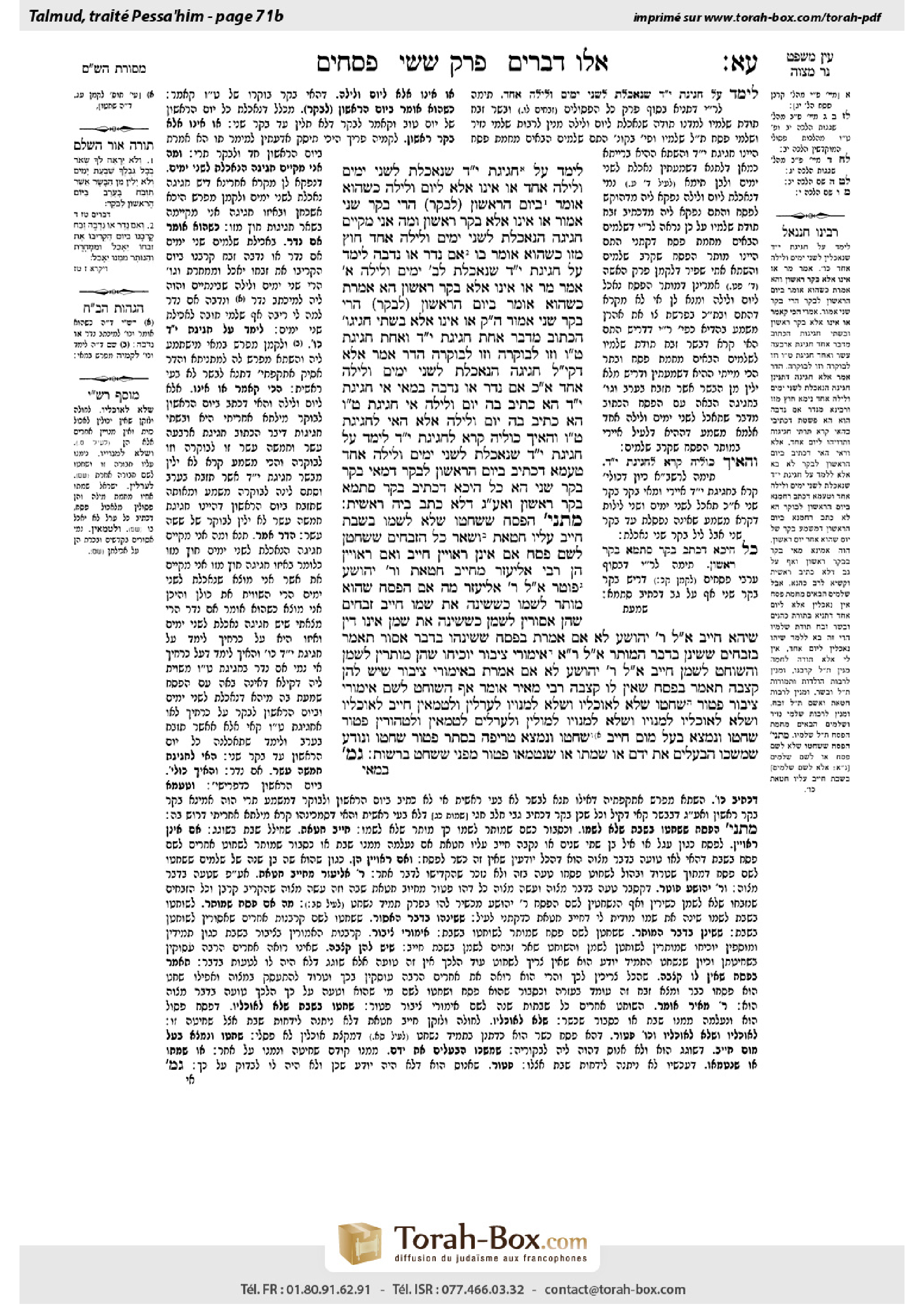
Pesachim 71b: Talmud study for Daf Yomi
Daf Yomi is the daily study of one Talmud folio. Explore 37 tractates with scans, Hebrew text, Sefaria English and AI-generated French translations where annotated.
Passage selection and English or AI-generated French translation are available where the scan has annotations. Daf Study is independent of Torah-Box and Sefaria.
Browse Pesachim · פסחים · All tractatesPesachim 71b text and translations
This page of Pesachim includes the Aramaic text, an English translation and an AI-generated French translation, alongside the scan above.
פסחים ע״א ב · Aramaic and Hebrew text
לִימֵּד עַל חֲגִיגַת אַרְבָּעָה עָשָׂר שֶׁנֶּאֱכֶלֶת לִשְׁנֵי יָמִים וְלַיְלָה אֶחָד. אוֹ אֵינוֹ אֶלָּא לְיוֹם וָלַיְלָה? כְּשֶׁהוּא אוֹמֵר: ״בְּיוֹם הָרִאשׁוֹן לַבֹּקֶר״ — הֲרֵי בֹּקֶר שֵׁנִי אָמוּר.
אוֹ אֵינוֹ אֶלָּא בֹּקֶר רִאשׁוֹן, וּמָה אֲנִי מְקַיֵּים חֲגִיגָה הַנֶּאֱכֶלֶת לִשְׁנֵי יָמִים וָלַיְלָה אֶחָד — חוּץ מִזּוֹ, כְּשֶׁהוּא אוֹמֵר בּוֹ: ״אִם נֶדֶר אוֹ נְדָבָה״ — לִימֵּד עַל חֲגִיגַת אַרְבָּעָה עָשָׂר שֶׁנֶּאֱכֶלֶת לִשְׁנֵי יָמִים וָלַיְלָה אֶחָד.
אָמַר מָר: אוֹ אֵינוֹ אֶלָּא בֹּקֶר רִאשׁוֹן. הָא אָמַרְתָּ: כְּשֶׁהוּא אוֹמֵר ״בַּיּוֹם הָרִאשׁוֹן (לַבֹּקֶר)״ — הֲרֵי בֹּקֶר שֵׁנִי אָמוּר? הָכִי קָאָמַר: אוֹ אֵינוֹ אֶלָּא בִּשְׁתֵּי חֲגִיגוֹת הַכָּתוּב מְדַבֵּר, אַחַת חֲגִיגַת אַרְבָּעָה עָשָׂר וְאַחַת חֲגִיגַת חֲמִשָּׁה עָשָׂר, וְזוֹ לְבוֹקְרָהּ וְזוֹ לְבוֹקְרָהּ.
הֲדַר אָמַר: אֶלָּא דְּקַיְימָא לַן חֲגִיגָה הַנֶּאֱכֶלֶת לִשְׁנֵי יָמִים וָלַיְלָה אֶחָד. אִם כֵּן: ״אִם נֶדֶר אוֹ נְדָבָה״ בְּמַאי? אִי חֲגִיגַת אַרְבָּעָה עָשָׂר, הָא כְּתִיב בַּהּ יוֹם וָלַיְלָה! אִי חֲגִיגַת חֲמִשָּׁה עָשָׂר, הָא כְּתִיב בַּהּ יוֹם וָלַיְלָה!
אֶלָּא, הַאי לַחֲגִיגַת חֲמִשָּׁה עָשָׂר, וְהַאיְךְ כּוּלֵּיהּ קְרָא לַחֲגִיגַת אַרְבָּעָה עָשָׂר, לִימֵּד עַל חֲגִיגַת אַרְבָּעָה עָשָׂר שֶׁנֶּאֱכֶלֶת לִשְׁנֵי יָמִים וָלַיְלָה אֶחָד.
טַעְמָא דִּכְתִיב ״בַּיּוֹם הָרִאשׁוֹן לַבֹּקֶר״, דְּמַאי ״בֹּקֶר״ — בֹּקֶר שֵׁנִי. הָא כׇּל הֵיכָא דִּכְתִיב בֹּקֶר סְתָמָא — בֹּקֶר רִאשׁוֹן, וְאַף עַל גַּב דְּלָא כְּתַב בֵּיהּ ״רֵאשִׁית״.
מַתְנִי׳ הַפֶּסַח שֶׁשְּׁחָטוֹ שֶׁלֹּא לִשְׁמוֹ בְּשַׁבָּת — חַיָּיב עָלָיו חַטָּאת.
וּשְׁאָר כׇּל הַזְּבָחִים שֶׁשְּׁחָטָן לְשֵׁם פֶּסַח, אִם אֵינָן רְאוּיִין — חַיָּיב, וְאִם רְאוּיִין הֵן — רַבִּי אֱלִיעֶזֶר מְחַיֵּיב חַטָּאת, וְרַבִּי יְהוֹשֻׁעַ פּוֹטֵר.
אֲמַר לֵיהּ רַבִּי אֱלִיעֶזֶר: מָה אִם הַפֶּסַח שֶׁהוּא מוּתָּר לִשְׁמוֹ, כְּשֶׁשִּׁינָּה אֶת שְׁמוֹ — חַיָּיב, זְבָחִים שֶׁהֵן אֲסוּרִין לִשְׁמָן, כְּשֶׁשִּׁינָּה אֶת שְׁמָן — אֵינוֹ דִּין שֶׁיְּהֵא חַיָּיב? אֲמַר לֵיהּ רַבִּי יְהוֹשֻׁעַ: לָא, אִם אָמַרְתָּ בַּפֶּסַח שֶׁשִּׁינָּהוּ בְּדָבָר אָסוּר, תֹּאמַר בִּזְבָחִים שֶׁשִּׁינָּן בְּדָבָר הַמּוּתָּר.
אֲמַר לֵיהּ רַבִּי אֱלִיעֶזֶר: אֵימוּרֵי צִיבּוּר יוֹכִיחוּ, שֶׁהֵן מוּתָּרִין לִשְׁמָן, וְהַשּׁוֹחֵט לִשְׁמָן חַיָּיב. אֲמַר לֵיהּ רַבִּי יְהוֹשֻׁעַ: לֹא, אִם אָמַרְתָּ בְּאֵימוּרֵי צִיבּוּר שֶׁיֵּשׁ לָהֶן קִצְבָה, תֹּאמַר בַּפֶּסַח שֶׁאֵין לוֹ קִצְבָה.
רַבִּי מֵאִיר אוֹמֵר: אַף הַשּׁוֹחֵט לְשֵׁם אֵימוּרֵי צִיבּוּר — פָּטוּר.
שְׁחָטוֹ שֶׁלֹּא לְאוֹכְלָיו וְשֶׁלֹּא לִמְנוּיָו, לַעֲרֵלִין וְלִטְמֵאִין — חַיָּיב. לְאוֹכְלָיו וְשֶׁלֹּא לְאוֹכְלָיו, לִמְנוּיָו וְשֶׁלֹּא לִמְנוּיָו, לְמוּלִין וְלַעֲרֵלִים, לִטְמֵאִין וְלִטְהוֹרִין — פָּטוּר.
שְׁחָטוֹ וְנִמְצָא בַּעַל מוּם — חַיָּיב. שְׁחָטוֹ וְנִמְצָא טְרֵיפָה בַּסֵּתֶר — פָּטוּר.
שְׁחָטוֹ וְנוֹדַע שֶׁמָּשְׁכוּ הַבְּעָלִים אֶת יָדָם, אוֹ שֶׁמֵּתוּ אוֹ שֶׁנִּטְמְאוּ — פָּטוּר, מִפְּנֵי שֶׁשָּׁחַט בִּרְשׁוּת.
Pesachim 71b · English translation
this verse teaches that the Festival peace-offering of the fourteenth is eaten for two days and one night; that is, it may not remain overnight until the morning of the sixteenth. Or perhaps it is eaten for only a day and a night; that is, it may not remain overnight until the morning of the fifteenth. Since for that it would have sufficed to say that an offering sacrificed “on the first day shall not remain overnight,” when it says that an offering sacrificed “on the first day shall not remain overnight until the morning” (Deuteronomy 16:4), the extra phrase “until the morning” indicates that the verse speaks of the second morning.
There is still room to say: Or perhaps it is eaten only until the first morning, and how do I establish what the Torah says, that a Festival peace-offering may be eaten for two days and one night? This applies to Festival peace-offerings other than this one. The baraita explains: When it says with regard to a peace-offering: “But if the sacrifice of his offering is a vow or a free-will offering, it shall be eaten on the same day that he sacrifices his offering; and on the morrow also, the remainder of it shall be eaten” (Leviticus 7:16), it teaches that any peace-offering, whether a vow or a free-will offering, or an obligation, including the Festival peace-offering of the fourteenth, is eaten for two days and one night.
The Master said above in the baraita: Or perhaps it is only the first morning. The Gemara asks: But you already said that when it says that any offering sacrificed “on the first day shall not remain overnight until the morning,” the extra phrase “until the morning” indicates that the verse speaks of the second morning. What need is there then to prove this a second time? The Gemara explains that this is what the baraita is saying: Or perhaps it is only that the verse is speaking about two different Festival peace-offerings, one being the Festival peace-offering of the fourteenth and one the Festival peace-offering of the fifteenth, and the halakha is that this, the Festival peace-offering of the fourteenth, may be eaten for only a day and a night until its morning, the morning of the fifteenth, and this, the Festival peace-offering of the fifteenth, may be eaten for only a day and a night until its morning, the sixteenth of Nisan.
It then says: But with regard to that which we maintain, that a Festival peace-offering may be eaten for two days and one night, if so, the verse that addresses a peace-offering and says: “But if the sacrifice of his offering is a vow or a free-will offering,” with regard to what case is it discussing? If it is talking about the Festival peace-offering of the fourteenth, surely it is written about it, according to this interpretation, that it is eaten for only a day and a night. And if it is talking about the Festival peace-offering of the fifteenth, surely it is written about it that it too is eaten for only a day and a night.
Rather, this verse that discusses a vow or free-will offering clearly must be discussing the Festival peace-offering of the fifteenth, and the entire other verse: “Nor shall…remain overnight until the morning,” is referring to the Festival peace-offering of the fourteenth and thus has taught that the Festival peace-offering of the fourteenth is eaten for two days and one night.
The Gemara returns to what it wanted to prove with regard to the term “first”: The reason is that it is written that an offering sacrificed “on the first day shall not remain overnight until the morning,” for what is the implication of the word morning? The second morning. We can infer from here that wherever the term morning is written unmodified and without further specification, it is referring to the first morning after the offering was sacrificed, even though the word “first” is not written in relation to “morning.” Thus, Rav Kahana’s derivation from the word “first” was unnecessary.
MISHNA: A Paschal lamb that one slaughtered for a different purpose on Shabbat, not knowing that it is prohibited for him to do so, is disqualified, and he is liable to bring a sin-offering for it because he unwittingly performed a prohibited labor on Shabbat.
As for all other offerings, such as a peace-offering, that one unwittingly slaughtered on Shabbat for the purpose of a Paschal offering, if they were not fit for the Paschal offering, e.g., if they were female or cattle or more than a year old and clearly ineligible for the Paschal offering, he is liable to bring a sin-offering. Because he did not fulfill the mitzva to bring a Paschal offering, his act of slaughter was therefore unnecessary. And if they were fit, Rabbi Eliezer nevertheless deems him liable to bring a sin-offering for his unwitting transgression. But Rabbi Yehoshua exempts him, because he maintains that if someone intended to perform a mitzva, and despite his error he in fact performed a mitzva, he is not liable to bring a sin-offering. And in this case he performed a mitzva, because offerings that are sacrificed for a different purpose are still fit.
Rabbi Eliezer said to Rabbi Yehoshua: If, with regard to the Paschal lamb, which is permitted to be slaughtered on Shabbat for its own purpose, when one changed its purpose he is nevertheless liable, then, with regard to other offerings that are forbidden to be slaughtered on Shabbat even for their own purpose, when one changed their purpose, is it not right that he should be liable? Rabbi Yehoshua said to him: No, this reasoning is faulty. If you say that one is liable to bring a sin-offering if he slaughtered a Paschal lamb for a different purpose, it is because he changed its purpose for something forbidden, as the offering he intended it to be may not be slaughtered on Shabbat. But can you necessarily say the same thing about other offerings that he slaughtered for the purpose of a Paschal offering and thus changed their purpose for something that is permitted to be sacrificed on Shabbat?
Rabbi Eliezer said to Rabbi Yehoshua: Let the communal offerings, such as the daily offering and the additional-offerings of Shabbat and the Festivals, prove the matter, for they are permitted to be slaughtered on Shabbat for their own purpose, and nevertheless, one who unnecessarily slaughters a different offering for their purpose is liable. This indicates that even when a particular offering may be slaughtered, one is nevertheless liable if he slaughtered a different offering for the purpose of the permitted offering. Rabbi Yehoshua said to him: No, if you say this halakha with regard to communal offerings, it is because they have a limit, as there is a specific number of communal offerings that must be offered on any particular day and there is no reason one would mistakenly sacrifice extra offerings for this purpose. But can you necessarily say the same thing about the Paschal lamb, which does not have a limit, making it more likely for someone to make a mistake?
Rabbi Meir says: According to Rabbi Yehoshua, even one who unwittingly slaughters other offerings for the purpose of communal offerings beyond their daily limit is exempt for the same reason, i.e., that he intended to fulfill a mitzva that is permitted on Shabbat.
The mishna continues with another halakha with regard to the Paschal lamb: If one slaughtered a Paschal lamb on Shabbat and mistakenly intended it for those who cannot eat it, such as sick or elderly people who are unable to eat the meat, or for those who did not register for it, or for the sake of the uncircumcised or for those ritually impure, the offering is disqualified and he is liable to bring a sin-offering for his unnecessary act of slaughter. If, however, he slaughtered it for those who can eat it and for those who cannot eat it, or for those who registered for it and for those who did not register for it, or for the circumcised and for those who are uncircumcised, or for those who are ritually impure and those who are ritually pure, he is exempt. Since a Paschal lamb slaughtered with dual intentions of these types is valid, the act of slaughter was justified.
If he slaughtered it and it was found to have a blemish, the offering is disqualified, and he is liable to bring a sin-offering for having unwittingly performed a prohibited labor on Shabbat, as he should have examined the animal before it was slaughtered. If he slaughtered it and it was found to have a hidden condition that would cause it to die within twelve months [tereifa] and that could not have been discovered before the slaughter even if it were examined properly, the offering is disqualified, but he is exempt from bringing a sin-offering. This is not a case of shogeg, unwitting violation of Shabbat, but rather of ones, an unavoidable accident.
If he slaughtered it and afterward it became known that the owners had withdrawn from it and registered for a different Paschal lamb, in which case this one was slaughtered unnecessarily, as no one was registered for it, or it became known that they had died or became ritually impure, in all these cases he is exempt from bringing a sin-offering, because he slaughtered with permission. At the time of the slaughter, he did not know and had no reason to suspect that the offering would be disqualified.
Pesachim 71b · Traduction française (IA)
Ce verset enseigne que le sacrifice de paix de fête du quatorze se mange pendant deux jours et une nuit, c’est-à-dire qu’il ne peut rester toute la nuit jusqu’au matin du seize. Ou peut-être ne se mange-t-il que pendant un jour et une nuit, c’est-à-dire qu’il ne peut rester toute la nuit jusqu’au matin du quinze. Puisqu’il aurait suffi, pour enseigner cela, de dire qu’un sacrifice offert « le premier jour ne restera pas toute la nuit », lorsqu’il est dit qu’un sacrifice offert « le premier jour ne restera pas toute la nuit jusqu’au matin » (Deutéronome 16:4), l’expression supplémentaire « jusqu’au matin » indique que le verset parle du deuxième matin.
On peut encore dire : ou peut-être ne se mange-t-il que jusqu’au premier matin. Comment faut-il alors comprendre ce que dit la Torah, à savoir qu’un sacrifice de paix de fête peut se manger pendant deux jours et une nuit ? Cela s’applique aux sacrifices de paix de fête autres que celui-ci. La baraïta explique : lorsqu’il est dit à propos d’un sacrifice de paix : « Mais si le sacrifice de son offrande est un vœu ou une offrande volontaire, il sera mangé le jour où il aura offert son sacrifice ; et le lendemain aussi, ce qui en restera sera mangé » (Lévitique 7:16), cela enseigne que tout sacrifice de paix, qu’il s’agisse d’un vœu, d’une offrande volontaire ou d’une obligation, y compris le sacrifice de paix de fête du quatorze, se mange pendant deux jours et une nuit.
Le Maître a dit plus haut dans la baraïta : « Ou peut-être s’agit-il seulement du premier matin. » La Guemara demande : mais vous avez déjà dit que, lorsqu’il est écrit qu’un sacrifice offert « le premier jour ne restera pas toute la nuit jusqu’au matin », l’expression supplémentaire « jusqu’au matin » indique que le verset parle du deuxième matin. Pourquoi faut-il donc le démontrer une seconde fois ? La Guemara explique que voici ce que dit la baraïta : ou peut-être le verset parle-t-il de deux sacrifices de paix de fête différents, l’un étant le sacrifice de paix de fête du quatorze et l’autre celui du quinze. La halakha serait alors que celui-ci, le sacrifice de paix de fête du quatorze, ne se mange que pendant un jour et une nuit, jusqu’à son matin, le matin du quinze, et que celui-là, le sacrifice de paix de fête du quinze, ne se mange que pendant un jour et une nuit, jusqu’à son matin, le seize de Nisan.
Il est alors dit : mais, selon ce que nous tenons pour établi, à savoir qu’un sacrifice de paix de fête peut se manger pendant deux jours et une nuit, de quel cas parle donc le verset concernant un sacrifice de paix qui dit : « Mais si le sacrifice de son offrande est un vœu ou une offrande volontaire » ? S’il parle du sacrifice de paix de fête du quatorze, il est assurément écrit à son sujet, selon cette interprétation, qu’il ne se mange que pendant un jour et une nuit. Et s’il parle du sacrifice de paix de fête du quinze, il est assurément écrit à son sujet que lui aussi ne se mange que pendant un jour et une nuit.
Au contraire, ce verset qui traite d’un vœu ou d’une offrande volontaire doit manifestement parler du sacrifice de paix de fête du quinze ; et l’autre verset dans son intégralité — « il ne restera pas toute la nuit jusqu’au matin » — se rapporte au sacrifice de paix de fête du quatorze. Il enseigne ainsi que le sacrifice de paix de fête du quatorze se mange pendant deux jours et une nuit.
La Guemara revient à ce qu’elle voulait démontrer au sujet du terme « premier » : la raison en est qu’il est écrit qu’un sacrifice offert « le premier jour ne restera pas toute la nuit jusqu’au matin ». En effet, que signifie le mot « matin » ? Le deuxième matin. On peut en déduire que partout où le terme « matin » apparaît sans qualification ni précision supplémentaire, il désigne le premier matin après que le sacrifice a été offert, même si le mot « premier » n’est pas écrit à propos du « matin ». Ainsi, la déduction de Rav Kahana à partir du mot « premier » était inutile.
Michna : Un agneau pascal abattu le Chabbat dans une intention différente, sans savoir qu’il était interdit de le faire, est invalide ; celui qui l’a abattu est tenu d’apporter un sacrifice expiatoire, car il a accompli par inadvertance un travail interdit le Chabbat.
Quant aux autres sacrifices, comme un sacrifice de paix, qu’on a abattus par inadvertance le Chabbat dans l’intention d’en faire un sacrifice pascal, si ces animaux n’étaient pas aptes à servir de sacrifice pascal — par exemple s’il s’agissait de femelles, de bovins ou d’animaux âgés de plus d’un an, manifestement inaptes au sacrifice pascal — celui qui les a abattus est tenu d’apporter un sacrifice expiatoire. Comme il n’a pas accompli la mitsva d’offrir un sacrifice pascal, son abattage était donc inutile. En revanche, s’ils étaient aptes, Rabbi Eliezer le tient néanmoins pour tenu d’apporter un sacrifice expiatoire pour sa transgression involontaire. Rabbi Yehoshoua l’en dispense, car il soutient que celui qui avait l’intention d’accomplir une mitsva et qui, malgré son erreur, l’a effectivement accomplie n’est pas tenu d’apporter un sacrifice expiatoire. En l’occurrence, il a accompli une mitsva, car les sacrifices abattus dans une intention différente restent valides.
Rabbi Eliezer dit à Rabbi Yehoshoua : si, dans le cas de l’agneau pascal, qu’il est permis d’abattre le Chabbat dans l’intention qui lui est propre, celui qui en a changé l’intention est néanmoins tenu d’apporter un sacrifice expiatoire, alors, dans le cas d’autres sacrifices, qu’il est interdit d’abattre le Chabbat même dans l’intention qui leur est propre, n’est-il pas d’autant plus juste qu’il soit tenu d’en apporter un lorsqu’il en a changé l’intention ? Rabbi Yehoshoua lui répondit : non, ce raisonnement est erroné. Si tu dis qu’on est tenu d’apporter un sacrifice expiatoire lorsqu’on a abattu un agneau pascal dans une intention différente, c’est parce qu’on a changé son intention pour quelque chose d’interdit, puisque le sacrifice qu’on voulait en faire ne peut pas être abattu le Chabbat. Mais peut-on nécessairement dire la même chose d’autres sacrifices qu’on a abattus dans l’intention d’en faire un sacrifice pascal, changeant ainsi leur intention pour quelque chose qu’il est permis de sacrifier le Chabbat ?
Rabbi Eliezer dit à Rabbi Yehoshoua : que les sacrifices communautaires, tels que le sacrifice perpétuel et les sacrifices supplémentaires du Chabbat et des fêtes, servent de preuve : il est permis de les abattre le Chabbat dans l’intention qui leur est propre et, pourtant, celui qui abat inutilement un autre sacrifice dans leur intention est tenu d’apporter un sacrifice expiatoire. Cela montre que, même lorsqu’il est permis d’abattre un sacrifice donné, on est néanmoins tenu d’apporter un sacrifice expiatoire si l’on a abattu un autre sacrifice dans l’intention de celui qui est permis. Rabbi Yehoshoua lui répondit : non, si tu invoques cette halakha à propos des sacrifices communautaires, c’est parce que leur nombre est limité : il existe un nombre précis de sacrifices communautaires à offrir un jour donné, et rien ne justifie qu’on offre par erreur des sacrifices supplémentaires dans cette intention. Mais peut-on nécessairement dire la même chose de l’agneau pascal, dont le nombre n’est pas limité, ce qui rend plus probable qu’une personne se trompe ?
Rabbi Meïr dit : selon Rabbi Yehoshoua, même celui qui abat par inadvertance d’autres sacrifices dans l’intention de sacrifices communautaires au-delà du nombre prévu pour la journée en est dispensé, pour la même raison, à savoir qu’il avait l’intention d’accomplir une mitsva dont l’accomplissement est permis le Chabbat.
La Michna poursuit avec une autre halakha concernant l’agneau pascal : si quelqu’un a abattu un agneau pascal le Chabbat en ayant par erreur l’intention de le réserver à des personnes qui ne peuvent pas le manger, comme des malades ou des personnes âgées incapables de manger la viande, à des personnes qui ne s’y étaient pas inscrites, à des incirconcis ou à des personnes en état d’impureté rituelle, le sacrifice est invalide et celui qui l’a abattu est tenu d’apporter un sacrifice expiatoire pour cet abattage inutile. En revanche, s’il l’a abattu pour des personnes qui peuvent le manger et d’autres qui ne le peuvent pas, pour des personnes qui s’y étaient inscrites et d’autres qui ne s’y étaient pas inscrites, pour des circoncis et des incirconcis, ou pour des personnes en état d’impureté rituelle et d’autres qui sont rituellement pures, il en est dispensé. Puisqu’un agneau pascal abattu avec ces intentions doubles est valide, l’abattage était justifié.
S’il l’a abattu et qu’on a découvert qu’il avait un défaut, le sacrifice est invalide et celui qui l’a abattu est tenu d’apporter un sacrifice expiatoire pour avoir accompli par inadvertance un travail interdit le Chabbat, car il aurait dû examiner l’animal avant de l’abattre. S’il l’a abattu et qu’on a découvert qu’il était atteint d’une affection cachée qui entraînerait sa mort dans les douze mois [tereifa], indécelable avant l’abattage même après un examen correctement effectué, le sacrifice est invalide, mais celui qui l’a abattu est dispensé d’apporter un sacrifice expiatoire. Il ne s’agit pas d’un cas de shogeg, une violation involontaire du Chabbat, mais d’un cas d’ones, un accident inévitable.
S’il l’a abattu et qu’on a appris par la suite que les propriétaires s’en étaient désistés et s’étaient inscrits pour un autre agneau pascal, si bien que celui-ci avait été abattu inutilement, puisque personne ne s’y était inscrit, ou qu’on a appris qu’ils étaient morts ou étaient devenus rituellement impurs, dans tous ces cas, il est dispensé d’apporter un sacrifice expiatoire, car il a abattu l’animal avec autorisation. Au moment de l’abattage, il ne savait pas et n’avait aucune raison de soupçonner que le sacrifice serait invalidé.
Traduction française générée par IA à partir de l’édition anglaise de Sefaria. Vérifie toujours un passage avec le texte source.
Text from Sefaria: William Davidson Edition - Vocalized Aramaic (CC BY NC); William Davidson Edition - English (CC BY NC).