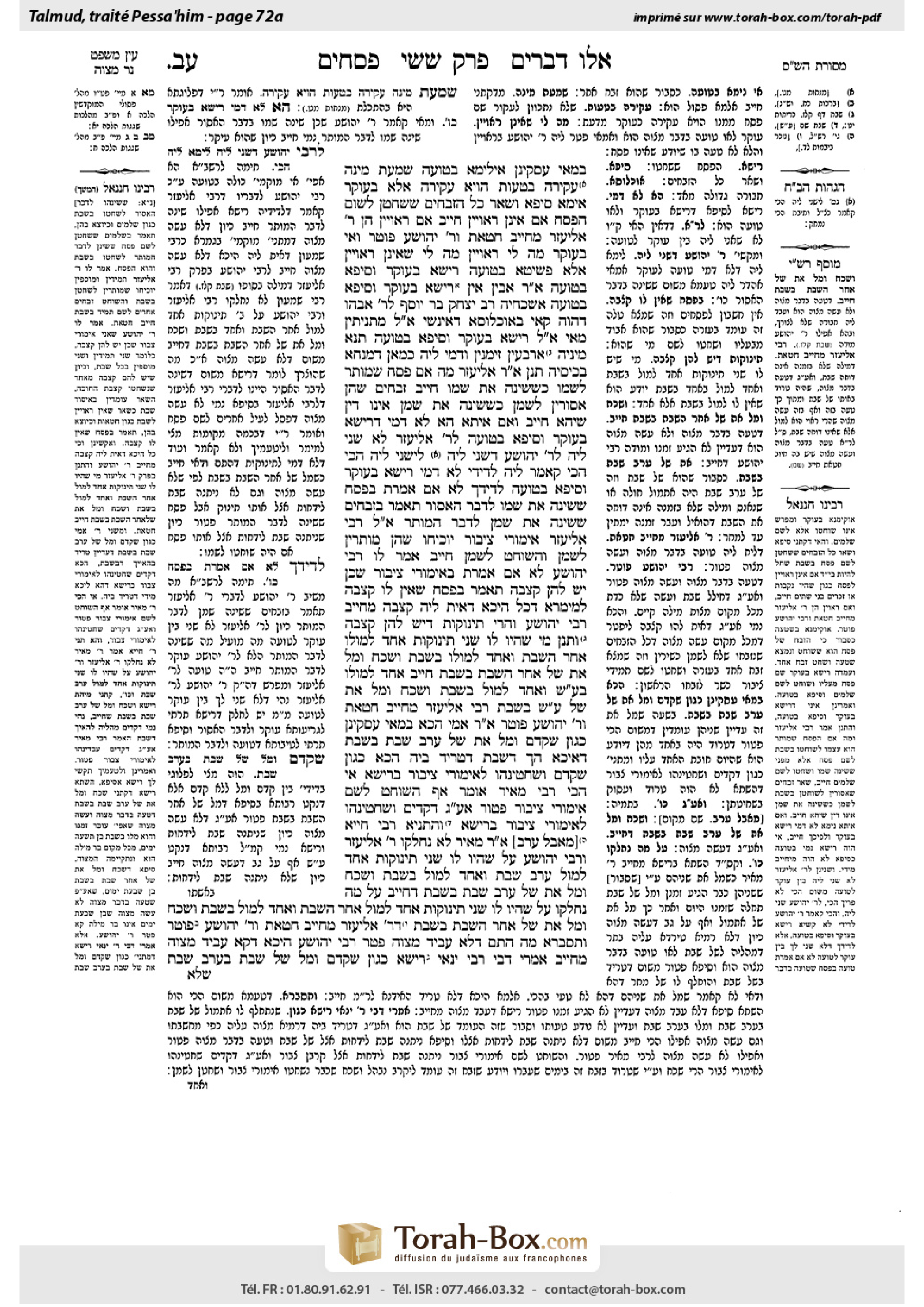
Pesachim 72a: Talmud study for Daf Yomi
Daf Yomi is the daily study of one Talmud folio. Explore 37 tractates with scans, Hebrew text, Sefaria English and AI-generated French translations where annotated.
Passage selection and English or AI-generated French translation are available where the scan has annotations. Daf Study is independent of Torah-Box and Sefaria.
Browse Pesachim · פסחים · All tractatesPesachim 72a text and translations
This page of Pesachim includes the Aramaic text, an English translation and an AI-generated French translation, alongside the scan above.
פסחים ע״ב א · Aramaic and Hebrew text
גְּמָ׳ בְּמַאי עָסְקִינַן? אִילֵימָא בְּטוֹעֶה — שָׁמְעַתְּ מִינַּהּ עֲקִירָה בְּטָעוּת הָוְיָא עֲקִירָה. אֶלָּא בְּעוֹקֵר.
אֵימָא סֵיפָא: וּשְׁאָר כׇּל הַזְּבָחִים שֶׁשְּׁחָטָן לְשׁוּם הַפֶּסַח, אִם אֵינָן רְאוּיִין — חַיָּיב, אִם רְאוּיִין הֵן — רַבִּי אֱלִיעֶזֶר מְחַיֵּיב חַטָּאת, וְרַבִּי יְהוֹשֻׁעַ פּוֹטֵר. וְאִי בְּעוֹקֵר, מָה לִי רְאוּיִין, מָה לִי שֶׁאֵינָן רְאוּיִין?
אֶלָּא פְּשִׁיטָא בְּטוֹעֶה. רֵישָׁא בְּעוֹקֵר וְסֵיפָא בְּטוֹעֶה! אָמַר רַבִּי אָבִין: אִין, רֵישָׁא בְּעוֹקֵר וְסֵיפָא בְּטוֹעֶה.
אַשְׁכְּחֵיהּ רַב יִצְחָק בַּר יוֹסֵף לְרַבִּי אֲבָהוּ דַּהֲוָה קָאֵי בְּאוּכְלוּסָא דְאִינָשֵׁי, אֲמַר לֵיהּ: מַתְנִיתִין מַאי? אֲמַר לֵיהּ: רֵישָׁא בְּעוֹקֵר וְסֵיפָא בְּטוֹעֶה. תְּנָא מִינֵּיהּ אַרְבְּעִין זִימְנִין וְדָמֵי לֵיהּ כְּמַאן דְּמַנְּחָא בְּכִיסֵיהּ.
תְּנַן אָמַר רַבִּי אֱלִיעֶזֶר: מָה אִם פֶּסַח שֶׁמּוּתָּר לִשְׁמוֹ, כְּשֶׁשִּׁינָּה אֶת שְׁמוֹ — חַיָּיב, זְבָחִים שֶׁהֵן אֲסוּרִין לִשְׁמָן, כְּשֶׁשִּׁינָּה אֶת שְׁמָן אֵינוֹ דִּין שֶׁיְּהֵא חַיָּיב! וְאִם אִיתָא, הָא לָא דָּמֵי, דְּרֵישָׁא בְּעוֹקֵר, וְסֵיפָא בְּטוֹעֶה!
לְרַבִּי אֱלִיעֶזֶר לָא שָׁנֵי לֵיהּ. לְרַבִּי יְהוֹשֻׁעַ דְּשָׁנֵי לֵיהּ, לִישַׁנֵּי לֵיהּ הָכִי!
הָכִי קָאָמַר לֵיהּ: לְדִידִי לָא דָּמֵי, רֵישָׁא בְּעוֹקֵר וְסֵיפָא בְּטוֹעֶה. לְדִידָךְ: לֹא אִם אָמַרְתָּ בְּפֶסַח שֶׁשִּׁינָּה אֶת שְׁמוֹ לְדָבָר הָאָסוּר, תֹּאמַר בִּזְבָחִים שֶׁשִּׁינָּה אֶת שְׁמָן לְדָבָר הַמּוּתָּר.
אֲמַר לֵיהּ רַבִּי אֱלִיעֶזֶר: אֵימוּרֵי צִיבּוּר יוֹכִיחוּ שֶׁהֵן מוּתָּרִין לִשְׁמָן, וְהַשּׁוֹחֵט לִשְׁמָן — חַיָּיב, אָמַר לוֹ רַבִּי יְהוֹשֻׁעַ: לֹא אִם אָמַרְתָּ בְּאֵימוּרֵי צִיבּוּר שֶׁכֵּן יֵשׁ לָהֶן קִצְבָה, תֹּאמַר בְּפֶסַח שֶׁאֵין לוֹ קִצְבָה.
לְמֵימְרָא דְּכֹל הֵיכָא דְּאִית לֵיהּ קִצְבָה מְחַיֵּיב רַבִּי יְהוֹשֻׁעַ? וַהֲרֵי תִּינוֹקוֹת, דְּיֵשׁ לָהֶן קִצְבָה, וּתְנַן: מִי שֶׁהָיוּ לוֹ שְׁנֵי תִינוֹקוֹת, אֶחָד לְמוּלוֹ אַחַר הַשַּׁבָּת וְאֶחָד לְמוּלוֹ בַּשַּׁבָּת, וְשָׁכַח וּמָל אֶת שֶׁל אַחַר הַשַּׁבָּת בַּשַּׁבָּת — חַיָּיב.
אֶחָד לְמוּלוֹ בְּעֶרֶב שַׁבָּת, וְאֶחָד לָמוּל בַּשַּׁבָּת, וְשָׁכַח וּמָל אֶת שֶׁל עֶרֶב שַׁבָּת בַּשַּׁבָּת — רַבִּי אֱלִיעֶזֶר מְחַיֵּיב חַטָּאת, וְרַבִּי יְהוֹשֻׁעַ פּוֹטֵר!
אָמַר רַבִּי אַמֵּי: הָכָא בְּמַאי עָסְקִינַן? כְּגוֹן שֶׁקָּדַם וּמָל אֶת שֶׁל עֶרֶב שַׁבָּת בַּשַּׁבָּת, דְּאִיכָּא הָךְ דְּשַׁבָּת דִּטְרִיד בֵּיהּ. הָכָא, כְּגוֹן שֶׁקָּדַם וְשַׁחְטִינְהוּ לְאֵימוּרֵי צִיבּוּר בְּרֵישָׁא.
אִי הָכִי? רַבִּי מֵאִיר אוֹמֵר: אַף הַשּׁוֹחֵט לְשֵׁם אֵימוּרֵי צִיבּוּר פָּטוּר, אַף עַל גַּב דִּקְדֵים וְשַׁחְטִינְהוּ לְאֵימוּרֵי צִיבּוּר בְּרֵישָׁא, וְהַתַּנְיָא, רַבִּי חִיָּיא [מֵאָבֵל עֲרָב] אָמַר רַבִּי מֵאִיר: לֹא נֶחְלְקוּ רַבִּי אֱלִיעֶזֶר וְרַבִּי יְהוֹשֻׁעַ עַל שֶׁהָיוּ לוֹ שְׁנֵי תִינוֹקוֹת, אֶחָד לָמוּל עֶרֶב שַׁבָּת וְאֶחָד לָמוּל בַּשַּׁבָּת, וְשָׁכַח וּמָל אֶת שֶׁל עֶרֶב שַׁבָּת בַּשַּׁבָּת — דְּחַיָּיב.
עַל מָה נֶחְלְקוּ — עַל שֶׁהָיוּ לוֹ שְׁנֵי תִינוֹקוֹת, אֶחָד לָמוּל אַחַר הַשַּׁבָּת וְאֶחָד לָמוּל בַּשַּׁבָּת, וְשָׁכַח וּמָל אֶת שֶׁל אַחַר הַשַּׁבָּת בַּשַּׁבָּת, דְּרַבִּי אֱלִיעֶזֶר מְחַיֵּיב חַטָּאת, וְרַבִּי יְהוֹשֻׁעַ פּוֹטֵר.
וְתִסְבְּרָא: מָה הָתָם דְּלָא עָבֵיד מִצְוָה — פָּטַר רַבִּי יְהוֹשֻׁעַ, הֵיכָא דְּקָא עָבֵיד מִצְוָה — מְחַיֵּיב?!
אָמְרִי דְּבֵי רַבִּי יַנַּאי: רֵישָׁא — כְּגוֹן שֶׁקָּדַם וּמָל שֶׁל שַׁבָּת בְּעֶרֶב שַׁבָּת,
Pesachim 72a · English translation
GEMARA: When the mishna speaks of one who slaughtered a Paschal lamb on Shabbat for a different purpose, with what precisely are we dealing? If you say we are dealing with one who erred in that he actually thought this was a different offering and not a Paschal offering, learn from it, i.e., from the fact that the offering is disqualified and he is therefore liable to bring a sin-offering, that the erroneous uprooting of the status of an offering constitutes uprooting, even though he had no intention to do so. It would, however, be surprising to find the mishna taking a stand on this issue, as we find elsewhere that it is the subject of an amoraic dispute (Tosafot). Rather, the mishna must certainly be referring to one who intentionally uprooted the animal’s designation as a Paschal lamb and offered it as a different offering.
If so, say the latter clause of the mishna: As for all other offerings that one unwittingly slaughtered on Shabbat for the purpose of a Paschal offering, if they were not fit for the Paschal offering, he is liable to bring a sin-offering. And if they are fit, Rabbi Eliezer deems him liable to bring a sin-offering, whereas Rabbi Yehoshua exempts him. Now if the mishna is referring to one who intentionally uprooted the original designation of the animal, which he knew was not a Paschal offering, what does it matter to me whether the animal was fit or unfit? He certainly does not think that he is performing a mitzva; why then does Rabbi Yehoshua exempt him from bringing a sin-offering?
Rather, it is obvious that we must be dealing with one who erred. But if so, we have a contradiction in the mishna, as the first clause is referring to one who intentionally uprooted the animal’s designation, whereas the latter clause is referring to one who erred about it. Rabbi Avin said: Yes, we must accept this conclusion even though it is unusual: The first clause deals with one who uprooted the animal’s designation, whereas the latter clause deals with one who erred about it.
The Gemara relates that Rav Yitzḥak bar Yosef once found Rabbi Abbahu standing among a multitude [okhlosa] of people, and he said to him: What is the meaning of our mishna? Rabbi Abbahu said to him: The first clause is referring to one who intentionally uprooted the animal’s status, whereas the latter clause is referring to one who erred about it. Rav Yitzḥak bar Yosef learned this statement from him forty times, and it seemed to him as though it were resting in his pouch; i.e., he repeated it many times until the mishna became crystal clear to him and etched in his memory.
The Gemara raises a difficulty with this understanding of the mishna: We learned in the continuation of the mishna that Rabbi Eliezer said to Rabbi Yehoshua: If with regard to the Paschal lamb, which is permitted to be slaughtered on Shabbat for its own purpose, when one changed its purpose he is nevertheless liable, then with regard to other offerings that are forbidden to be slaughtered on Shabbat even for their own purpose, when he changed their purpose is it not right that he should be liable? And if it is so that the two parts of the mishna are not talking about the same case, surely they are not similar and cannot be compared; as the first clause is referring to one who intentionally uprooted the animal’s status, whereas the latter clause is referring to one who erred about it.
The Gemara answers: According to Rabbi Eliezer, who put forward this a fortiori argument, there is no difference, for in his opinion someone who erred while intending to perform a mitzva is liable to bring a sin-offering, even if he made a reasonable mistake. Thus, he does not differentiate between the deliberate uprooting of the animal’s status and the erroneous sacrificing of the offering for a different purpose. The Gemara asks: But according to Rabbi Yehoshua, for whom there is a difference between the two cases, let him answer Rabbi Eliezer in this way, that the first clause of the mishna is referring to one who intentionally uprooted the status of an offering, while the latter clause is referring to one who erred about it. Why does he introduce another factor, that in the first clause he changed the animal’s purpose for something forbidden, whereas in the latter clause he changed it for something permitted?
The Gemara explains that this is what Rabbi Yehoshua said to Rabbi Eliezer: According to me, these cases are not comparable, because the first clause deals with one who intentionally uprooted the animal’s designation, whereas the latter clause deals with one who erred about it. However, even according to you, who do not differentiate in this manner, I can still answer as follows: No, if you say that one is liable if he slaughtered a Paschal lamb for a different purpose, it is because he changed its purpose for something prohibited. But can you say the same thing about other offerings that he slaughtered for the purpose of a Paschal offering and thus changed their purpose for something permitted?
The mishna continues with what Rabbi Eliezer said to Rabbi Yehoshua: Let the communal offerings prove the matter, for they are permitted for slaughter on Shabbat for their own purpose, and nevertheless, one who unnecessarily slaughters different offerings for their purpose is liable. Rabbi Yehoshua said to him: No, if you said this halakha with regard to communal offerings, it is because they have a limit. But can you necessarily say the same thing with regard to the Paschal lamb, which does not have a limit?
The Gemara asks: Is that to say that wherever there is a limit, Rabbi Yehoshua deems liable one who erred while intending to perform a mitzva? But with regard to the circumcision of babies on Shabbat, which has a limit, we nevertheless learned in a mishna that with regard to one who had two babies to circumcise, one of whom he needed to circumcise after Shabbat and one of whom he needed to circumcise on Shabbat, and he forgot and circumcised the one that should have been circumcised after Shabbat on Shabbat, he is liable to bring a sin-offering. This is because he performed the prohibited labor of causing a wound not in the framework of performing a mitzva, as no obligation yet existed to circumcise the child.
If, however, there were two babies, one of whom he needed to circumcise on Shabbat eve, and one of whom he needed to circumcise on Shabbat, and he forgot and circumcised the one that he should have circumcised on Shabbat eve on Shabbat, Rabbi Eliezer deems him liable to bring a sin-offering. As circumcision after its appointed time does not override Shabbat, he has therefore unwittingly violated Shabbat. And Rabbi Yehoshua exempts him. Since he intended to perform a mitzva, and despite his error in fact performed a mitzva, he is exempt from bringing a sin-offering. Thus, we see that even though there is a limit in the case of the babies, Rabbi Yehoshua nevertheless exempts one who errs while intending to perform a mitzva.
Rabbi Ami said: With what are we dealing here? We are dealing with a case where the circumciser first unwittingly circumcised the baby who should have been circumcised on Shabbat eve on Shabbat, when there is still this other baby who should be circumcised on Shabbat with whom he is preoccupied. Since he was legitimately preoccupied with a mitzva, as he knew that there was a baby that needed to be circumcised, he is exempt from bringing a sin-offering. Here, however, with regard to offerings, we are dealing with a case where he first slaughtered the required communal offerings at the beginning, so that there was no need to slaughter any more offerings, as communal offerings have a limit. Since he had no reason to make a mistake, he is liable to bring a sin-offering for having unnecessarily slaughtered an animal on Shabbat.
The Gemara asks: If so, how do we understand the continuation of the mishna, where Rabbi Meir says that according to Rabbi Yehoshua, even one who unwittingly slaughters other offerings for the purpose of communal offerings beyond their daily limit is exempt? According to our explanation, this must be true even though he first slaughtered the required communal offerings at the beginning. But didn’t Rabbi Ḥiyya from the village of Avel Arav teach in a baraita another version of the dispute, according to which Rabbi Meir said: Rabbi Eliezer and Rabbi Yehoshua did not disagree over one who had two babies to circumcise, one to circumcise on Shabbat eve and one to circumcise on Shabbat, and he forgot and circumcised the one who should have been circumcised on Shabbat eve on Shabbat; in that case, everyone agrees that he is liable to bring a sin-offering.
With regard to what did they disagree? With regard to one who had two babies to circumcise, one to circumcise after Shabbat and one to circumcise on Shabbat, and he forgot and circumcised the baby who should have been circumcised after Shabbat on Shabbat, as Rabbi Eliezer deems him liable to bring a sin-offering, and Rabbi Yehoshua exempts him.
The Gemara expresses surprise: And how can you understand this baraita in its current formulation? If there, in the latter clause, where he circumcised the baby who should have been circumcised after Shabbat on Shabbat, so that he did not perform a mitzva because the baby was not yet eight days old and the mitzva did not yet apply, Rabbi Yehoshua nevertheless exempted him because he erred while intending to perform a mitzva. Then where he did perform a mitzva, i.e., where he circumcised a baby on Shabbat who was already eight days old before Shabbat and to whom the mitzva of circumcision applied, would Rabbi Yehoshua deem him liable?
The Rabbis of the school of Rabbi Yannai said: The first clause of the baraita is referring to a unique situation, where the circumciser first unwittingly circumcised on Shabbat eve the baby who should have been circumcised on Shabbat.
Pesachim 72a · Traduction française (IA)
GUEMARA : Lorsque la Michna parle de celui qui a égorgé un agneau pascal le Chabbat dans une intention différente, de quel cas précis s’agit-il ? Si tu dis qu’il s’agit de quelqu’un qui s’est trompé, pensant en réalité qu’il s’agissait d’un autre sacrifice et non d’un sacrifice pascal, apprends-en, c’est-à-dire du fait que le sacrifice est invalide et qu’il est donc tenu d’apporter un sacrifice expiatoire, que le changement involontaire de la désignation d’un sacrifice constitue bien un changement de désignation, même s’il n’avait pas l’intention de le faire. Il serait toutefois surprenant que la Michna tranche cette question, alors qu’on constate ailleurs qu’elle fait l’objet d’un désaccord entre amoraïm (Tosafot). Il faut donc certainement comprendre que la Michna parle de quelqu’un qui a délibérément changé la désignation de l’animal comme agneau pascal et l’a offert comme un autre sacrifice.
Si tel est le cas, dis ce qu’énonce la clause finale de la Michna : Quant à tous les autres sacrifices qu’on a égorgés involontairement le Chabbat dans l’intention d’en faire un sacrifice pascal, s’ils ne convenaient pas comme sacrifice pascal, on est tenu d’apporter un sacrifice expiatoire. Et s’ils convenaient, Rabbi Éliézer estime qu’on est tenu d’apporter un sacrifice expiatoire, tandis que Rabbi Yehoshoua en dispense. Or, si la Michna parle de quelqu’un qui a délibérément changé la désignation initiale de l’animal, sachant qu’il ne s’agissait pas d’un sacrifice pascal, qu’importe que l’animal ait convenu ou non ? Il ne pense certainement pas accomplir une mitsva ; pourquoi Rabbi Yehoshoua le dispense-t-il alors d’apporter un sacrifice expiatoire ?
Il est donc évident qu’il faut parler de quelqu’un qui s’est trompé. Mais, dans ce cas, il y a une contradiction dans la Michna, car la première clause parle de quelqu’un qui a délibérément changé la désignation de l’animal, tandis que la clause finale parle de quelqu’un qui s’est trompé à ce sujet. Rabbi Avin dit : Oui, il faut accepter cette conclusion, bien qu’elle soit inhabituelle : la première clause traite de quelqu’un qui a changé la désignation de l’animal, tandis que la clause finale traite de quelqu’un qui s’est trompé à ce sujet.
La Guemara rapporte que Rav Yitzḥak bar Yosef trouva un jour Rabbi Abbahou debout au milieu d’une foule [okhlosa] et lui demanda : Quel est le sens de notre Michna ? Rabbi Abbahou lui répondit : La première clause parle de quelqu’un qui a délibérément changé la désignation de l’animal, tandis que la clause finale parle de quelqu’un qui s’est trompé à ce sujet. Rav Yitzḥak bar Yosef apprit cette déclaration de lui quarante fois, et elle lui sembla alors comme déposée dans sa bourse ; autrement dit, il la répéta de nombreuses fois, jusqu’à ce que la Michna lui devienne parfaitement claire et s’inscrive dans sa mémoire.
La Guemara soulève une difficulté concernant cette interprétation de la Michna : Nous avons appris dans la suite de la Michna que Rabbi Éliézer dit à Rabbi Yehoshoua : Si, pour l’agneau pascal, qu’il est permis d’égorger le Chabbat dans l’intention qui lui convient, celui qui en change l’intention est néanmoins passible, alors, pour les autres sacrifices, qu’il est interdit d’égorger le Chabbat même dans l’intention qui leur convient, celui qui en change l’intention ne devrait-il pas, à plus forte raison, être passible ? Or, si les deux parties de la Michna ne parlent pas du même cas, elles ne sont certainement pas comparables et ne peuvent être mises en parallèle, puisque la première clause parle de quelqu’un qui a délibérément changé la désignation de l’animal, tandis que la clause finale parle de quelqu’un qui s’est trompé à ce sujet.
La Guemara répond : Selon Rabbi Éliézer, qui a avancé cet argument a fortiori, il n’y a pas de différence, car, selon lui, celui qui se trompe alors qu’il a l’intention d’accomplir une mitsva est tenu d’apporter un sacrifice expiatoire, même s’il a commis une erreur raisonnable. Ainsi, il ne fait pas de distinction entre le changement délibéré de la désignation de l’animal et le fait d’offrir par erreur le sacrifice dans une intention différente. La Guemara demande : Mais, selon Rabbi Yehoshoua, pour qui il y a une différence entre les deux cas, qu’il réponde ainsi à Rabbi Éliézer : la première clause de la Michna parle de quelqu’un qui a délibérément changé la désignation d’un sacrifice, tandis que la clause finale parle de quelqu’un qui s’est trompé à ce sujet. Pourquoi introduit-il un autre facteur, à savoir que, dans la première clause, il a changé l’intention de l’animal pour quelque chose d’interdit, tandis que, dans la clause finale, il l’a changée pour quelque chose de permis ?
La Guemara explique que voici ce que Rabbi Yehoshoua dit à Rabbi Éliézer : Selon moi, ces cas ne sont pas comparables, puisque la première clause traite de quelqu’un qui a délibérément changé la désignation de l’animal, tandis que la clause finale traite de quelqu’un qui s’est trompé à ce sujet. Toutefois, même selon toi, qui ne fais pas cette distinction, je peux encore répondre ainsi : Non, si tu dis qu’on est passible lorsqu’on a égorgé un agneau pascal dans une intention différente, c’est parce qu’on a changé son intention pour quelque chose d’interdit. Mais peux-tu en dire autant des autres sacrifices qu’on a égorgés dans l’intention d’en faire un sacrifice pascal, changeant ainsi leur intention pour quelque chose de permis ?
La Michna poursuit en rapportant les paroles de Rabbi Éliézer à Rabbi Yehoshoua : Que les sacrifices communautaires le prouvent, car il est permis de les égorger le Chabbat dans l’intention qui leur convient, et pourtant, celui qui égorge inutilement d’autres sacrifices dans l’intention qui leur convient est passible. Rabbi Yehoshoua lui répondit : Non, si tu as énoncé cette halakha au sujet des sacrifices communautaires, c’est parce que leur nombre est limité. Mais peux-tu nécessairement en dire autant de l’agneau pascal, dont le nombre n’est pas limité ?
La Guemara demande : Cela signifie-t-il que, chaque fois que le nombre est limité, Rabbi Yehoshoua tient pour passible celui qui s’est trompé en ayant l’intention d’accomplir une mitsva ? Pourtant, concernant la circoncision des nourrissons le Chabbat, où le nombre est limité, nous avons néanmoins appris dans une Michna que, lorsqu’un homme avait deux nourrissons à circoncire, l’un après le Chabbat et l’autre le Chabbat, et qu’il oublia et circoncit le Chabbat celui qui devait l’être après le Chabbat, il est tenu d’apporter un sacrifice expiatoire. C’est parce qu’il a accompli le travail interdit consistant à causer une blessure sans que cela relève de l’accomplissement d’une mitsva, puisqu’il n’était pas encore tenu de circoncire l’enfant.
Cependant, s’il avait deux nourrissons, l’un qu’il devait circoncire la veille du Chabbat et l’autre le Chabbat, et qu’il oublia et circoncit le Chabbat celui qu’il aurait dû circoncire la veille du Chabbat, Rabbi Éliézer estime qu’il est tenu d’apporter un sacrifice expiatoire. Comme la circoncision après le délai fixé ne repousse pas le Chabbat, il a donc transgressé le Chabbat involontairement. Rabbi Yehoshoua, lui, l’en dispense. Puisqu’il avait l’intention d’accomplir une mitsva et que, malgré son erreur, il a effectivement accompli une mitsva, il est dispensé d’apporter un sacrifice expiatoire. Nous voyons donc que, bien que le nombre soit limité dans le cas des nourrissons, Rabbi Yehoshoua dispense néanmoins celui qui se trompe en ayant l’intention d’accomplir une mitsva.
Rabbi Ami dit : De quel cas s’agit-il ici ? D’un cas où le circonciseur a d’abord circoncis involontairement le Chabbat le nourrisson qui aurait dû l’être la veille du Chabbat, alors qu’il y avait encore cet autre nourrisson à circoncire le Chabbat et qu’il était occupé par lui. Comme il était légitimement occupé par une mitsva, sachant qu’il y avait un nourrisson qui devait être circoncis, il est dispensé d’apporter un sacrifice expiatoire. Ici, en revanche, concernant les sacrifices, il s’agit d’un cas où il a d’abord égorgé les sacrifices communautaires requis au début, de sorte qu’il n’était plus nécessaire d’égorger d’autres sacrifices, puisque le nombre des sacrifices communautaires est limité. N’ayant aucune raison de se tromper, il est tenu d’apporter un sacrifice expiatoire pour avoir inutilement égorgé un animal le Chabbat.
La Guemara demande : Si tel est le cas, comment comprendre la suite de la Michna, où Rabbi Meïr dit que, selon Rabbi Yehoshoua, même celui qui égorge involontairement d’autres sacrifices dans l’intention d’en faire des sacrifices communautaires au-delà de leur limite quotidienne est dispensé ? Selon notre explication, cela doit être vrai même s’il a d’abord égorgé les sacrifices communautaires requis. Mais Rabbi Ḥiyya, du village d’Avel Arav, n’a-t-il pas enseigné dans une baraïta une autre version du désaccord, selon laquelle Rabbi Meïr a dit : Rabbi Éliézer et Rabbi Yehoshoua ne sont pas en désaccord au sujet de celui qui avait deux nourrissons à circoncire, l’un la veille du Chabbat et l’autre le Chabbat, et qui oublia et circoncit le Chabbat celui qui aurait dû l’être la veille du Chabbat ; dans ce cas, tous conviennent qu’il est tenu d’apporter un sacrifice expiatoire.
Sur quoi étaient-ils en désaccord ? Sur le cas de celui qui avait deux nourrissons à circoncire, l’un après le Chabbat et l’autre le Chabbat, et qui oublia et circoncit le Chabbat le nourrisson qui aurait dû l’être après le Chabbat : Rabbi Éliézer estime qu’il est tenu d’apporter un sacrifice expiatoire, tandis que Rabbi Yehoshoua l’en dispense.
La Guemara exprime son étonnement : Et comment comprendre cette baraïta telle qu’elle est formulée ? Si, dans la clause finale, Rabbi Yehoshoua l’a dispensé alors qu’il avait circoncis le Chabbat le nourrisson qui aurait dû l’être après le Chabbat, de sorte qu’il n’avait pas accompli de mitsva, puisque l’enfant n’avait pas encore huit jours et que la mitsva ne s’appliquait pas encore, parce qu’il s’était trompé en ayant l’intention d’accomplir une mitsva, alors, dans le cas où il a effectivement accompli une mitsva, c’est-à-dire où il a circoncis le Chabbat un nourrisson qui avait déjà huit jours avant le Chabbat et auquel s’appliquait la mitsva de la circoncision, Rabbi Yehoshoua le tiendrait-il pour passible ?
Les Rabbins de l’école de Rabbi Yannai ont dit : La première clause de la baraïta parle d’une situation particulière, où le circonciseur a d’abord circoncis involontairement, la veille du Chabbat, le nourrisson qui aurait dû être circoncis le Chabbat.
Traduction française générée par IA à partir de l’édition anglaise de Sefaria. Vérifie toujours un passage avec le texte source.
Text from Sefaria: William Davidson Edition - Vocalized Aramaic (CC BY NC); William Davidson Edition - English (CC BY NC).