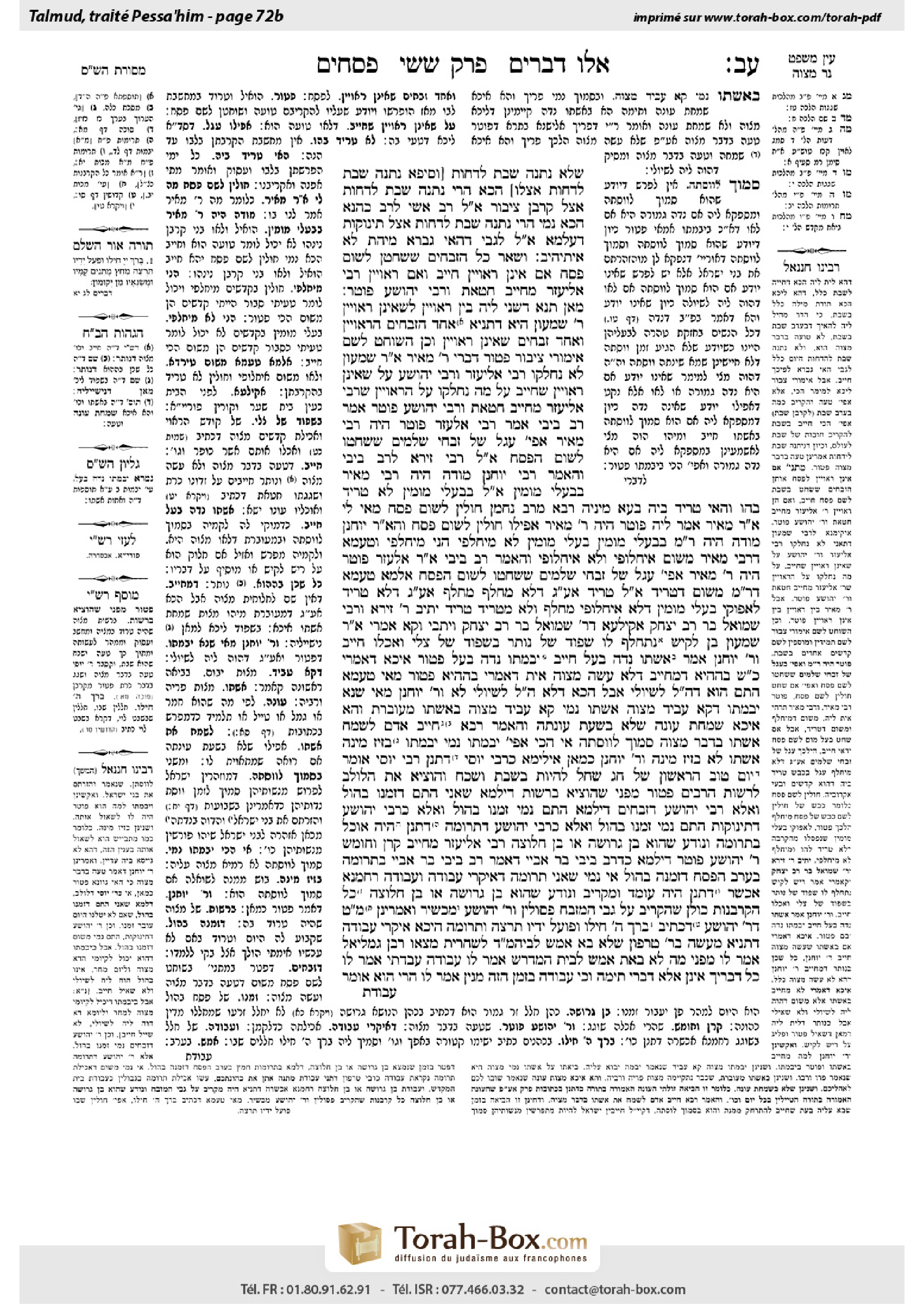
Pesachim 72b: Talmud study for Daf Yomi
Daf Yomi is the daily study of one Talmud folio. Explore 37 tractates with scans, Hebrew text, Sefaria English and AI-generated French translations where annotated.
Passage selection and English or AI-generated French translation are available where the scan has annotations. Daf Study is independent of Torah-Box and Sefaria.
Browse Pesachim · פסחים · All tractatesPesachim 72b text and translations
This page of Pesachim includes the Aramaic text, an English translation and an AI-generated French translation, alongside the scan above.
פסחים ע״ב ב · Aramaic and Hebrew text
שֶׁלֹּא נִתְּנָה שַׁבָּת לִדָּחוֹת. [וְסֵיפָא — נִתְּנָה שַׁבָּת לִדָּחוֹת אֶצְלוֹ].
הָכָא — הֲרֵי נִתְּנָה שַׁבָּת לִדָּחוֹת אֵצֶל קׇרְבַּן צִיבּוּר.
אֲמַר לֵיהּ רַב אָשֵׁי לְרַב כָּהֲנָא: הָכָא נָמֵי, הֲרֵי נִתְּנָה שַׁבָּת לִדָּחוֹת אֵצֶל תִּינוֹקוֹת דְּעָלְמָא! אֲמַר לֵיהּ: לְגַבֵּי דְּהַאי גַּבְרָא מִיהַת לָא אִיתְיְהִיב.
וּשְׁאָר כׇּל הַזְּבָחִים שֶׁשְּׁחָטָן לְשׁוּם פֶּסַח, אִם אֵינָן רְאוּיִין — חַיָּיב, וְאִם רְאוּיִין — רַבִּי אֱלִיעֶזֶר מְחַיֵּיב חַטָּאת, וְרַבִּי יְהוֹשֻׁעַ פּוֹטֵר. מַאן תַּנָּא דְּשָׁנֵי לֵיהּ בֵּין רְאוּיִין לְשֶׁאֵינָן רְאוּיִין?
רַבִּי שִׁמְעוֹן הִיא. דְּתַנְיָא: אֶחָד הַזְּבָחִים הָרְאוּיִין וְאֶחָד זְבָחִים שֶׁאֵינָן רְאוּיִין, וְכֵן הַשּׁוֹחֵט לְשֵׁם אֵימוּרֵי צִיבּוּר — פָּטוּר, דִּבְרֵי רַבִּי מֵאִיר. אָמַר רַבִּי שִׁמְעוֹן: לֹא נֶחְלְקוּ רַבִּי אֱלִיעֶזֶר וְרַבִּי יְהוֹשֻׁעַ עַל שֶׁאֵינָן רְאוּיִין שֶׁחַיָּיב, עַל מָה נֶחְלְקוּ — עַל הָרְאוּיִין, שֶׁרַבִּי אֱלִיעֶזֶר מְחַיֵּיב חַטָּאת, וְרַבִּי יְהוֹשֻׁעַ פּוֹטֵר.
אָמַר רַב בִּיבִי אָמַר רַבִּי אֶלְעָזָר: פּוֹטֵר הָיָה רַבִּי מֵאִיר אֲפִילּוּ עֵגֶל שֶׁל זִבְחֵי שְׁלָמִים שֶׁשְּׁחָטוֹ לְשׁוּם הַפֶּסַח. אֲמַר לֵיהּ רַבִּי זֵירָא לְרַב בִּיבִי: וְהָאָמַר רַבִּי יוֹחָנָן: מוֹדֶה הָיָה רַבִּי מֵאִיר בְּבַעֲלֵי מוּמִין! אֲמַר לֵיהּ: בְּבַעֲלֵי מוּמִין לָא טְרִיד בְּהוּ, וְהַאי טְרִיד בֵּיהּ.
בְּעָא מִינֵּיהּ רָבָא מֵרַב נַחְמָן: חוּלִּין לְשׁוּם פֶּסַח, מַאי לִי אָמַר רַבִּי מֵאִיר? אֲמַר לֵיהּ: פּוֹטֵר הָיָה רַבִּי מֵאִיר אֲפִילּוּ חוּלִּין לְשׁוּם פֶּסַח.
וְהָאָמַר רַבִּי יוֹחָנָן: מוֹדֶה הָיָה רַבִּי מֵאִיר בְּבַעֲלֵי מוּמִין! בַּעֲלֵי מוּמִין לָא מִיחַלְּפִי, הָנֵי מִיחַלְּפִי.
וְטַעְמָא דְּרַבִּי מֵאִיר מִשּׁוּם אִיחַלּוֹפֵי וְלָא אִיחַלּוֹפֵי? וְהָאָמַר רַב בִּיבִי אָמַר רַבִּי אֶלְעָזָר: פּוֹטֵר הָיָה רַבִּי מֵאִיר אֲפִילּוּ עֵגֶל שֶׁל זִבְחֵי שְׁלָמִים שֶׁשְּׁחָטוֹ לְשׁוּם הַפֶּסַח! אַלְמָא, טַעְמָא דְּרַבִּי מֵאִיר מִשּׁוּם דִּטְרִיד!
אֲמַר לֵיהּ: טְרִיד — אַף עַל גַּב דְּלָא מִחַלַּף, מִחַלַּף — אַף עַל גַּב דְּלָא טְרִיד, לְאַפּוֹקֵי בַּעֲלֵי מוּמִין, דְּלָא אִיחַלּוֹפֵי מִחַלַּף וְלָא מִטְרִיד טְרִיד.
יָתֵיב רַבִּי זֵירָא וְרַבִּי שְׁמוּאֵל בַּר רַב יִצְחָק אַקִּילְעָא דְּרַבִּי שְׁמוּאֵל בַּר רַב יִצְחָק, וְיָתְבִי וְקָא אָמְרִי, אָמַר רַבִּי שִׁמְעוֹן בֶּן לָקִישׁ: נִתְחַלֵּף לוֹ שַׁפּוּד שֶׁל נוֹתָר בְּשַׁפּוּד שֶׁל צָלִי, וַאֲכָלוֹ — חַיָּיב.
וְרַבִּי יוֹחָנָן אָמַר: אִשְׁתּוֹ נִדָּה בָּעַל — חַיָּיב. יְבִמְתּוֹ נִדָּה בָּעַל — פָּטוּר.
אִיכָּא דְאָמְרִי: כׇּל שֶׁכֵּן בְּהָהִיא דְּמִחַיַּיב, דְּלֹא עָשָׂה מִצְוָה.
אִית דְּאָמְרִי, בְּהַהִיא — פָּטוּר. מַאי טַעְמָא? הָתָם הוּא דַּהֲוָה לֵיהּ לְשַׁיּוֹלֵי. אֲבָל הָכָא, דְּלָא הֲוָה לֵיהּ לְשַׁיּוֹלֵי — לָא.
וְרַבִּי יוֹחָנָן, מַאי שְׁנָא יְבִמְתּוֹ, דְּקָא עָבֵיד מִצְוָה? אִשְׁתּוֹ נָמֵי קָא עָבֵיד מִצְוָה! בְּאִשְׁתּוֹ מְעוּבֶּרֶת.
וְהָא אִיכָּא שִׂמְחַת עוֹנָה! שֶׁלֹּא בִּשְׁעַת עוֹנָתָהּ.
וְהָאָמַר רָבָא: חַיָּיב אָדָם לְשַׂמֵּחַ אִשְׁתּוֹ בִּדְבַר מִצְוָה! סָמוּךְ לְוִוסְתָּהּ.
אִי הָכִי, אֲפִילּוּ יְבִמְתּוֹ נָמֵי! יְבִמְתּוֹ בְּזִיז מִינַּהּ, אִשְׁתּוֹ לָא בְּזִיז מִינַּהּ.
וְרַבִּי יוֹחָנָן כְּמַאן? אִילֵּימָא כְּרַבִּי יוֹסֵי. דִּתְנַן, רַבִּי יוֹסֵי אוֹמֵר: יוֹם טוֹב הָרִאשׁוֹן שֶׁל חַג שֶׁחָל לִהְיוֹת בַּשַּׁבָּת, וְשָׁכַח וְהוֹצִיא אֶת הַלּוּלָב לִרְשׁוּת הָרַבִּים — פָּטוּר, מִפְּנֵי שֶׁהוֹצִיא בִּרְשׁוּת.
דִּילְמָא שָׁאנֵי הָתָם, דִּזְמַנּוֹ בָּהוּל.
וְאֶלָּא רַבִּי יְהוֹשֻׁעַ דִּזְבָחִים. דִּילְמָא הָתָם נָמֵי זְמַנּוֹ בָּהוּל.
וְאֶלָּא כְּרַבִּי יְהוֹשֻׁעַ דְּתִינוֹקוֹת. הָתָם נָמֵי זְמַנּוֹ בָּהוּל.
וְאֶלָּא כְּרַבִּי יְהוֹשֻׁעַ דִּתְרוּמָה, דִּתְנַן: הָיָה אוֹכֵל בִּתְרוּמָה וְנוֹדַע שֶׁהוּא בֶּן גְּרוּשָׁה אוֹ בֶּן חֲלוּצָה — רַבִּי אֱלִיעֶזֶר מְחַיֵּיב קֶרֶן וָחוֹמֶשׁ, רַבִּי יְהוֹשֻׁעַ פּוֹטֵר.
דִּילְמָא כִּדְרַב בִּיבִי בַּר אַבָּיֵי, דְּאָמַר רַב בִּיבִי בַּר אַבָּיֵי: בִּתְרוּמָה בְּעֶרֶב הַפֶּסַח, דִּזְמַנָּהּ בָּהוּל.
אִי נָמֵי: שָׁאנֵי תְּרוּמָה דְּאִיקְּרִי עֲבוֹדָה, וַעֲבוֹדָה רַחֲמָנָא אַכְשַׁר.
דִּתְנַן: הָיָה עוֹמֵד וּמַקְרִיב, וְנוֹדַע שֶׁהוּא בֶּן גְּרוּשָׁה אוֹ בֶּן חֲלוּצָה — כׇּל הַקָּרְבָּנוֹת כּוּלָּן שֶׁהִקְרִיב עַל גַּבֵּי הַמִּזְבֵּחַ פְּסוּלִין, וְרַבִּי יְהוֹשֻׁעַ מַכְשִׁיר. וְאָמְרִינַן, מַאי טַעְמָא דְּרַבִּי יְהוֹשֻׁעַ — דִּכְתִיב: ״בָּרֵךְ ה׳ חֵילוֹ וּפֹעַל יָדָיו תִּרְצֶה״.
וּתְרוּמָה הֵיכָא אִיקְּרִי עֲבוֹדָה? דְּתַנְיָא, מַעֲשֶׂה בְּרַבִּי טַרְפוֹן שֶׁלֹּא בָּא אֶמֶשׁ לְבֵית הַמִּדְרָשׁ. לְשַׁחֲרִית מְצָאוֹ רַבָּן גַּמְלִיאֵל, אָמַר לוֹ: מִפְּנֵי מָה לֹא בָּאתָ אֶמֶשׁ לְבֵית הַמִּדְרָשׁ? אָמַר לוֹ: עֲבוֹדָה עָבַדְתִּי. אָמַר לוֹ: כׇּל דְּבָרֶיךָ אֵינָן אֶלָּא דִּבְרֵי תֵימָה, וְכִי עֲבוֹדָה בַּזְּמַן הַזֶּה מִנַּיִן? אָמַר לוֹ, הֲרֵי הוּא אוֹמֵר:
Pesachim 72b · English translation
In that case, Shabbat does not stand to be overridden at all. Since the baby who should have been circumcised on Shabbat was already circumcised, and the only one left is the baby who should have been circumcised on Friday, the circumciser should have known that he has no circumcisions to perform on Shabbat, because a circumcision that was delayed beyond the eighth day does not override Shabbat. Therefore, he is liable if he performed the circumcision on Shabbat. In the latter clause, however, the circumcision was performed in a situation where Shabbat stands to be overridden for him, as the baby who should have been circumcised on Shabbat was not yet circumcised.
Based on the understanding that everything depends on whether or not Shabbat stands to be overridden, it may be argued that here too, Shabbat stands to be overridden with regard to a communal offering. Therefore, one who on Shabbat unwittingly slaughters other offerings for the purpose of communal offerings is exempt from bringing a sin-offering, because he knows that communal offerings must be brought on Shabbat, and consequently there is some justification for his error.
Rav Ashi said to Rav Kahana that this explanation is difficult: Here too, it may be argued that Shabbat stands to be overridden with regard to babies in general, as it is permitted to circumcise a baby whose eighth day occurs on Shabbat, and so there is some minimal justification for his mistake. Rav Kahana said to him: That is indeed so. However, with regard to this person, Shabbat does not stand to be overridden, as there is no longer any child who is supposed to be circumcised on Shabbat. Therefore, if he unwittingly performed a circumcision on Shabbat, it is not considered as if he performed a transgression while preoccupied with the performance of a mitzva.
We learned in the mishna with regard to all other offerings that one unwittingly slaughtered on Shabbat for the purpose of a Paschal offering, that if they were not fit for the Paschal offering, he is liable to bring a sin-offering, and if they were fit, Rabbi Eliezer deems him liable to bring a sin-offering, and Rabbi Yehoshua exempts him. The Gemara asks: Who is the tanna that distinguishes between offerings that are fit for the Paschal lamb and those that are not fit?
The Gemara explains: It is Rabbi Shimon, as it was taught in a baraita: If one unwittingly slaughters other offerings on Shabbat for the purpose of a Paschal offering, whether they are offerings that are fit for the Paschal lamb or they are offerings that are not fit, and similarly, if he unwittingly slaughters other offerings for the purpose of communal offerings on Shabbat, he is exempt from bringing a sin-offering; this is the statement of Rabbi Meir. Rabbi Shimon said: Rabbi Eliezer and Rabbi Yehoshua did not disagree about one who slaughtered offerings that are not fit, for in that case all agree that he is liable. With regard to what did they disagree? With regard to one who slaughtered offerings that are fit, for Rabbi Eliezer deems him liable to bring a sin-offering and Rabbi Yehoshua exempts him. This indicates that the unattributed ruling of our mishna is in accordance with the opinion of Rabbi Shimon.
Rav Beivai said that Rabbi Elazar said: Rabbi Meir would exempt him even in the case of a calf of a peace-offering that he slaughtered for the purpose of the Paschal offering, even though one does not ordinarily mistake a calf for a lamb. Rabbi Zeira said to Rav Beivai: But didn’t Rabbi Yoḥanan say that Rabbi Meir conceded that if one slaughtered blemished animals on Shabbat he is liable to bring a sin-offering? He said to him: With regard to blemished animals, he is not at all preoccupied with them, because he knows that they are ineligible to be offered as sacrifices. But as for this calf, he is preoccupied with sacrificing it as an offering, and he may therefore make a mistake.
Rava raised a dilemma before Rav Naḥman: If one unwittingly slaughtered an unconsecrated animal for the purpose of a Paschal offering, what would Rabbi Meir say? Would he exempt him in this case as well? Rav Naḥman said to him: Rabbi Meir would exempt him even if he slaughtered an unconsecrated animal for the purpose of a Paschal offering.
Rava asked him: But didn’t Rabbi Yoḥanan say that Rabbi Meir concedes that if one slaughtered blemished animals on Shabbat he is liable to bring a sin-offering, as they are never sacrificed as offerings, and similarly, unconsecrated animals are never sacrificed as offerings? Rav Naḥman responded: There is room for a distinction. Blemished animals cannot be confused with unblemished ones, and so there is no legitimate reason for error; but these, i.e., unconsecrated animals, can easily be confused with consecrated animals, as they are externally indistinguishable from one another, and therefore one who confuses them is exempt.
Rava asked further: And is Rabbi Meir’s reason really that these can be confused and these cannot be confused with a legitimate offering? But didn’t Rav Beivai say that Rabbi Elazar said that Rabbi Meir would exempt him even in the case of a calf of a peace-offering that he slaughtered for the purpose of the Paschal offering, even though there is no way to mistake a calf for an animal that can be brought for the Paschal offering? Therefore, it is apparent that Rabbi Meir’s reason is that he is preoccupied with sacrificing the calf as an offering, and consequently he is exempt if he erred and slaughtered it for the purpose of a Paschal lamb. But why should one be exempt if he brought an unconsecrated animal for the purpose of a Paschal offering? He is not preoccupied with bringing it as an offering.
Rav Naḥman said to him: Both reasons apply according to Rabbi Meir. If one is preoccupied with bringing the animal as an offering, he is exempt even though the animal cannot easily be confused with the one he was supposed to sacrifice. And when the animal can easily be confused with the one set aside as an offering, he is exempt, even though he is not preoccupied with bringing it as an offering. This comes to exclude blemished animals, which cannot be confused with unblemished animals and with whose sacrifice he is not preoccupied.
The Gemara relates that Rabbi Zeira and Rabbi Shmuel bar Rav Yitzḥak were sitting on the porch of Rabbi Shmuel bar Rav Yitzḥak, and they sat and said: Rabbi Shimon ben Lakish said: If one unwittingly confused a spit of leftover sacrificial meat, which it is prohibited to eat and which makes one liable to receive the punishment of karet when one eats it intentionally, with a spit of roasted sacrificial meat, which is a mitzva to eat, and he ate it, he is liable to bring a sin-offering. Although he intended to do a mitzva, since he unwittingly transgressed the prohibition against eating leftover sacrificial meat, he must bring a sin-offering.
And they further reported that Rabbi Yoḥanan said: If one unwittingly engaged in sexual intercourse with his wife while she was menstruating, he is liable to bring a sin-offering. But if he unwittingly engaged in sexual intercourse with his sister-in-law who was waiting to become his wife through levirate marriage while she was menstruating, he is exempt, because the act of intercourse itself is a mitzva. A man whose brother died without children is obliged by Torah law to marry his deceased brother’s widow and “come to her” (Deuteronomy 25:5), so that even if he mistakenly transgressed while attempting to fulfill the mitzva, he is exempt from bringing a sin-offering.
The Gemara attempts to determine whether Rabbi Yoḥanan agrees or disagrees with Reish Lakish’s ruling: Some say that all the more so in the first case, where one unwittingly ate a spit of leftover sacrificial meat, Rabbi Yoḥanan would deem him liable to bring a sin-offering, for he did not actually perform a mitzva when he ate the meat, even though he intended to do so. This stands in contrast to the second case, where the person unwittingly engaged in sexual intercourse with his wife while she was menstruating, where he at least performed a small mitzva, as will be explained shortly.
Others say that according to Rabbi Yoḥanan in that case where one ate leftover sacrificial meat, he is exempt from bringing a sin-offering. What is the reason? There, where he had sexual intercourse with his wife while she was menstruating, he is liable, for he should have asked her if she was menstruating, and because he failed to do so he is liable to bring a sin-offering. But here, where he ate a spit of leftover sacrificial meat, he did not have anyone to ask, and so he is not liable to bring a sin-offering.
The Gemara asks: And according to Rabbi Yoḥanan, what is different about one who unwittingly engaged in sexual intercourse with his sister-in-law, in that he is exempt from bringing a sin-offering? Is it that he performed a mitzva, i.e., the mitzva of levirate marriage? If so, then also in the case where he unwittingly engaged in sexual intercourse with his wife while she was menstruating, he performed a mitzva, for he occupied himself in the fulfillment of the mitzva of procreation. The Gemara answers that we are dealing here with a case where his wife is pregnant, such that intercourse cannot lead to procreation.
The Gemara raises another question: Nevertheless, there is the mitzva of the enjoyment of conjugal rights. One of a husband’s marital obligations is to engage in sexual intercourse with his wife at regular intervals (see Exodus 21:10), and this is considered a mitzva. The Gemara answers that we are talking about a case where it is not the time of her conjugal rights.
The Gemara asks further: Even so, didn’t Rava say that a man is obligated to please his wife through a mitzva? That is to say, he must engage in sexual intercourse with her when she so desires, even if it is not the time of her conjugal rights. The Gemara answers that we are dealing with a case where it was near her expected date of menstruation, when sexual relations are prohibited due to a concern that the woman may already be menstruating or that she may begin to menstruate during the sexual act.
The Gemara asks: If so, i.e., if they engaged in sexual intercourse near the woman’s expected date of menstruation when he should have refrained from doing so, then even in the case where he had sexual intercourse with his sister-in-law and she turned out to be menstruating, he should also be liable, as the mitzva of levirate marriage does not apply at that time. The Gemara explains that with regard to his sister-in-law, he is still shy [bazeiz] in front of her and uncomfortable asking her whether she is close to her expected menstruation date, whereas with regard to his wife, he is not shy in front of her, and so he should have asked her.
The Gemara asks: And Rabbi Yoḥanan, in accordance with whose opinion did he rule with regard to one who erred while engaged in a mitzva? If you say he ruled in accordance with the opinion of Rabbi Yosei, as we learned in a mishna: Rabbi Yosei says: If the first Festival day of the festival of Sukkot occurs on Shabbat, and he forgot and carried his lulav out into the public domain and continued to transport it there, unwittingly performing a prohibited labor, he is exempt from bringing a sin-offering. That is because he carried it out with permission, that is to say, he was acting with the intention of fulfilling a mitzva.
There is room to differentiate between Rabbi Yosei’s ruling and that of Rabbi Yoḥanan: Perhaps it is different there, as he is pressed for time. Since by Torah law the mitzva of lulav applies only one day a year, he is anxious to fulfill the mitzva and therefore does not realize that he is violating a Torah prohibition. This is unlike the case of levirate marriage, which need not be performed at any specific time and about which he is less pressured.
Rather, one might say that Rabbi Yoḥanan issued his ruling in accordance with the opinion of Rabbi Yehoshua in our mishna with regard to offerings, for according to Rabbi Yehoshua, one who unwittingly slaughtered another offering on Shabbat for the purpose of a Paschal offering, and the animal was fit to be brought as a Paschal offering, is exempt from bringing a sin-offering. Here too, however, there is room to differentiate. Perhaps there also we can say that Rabbi Yehoshua exempts him because he is pressed for time.
Rather, one might say that Rabbi Yoḥanan’s ruling is in accordance with the opinion of Rabbi Yehoshua with regard to babies, one that should have been circumcised on Shabbat eve and the other on Shabbat, and the circumciser forgot and circumcised the one that should have been circumcised on Shabbat eve on Shabbat. In that case the circumciser is exempt from bringing a sin-offering. But once again there is room to differentiate: Perhaps there too, Rabbi Yehoshua exempts him because he is pressed for time.
Rather, we should say that Rabbi Yoḥanan’s ruling is in accordance with the opinion of Rabbi Yehoshua with regard to teruma, as we learned in a mishna: If a priest was eating teruma, and it became known that he was the son of a divorced woman or a woman who underwent ḥalitza and he is therefore disqualified from the priesthood and may not eat teruma, Rabbi Eliezer deems him liable to pay the value of the principal and an additional fifth, like any non-priest who unwittingly ate teruma, whereas Rabbi Yehoshua exempts him. In this case, one who thought he was a priest and therefore fulfilling a mitzva when he ate the teruma was actually committing a transgression, but nevertheless, Rabbi Yehoshua exempts him from the ordinary penalty. On the face of it, this is similar to Rabbi Yoḥanan’s ruling.
This comparison can, however, be rejected, for perhaps that case should be explained in accordance with the opinion of Rav Beivai bar Abaye. For Rav Beivai bar Abaye said: The mishna is talking about a disqualified priest who ate teruma which is leaven on the eve of Passover, whose time is pressing, because if he does not eat it quickly he will have to burn it.
Alternatively, there may be another reason to differentiate: Eating teruma is different, because it is called sacred service, and the Merciful One validates service performed by someone of priestly descent even if he is not fit for the priesthood.
As we learned in a mishna: If a priest was standing and sacrificing offerings on the altar, and it became known that he was the son of a divorced woman or the son of a woman who underwent ḥalitza, all the offerings that he offered on the altar until that time are disqualified, because only service performed by a priest deemed fit is acceptable. And Rabbi Yehoshua validates them. And we said: What is the reason of Rabbi Yehoshua? As it is written with regard to the tribe of Levi: “Bless, Lord, his substance and accept the work of his hands” (Deuteronomy 33:11), which teaches that after the fact, God accepts the work of a priest’s hands, even if it becomes clear that he was actually disqualified at the time he performed the service.
The Gemara questions what was stated above: And where is teruma called service? The Gemara explains: As it was taught in a baraita: There was an incident involving Rabbi Tarfon, who did not come in the evening to the study hall. In the morning, Rabban Gamliel found him and said to him: For what reason did you not come in the evening to the study hall? He said to him: I was performing sacred service. He said to him: All your words are astonishing; from where do we have service in this time after the destruction of the Temple? He said to him: It says in Scripture:
Pesachim 72b · Traduction française (IA)
Dans ce cas, le Chabbat n’a aucunement à être repoussé. Puisque le bébé qui aurait dû être circoncis le Chabbat l’a déjà été et que le seul qui reste est celui qui aurait dû être circoncis le vendredi, le circonciseur aurait dû savoir qu’il n’avait aucune circoncision à pratiquer le Chabbat, car une circoncision retardée au-delà du huitième jour ne repousse pas le Chabbat. Il est donc passible d’un sacrifice expiatoire s’il a pratiqué la circoncision le Chabbat. Dans la dernière clause, en revanche, la circoncision a été pratiquée dans une situation où le Chabbat devait être repoussé pour lui, puisque le bébé qui aurait dû être circoncis le Chabbat ne l’avait pas encore été.
Selon l’idée que tout dépend du fait que le Chabbat doive ou non être repoussé, on pourrait également soutenir qu’ici aussi, le Chabbat doit être repoussé en ce qui concerne une offrande communautaire. Par conséquent, celui qui égorge par inadvertance, le Chabbat, d’autres offrandes en vue d’offrandes communautaires est dispensé d’apporter un sacrifice expiatoire, car il sait que les offrandes communautaires doivent être apportées le Chabbat et que son erreur est donc quelque peu justifiée.
Rav Ashi dit à Rav Kahana que cette explication pose également difficulté ici : on pourrait soutenir que le Chabbat doit être repoussé en général pour les bébés, puisqu’il est permis de circoncire un bébé dont le huitième jour tombe le Chabbat, et que son erreur est donc quelque peu justifiée. Rav Kahana lui répondit : C’est effectivement le cas. Toutefois, pour cet homme, le Chabbat n’a pas à être repoussé, puisqu’il ne reste aucun enfant qui soit censé être circoncis le Chabbat. Par conséquent, s’il a pratiqué par inadvertance une circoncision le Chabbat, on ne considère pas qu’il a commis une transgression alors qu’il était occupé à accomplir une mitsva.
Nous avons appris dans la Michna, au sujet de toutes les autres offrandes qu’on a égorgées par inadvertance le Chabbat en vue d’une offrande pascale, que si elles ne convenaient pas comme offrande pascale, leur auteur est tenu d’apporter un sacrifice expiatoire ; si elles convenaient, Rabbi Eliezer le déclare tenu d’apporter un sacrifice expiatoire, tandis que Rabbi Yehoshua l’en dispense. La Guemara demande : Quel est le tanna qui distingue entre les offrandes pouvant convenir comme agneau pascal et celles qui ne le peuvent pas ?
La Guemara explique : C’est Rabbi Shimon, comme il a été enseigné dans une baraïta : Si quelqu’un égorge par inadvertance d’autres offrandes le Chabbat en vue d’une offrande pascale, qu’elles puissent ou non convenir comme agneau pascal, et de même s’il égorge par inadvertance d’autres offrandes le Chabbat en vue d’offrandes communautaires, il est dispensé d’apporter un sacrifice expiatoire. Telle est l’opinion de Rabbi Meir. Rabbi Shimon dit : Rabbi Eliezer et Rabbi Yehoshua ne sont pas en désaccord au sujet de celui qui a égorgé des offrandes qui ne conviennent pas, car tous reconnaissent alors qu’il est tenu d’apporter un sacrifice expiatoire. Sur quoi sont-ils en désaccord ? Sur le cas de celui qui a égorgé des offrandes qui conviennent : Rabbi Eliezer le déclare tenu d’apporter un sacrifice expiatoire, tandis que Rabbi Yehoshua l’en dispense. Cela indique que la décision anonyme de notre Michna est conforme à l’opinion de Rabbi Shimon.
Rav Beivai a dit au nom de Rabbi Elazar : Rabbi Meir le dispenserait même dans le cas d’un veau d’une offrande de paix qu’il aurait égorgé en vue de l’offrande pascale, bien qu’on ne confonde normalement pas un veau avec un agneau. Rabbi Zeira dit à Rav Beivai : Mais Rabbi Yoḥanan n’a-t-il pas dit que Rabbi Meir reconnaissait que celui qui égorge le Chabbat des animaux atteints d’un défaut est tenu d’apporter un sacrifice expiatoire ? Il lui répondit : Pour les animaux atteints d’un défaut, il n’est aucunement occupé à les sacrifier, car il sait qu’ils ne peuvent pas être offerts en sacrifice. Mais, dans le cas de ce veau, il est occupé à l’offrir en sacrifice et peut donc se tromper.
Rava posa une question à Rav Naḥman : Si quelqu’un égorge par inadvertance un animal non consacré en vue d’une offrande pascale, qu’en dirait Rabbi Meir ? Le dispenserait-il aussi dans ce cas ? Rav Naḥman lui répondit : Rabbi Meir le dispenserait même s’il avait égorgé un animal non consacré en vue d’une offrande pascale.
Rava lui demanda : Mais Rabbi Yoḥanan n’a-t-il pas dit que Rabbi Meir reconnaissait que celui qui égorge le Chabbat des animaux atteints d’un défaut est tenu d’apporter un sacrifice expiatoire, puisqu’ils ne sont jamais offerts en sacrifice, et que, de même, les animaux non consacrés ne sont jamais offerts en sacrifice ? Rav Naḥman répondit : Il y a lieu de faire une distinction. On ne peut pas confondre des animaux atteints d’un défaut avec des animaux sans défaut ; il n’y a donc aucune raison justifiant une erreur. Mais ces animaux-ci, c’est-à-dire les animaux non consacrés, peuvent facilement être confondus avec des animaux consacrés, car ils ne se distinguent pas extérieurement les uns des autres ; celui qui les confond est donc dispensé.
Rava demanda encore : La raison de Rabbi Meir est-elle vraiment que certains animaux peuvent être confondus avec une offrande convenable et d’autres non ? Mais Rav Beivai n’a-t-il pas dit au nom de Rabbi Elazar que Rabbi Meir le dispenserait même dans le cas d’un veau d’une offrande de paix qu’il aurait égorgé en vue de l’offrande pascale, bien qu’il soit impossible de confondre un veau avec un animal pouvant être offert comme agneau pascal ? Il est donc évident que, selon Rabbi Meir, l’homme est occupé à offrir le veau en sacrifice et qu’il est par conséquent dispensé s’il se trompe et l’égorge en vue d’un agneau pascal. Mais pourquoi serait-on dispensé si l’on égorge un animal non consacré en vue d’une offrande pascale ? On n’est pas occupé à l’offrir en sacrifice.
Rav Naḥman lui dit : Selon Rabbi Meir, les deux raisons s’appliquent. Si quelqu’un est occupé à offrir l’animal en sacrifice, il est dispensé, même si l’animal ne peut pas facilement être confondu avec celui qu’il était censé sacrifier. Et lorsqu’un animal peut facilement être confondu avec celui qui a été mis à part comme offrande, celui qui le confond est dispensé, même s’il n’est pas occupé à l’offrir en sacrifice. Cela exclut les animaux atteints d’un défaut, qui ne peuvent pas être confondus avec des animaux sans défaut et dont celui qui les égorge n’est pas occupé à faire le sacrifice.
La Guemara rapporte que Rabbi Zeira et Rabbi Shmuel bar Rav Yitzḥak étaient assis sur la véranda de Rabbi Shmuel bar Rav Yitzḥak et qu’ils dirent : Reish Lakish a dit : Si quelqu’un confond par inadvertance une broche de viande sacrificielle restante, qu’il est interdit de manger et dont la consommation intentionnelle rend passible de karet, avec une broche de viande sacrificielle rôtie, qu’il y a une mitsva de manger, puis la mange, il est tenu d’apporter un sacrifice expiatoire. Bien qu’il ait eu l’intention d’accomplir une mitsva, puisqu’il a transgressé par inadvertance l’interdiction de manger de la viande sacrificielle restante, il doit apporter un sacrifice expiatoire.
Ils rapportèrent également que Rabbi Yoḥanan a dit : Si quelqu’un a par inadvertance des rapports sexuels avec sa femme alors qu’elle a ses règles, il est tenu d’apporter un sacrifice expiatoire. Mais s’il a par inadvertance des rapports sexuels avec sa belle-sœur, qui attend de devenir son épouse par le lévirat, alors qu’elle a ses règles, il est dispensé, car l’acte sexuel lui-même constitue une mitsva. Un homme dont le frère est mort sans enfant est tenu par la Torah d’épouser la veuve de son frère défunt et d’« entrer chez elle » (Deutéronome 25:5) ; ainsi, même s’il transgresse par erreur en tentant d’accomplir la mitsva, il est dispensé d’apporter un sacrifice expiatoire.
La Guemara cherche à déterminer si Rabbi Yoḥanan est d’accord ou non avec la décision de Reish Lakish : selon certains, à plus forte raison, dans le premier cas, où quelqu’un a mangé par inadvertance une broche de viande sacrificielle restante, Rabbi Yoḥanan le déclarerait tenu d’apporter un sacrifice expiatoire, car il n’a pas réellement accompli de mitsva en mangeant la viande, même s’il en avait l’intention. Cela contraste avec le second cas, où l’homme a par inadvertance des rapports sexuels avec sa femme alors qu’elle a ses règles : il a au moins accompli une petite mitsva, comme cela sera expliqué bientôt.
Selon d’autres, d’après Rabbi Yoḥanan, dans le cas où quelqu’un a mangé de la viande sacrificielle restante, il est dispensé d’apporter un sacrifice expiatoire. Pour quelle raison ? Dans le cas où il a eu des rapports sexuels avec sa femme alors qu’elle avait ses règles, il est tenu d’apporter un sacrifice expiatoire, car il aurait dû lui demander si elle avait ses règles ; comme il ne l’a pas fait, il est tenu d’en apporter un. Mais ici, où il a mangé une broche de viande sacrificielle restante, il n’avait personne à qui demander ; il n’est donc pas tenu d’apporter un sacrifice expiatoire.
La Guemara demande : Et selon Rabbi Yoḥanan, en quoi celui qui a par inadvertance des rapports sexuels avec sa belle-sœur est-il différent, au point d’être dispensé d’apporter un sacrifice expiatoire ? Est-ce parce qu’il a accompli une mitsva, à savoir la mitsva du lévirat ? Si tel est le cas, alors, lorsqu’il a par inadvertance des rapports sexuels avec sa femme alors qu’elle a ses règles, il a également accompli une mitsva, puisqu’il s’est consacré à l’accomplissement de la mitsva de procréation. La Guemara répond que le cas envisagé est celui où sa femme est enceinte, de sorte que les rapports sexuels ne peuvent pas conduire à la procréation.
La Guemara soulève une autre question : il y a néanmoins la mitsva du devoir conjugal. Parmi les obligations conjugales du mari figure celle d’avoir des rapports sexuels avec sa femme à intervalles réguliers (voir Exode 21:10), et cela est considéré comme une mitsva. La Guemara répond qu’il s’agit d’un cas où le moment du devoir conjugal n’est pas encore arrivé.
La Guemara poursuit : Malgré tout, Rava n’a-t-il pas dit qu’un homme est tenu de satisfaire sa femme par une mitsva ? Autrement dit, il doit avoir des rapports sexuels avec elle lorsqu’elle le désire, même si ce n’est pas le moment du devoir conjugal. La Guemara répond que le cas envisagé est celui où la date présumée de ses règles était proche ; les rapports sexuels sont alors interdits, car on craint qu’elle n’ait déjà ses règles ou qu’elle ne les ait au cours de l’acte sexuel.
La Guemara demande : Dans ce cas, c’est-à-dire s’ils ont eu des rapports sexuels à l’approche de la date présumée des règles de la femme, alors qu’il aurait dû s’en abstenir, même s’il a eu des rapports sexuels avec sa belle-sœur et qu’il s’avère qu’elle avait ses règles, il devrait également être tenu d’apporter un sacrifice expiatoire, puisque la mitsva du lévirat ne s’applique pas à ce moment-là. La Guemara explique que, vis-à-vis de sa belle-sœur, il est encore gêné [bazeiz] et mal à l’aise à l’idée de lui demander si la date présumée de ses règles approche ; en revanche, il n’est pas gêné vis-à-vis de sa femme et aurait donc dû le lui demander.
La Guemara demande : Et selon l’opinion de qui Rabbi Yoḥanan a-t-il statué au sujet de celui qui commet une erreur alors qu’il est occupé à accomplir une mitsva ? Si l’on dit qu’il a statué selon l’opinion de Rabbi Yosei, comme nous l’avons appris dans une Michna : Rabbi Yosei dit : Si le premier jour de fête de Soukkot tombe le Chabbat et qu’un homme oublie et transporte son loulav dans le domaine public, puis continue à le transporter là-bas, accomplissant ainsi par inadvertance un travail interdit, il est dispensé d’apporter un sacrifice expiatoire. C’est parce qu’il l’a transporté avec permission, c’est-à-dire qu’il agissait dans l’intention d’accomplir une mitsva.
Il est possible de distinguer la décision de Rabbi Yosei de celle de Rabbi Yoḥanan : peut-être le cas de Rabbi Yosei est-il différent, parce que l’homme est pressé par le temps. Puisque, selon la Torah écrite, la mitsva du loulav ne s’applique qu’un seul jour par an, il est soucieux de l’accomplir et ne se rend donc pas compte qu’il enfreint une interdiction de la Torah. Cela diffère du cas du lévirat, qui n’a pas à être pratiqué à un moment précis et pour lequel l’homme est moins pressé.
On pourrait plutôt dire que Rabbi Yoḥanan a statué selon l’opinion de Rabbi Yehoshua, dans notre Michna concernant les offrandes : selon Rabbi Yehoshua, celui qui égorge par inadvertance une autre offrande le Chabbat en vue d’une offrande pascale, alors que l’animal pouvait être offert comme offrande pascale, est dispensé d’apporter un sacrifice expiatoire. Mais ici aussi, il est possible de distinguer les cas : peut-être Rabbi Yehoshua le dispense-t-il également parce qu’il est pressé par le temps.
On pourrait plutôt dire que Rabbi Yoḥanan a statué selon l’opinion de Rabbi Yehoshua au sujet des bébés : l’un aurait dû être circoncis la veille du Chabbat et l’autre le Chabbat, mais le circonciseur a oublié et a circoncis le Chabbat celui qui aurait dû l’être la veille. Dans ce cas, le circonciseur est dispensé d’apporter un sacrifice expiatoire. Mais, là encore, il est possible de distinguer les cas : peut-être Rabbi Yehoshua le dispense-t-il également parce qu’il est pressé par le temps.
On pourrait plutôt dire que Rabbi Yoḥanan a statué selon l’opinion de Rabbi Yehoshua au sujet de la terouma, comme nous l’avons appris dans une Michna : Si un prêtre mangeait de la terouma et qu’on découvrait qu’il est le fils d’une femme divorcée ou d’une femme ayant subi la ḥalitsa, ce qui le disqualifie de la prêtrise et lui interdit de manger de la terouma, Rabbi Eliezer le déclare tenu de payer la valeur du principal ainsi qu’un cinquième supplémentaire, comme tout non-prêtre ayant mangé par inadvertance de la terouma, tandis que Rabbi Yehoshua l’en dispense. Dans ce cas, celui qui se croyait prêtre et pensait donc accomplir une mitsva en mangeant la terouma commettait en réalité une transgression ; néanmoins, Rabbi Yehoshua le dispense de la pénalité habituelle. À première vue, cela ressemble à la décision de Rabbi Yoḥanan.
Cette comparaison peut toutefois être rejetée, car on pourrait expliquer ce cas conformément à l’opinion de Rav Beivai bar Abaye. En effet, Rav Beivai bar Abaye a dit que la Michna parle d’un prêtre disqualifié qui a mangé de la terouma qui est du levain à la veille de Pessa’h, alors qu’il est pressé par le temps, car s’il ne la mange pas rapidement, il devra la brûler.
Une autre raison peut également distinguer les cas : la consommation de terouma est différente, car elle est qualifiée de service sacré, et le Miséricordieux valide le service accompli par quelqu’un issu de la lignée sacerdotale, même s’il n’est pas apte à exercer la prêtrise.
Comme nous l’avons appris dans une Michna : Si un prêtre se tenait devant l’autel et y offrait des sacrifices, puis qu’on découvrait qu’il est le fils d’une femme divorcée ou d’une femme ayant subi la ḥalitsa, tous les sacrifices qu’il avait offerts sur l’autel jusque-là sont disqualifiés, car seul est recevable le service accompli par un prêtre reconnu comme apte. Rabbi Yehoshua, lui, les valide. Et nous avons dit : Quelle est la raison de Rabbi Yehoshua ? Il est écrit au sujet de la tribu de Lévi : « Bénis, Seigneur, ses biens, et agrée le travail de ses mains » (Deutéronome 33:11). Cela enseigne qu’a posteriori, Dieu accepte le travail des mains d’un prêtre, même s’il s’avère qu’il était en réalité disqualifié au moment où il a accompli le service.
La Guemara interroge ce qui a été dit plus haut : Où la terouma est-elle qualifiée de service ? La Guemara explique : Comme il a été enseigné dans une baraïta : Un jour, Rabbi Tarfon ne vint pas le soir à la maison d’étude. Le matin, Rabban Gamliel le trouva et lui demanda : Pour quelle raison n’es-tu pas venu le soir à la maison d’étude ? Il lui répondit : J’accomplissais un service sacré. Il lui dit : Toutes tes paroles sont étonnantes ; d’où vient qu’il y ait un service à cette époque, après la destruction du Temple ? Il lui répondit : Il est écrit dans l’Écriture :
Traduction française générée par IA à partir de l’édition anglaise de Sefaria. Vérifie toujours un passage avec le texte source.
Text from Sefaria: William Davidson Edition - Vocalized Aramaic (CC BY NC); William Davidson Edition - English (CC BY NC).