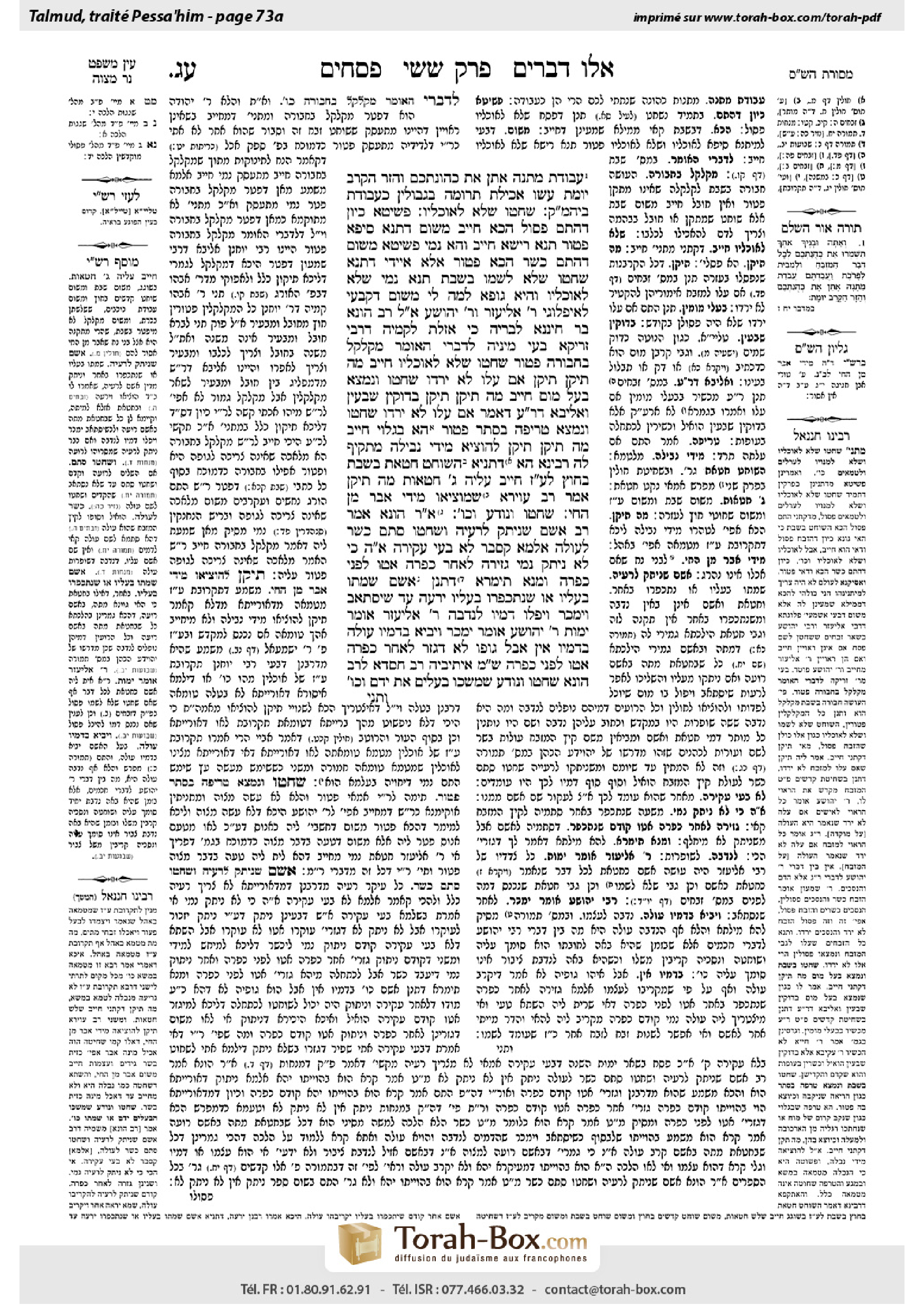
Pesachim 73a: Talmud study for Daf Yomi
Daf Yomi is the daily study of one Talmud folio. Explore 37 tractates with scans, Hebrew text, Sefaria English and AI-generated French translations where annotated.
Passage selection and English or AI-generated French translation are available where the scan has annotations. Daf Study is independent of Torah-Box and Sefaria.
Browse Pesachim · פסחים · All tractatesPesachim 73a text and translations
This page of Pesachim includes the Aramaic text, an English translation and an AI-generated French translation, alongside the scan above.
פסחים ע״ג א · Aramaic and Hebrew text
״עֲבוֹדַת מַתָּנָה אֶתֵּן אֶת כְּהֻנַּתְכֶם וְהַזָּר הַקָּרֵב יוּמָת״, עָשׂוּ אֲכִילַת תְּרוּמָה בִּגְבוּלִין כַּעֲבוֹדַת בֵּית הַמִּקְדָּשׁ.
שְׁחָטוֹ שֶׁלֹּא לְאוֹכְלָיו. פְּשִׁיטָא! כֵּיוָן דְּהָתָם — פָּסוּל, הָכָא — חַיָּיב! מִשּׁוּם דְּתַנָּא סֵיפָא פָּטוּר, תְּנָא רֵישָׁא חַיָּיב.
וְהָא נָמֵי פְּשִׁיטָא, מִשּׁוּם דְּהָתָם כָּשֵׁר, הָכָא פָּטוּר! אֶלָּא, אַיְּידֵי דִּתְנָא שְׁחָטוֹ שֶׁלֹּא לִשְׁמוֹ בְּשַׁבָּת, תְּנָא נָמֵי שֶׁלֹּא לְאוֹכְלָיו. וְהִיא גּוּפָא לְמָה לִי? מִשּׁוּם דְּקָבָעֵי לְאִיפְּלוֹגֵי רַבִּי אֱלִיעֶזֶר וְרַבִּי יְהוֹשֻׁעַ.
אֲמַר לֵיהּ רַב הוּנָא בַּר חִינָּנָא לִבְרֵיהּ: כִּי אָזְלַתְּ לְקַמֵּיהּ דְּרַבִּי זְרִיקָא, בָּעֵי מִינֵּיהּ: לְדִבְרֵי הָאוֹמֵר ״מְקַלְקֵל בְּחַבּוּרָה — פָּטוּר״, ״שְׁחָטוֹ שֶׁלֹּא לְאוֹכְלָיו — חַיָּיב״? מָה תִּיקֵּן?!
תִּיקֵּן אִם עָלוּ לֹא יֵרְדוּ.
שְׁחָטוֹ וְנִמְצָא בַּעַל מוּם חַיָּיב, מָה תִּיקֵּן? תִּיקֵּן בְּדוּקִּין שֶׁבָּעַיִן, וְאַלִּיבָּא דְּרַבִּי עֲקִיבָא דְּאָמַר אִם עָלוּ לֹא יֵרְדוּ.
שְׁחָטוֹ וְנִמְצָא טְרֵיפָה בַּסֵּתֶר — פָּטוּר. הָא בְּגָלוּי — חַיָּיב. מָה תִּיקֵּן? תִּיקֵּן לְהוֹצִיא מִידֵי נְבֵילָה.
מַתְקֵיף לַהּ רָבִינָא: הָא דְּתַנְיָא: הַשּׁוֹחֵט חַטָּאת בַּשַּׁבָּת בַּחוּץ לַעֲבוֹדָה זָרָה — חַיָּיב עָלֶיהָ שָׁלֹשׁ חַטָּאוֹת, מָה תִּיקֵּן?
אָמַר רַב עַוִּירָא: שֶׁמּוֹצִיאוֹ מִידֵי אֵבֶר מִן הַחַי.
שְׁחָטוֹ וְנוֹדַע וְכוּ׳. אָמַר רַב הוּנָא אָמַר רַב: אָשָׁם שֶׁנִּיתַּק לִרְעִיָּה, וּשְׁחָטוֹ סְתָם — כָּשֵׁר לָעוֹלָה. אַלְמָא קָסָבַר: לָא בָּעֵי עֲקִירָה.
אִי הָכִי כִּי לֹא נִיתַּק נָמֵי! גְּזֵירָה לְאַחַר כַּפָּרָה אַטּוּ לִפְנֵי כַפָּרָה.
וּמְנָא תֵּימְרָא, דִּתְנַן: אָשָׁם שֶׁמֵּתוּ בְּעָלָיו אוֹ שֶׁנִּתְכַּפְּרוּ בְּעָלָיו — יִרְעֶה עַד שֶׁיִּסְתָּאֵב, וְיִמָּכֵר, וְיִפְּלוּ דָּמָיו לִנְדָבָה. רַבִּי אֱלִיעֶזֶר אוֹמֵר: יָמוּת. רַבִּי יְהוֹשֻׁעַ אוֹמֵר: יִמָּכֵר וְיָבִיא בְּדָמָיו עוֹלָה.
בְּדָמָיו אִין, אֲבָל גּוּפוֹ לָא. דְּגָזַר לְאַחַר כַּפָּרָה אַטּוּ לִפְנֵי כַּפָּרָה. שְׁמַע מִינַּהּ.
אֵיתִיבֵיהּ רַב חִסְדָּא לְרַב הוּנָא: שְׁחָטוֹ וְנוֹדַע שֶׁמָּשְׁכוּ בְּעָלִים אֶת יָדָם וְכוּ׳,
Pesachim 73a · English translation
“I have given you the priesthood as a service of gift; and the stranger that comes near shall be put to death” (Numbers 18:7). This verse is found in the context of the priestly gifts, including teruma, and comes to teach us that they made the eating of teruma in the outlying areas, i.e., outside the Temple, like the service of the Temple.
We learned in our mishna that if one unwittingly slaughtered the Paschal lamb on Shabbat for those who cannot eat it or for those who did not register for it, he is liable to bring a sin-offering. The Gemara asks: It is obvious. Since there, with regard to the slaughter itself, it is invalid, here, with regard to Shabbat, he is liable, for it turns out that he performed a prohibited labor that was not necessary for sacrificing an offering. The Gemara answers: Since the latter clause of the mishna taught cases in which he is exempt from bringing a sin-offering, the first clause taught cases in which he is liable, even though it does not really teach us anything new.
The Gemara asks: But this also is obvious, since there, the offering is valid, here with regard to Shabbat he is exempt, as the slaughter did not involve a desecration of Shabbat. Rather, since the mishna taught the case of one who slaughtered the Paschal lamb for a different purpose on Shabbat, it also taught the case of one who slaughtered it for those who cannot eat it. The Gemara asks further: And it itself, the case of slaughtering the Paschal offering for a different purpose, why do I need it? The halakha there is also obvious. The Gemara answers: Since the mishna wished to teach the dispute between Rabbi Eliezer and Rabbi Yehoshua, it taught all these other halakhot as well.
The Gemara relates that Rav Huna bar Ḥinnana said to his son: When you go before Rabbi Zerika, ask him: According to the opinion that says that one who inflicts a destructive wound is exempt, i.e., that one who causes a wound on Shabbat that has no constructive effect but rather is purely destructive in nature has not performed a prohibited labor and is therefore exempt from bringing a sin-offering, how are we to understand the mishna’s ruling that one who slaughtered the Paschal lamb for those who cannot eat it is liable? Since the slaughter is invalid, he should be seen as having wounded the animal in a way that brings no benefit and is simply destructive. What has he improved through the slaughter that he should be liable for having performed a prohibited labor?
The Gemara answers: He has improved it in that if the sacrificial parts of the offering ascended to the top of the altar, they do not descend. The halakha is that if the sacrificial parts of a disqualified offering are inadvertently brought up to the top of the altar, they need not be removed and they may be burned on the altar. Thus, the slaughter had some constructive effect.
The Gemara asks further: We learned in the mishna that if one slaughtered the Paschal lamb and it was found to have a blemish, he is liable to bring a sin-offering. Here too, it may be asked: What has he improved through the slaughter, so that he should be liable? The Gemara answers: He has improved it if the blemish was small, e.g., if it was on the animal’s eyelid, and in accordance with the opinion of Rabbi Akiva, who said that in the case of an offering with such a small blemish, if its sacrificial parts ascended to the top of the altar, they do not descend from it, because it is not a disgrace to the altar for the sacrificial parts of such an offering to be burned on it.
We learned in the next clause of our mishna that if one slaughtered the Paschal lamb and it was found to have a hidden condition that would cause it to die within twelve months [tereifa], he is exempt from bringing a sin-offering. The mishna’s wording indicates that if the animal’s condition is visible, its owner is liable. It may be asked: What has he improved by slaughtering an animal with a such a condition? The Gemara answers: He has improved it in that he removed it from the category of an animal carcass [neveila], i.e., an animal that died of natural causes or as the result of an improperly carried out act of ritual slaughter. Had the animal died on its own it would have been treated as a neveila, which is a primary source of ritual impurity, rendering those who touch or carry it ritually impure. Proper slaughter of the animal prevents it from falling into that category and imparting ritual impurity.
Ravina strongly objects to this: With regard to that which was taught elsewhere in a baraita, that one who unwittingly slaughters a sin-offering on Shabbat outside the Temple for the sake of idolatry is liable to bring three sin-offerings for it: For desecrating Shabbat, for slaughtering an offering outside the Temple, and for practicing idolatry; here too, the question may be raised: What has he improved by slaughtering the animal? Here we cannot answer that he removed it from the category of an animal carcass and prevented it from becoming a primary source of ritual impurity, because any animal that was used as an idolatrous offering imparts ritual impurity. Therefore, it would seem that the slaughter served no constructive purpose.
Rav Avira said: Even here he has improved it in that he removed it from the category of limbs from a living creature. Even a gentile is liable if he eats meat taken from a living animal, but once the animal is slaughtered there is no longer any liability. Accordingly, even this act of slaughter has achieved a productive result.
We learned in the mishna that if one slaughtered the Paschal lamb and it became known afterward that the owners had died, he is exempt from bringing a sin-offering. Rav Huna said that Rav said: Regarding a guilt-offering that was consigned to grazing: If the owner of a guilt-offering dies or achieves atonement through a different guilt-offering, the animal is sent out to graze in the field until it develops a blemish, at which point it can be sold. The money from the sale is used to purchase a burnt-offering. And if, before it developed a blemish, someone slaughtered it without specifying its purpose, it is valid as a burnt-offering. The Gemara concludes that Rav apparently holds that it does not require uprooting. There is no need for an explicit declaration in order to change the status of the offering; even if it is slaughtered without its purpose specified it is valid.
The Gemara asks: If so, even when it has not yet been consigned to grazing, it should also be valid, for any guilt-offering whose owner has achieved atonement through a different offering is presumably going to be brought as a free-will burnt-offering. The Gemara answers: This invalidation stems from a rabbinic decree with regard to a guilt-offering after its owner achieved atonement with a different offering due to concern about a guilt-offering before its owner achieved atonement with a different offering. Before the owner achieves atonement the animal is certainly considered a guilt-offering; it is only after the owner achieves atonement that the offering becomes valid for use as a burnt-offering, and then by strict halakha it is immediately valid for that purpose, even before the animal develops a blemish.
From where do you say that this is the case? As we learned elsewhere in a mishna: A guilt-offering whose owner has died or whose owner has achieved atonement through a different guilt-offering grazes until it becomes unfit, whereupon it is sold and its money is used for a communal free-will burnt-offering. Rabbi Eliezer says: This guilt-offering is made to die on its own. Rabbi Yehoshua says: When it develops a blemish, it is sold, and he brings a burnt-offering for himself with its money.
This indicates that according to Rabbi Yehoshua, as soon as the owner achieves atonement, his animal loses its status as a guilt-offering and it becomes a burnt-offering. Nevertheless, even he says that the animal that is bought with its money may indeed be brought as a burnt-offering, but the guilt-offering itself must not be sacrificed as a burnt-offering. Undoubtedly, his reason must be that the Sages issued a decree with regard to a guilt-offering after its owner achieved atonement with a different offering, due to concern about a guilt-offering before its owner achieved atonement with a different offering. The Gemara concludes: Indeed, learn from it that this is correct.
Rav Ḥisda raised an objection to Rav Huna with regard to his opinion about uprooting the status of an offering from what we learned in our mishna: If one slaughtered a Paschal lamb on Shabbat and afterward it became known that the owners had withdrawn from it and registered for a different one, or that they had died or become ritually impure, he is exempt from bringing a sin-offering, because he slaughtered with permission.
Pesachim 73a · Traduction française (IA)
« Je vous ai donné la prêtrise comme un service accordé en don ; et l’étranger qui s’en approche sera mis à mort » (Nombres 18:7). Ce verset figure dans le contexte des dons sacerdotaux, notamment de la terouma, et vient nous enseigner qu’ils ont assimilé la consommation de terouma dans les localités éloignées, c’est-à-dire hors du Temple, au service du Temple.
Nous avons appris dans notre Michna que si quelqu’un égorge par inadvertance l’agneau pascal pendant Chabbat pour des personnes qui ne peuvent pas le consommer ou qui ne s’y sont pas inscrites, il est tenu d’apporter un sacrifice expiatoire. La Guemara demande : Cela va de soi. Puisque, dans ce cas, l’égorgement lui-même est invalide, ici, concernant Chabbat, il est passible d’un sacrifice expiatoire : il s’avère qu’il a accompli un travail interdit qui n’était pas nécessaire au sacrifice d’une offrande. La Guemara répond : Puisque la dernière partie de la Michna a enseigné des cas où il est exempt d’apporter un sacrifice expiatoire, la première partie a enseigné des cas où il y est passible, bien qu’elle ne nous apprenne en réalité rien de nouveau.
La Guemara demande : Mais cela aussi va de soi : puisque, dans ce cas, l’offrande est valide, ici, concernant Chabbat, il est exempt, car l’égorgement n’a pas profané Chabbat. En réalité, puisque la Michna a enseigné le cas de celui qui égorge l’agneau pascal pendant Chabbat dans une intention différente, elle a également enseigné celui de celui qui l’égorge pour des personnes qui ne peuvent pas le consommer. La Guemara demande encore : Et pourquoi fallait-il enseigner ce cas lui-même, celui de l’égorgement de l’offrande pascale dans une intention différente ? La halakha à ce sujet va elle aussi de soi. La Guemara répond : Puisque la Michna voulait enseigner la controverse entre Rabbi Eliezer et Rabbi Yehoshua, elle a également enseigné toutes ces autres halakhot.
La Guemara rapporte que Rav Huna bar Ḥinnana dit à son fils : Lorsque tu te présenteras devant Rabbi Zerika, demande-lui : Selon l’opinion qui affirme que celui qui inflige une blessure destructrice est exempt — c’est-à-dire que celui qui cause, pendant Chabbat, une blessure sans effet constructif, mais purement destructrice, n’a pas accompli un travail interdit et est donc exempt d’apporter un sacrifice expiatoire —, comment comprendre la décision de la Michna selon laquelle celui qui égorge l’agneau pascal pour des personnes qui ne peuvent pas le consommer est passible ? Puisque l’égorgement est invalide, il devrait être considéré comme ayant blessé l’animal sans en tirer aucun bénéfice, dans un acte purement destructeur. Qu’a-t-il amélioré par l’égorgement pour être passible d’avoir accompli un travail interdit ?
La Guemara répond : Il l’a amélioré en ceci : si les parties sacrificielles de l’offrande étaient montées sur le haut de l’autel, elles n’en redescendaient pas. Selon la halakha, si les parties sacrificielles d’une offrande disqualifiée sont amenées par inadvertance sur le haut de l’autel, il n’est pas nécessaire de les en retirer et elles peuvent y être brûlées. Ainsi, l’égorgement a eu un effet constructif.
La Guemara demande encore : Nous avons appris dans la Michna que si quelqu’un égorge l’agneau pascal et qu’on découvre qu’il présente un défaut, il est tenu d’apporter un sacrifice expiatoire. On peut ici aussi demander : Qu’a-t-il amélioré par l’égorgement pour être passible ? La Guemara répond : Il l’a amélioré si le défaut était minime, par exemple s’il se trouvait sur la paupière de l’animal, conformément à l’opinion de Rabbi Akiva, qui a dit que, dans le cas d’une offrande présentant un défaut aussi léger, si ses parties sacrificielles sont montées sur le haut de l’autel, elles n’en redescendent pas, car il n’est pas déshonorant pour l’autel que les parties sacrificielles d’une telle offrande y soient brûlées.
Nous avons appris dans la clause suivante de notre Michna que si quelqu’un égorge l’agneau pascal et qu’on découvre qu’il présente une affection cachée qui entraînerait sa mort dans les douze mois [tereifa], il est exempt d’apporter un sacrifice expiatoire. La formulation de la Michna indique que si l’affection de l’animal est visible, son propriétaire est passible d’en apporter un. On peut demander : Qu’a-t-il amélioré en égorgeant un animal atteint d’une telle affection ? La Guemara répond : Il l’a amélioré en le faisant sortir de la catégorie des cadavres d’animaux [neveila], c’est-à-dire des animaux morts de causes naturelles ou à la suite d’un égorgement rituel mal exécuté. Si l’animal était mort de lui-même, il aurait été considéré comme une neveila, source primaire d’impureté rituelle, qui rend impurs ceux qui le touchent ou le portent. Un égorgement rituel correct empêche l’animal d’entrer dans cette catégorie et de transmettre l’impureté rituelle.
Ravina soulève une objection catégorique : à propos de ce qui a été enseigné ailleurs dans une baraïta, à savoir que celui qui égorge par inadvertance un sacrifice expiatoire pendant Chabbat, hors du Temple, pour l’idolâtrie, est passible de trois sacrifices expiatoires : pour avoir profané Chabbat, pour avoir égorgé une offrande hors du Temple et pour avoir pratiqué l’idolâtrie ; ici aussi, on peut demander : Qu’a-t-il amélioré en égorgeant l’animal ? Ici, nous ne pouvons pas répondre qu’il l’a fait sortir de la catégorie des cadavres d’animaux et l’a empêché de devenir une source primaire d’impureté rituelle, car tout animal utilisé comme offrande idolâtre transmet l’impureté rituelle. Il semblerait donc que l’égorgement n’ait eu aucun effet constructif.
Rav Avira dit : Même ici, il l’a amélioré en le faisant sortir de la catégorie des membres prélevés sur un animal vivant. Même un non-Juif est passible s’il mange de la viande prélevée sur un animal vivant, mais dès que l’animal est égorgé, il n’encourt plus cette peine. Par conséquent, même cet acte d’égorgement a produit un résultat utile.
Nous avons appris dans la Michna que si quelqu’un égorge l’agneau pascal et qu’on découvre par la suite que les propriétaires sont morts, il est exempt d’apporter un sacrifice expiatoire. Rav Huna a dit au nom de Rav : Concernant un sacrifice de culpabilité destiné à paître : si le propriétaire d’un sacrifice de culpabilité meurt ou obtient l’expiation grâce à un autre sacrifice de culpabilité, l’animal est envoyé paître dans les champs jusqu’à ce qu’il développe un défaut ; il peut alors être vendu. L’argent de la vente sert à acheter un holocauste. Et si, avant qu’il ne développe un défaut, quelqu’un l’égorge sans préciser l’intention du sacrifice, celui-ci est valide comme holocauste. La Guemara conclut que Rav considère apparemment qu’il n’est pas nécessaire de modifier son statut. Aucune déclaration explicite n’est requise pour changer le statut de l’offrande : même si elle est égorgée sans que son intention soit précisée, elle est valide.
La Guemara demande : Si tel est le cas, même lorsqu’il n’a pas encore été envoyé paître, il devrait aussi être valide, car tout sacrifice de culpabilité dont le propriétaire a obtenu l’expiation grâce à une autre offrande est censé être offert comme holocauste volontaire. La Guemara répond : Cette disqualification découle d’un décret rabbinique concernant un sacrifice de culpabilité après que son propriétaire a obtenu l’expiation au moyen d’une autre offrande, par crainte d’un sacrifice de culpabilité dont le propriétaire n’a pas encore obtenu l’expiation au moyen d’une autre offrande. Avant que le propriétaire n’obtienne l’expiation, l’animal est certainement considéré comme un sacrifice de culpabilité ; ce n’est qu’après que le propriétaire a obtenu l’expiation que l’offrande devient utilisable comme holocauste. Selon la halakha stricte, elle est alors immédiatement valide à cette fin, même avant que l’animal ne développe un défaut.
D’où savons-nous que c’est bien le cas ? Comme nous l’avons appris ailleurs dans une Michna : Un sacrifice de culpabilité dont le propriétaire est mort ou a obtenu l’expiation au moyen d’un autre sacrifice de culpabilité paît jusqu’à ce qu’il devienne impropre ; il est alors vendu et l’argent sert à acheter un holocauste volontaire communautaire. Rabbi Eliezer dit : On laisse ce sacrifice de culpabilité mourir de lui-même. Rabbi Yehoshua dit : Lorsqu’il développe un défaut, on le vend et le propriétaire apporte pour lui-même un holocauste avec l’argent de la vente.
Cela indique que, selon Rabbi Yehoshua, dès que le propriétaire obtient l’expiation, son animal perd son statut de sacrifice de culpabilité et devient un holocauste. Pourtant, lui aussi dit que l’animal acheté avec le produit de sa vente peut bien être offert comme holocauste, mais que le sacrifice de culpabilité lui-même ne doit pas être offert comme holocauste. Il ne fait aucun doute que cela s’explique par le fait que les Sages ont institué un décret concernant un sacrifice de culpabilité après que son propriétaire a obtenu l’expiation au moyen d’une autre offrande, par crainte d’un sacrifice de culpabilité dont le propriétaire n’a pas encore obtenu l’expiation au moyen d’une autre offrande. La Guemara conclut : En effet, déduis-en que c’est bien le cas.
Rav Ḥisda soulève une objection à Rav Huna concernant son opinion sur la nécessité de modifier le statut d’une offrande, d’après ce que nous avons appris dans notre Michna : Si quelqu’un égorge un agneau pascal pendant Chabbat et qu’on découvre ensuite que les propriétaires s’en étaient désistés et s’étaient inscrits pour un autre, ou qu’ils étaient morts ou devenus rituellement impurs, il est exempt d’apporter un sacrifice expiatoire, car il a égorgé avec permission.
Traduction française générée par IA à partir de l’édition anglaise de Sefaria. Vérifie toujours un passage avec le texte source.
Text from Sefaria: William Davidson Edition - Vocalized Aramaic (CC BY NC); William Davidson Edition - English (CC BY NC).