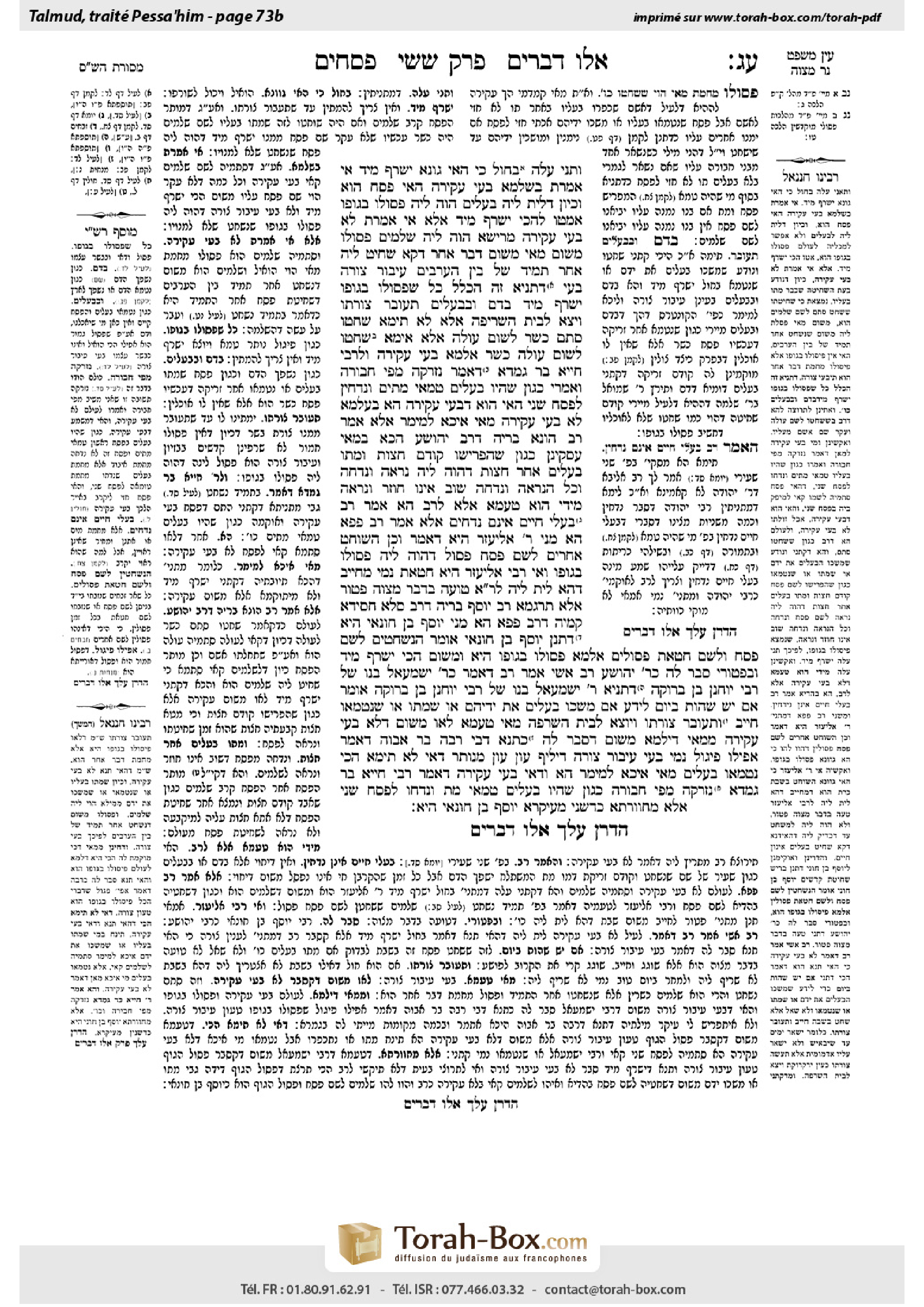
Pesachim 73b: Talmud study for Daf Yomi
Daf Yomi is the daily study of one Talmud folio. Explore 37 tractates with scans, Hebrew text, Sefaria English and AI-generated French translations where annotated.
Passage selection and English or AI-generated French translation are available where the scan has annotations. Daf Study is independent of Torah-Box and Sefaria.
Browse Pesachim · פסחים · All tractatesPesachim 73b text and translations
This page of Pesachim includes the Aramaic text, an English translation and an AI-generated French translation, alongside the scan above.
פסחים ע״ג ב · Aramaic and Hebrew text
וְתָנֵי עֲלַהּ: בַּחוֹל כִּי הַאי גַוְנָא יִשָּׂרֵף מִיָּד. אִי אָמְרַתְּ בִּשְׁלָמָא בָּעֵי עֲקִירָה, הַאי פֶּסַח הוּא, וְכֵיוָן דְּלֵית לֵיהּ בְּעָלִים — הָוֵה לֵיהּ פְּסוּלוֹ בְּגוּפוֹ, אַמְּטוּ לְהָכִי יִשָּׂרֵף מִיָּד.
אֶלָּא אִי אָמְרַתְּ לָא בָּעֵי עֲקִירָה — מֵרֵישָׁא הָוֵה לֵיהּ שְׁלָמִים, פְּסוּלוֹ מִשּׁוּם מַאי — מִשּׁוּם דָּבָר אַחֵר, דְּקָא שָׁחֵיט לֵיהּ אַחַר תָּמִיד שֶׁל בֵּין הָעַרְבַּיִם. עִיבּוּר צוּרָה בָּעֵי.
דְּתַנְיָא, זֶה הַכְּלָל: כֹּל שֶׁפְּסוּלוֹ בְּגוּפוֹ — יִשָּׂרֵף מִיָּד. בַּדָּם וּבַבְּעָלִים — תְּעוּבַּר צוּרָתוֹ וְיֵצֵא לְבֵית הַשְּׂרֵיפָה!
אֶלָּא לָא תֵּימָא שְׁחָטוֹ סְתָם — כָּשֵׁר לְשׁוּם עוֹלָה, אֶלָּא אֵימָא שְׁחָטוֹ לְשׁוּם עוֹלָה — כָּשֵׁר. אַלְמָא בָּעֵי עֲקִירָה.
וּלְרַבִּי חִיָּיא בַּר גַּמָּדָא, דְּאָמַר: נִזְרְקָה מִפִּי חֲבוּרָה וְאָמְרִי, כְּגוֹן שֶׁהָיוּ בְּעָלִים טְמֵאֵי מֵתִים וְנִדְחִין לְפֶסַח שֵׁנִי.
הַאי הוּא דְּבָעֵי עֲקִירָה, הָא בְּעָלְמָא לָא בָּעֵי עֲקִירָה. מַאי אִיכָּא לְמֵימַר?
אֶלָּא אָמַר רַב הוּנָא בְּרֵיהּ דְּרַב יְהוֹשֻׁעַ: הָכָא בְּמַאי עָסְקִינַן — כְּגוֹן שֶׁהִפְרִישׁוֹ קוֹדֶם חֲצוֹת, וּמֵתוּ בְּעָלִים אַחַר חֲצוֹת, דְּהָוֵה לֵיהּ נִרְאֶה וְנִדְחֶה. וְכׇל הַנִּרְאֶה וְנִדְחֶה — שׁוּב אֵינוֹ חוֹזֵר וְנִרְאֶה.
מִידֵּי הוּא טַעְמָא אֶלָּא לְרַב, הָא אָמַר רַב: בַּעֲלֵי חַיִּים אֵינָם נִדְחִים.
אֶלָּא אָמַר רַב פָּפָּא: הָא מַנִּי? רַבִּי אֱלִיעֶזֶר הִיא, דְּאָמַר: וְכֵן הַשּׁוֹחֵט אֲחֵרִים לְשֵׁם פֶּסַח — פָּסוּל, דְּהָוֵה לֵיהּ פְּסוּלוֹ בְּגוּפוֹ.
וְאִי רַבִּי אֱלִיעֶזֶר הִיא, חַטָּאת נָמֵי מִחַיַּיב, דְּהָא לֵית לֵיהּ לְרַבִּי אֱלִיעֶזֶר טוֹעֶה בִּדְבַר מִצְוָה פָּטוּר?
אֶלָּא, תַּרְגְּמָא רַב יוֹסֵף בְּרֵיהּ דְּרַב סַלָּא חֲסִידָא קַמֵּיהּ דְּרַב פָּפָּא: הָא מַנִּי יוֹסֵף בֶּן חוֹנַאי הִיא. דִּתְנַן, יוֹסֵף בֶּן חוֹנַאי אוֹמֵר: הַנִּשְׁחָטִים לְשֵׁם פֶּסַח וּלְשֵׁם חַטָּאת — פְּסוּלִים, אַלְמָא: פְּסוּלוֹ בְּגוּפוֹ הִיא, וּמִשּׁוּם הָכִי יִשָּׂרֵף מִיָּד, וּבִפְטוֹרֵי — סָבַר לַהּ כְּרַבִּי יְהוֹשֻׁעַ.
רַב אָשֵׁי אָמַר: רַב דְּאָמַר כְּרַבִּי יִשְׁמָעֵאל בְּנוֹ שֶׁל רַבִּי יוֹחָנָן בֶּן בְּרוֹקָה. דְּתַנְיָא, רַבִּי יִשְׁמָעֵאל בְּנוֹ שֶׁל רַבִּי יוֹחָנָן בֶּן בְּרוֹקָה אוֹמֵר: אִם יֵשׁ שְׁהוּת בְּיוֹם לֵידַע אִם מָשְׁכוּ בְּעָלִים אֶת יְדֵיהֶם אוֹ שֶׁמֵּתוּ אוֹ שֶׁנִּטְמְאוּ — חַיָּיב, וּתְעוּבַּר צוּרָתוֹ וְיוֹצֵא לְבֵית הַשְּׂרֵיפָה. מַאי טַעְמָא? לָאו מִשּׁוּם דְּלָא בָּעֵי עֲקִירָה!
מִמַּאי? דִּילְמָא מִשּׁוּם דְּסָבַר לַהּ כְּתַנָּא דְּבֵי רַבָּה בַּר אֲבוּהּ, דְּאָמַר: אֲפִילּוּ פִּיגּוּל נָמֵי בָּעֵי עִיבּוּר צוּרָה. דְּיָלֵיף ״עָוֹן״ ״עָוֹן״ מִנּוֹתָר.
דְּאִי לָא תֵּימָא הָכִי, נִטְמְאוּ בְּעָלִים מַאי אִיכָּא לְמֵימַר? הָא וַדַּאי בָּעֵי עֲקִירָה, דְּאָמַר רַבִּי חִיָּיא בַּר גַּמָּדָא: נִזְרְקָה מִפִּי חֲבוּרָה, כְּגוֹן שֶׁהָיוּ בְּעָלִים טְמֵאֵי מֵת וְנִדְחוּ לְפֶסַח שֵׁנִי.
אֶלָּא מְחַוַּורְתָּא כִּדְשַׁנִּי מֵעִיקָּרָא: יוֹסֵף בֶּן חוֹנַאי הִיא.
הָדְרָן עֲלָךְ אֵלּוּ דְּבָרִים
Pesachim 73b · English translation
And it was taught in a baraita with regard to this mishna that on a weekday, in a case like this, where it turns out that there is no one to eat the Paschal offering, it should be burned immediately. Granted, if you say that an offering that has no owner requires uprooting from its previous status in order for its status to change and in the absence of explicit uprooting it retains its original status, here too it can be argued that this is still a Paschal offering. And since it has no owners, its disqualification is in the body of the offering itself, because it was sacrificed for no purpose, and therefore it should be burned immediately.
But if you say that an offering such as this does not require uprooting, but rather its original status is automatically void upon the death of its owner, and it was a peace-offering from the beginning, as a Paschal offering whose status has been revoked is considered a peace-offering, due to what then is its disqualification? Due to something else, i.e., that he slaughtered it after the daily afternoon offering, which is the proper time to slaughter the Paschal lamb. But a peace-offering that is slaughtered then is disqualified. In that case, however, it should require that it be left overnight until its form decays, thus attaining the status of leftover sacrificial meat, and only then should it be burned.
As it was taught in a baraita: This is the principle: Any offering whose disqualification is in the body of the offering itself should be burned immediately and without delay. But if the disqualification is in the blood of the offering or in the owners, the meat must be kept overnight, so that its form is allowed to decay, and only then should it be taken out to the place of burning. Thus, the baraita that says that a Paschal lamb that was slaughtered on a weekday, and afterward it became known that the owners had died, should be burned immediately proves, against the opinion of Rav Huna, that an offering that has no owners still requires explicit uprooting from its previous status for its status to change.
Rather, do not say that Rav said that a guilt-offering that one slaughtered without specification is valid as a burnt-offering. Say rather that he said that if one took a guilt-offering whose owner had already achieved atonement through a different animal and he explicitly slaughtered it as a burnt-offering, it is valid. And conclude from this that Rav apparently holds that changing the status of an offering requires explicit uprooting.
The Gemara asks: A difficulty arises according to Rabbi Ḥiyya bar Gamda, who dealt with the question whether a Paschal lamb requires uprooting and said that it was thrown out from the group of scholars who were studying the issue, and they all said as follows: Uprooting is required in a case where the owners of the offering were ritually impure with impurity imparted by a corpse during the first Pesaḥ and they were pushed off to the second Pesaḥ, for in that case, they presumably want to sacrifice this animal as their Paschal offering on the second Pesaḥ, and therefore its status does not change unless it is explicitly uprooted.
The Gemara infers from this that it is only this offering that requires explicit uprooting, because it is reasonable to assume that its owners still intend to use it for its original purpose, but in general it does not require uprooting. According to this opinion, what is there to say, as it would seem that our mishna indicates that explicit uprooting is necessary?
Rather, Rav Huna, son of Rav Yehoshua, said: With what are we dealing here in our mishna? We are dealing with a case where they designated the animal to be sacrificed as their Paschal offering before midday, and midday came and it was firmly established as their Paschal offering, and the owners died after midday, such that the offering was first considered fit and then rejected: It was originally fit to be sacrificed as either a Paschal offering or a peace-offering, and then it was rejected as a peace-offering when it was firmly established as a Paschal offering, and rejected as a Paschal offering when its owners died. And the principle is that anything that was first fit and afterward rejected does not return to being fit. The offering is therefore disqualified and burned immediately, as it can never be brought as a Paschal offering or as a peace-offering.
The Gemara rejects this answer: Is this reason necessary for anyone but Rav, who holds that explicit uprooting is not required? But Rav himself said that living creatures cannot be permanently rejected. The halakha of rejection applies only to animals that were already slaughtered, but living creatures cannot be permanently rejected from their sanctified status or eligibility for a mitzva.
Rather, Rav Pappa said: In accordance with whose opinion is this baraita that adds to the mishna the detail that on a weekday the disqualified offering is immediately burned? It is in accordance with the opinion of Rabbi Eliezer, who said: And similarly, if one slaughtered another offering, such as a peace-offering, for the purpose of a Paschal offering, it is disqualified. If so, its disqualification is in the body of the offering itself, and so it should be burned immediately.
The Gemara asks: But if it is in accordance with the opinion of Rabbi Eliezer, he would deem him liable also to bring a sin-offering for having slaughtered an invalid offering on Shabbat, for Rabbi Eliezer does not accept the position that one who errs in regard to a mitzva is exempt from bringing a sin-offering. This explanation must, therefore, be rejected.
Rather, Rav Yosef, son of Rav Salla the Ḥasid, explained before Rav Pappa as follows: In accordance with whose opinion is this baraita? It is in accordance with the opinion of Yosef ben Ḥonai. As we learned in a mishna that Yosef ben Ḥonai says: Other offerings that are slaughtered for the purpose of a Paschal offering or for the purpose of a sin-offering are disqualified, as he agrees with Rabbi Eliezer in this regard. It is apparent that its disqualification is in the body of the offering itself and therefore it should be burned immediately. But with regard to exemptions from sin-offerings in cases of unintentional desecration of Shabbat, he holds in accordance with the opinion of Rabbi Yehoshua, that one who errs in regard to a mitzva is exempt.
Rav Ashi said a different answer to this question: Rav said his ruling with regard to a guilt-offering in accordance with the opinion of Rabbi Yishmael, son of Rabbi Yoḥanan ben Beroka. As it was taught in a baraita: Rabbi Yishmael, son of Rabbi Yoḥanan ben Beroka, says: If one slaughtering the Paschal offering on Shabbat still has time in the day to clarify whether the owners withdrew or died or became ritually impure, he is liable to bring a sin-offering for having slaughtered on Shabbat, and the meat must be kept overnight so that its form be allowed to decay, and then it should be taken out to the place of burning. What is the reason that its form must be allowed to decay? Is it not because he holds that it does not require uprooting? And for that reason the disqualification is not inherent in the offering, and so it must be left overnight to attain the status of leftover sacrificial meat before being burned.
The Gemara rejects this argument: From where is this known to be correct? Perhaps it requires uprooting and the disqualification is inherent. And the fact that he requires decay of form is because he agrees with the tanna of the school of Rabba bar Avuh, who said that even piggul, an offering disqualified by improper intent, which is considered an inherent disqualification, also requires decay of form, for he derived this requirement by way of a verbal analogy between the word “iniquity” (Leviticus 7:18) stated in relation to an offering disqualified by improper intent and the word “iniquity” (Leviticus 19:7) stated with regard to leftover sacrificial meat.
For if you do not say so, i.e., that the baraita was taught in accordance with this opinion, then in a case in which the owners became ritually impure, what is there to say? In that case it certainly requires uprooting, for Rabbi Ḥiyya bar Gamda said that it was thrown out from the group of scholars who were studying the issue: Uprooting is required in a case where the owners of the offering were ritually impure with impurity imparted by a corpse during the first Pesaḥ and they were pushed off to the second Pesaḥ. Since their offering is presumably set to be used on the second Pesaḥ, explicit change of the offering’s status is required.
Rather, it is clear that it is as he answered at the beginning, that our mishna is in accordance with the opinion of Yosef ben Ḥonai. Therefore, on weekdays the offering is burned immediately, and on Shabbat, in accordance with the opinion of Rabbi Yehoshua, one does not become liable to bring a sin-offering.
Pesachim 73b · Traduction française (IA)
Et il a été enseigné dans une baraïta au sujet de cette Michna que, pendant la semaine, dans un cas comme celui-ci, où l’on découvre qu’il n’y a personne pour manger le sacrifice pascal, il faut le brûler immédiatement. Certes, si l’on considère qu’un sacrifice sans propriétaire doit être explicitement détaché de son statut antérieur pour que celui-ci change, et qu’en l’absence d’un tel changement explicite il conserve son statut initial, on peut aussi soutenir ici qu’il s’agit toujours d’un sacrifice pascal. Et puisqu’il n’a pas de propriétaires, son invalidité tient au sacrifice lui-même, car il a été offert sans raison ; il faut donc le brûler immédiatement.
Mais si l’on considère qu’un sacrifice de ce genre n’exige pas de changement explicite de statut, mais que son statut initial est automatiquement annulé à la mort de son propriétaire, et qu’il était donc un sacrifice de paix depuis le début — car un sacrifice pascal dont le statut a été annulé est considéré comme un sacrifice de paix —, quelle est alors la cause de son invalidité ? Elle tient à un autre facteur : il l’a égorgé après le sacrifice quotidien de l’après-midi, alors que c’est le moment approprié pour égorger l’agneau pascal. Or un sacrifice de paix égorgé à ce moment-là est invalide. Dans ce cas, toutefois, il faudrait le laisser toute la nuit, jusqu’à ce que son apparence se dégrade, acquérant ainsi le statut de restes de viande sacrificielle ; ce n’est qu’alors qu’il faudrait le brûler.
Car il a été enseigné dans une baraïta : Voici le principe : tout sacrifice dont l’invalidité tient au sacrifice lui-même doit être brûlé immédiatement, sans délai. Mais si l’invalidité tient au sang du sacrifice ou à ses propriétaires, la viande doit être gardée toute la nuit, afin que son apparence se dégrade, et ce n’est qu’ensuite qu’il faut la sortir pour la brûler. Ainsi, la baraïta qui enseigne qu’un agneau pascal égorgé pendant la semaine doit être brûlé immédiatement lorsqu’on apprend ensuite que ses propriétaires sont morts prouve, contre l’opinion de Rav Houna, qu’un sacrifice sans propriétaire exige encore un changement explicite de son statut antérieur pour que celui-ci change.
Mais plutôt que de dire que Rav a affirmé qu’un sacrifice de culpabilité égorgé sans précision est valide comme holocauste, disons qu’il a affirmé qu’un sacrifice de culpabilité dont le propriétaire avait déjà obtenu l’expiation grâce à un autre animal est valide si on l’a pris et égorgé explicitement comme holocauste. Concluons-en que Rav semble considérer que le changement de statut d’un sacrifice exige qu’il soit explicitement détaché de son statut antérieur.
La Guemara soulève une difficulté selon Rabbi Ḥiyya bar Gamda, qui a examiné la question de savoir si un agneau pascal exige un changement explicite de statut et a rapporté que la question fut soumise au groupe de sages qui étudiaient le sujet, lesquels répondirent tous ainsi : un changement explicite de statut est requis lorsque les propriétaires du sacrifice étaient rituellement impurs en raison d’une impureté transmise par un cadavre pendant le premier Pessaḥ et qu’ils ont été repoussés au second Pessaḥ. En effet, dans ce cas, ils souhaitent vraisemblablement offrir cet animal comme sacrifice pascal lors du second Pessaḥ ; son statut ne change donc que s’il est explicitement annulé.
La Guemara en déduit que seul ce sacrifice exige un changement explicite de statut, car on peut raisonnablement supposer que ses propriétaires ont toujours l’intention de l’utiliser à sa destination initiale ; en général, un tel changement n’est pas nécessaire. Selon cette opinion, que peut-on répondre, puisque notre Michna semble indiquer qu’un changement explicite de statut est nécessaire ?
Mais Rav Houna, fils de Rav Yehoshoua, a dit : De quel cas traite notre Michna ? D’un cas où ils ont désigné l’animal comme sacrifice pascal avant midi ; midi est arrivé, son statut de sacrifice pascal s’est trouvé définitivement établi, puis les propriétaires sont morts après midi. Ainsi, le sacrifice a d’abord été considéré comme apte, puis rejeté : à l’origine, il était apte à être offert soit comme sacrifice pascal, soit comme sacrifice de paix ; ensuite, il a été rejeté comme sacrifice de paix lorsque son statut de sacrifice pascal a été définitivement établi, puis comme sacrifice pascal lorsque ses propriétaires sont morts. Or le principe veut que tout ce qui a d’abord été apte, puis rejeté, ne redevienne pas apte. Le sacrifice est donc invalide et doit être brûlé immédiatement, puisqu’il ne peut plus jamais être offert ni comme sacrifice pascal ni comme sacrifice de paix.
La Guemara rejette cette réponse : cette raison n’est-elle nécessaire que pour Rav, qui considère qu’un changement explicite de statut n’est pas nécessaire ? Pourtant, Rav lui-même a dit que les êtres vivants ne peuvent pas être définitivement rejetés. La règle du rejet ne s’applique qu’aux animaux déjà égorgés ; les êtres vivants ne peuvent pas être définitivement privés de leur statut de consécration ni de leur aptitude à accomplir une mitsva.
Mais Rav Pappa a dit : Selon l’opinion de qui cette baraïta ajoute-t-elle à la Michna le détail selon lequel, pendant la semaine, le sacrifice invalide est brûlé immédiatement ? Selon l’opinion de Rabbi Eliezer, qui a dit que, de même, si quelqu’un égorge un autre sacrifice, tel qu’un sacrifice de paix, dans l’intention d’en faire un sacrifice pascal, celui-ci est invalide. Dans ce cas, son invalidité tient au sacrifice lui-même ; il faut donc le brûler immédiatement.
La Guemara demande : Mais s’il s’agit de l’opinion de Rabbi Eliezer, celui-ci le déclarerait également passible d’un sacrifice expiatoire pour avoir égorgé un sacrifice invalide pendant Chabbat, car Rabbi Eliezer n’admet pas que celui qui se trompe en accomplissant une mitsva soit dispensé d’apporter un sacrifice expiatoire. Cette explication doit donc être rejetée.
Mais Rav Yossef, fils de Rav Salla le Ḥasid, expliqua ainsi devant Rav Pappa : Selon l’opinion de qui cette baraïta a-t-elle été enseignée ? Selon celle de Yossef ben Ḥonaï. Car nous avons appris dans une Michna que Yossef ben Ḥonaï dit : les autres sacrifices égorgés dans l’intention d’être offerts comme sacrifice pascal ou comme sacrifice expiatoire sont invalides ; sur ce point, il est du même avis que Rabbi Eliezer. Il est donc clair que l’invalidité tient au sacrifice lui-même et qu’il faut par conséquent le brûler immédiatement. Mais, en ce qui concerne l’exemption de sacrifices expiatoires dans les cas de profanation involontaire de Chabbat, il suit l’opinion de Rabbi Yehoshoua, selon laquelle celui qui se trompe en accomplissant une mitsva est dispensé.
Rav Achi proposa une autre réponse à cette question : Rav a énoncé sa règle concernant un sacrifice de culpabilité conformément à l’opinion de Rabbi Yishmaël, fils de Rabbi Yoḥanan ben Beroka. Car il a été enseigné dans une baraïta : Rabbi Yishmaël, fils de Rabbi Yoḥanan ben Beroka, dit : si celui qui égorge le sacrifice pascal pendant Chabbat a encore le temps, dans la journée, de vérifier si les propriétaires se sont désistés, sont morts ou sont devenus rituellement impurs, il est passible d’un sacrifice expiatoire pour l’avoir égorgé pendant Chabbat ; la viande doit être gardée toute la nuit afin que son apparence se dégrade, puis sortie pour être brûlée. Pourquoi faut-il que son apparence se dégrade ? N’est-ce pas parce qu’il considère qu’un changement explicite de statut n’est pas nécessaire ? C’est pourquoi l’invalidité n’est pas inhérente au sacrifice, qui doit donc rester toute la nuit afin d’acquérir le statut de restes de viande sacrificielle avant d’être brûlé.
La Guemara rejette cet argument : d’où sait-on que cela est exact ? Peut-être qu’un changement explicite de statut est nécessaire et que l’invalidité est inhérente au sacrifice. S’il exige que l’apparence se dégrade, c’est parce qu’il est du même avis que le tanna de l’école de Rabba bar Avouh, qui a dit que même le piggoul, sacrifice invalidé par une intention inappropriée et considéré comme présentant une invalidité inhérente, doit lui aussi voir son apparence se dégrader. Il a déduit cette exigence par une analogie verbale entre le mot « faute » (Lévitique 7,18), énoncé au sujet d’un sacrifice invalidé par une intention inappropriée, et le mot « faute » (Lévitique 19,7), énoncé au sujet des restes de viande sacrificielle.
Car si l’on ne dit pas cela, à savoir que la baraïta a été enseignée conformément à cette opinion, que répondre dans le cas où les propriétaires sont devenus rituellement impurs ? Dans ce cas, un changement explicite de statut est certainement nécessaire, car Rabbi Ḥiyya bar Gamda a rapporté que la question fut soumise au groupe de sages qui étudiaient le sujet : un changement explicite de statut est requis lorsque les propriétaires du sacrifice étaient rituellement impurs en raison d’une impureté transmise par un cadavre pendant le premier Pessaḥ et qu’ils ont été repoussés au second Pessaḥ. Puisque leur sacrifice est vraisemblablement destiné à être utilisé lors du second Pessaḥ, son statut doit être explicitement modifié.
Mais il est clair qu’il faut retenir la réponse donnée au début : notre Michna suit l’opinion de Yossef ben Ḥonaï. Par conséquent, pendant la semaine, le sacrifice est brûlé immédiatement ; et, le Chabbat, conformément à l’opinion de Rabbi Yehoshoua, on n’est pas passible d’un sacrifice expiatoire.
Traduction française générée par IA à partir de l’édition anglaise de Sefaria. Vérifie toujours un passage avec le texte source.
Text from Sefaria: William Davidson Edition - Vocalized Aramaic (CC BY NC); William Davidson Edition - English (CC BY NC).