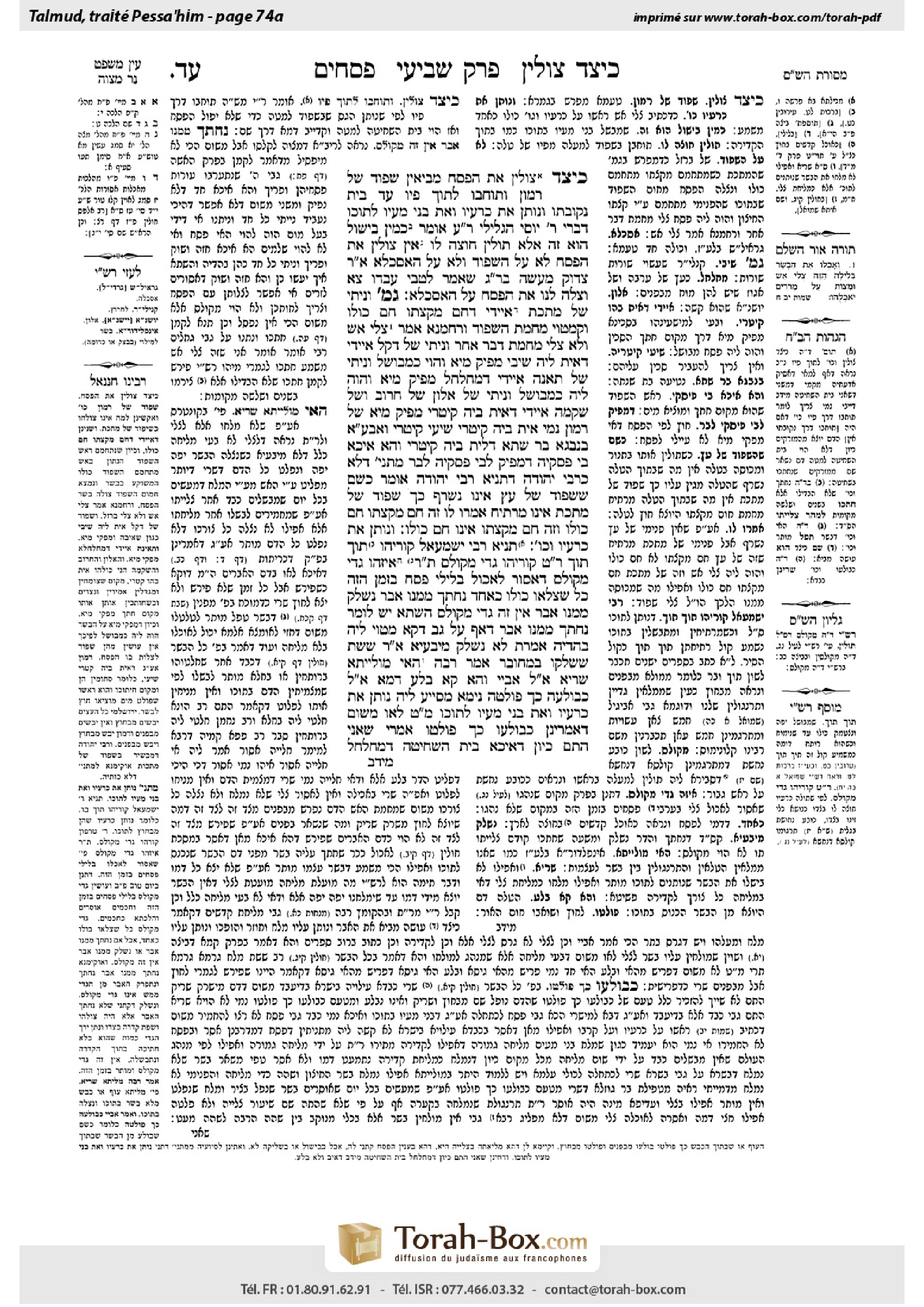
Pesachim 74a: Talmud study for Daf Yomi
Daf Yomi is the daily study of one Talmud folio. Explore 37 tractates with scans, Hebrew text, Sefaria English and AI-generated French translations where annotated.
Passage selection and English or AI-generated French translation are available where the scan has annotations. Daf Study is independent of Torah-Box and Sefaria.
Browse Pesachim · פסחים · All tractatesPesachim 74a text and translations
This page of Pesachim includes the Aramaic text, an English translation and an AI-generated French translation, alongside the scan above.
פסחים ע״ד א · Aramaic and Hebrew text
מַתְנִי׳ כֵּיצַד צוֹלִין אֶת הַפֶּסַח? מְבִיאִין שַׁפּוּד שֶׁל רִמּוֹן, וְתוֹחֲבוֹ לְתוֹךְ פִּיו עַד בֵּית נְקוּבָתוֹ, וְנוֹתֵן אֶת כְּרָעָיו וְאֶת בְּנֵי מֵעָיו לְתוֹכוֹ, דִּבְרֵי רַבִּי יוֹסֵי הַגְּלִילִי. רַבִּי עֲקִיבָא אוֹמֵר: כְּמִין בִּישּׁוּל הוּא זֶה, אֶלָּא תּוֹלִין חוּצָה לוֹ. אֵין צוֹלִין אֶת הַפֶּסַח לֹא עַל הַשַּׁפּוּד וְלֹא עַל הָאַסְכָּלָא. אָמַר רַבִּי צָדוֹק: מַעֲשֶׂה בְּרַבָּן גַּמְלִיאֵל שֶׁאָמַר לְטָבִי עַבְדּוֹ: צֵא וּצְלֵה לָנוּ אֶת הַפֶּסַח עַל הָאַסְכָּלָא.
גְּמָ׳ וְנַיְתֵי שֶׁל מַתֶּכֶת? אַיְּידֵי דְּחַם מִקְצָתוֹ חַם כּוּלּוֹ, וְקָמִטְּוֵי מֵחֲמַת הַשַּׁפּוּד, וְרַחֲמָנָא אָמַר ״צְלִי אֵשׁ״, וְלֹא צָלִי מֵחֲמַת דָּבָר אַחֵר. וְנַיְתֵי שֶׁל דֶּקֶל? אַיְּידֵי דְּאִית לֵיהּ שִׁיבֵּי, מַפֵּיק מַיָּא וְהָוֵי כִּמְבוּשָּׁל. וְנַיְתֵי שֶׁל תְּאֵנָה? אַיְּידִי דִּמְחַלְחֵל, מַפֵּיק מַיָּא וְהָוֵה לֵיהּ כִּמְבוּשָּׁל.
וְנַיְתֵי שֶׁל אַלּוֹן, שֶׁל חָרוּב, וְשֶׁל שִׁקְמָה? אַיְּידֵי דְּאִית בֵּיהּ קִיטְרֵי, מַפֵּיק מַיָּא.
שֶׁל רִמּוֹן נָמֵי אִית בֵּיהּ קִיטְרֵי? שִׁיעִי קִיטְרֵי. וְאִיבָּעֵית אֵימָא: בְּנַבְגָּא בַּר שַׁתָּא, דְּלֵית בֵּיהּ קִיטְרֵי. וְהָא אִיכָּא בֵּי פִסְקֵיהּ! דְּמַפֵּיק לְבֵי פִסְקֵיהּ לְבַר.
מַתְנִיתִין דְּלָא כְּרַבִּי יְהוּדָה. דְּתַנְיָא, רַבִּי יְהוּדָה אוֹמֵר: כְּשֵׁם שֶׁשַּׁפּוּד שֶׁל עֵץ אֵינוֹ נִשְׂרָף, כָּךְ שַׁפּוּד שֶׁל מַתֶּכֶת אֵינוֹ מַרְתִּיחַ. אָמְרוּ לוֹ: זֶה חַם מִקְצָתוֹ — חַם כּוּלּוֹ, וְזֶה חַם מִקְצָתוֹ — אֵינוֹ חַם כּוּלּוֹ.
וְנוֹתֵן אֶת כְּרָעָיו וְכוּ׳. תַּנְיָא: רַבִּי יִשְׁמָעֵאל קוֹרֵיהוּ ״תּוֹךְ תּוֹךְ״. רַבִּי טַרְפוֹן קוֹרֵיהוּ ״גְּדִי מְקוּלָּס״.
תָּנוּ רַבָּנַן: אֵיזֶהוּ גְּדִי מְקוּלָּס דְּאָסוּר לֶאֱכוֹל בְּלֵילֵי פֶסַח בַּזְּמַן הַזֶּה — כׇּל שֶׁצְּלָאוֹ כּוּלּוֹ כְּאֶחָד! נֶחְתַּךְ מִמֶּנּוּ אֵבֶר, נִשְׁלַק מִמֶּנּוּ אֵבֶר — אֵין זֶה גְּדִי מְקוּלָּס.
הַשְׁתָּא יֵשׁ לוֹמַר נֶחְתַּךְ מִמֶּנּוּ אֵבֶר, דְּאַף עַל גַּב דְּקָא מִטְּוֵי לֵיהּ בַּהֲדֵיהּ, אָמְרַתְּ לָא — נִשְׁלַק מִיבַּעְיָא?! אָמַר רַב שֵׁשֶׁת: שֶׁשְּׁלָקוֹ בִּמְחוּבָּר.
אָמַר רַבָּה: הַאי מוּלַיְיתָא — שַׁרְיָא. אֲמַר לֵיהּ אַבָּיֵי: וְהָא קָא בָּלַע דְּמָא! אֲמַר לֵיהּ: כְּבוֹלְעָהּ כָּךְ פּוֹלְטָהּ.
נֵימָא מְסַיַּיע לֵיהּ: נוֹתֵן אֶת כְּרָעָיו וְאֶת בְּנֵי מֵעָיו לְתוֹכוֹ. מַאי טַעְמָא — לָאו מִשּׁוּם דְּאָמְרִינַן כְּבוֹלְעוֹ כָּךְ פּוֹלְטוֹ? אָמְרִי: שָׁאנֵי הָתָם, כֵּיוָן דְּאִיכָּא בֵּית הַשְּׁחִיטָה דִּמְחַלְחֵל,
Pesachim 74a · English translation
MISHNA: How does one roast the Paschal lamb? One brings a spit [shappud] of pomegranate wood and thrusts it into the mouth of the lamb until it reaches its anus, and one then puts its legs and entrails inside it and roasts it all together; this is the statement of Rabbi Yosei HaGelili. Rabbi Akiva says: One does not insert its legs and entrails inside it, as this is a type of cooking. Anything placed inside the offering does not get roasted directly by the fire and is considered to have been cooked. Rather, one suspends the legs and entrails from the spit above the animal’s head outside it. One may not roast the Paschal lamb on the metal spit nor on a metal grill [askela]. However, Rabbi Tzadok said: There was an incident with Rabban Gamliel, who said to his slave Tavi: Go and roast the Paschal lamb for us on the grill.
GEMARA: The Gemara suggests: Let them bring a metal spit. The Gemara answers: With regard to a metal utensil, once part of it is hot, it is all hot, and the meat is roasted due to the heat of the spit. And the Merciful One states in the Torah that the Paschal lamb must be roasted in fire and not roasted through something else. The Gemara asks why it is necessary to use specifically a spit of pomegranate wood: Let them bring a spit of palm wood. The Gemara answers: Since the palm branch has grooves between the leaves, it gives off a small amount of water from the grooves during roasting. The meat of the offering that touches the spit is as though it is cooked. The Gemara suggests: Let them bring a spit of fig wood. The Gemara answers: Since it is hollow and has sap inside, it gives off water, and it is as though the meat is cooked.
The Gemara suggests: Let them bring a spit made from an oak or from a carob tree or from a sycamore, which are hard and do not have sap. The Gemara answers: With regard to each one of these trees, since it has knots and one must cut them off in order to smooth the branch, it gives off water from the locations of the cuts during roasting, and the meat is considered cooked.
The Gemara asks: A branch from a pomegranate tree also has knots. The Gemara answers: Its knots are smooth. There is no need to straighten the branch with a knife in order to use it, and therefore it does not emit water. And if you wish, say that the mishna is referring to a branch within its first year, which does not yet have knots. The Gemara asks: But there is the place it was cut from the tree, and water will come from there. The Gemara answers: One leaves the place it was cut outside of the animal rather than inserting that side of the branch into the animal.
The Gemara notes that the mishna is not in accordance with the opinion of Rabbi Yehuda, as it was taught in a baraita that Rabbi Yehuda says: Just as the part of a spit of wood that is inside the animal is not burned, although it is over the fire, so the part of a spit of metal that is inside the animal does not become burning hot. There is no concern that the meat will be roasted from the heat of the spit. The Rabbis said to him: This is not the case. With regard to this, the metal, when part of it is hot, it is all hot. And with regard to that, the wood, when part of it is hot, not all of it is hot, and therefore the meat is cooked by the heat of the fire and not by the heat of the spit.
It was taught in the mishna that according to the opinion of Rabbi Yosei HaGelili, one places the legs and entrails inside the lamb’s body and roasts them together. It was taught in a baraita: Rabbi Yishmael would call the Paschal lamb: Tokh, tokh, because when one roasts the legs and entrails inside the lamb they make that sound, like other things that are cooked. Rabbi Tarfon would call it: Helmeted kid. In his opinion, the entrails must be roasted when they are suspended from the spit above the head of the animal, somewhat resembling a helmet.
The Sages taught: Which is the kid roasted whole that it is prohibited to eat on the nights of Passover in modern times, so as not appear as though one sacrificed the Paschal lamb outside the Temple? It is any kid that one roasted all at once in the manner that the Paschal lamb was roasted. However, if one of its limbs is severed or one of its limbs is boiled, it is no longer considered a kid roasted whole.
The Gemara expresses surprise at the formulation of this baraita. Now, one can say that if one of its limbs is severed, although one roasts it together with the rest of the animal, you said that it is no longer considered a kid roasted whole, and it is permitted in modern times. If one of its limbs is severed and boiled, which is not an approved method of preparation of the Paschal lamb, is it necessary to say that that it is not considered roasted whole? Rav Sheshet said: This is referring to a case where one boiled the limb while it was attached to the rest of the animal. The halakha teaches that even if the animal remains whole, if one of its limbs is cooked it is no longer considered a kid roasted whole.
The Gemara raises a general halakhic discussion related to the mishna. Rabba said: This stuffing of raw meat inside another animal that is being roasted is permitted, even if the meat that is stuffed inside has not been salted to remove the blood. Abaye said to him: But the meat of the animal being roasted absorbs blood from the stuffing. He said to him: As it absorbs it, so it then emits it. The heat of the fire causes blood to be released from the meat used as stuffing into the meat of the animal being stuffed, and the heat then draws the blood out of that meat as well.
The Gemara suggests: Let us say that this mishna supports him: He places its legs and its entrails inside the Paschal lamb and roasts them together. What is the reason that it is permitted to do this? Is it not because we say: As it absorbs it, so it emits it? Although Rabbi Akiva disputes this statement, his opinion is due to the unique halakhot of the Paschal lamb. It seems that everyone agrees that there is no concern about the prohibition against consuming blood. The Gemara refutes this proof: Say it is different there, in the case of the Paschal lamb. Since there is the place of the slaughter, which is hollow and open,
Pesachim 74a · Traduction française (IA)
MICHNA : Comment rôtit-on l’agneau pascal ? On prend une broche [shappud] en bois de grenadier et on l’introduit par la bouche de l’agneau jusqu’à son anus. On place ensuite ses pattes et ses entrailles à l’intérieur de son corps, puis on rôtit le tout ensemble. Telle est l’opinion de Rabbi Yosei HaGelili. Rabbi Akiva dit : On ne place pas ses pattes et ses entrailles à l’intérieur, car cela constitue une forme de cuisson. Tout ce qui est placé à l’intérieur de l’offrande n’est pas rôti directement par le feu et est considéré comme ayant été cuit. On suspend plutôt les pattes et les entrailles à la broche, au-dessus de la tête de l’animal, à l’extérieur de son corps. On ne peut pas rôtir l’agneau pascal sur une broche en métal ni sur une grille métallique [askela]. Cependant, Rabbi Tsadok a dit : Un jour, Rabban Gamliel dit à son esclave Tavi : « Va nous rôtir l’agneau pascal sur la grille. »
GUEMARA : La Guemara suggère : Qu’ils prennent une broche en métal. La Guemara répond : Dans le cas d’un ustensile en métal, dès qu’une partie est chaude, il l’est tout entier, et la viande est rôtie par la chaleur de la broche. Or le Miséricordieux a prescrit dans la Torah que l’agneau pascal doit être rôti au feu, et non par l’intermédiaire d’autre chose. La Guemara demande pourquoi il faut précisément prendre une broche en bois de grenadier : Qu’ils prennent une broche en bois de palmier. La Guemara répond : Comme la branche de palmier présente des rainures entre ses feuilles, un peu d’eau s’en écoule pendant le rôtissage. La viande de l’offrande qui touche la broche est alors considérée comme cuite. La Guemara suggère : Qu’ils prennent une broche en bois de figuier. La Guemara répond : Comme ce bois est creux et contient de la sève, de l’eau s’en écoule et la viande est considérée comme cuite.
La Guemara suggère : Qu’ils prennent une broche en chêne, en caroubier ou en sycomore, des arbres dont le bois est dur et qui ne contiennent pas de sève. La Guemara répond : Pour chacun de ces arbres, comme il y a des nœuds et qu’il faut les couper pour lisser la branche, de l’eau s’écoule des endroits où ils ont été coupés pendant le rôtissage, et la viande est considérée comme cuite.
La Guemara demande : Une branche de grenadier a elle aussi des nœuds. La Guemara répond : Ses nœuds sont lisses. Il n’est pas nécessaire de redresser la branche au couteau pour s’en servir ; elle ne libère donc pas d’eau. Et, si tu le souhaites, dis que la Michna parle d’une branche de moins d’un an, qui n’a pas encore de nœuds. La Guemara demande : Mais il y a l’endroit où elle a été coupée de l’arbre, d’où de l’eau s’écoulera. La Guemara répond : On laisse l’extrémité coupée à l’extérieur de l’animal, au lieu d’introduire ce côté de la branche dans son corps.
La Guemara relève que la Michna ne suit pas l’opinion de Rabbi Yehouda, car il a été enseigné dans une baraïta que Rabbi Yehouda dit : De même que la partie d’une broche en bois qui se trouve à l’intérieur de l’animal ne brûle pas, bien qu’elle soit au-dessus du feu, de même la partie d’une broche en métal qui se trouve à l’intérieur de l’animal ne devient pas brûlante. Il n’y a donc pas lieu de craindre que la viande soit rôtie par la chaleur de la broche. Les Sages lui dirent : Il n’en est pas ainsi. Dans ce cas-ci, le métal, dès qu’une partie est chaude, l’est tout entier ; dans l’autre cas, le bois, dès qu’une partie est chaude, ne l’est pas tout entier. La viande est donc cuite par la chaleur du feu et non par celle de la broche.
Il a été enseigné dans la Michna que, selon l’opinion de Rabbi Yosei HaGelili, on place les pattes et les entrailles à l’intérieur du corps de l’agneau et on les rôtit ensemble. Il a été enseigné dans une baraïta : Rabbi Yishmaël appelait l’agneau pascal « tokh, tokh », car, lorsqu’on rôtit les pattes et les entrailles à l’intérieur de l’agneau, elles produisent ce bruit, comme d’autres aliments qui cuisent. Rabbi Tarfon l’appelait « chevreau casqué ». Selon son opinion, les entrailles doivent être rôties suspendues à la broche au-dessus de la tête de l’animal, de manière à ressembler quelque peu à un casque.
Les Sages ont enseigné : Quel est le chevreau rôti entier qu’il est interdit de manger de nos jours, les nuits de Pessa'h, afin de ne pas donner l’impression qu’on a offert l’agneau pascal hors du Temple ? C’est tout chevreau qu’on a rôti d’un seul tenant, à la manière dont l’agneau pascal était rôti. En revanche, si l’un de ses membres est détaché ou si l’un de ses membres est bouilli, il n’est plus considéré comme un chevreau rôti entier.
La Guemara s’étonne de la formulation de cette baraïta. On pourrait dire : si l’un de ses membres est détaché, bien qu’on le rôtisse avec le reste de l’animal, vous avez dit qu’il n’est plus considéré comme un chevreau rôti entier et qu’il est permis de le manger de nos jours. S’il l’on détache l’un de ses membres et qu’on le fait bouillir — ce qui n’est pas une méthode de préparation admise pour l’agneau pascal —, est-il nécessaire de préciser qu’il n’est pas considéré comme rôti entier ? Rav Sheshet dit : Cela fait référence à un cas où l’on a fait bouillir le membre alors qu’il était encore attaché au reste de l’animal. La halakha enseigne que, même si l’animal reste entier, dès lors que l’un de ses membres est cuit, il n’est plus considéré comme un chevreau rôti entier.
La Guemara soulève une discussion halakhique générale liée à la Michna. Rabba dit : Il est permis de farcir de viande crue un autre animal que l’on fait rôtir, même si la viande placée à l’intérieur n’a pas été salée pour en extraire le sang. Abayé lui dit : Mais la viande de l’animal que l’on fait rôtir absorbe le sang de la farce. Il lui répondit : De même qu’elle l’absorbe, elle l’expulse ensuite. La chaleur du feu fait passer le sang de la viande servant de farce dans celle de l’animal farci, puis la chaleur fait également sortir le sang de cette viande.
La Guemara suggère : Disons que cette Michna appuie son opinion : On place ses pattes et ses entrailles à l’intérieur de l’agneau pascal et on les rôtit ensemble. Pourquoi cela est-il permis ? N’est-ce pas parce que nous disons : De même qu’elle absorbe, elle expulse ? Bien que Rabbi Akiva conteste cette affirmation, son opinion tient aux règles particulières de l’agneau pascal. Il semble que tous conviennent qu’il n’y a pas lieu de craindre une transgression de l’interdiction de consommer du sang. La Guemara réfute cette preuve : Dis plutôt que le cas de l’agneau pascal est différent. Comme il y a l’emplacement de l’abattage, qui est creux et ouvert,
Traduction française générée par IA à partir de l’édition anglaise de Sefaria. Vérifie toujours un passage avec le texte source.
Text from Sefaria: William Davidson Edition - Vocalized Aramaic (CC BY NC); William Davidson Edition - English (CC BY NC).