Pesachim 74b: Talmud study for Daf Yomi
Daf Yomi is the daily study of one Talmud folio. Explore 37 tractates with scans, Hebrew text, Sefaria English and AI-generated French translations where annotated.
Passage selection and English or AI-generated French translation are available where the scan has annotations. Daf Study is independent of Torah-Box and Sefaria.
Browse Pesachim · פסחים · All tractatesPesachim 74b text and translations
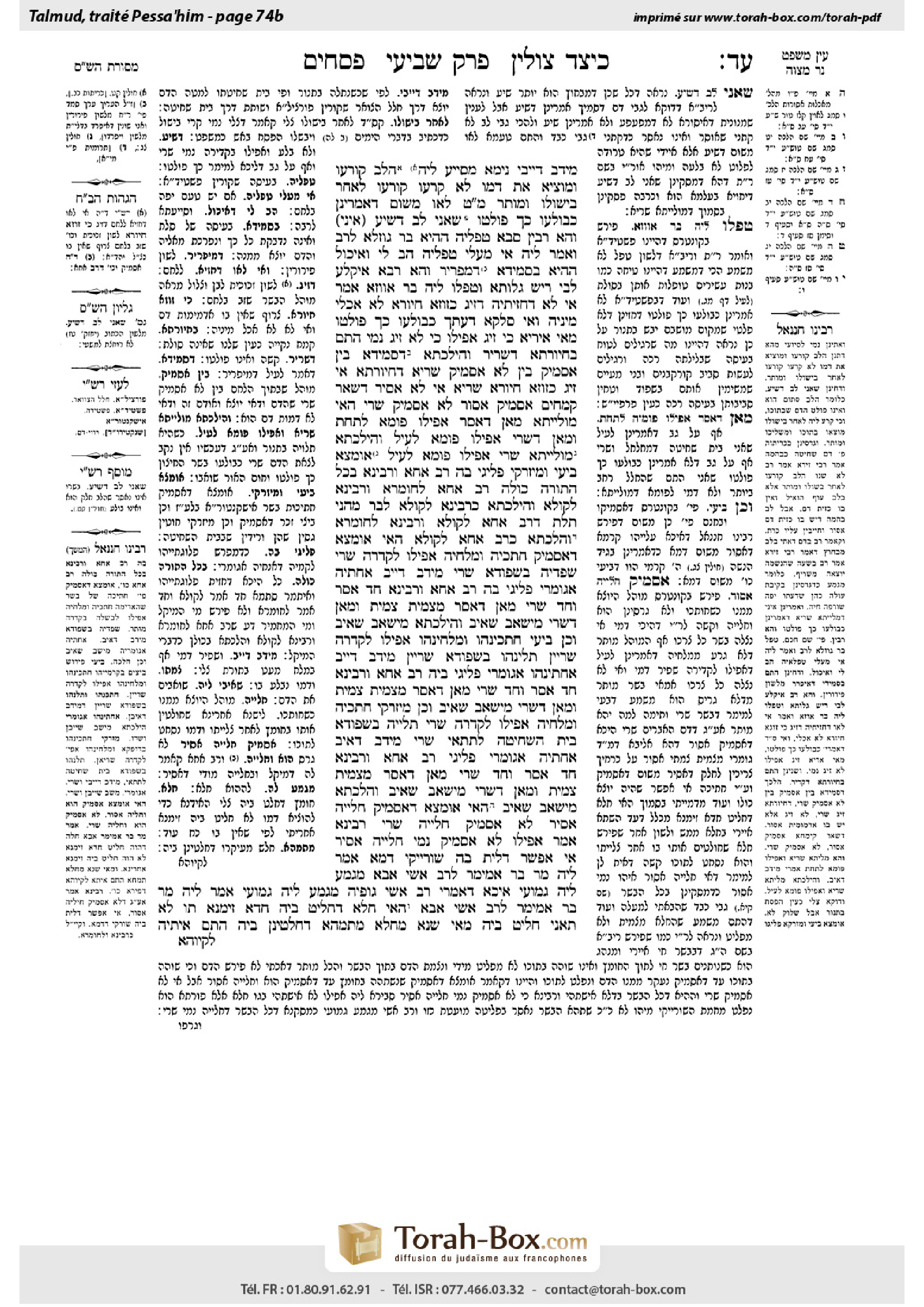
This page of Pesachim includes the Aramaic text, an English translation and an AI-generated French translation, alongside the scan above.
פסחים ע״ד ב · Aramaic and Hebrew text
מֵידָב דָּיְיבִי.
נֵימָא מְסַיַּיע לֵיהּ: הַלֵּב, קוֹרְעוֹ וּמוֹצִיא אֶת דָּמוֹ. לֹא קְרָעוֹ — קוֹרְעוֹ לְאַחַר בִּישּׁוּלוֹ, וּמוּתָּר. מַאי טַעְמָא — לָאו מִשּׁוּם דְּאָמְרִינַן כְּבוֹלְעוֹ כָּךְ פּוֹלְטוֹ?
שָׁאנֵי לֵב, דְּשִׁיעַ.
(אִינִי) וְהָא רָבִין סָבָא טַפְלֵיהּ הָהִיא בַּר גּוֹזָלָא לְרַב, וַאֲמַר לֵיהּ: אִי מְעַלֵּי טִפְלֵיהּ, הַב לִי וְאֵיכוֹל! הָהִיא בִּסְמִידָא דְּמִפְּרִיר.
וְהָא רָבָא אִיקְּלַע לְבֵי רֵישׁ גָּלוּתָא וּטְפַלוּ לֵיהּ בַּר אֲווֹזָא, אָמַר: אִי לָא דַּחֲזִיתֵיהּ דְּזִיג כְּזוּזָא חִיוָּרָא, לָא אֲכַלִי מִינֵּיהּ. וְאִי סָלְקָא דַעְתָּךְ ״כְּבוֹלְעוֹ כָּךְ פּוֹלְטוֹ״ — מַאי אִירְיָא כִּי זִיג? אֲפִילּוּ כִּי לָא זִיג, נָמֵי! הָתָם בְּחִיוָּרְתָּא דְּשָׁרִיר.
וְהִילְכְתָא: דִּסְמִידָא, בֵּין אַסְמֵיק בֵּין לָא אַסְמֵיק — שַׁרְיָא. דְּחִיוָּרְתָּא, אִי זִיג כְּזוּזָא חִיוָּרָא — שַׁרְיָא, אִי לָא — אֲסִיר. דִּשְׁאָר קְמָחִים, אַסְמֵיק — אָסוּר, לָא אַסְמֵיק — שְׁרֵי.
הַאי מוּלַיְיתָא, מַאן דְּאָסַר — אֲפִילּוּ פּוּמָּא לְתַחַת, וּמַאן דְּשָׁרֵי — אֲפִילּוּ פּוּמָּא לְעֵיל. וְהִילְכְתָא: מוּלַיְיתָא שְׁרֵי, אֲפִילּוּ פּוּמָּא לְעֵיל.
אוּמְצָא, בֵּיעֵי, וּמִיזְרְקֵי, פְּלִיגִי בַּהּ רַב אַחָא וְרָבִינָא. בְּכׇל הַתּוֹרָה כּוּלָּהּ רַב אַחָא לְחוּמְרָא וְרָבִינָא לְקוּלָּא, וְהִילְכְתָא כְּרָבִינָא לְקוּלָּא. לְבַר מֵהָנֵי תְּלָת דְּרַב אַחָא לְקוּלָּא וְרָבִינָא לְחוּמְרָא, וְהִלְכְתָא כְּרַב אַחָא לְקוּלָּא.
הַאי אוּמְצָא דְּאַסְמֵיק, חַתְכֵיהּ וּמַלְחֵיהּ — אֲפִילּוּ לִקְדֵרָה שְׁרֵי. שַׁפְּדֵיהּ בְּשַׁפּוּדָא — שְׁרֵי, מֵידָב דָּיֵיב. אַחֲתֵיהּ אַגּוּמְרֵי — פְּלִיגִי בַּהּ רַב אַחָא וְרָבִינָא, חַד אָסַר וְחַד שָׁרֵי. מַאן דְּאָסַר, מִצְמָית צָמֵית. וּמַאן דְּשָׁרֵי, מִישְׁאָב שָׁאֵיב. וְהִילְכְתָא: מִישְׁאָב שָׁאֵיב.
וְכֵן בֵּיעֵי, חַתְכִינְהוּ וּמַלְחִינְהוּ — אֲפִילּוּ לִקְדֵרָה שַׁרְיָין. תְּלִינְהוּ בְּשַׁפּוּדָא — שַׁרְיָין, מֵידָב דָּיֵיב. אַחְתִינְהוּ אַגּוּמְרֵי — פְּלִיגִי בֵּיהּ רַב אַחָא וְרָבִינָא, חַד אָסַר וְחַד שָׁרֵי. מַאן דְּאָסַר, מִצְמָית צָמֵית. וּמַאן דְּשָׁרֵי, מִישְׁאָב שָׁאֵיב.
וְכֵן מִיזְרְקֵי חַתְכֵיהּ וּמַלְחֵיהּ — אֲפִילּוּ לִקְדֵרָה שְׁרֵי. תַּלְיֵיהּ בְּשַׁפּוּדָא, בֵּית הַשְּׁחִיטָה לְתַתַּאי — שְׁרֵי, מֵידָב דָּאֵיב. אַחֲתֵיהּ אַגּוּמְרֵי — פְּלִיגִי רַב אַחָא וְרָבִינָא, חַד אָסַר וְחַד שָׁרֵי. מַאן דְּאָסַר, מִצְמָית צָמֵית. וּמַאן דְּשָׁרֵי, מִישְׁאָב שָׁאֵיב. וְהִלְכְתָא: מִישְׁאָב שָׁאֵיב.
הַאי אוּמְצָא דְּאַסְמֵיק חַלְיֵיהּ — אֲסִיר. לָא אַסְמֵיק חַלְיֵיהּ — שְׁרֵי. רָבִינָא אָמַר: אֲפִילּוּ לָא אַסְמֵיק נָמֵי חַלְיֵיהּ — אֲסִיר, אִי אֶפְשָׁר דְּלֵית בֵּהּ שׁוּרְיָיקֵי דְּמָא. אֲמַר לֵיהּ מָר בַּר אַמֵּימָר לְרַב אָשֵׁי: אַבָּא מְגַמַּע לֵיהּ גַּמּוֹעֵי. אִיכָּא דְּאָמְרִי: רַב אָשֵׁי גּוּפֵיהּ מְגַמַּע לֵיהּ גַּמּוֹעֵי.
אֲמַר לֵיהּ מָר בַּר אַמֵּימָר לְרַב אָשֵׁי: אַבָּא, הַאי חַלָּא דְּחָלֵיט בֵּיהּ חֲדָא זִימְנָא, תּוּ לָא תָּאנֵי חָלֵיט בֵּיהּ. מַאי שְׁנָא מֵחַלָּא מַתְמְהָא דְּחָלְטִינַן בֵּיהּ? הָתָם — אִיתֵיהּ
Pesachim 74b · English translation
the blood flows out. However, in the case of regular stuffing, which is closed on all sides, there is no way for the blood to drain.
The Gemara suggests further: Let us say that the following mishna supports him: With regard to the heart of an animal, one must tear it and remove its blood before one roasts or cooks it. And if he did not tear it beforehand, he tears it after it is cooked, i.e., roasted, and it is permitted. What is the reason the heart is permitted although there is presumably still blood inside? Is it not because we say that as it absorbs it, so it emits it, and therefore as the heart is roasted the blood is absorbed in the meat and then discharged, so that no blood is left in the meat, and whatever is still inside the hollow part of the heart can be removed when it is torn open? This would support the opinion of Rabba.
The Gemara refutes the proof: A heart is different because it is smooth and does not absorb much blood. However, generally one does not necessarily rely on the principle that as it absorbs it so it emits it.
The Gemara asks: Is that so? Didn’t Ravin the Elder wrap a particular young dove in dough for Rav and roast it, and Rav said to him: If its dough tastes good, give me some and I will eat? Apparently, according to Rav, although the breading absorbed blood, it also certainly discharged it during the roasting. The Gemara refutes this point: That incident involved fine flour [semida], which is crumbly and allows the blood to flow through it.
The Gemara asks: Didn’t Rava happen to come to the house of the Exilarch, and they breaded a young goose for him, and he said: If I had not seen that the breading is as clear as a white, i.e., new, coin, I would not eat from it out of concern that it absorbed some of the blood? And if it should enter your mind to accept the principle that as it absorbs it so it emits it, why note that he ate it particularly because it was clear? Even if it was not clear, it should also be permitted. The Gemara responds: There, it was talking about white flour, which is firm and does not allow the blood to pass through; Rava ate it only because its color indicated that no blood remained in the breading.
The Gemara concludes: And the halakha is that if one makes the breading of fine flour, whether it turned red from blood or did not turn red, it is permitted. The following rule applies to breading of white flour: If it is clear like a white coin, it is permitted; if not, it is prohibited. With regard to breading of other types of flour, which are not especially firm or crumbly, if the breading turned red, it is prohibited; if it did not turn red, it is permitted.
With regard to this meat stuffing in an animal: The one who prohibits one to eat it, Abaye, does so even if the opening is facing downward, allowing the blood to escape more easily. And the one who permits one to eat it, Rabba, does so even if the opening is facing upward. The Gemara concludes: And the halakha is that stuffing is permitted even if the opening is facing upward, in accordance with the lenient opinion.
The Gemara quotes a further discussion concerning the topic of blood absorbed in meat and the preparation of meat permitted for eating. The Gemara addresses three cases: Raw meat [umtza] that is eaten without being salted, testicles of an animal, and the large veins of the neck. Rav Aḥa and Ravina disagreed about this. The Gemara points out: In all their discussions about the Torah, whenever there is a dispute between them and there is no explanation as to which of them holds which opinion, the opinion of Rav Aḥa is stringent and the opinion of Ravina is lenient, and the halakha is in accordance with the opinion of Ravina to be lenient. This applies to all their disputes except for these three, in which Rav Aḥa is lenient and Ravina is stringent, and the halakha is in accordance with the opinion of Rav Aḥa to be lenient.
The Gemara explains: With regard to this piece of raw meat that became red from the blood inside it, if one cut it and salted it, it is permitted even to cook them in a pot because it is clear that salt removes blood from meat. If one put it on a spit in order to roast it, it is permitted because the blood flows out. With regard to a case where one placed it on coals, Rav Aḥa and Ravina disagreed about the halakha in this case; one prohibited it and one permitted it. The one who prohibited it reasoned that the coals cause the meat to shrivel and harden, trapping the blood inside. And the one who permitted it reasoned that the heat of the coals draws out the blood, leaving only the meat. And the halakha is that the heat of the coals draws out the blood.
And, so too, with regard to testicles: If one cut them and salted them, they are permitted even to be cooked in a pot. If one hung them on a spit in order to roast them, they are permitted because the blood flows out. With regard to a case where one placed them on coals, Rav Aḥa and Ravina disagreed about this; one prohibited it and one permitted it. The one who prohibited it reasoned that it shrivels, and the one who permitted it reasoned that the heat draws out the blood.
And, so too, with regard to large veins: If one cut them and salted them, it is permitted even to cook them in a pot. If one hung them on a spit and the place of the incision of the slaughter is facing downward, it is permitted because the blood flows out. With regard to a case where one placed it on coals, Rav Aḥa and Ravina disagreed about this matter; one prohibited it and one permitted it. The one who prohibited it reasoned that it shrivels, and the one who permitted it reasoned that the heat draws out the blood. And the halakha is that the heat of the coals draws out the blood, and it is permitted.
The Gemara raises another discussion with regard to blood absorbed in meat. People would soak raw meat (Tosafot) in vinegar in order to ensure that none of the blood would separate from its original place and prohibit the meat from being eaten, as it is permitted to eat blood that has not separated from its original place. This piece of raw meat, whose vinegar became red due to the blood absorbed in it, is forbidden. If its vinegar did not become red, it is permitted. Ravina said: Even if its vinegar did not become red, it is forbidden; it is impossible that it does not have streaks of blood. Mar bar Ameimar said to Rav Ashi: Father, i.e., Ameimar, would swallow the vinegar and was unconcerned that there may be blood in it. Some say Rav Ashi himself would swallow it.
Mar bar Ameimar said to Rav Ashi: The practice of my father, Ameimar, was that with regard to vinegar in which he had soaked meat one time to keep in its blood, he would not soak meat in it again. It could no longer keep the blood in the meat. The Gemara asks: In what way is vinegar that has been used once different from weak vinegar, in which we soak meat without concern that it will be unable to keep the blood in the meat? The Gemara explains: There, the
Pesachim 74b · Traduction française (IA)
le sang s’écoule. En revanche, dans le cas d’une farce ordinaire, fermée de tous côtés, le sang ne peut pas s’écouler.
La Guemara suggère une autre preuve : la Michna suivante ne vient-elle pas appuyer son opinion ? À propos du cœur d’un animal, il faut l’ouvrir et en retirer le sang avant de le rôtir ou de le cuire. Si on ne l’a pas ouvert au préalable, on l’ouvre après la cuisson, c’est-à-dire après l’avoir rôti, et il est permis. Pourquoi le cœur est-il permis alors qu’il reste vraisemblablement du sang à l’intérieur ? N’est-ce pas parce que nous disons que ce qu’il absorbe, il le rejette aussi ? Ainsi, pendant que le cœur rôtit, le sang est absorbé par la chair puis rejeté, de sorte qu’il ne reste pas de sang dans la chair ; quant au sang qui demeure dans la cavité du cœur, on peut l’en retirer en l’ouvrant. Cela appuierait l’opinion de Rabba.
La Guemara réfute cette preuve : le cœur est un cas particulier, car il est lisse et n’absorbe pas beaucoup de sang. En général, on ne se fie toutefois pas nécessairement au principe selon lequel ce qu’un aliment absorbe, il le rejette aussi.
La Guemara demande : Est-ce bien le cas ? Ravin l’Ancien n’a-t-il pas enveloppé une certaine jeune colombe dans de la pâte pour Rav, puis ne l’a-t-il pas fait rôtir, et Rav ne lui a-t-il pas dit : « Si la pâte est bonne, donne-m’en un peu et j’en mangerai » ? Apparemment, selon Rav, bien que la panure ait absorbé du sang, elle l’a aussi nécessairement rejeté pendant la cuisson. La Guemara réfute cette déduction : cet épisode concernait de la farine fine [semida], friable, qui laisse le sang s’écouler.
La Guemara demande : Rava n’est-il pas arrivé par hasard chez l’Exilarque, où l’on avait pané une jeune oie pour lui, et n’a-t-il pas dit : « Si je n’avais pas vu que la panure était claire comme une pièce blanche, c’est-à-dire neuve, je n’en mangerais pas, de peur qu’elle n’ait absorbé du sang » ? Or, si l’on devait admettre le principe selon lequel ce qu’un aliment absorbe, il le rejette aussi, pourquoi préciser qu’il en a mangé uniquement parce que la panure était claire ? Même si elle ne l’avait pas été, elle aurait dû être permise. La Guemara répond : dans ce cas, il s’agissait de farine blanche, compacte, qui ne laisse pas passer le sang ; Rava n’en a mangé que parce que sa couleur indiquait qu’il ne restait pas de sang dans la panure.
La Guemara conclut : la halakha est que, si l’on prépare la panure avec de la farine fine, elle est permise, qu’elle soit devenue rouge à cause du sang ou non. Pour une panure faite de farine blanche, la règle est la suivante : si elle est claire comme une pièce blanche, elle est permise ; sinon, elle est interdite. Quant à une panure faite d’autres types de farine, qui ne sont ni particulièrement compactes ni friables, si elle est devenue rouge, elle est interdite ; si elle n’est pas devenue rouge, elle est permise.
À propos de cette farce de viande placée dans un animal : celui qui, Abaye, interdit de la manger le fait même si l’ouverture est tournée vers le bas, ce qui permet au sang de s’écouler plus facilement. Quant à celui qui, Rabba, permet de la manger, il le fait même si l’ouverture est tournée vers le haut. La Guemara conclut : la halakha est que la farce est permise même si l’ouverture est tournée vers le haut, conformément à l’opinion indulgente.
La Guemara rapporte une autre discussion sur le sang absorbé dans la viande et sur la préparation de la viande en vue de sa consommation. Elle examine trois cas : la viande crue [umtza], consommée sans salage, les testicules d’un animal et les grosses veines du cou. Rav Aḥa et Ravina étaient en désaccord à ce sujet. La Guemara précise que, dans toutes leurs discussions sur la Torah, lorsqu’ils sont en désaccord sans que l’on précise lequel soutient quelle opinion, Rav Aḥa adopte l’opinion rigoureuse, Ravina l’opinion indulgente, et la halakha suit l’opinion indulgente de Ravina. Cela vaut pour tous leurs désaccords, à l’exception de ces trois cas : Rav Aḥa y adopte l’opinion indulgente et Ravina l’opinion rigoureuse, et la halakha suit l’opinion indulgente de Rav Aḥa.
La Guemara explique : dans le cas de ce morceau de viande crue devenu rouge à cause du sang qu’il contient, s’il a été coupé et salé, il est permis de le cuire même dans une marmite, car il est clair que le sel extrait le sang de la viande. Si on l’a placé sur une broche pour le rôtir, il est permis, car le sang s’écoule. Si on l’a placé sur des braises, Rav Aḥa et Ravina étaient en désaccord sur la halakha : l’un l’interdisait et l’autre le permettait. Celui qui l’interdisait estimait que les braises font se contracter et durcir la viande, emprisonnant le sang à l’intérieur. Celui qui le permettait estimait que la chaleur des braises extrait le sang, ne laissant que la viande. La halakha est que la chaleur des braises extrait le sang.
De même, pour les testicules : si on les a coupés et salés, il est permis de les cuire même dans une marmite. Si on les a suspendus à une broche pour les rôtir, ils sont permis, car le sang s’écoule. Si on les a placés sur des braises, Rav Aḥa et Ravina étaient en désaccord : l’un les interdisait et l’autre les permettait. Celui qui les interdisait estimait qu’ils se contractent, tandis que celui qui les permettait estimait que la chaleur extrait le sang.
De même, pour les grosses veines : si on les a coupées et salées, il est permis de les cuire même dans une marmite. Si on les a suspendues à une broche, l’endroit de l’incision faite lors de l’abattage étant tourné vers le bas, elles sont permises, car le sang s’écoule. Si on les a placées sur des braises, Rav Aḥa et Ravina étaient en désaccord à ce sujet : l’un les interdisait et l’autre les permettait. Celui qui les interdisait estimait qu’elles se contractent, tandis que celui qui les permettait estimait que la chaleur extrait le sang. La halakha est que la chaleur des braises extrait le sang et qu’elles sont permises.
La Guemara soulève une autre question concernant le sang absorbé dans la viande. On avait coutume de faire tremper la viande crue (Tosafot) dans du vinaigre afin d’éviter que le sang ne se sépare de son emplacement d’origine et ne rende la viande interdite à la consommation, car il est permis de consommer le sang qui ne s’est pas séparé de son emplacement d’origine. Ce morceau de viande crue, dont le vinaigre est devenu rouge à cause du sang qu’il contient, est interdit. Si le vinaigre n’est pas devenu rouge, il est permis. Ravina dit : même si le vinaigre n’est pas devenu rouge, c’est interdit ; il est impossible qu’il ne contienne pas de traînées de sang. Mar bar Ameimar dit à Rav Ashi : « Mon père », c’est-à-dire Ameimar, avalait le vinaigre sans se soucier qu’il puisse contenir du sang. Certains disent que Rav Ashi lui-même l’avalait.
Mar bar Ameimar dit à Rav Ashi : « Mon père, Ameimar, avait pour pratique de ne pas faire tremper une seconde fois de la viande dans le vinaigre dans lequel il en avait déjà fait tremper une fois afin d’y retenir son sang. Le vinaigre ne pouvait plus retenir le sang dans la viande. » La Guemara demande : En quoi le vinaigre déjà utilisé une fois diffère-t-il du vinaigre faible, dans lequel nous faisons tremper la viande sans craindre qu’il soit incapable d’y retenir le sang ? La Guemara explique : dans ce cas,
Traduction française générée par IA à partir de l’édition anglaise de Sefaria. Vérifie toujours un passage avec le texte source.
Text from Sefaria: William Davidson Edition - Vocalized Aramaic (CC BY NC); William Davidson Edition - English (CC BY NC).