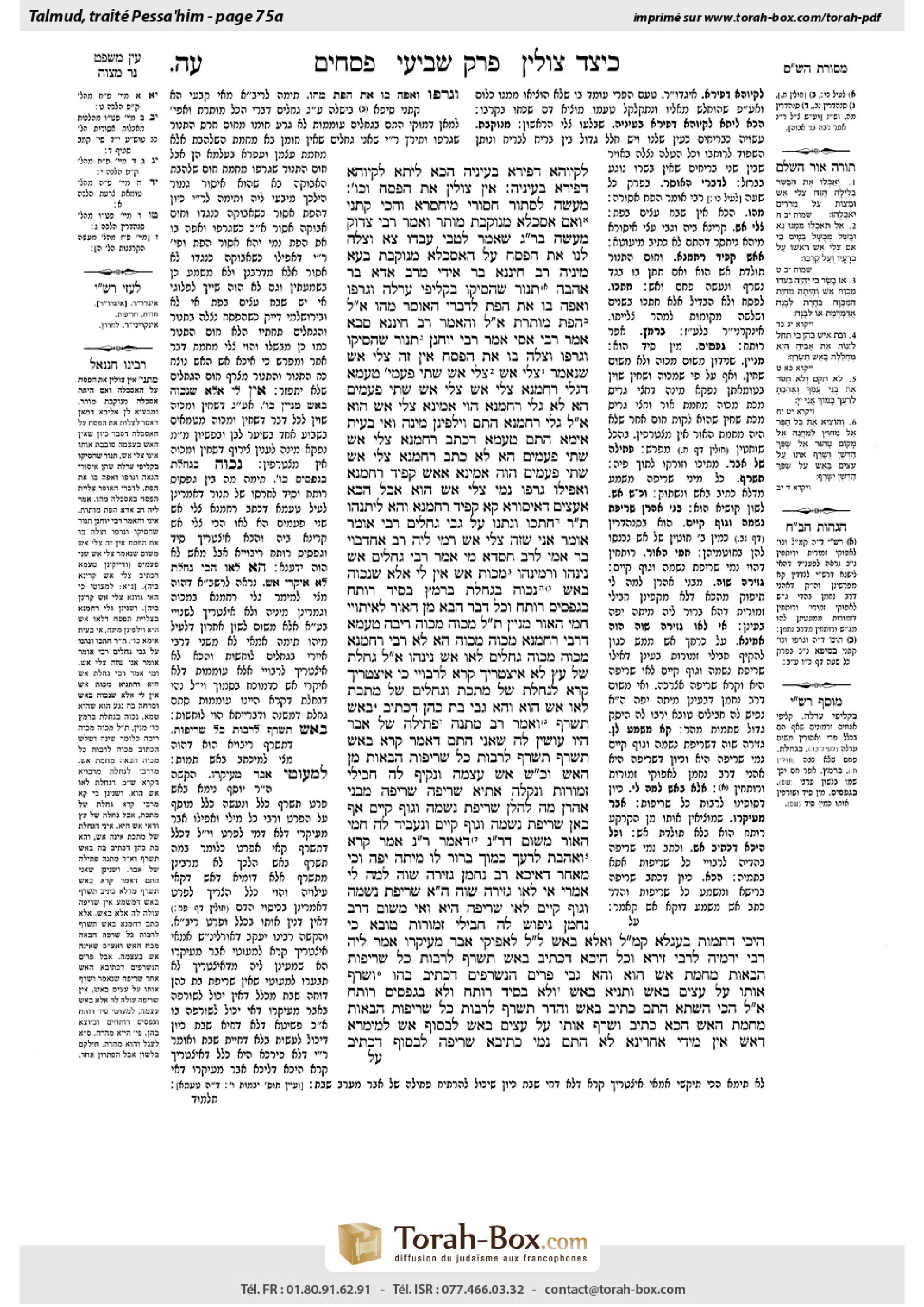
Pesachim 75a: Talmud study for Daf Yomi
Daf Yomi is the daily study of one Talmud folio. Explore 37 tractates with scans, Hebrew text, Sefaria English and AI-generated French translations where annotated.
Passage selection and English or AI-generated French translation are available where the scan has annotations. Daf Study is independent of Torah-Box and Sefaria.
Browse Pesachim · פסחים · All tractatesPesachim 75a text and translations
This page of Pesachim includes the Aramaic text, an English translation and an AI-generated French translation, alongside the scan above.
פסחים ע״ה א · Aramaic and Hebrew text
לְקִיּוּהָא דְפֵירָא בְּעֵינֵיהּ. הָכָא — לֵיתָא לְקִיּוּהָא דְפֵירָא בְּעֵינֵיהּ.
אֵין צוֹלִין אֶת הַפֶּסַח וְכוּ׳. מַעֲשֶׂה לִסְתּוֹר?! חַסּוֹרֵי מִיחַסְּרָא, וְהָכִי קָתָנֵי: וְאִם אַסְכָּלָא מְנוּקֶּבֶת — מוּתָּר. וְאָמַר רַבִּי צָדוֹק, מַעֲשֶׂה בְּרַבָּן גַּמְלִיאֵל שֶׁאָמַר לְטָבִי עַבְדּוֹ: צֵא וּצְלֵה לָנוּ אֶת הַפֶּסַח עַל הָאַסְכָּלָא מְנוּקֶּבֶת.
בְּעָא מִינֵּיהּ רַב חִינָּנָא בַּר אִידִי מֵרַב אַדָּא בַּר אַהֲבָה: תַּנּוּר שֶׁהִסִּיקוֹ בִּקְלִיפֵּי עׇרְלָה וּגְרָפוֹ וְאָפָה בּוֹ אֶת הַפַּת, לְדִבְרֵי הָאוֹסֵר, מַהוּ? אֲמַר לֵיהּ: הַפַּת מוּתֶּרֶת.
אֲמַר לֵיהּ: וְהָאָמַר רַב חִינָּנָא סָבָא אָמַר רַבִּי אַסִּי אָמַר רַבִּי יוֹחָנָן: תַּנּוּר שֶׁהִסִּיקוֹ וּגְרָפוֹ וְצָלָה בּוֹ אֶת הַפֶּסַח — אֵין זֶה צְלִי אֵשׁ, שֶׁנֶּאֱמַר ״צְלִי אֵשׁ ... צְלִי אֵשׁ״, שְׁתֵּי פְעָמִים.
טַעְמָא דְּגַלִּי רַחֲמָנָא ״צְלִי אֵשׁ״ ״צְלִי אֵשׁ״ שְׁתֵּי פְעָמִים. הָא לָא גַּלִּי רַחֲמָנָא, הֲוֵי אָמֵינָא צְלִי אֵשׁ הוּא.
אֲמַר לֵיהּ: גַּלִּי רַחֲמָנָא הָתָם, וְיָלְפִינַן מִינַּהּ.
וְאִי בָּעֵית אֵימָא: הָתָם טַעְמָא דִּכְתַב רַחֲמָנָא ״צְלִי אֵשׁ״ שְׁתֵּי פְעָמִים, הָא לָא כְּתַב רַחֲמָנָא ״צְלִי אֵשׁ״ שְׁתֵּי פְעָמִים, הֲוָה אָמֵינָא: אַאֵשׁ קָפֵיד רַחֲמָנָא, וַאֲפִילּוּ גְּרָפוֹ נָמֵי — צְלִי אֵשׁ הוּא. אֲבָל הָכָא, אַעֵצִים דְּאִיסּוּרָא קָא קָפֵיד רַחֲמָנָא, וְהָא לֵיתַנְהוּ.
תָּנוּ רַבָּנַן: חֲתָכוֹ, וּנְתָנוֹ עַל גַּבֵּי גֶּחָלִים. רַבִּי אוֹמֵר: אוֹמֵר אֲנִי שֶׁזֶּה צְלִי אֵשׁ. רָמֵי לֵיהּ רַב אַחָדְבוּי בַּר אַמֵּי לְרַב חִסְדָּא: מִי אָמַר רַבִּי גֶּחָלִים אֵשׁ נִינְהוּ?
וּרְמִינְהוּ ״מִכְוַת אֵשׁ״, אֵין לִי אֶלָּא שֶׁנִּכְוָה בְּאֵשׁ, נִכְוָה בְּגַחֶלֶת, בְּרֶמֶץ, בְּסִיד רוֹתֵחַ, בְּגִפְסִיס רוֹתֵחַ, וְכׇל דָּבָר הַבָּא מִן הָאוּר, לְאֵיתוֹיֵי חַמֵּי הָאוּר, מִנַּיִין? תַּלְמוּד לוֹמַר: ״מִכְוָה״ ״מִכְוָה״ רִיבָּה.
טַעְמָא דְּרַבִּי רַחֲמָנָא ״מִכְוָה״ ״מִכְוָה״, הָא לָא רַבִּי רַחֲמָנָא ״מִכְוָה״ ״מִכְוָה״, גֶּחָלִים לָאו אֵשׁ נִינְהוּ!
אֲמַר לֵיהּ: גַּחֶלֶת שֶׁל עֵץ לָא אִיצְטְרִיךְ קְרָא לְרַבּוֹיֵי. כִּי אִיצְטְרִיךְ קְרָא לְגַחֶלֶת שֶׁל מַתֶּכֶת.
וְגֶחָלִים שֶׁל מַתֶּכֶת לָאו אֵשׁ הוּא? וְהָא גַּבֵּי בַּת כֹּהֵן, דִּכְתִיב: ״בָּאֵשׁ תִּשָּׂרֵף״. וְאָמַר רַב מַתְנָה: פְּתִילָה שֶׁל אֲבָר הָיוּ עוֹשִׂין לָהּ!
שָׁאנֵי הָתָם, דְּאָמַר קְרָא: ״בָּאֵשׁ תִּשָּׂרֵף״, ״תִּשָּׂרֵף״ — לְרַבּוֹת כׇּל שְׂרֵיפוֹת הַבָּאוֹת מִן הָאֵשׁ.
וְכׇל שֶׁכֵּן אֵשׁ עַצְמָהּ. וְנַקֵּיף לַהּ חֲבִילֵי זְמוֹרוֹת וְנִקְלַהּ! אָתְיָא ״שְׂרֵיפָה״ ״שְׂרֵיפָה״ מִבְּנֵי אַהֲרֹן. מָה לְהַלָּן — שְׂרֵיפַת נְשָׁמָה וְגוּף קַיָּים, אַף כָּאן — שְׂרֵיפַת נְשָׁמָה וְגוּף קַיָּים.
וְנַעְבֵּיד לַהּ חַמֵּי הָאוּר? מִשּׁוּם דְּרַב נַחְמָן, דְּאָמַר רַב נַחְמָן: אָמַר קְרָא: ״וְאָהַבְתָּ לְרֵעֲךָ כָּמוֹךָ״, בְּרוֹר לוֹ מִיתָה יָפָה.
וְכִי מֵאַחַר דְּאִיכָּא רַב נַחְמָן, גְּזֵירָה שָׁוָה לְמָה לִי? אָמְרִי: אִי לָאו גְּזֵירָה שָׁוָה, הֲוָה אָמֵינָא: שְׂרֵיפַת נְשָׁמָה וְגוּף קַיָּים — לָאו שְׂרֵיפָה הִיא. וְאִי מִשּׁוּם דְּרַב נַחְמָן — נַיפֵּושׁ לַהּ חֲבִילֵי זְמוֹרוֹת טוּבָא, כִּי הֵיכִי דִּתְמוּת בַּעֲגָלָא, קָא מַשְׁמַע לַן.
וְאֶלָּא ״בָּאֵשׁ״ לְמָה לִי? לְאַפּוֹקֵי אֲבָר מֵעִיקָּרוֹ.
אֲמַר לֵיהּ רַבִּי יִרְמְיָה לְרַבִּי זֵירָא: וְכֹל הֵיכָא דִּכְתִיב ״בָּאֵשׁ תִּשָּׂרֵף״, לְרַבּוֹת כׇּל שְׂרֵיפוֹת הַבָּאוֹת מֵחֲמַת אֵשׁ הוּא? וְהָא גַּבֵּי פָּרִים הַנִּשְׂרָפִים, דִּכְתִיב בְּהוּ: ״וְשָׂרַף אֹתוֹ עַל עֵצִים בָּאֵשׁ״, וְתַנְיָא: ״בָּאֵשׁ״ וְלֹא בְּסִיד רוֹתֵחַ, וְלֹא בְּגִפְסִיס רוֹתֵחַ?
אֲמַר לֵיהּ: הָכִי הַשְׁתָּא?! הָתָם כְּתִיב ״בָּאֵשׁ״ וַהֲדַר ״תִּשָּׂרֵף״ — לְרַבּוֹת כׇּל שְׂרֵיפוֹת הַבָּאוֹת מֵחֲמַת הָאֵשׁ. הָכָא כְּתִיב ״וְשָׂרַף אֹתוֹ עַל עֵצִים בָּאֵשׁ״ לְבַסּוֹף ״אֵשׁ״, לְמֵימְרָא דְּאֵשׁ — אִין, מִידֵּי אַחֲרִינָא — לָא.
הָתָם נָמֵי כְּתִיבָא שְׂרֵיפָה לְבַסּוֹף, דִּכְתִיב:
Pesachim 75a · English translation
sharpness of the fruit remains present in the vinegar in its pure, unadulterated form, despite the fact that the vinegar itself is not sharp. Here, the sharpness of the fruit does not remain present in the vinegar in its pure, unadulterated form because it has already been used with the meat. Therefore, the vinegar is no longer potent enough to keep the blood in the meat.
It was taught in the mishna that one may not roast the Paschal lamb on a grill. Subsequently, the mishna quotes an incident in which Rabban Gamliel instructed his servant to roast the Paschal lamb for him on a grill. The Gemara expresses surprise: Was an incident cited to contradict what was previously stated? The Gemara responds: The mishna is incomplete and is teaching the following: And if it is a perforated grill, so that the fire reaches each part of the meat and the animal will not be roasted from the heat of the grill itself, it is permitted. And with regard to this Rabbi Tzadok said that there was an incident with Rabban Gamliel, who said to his slave Tavi: Go and roast the Paschal lamb for us on the perforated grill.
The Gemara cites a discussion related to the subject of roasting the Paschal lamb. Rav Ḥinnana bar Idi raised a dilemma before Rav Adda bar Ahava: In the case of an oven that one fired with peels of fruit that are orla, i.e., fruit that grows on a tree the first three years after it was planted, from which one may not receive any benefit, if, after the oven became very hot, he swept it and removed the fuel and the ashes, and he baked bread in it, according to the opinion that prohibits bread baked directly with heat from orla fuel, what is the halakha with regard to this bread? It was baked with the heat trapped in the oven only after the fuel was removed. He said to him: The bread is permitted.
Rav Ḥinnana said to him: But didn’t Rav Ḥinnana the Elder say that Rabbi Asi said that Rabbi Yoḥanan said: If there is an oven that one fired and swept so that the heat remains but there is no longer any fire in the oven, and one then roasted the Paschal lamb in it, this is not a fulfillment of the Torah’s command that the Paschal lamb must be roasted in fire, as it is stated in the Torah: “And they shall eat the meat on that night, roasted in fire, and matzot; with bitter herbs they shall eat it. Do not eat of it raw, nor boiled in water, but roasted in fire; its head with its legs and with its inner parts” (Exodus 12:8–9), and since it says the phrase: Roasted in fire, two times, the verse emphasizes that the Paschal lamb must literally be roasted on the fire?
The following can now be inferred: The reason is specifically because the Merciful One reveals this halakha with regard to the Paschal lamb in the Torah by repeating: Roasted in fire, roasted in fire, twice. But if the Merciful One had not revealed this halakha by emphasizing the need to roast it directly on the fire, I would have said a Paschal lamb roasted in an oven that has already been swept is nonetheless considered roasted in fire. Therefore, in other situations in which something is roasted in an oven, even if it is not roasted directly from the heat of a fire, its status should be comparable to something that was roasted directly from the fuel. If the fuel is forbidden, the food should be forbidden.
Rav Adda bar Ahava said to Rav Ḥinnana bar Idi: The Merciful One reveals it there, with regard to the Paschal lamb, and we learn from it that even in other areas of halakha, only something that is roasted directly by a fire is considered roasted in fire.
And if you wish, say a different answer instead: There, in the case of the Paschal lamb, the reason one may not roast the lamb if one has already swept out the oven is that the Merciful One writes “roasted in fire” twice. But if the Merciful One had not written “roasted in fire” twice, I would have said that the Merciful One is particular about fire, meaning that the source of the heat in the oven should be fire, and even if one swept it, it is still considered roasted in fire. It was therefore necessary to repeat the phrase “roasted in fire.” But here, in the case of orla, the Merciful One is particular about the prohibited fuel, and it is not here in the oven. Therefore, there is no reason to prohibit the bread.
The Sages taught: If one cuts the Paschal lamb superficially in several places and places it on coals, Rabbi Yehuda HaNasi says: I say that this is considered roasted in fire, as coals have the status of real fire. Rav Aḥadvoi bar Ami raised a contradiction to Rav Ḥisda: Did Rabbi Yehuda HaNasi actually say that coals are considered like fire?
Rav Aḥadvoi bar Ami raised a contradiction based on the Torah’s statement with regard to the laws of leprosy: “Or flesh that shall have on its skin a burn from fire” (Leviticus 13:24). From the fact that it says a burn from fire, I have derived nothing other than a case in which it is burned by fire itself; if it is burned by a coal, by burning ash, by burning lime, by burning plaster [gipsis], or by anything else that is burning and whose source of heat comes from fire, to include also water heated by fire, from where is it derived that these are also considered a burn from fire? The verse states: A burn, a burn, twice. By repeating the term, it includes all these types of burns.
The following can now be inferred: The reason is that the Merciful One includes these types of burns in the Torah through the words: A burn, a burn. But if the Merciful One had not included them through the repetitive expression a burn, a burn, one would have assumed that coals are not considered fire, which contradicts the opinion of Rabbi Yehuda HaNasi that any usage of the term fire includes coals as well.
He said to him: With regard to a red-hot wood coal, it is not necessary for the verse to include it. As long as it is burning, it is certainly considered a fire. Where a verse is necessary is with regard to a red-hot piece of metal that was heated by a fire. Without the verse, it would have been possible to think a person burned by hot metal it is not considered burned by fire.
The Gemara expresses surprise at the previous answer: And are red-hot pieces of metal not considered fire? But with regard to a daughter of a priest who committed adultery after betrothal, it is written: “And the daughter of a priest, if she profanes herself through adultery, she profanes her father; in fire she shall be burned” (Leviticus 21:9), and Rav Mattana said: They would not literally burn her in fire; rather, they would prepare for her a molten bar of lead. They would execute her by pouring molten lead down her throat. This proves that burning metal is considered fire.
The Gemara responds: It is different there, as the verse states not simply fire, but “in fire she shall be burned.” The expression “she shall be burned” comes to include all burnings that come from fire.
The Gemara suggests: If so, all the more so fire itself fulfills the requirement of burning. Let us surround her with bundles of branches and burn her with them. The Gemara responds: It comes from a verbal analogy between the word “burning” stated here and the word “burning” stated and in the context of the death of the sons of Aaron: Just as below, with regard to the sons of Aaron, the verse states that they were burned with fire (see Leviticus 10:2), and it was a burning of the soul and the body remained, as even their clothes were not burned, so too, here, with regard to the daughter of a priest, it means the burning of the soul and the body remains.
The Gemara challenges: Let us execute her with boiling water heated by fire. The Gemara answers: It is due to the statement of Rav Naḥman, as Rav Naḥman said that the verse states: “And you shall love your fellow as yourself” (Leviticus 19:18). When executing someone, select for him a kind death. Even when someone must be executed, his dignity should be protected. He should be executed in the most comfortable way possible.
The Gemara asks: Once there is the reason of Rav Naḥman, why do I need the verbal analogy derived from the sons of Aaron? Even without it, Rav Naḥman’s ruling requires the court to carry out the execution with molten lead, which provides an easier death. Say in answer to this question: If not for the verbal analogy, I would have said that burning the soul while the body remains is not considered burning. And if it were only due to the statement of Rav Naḥman that one must select a kind death, we should add many bundles of branches so that she would die quickly. Therefore, the verbal analogy teaches us that executing with molten lead is considered burning.
But if it so that the verse says “she shall be burned” to include all methods of burning, for what do I need the expression “in fire”? The Gemara answers: To exclude lead from its source.
Rabbi Yirmeya said to Rabbi Zeira: Is it true that anywhere that it is written: “In fire she shall be burned” it comes to include all methods of burning that come from fire? But what of bulls that are burned, about which it is written: “And he shall burn it on wood in fire, where the ash is poured it shall be burned” (Leviticus 4:12), and it was taught in a baraita: In fire, and not in burning lime and not in burning plaster? Why aren’t all methods of burning permitted in this case as well?
He said to him: How can these cases be compared? There, in the case of the daughter of a priest, it is written: “In fire,” and the verse subsequently states that she shall be burned, which comes to include all methods of burning that come from fire. Here, in the case of a bull, it is written: “And he shall burn it on wood in fire.” At the end it says fire, to say that with regard to fire, yes, it may be used, but with regard to something else, no, it may not be used.
The Gemara objects: There, too, with regard to bulls that are burned, burning is written at the end, as it is written at the end of that verse:
Pesachim 75a · Traduction française (IA)
L’acidité du fruit reste présente dans le vinaigre sous sa forme pure, sans mélange, bien que le vinaigre lui-même ne soit pas acide. Ici, l’acidité du fruit ne reste pas présente dans le vinaigre sous sa forme pure, sans mélange, car le vinaigre a déjà été utilisé avec la viande. Il n’est donc plus assez puissant pour retenir le sang dans la viande.
La Michna enseigne qu’on ne peut pas faire rôtir l’agneau pascal sur une grille. Elle cite ensuite un épisode au cours duquel Rabban Gamliel ordonna à son serviteur de faire rôtir l’agneau pascal sur une grille. La Guemara s’étonne : cite-t-on un épisode qui contredit ce qui vient d’être enseigné ? La Guemara répond : La Michna est incomplète et enseigne ceci : si la grille est perforée, de sorte que le feu atteigne toutes les parties de la viande et que l’animal ne soit pas rôti par la chaleur de la grille elle-même, cela est permis. À ce propos, Rabbi Tsadok a raconté qu’un jour Rabban Gamliel dit à son esclave Tavi : « Va nous faire rôtir l’agneau pascal sur la grille perforée. »
La Guemara cite une discussion liée à la cuisson de l’agneau pascal. Rav Ḥinnana bar Idi soumit une question à Rav Adda bar Ahava : dans le cas d’un four chauffé avec des écorces de fruits d’orla — c’est-à-dire de fruits qui poussent sur un arbre au cours des trois premières années après sa plantation et dont on ne peut tirer aucun profit —, si, une fois le four devenu très chaud, on l’a balayé et qu’on a retiré le combustible et les cendres, puis qu’on y a cuit du pain, quelle est la halakha concernant ce pain, selon l’opinion qui interdit le pain cuit directement grâce à la chaleur d’un combustible d’orla ? Le pain a été cuit grâce à la chaleur retenue dans le four, une fois le combustible retiré. Il lui répondit : Le pain est permis.
Rav Ḥinnana lui dit : Mais Rav Ḥinnana l’Ancien n’a-t-il pas dit que Rabbi Asi a dit que Rabbi Yoḥanan a dit : si l’on a chauffé un four puis qu’on l’a balayé, de sorte que la chaleur y demeure mais qu’il n’y ait plus de feu, et qu’on y a ensuite rôti l’agneau pascal, on n’a pas accompli le commandement de la Torah selon lequel l’agneau pascal doit être rôti au feu. Car il est écrit dans la Torah : « Ils en mangeront la viande cette nuit-là, rôtie au feu, avec des pains azymes ; ils la mangeront avec des herbes amères. N’en mangez pas cru ni bouilli dans l’eau, mais rôti au feu ; sa tête, ses jambes et ses entrailles » (Exode 12, 8-9). Et puisque l’expression « rôti au feu » est répétée deux fois, le verset souligne que l’agneau pascal doit littéralement être rôti sur le feu ?
On peut en déduire que la raison tient précisément au fait que le Miséricordieux révèle cette halakha concernant l’agneau pascal dans la Torah en répétant deux fois : « Rôti au feu, rôti au feu ». Mais si le Miséricordieux n’avait pas révélé cette halakha en soulignant qu’il faut le rôtir directement sur le feu, j’aurais dit qu’un agneau pascal rôti dans un four déjà balayé est tout de même considéré comme rôti au feu. Par conséquent, dans les autres cas où un aliment est rôti dans un four, même s’il n’est pas rôti directement grâce à la chaleur du feu, son statut devrait être comparable à celui d’un aliment rôti directement grâce au combustible. Si le combustible est interdit, l’aliment devrait être interdit.
Rav Adda bar Ahava dit à Rav Ḥinnana bar Idi : Le Miséricordieux révèle cette règle à cet endroit, à propos de l’agneau pascal, et nous en apprenons que, même dans les autres domaines de la halakha, seul ce qui est rôti directement par un feu est considéré comme rôti au feu.
Et si tu veux, donne plutôt une autre réponse : là, dans le cas de l’agneau pascal, la raison pour laquelle on ne peut pas le faire rôtir après avoir balayé le four est que le Miséricordieux écrit deux fois « rôti au feu ». Mais si le Miséricordieux n’avait pas écrit deux fois « rôti au feu », j’aurais dit que le Miséricordieux tient au feu, c’est-à-dire que la source de chaleur dans le four doit être le feu, et que, même après avoir balayé le four, l’agneau est toujours considéré comme rôti au feu. Il était donc nécessaire de répéter l’expression « rôti au feu ». Mais ici, dans le cas de l’orla, le Miséricordieux tient au combustible interdit, qui ne se trouve plus dans le four. Il n’y a donc aucune raison d’interdire le pain.
Les Sages ont enseigné : Si l’on incise superficiellement l’agneau pascal en plusieurs endroits et qu’on le place sur des braises, Rabbi Yehuda HaNasi dit : Je considère qu’il est rôti au feu, car les braises ont le statut d’un feu véritable. Rav Aḥadvoi bar Ami souleva une contradiction devant Rav Ḥisda : Rabbi Yehuda HaNasi a-t-il réellement dit que les braises sont considérées comme du feu ?
Rav Aḥadvoi bar Ami souleva une contradiction à partir de ce que dit la Torah au sujet des lois de la lèpre : « Ou une chair qui aurait sur sa peau une brûlure causée par le feu » (Lévitique 13, 24). De l’expression « brûlure causée par le feu », je n’ai déduit que le cas où elle est causée par le feu lui-même. Mais si elle est causée par une braise, de la cendre brûlante, de la chaux brûlante, du plâtre brûlant [gipsis], ou par toute autre chose brûlante dont la source de chaleur vient du feu, y compris de l’eau chauffée par le feu, d’où apprend-on que cela aussi est considéré comme une brûlure causée par le feu ? Le verset répète deux fois le terme « brûlure ». Cette répétition inclut tous ces types de brûlures.
On peut en déduire que la raison tient au fait que le Miséricordieux inclut ces types de brûlures dans la Torah par les mots répétés « brûlure, brûlure ». Mais si le Miséricordieux ne les avait pas inclus au moyen de cette expression répétée, « brûlure, brûlure », on aurait supposé que les braises ne sont pas considérées comme du feu, ce qui contredit l’opinion de Rabbi Yehuda HaNasi selon laquelle toute occurrence du terme « feu » inclut également les braises.
Il lui dit : Pour une braise de bois rougeoyante, le verset n’a pas besoin de l’inclure. Tant qu’elle brûle, elle est certainement considérée comme un feu. Le verset est nécessaire pour un morceau de métal rougeoyant qui a été chauffé par un feu. Sans ce verset, on aurait pu penser qu’une personne brûlée par du métal chaud n’est pas considérée comme ayant été brûlée par le feu.
La Guemara s’étonne de la réponse précédente : Les morceaux de métal rougeoyant ne sont-ils pas considérés comme du feu ? À propos de la fille d’un prêtre qui a commis un adultère après ses fiançailles, il est écrit : « Si la fille d’un prêtre se déshonore en se prostituant, elle déshonore son père ; elle sera brûlée par le feu » (Lévitique 21, 9). Et Rav Mattana a dit : On ne la brûlait pas littéralement dans le feu ; on lui préparait plutôt une barre de plomb en fusion. On l’exécutait en lui faisant couler du plomb en fusion dans la gorge. Cela prouve que le métal brûlant est considéré comme du feu.
La Guemara répond : Ce cas est différent, car le verset ne dit pas simplement « feu », mais « elle sera brûlée par le feu ». L’expression « elle sera brûlée » vient inclure toutes les formes de brûlure provoquées par le feu.
La Guemara propose : Dans ce cas, le feu lui-même satisfait d’autant plus à l’exigence de la brûler. Entourons-la de fagots et brûlons-la avec ceux-ci. La Guemara répond : Cela découle d’une analogie verbale entre le terme « brûlure » employé ici et le terme « brûlure » employé à propos de la mort des fils d’Aaron. De même que, dans le passage concernant les fils d’Aaron, le verset dit qu’ils furent brûlés par le feu (voir Lévitique 10, 2), et qu’il s’agissait d’une brûlure de l’âme tandis que le corps demeurait intact — leurs vêtements eux-mêmes n’ayant pas brûlé —, de même ici, à propos de la fille d’un prêtre, il s’agit d’une brûlure de l’âme tandis que le corps demeure intact.
La Guemara objecte : Faisons-la exécuter au moyen d’eau bouillante chauffée par le feu. La Guemara répond : C’est en vertu de la déclaration de Rav Naḥman, car Rav Naḥman a dit que le verset déclare : « Tu aimeras ton prochain comme toi-même » (Lévitique 19, 18). Quand on exécute quelqu’un, on doit lui choisir une mort clémente. Même lorsqu’une personne doit être exécutée, sa dignité doit être préservée. Il faut l’exécuter de la manière la plus douce possible.
La Guemara demande : Puisqu’on a l’argument de Rav Naḥman, pourquoi faut-il l’analogie verbale tirée du cas des fils d’Aaron ? Même sans elle, la décision de Rav Naḥman impose au tribunal de procéder à l’exécution avec du plomb en fusion, ce qui entraîne une mort plus douce. On peut répondre à cette question : Sans l’analogie verbale, j’aurais dit que brûler l’âme tandis que le corps demeure intact n’est pas considéré comme une brûlure. Et si l’on ne se fondait que sur la déclaration de Rav Naḥman, selon laquelle il faut choisir une mort clémente, on pourrait ajouter de nombreux fagots pour qu’elle meure rapidement. L’analogie verbale nous apprend donc que l’exécution au moyen de plomb en fusion est considérée comme une brûlure.
Mais s’il en est ainsi, si le verset dit « elle sera brûlée » pour inclure toutes les méthodes de brûlure, pourquoi faut-il l’expression « par le feu » ? La Guemara répond : Pour exclure le plomb à l’état naturel.
Rabbi Yirmeya dit à Rabbi Zeira : Est-il vrai que partout où il est écrit « elle sera brûlée par le feu », cela vient inclure toutes les méthodes de brûlure provoquées par le feu ? Mais qu’en est-il des taureaux que l’on brûle, à propos desquels il est écrit : « Il le brûlera sur du bois, au feu, là où l’on déverse les cendres, il sera brûlé » (Lévitique 4, 12) ? Or, il a été enseigné dans une baraïta : « Au feu », mais ni dans de la chaux brûlante ni dans du plâtre brûlant. Pourquoi, dans ce cas également, toutes les méthodes de brûlure ne sont-elles pas permises ?
Il lui dit : Comment comparer ces cas ? Là, à propos de la fille d’un prêtre, il est écrit « par le feu », puis le verset dit qu’elle sera brûlée, ce qui vient inclure toutes les méthodes de brûlure provoquées par le feu. Ici, à propos d’un taureau, il est écrit : « Il le brûlera sur du bois, au feu. » Le verset se termine par le mot « feu », pour dire que le feu, oui, peut être utilisé, mais que toute autre chose, non, ne peut pas l’être.
La Guemara objecte : Là aussi, à propos des taureaux que l’on brûle, le terme « brûler » figure à la fin, comme il est écrit à la fin de ce verset :
Traduction française générée par IA à partir de l’édition anglaise de Sefaria. Vérifie toujours un passage avec le texte source.
Text from Sefaria: William Davidson Edition - Vocalized Aramaic (CC BY NC); William Davidson Edition - English (CC BY NC).