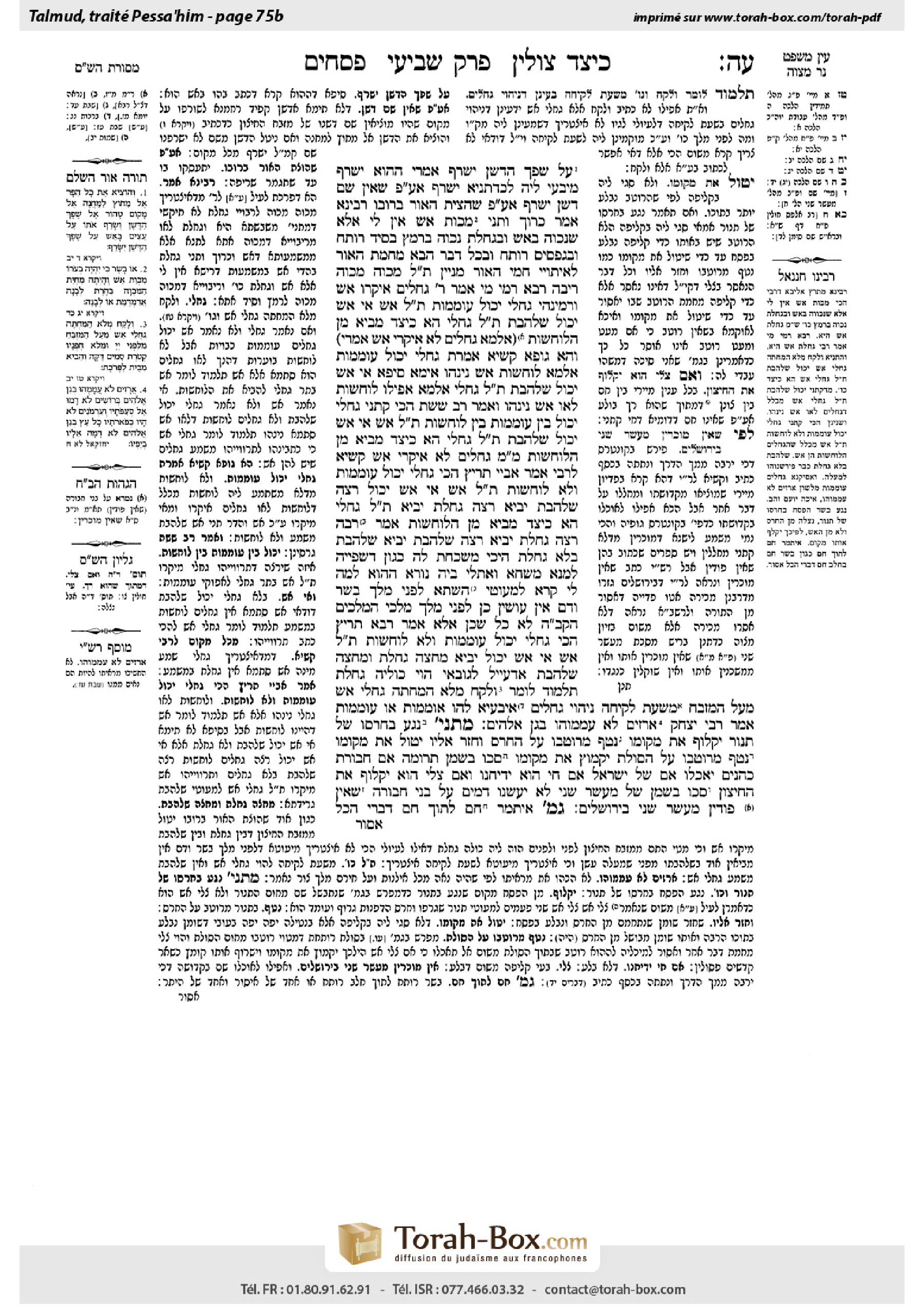
Pesachim 75b: Talmud study for Daf Yomi
Daf Yomi is the daily study of one Talmud folio. Explore 37 tractates with scans, Hebrew text, Sefaria English and AI-generated French translations where annotated.
Passage selection and English or AI-generated French translation are available where the scan has annotations. Daf Study is independent of Torah-Box and Sefaria.
Browse Pesachim · פסחים · All tractatesPesachim 75b text and translations
This page of Pesachim includes the Aramaic text, an English translation and an AI-generated French translation, alongside the scan above.
פסחים ע״ה ב · Aramaic and Hebrew text
״עַל שֶׁפֶךְ הַדֶּשֶׁן יִשָּׂרֵף״! אָמְרִי: הָהוּא ״יִשָּׂרֵף״ מִיבְּעֵי לֵיהּ לְכִדְתַנְיָא: ״יִשָּׂרֵף״ — אַף עַל פִּי שֶׁאֵין שָׁם דֶּשֶׁן. ״יִשָּׂרֵף״ — אַף עַל פִּי שֶׁהִצִּית הָאוּר בְּרוּבּוֹ.
רָבִינָא אָמַר, כְּרוֹךְ וּתְנִי: ״מִכְוַת אֵשׁ״ — אֵין לִי אֶלָּא שֶׁנִּכְוָה בְּאֵשׁ וּבְגַחֶלֶת. נִכְוָה בְּרֶמֶץ, בְּסִיד רוֹתֵחַ, וּבְגִפְסִיס רוֹתֵחַ, וּבְכׇל דָּבָר הַבָּא מֵחֲמַת הָאוּר, לְאֵיתוֹיֵי חַמֵּי הָאוּר, מִנַּיִין? תַּלְמוּד לוֹמַר: ״מִכְוָה״ ״מִכְוָה״ רִיבָּה.
רָבָא רָמֵי. מִי אָמַר רַבִּי גֶּחָלִים אִיקְּרוּ אֵשׁ? וּרְמִינְהִי: ״גַּחֲלֵי״ — יָכוֹל עוֹמְמוֹת, תַּלְמוּד לוֹמַר: ״אֵשׁ״. אִי אֵשׁ — יָכוֹל שַׁלְהֶבֶת, תַּלְמוּד לוֹמַר: ״גַּחֲלֵי״. הָא כֵּיצַד? מֵבִיא מִן הַלּוֹחֲשׁוֹת. (אַלְמָא גֶּחָלִים לָא אִיקְּרִי אֵשׁ!
אָמְרִי:) וְהָא גּוּפָא קַשְׁיָא, אָמְרַתְּ: ״גַּחֲלֵי״ — יָכוֹל עוֹמְמוֹת, אַלְמָא לוֹחֲשׁוֹת אֵשׁ נִינְהוּ, אֵימָא סֵיפָא: אִי אֵשׁ — יָכוֹל שַׁלְהֶבֶת, תַּלְמוּד לוֹמַר: ״גַּחֲלֵי״, אַלְמָא אֲפִילּוּ לוֹחֲשׁוֹת לָאו אֵשׁ נִינְהוּ.
וְאָמַר רַב שֵׁשֶׁת, הָכִי קָתָנֵי: ״גַּחֲלֵי״ — יָכוֹל בֵּין עוֹמְמוֹת בֵּין לוֹחֲשׁוֹת, תַּלְמוּד לוֹמַר: ״אֵשׁ״. אִי אֵשׁ — יָכוֹל שַׁלְהֶבֶת, תַּלְמוּד לוֹמַר: ״גַּחֲלֵי״, הָא כֵּיצַד? מֵבִיא מִן הַלּוֹחֲשׁוֹת. מִכׇּל מָקוֹם גֶּחָלִים לָא אִיקְּרִי אֵשׁ, קַשְׁיָא לְרַבִּי!
אָמַר אַבָּיֵי, תָּרֵיץ הָכִי: ״גַּחֲלֵי״ — יָכוֹל עוֹמְמוֹת וְלֹא לוֹחֲשׁוֹת, תַּלְמוּד לוֹמַר: ״אֵשׁ״. אִי אֵשׁ, יָכוֹל רָצָה שַׁלְהֶבֶת — יָבִיא, רָצָה גַּחֶלֶת — יָבִיא, תַּלְמוּד לוֹמַר: ״גַּחֲלֵי״. הָא כֵּיצַד? מֵבִיא מִן הַלּוֹחֲשׁוֹת.
אָמַר רַבָּה: רָצָה גַּחֶלֶת — יָבִיא, רָצָה שַׁלְהֶבֶת — יָבִיא. שַׁלְהֶבֶת בְּלֹא גַּחֶלֶת הֵיכִי מַשְׁכַּחַתְּ לַהּ? כְּגוֹן דְּשַׁפְיֵיהּ לְמָנָא מִשְׁחָא וְאַתְלִי בֵּיהּ נוּרָא. הָהוּא לְמָה לִי קְרָא לְמַעוֹטֵי, הַשְׁתָּא לִפְנֵי מֶלֶךְ בָּשָׂר וְדָם אֵין עוֹשִׂין כֵּן, לִפְנֵי מֶלֶךְ מַלְכֵי הַמְּלָכִים הַקָּדוֹשׁ בָּרוּךְ הוּא לֹא כׇּל שֶׁכֵּן!
אֶלָּא אָמַר רָבָא, תָּרֵיץ הָכִי: ״גַּחֲלֵי״ — יָכוֹל עוֹמְמוֹת וְלֹא לוֹחֲשׁוֹת, תַּלְמוּד לוֹמַר: ״אֵשׁ״. אִי אֵשׁ — יָכוֹל יָבִיא מֶחֱצָה גַּחֶלֶת וּמֶחֱצָה שַׁלְהֶבֶת, אַדְּעָיֵיל לְגַוַּאי הָוֵי כּוּלֵּיהּ גַּחֶלֶת — תַּלְמוּד לוֹמַר: ״וְלָקַח מְלֹא הַמַּחְתָּה גַּחֲלֵי אֵשׁ מֵעַל הַמִּזְבֵּחַ״, מִשְּׁעַת לְקִיחָה נִיהְוֵי גֶּחָלִים.
אִיבַּעְיָא לְהוּ: אוֹמְמוֹת אוֹ עוֹמְמוֹת? אָמַר רַבִּי יִצְחָק: ״אֲרָזִים לֹא עֲמָמֻהוּ בְּגַן אֱלֹהִים״.
מַתְנִי׳ נָגַע בְּחַרְסוֹ שֶׁל תַּנּוּר — יִקְלוֹף אֶת מְקוֹמוֹ. נָטַף מֵרוֹטְבּוֹ עַל הַחֶרֶס וְחָזַר אֵלָיו — יִטּוֹל אֶת מְקוֹמוֹ. נָטַף מֵרוֹטְבּוֹ עַל הַסּוֹלֶת — יִקְמוֹץ אֶת מְקוֹמוֹ.
סָכוֹ בְּשֶׁמֶן תְּרוּמָה, אִם חֲבוּרַת כֹּהֲנִים — יֹאכֵלוּ. אִם שֶׁל יִשְׂרָאֵל, אִם חַי הוּא — יְדִיחֶנּוּ. וְאִם צָלִי הוּא — יִקְלוֹף אֶת הַחִיצוֹן. סָכוֹ בְּשֶׁמֶן שֶׁל מַעֲשֵׂר שֵׁנִי — לֹא יַעֲשֶׂנּוּ דָּמִים עַל בְּנֵי חֲבוּרָה, שֶׁאֵין פּוֹדִין מַעֲשֵׂר שֵׁנִי בִּירוּשָׁלַיִם.
גְּמָ׳ אִיתְּמַר: חַם לְתוֹךְ חַם — דִּבְרֵי הַכֹּל
Pesachim 75b · English translation
“Where the ash is poured it shall be burned” (Leviticus 4:12). The Gemara responds: Say: That usage of the expression “it shall be burned” is needed for that which was taught in a baraita: It shall be burned even though there is no ash there, as the presence of ash from the altar is not essential for burning the bulls. “It shall be burned” also teaches that although the fire has consumed most of it, that is not sufficient. One must take care to complete the burning process.
Ravina said that the contradiction cited earlier between Rabbi Yehuda HaNasi’s statement, that roasting over coal is considered roasting over fire, and the baraita, which requires a derivation to indicate that coal is considered fire with regard to leprosy, can be answered by changing the text of the baraita. Combine and teach the first two types of burns together. From the phrase “a burn from fire,” I have derived nothing other than a case in which one was burned by a fire or by a coal. With regard to one who is burned by hot ash, by burning lime, or by burning plaster, or by anything else that is burning and whose source of heat comes from fire, to include water heated by fire, from where is it derived that these cases are also considered a burn from fire? The verse states: A burn, a burn, twice. By repeating the term, it includes all these types of burns.
Rava raised a contradiction: Did Rabbi Yehuda HaNasi actually say that coals are called fire? And we raise a contradiction based on the verse: “And he shall take a pan full of burning coals from upon the altar before the Lord” (Leviticus 16:12). From the verse’s use of the word coals, I might have thought that one may bring smoldering coals, meaning that the fire is almost extinguished and is not noticeable from the outside. Therefore, the verse states: Fire. If it had stated only fire, I might have thought it was referring to a flame. Therefore, the verse states: Coals. How are these two requirements reconciled? One brings from the coals that are flickering, meaning that the fire is visible. Apparently, plain coals are not called fire.
Say in answer to this question: Isn’t this baraita itself difficult? You said: From the verse’s use of the word coals, I might have thought the verse is referring to coals that are smoldering. Apparently, it is clear that flickering coals are considered fire. Say the latter clause of that same baraita as follows: If it had stated only fire, I might have thought it was referring to a flame. Therefore, the verse states: Coals. Apparently, even flickering coals are not considered fire, and there is an internal contradiction in the baraita.
And Rav Sheshet said, in order to resolve this contradiction: This is what the baraita is teaching: From the verse’s use of the word coals, I might have thought he can take whatever he wants, whether smoldering or flickering. Therefore, the Torah states: Fire. If it had stated only fire, I might have thought it was referring to a flame. Therefore, the verse states: Coals. How is this to be understood? He brings from the flickering coals. In any event, it is derived from here that coals, even if they are flickering, are not called fire. This poses a difficulty to the opinion of Rabbi Yehuda HaNasi, according to which coals are considered fire.
Abaye said that the answer is as follows: Based on the word coals, I might have thought they must be smoldering and not flickering. Therefore, the verse states: Fire. If it had stated only fire, I might have thought that if one wanted a flame he may bring it, and if he wanted a coal he may bring it. Therefore, the Torah states: Coals. How is this to be understood? He brings from the flickering coals. According to this, it is clear that coals are considered fire, in accordance with the opinion of Rabbi Yehuda HaNasi.
Rabba said: In this last explanation, it was stated that one might have thought that if he wanted a coal he may bring it, and if he wanted a flame he may bring it. Under what circumstances can a flame without a coal be found? The Gemara answers: In a case where one smears a utensil with oil and lights it on fire. However, for a case like this, why do I need a verse to exclude it and indicate that one may not bring such a flame? Now, in front of a king of flesh and blood one does not do this, as it is considered disgraceful to bring such a flame before a king; in front of the King of kings, the Holy One, Blessed be He, is it not all the more so a disgrace? Therefore, the verse would not need to exclude this type of flame.
Rather, Rava said that one should answer as follows: Based on the word coals, I might have thought they must be smoldering and not flickering; therefore, the verse states: Fire. If it had said only fire, I might have thought one should bring half coal and half fire, meaning that when one takes the coals from the altar they should be burning strongly and their flame should be visible, and by the time he enters the inside of the Holy of Holies the fire will die down and it will be all coal. Therefore, the verse states: “And he shall take a coal-pan full of burning coals from upon the altar” (Leviticus 16:12), which indicates that from the time of their taking they should be coals and not flames.
Since the discussion until now has focused on smoldering coals, the Gemara mentions that a dilemma was raised before the Sages in the study hall about whether the word smoldering should be rendered omemot with an alef or omemot with an ayin. Rabbi Yitzḥak said: It should be rendered with an ayin, as it is stated: “The cedars in the garden of God could not hide it [amamuhu]” (Ezekiel 31:8), as the word amamuhu in the verse is spelled with an ayin.
MISHNA: If the Paschal lamb touched the earthenware surface of an oven, one must peel off its place on the Paschal lamb, as it was roasted by the heat of the oven and not by the fire itself. If some of the gravy of the Paschal lamb dripped on the earthenware and then returned to it, i.e., the gravy splattered back onto the meat, one must remove its place. Peeling off the outer layer is not enough, and one must remove some of the meat underneath the outer layer, because it is considered to have been cooked by the liquid rather than roasted by the fire. If some of the Paschal lamb’s gravy dripped onto hot flour, one must remove a handful of flour from its place, i.e., the place where the gravy landed in the flour, and destroy it.
In a case where one smears the Paschal lamb with teruma oil, if the Paschal lamb belongs to a group of priests they may eat it, as they are permitted to eat teruma. If the Paschal lamb belongs to a group of Israelites, then if it is still raw, one must rinse it in order to remove the teruma oil; and if it is roasted, one must peel off the outer layer that has absorbed the oil, so that the Israelites do not eat the teruma, which is prohibited to them. If one smears the Paschal lamb with oil of the second tithe, he may not demand money for it from the members of the group, as one may not redeem second tithe in Jerusalem. Second-tithe produce that is in Jerusalem is meant to be eaten; it may be given as a gift to others, but may not be redeemed or sold.
GEMARA: Based on the mishna, the Gemara introduces a general discussion concerning the halakhot of forbidden foods that come into contact with other foods. It was stated that the amora’im disagreed with regard to these matters, but first the Gemara mentions the cases that are clear: If a hot food item falls into another hot item, e.g., hot meat falls into boiling milk or hot permitted meat falls into hot prohibited soup, all agree
Pesachim 75b · Traduction française (IA)
« Là où l’on répand les cendres, il sera brûlé » (Lévitique 4,12). La Guemara répond : dis plutôt que cet emploi de l’expression « il sera brûlé » est nécessaire pour enseigner ce qui a été enseigné dans une baraïta : il sera brûlé même s’il n’y a pas de cendres à cet endroit, car la présence de cendres provenant de l’autel n’est pas indispensable pour brûler les taureaux. « Il sera brûlé » enseigne aussi que, même si le feu en a consumé la majeure partie, cela ne suffit pas. Il faut veiller à achever la combustion.
Ravina dit que la contradiction citée précédemment entre la déclaration de Rabbi Yehouda HaNassi, selon laquelle rôtir sur des braises est considéré comme rôtir au feu, et la baraïta, qui exige une déduction pour établir que les braises sont considérées comme du feu dans le cas de la lèpre, peut être résolue en modifiant le texte de la baraïta. Il faut réunir et enseigner ensemble les deux premiers types de brûlures. De l’expression « brûlure par le feu », je n’ai déduit que le cas où quelqu’un a été brûlé par un feu ou par une braise. Quant à celui qui est brûlé par des cendres chaudes, par de la chaux ou du plâtre brûlants, ou par toute autre matière brûlante dont la chaleur provient du feu — y compris de l’eau chauffée par le feu —, d’où déduit-on que ces cas sont également considérés comme une brûlure par le feu ? Le verset dit deux fois : « brûlure, brûlure ». La répétition du terme inclut tous ces types de brûlures.
Rava soulève une contradiction : Rabbi Yehouda HaNassi a-t-il réellement dit que les braises sont appelées du feu ? Or, nous soulevons une contradiction à partir du verset : « Il prendra une pelle pleine de braises ardentes sur l’autel, devant le Seigneur » (Lévitique 16,12). Du fait que le verset emploie le mot « braises », j’aurais pu penser qu’on peut apporter des braises couvantes, c’est-à-dire que le feu est presque éteint et n’est pas visible de l’extérieur. Le verset dit donc : « feu ». Si le verset n’avait mentionné que le feu, j’aurais pu penser qu’il s’agit d’une flamme. Le verset dit donc : « braises ». Comment concilier ces deux exigences ? On apporte des braises qui flambent, c’est-à-dire dont le feu est visible. Il apparaît donc que de simples braises ne sont pas appelées du feu.
Réponds à cette question : cette baraïta elle-même n’est-elle pas difficile ? Tu as dit : du fait que le verset emploie le mot « braises », j’aurais pu penser qu’il s’agit de braises couvantes. Il apparaît donc clairement que les braises qui flambent sont considérées comme du feu. Explique la dernière partie de cette même baraïta comme suit : si le verset n’avait mentionné que le feu, j’aurais pu penser qu’il s’agit d’une flamme. Le verset dit donc : « braises ». Il apparaît donc que même les braises qui flambent ne sont pas considérées comme du feu, et la baraïta comporte une contradiction interne.
Et Rav Chéchet dit, afin de résoudre cette contradiction : voici ce qu’enseigne la baraïta : du fait que le verset emploie le mot « braises », j’aurais pu penser qu’il peut prendre ce qu’il veut, qu’elles soient couvantes ou flambantes. La Torah dit donc : « feu ». Si le verset n’avait mentionné que le feu, j’aurais pu penser qu’il s’agit d’une flamme. Le verset dit donc : « braises ». Comment faut-il comprendre cela ? Il apporte des braises qui flambent. Quoi qu’il en soit, on déduit de là que les braises, même lorsqu’elles flambent, ne sont pas appelées du feu. Cela pose une difficulté à l’opinion de Rabbi Yehouda HaNassi, selon laquelle les braises sont considérées comme du feu.
Abayé dit que la réponse est la suivante : à partir du mot « braises », j’aurais pu penser qu’elles doivent être couvantes et non flambantes. Le verset dit donc : « feu ». Si le verset n’avait mentionné que le feu, j’aurais pu penser que, s’il veut une flamme, il peut en apporter une, et que, s’il veut une braise, il peut en apporter une. La Torah dit donc : « braises ». Comment faut-il comprendre cela ? Il apporte des braises qui flambent. Selon cette interprétation, il est clair que les braises sont considérées comme du feu, conformément à l’opinion de Rabbi Yehouda HaNassi.
Rabba dit : dans cette dernière explication, il a été dit qu’on aurait pu penser que, s’il veut une braise, il peut en apporter une, et que, s’il veut une flamme, il peut en apporter une. Dans quelles circonstances peut-on trouver une flamme sans braise ? La Guemara répond : dans le cas où l’on enduit un ustensile d’huile et qu’on y met le feu. Mais, dans un cas comme celui-ci, pourquoi aurais-je besoin d’un verset pour l’exclure et indiquer qu’on ne peut pas apporter une telle flamme ? Même devant un roi de chair et de sang, on n’agit pas ainsi, car il serait indigne de présenter une telle flamme devant un roi ; devant le Roi des rois, le Saint, béni soit-Il, ne serait-ce pas à plus forte raison une indignité ? Le verset n’aurait donc pas besoin d’exclure ce type de flamme.
Rava dit plutôt qu’il faut répondre ainsi : à partir du mot « braises », j’aurais pu penser qu’elles doivent être couvantes et non flambantes ; le verset dit donc : « feu ». S’il n’avait mentionné que le feu, j’aurais pu penser qu’il faut apporter la moitié en braises et la moitié en flammes, c’est-à-dire que, lorsqu’on prend les braises sur l’autel, elles doivent brûler vivement et leur flamme doit être visible ; au moment où l’on entre dans le Saint des saints, le feu se sera affaibli et il ne restera que des braises. Le verset dit donc : « Il prendra une pelle pleine de braises ardentes sur l’autel » (Lévitique 16,12), ce qui indique que, dès le moment où il les prend, ce doivent être des braises et non des flammes.
Puisque la discussion a porté jusqu’ici sur les braises couvantes, la Guemara mentionne qu’une question a été soulevée devant les Sages de la maison d’étude : le mot « couvantes » doit-il s’écrire omemot avec un alef ou omemot avec un ayin ? Rabbi Yitzḥak dit : il doit s’écrire avec un ayin, comme il est dit : « Les cèdres du jardin de Dieu ne pouvaient la cacher [amamuhu] » (Ézéchiel 31,8), car le mot amamuhu dans le verset s’écrit avec un ayin.
Michna : si l’agneau pascal a touché la surface en terre cuite d’un four, il faut en retirer la partie correspondante, car il a été rôti par la chaleur du four et non par le feu lui-même. Si un peu du jus de l’agneau pascal a coulé sur la terre cuite puis est retombé sur lui, c’est-à-dire si le jus a éclaboussé la viande, il faut en retirer la partie correspondante. Il ne suffit pas d’enlever la couche extérieure ; il faut aussi retirer un peu de viande sous cette couche, car elle est considérée comme ayant cuit dans le liquide plutôt que d’avoir rôti au feu. Si un peu du jus de l’agneau pascal a coulé sur de la farine chaude, il faut retirer une poignée de farine à l’endroit où le jus est tombé, puis la détruire.
Si l’on enduit l’agneau pascal d’huile de terouma et qu’il appartient à un groupe de prêtres, ceux-ci peuvent le manger, car ils sont autorisés à consommer la terouma. Si l’agneau pascal appartient à un groupe d’Israélites, alors, s’il est encore cru, il faut le rincer afin d’en enlever l’huile de terouma ; s’il est rôti, il faut retirer la couche extérieure qui a absorbé l’huile, pour que les Israélites ne consomment pas la terouma, qui leur est interdite. Si l’on enduit l’agneau pascal d’huile provenant de la seconde dîme, il ne peut pas réclamer d’argent aux membres du groupe pour cela, car on ne peut pas racheter la seconde dîme à Jérusalem. Les produits de la seconde dîme qui se trouvent à Jérusalem sont destinés à être consommés ; ils peuvent être donnés à d’autres en cadeau, mais ne peuvent être ni rachetés ni vendus.
Guemara : à partir de la Michna, la Guemara introduit une discussion générale sur les halakhot relatives aux aliments interdits qui entrent en contact avec d’autres aliments. Il a été rapporté que les amoraïm sont en désaccord à ce sujet, mais la Guemara mentionne d’abord les cas qui ne prêtent pas à controverse : si un aliment chaud tombe dans un autre aliment chaud, par exemple si de la viande chaude tombe dans du lait bouillant, ou si de la viande chaude permise tombe dans une soupe chaude interdite, tous sont d’accord
Traduction française générée par IA à partir de l’édition anglaise de Sefaria. Vérifie toujours un passage avec le texte source.
Text from Sefaria: William Davidson Edition - Vocalized Aramaic (CC BY NC); William Davidson Edition - English (CC BY NC).