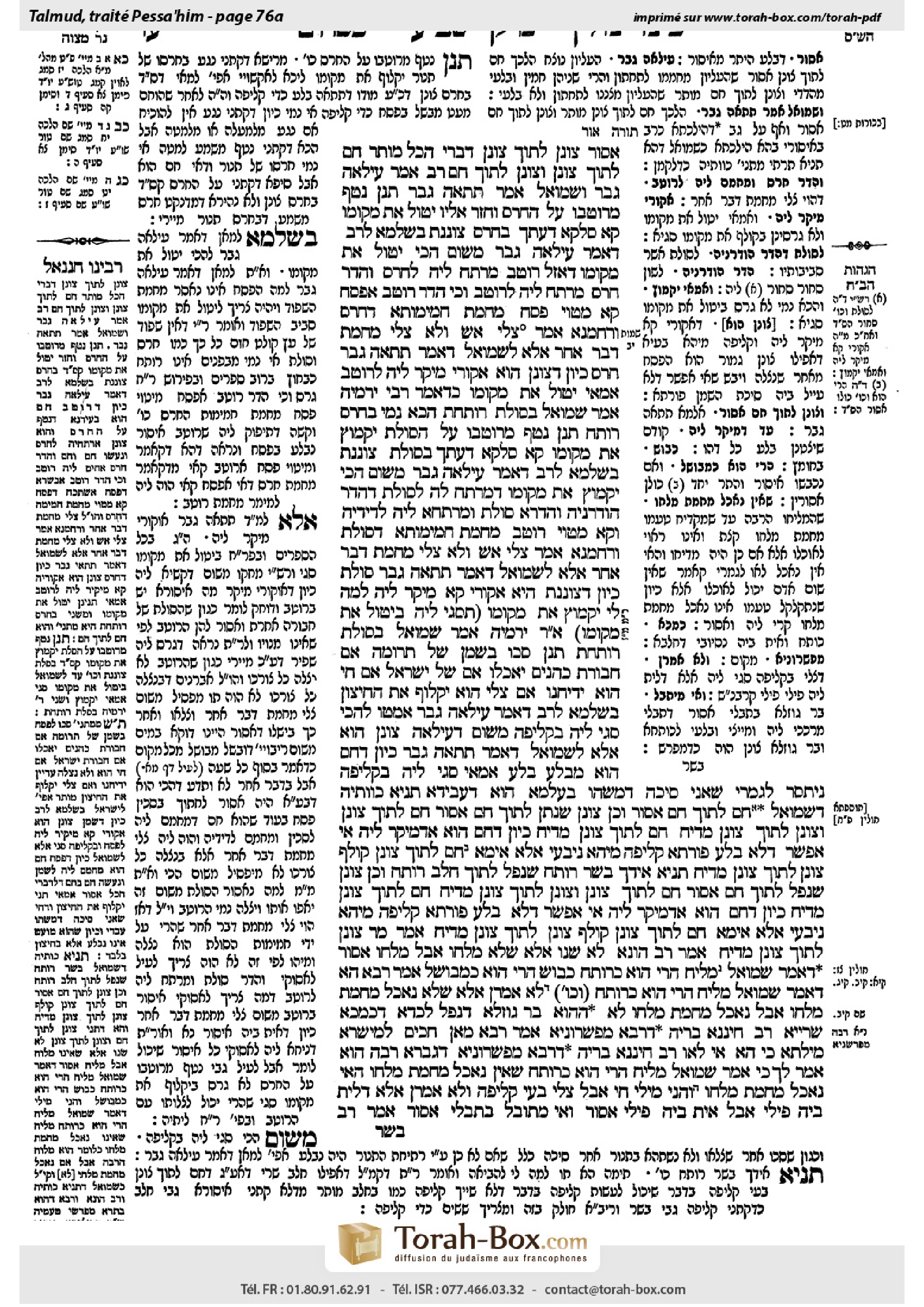
Pesachim 76a: Talmud study for Daf Yomi
Daf Yomi is the daily study of one Talmud folio. Explore 37 tractates with scans, Hebrew text, Sefaria English and AI-generated French translations where annotated.
Passage selection and English or AI-generated French translation are available where the scan has annotations. Daf Study is independent of Torah-Box and Sefaria.
Browse Pesachim · פסחים · All tractatesPesachim 76a text and translations
This page of Pesachim includes the Aramaic text, an English translation and an AI-generated French translation, alongside the scan above.
פסחים ע״ו א · Aramaic and Hebrew text
אָסוּר. צוֹנֵן לְתוֹךְ צוֹנֵן — דִּבְרֵי הַכֹּל מוּתָּר. חַם לְתוֹךְ צוֹנֵן, וְצוֹנֵן לְתוֹךְ חַם, רַב אָמַר: עִילָּאָה גָּבַר. וּשְׁמוּאֵל אָמַר: תַּתָּאָה גָּבַר.
תְּנַן: נָטַף מֵרוֹטְבּוֹ עַל הַחֶרֶס וְחָזַר אֵלָיו — יִטּוֹל אֶת מְקוֹמוֹ. קָא סָלְקָא דַּעְתָּךְ בְּחֶרֶס צוֹנֶנֶת. בִּשְׁלָמָא לְרַב דְּאָמַר ״עִילָּאָה גָּבַר״, מִשּׁוּם הָכִי יִטּוֹל אֶת מְקוֹמוֹ — דְּאָזֵל רוֹטֶב מַרְתַּח לֵיהּ לְחֶרֶס, וְהָדַר חֶרֶס מַרְתַּח לֵיהּ לְרוֹטֶב. וְכִי הָדַר רוֹטֶב אַפֶּסַח — קָא מִטְּוֵי פֶּסַח מֵחֲמַת חַמִּימוּתָא דְחֶרֶס, וְרַחֲמָנָא אָמַר ״צְלִי אֵשׁ״, וְלֹא צָלִי מֵחֲמַת דָּבָר אַחֵר.
אֶלָּא לִשְׁמוּאֵל דְּאָמַר ״תַּתָּאָה גָּבַר״, חֶרֶס כֵּיוָן דְּצוֹנֵן הוּא — אַקּוֹרֵי מֵיקַר לֵיהּ לְרוֹטֶב, אַמַּאי יִטּוֹל אֶת מְקוֹמוֹ? כִּדְאָמַר רַבִּי יִרְמְיָה אָמַר שְׁמוּאֵל: בְּסוֹלֶת רוֹתַחַת, הָכָא נָמֵי בְּחֶרֶס רוֹתֵחַ.
תְּנַן: נָטַף מֵרוֹטְבּוֹ עַל הַסּוֹלֶת יִקְמוֹץ אֶת מְקוֹמוֹ. קָא סָלְקָא דַּעְתָּךְ בְּסוֹלֶת צוֹנֶנֶת. בִּשְׁלָמָא לְרַב דְּאָמַר ״עִילָּאָה גָּבַר״, מִשּׁוּם הָכִי יִקְמוֹץ אֶת מְקוֹמוֹ — דְּמַרְתַּח לַהּ לְסוֹלֶת דְּהָדַר הוּדְרָנֵיהּ, וְהָדְרָא סוֹלֶת וּמַרְתְּחָא לֵיהּ לְדִידֵיהּ, וְקָא מִטְּוֵי רוֹטֶב מֵחֲמַת חַמִּימוּתָא דְסוֹלֶת, וְרַחֲמָנָא אָמַר ״צְלִי אֵשׁ״, וְלֹא צָלִי מֵחֲמַת דָּבָר אַחֵר.
אֶלָּא לִשְׁמוּאֵל דְּאָמַר ״תַּתָּאָה גָּבַר״, סוֹלֶת כֵּיוָן דְּצוֹנֶנֶת הִיא — אַקּוֹרֵי קָא מֵיקַר לֵיהּ, לְמָה לִי יִקְמוֹץ אֶת מְקוֹמוֹ? (תִּסְגֵּי לֵיהּ בְּיִטּוֹל אֶת מְקוֹמוֹ!) אָמַר רַבִּי יִרְמְיָה אָמַר שְׁמוּאֵל: בְּסוֹלֶת רוֹתַחַת.
תְּנַן: סָכוֹ בְּשֶׁמֶן שֶׁל תְּרוּמָה, אִם חֲבוּרַת כֹּהֲנִים — יֹאכֵלוּ. אִם שֶׁל יִשְׂרָאֵל, אִם חַי הוּא — יְדִיחֶנּוּ, אִם צָלִי הוּא — יִקְלוֹף אֶת הַחִיצוֹן. בִּשְׁלָמָא לְרַב דְּאָמַר ״עִילָּאָה גָּבַר״, אַמְּטוּ לְהָכִי סַגִּי לֵיהּ בִּקְלִיפָה, מִשּׁוּם דְּעִילָּאָה צוֹנֵן הוּא.
אֶלָּא לִשְׁמוּאֵל דְּאָמַר ״תַּתָּאָה גָּבַר״, כֵּיוָן דְּחַם הוּא — מִבְלָע בָּלַע, אַמַּאי סַגִּי לֵיהּ בִּקְלִיפָה? נִיתְּסַר לִגְמָרֵי! שָׁאנֵי סִיכָה, דְּמַשֶּׁהוּ בְּעָלְמָא הוּא דַּעֲבִידָא.
תַּנְיָא כְּווֹתֵיהּ דִּשְׁמוּאֵל: חַם לְתוֹךְ חַם — אָסוּר. וְכֵן צוֹנֵן שֶׁנָּתַן לְתוֹךְ חַם — אָסוּר. חַם לְתוֹךְ צוֹנֵן וְצוֹנֵן לְתוֹךְ צוֹנֵן — מֵדִיחַ.
חַם לְתוֹךְ צוֹנֵן מֵדִיחַ — כֵּיוָן דְּחָם הוּא, אַדְּמֵיקַר לֵיהּ — אִי אֶפְשָׁר דְּלָא בָּלַע פּוּרְתָּא, קְלִיפָה מִיהָא נִיבְעֵי! אֶלָּא אֵימָא: חַם לְתוֹךְ צוֹנֵן — קוֹלֵף, צוֹנֵן לְתוֹךְ צוֹנֵן — מֵדִיחַ.
תַּנְיָא אִידַּךְ: בָּשָׂר רוֹתֵחַ שֶׁנָּפַל לְתוֹךְ חָלָב רוֹתֵחַ, וְכֵן צוֹנֵן שֶׁנָּפַל לְתוֹךְ חַם — אָסוּר. חַם לְתוֹךְ צוֹנֵן וְצוֹנֵן לְתוֹךְ צוֹנֵן — מֵדִיחַ. חַם לְתוֹךְ צוֹנֵן מֵדִיחַ — כֵּיוָן דְּחַם הוּא, אַדְּמֵיקַר לֵיהּ — אִי אֶפְשָׁר דְּלָא בָּלַע פּוּרְתָּא, קְלִיפָה מִיהָא נִיבְעֵי! אֶלָּא אֵימָא: חַם לְתוֹךְ צוֹנֵן — קוֹלֵף, צוֹנֵן לְתוֹךְ צוֹנֵן — מֵדִיחַ.
אָמַר מָר: צוֹנֵן לְתוֹךְ צוֹנֵן — מֵדִיחַ. אָמַר רַב הוּנָא: לֹא שָׁנוּ אֶלָּא שֶׁלֹּא מְלָחוֹ, אֲבָל מְלָחוֹ — אָסוּר. דְּאָמַר שְׁמוּאֵל: מָלִיחַ הֲרֵי הוּא כְּרוֹתֵחַ. כָּבוּשׁ הֲרֵי הוּא כִּמְבוּשָּׁל.
אָמַר רָבָא: הָא דְּאָמַר שְׁמוּאֵל מָלִיחַ הֲרֵי הוּא כְּרוֹתֵחַ (וְכוּ׳) — לֹא (אֲמַרַן) [שָׁנוּ] אֶלָּא שֶׁלֹּא נֶאֱכָל מֵחֲמַת מִלְחוֹ, אֲבָל נֶאֱכָל מֵחֲמַת מִלְחוֹ — לֹא.
הָהוּא בַּר גּוֹזָלָא דִּנְפַל לְכַדָּא דְּכַמְכָּא, שַׁרְיֵיא רַב חִינָּנָא בְּרֵיהּ דְּרָבָא מִפַּשְׁרוּנְיָא.
אָמַר רָבָא: מַאן חַכִּים לְמִישְׁרֵא מִילְּתָא כִּי הָא, אִי לָאו רַב חִינָּנָא בְּרֵיהּ דְּרָבָא מִפַּשְׁרוּנְיָא, דְּגַבְרָא רַבָּה הוּא. אָמַר לְךָ, כִּי אָמַר שְׁמוּאֵל מָלִיחַ הֲרֵי הוּא כְּרוֹתֵחַ — שֶׁאֵין נֶאֱכָל מֵחֲמַת מִלְחוֹ, הַאי נֶאֱכָל מֵחֲמַת מִלְחוֹ.
וְהָנֵי מִילֵּי חַי, אֲבָל צָלִי — בָּעֵי קְלִיפָה. וְלָא אֲמַרַן אֶלָּא דְּלֵית בֵּיהּ פִּילֵי, אֲבָל אִית בֵּיהּ פִּילֵי — אָסוּר. וְאִי מְתוּבַּל בְּתַבְלֵי — אָסוּר.
אָמַר רַב:
Pesachim 76a · English translation
that the permitted foods become forbidden, because they absorb some of the forbidden food. If a cold food item falls into another cold item, all agree it is permitted; the food needs only to be rinsed off. The dispute pertains to a hot food item that falls into a cold one or a cold food item that falls into a hot one. Rav said: The upper one prevails. The halakha is determined based upon the state of the upper substance. If the upper food is hot, the case is judged as though a hot food fell into another hot food because the upper food heats the lower food. If the upper food is cold, the case is similar to a situation where a cold food falls into another cold food because the upper food cools down the lower one and prevents absorption. And Shmuel said: The lower one prevails. In his opinion, if the upper substance is hot and the lower one is cold, the permitted food remains permitted; if the lower one is hot and upper one is cold, they are forbidden.
We learned in the mishna: If some of the gravy of the Paschal lamb dripped onto the earthenware and returned to it, one must remove its place. It might enter your mind to say that this is referring to cold earthenware. Granted, according to the opinion of Rav, who said the upper one prevails, it is due to this reason that one must remove its place. According to Rav’s view, the gravy goes and heats the earthenware, and then the earthenware heats the gravy, and when the gravy returns to the Paschal lamb, the Paschal lamb becomes roasted from the heat of the earthenware, and the Merciful One states in the Torah: “Roasted in fire” (Exodus 12:8), and not roasted due to something else.
But according to the opinion of Shmuel, who said the lower one prevails, since the earthenware is cold, it cools down the gravy. In that case, why must he remove its place? The Gemara answers: As Rabbi Yirmeya said that Shmuel said in explanation of the mishna’s next ruling in the case of gravy that dripped onto flour: The mishna is referring to hot flour. Here, too, it is referring to hot earthenware. Since the earthenware is already hot, it is a case of something hot that fell onto something hot, even according to Shmuel.
We also learned in the mishna that if some of the Paschal lamb’s gravy dripped onto flour, one must remove a handful of flour from its place. It could enter your mind to say that this is talking about cold flour. Granted, according to the opinion of Rav, who said the upper one prevails, it is due to this reason that one must remove a handful of flour from its place, as the gravy heats the flour around it, and the flour then heats the gravy, and the gravy is roasted from the heat of the flour, and the Merciful One states in the Torah: “Roasted in fire,” and not roasted due to something else.
But according to the opinion of Shmuel, who said the lower one prevails, since the flour is cold it cools down the gravy. In that case, why do I need to say: One must remove a handful of flour from its place? It should be enough for one to remove a small amount from its place, and it should not be necessary to take anything more. With regard to this Rabbi Yirmeya said that Shmuel said: The mishna is referring to hot flour. The gravy is therefore roasted from the heat of the flour, and an entire handful of flour must be removed.
We learned in the mishna: In a case where one smears the Paschal lamb with teruma oil, if the Paschal lamb belongs to a group of priests they may eat it, as they are permitted to eat teruma. If it belongs to a group of Israelites, then if the Paschal lamb is still raw, one must rinse it in order to remove the teruma oil; and if it is roasted, one must peel off the outer layer. Granted, according to Rav, who said the upper one prevails, for this reason it is sufficient to remove only the outer peel, because the upper one is cold and therefore the oil is not absorbed deeply into the meat.
But according to Shmuel, who said: The lower one prevails, since the meat, which is on the bottom, is hot, it absorbs the oil. In that case, why is it enough for it to be permitted when only the outer peel is removed? It should be entirely forbidden. The Gemara answers: Smearing is different because it is done with only a minute amount. Since one smears only a little bit of oil, there is not enough oil to render the entire offering forbidden.
It was taught in a baraita in accordance with the opinion of Shmuel: If hot permitted food falls into hot forbidden food, it is forbidden. And, so too, cold permitted food that one put into hot forbidden food is forbidden. If hot food falls into cold food, and similarly, if cold food falls into cold food, one must rinse the permitted food, and it remains permitted.
The Gemara asks: Is it true that if hot permitted food falls into cold forbidden food, one must rinse the permitted food and it remains permitted? Since it is hot, until the bottom food cools it, it is impossible that it will not absorb a little of the forbidden food. Therefore, it should at least require the removal of the outer peel; rinsing it should not be sufficient. Rather, say the following corrected version: If hot food falls into cold food, one must peel off the outer layer; if cold food falls into cold food, one must rinse it off and that is sufficient.
It was taught in another baraita: Hot meat that fell into hot milk, and so too, cold meat that fell into hot milk, is prohibited. If hot meat falls into cold milk and similarly, if cold meat falls into cold milk, one must rinse it off and that is sufficient. The Gemara asks: Is it true that if hot meat falls into cold milk, one must rinse it off and that is sufficient? Since it is hot, until the bottom food cools it, it is impossible that it will not absorb a little of the milk. Therefore, it should at least require the removal of the outer peel. Rather, say the following corrected version: If hot meat falls into cold milk, one must peel off the outer layer; if cold meat falls into cold milk, one must rinse it off and that is sufficient.
The Master said in the baraita quoted above: If cold meat falls into cold milk or into a prohibited food, one must rinse it off and that is sufficient. Rav Huna said: They taught this halakha only in a case where he did not salt either of the food items. However, if he salted one of them it is forbidden, as Shmuel said: A salted food item is considered like a boiling food item with regard to its ability to transmit flavor. Additionally, a food item marinated in vinegar, brine, or the like is considered like a cooked food item, as it absorbs flavor from the liquid in which it is marinated or from other foods with which it is marinated.
Rava said: With regard to that which Shmuel said, that a salted food is like a boiling food, we said it only with regard to something salted to the point that it is not typically eaten due to its salt. But if the food is still eaten due to its salt, i.e., despite its having been salted, then it is not considered like something that is boiling, and it does not transmit flavor.
There was a particular young bird that fell into a jug of kamka, also known as kutaḥ, a food item that contains milk. There was a question whether the food is considered a forbidden mixture of meat and milk. Rav Ḥinnana, son of Rava of the city of Pashronya, permitted it.
Rava said about this: Who is wise enough to permit something as complicated as this, if not Rav Ḥinnana, son of Rava of Pashronya, as he is a great man and can recognize the reason for leniency even in a case that appears to be prohibited? He could have said to you in explanation of his lenient ruling: When Shmuel said that a salted food item is like a boiling food item, that halakha concerned a food that was salted to the point that it is not eaten due to its salt, but this kutaḥ is still eaten due to, i.e., despite, its salt. Therefore, the case is comparable to a cold food that falls into another cold food, which is permitted after it is rinsed.
The Gemara points out that this applies only if the bird is raw; but if it is roasted, it requires the removal of the outer peel. The roasting softens the meat, enabling it to absorb flavor more easily. And we said that the bird is permitted only when it does not have cracks; but if it has cracks, it is forbidden because the milk is absorbed into the cracks. And if it has been flavored with spices it is forbidden because the spices soften the meat, causing it to be absorbent.
Rav said:
Pesachim 76a · Traduction française (IA)
de sorte que les aliments permis deviennent interdits, car ils absorbent une partie de l’aliment interdit. Si un aliment froid tombe dans un autre aliment froid, tous conviennent qu’il est permis ; il suffit de rincer l’aliment. La controverse porte sur le cas d’un aliment chaud qui tombe dans un aliment froid ou d’un aliment froid qui tombe dans un aliment chaud. Rav a dit : C’est l’élément supérieur qui l’emporte. La halakha est déterminée par l’état de l’élément supérieur. Si l’aliment supérieur est chaud, le cas est considéré comme celui d’un aliment chaud tombé dans un autre aliment chaud, car l’aliment supérieur réchauffe l’inférieur. Si l’aliment supérieur est froid, le cas est comparable à celui d’un aliment froid tombé dans un autre aliment froid, car l’aliment supérieur refroidit l’inférieur et l’empêche d’absorber. Et Chmouel a dit : C’est l’élément inférieur qui l’emporte. Selon lui, si l’élément supérieur est chaud et l’inférieur froid, l’aliment permis reste permis ; si l’élément inférieur est chaud et le supérieur froid, ils sont interdits.
Nous avons appris dans la Michna : Si un peu du jus de l’agneau pascal a coulé sur la poterie puis y est retourné, il faut retirer la partie concernée. On pourrait penser qu’il s’agit d’une poterie froide. Certes, selon l’opinion de Rav, qui a dit que c’est l’élément supérieur qui l’emporte, c’est pour cette raison qu’il faut retirer la partie concernée. Selon Rav, le jus réchauffe la poterie, puis la poterie réchauffe le jus ; lorsque le jus retourne sur l’agneau pascal, celui-ci est alors rôti par la chaleur de la poterie. Or le Miséricordieux dit dans la Torah : « Rôti au feu » (Exode 12, 8), et non rôti par autre chose.
Mais selon l’opinion de Chmouel, qui a dit que c’est l’élément inférieur qui l’emporte, puisque la poterie est froide, elle refroidit le jus. Dans ce cas, pourquoi faut-il retirer la partie concernée ? La Guemara répond : Comme Rabbi Yirmeya l’a dit au nom de Chmouel pour expliquer la règle suivante de la Michna, au sujet du jus qui a coulé sur de la farine : la Michna parle de farine chaude. Ici aussi, elle parle de poterie chaude. Puisque la poterie est déjà chaude, il s’agit d’un aliment chaud tombé sur un aliment chaud, même selon Chmouel.
Nous avons également appris dans la Michna que si un peu du jus de l’agneau pascal a coulé sur de la farine, il faut retirer une poignée de farine à l’endroit concerné. On pourrait penser qu’il s’agit de farine froide. Certes, selon l’opinion de Rav, qui a dit que c’est l’élément supérieur qui l’emporte, c’est pour cette raison qu’il faut retirer une poignée de farine à l’endroit concerné : le jus réchauffe la farine autour de lui, puis la farine réchauffe le jus, qui est alors rôti par la chaleur de la farine. Or le Miséricordieux dit dans la Torah : « Rôti au feu », et non rôti par autre chose.
Mais selon l’opinion de Chmouel, qui a dit que c’est l’élément inférieur qui l’emporte, puisque la farine est froide, elle refroidit le jus. Dans ce cas, pourquoi la Michna précise-t-elle qu’il faut retirer une poignée de farine à l’endroit concerné ? Il devrait suffire d’en retirer une petite quantité à cet endroit, sans qu’il soit nécessaire d’en prendre davantage. À ce sujet, Rabbi Yirmeya a dit au nom de Chmouel : La Michna parle de farine chaude. Le jus est donc rôti par la chaleur de la farine, et il faut retirer une poignée entière de farine.
Nous avons appris dans la Michna : Si l’on enduit l’agneau pascal d’huile de terouma, les membres d’un groupe de prêtres peuvent le manger, car ils ont le droit de consommer la terouma. S’il appartient à un groupe d’Israélites, alors, s’il est encore cru, il faut le rincer afin d’enlever l’huile de terouma ; s’il est rôti, il faut en retirer la couche extérieure. Certes, selon Rav, qui a dit que c’est l’élément supérieur qui l’emporte, il suffit pour cette raison d’enlever seulement la couche extérieure, car l’élément supérieur est froid et l’huile ne pénètre donc pas profondément dans la viande.
Mais selon Chmouel, qui a dit que c’est l’élément inférieur qui l’emporte, puisque la viande, qui se trouve en dessous, est chaude, elle absorbe l’huile. Dans ce cas, pourquoi suffit-il d’enlever seulement la couche extérieure pour rendre l’agneau permis ? Il devrait être entièrement interdit. La Guemara répond : L’application d’huile est un cas différent, car elle se fait avec une quantité infime. Puisqu’on n’enduit l’agneau que d’un peu d’huile, il n’y en a pas assez pour rendre toute l’offrande interdite.
Il a été enseigné dans une baraïta conformément à l’opinion de Chmouel : Si un aliment permis chaud tombe dans un aliment interdit chaud, il est interdit. De même, un aliment permis froid que l’on met dans un aliment interdit chaud est interdit. Si un aliment chaud tombe dans un aliment froid, et de même si un aliment froid tombe dans un aliment froid, il faut rincer l’aliment permis, qui reste alors permis.
La Guemara demande : Est-il vrai que si un aliment permis chaud tombe dans un aliment interdit froid, il suffit de rincer l’aliment permis et qu’il reste permis ? Puisqu’il est chaud, il est impossible qu’il n’absorbe pas un peu de l’aliment interdit avant que l’élément inférieur ne le refroidisse. Il devrait donc au moins falloir en retirer la couche extérieure ; le rinçage ne devrait pas suffire. Il faut plutôt corriger ainsi : Si un aliment chaud tombe dans un aliment froid, il faut en retirer la couche extérieure ; si un aliment froid tombe dans un aliment froid, il faut le rincer, et cela suffit.
Il a été enseigné dans une autre baraïta : De la viande chaude tombée dans du lait chaud, et de même de la viande froide tombée dans du lait chaud, sont interdites. Si de la viande chaude tombe dans du lait froid, et de même si de la viande froide tombe dans du lait froid, il faut la rincer, et cela suffit. La Guemara demande : Est-il vrai que si de la viande chaude tombe dans du lait froid, il suffit de la rincer ? Puisqu’elle est chaude, il est impossible qu’elle n’absorbe pas un peu de lait avant que l’élément inférieur ne la refroidisse. Il devrait donc au moins falloir en retirer la couche extérieure. Il faut plutôt corriger ainsi : Si de la viande chaude tombe dans du lait froid, il faut en retirer la couche extérieure ; si de la viande froide tombe dans du lait froid, il faut la rincer, et cela suffit.
Le Maître a dit dans la baraïta citée plus haut : Si de la viande froide tombe dans du lait froid ou dans un aliment interdit, il faut la rincer, et cela suffit. Rav Houna a dit : Ils n’ont enseigné cette halakha que dans le cas où aucun des deux aliments n’a été salé. Mais si l’un d’eux a été salé, il est interdit, car Chmouel a dit : Un aliment salé est considéré comme un aliment bouillant quant à sa capacité à transmettre sa saveur. De plus, un aliment mariné dans du vinaigre, de la saumure ou un liquide semblable est considéré comme un aliment cuit, car il absorbe la saveur du liquide dans lequel il marine ou des autres aliments avec lesquels il marine.
Rava a dit : En ce qui concerne ce que Chmouel a dit, à savoir qu’un aliment salé est comme un aliment bouillant, cela ne s’applique qu’à un aliment salé au point qu’on ne le mange habituellement pas en raison de son sel. Mais si l’aliment reste consommable malgré le sel, c’est-à-dire qu’on le mange bien qu’il ait été salé, il n’est pas considéré comme un aliment bouillant et ne transmet pas sa saveur.
Un jeune oiseau tomba dans une cruche de kamka, également appelé kutaḥ, un aliment contenant du lait. La question se posa de savoir si ce mélange était interdit comme mélange de viande et de lait. Rav Ḥinnana, fils de Rava, de la ville de Pashronya, le déclara permis.
Rava dit à ce sujet : Qui serait assez sage pour permettre une chose aussi complexe, sinon Rav Ḥinnana, fils de Rava de Pashronya ? C’est un grand homme, capable de discerner la raison qui justifie une décision indulgente même dans un cas qui semble interdit. Il aurait pu te dire, pour expliquer sa décision indulgente : Lorsque Chmouel a dit qu’un aliment salé est comme un aliment bouillant, il parlait d’un aliment salé au point qu’on ne le mange pas en raison de son sel ; mais ce kutaḥ reste consommable malgré son sel. Le cas est donc comparable à celui d’un aliment froid tombé dans un autre aliment froid, qui est permis après rinçage.
La Guemara précise que cela ne s’applique que si l’oiseau est cru ; mais s’il est rôti, il faut en retirer la couche extérieure. La cuisson attendrit la viande et lui permet d’absorber plus facilement les saveurs. Et nous avons dit que l’oiseau n’est permis que s’il ne présente pas de fissures ; mais s’il en présente, il est interdit, car le lait pénètre dans les fissures. Et s’il a été assaisonné d’épices, il est interdit, car les épices attendrissent la viande, ce qui la rend plus absorbante.
Rav a dit :
Traduction française générée par IA à partir de l’édition anglaise de Sefaria. Vérifie toujours un passage avec le texte source.
Text from Sefaria: William Davidson Edition - Vocalized Aramaic (CC BY NC); William Davidson Edition - English (CC BY NC).