Pesachim 76b: Talmud study for Daf Yomi
Daf Yomi is the daily study of one Talmud folio. Explore 37 tractates with scans, Hebrew text, Sefaria English and AI-generated French translations where annotated.
Passage selection and English or AI-generated French translation are available where the scan has annotations. Daf Study is independent of Torah-Box and Sefaria.
Browse Pesachim · פסחים · All tractatesPesachim 76b text and translations
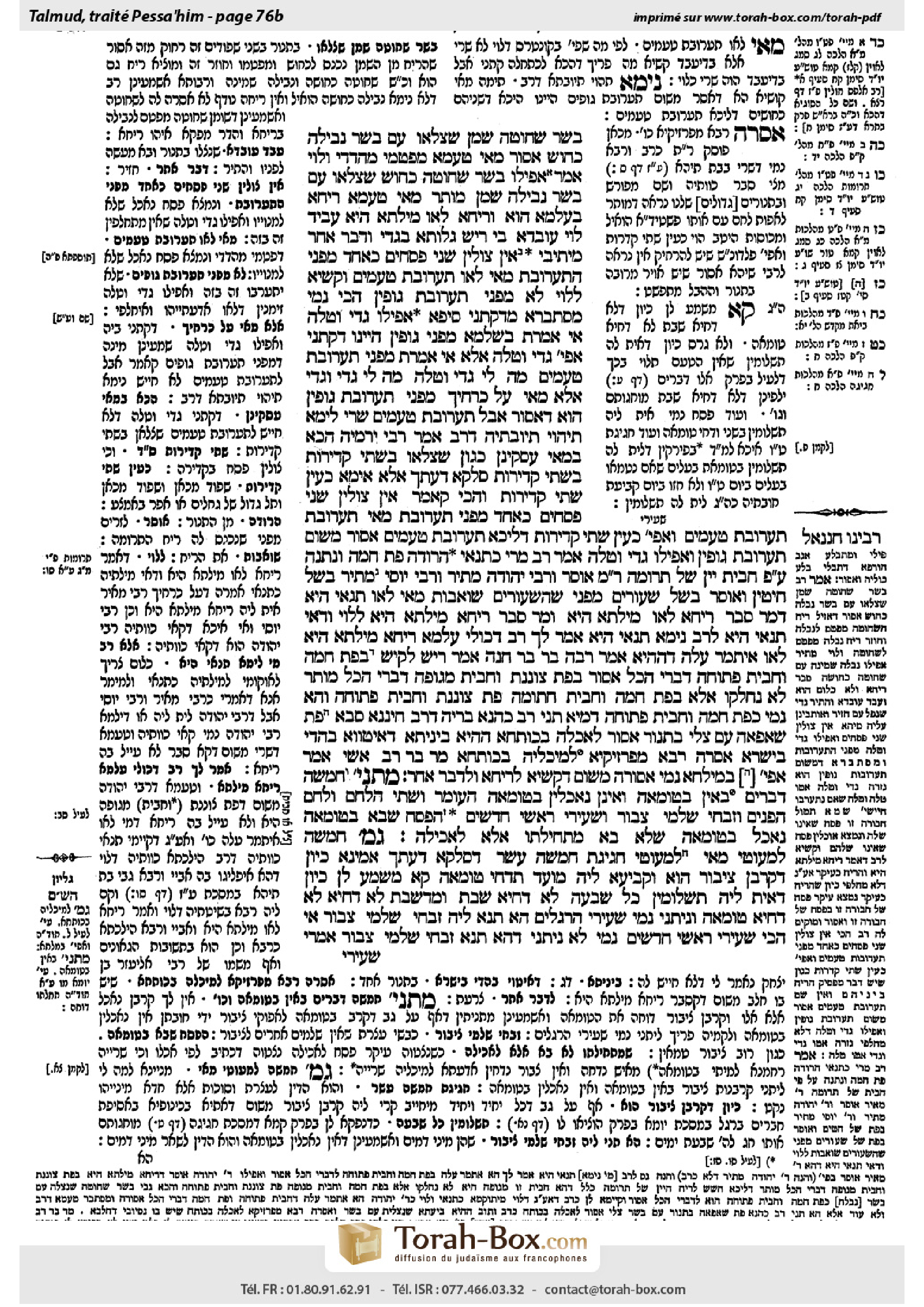
This page of Pesachim includes the Aramaic text, an English translation and an AI-generated French translation, alongside the scan above.
פסחים ע״ו ב · Aramaic and Hebrew text
בְּשַׂר שְׁחוּטָה שָׁמֵן, שֶׁצְּלָאוֹ עִם בְּשַׂר נְבֵילָה כָּחוּשׁ — אָסוּר. מַאי טַעְמָא — מִפַּטְּמִי מֵהֲדָדֵי.
וְלֵוִי אָמַר: אֲפִילּוּ בְּשַׂר שְׁחוּטָה כָּחוּשׁ, שֶׁצְּלָאוֹ עִם בְּשַׂר נְבֵילָה שָׁמֵן — מוּתָּר. מַאי טַעְמָא — רֵיחָא בְּעָלְמָא הוּא, וְרֵיחָא לָאו מִילְּתָא הִיא. עָבֵיד לֵוִי עוֹבָדָא בֵּי רֵישׁ גָּלוּתָא בִּגְדִי וְדָבָר אַחֵר.
מֵיתִיבִי: אֵין צוֹלִין שְׁנֵי פְסָחִים כְּאֶחָד מִפְּנֵי הַתַּעֲרוֹבֶת. מַאי לָאו — תַּעֲרוֹבֶת טְעָמִים, וְקַשְׁיָא לְלֵוִי! לָא, מִפְּנֵי תַּעֲרוֹבֶת גּוּפִין.
הָכִי נָמֵי מִסְתַּבְּרָא, מִדְּקָתָנֵי סֵיפָא: אֲפִילּוּ גְּדִי וְטָלֶה. אִי אָמְרַתְּ בִּשְׁלָמָא מִפְּנֵי גּוּפִין — הַיְינוּ דְּקָתָנֵי אֲפִילּוּ גְּדִי וְטָלֶה. אֶלָּא אִי אָמְרַתְּ מִפְּנֵי תַּעֲרוֹבֶת טְעָמִים, מָה לִי גְּדִי וְטָלֶה מָה לִי גְּדִי וּגְדִי.
אֶלָּא מַאי, עַל כׇּרְחָיךְ מִפְּנֵי תַּעֲרוֹבֶת גּוּפִין הוּא דְּאָסוּר, אֲבָל תַּעֲרוֹבֶת טְעָמִים — שְׁרֵי, לֵימָא תֶּיהְוֵי תְּיוּבְתֵּיהּ דְּרַב! אָמַר רַבִּי יִרְמְיָה: הָכָא בְּמַאי עָסְקִינַן, כְּגוֹן שֶׁצְּלָאוֹ בִּשְׁתֵּי קְדֵירוֹת.
בִּשְׁתֵּי קְדֵירוֹת סָלְקָא דַּעְתָּךְ?! אֶלָּא אֵימָא: כְּעֵין שְׁתֵּי קְדֵירוֹת. וְהָכִי קָאָמַר: אֵין צוֹלִין שְׁנֵי פְסָחִים כְּאֶחָד מִפְּנֵי תַּעֲרוֹבֶת. מַאי תַּעֲרוֹבֶת — תַּעֲרוֹבֶת טְעָמִים. וַאֲפִילּוּ כְּעֵין שְׁתֵּי קְדֵירוֹת, דְּלֵיכָּא תַּעֲרוֹבֶת טְעָמִים — אָסוּר מִשּׁוּם תַּעֲרוֹבֶת גּוּפִין, וַאֲפִילּוּ גְּדִי וְטָלֶה.
אָמַר רַב מָרִי כְּתַנָּאֵי. הָרוֹדֶה פַּת חַמָּה וּנְתָנָהּ עַל פִּי חָבִית יַיִן שֶׁל תְּרוּמָה — רַבִּי מֵאִיר אוֹסֵר, וְרַבִּי יְהוּדָה מַתִּיר. וְרַבִּי יוֹסֵי מַתִּיר בְּשֶׁל חִיטִּין וְאוֹסֵר בְּשֶׁל שְׂעוֹרִים, מִפְּנֵי שֶׁהַשְּׂעוֹרִים שׁוֹאֲבוֹת. מַאי לָאו תַּנָּאֵי הִיא, דְּמָר סָבַר: רֵיחָא — לָאו מִילְּתָא הִיא, וּמָר סָבַר: רֵיחָא — מִילְּתָא הִיא.
לְלֵוִי, וַדַּאי תַּנָּאֵי הִיא. לְרַב, נֵימָא תַּנָּאֵי הִיא?
אָמַר לְךָ רַב: דְּכוּלֵּי עָלְמָא רֵיחָא מִילְּתָא הִיא, לָאו אִיתְּמַר עֲלַהּ דְּהַהִיא, אָמַר רַבָּה בַּר בַּר חָנָה אָמַר רֵישׁ לָקִישׁ: בְּפַת חַמָּה וְחָבִית פְּתוּחָה — דִּבְרֵי הַכֹּל אָסוּר. בְּפַת צוֹנֶנֶת וְחָבִית מְגוּפָה — דִּבְרֵי הַכֹּל מוּתָּר. לֹא נֶחְלְקוּ אֶלָּא בְּפַת חַמָּה וְחָבִית חֲתוּמָה, פַּת צוֹנֶנֶת וְחָבִית פְּתוּחָה. וְהָא נָמֵי כְּפַת חַמָּה וְחָבִית פְּתוּחָה דָּמְיָא.
תָּנֵי רַב כָּהֲנָא בְּרֵיהּ דְּרַב חִינָּנָא סָבָא: פַּת שֶׁאֲפָאָהּ עִם צָלִי בַּתַּנּוּר — אָסוּר לְאׇכְלָהּ בְּכוּתָּחָא. הָהִיא בִּינִיתָא דְּאִיטְּווֹא בַּהֲדֵי בִּישְׂרָא, אַסְרַהּ רָבָא מִפַּרְזִיקְיָא לְמֵיכְלַיהּ בְּכוּתָּחָא. מָר בַּר רַב אָשֵׁי אָמַר: אֲפִילּוּ בְּמִילְחָא נָמֵי אֲסוּרָה, מִשּׁוּם דְּקַשְׁיָא לְרֵיחָא וּלְדָבָר אַחֵר.
מַתְנִי׳ חֲמִשָּׁה דְּבָרִים בָּאִין בְּטוּמְאָה, וְאֵינָן נֶאֱכָלִין בְּטוּמְאָה: הָעוֹמֶר, וּשְׁתֵּי הַלֶּחֶם, וְלֶחֶם הַפָּנִים, וְזִבְחֵי שַׁלְמֵי צִבּוּר, וּשְׂעִירֵי רָאשֵׁי חֳדָשִׁים. הַפֶּסַח שֶׁבָּא בְּטוּמְאָה נֶאֱכָל בְּטוּמְאָה, שֶׁלֹּא בָּא מִתְּחִילָּתוֹ אֶלָּא לַאֲכִילָה.
גְּמָ׳ חֲמִשָּׁה. לְמַעוֹטֵי מַאי? לְמַעוֹטֵי חֲגִיגַת חֲמִשָּׁה עָשָׂר.
דְּסָלְקָא דַּעְתָּךְ אָמֵינָא: כֵּיוָן דְּקׇרְבַּן צִיבּוּר הוּא, וּקְבִיעָא לֵיהּ מוֹעֵד — תִּדְחֵי טוּמְאָה, קָא מַשְׁמַע לַן: כֵּיוָן דְּאִית לֵיהּ תַּשְׁלוּמִין כׇּל שִׁבְעָה — לָא דָּחֲיָא שַׁבָּת, וּמִדְּשַׁבָּת לָא דָּחֲיָא — לָא דָּחֲיָא טוּמְאָה.
וְנִיתְנֵי נָמֵי שְׂעִירֵי הָרְגָלִים! הָא תְּנָא לֵיהּ זִבְחֵי שַׁלְמֵי צִבּוּר. אִי הָכִי, שְׂעִירֵי רָאשֵׁי חֳדָשִׁים נָמֵי לָא נִיתְנֵי, דְּהָא תְּנָא זִבְחֵי שַׁלְמֵי צִבּוּר! אָמְרִי:
Pesachim 76b · English translation
Fatty kosher meat that one roasted in an oven together with lean non-kosher meat is forbidden, even if the two meats never came into contact with one another. What is the reason for this halakha? It is that they are flavored from one another. The fatty meat emits an aroma that is absorbed in the non-kosher meat. The aroma is then transferred back to the kosher meat, causing the kosher meat to absorb some aroma from the non-kosher meat.
And Levi said: That aroma does not cause meat to be forbidden. Even lean kosher meat that one roasted with fatty non-kosher meat is permitted. What is the reason for this halakha? Although the non-kosher meat emits an aroma that is absorbed into the kosher meat, it is merely an aroma, and an aroma is nothing significant. The Gemara relates that Levi took action, meaning that he put his opinion into practice, in the house of the Exilarch with a kid and something else, i.e., a pig, that had been roasted together. Levi did not prohibit the meat of the kid due to the aroma of the pig.
The Gemara raises an objection: One may not roast two Paschal lambs together due to the mixing. What, is it not prohibited due to the mixing of flavors, i.e., due to the aromas that waft from one to the other, and it poses a difficulty to the opinion of Levi? The Gemara rejects this challenge: No, it is prohibited due to the mixing of carcasses. The groups who are roasting their Paschal offerings might accidentally switch offerings, in which case the offerings will be eaten by people who did not register for them.
The Gemara adds: So too, one can conclude that this explanation is reasonable from the fact that it is taught in the latter clause that the ruling applies even if the two offerings are a kid and a lamb. Granted, if you say that the reason is due to the mixing of carcasses, this is why it was taught that the halakha applies to even a kid and a lamb. The baraita needed to teach that although they do not look alike, there is still a concern that after they have been skinned they will be mixed up. But if you say that the reason is due to the mixing of flavors, what is the difference between a case in which the two offerings are a kid and a lamb and one in which they are a kid and another kid? The case of the kid and the lamb mentioned at the end of the baraita would not teach anything new.
The Gemara asks: Rather, what do you say? Perforce, it is due to the mixing of carcasses that it is prohibited, but a mixing of flavors is permitted. Let us say that this will be a refutation of the opinion of Rav, who prohibited the mixing of flavors by means of an aroma. Rabbi Yirmeya said: With what are we dealing here? It is a case where one roasted the offerings in two pots. Consequently, they do not absorb flavor from one another.
The Gemara expresses surprise: Could it enter your mind to say that they roasted the Paschal offerings in two pots? It is prohibited to the roast the Paschal offering in a pot. Rather, say that they were roasted in a manner similar to two pots, meaning that they were distanced from each other and separated by a partition. And this is what the baraita is saying: One may not roast two Paschal offerings together due to mixing. What is this mixing? It is the mixing of flavors. And even roasting them in a manner similar to two pots, where there is no mixing of flavors, is also prohibited, due to the concern with regard to the mixing of carcasses. And this is the halakha even if the animals are a kid and a lamb.
Rav Mari said: This is like the following dispute between tanna’im: In the case of one who removes hot bread from an oven and places it on top of a barrel of wine that is teruma, Rabbi Meir prohibits a non-priest from eating the bread. In his opinion, the bread absorbs the aroma of the teruma wine and therefore attains the status of teruma. And Rabbi Yehuda permits it. And Rabbi Yosei permits bread made of wheat, which is not very absorbent, but prohibits bread made of barley, because barley draws out and absorbs the aroma. What, is it not a dispute between tanna’im? One Sage, Rabbi Yehuda, holds that an aroma is nothing significant, and one Sage, Rabbi Meir, holds that an aroma is something significant.
The Gemara says: According to the opinion of Levi, i.e., that aroma is insignificant, it certainly is a dispute between tanna’im. Rabbi Meir and Rabbi Yosei hold that it is significant, and Levi accepts the opinion of Rabbi Yehuda that aroma is insignificant. However, according to the opinion of Rav, shall we say it is a dispute between tanna’im?
Rav could have said to you: Everyone agrees that aroma is something significant. The dispute is about whether bread absorbs aroma in the circumstance under discussion. Was it not stated with regard to that mishna that Rabba bar bar Ḥana said that Reish Lakish said: With regard to hot bread and an open barrel, everyone agrees that it is prohibited because it certainly draws out the aroma; and with regard to cold bread and a closed barrel, everyone agrees it is permitted? They disagreed only with regard to hot bread and a sealed barrel because perhaps the bread nonetheless draws out aroma through the cracks. Similarly, they disputed the case of cold bread and an open barrel. And this case of two Paschal offerings roasted in the same oven is also considered like the case of hot bread and an open barrel.
Rav Kahana, son of Rav Ḥinnana the Elder, teaches: In the case of bread that one baked together with roasting meat in the oven, it is prohibited to eat the bread with kutaḥ, which contains milk, because the bread absorbs some of the meat’s aroma. The Gemara relates: There was a certain fish that was roasted together with meat, Rava of Parzikiyya prohibited it from being eaten with kutaḥ, due to the meat flavor absorbed in the fish. Mar bar Rav Ashi said: Even to merely eat it with salt is also prohibited because meat that is roasted or cooked with fish is bad for odor, meaning it causes bad breath, and for something else, i.e., leprosy. Therefore, one should avoid eating it due to the danger involved.
MISHNA: Five items, i.e., offerings, may be brought in a state of ritual impurity, but they may not be eaten in a state of ritual impurity. They are all communal offerings: The omer, which is brought in Nisan; the two loaves brought on Shavuot; the shewbread, which were arranged each week; the communal peace-offerings, which were brought on Shavuot; and the goats sacrificed on the New Moons, which were sin-offerings eaten by the priests. However, the Paschal lamb that is sacrificed in impurity is eaten even in impurity, as it is brought to begin with only for eating, which is the essence of the mitzva. With regard to other offerings, the essence of their mitzva is fulfilled when they are sacrificed on the altar, and the eating is non-essential.
GEMARA: The mishna mentions the number five. The Gemara asks: To exclude what does the mishna emphasize this number? The Gemara answers: It is to exclude the Festival peace-offering of the fifteenth of Nisan, which is a Festival peace-offering brought on the Festival itself and which may not be sacrificed in a state of ritual impurity.
It could enter your mind to say: Since it is a communal offering, as each individual sacrifices it on the Festival in a public setting, and its time is set, as it cannot be brought every day, it should override ritual impurity like the other communal offerings that have a set time. Therefore, the mishna teaches us: Since there is redress all seven days of the Festival if the offering was not brought on the fifteenth, it does not override Shabbat. And since it does not override Shabbat, it does not override ritual impurity. Therefore, this offering may not be brought in a state of ritual impurity.
The Gemara asks: Let it also teach that the goats brought as sin-offerings on the Festivals override ritual impurity. The Gemara answers: It did teach that, as the goats are included in the category of communal peace-offerings. The Gemara asks: If so, it should also not be necessary to teach separately that the goats sacrificed on the New Moons are brought in a state of ritual impurity, as it already taught the halakha with regard to the communal peace-offerings. Say in answer to this question:
Pesachim 76b · Traduction française (IA)
De la viande grasse cachère rôtie au four avec de la viande maigre non cachère est interdite, même si les deux viandes n’ont jamais été en contact l’une avec l’autre. Quelle est la raison de cette halakha ? Les viandes se transmettent mutuellement leur goût. La viande grasse dégage un arôme qui est absorbé par la viande non cachère. Cet arôme est ensuite retransmis à la viande cachère, qui absorbe ainsi une partie de l’arôme de la viande non cachère.
Et Lévi dit : Cet arôme ne rend pas la viande interdite. Même de la viande maigre cachère rôtie avec de la viande grasse non cachère est permise. Quelle est la raison de cette halakha ? Bien que la viande non cachère dégage un arôme qui est absorbé par la viande cachère, ce n’est qu’un arôme, et un arôme est négligeable. La Guemara rapporte que Lévi mit son opinion en pratique dans la maison de l’Exilarque, avec un chevreau et autre chose, c’est-à-dire un porc, rôtis ensemble. Lévi n’interdit pas la viande du chevreau à cause de l’arôme du porc.
La Guemara soulève une objection : On ne peut pas faire rôtir ensemble deux agneaux pascals, en raison du mélange. N’est-ce pas interdit à cause du mélange des saveurs, c’est-à-dire des arômes qui passent de l’un à l’autre, ce qui met en difficulté l’opinion de Lévi ? La Guemara rejette cette objection : Non, c’est interdit en raison du mélange des carcasses. Les groupes qui font rôtir leurs offrandes pascales risqueraient de les intervertir par inadvertance ; les offrandes seraient alors mangées par des personnes qui ne s’étaient pas inscrites pour elles.
La Guemara ajoute : On peut également conclure que cette explication est raisonnable du fait que la clause finale enseigne que la règle s’applique même lorsque les deux offrandes sont un chevreau et un agneau. En effet, si tu dis que la raison tient au mélange des carcasses, c’est pourquoi il est enseigné que la halakha s’applique même à un chevreau et à un agneau. La baraïta devait enseigner que, bien qu’ils ne se ressemblent pas, on peut tout de même craindre qu’ils soient confondus après avoir été dépouillés. Mais si tu dis que la raison tient au mélange des saveurs, quelle différence y a-t-il entre le cas d’un chevreau et d’un agneau et celui d’un chevreau et d’un autre chevreau ? Le cas du chevreau et de l’agneau mentionné à la fin de la baraïta n’enseignerait rien de nouveau.
La Guemara demande : Alors, que dis-tu ? Il faut nécessairement que l’interdit soit dû au mélange des carcasses, tandis que le mélange des saveurs est permis. Faut-il donc en conclure que cela réfute l’opinion de Rav, qui interdit le mélange des saveurs par l’intermédiaire d’un arôme ? Rabbi Yirmeya dit : De quoi parlons-nous ici ? D’un cas où l’on a fait rôtir les offrandes dans deux marmites. Par conséquent, elles n’absorbent pas le goût l’une de l’autre.
La Guemara s’étonne : Peut-on imaginer qu’ils aient fait rôtir les offrandes pascales dans deux marmites ? Il est interdit de faire rôtir l’offrande pascale dans une marmite. Dis plutôt qu’elles ont été rôties comme si elles se trouvaient dans deux marmites, c’est-à-dire éloignées l’une de l’autre et séparées par une cloison. Voici ce que dit la baraïta : On ne peut pas faire rôtir ensemble deux offrandes pascales, en raison du mélange. De quel mélange s’agit-il ? Du mélange des saveurs. Même les faire rôtir comme si elles se trouvaient dans deux marmites, sans mélange des saveurs, est également interdit, par crainte du mélange des carcasses. Et cela vaut même si les animaux sont un chevreau et un agneau.
Rav Mari dit : Cela correspond à la controverse suivante entre tannaïm. Si quelqu’un sort du pain chaud d’un four et le pose sur un tonneau de vin de terouma, Rabbi Meïr interdit à un non-prêtre de manger ce pain. Selon lui, le pain absorbe l’arôme du vin de terouma et acquiert donc le statut de terouma. Rabbi Yehouda, lui, le permet. Rabbi Yossi permet le pain de blé, qui est peu absorbant, mais interdit le pain d’orge, car l’orge attire et absorbe l’arôme. N’est-ce pas une controverse entre tannaïm ? Un Sage, Rabbi Yehouda, estime qu’un arôme est négligeable, tandis qu’un autre Sage, Rabbi Meïr, estime qu’un arôme a de l’importance.
La Guemara dit : Selon l’opinion de Lévi, à savoir qu’un arôme est négligeable, il s’agit certainement d’une controverse entre tannaïm. Rabbi Meïr et Rabbi Yossi estiment qu’un arôme a de l’importance, et Lévi accepte l’opinion de Rabbi Yehouda, selon laquelle un arôme est négligeable. Mais selon l’opinion de Rav, faut-il dire qu’il s’agit d’une controverse entre tannaïm ?
Rav aurait pu te répondre : Tout le monde convient qu’un arôme a de l’importance. La controverse porte sur la question de savoir si, dans les circonstances en discussion, le pain absorbe l’arôme. N’a-t-il pas été enseigné au sujet de cette Michna que Rabba bar bar Ḥana a dit au nom de Reish Lakish : dans le cas de pain chaud et d’un tonneau ouvert, tout le monde convient que c’est interdit, car le pain attire certainement l’arôme ; et dans le cas de pain froid et d’un tonneau fermé, tout le monde convient que c’est permis ? Ils ne sont en désaccord que dans le cas de pain chaud et d’un tonneau scellé, car le pain attire peut-être néanmoins l’arôme à travers les fissures. De même, ils sont en désaccord dans le cas de pain froid et d’un tonneau ouvert. Le cas de deux offrandes pascales rôties dans le même four est lui aussi considéré comme celui du pain chaud et du tonneau ouvert.
Rav Kahana, fils de Rav Ḥinnana l’Ancien, enseigne : Si l’on a fait cuire du pain au four avec de la viande rôtie, il est interdit de manger ce pain avec du kutaḥ, qui contient du lait, car le pain absorbe une partie de l’arôme de la viande. La Guemara rapporte qu’un poisson avait été rôti avec de la viande ; Rava de Parzikiyya interdit de le manger avec du kutaḥ, en raison du goût de viande absorbé par le poisson. Mar bar Rav Ashi dit : Il est même interdit de le manger simplement avec du sel, car la viande rôtie ou cuite avec du poisson est néfaste pour l’haleine, c’est-à-dire qu’elle donne mauvaise haleine, et pour une autre chose, à savoir la lèpre. Il faut donc éviter d’en manger en raison du danger que cela représente.
MICHNA : Cinq offrandes peuvent être apportées en état d’impureté rituelle, mais ne peuvent pas être consommées en état d’impureté rituelle. Elles sont toutes des offrandes communautaires : l’omer, apporté au mois de Nissan ; les deux pains apportés à Chavouot ; les pains de proposition, disposés chaque semaine ; les offrandes de paix communautaires, apportées à Chavouot ; et les boucs sacrifiés aux nouvelles lunes, qui étaient des sacrifices expiatoires consommés par les prêtres. Toutefois, l’agneau pascal sacrifié en état d’impureté rituelle est consommé même en état d’impureté, car il est apporté dès le départ uniquement pour être mangé, ce qui constitue l’essence de la mitsva. Pour les autres offrandes, l’essence de la mitsva est accomplie lorsqu’elles sont sacrifiées sur l’autel, et leur consommation n’est pas essentielle.
GUEMARA : La Michna mentionne le nombre cinq. La Guemara demande : Qu’est-ce que la Michna entend exclure en précisant ce nombre ? La Guemara répond : Elle veut exclure l’offrande de paix de la fête du quinze Nissan, une offrande de paix apportée pendant la fête elle-même, qui ne peut pas être sacrifiée en état d’impureté rituelle.
On pourrait penser : puisqu’il s’agit d’une offrande communautaire, car chaque individu la sacrifie pendant la fête, dans un cadre public, et que sa date est fixée, puisqu’elle ne peut pas être apportée chaque jour, elle devrait l’emporter sur l’impureté rituelle, comme les autres offrandes communautaires dont la date est fixée. La Michna nous enseigne donc ceci : puisqu’il est possible de s’en acquitter durant les sept jours de la fête si l’offrande n’a pas été apportée le quinze, elle ne l’emporte pas sur le Chabbat. Et puisqu’elle ne l’emporte pas sur le Chabbat, elle ne l’emporte pas sur l’impureté rituelle. Par conséquent, cette offrande ne peut pas être apportée en état d’impureté rituelle.
La Guemara demande : Qu’elle enseigne également que les boucs apportés comme sacrifices expiatoires pendant les fêtes l’emportent sur l’impureté rituelle. La Guemara répond : Elle l’a enseigné, puisque les boucs sont inclus dans la catégorie des offrandes de paix communautaires. La Guemara demande : Dans ce cas, il ne devrait pas non plus être nécessaire d’enseigner séparément que les boucs sacrifiés aux nouvelles lunes sont apportés en état d’impureté rituelle, puisqu’elle a déjà enseigné la halakha concernant les offrandes de paix communautaires. Répondons à cette question :
Traduction française générée par IA à partir de l’édition anglaise de Sefaria. Vérifie toujours un passage avec le texte source.
Text from Sefaria: William Davidson Edition - Vocalized Aramaic (CC BY NC); William Davidson Edition - English (CC BY NC).