Pesachim 77a: Talmud study for Daf Yomi
Daf Yomi is the daily study of one Talmud folio. Explore 37 tractates with scans, Hebrew text, Sefaria English and AI-generated French translations where annotated.
Passage selection and English or AI-generated French translation are available where the scan has annotations. Daf Study is independent of Torah-Box and Sefaria.
Browse Pesachim · פסחים · All tractatesPesachim 77a text and translations
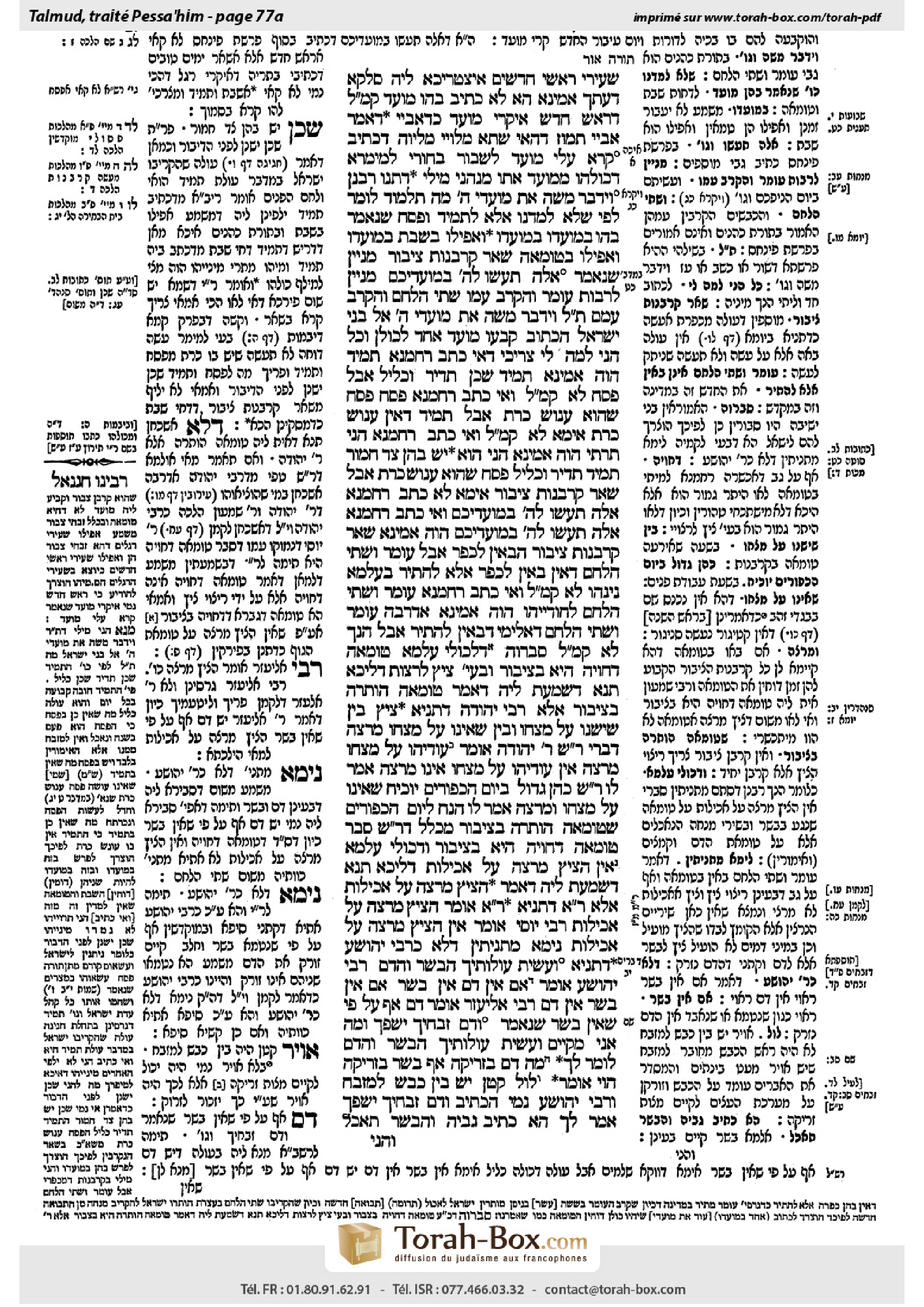
This page of Pesachim includes the Aramaic text, an English translation and an AI-generated French translation, alongside the scan above.
פסחים ע״ז א · Aramaic and Hebrew text
שְׂעִירֵי רָאשֵׁי חֳדָשִׁים אִיצְטְרִיכָא לֵיהּ, סָלְקָא דַּעְתָּךְ אָמֵינָא הָא לָא כְּתִיב בְּהוּ ״מוֹעֵד״, קָא מַשְׁמַע לַן דְּרֹאשׁ חֹדֶשׁ אִיקְּרִי מוֹעֵד,
כִּדְאַבָּיֵי, דְּאָמַר אַבָּיֵי: תַּמּוּז דְּהַאי שַׁתָּא מַלּוֹיֵי מַלְּיוּהּ, דִּכְתִיב: ״קָרָא עָלַי מוֹעֵד לִשְׁבֹּר בַּחוּרָי״.
לְמֵימְרָא דְּכוּלְּהוּ מִ״מּוֹעֵד״ אָתוּ, מְנָהָנֵי מִילֵּי? דְּתָנוּ רַבָּנַן: ״וַיְדַבֵּר מֹשֶׁה אֶת מֹעֲדֵי ה׳״ — מָה תַּלְמוּד לוֹמַר? לְפִי שֶׁלֹּא לָמַדְנוּ אֶלָּא לְתָמִיד וּפֶסַח שֶׁנֶּאֱמַר בְּהוּ ״בְּמוֹעֲדוֹ״, ״בְּמוֹעֲדוֹ״ וַאֲפִילּוּ בְּשַׁבָּת, ״בְּמוֹעֲדוֹ״ וַאֲפִילּוּ בְּטוּמְאָה.
שְׁאָר קׇרְבְּנוֹת צִיבּוּר מִנַּיִין — שֶׁנֶּאֱמַר: ״אֵלֶּה תַּעֲשׂוּ לַה׳ בְּמוֹעֲדֵיכֶם״.
מִנַּיִן לְרַבּוֹת עוֹמֶר וְהַקָּרֵב עִמּוֹ, שְׁתֵּי הַלֶּחֶם וְהַקָּרֵב עִמָּם — תַּלְמוּד לוֹמַר: ״וַיְדַבֵּר מֹשֶׁה אֶת מֹעֲדֵי ה׳ אֶל בְּנֵי יִשְׂרָאֵל״, הַכָּתוּב קְבָעוֹ מוֹעֵד אֶחָד לְכוּלָּן.
וְכׇל הָנֵי לְמָה לִי? צְרִיכִי, דְּאִי כְּתַב רַחֲמָנָא תָּמִיד, הֲוָה אָמֵינָא תָּמִיד — שֶׁכֵּן תָּדִיר וְכָלִיל, אֲבָל פֶּסַח — לָא, קָא מַשְׁמַע לַן.
וְאִי כְּתַב רַחֲמָנָא פֶּסַח, פֶּסַח שֶׁהוּא עָנוּשׁ כָּרֵת, אֲבָל תָּמִיד דְּאֵין עָנוּשׁ כָּרֵת — אֵימָא לָא, קָא מַשְׁמַע לַן.
וְאִי כְּתַב רַחֲמָנָא הָנֵי תַּרְתֵּי, הֲוָה אָמֵינָא הָנֵי הוּא יֵשׁ בָּהֶן צַד חָמוּר, תָּמִיד — תָּדִיר וְכָלִיל, פֶּסַח — שֶׁהוּא עָנוּשׁ כָּרֵת. אֲבָל שְׁאָר קׇרְבְּנוֹת צִיבּוּר — אֵימָא לָא, כְּתַב רַחֲמָנָא: ״אֵלֶּה תַּעֲשׂוּ לַה׳ בְּמוֹעֲדֵיכֶם״.
וְאִי כְּתַב רַחֲמָנָא: ״אֵלֶּה תַּעֲשׂוּ לַה׳ בְּמוֹעֲדֵיכֶם״, הֲוָה אָמֵינָא שְׁאָר קׇרְבְּנוֹת צִיבּוּר הַבָּאִין לְכַפֵּר. אֲבָל עוֹמֶר וּשְׁתֵּי הַלֶּחֶם דְּאֵין בָּאִין לְכַפֵּר, אֶלָּא לְהַתִּיר בְּעָלְמָא נִינְהוּ — לָא, קָא מַשְׁמַע לַן.
וְאִי כְּתַב רַחֲמָנָא עוֹמֶר וּשְׁתֵּי הַלֶּחֶם לְחוֹדַיְיהוּ, הֲוָה אָמֵינָא אַדְּרַבָּה: עוֹמֶר וּשְׁתֵּי הַלֶּחֶם דְּאַלִּימִי דְּבָאִין לְהַתִּיר, אֲבָל הָנָךְ — לָא, קָא מַשְׁמַע לַן.
סַבְרוּהָ דִּלְכוּלֵּי עָלְמָא טוּמְאָה דְּחוּיָה הִיא בְּצִיבּוּר, וּבָעֲיָא צִיץ לְרַצּוֹת.
דְּלֵיכָּא תַּנָּא דְּשָׁמְעַתְּ לֵיהּ דְּאָמַר טוּמְאָה הוּתְּרָה בְּצִיבּוּר אֶלָּא רַבִּי יְהוּדָה, דְּתַנְיָא: צִיץ, בֵּין שֶׁיֶּשְׁנוֹ עַל מִצְחוֹ וּבֵין שֶׁאֵינוֹ עַל מִצְחוֹ — מְרַצֶּה, דִּבְרֵי רַבִּי שִׁמְעוֹן. רַבִּי יְהוּדָה אוֹמֵר: עוֹדֵיהוּ עַל מִצְחוֹ — מְרַצֶּה, אֵין עוֹדֵיהוּ עַל מִצְחוֹ — אֵינוֹ מְרַצֶּה.
אָמַר לוֹ רַבִּי שִׁמְעוֹן: כֹּהֵן גָּדוֹל בְּיוֹם הַכִּפּוּרִים יוֹכִיחַ, שֶׁאֵינוֹ עַל מִצְחוֹ וּמְרַצֶּה.
אָמַר לוֹ: הַנַּח לְיוֹם הַכִּפּוּרִים שֶׁטּוּמְאָה הוּתְּרָה בְּצִיבּוּר. מִכְּלָל דְּרַבִּי שִׁמְעוֹן סָבַר: טוּמְאָה דְּחוּיָה הִיא בְּצִיבּוּר.
וּדְכוּלֵּי עָלְמָא אֵין הַצִּיץ מְרַצֶּה עַל אֲכִילוֹת, דְּלֵיכָּא תַּנָּא דְּשָׁמְעַתְּ לֵיהּ דְּאָמַר הַצִּיץ מְרַצֶּה עַל אֲכִילוֹת אֶלָּא רַבִּי אֱלִיעֶזֶר, דְּתַנְיָא: רַבִּי אֱלִיעֶזֶר אוֹמֵר: הַצִּיץ מְרַצֶּה עַל אֲכִילוֹת, רַבִּי יוֹסֵי אוֹמֵר: אֵין הַצִּיץ מְרַצֶּה עַל אֲכִילוֹת.
נֵימָא מַתְנִיתִין דְּלָא כְּרַבִּי יְהוֹשֻׁעַ, דְּתַנְיָא: ״וְעָשִׂיתָ עֹלֹתֶיךָ הַבָּשָׂר וְהַדָּם״, רַבִּי יְהוֹשֻׁעַ אוֹמֵר: אִם אֵין דָּם — אֵין בָּשָׂר, אִם אֵין בָּשָׂר — אֵין דָּם.
רַבִּי אֱלִיעֶזֶר אוֹמֵר: דָּם — אַף עַל פִּי שֶׁאֵין בָּשָׂר, שֶׁנֶּאֱמַר: ״וְדַם זְבָחֶיךָ יִשָּׁפֵךְ״, וּמָה אֲנִי מְקַיֵּים ״וְעָשִׂיתָ עֹלֹתֶיךָ הַבָּשָׂר וְהַדָּם״ — לוֹמַר לְךָ: מָה דָּם בִּזְרִיקָה, אַף בָּשָׂר בִּזְרִיקָה.
הֱוֵי אוֹמֵר: לוּל קָטָן יֵשׁ בֵּין כֶּבֶשׁ לַמִּזְבֵּחַ.
וְרַבִּי יְהוֹשֻׁעַ נָמֵי, הָכְתִיב ״וְדַם זְבָחֶיךָ יִשָּׁפֵךְ״! אָמַר לָךְ: הָא כְּתִיב גַּבֵּיהּ ״וְהַבָּשָׂר תֹּאכֵל״.
Pesachim 77a · English translation
It was necessary for the mishna to mention the goats sacrificed on the New Moons. It could enter your mind to say that since the term appointed time is not written with regard to them, these offerings do not override Shabbat or ritual impurity as do other communal offerings during their appointed times. Therefore, it teaches us that even the New Moon is called an appointed time.
This is in accordance with what Abaye said in order to defend the tradition that the spies returned from Eretz Yisrael and the entire Jewish people cried unnecessarily on the Ninth of Av, which resulted in the Ninth of Av becoming a day of crying for future generations. The calculation of the days does not work out precisely, and therefore Abaye said: They filled out Tammuz of that year, meaning that it was a thirty-day month, rather than a twenty-nine-day month as it is nowadays. There is an allusion to this in a verse, as it is written: “He proclaimed an appointed time against me to crush my young men” (Lamentations 1:15), meaning that the New Moon was proclaimed in order to harm the Jewish people in the future. This proves that even the New Moon is called an appointed time.
The Gemara asks: Is that to say that all of them come from, i.e., are derived from, the term appointed time? From where are these matters derived? The Gemara answers: It is as the Sages taught based upon the verse: “And Moses declared the appointed times of the Lord to the children of Israel” (Leviticus 23:44). What is the meaning when the verse states this phrase? This phrase is necessary because we had learned only that the daily offering and the Paschal lamb override Shabbat and ritual impurity, as it is stated with regard to them: In its appointed time, from which it is derived that each of them must be sacrificed in its appointed time and even on Shabbat, in its appointed time and even in ritual impurity.
With regard to the rest of the communal offerings, from where is it derived that they also override Shabbat and ritual impurity? As it is stated with regard to additional offerings that are brought on the Festivals: “These you shall sacrifice to the Lord in your appointed times” (Numbers 29:39).
The baraita continues: From where is it derived to include the omer and the lambs that are sacrificed with it, the two loaves sacrificed on Shavuot, and the communal peace-offerings that are sacrificed with them? The verse states: “And Moses declared the appointed times of the Lord to the children of Israel” after it lists Shabbat and the Festivals. This indicates that the verse established one time for all of them. All of these days are considered appointed times, and their offerings are not deferred.
The Gemara asks: Why do I need all these derivations? It should have been sufficient to provide one derivation and use that as a model for all communal offerings. The Gemara answers: They are all necessary. As, if the Merciful One had written this halakha only with regard to the daily offering in the Torah, I would have said: The daily offering is unique in that it is frequent and it is consumed, as it is entirely consumed as a burnt-offering, and that is why it overrides Shabbat and ritual impurity; but the Paschal lamb, which does not have either of these characteristics, does not override Shabbat and ritual impurity. Therefore, it teaches us that the Paschal lamb also overrides Shabbat and ritual impurity.
And if the Merciful One had written that this halakha applies to the Paschal lamb, I would have said that the Paschal lamb, for which one is punished with karet if one neglects to sacrifice it, overrides Shabbat and ritual impurity; but with regard to the daily offering, for which one is not punished with karet for neglecting to sacrifice it, say that it does not override Shabbat and ritual impurity. Therefore, it comes to teach us that the daily offering also overrides Shabbat and ritual impurity.
And if the Merciful One had written this halakha only with regard to these two offerings, I would have said that it is only with regard to these offerings that the halakha applies, because they have a stringent aspect. The daily offering is frequent and entirely consumed on the altar, and one who neglects to bring the Paschal lamb is punished with karet. But with regard to the rest of the communal offerings, which do not have these stringencies, say that they do not override Shabbat and ritual impurity. Therefore, the Merciful One writes: “These you shall sacrifice to the Lord in your appointed times,” to teach that even these override Shabbat and ritual impurity.
And if the Merciful One had written “These you shall sacrifice to the Lord in your appointed times” and nothing else, I would have said that only the other communal offerings that come to atone for sins are included, such as sin-offerings and burnt-offerings. Burnt-offerings atone for the neglect of positive commandments and for the violation of negative commandments that can be rectified through positive commandments. But the omer and the two loaves, which do not come to atone for sin but merely come to permit, as the omer permits the consumption of the new crop of grain and the two loaves permit using the new crop of grain as offerings in the Temple, do not override Shabbat and ritual impurity. Therefore, it teaches us that even these override Shabbat and ritual impurity.
And if the Merciful One had written: The omer and the two loaves, by themselves, I would have said: On the contrary, the omer and the two loaves, which are important because they come to permit, override Shabbat and ritual impurity, but these other communal offerings do not. Therefore, it teaches us each of the derivations separately.
Since the Gemara has discussed communal offerings that are brought even in a state of ritual impurity, it addresses the basic halakhot relating to this area. The Gemara posits two assumptions and then compares the opinion of Rabbi Yehoshua to the mishna. It states as a preface that the Sages originally assumed that everyone agrees that ritual impurity is overridden in cases involving the public. In other words, the prohibition against sacrificing offerings in a state of ritual impurity applies to communal offerings, but it is superseded by the obligation to sacrifice the offering. Therefore, the frontplate of the High Priest is required to appease God for the sacrifice of the offering in a state of ritual impurity.
There is no tanna that you have heard of who said that ritual impurity is entirely permitted in cases involving the public, i.e., that with regard to the public there is no significance to ritual impurity in the Temple, except for Rabbi Yehuda. As it was taught in a baraita: The frontplate of the High Priest, whether it is on his forehead or whether it is not on his forehead, appeases God and thereby facilitates the acceptance of offerings sacrificed in a state of impurity; this is the statement of Rabbi Shimon. Rabbi Yehuda says: When it is still on his forehead it appeases God, but when it is no longer on his forehead it does not appease Him, as indicated in the verse: “And it shall be on Aaron’s forehead, that Aaron may bear the iniquity of the sacred things which the children of Israel shall hallow” (Exodus 28:38).
Rabbi Shimon said to Rabbi Yehuda: The halakha with regard to the High Priest on Yom Kippur shall prove it, as the frontplate is not on his forehead, and it nonetheless appeases God if communal offerings are brought in a state of ritual impurity. The High Priest spends part of Yom Kippur wearing only the four white garments instead of his usual golden vestments, which include the frontplate.
Rabbi Yehuda said to him: Set aside Yom Kippur, as ritual impurity is wholly permitted in cases involving the public. The frontplate is needed only to atone for individual offerings that are brought in a state of ritual impurity. This proves by inference that Rabbi Shimon holds that ritual impurity is overridden in cases involving the public, but it is not wholly permitted. Therefore, the frontplate is needed to appease God for the sacrifice of the offering in a state of ritual impurity.
The Sages also presumed that everyone agrees that the frontplate appeases God only for the sacrifice of the offering and the burning of the requisite parts on the altar in a state of ritual impurity, but it does not appease God for the impurity of the portions of offerings that are supposed to be eaten. Therefore, although the offering is valid, it may not be eaten. As, the only tanna you have heard say the frontplate appeases God for the impurity of the portions of offerings that are supposed to be eaten is Rabbi Eliezer, as it was taught in a baraita that Rabbi Eliezer says: The frontplate appeases God for the impurity of the portions of offerings that supposed to be eaten. And Rabbi Yosei says: The frontplate does not appease God for the impurity of portions of offerings that are supposed to be eaten.
On the basis of these two assumptions, let us say that the mishna is not in accordance with the opinion of Rabbi Yehoshua, as it was taught in a baraita with regard to the verse: “And you shall sacrifice your burnt-offerings, the flesh and the blood, upon the altar of the Lord your God, and the blood of your offerings shall be poured out against the altar of the Lord your God, and you shall eat the flesh” (Deuteronomy 12:27), that Rabbi Yehoshua says: If there is no blood that is fit to be sprinkled on the altar, due to the fact that it became ritually impure or was lost, there is no meat, as the meat is also disqualified. Similarly, if there is no meat that is fit for use, due to the fact that it became ritually impure or was lost, there is no blood sprinkled on the altar, and the offering does not bring atonement.
Rabbi Eliezer says: Blood brings atonement although there is no suitable meat, as it is stated: “And the blood of your offerings shall be poured out.” Blood is the aspect of the offering most essential for atonement. And how do I uphold the significance of the juxtaposition of flesh and blood in the verse: “And you shall sacrifice your burnt-offerings, the flesh and the blood”? I hold that it is there to tell you that just as the blood is presented upon the altar via sprinkling, so too, the meat is presented via throwing.
You must say, based upon this, that there is a small gap between the ramp and the altar. In order to fulfill the requirement to throw, the priest would proceed as follows: Rather than walking to the arrangement of wood and putting down the meat, he would stand on the ramp and throw the meat of the offering over the gap between the ramp and the altar, onto the arrangement of wood on the altar.
The Gemara asks: And according to the opinion of Rabbi Yehoshua as well, isn’t it written: “And the blood of your offerings shall be poured out,” which indicates that the blood is the essential part of the offering? He could have said to you that it is written right next to it: “And you shall eat the flesh,” which indicates that the meat is also essential and must still be suitable for eating.
Pesachim 77a · Traduction française (IA)
Il était nécessaire que la Michna mentionne les boucs sacrifiés aux nouvelles lunes. On aurait pu penser que, puisque l’expression « temps fixé » n’est pas employée à leur sujet, ces sacrifices ne repoussent ni le Chabbat ni l’impureté rituelle, contrairement aux autres sacrifices communautaires accomplis à leurs temps fixés. Elle nous enseigne donc que même la nouvelle lune est appelée « temps fixé ».
Cela est conforme à ce qu’a dit Abayé pour défendre la tradition selon laquelle les explorateurs revinrent d’Eretz Israël et tout le peuple juif pleura sans raison le neuf Av, ce qui fit du neuf Av un jour de pleurs pour les générations futures. Le calcul des jours ne concorde pas exactement ; Abayé a donc dit qu’ils avaient complété Tammouz cette année-là, c’est-à-dire qu’ils en avaient fait un mois de trente jours plutôt que de vingt-neuf jours, comme c’est le cas aujourd’hui. Un verset y fait allusion, comme il est écrit : « Il a proclamé contre moi un temps fixé pour écraser mes jeunes hommes » (Lamentations 1:15), ce qui signifie que la nouvelle lune fut proclamée afin de nuire au peuple juif à l’avenir. Cela prouve que même la nouvelle lune est appelée « temps fixé ».
La Guemara demande : Faut-il en déduire que toutes ces dispositions découlent de l’expression « temps fixé » ? De quoi ces règles sont-elles dérivées ? La Guemara répond : C’est ce que les Sages ont enseigné à partir du verset : « Moïse déclara aux enfants d’Israël les temps fixés par le Seigneur » (Lévitique 23:44). Pourquoi le verset énonce-t-il cette phrase ? Elle est nécessaire, car nous avions appris seulement que le sacrifice quotidien et l’agneau pascal repoussent le Chabbat et l’impureté rituelle, comme il est dit à leur sujet : « en son temps fixé ». On en déduit que chacun d’eux doit être offert à son temps fixé, même le Chabbat, et à son temps fixé, même en état d’impureté rituelle.
D’où apprend-on que les autres sacrifices communautaires repoussent eux aussi le Chabbat et l’impureté rituelle ? Il est dit à propos des sacrifices supplémentaires offerts lors des fêtes : « Vous les sacrifierez au Seigneur à vos temps fixés » (Nombres 29:39).
La baraïta poursuit : D’où apprend-on qu’il faut inclure l’omer et les agneaux sacrifiés avec lui, les deux pains offerts à Chavouot et les sacrifices de paix communautaires offerts avec eux ? Le verset dit : « Moïse déclara aux enfants d’Israël les temps fixés par le Seigneur », après avoir énuméré le Chabbat et les fêtes. Cela indique que le verset a établi un temps commun pour tous. Tous ces jours sont considérés comme des temps fixés, et les sacrifices qui y sont offerts ne sont pas reportés.
La Guemara demande : Pourquoi ai-je besoin de toutes ces déductions ? Une seule aurait dû suffire pour servir de modèle à tous les sacrifices communautaires. La Guemara répond : Elles sont toutes nécessaires. En effet, si le Miséricordieux n’avait inscrit cette halakha dans la Torah qu’à propos du sacrifice quotidien, j’aurais dit que celui-ci est particulier en ce qu’il est offert régulièrement et qu’il est entièrement consumé sur l’autel comme holocauste ; c’est pourquoi il repousse le Chabbat et l’impureté rituelle. Mais l’agneau pascal, qui ne possède aucune de ces caractéristiques, ne repousse ni le Chabbat ni l’impureté rituelle. Le verset nous enseigne donc que l’agneau pascal repousse lui aussi le Chabbat et l’impureté rituelle.
Et si le Miséricordieux avait écrit cette halakha à propos de l’agneau pascal, j’aurais dit que celui-ci, dont l’omission expose à la peine de karet, repousse le Chabbat et l’impureté rituelle ; mais, concernant le sacrifice quotidien, dont l’omission n’expose pas à la peine de karet, j’aurais dit qu’il ne repousse ni le Chabbat ni l’impureté rituelle. Le verset vient donc enseigner que le sacrifice quotidien repousse lui aussi le Chabbat et l’impureté rituelle.
Et si le Miséricordieux n’avait écrit cette halakha qu’à propos de ces deux sacrifices, j’aurais dit qu’elle ne s’applique qu’à eux, car ils présentent un aspect plus rigoureux. Le sacrifice quotidien est offert régulièrement et entièrement consumé sur l’autel, et celui qui omet d’offrir l’agneau pascal est passible de karet. Mais, concernant les autres sacrifices communautaires, qui ne présentent pas ces rigueurs, j’aurais dit qu’ils ne repoussent ni le Chabbat ni l’impureté rituelle. Le Miséricordieux écrit donc : « Vous les sacrifierez au Seigneur à vos temps fixés », pour enseigner que ceux-là aussi repoussent le Chabbat et l’impureté rituelle.
Et si le Miséricordieux avait écrit : « Vous les sacrifierez au Seigneur à vos temps fixés », et rien d’autre, j’aurais dit que seuls sont inclus les autres sacrifices communautaires qui viennent expier les péchés, tels que les sacrifices expiatoires et les holocaustes. Les holocaustes expient l’omission des commandements positifs et la transgression des commandements négatifs qui peut être réparée par l’accomplissement d’un commandement positif. Mais l’omer et les deux pains, qui ne viennent pas expier le péché, mais seulement rendre certaines choses permises — l’omer autorisant la consommation de la nouvelle récolte de céréales et les deux pains permettant d’utiliser cette nouvelle récolte comme offrandes dans le Temple — ne repousseraient ni le Chabbat ni l’impureté rituelle. Le verset nous enseigne donc que ceux-là aussi repoussent le Chabbat et l’impureté rituelle.
Et si le Miséricordieux avait écrit seulement : « l’omer et les deux pains », j’aurais dit au contraire que l’omer et les deux pains, qui sont importants parce qu’ils rendent certaines choses permises, repoussent le Chabbat et l’impureté rituelle, mais que les autres sacrifices communautaires ne les repoussent pas. Le verset nous enseigne donc chacune de ces déductions séparément.
Puisque la Guemara a traité des sacrifices communautaires offerts même en état d’impureté rituelle, elle aborde les halakhot fondamentales relatives à cette question. La Guemara pose deux présupposés, puis compare l’opinion de Rabbi Yehoshoua à celle de la Michna. En préambule, elle indique que les Sages supposaient au départ que tous s’accordent à dire que l’impureté rituelle est repoussée dans les cas concernant la collectivité. Autrement dit, l’interdiction d’offrir des sacrifices en état d’impureté rituelle s’applique aux sacrifices communautaires, mais elle cède devant l’obligation de les offrir. La plaque frontale du grand prêtre est donc nécessaire pour obtenir l’agrément de Dieu lorsqu’un sacrifice est offert en état d’impureté rituelle.
Parmi les tannaim que vous connaissez, aucun, sauf Rabbi Yehouda, n’a dit que l’impureté rituelle est entièrement permise dans les cas concernant la collectivité, c’est-à-dire que, pour la collectivité, l’impureté rituelle n’a aucune conséquence dans le Temple. En effet, il a été enseigné dans une baraïta : La plaque frontale du grand prêtre, qu’elle soit sur son front ou qu’elle n’y soit pas, obtient l’agrément de Dieu et permet ainsi l’acceptation des sacrifices offerts en état d’impureté ; telle est l’opinion de Rabbi Shimon. Rabbi Yehouda dit : Lorsqu’elle est sur son front, elle obtient l’agrément de Dieu, mais lorsqu’elle n’y est plus, elle ne l’obtient pas, comme l’indique le verset : « Elle sera sur le front d’Aaron, et Aaron portera la faute commise à l’égard des choses saintes que les enfants d’Israël consacreront » (Exode 28:38).
Rabbi Shimon dit à Rabbi Yehouda : Le cas du grand prêtre à Yom Kippour le prouve, car la plaque frontale n’est pas sur son front et, pourtant, elle obtient l’agrément de Dieu si des sacrifices communautaires sont offerts en état d’impureté rituelle. Pendant une partie de Yom Kippour, le grand prêtre ne porte que les quatre vêtements blancs, au lieu de ses vêtements habituels en or, qui comprennent la plaque frontale.
Rabbi Yehouda lui dit : Écarte le cas de Yom Kippour, car l’impureté rituelle y est entièrement permise dans les cas concernant la collectivité. La plaque frontale n’est nécessaire que pour expier les sacrifices individuels offerts en état d’impureté rituelle. On en déduit que Rabbi Shimon tient l’impureté rituelle pour repoussée dans les cas concernant la collectivité, mais non pour entièrement permise. La plaque frontale est donc nécessaire pour obtenir l’agrément de Dieu lorsqu’un sacrifice est offert en état d’impureté rituelle.
Les Sages présumaient également que tous s’accordent à dire que la plaque frontale obtient l’agrément de Dieu uniquement pour le sacrifice et la combustion sur l’autel des parties requises, lorsque ces actes ont lieu en état d’impureté rituelle ; elle ne l’obtient pas pour l’impureté des portions des sacrifices destinées à être consommées. Ainsi, bien que le sacrifice soit valide, il ne peut pas être consommé. En effet, le seul tanna que vous ayez entendu dire que la plaque frontale obtient l’agrément de Dieu pour l’impureté des portions des sacrifices destinées à être consommées est Rabbi Eliezer, comme il a été enseigné dans une baraïta : Rabbi Eliezer dit que la plaque frontale obtient l’agrément de Dieu pour l’impureté des portions des sacrifices destinées à être consommées. Rabbi Yossei dit que la plaque frontale n’obtient pas l’agrément de Dieu pour l’impureté de ces portions.
Sur la base de ces deux présupposés, disons que la Michna n’est pas conforme à l’opinion de Rabbi Yehoshoua. En effet, il a été enseigné dans une baraïta, à propos du verset : « Vous offrirez vos holocaustes, la chair et le sang, sur l’autel du Seigneur votre Dieu ; le sang de vos sacrifices sera répandu contre l’autel du Seigneur votre Dieu, et vous mangerez la chair » (Deutéronome 12:27), que Rabbi Yehoshoua dit : S’il n’y a pas de sang apte à être aspergé sur l’autel, parce qu’il est devenu impur ou a été perdu, il n’y a pas de viande, car celle-ci est elle aussi disqualifiée. De même, s’il n’y a pas de viande apte à être utilisée, parce qu’elle est devenue impure ou a été perdue, le sang ne sera pas aspergé sur l’autel et le sacrifice n’apportera pas l’expiation.
Rabbi Eliezer dit : Le sang apporte l’expiation même s’il n’y a pas de viande apte, comme il est dit : « Le sang de vos sacrifices sera répandu. » Le sang est l’élément du sacrifice le plus essentiel à l’expiation. Comment, alors, préserver la signification du rapprochement entre la chair et le sang dans le verset : « Vous offrirez vos holocaustes, la chair et le sang » ? Je considère que ce rapprochement vise à t’enseigner que, de même que le sang est présenté sur l’autel par aspersion, la viande y est, elle aussi, présentée en étant lancée.
Il faut en déduire qu’il y a un petit espace entre la rampe et l’autel. Pour satisfaire à l’obligation de lancer la viande, le prêtre procédait ainsi : au lieu de marcher jusqu’à l’empilement de bois et d’y déposer la viande, il se tenait sur la rampe et lançait la viande du sacrifice par-dessus l’espace entre la rampe et l’autel, sur l’empilement de bois de l’autel.
La Guemara demande : Et selon l’opinion de Rabbi Yehoshoua également, n’est-il pas écrit : « Le sang de vos sacrifices sera répandu », ce qui indique que le sang est l’élément essentiel du sacrifice ? Il aurait pu te répondre que le texte ajoute juste après : « Et vous mangerez la chair », ce qui indique que la viande est elle aussi essentielle et doit rester apte à la consommation.
Traduction française générée par IA à partir de l’édition anglaise de Sefaria. Vérifie toujours un passage avec le texte source.
Text from Sefaria: William Davidson Edition - Vocalized Aramaic (CC BY NC); William Davidson Edition - English (CC BY NC).