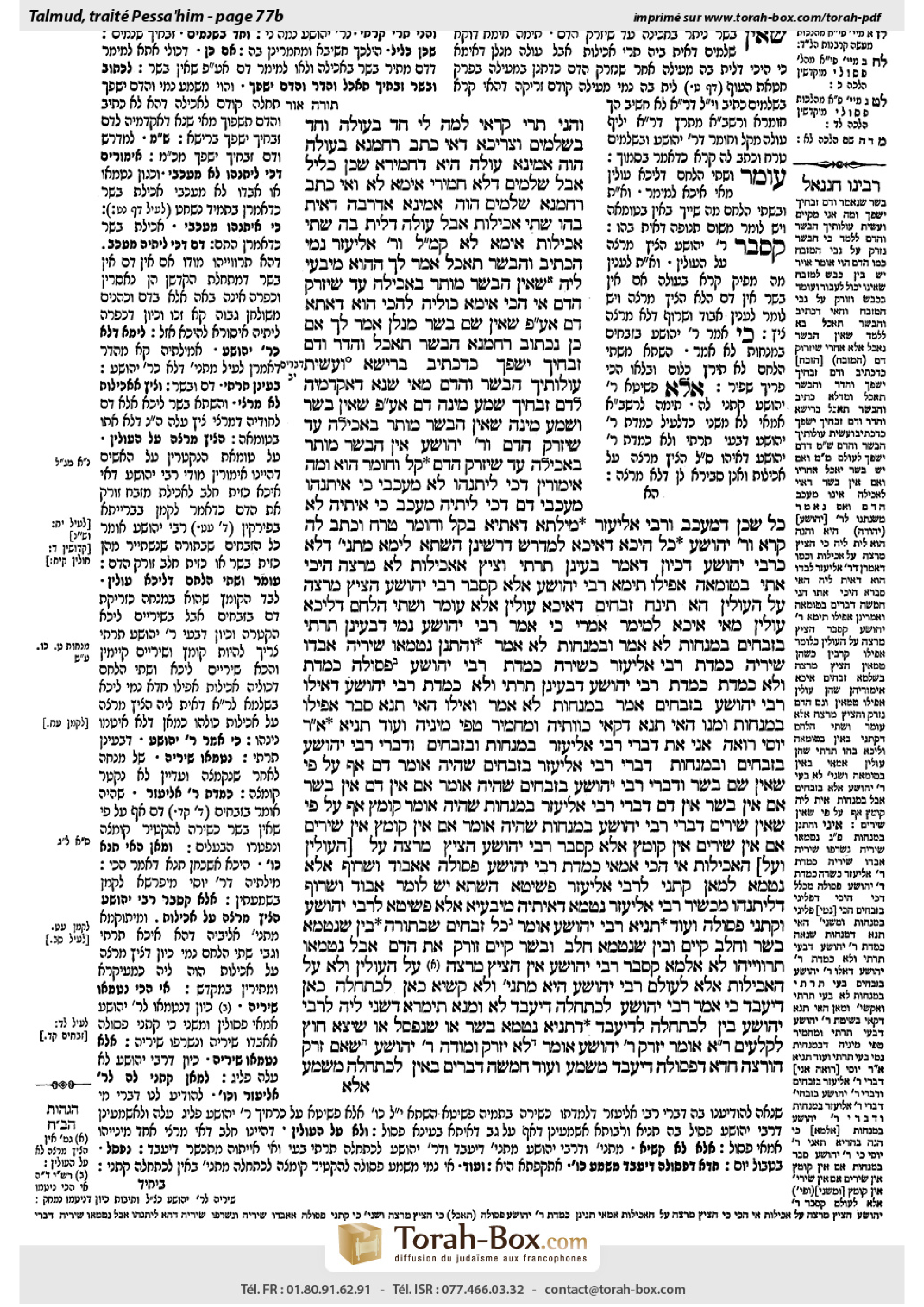
Pesachim 77b: Talmud study for Daf Yomi
Daf Yomi is the daily study of one Talmud folio. Explore 37 tractates with scans, Hebrew text, Sefaria English and AI-generated French translations where annotated.
Passage selection and English or AI-generated French translation are available where the scan has annotations. Daf Study is independent of Torah-Box and Sefaria.
Browse Pesachim · פסחים · All tractatesPesachim 77b text and translations
This page of Pesachim includes the Aramaic text, an English translation and an AI-generated French translation, alongside the scan above.
פסחים ע״ז ב · Aramaic and Hebrew text
וְהָנֵי תְּרֵי קְרָאֵי לְמָה לִי? חַד בְּעוֹלָה, וְחַד בִּשְׁלָמִים. וּצְרִיכָא, דְּאִי כְּתַב רַחֲמָנָא בְּעוֹלָה, הֲוָה אָמֵינָא: עוֹלָה הִיא דַּחֲמִירָא, שֶׁכֵּן כָּלִיל, אֲבָל שְׁלָמִים דְּלָא חֲמִירִי, אֵימָא לָא.
וְאִי כְּתַב רַחֲמָנָא שְׁלָמִים, הֲוָה אָמֵינָא: אַדְּרַבָּה, דְּאִית בְּהוּ שְׁתֵּי אֲכִילוֹת. אֲבָל עוֹלָה דְּלֵית בָּהּ שְׁתֵּי אֲכִילוֹת, אֵימָא לָא, קָא מַשְׁמַע לַן.
וְרַבִּי אֱלִיעֶזֶר נָמֵי, הָכְתִיב ״וְהַבָּשָׂר תֹּאכֵל״! אָמַר לָךְ: הַהוּא מִיבְּעֵי לֵיהּ אַשֶּׁאֵין הַבָּשָׂר מוּתָּר בַּאֲכִילָה עַד שֶׁיִּזָּרֵק הַדָּם.
אִי הָכִי, אֵימָא כּוּלֵּיהּ לְהָכִי הוּא דַּאֲתָא! דָּם אַף עַל פִּי שֶׁאֵין שָׁם בָּשָׂר מְנָלַן?
אָמַר לָךְ: אִם כֵּן, נִכְתּוֹב רַחֲמָנָא ״הַבָּשָׂר תֹּאכֵל״ וַהֲדַר ״וְדַם זְבָחֶיךָ יִשָּׁפֵךְ״, כְּדִכְתִיב בְּרֵישָׁא ״וְעָשִׂיתָ עֹלֹתֶיךָ הַבָּשָׂר וְהַדָּם״, מַאי שְׁנָא דְּאַקְדְּמֵיהּ לְ״דַם זְבָחֶיךָ״? שְׁמַע מִינַּהּ: דָּם אַף עַל פִּי שֶׁאֵין בָּשָׂר, וּשְׁמַע מִינַּהּ: שֶׁאֵין הַבָּשָׂר מוּתָּר בַּאֲכִילָה עַד שֶׁיִּזָּרֵק הַדָּם.
וְרַבִּי יְהוֹשֻׁעַ, אֵין הַבָּשָׂר מוּתָּר בַּאֲכִילָה עַד שֶׁיִּזָּרֵק הַדָּם — קַל וָחוֹמֶר הוּא, וּמָה אֵימוּרִין דְּכִי לֵיתַנְהוּ — לָא מְעַכְּבִי, כִּי אִיתַנְהוּ — מְעַכְּבִי, דָּם, דְּכִי לֵיתֵיהּ — מְעַכֵּב, כִּי אִיתֵיהּ — לֹא כׇּל שֶׁכֵּן דִּמְעַכֵּב!
וְרַבִּי אֱלִיעֶזֶר? מִילְּתָא דְּאָתְיָא בְּקַל וָחוֹמֶר טָרַח וְכָתֵב לַהּ קְרָא. וְרַבִּי יְהוֹשֻׁעַ? כׇּל הֵיכָא דְּאִיכָּא לְמִדְרַשׁ — דָּרְשִׁינַן.
הַשְׁתָּא לֵימָא מַתְנִיתִין דְּלָא כְּרַבִּי יְהוֹשֻׁעַ, דְּכֵיוָן דְּאָמַר בָּעֵינַן תַּרְתֵּי, וְצִיץ אַאֲכִילוֹת לֹא מְרַצֶּה, הֵיכִי אָתֵי בְּטוּמְאָה?
אֲפִילּוּ תֵּימָא רַבִּי יְהוֹשֻׁעַ, אֶלָּא קָסָבַר רַבִּי יְהוֹשֻׁעַ: הַצִּיץ מְרַצֶּה עַל הָעוֹלִין.
הָא תִּינַח זְבָחִים דְּאִיכָּא עוֹלִין, אֶלָּא עוֹמֶר וּשְׁתֵּי הַלֶּחֶם דְּלֵיכָּא עוֹלִין, מַאי אִיכָּא לְמֵימַר? אָמְרִי: כִּי אָמַר רַבִּי יְהוֹשֻׁעַ נָמֵי דְּבָעֵינַן תַּרְתֵּי — בִּזְבָחִים, בִּמְנָחוֹת לָא אָמַר.
וּבִמְנָחוֹת לָא אָמַר? וְהָתְנַן: נִטְמְאוּ שְׁיָרֶיהָ, אָבְדוּ שְׁיָרֶיהָ, כְּמִדַּת רַבִּי אֱלִיעֶזֶר — כְּשֵׁירָה, כְּמִדַּת רַבִּי יְהוֹשֻׁעַ — פְּסוּלָה.
כְּמִדַּת וְלֹא כְּמִדַּת: כְּמִדַּת רַבִּי יְהוֹשֻׁעַ, דְּבָעֵינַן תַּרְתֵּי. וְלֹא כְּמִדַּת רַבִּי יְהוֹשֻׁעַ, דְּאִילּוּ רַבִּי יְהוֹשֻׁעַ בִּזְבָחִים אָמַר, בִּמְנָחוֹת — לָא אָמַר, וְאִילּוּ הַאי תַּנָּא סָבַר: אֲפִילּוּ בִּמְנָחוֹת.
וּמַנּוּ הַאי תַּנָּא דְּקָאֵי כְּווֹתֵיהּ וּמַחְמֵיר טְפֵי מִינֵּיהּ? וְעוֹד, תַּנְיָא אָמַר רַבִּי יוֹסֵי: רוֹאֶה אֲנִי אֶת דִּבְרֵי רַבִּי אֱלִיעֶזֶר בִּמְנָחוֹת וּבִזְבָחִים, וְדִבְרֵי רַבִּי יְהוֹשֻׁעַ בִּזְבָחִים וּבִמְנָחוֹת.
דִּבְרֵי רַבִּי אֱלִיעֶזֶר בִּזְבָחִים, שֶׁהָיָה אוֹמֵר: דָּם — אַף עַל פִּי שֶׁאֵין שָׁם בָּשָׂר. וְדִבְרֵי רַבִּי יְהוֹשֻׁעַ בִּזְבָחִים, שֶׁהָיָה אוֹמֵר: אִם אֵין דָּם — אֵין בָּשָׂר, אִם אֵין בָּשָׂר — אֵין דָּם. דִּבְרֵי רַבִּי אֱלִיעֶזֶר בִּמְנָחוֹת, שֶׁהָיָה אוֹמֵר: קוֹמֶץ — אַף עַל פִּי שֶׁאֵין שִׁירַיִם, דִּבְרֵי רַבִּי יְהוֹשֻׁעַ בִּמְנָחוֹת, שֶׁהָיָה אוֹמֵר: אִם אֵין קוֹמֶץ — אֵין שִׁירַיִם, אִם אֵין שִׁירַיִם — אֵין קוֹמֶץ.
אֶלָּא, קָסָבַר רַבִּי יְהוֹשֻׁעַ: הַצִּיץ מְרַצֶּה עַל [הָעוֹלִין וְעַל] הָאֲכִילוֹת.
אִי הָכִי, אַמַּאי כְּמִדַּת רַבִּי יְהוֹשֻׁעַ פְּסוּלָה? אַאָבוּד וְשָׂרוּף.
אֶלָּא נִטְמָא, לְמַאן קָתָנֵי? לְרַבִּי אֱלִיעֶזֶר — פְּשִׁיטָא, הַשְׁתָּא יֵשׁ לוֹמַר אָבוּד וְשָׂרוּף דְּלֵיתַנְהוּ, מַכְשִׁיר רַבִּי אֱלִיעֶזֶר, נִטְמָא דְּאִיתֵיהּ — מִיבַּעְיָא? אֶלָּא פְּשִׁיטָא לְרַבִּי יְהוֹשֻׁעַ, וְקָתָנֵי פְּסוּלָה.
וְעוֹד, תַּנְיָא רַבִּי יְהוֹשֻׁעַ אוֹמֵר: כׇּל זְבָחִים שֶׁבַּתּוֹרָה, בֵּין שֶׁנִּטְמָא בָּשָׂר וְחֵלֶב קַיָּים, וּבֵין שֶׁנִּטְמָא חֵלֶב וּבָשָׂר קַיָּים — זוֹרֵק אֶת הַדָּם. אֲבָל נִטְמְאוּ תַּרְוַויְיהוּ — לָא. אַלְמָא קָסָבַר רַבִּי יְהוֹשֻׁעַ אֵין הַצִּיץ מְרַצֶּה עַל הָעוֹלִין וְלֹא עַל הָאֲכִילוֹת!
אֶלָּא: לְעוֹלָם רַבִּי יְהוֹשֻׁעַ הִיא מַתְנִיתִין, וְלָא קַשְׁיָא: כָּאן — לְכַתְּחִלָּה, כָּאן — דִּיעֲבַד. כִּי אָמַר רַבִּי יְהוֹשֻׁעַ — לְכַתְּחִלָּה, דִּיעֲבַד לָא.
וּמְנָא תֵּימְרָא דְּשָׁנֵי לֵיהּ לְרַבִּי יְהוֹשֻׁעַ בֵּין לְכַתְּחִלָּה לְדִיעֲבַד — דְּתַנְיָא: נִטְמָא בָּשָׂר אוֹ שֶׁנִּפְסַל אוֹ שֶׁיָּצָא חוּץ לַקְּלָעִים, רַבִּי אֱלִיעֶזֶר אוֹמֵר: יִזָּרֵק, רַבִּי יְהוֹשֻׁעַ אוֹמֵר: לֹא יִזָּרֵק. וּמוֹדֶה רַבִּי יְהוֹשֻׁעַ שֶׁאִם זָרַק — הוּרְצָה.
חֲדָא, דִּ״פְסוּלָה״ — דִּיעֲבַד מַשְׁמַע. וְעוֹד, ״חֲמִשָּׁה דְּבָרִים בָּאִין״ — לְכַתְּחִלָּה מַשְׁמַע.
Pesachim 77b · English translation
The Gemara asks: Why do I need these two parts of the verse? According to the opinion of Rabbi Yehoshua, the halakha that both the blood and meat are essential is derived twice from the verse. The Gemara answers: One part of the verse is referring to a burnt-offering and one part is referring to a peace-offering. The Gemara notes that both derivations are necessary, as if the Merciful One had written the halakha that the meat must be suitable for eating only with regard to a burnt-offering, I would have said that it applies only to a burnt-offering, which is stringent, as it is totally consumed on the altar. However, with regard to a peace-offering, which is not stringent, as most of its meat is eaten by the priests and by the one who brought the offering, say that its meat is not essential.
And if the Merciful One had written this halakha with regard to a peace-offering, I would have said: On the contrary, the meat of a peace-offering is more important because it has two forms of consumption. The sacrificial parts are burned on the altar, and the owners and priests eat the rest of the meat. But with regard to a burnt-offering, which is completely burned on the altar and therefore does not have two forms of consumption, say that its meat is not essential. For this reason, it teaches us the halakha in both cases.
The Gemara asks: And according to the opinion of Rabbi Eliezer as well, isn’t it written: “And you shall eat the flesh”? The Gemara answers that Rabbi Eliezer could have said to you: That part of the verse is necessary to teach that the meat of an offering is not permitted to be eaten until the blood is sprinkled.
The Gemara asks: If so, say that the entire verse comes for this purpose, and in that case, from where do we derive the halakha that one sprinkles the blood even though there is no suitable meat because it became ritually impure or was lost?
The Gemara answers that Rabbi Eliezer could have said to you: If so, the Merciful One should have written “and you shall eat the flesh” and then “and the blood of your offerings shall be poured out,” as it is written in the first clause of that verse: “And you shall sacrifice your burnt-offerings, the flesh, and the blood,” listing the meat before the blood. What is different that caused the verse to precede “and you shall eat the flesh” with the phrase “the blood of your offerings”? Learn from it that blood brings atonement although there is no meat, and learn from it also that the meat is not permitted to be eaten until the blood is sprinkled.
The Gemara asks: And from where does Rabbi Yehoshua derive the halakha that the meat is not permitted to be eaten until the blood is sprinkled? The Gemara answers that according to his opinion, it is an a fortiori inference: Just as with regard to sacrificial portions brought on the altar, which do not preclude acceptance of the offering when they are not present, when they are present they do preclude the eating of the meat; with regard to blood, which precludes acceptance of the offering when it is not present, e.g., when it became ritually impure or lost, then when it is present, all the more so is it not clear that it precludes the continuation of the service and the eating the meat until it is sprinkled?
The Gemara asks: And according to the opinion of Rabbi Eliezer, if there is an a fortiori inference, why did the Torah have to write this halakha explicitly in a verse? The Gemara answers: A matter that could be derived by means of an a fortiori inference, the verse nonetheless exerted itself and wrote it explicitly. Even when a halakha can be derived through an a fortiori inference, the Torah sometimes writes it explicitly in order to emphasize the halakha. The Gemara asks: How does Rabbi Yehoshua respond to this claim? The Gemara answers: Anywhere that there is a possibility to expound the verse and thereby derive a new halakha, we expound it rather than explain that the verse taught only a halakha that could also have been derived in a different manner.
Now, after these introductions, let us say that the mishna is not in accordance with the opinion of Rabbi Yehoshua: Since he said that we require the two parts of the offering to be valid, i.e., the meat and the blood, and since he presumably holds that the frontplate does not appease God for the impurity of the portions of offerings that are supposed to be eaten, and consequently only the blood of these offerings is valid, how can they be brought in ritual impurity?
The Gemara refutes this statement: Even if you say that the mishna is in accordance with the opinion of Rabbi Yehoshua, it is not difficult. Rather, Rabbi Yehoshua holds that the frontplate appeases God for the impurity of that which goes up, i.e., the sacrificial parts that are brought onto the altar and burned. These portions may be burned on the altar even when they are impure. This is considered a form of consumption. Since part of meat is therefore suitable for consumption, the blood may be sprinkled.
The Gemara asks: This works out well with regard to communal animal offerings, from which there are portions that go up onto the altar. But what of the omer and the two loaves, of which there are no parts that go up onto the altar? These offerings are entirely eaten by the priests except for the handful of flour which is scooped out and burned on the altar, and which serves the same function for a meal-offering as the sprinkling of the blood for an animal offering. What is there to say concerning those offerings? Say in answer to this question: When Rabbi Yehoshua said that we require the two parts of the offering to be valid, he said it with regard to animal offerings; but with regard to meal-offerings he did not say it.
The Gemara expresses surprise: Is it true that with regard to meal-offerings he did not say that there is a requirement that both the handful and the remainder of the meal-offering remain valid? Didn’t we learn in a mishna: If the remainder of the meal-offering, i.e., everything left after the handful has been separated, became ritually impure, or if the remainder was lost, according to the principle of Rabbi Eliezer, who says that the blood is fit even if there is no meat, it is valid, but according to the principle of Rabbi Yehoshua it is disqualified?
The Gemara responds: It is in accordance with the principle of Rabbi Yehoshua but not entirely in accordance with the principle of Rabbi Yehoshua, meaning that the statement in the mishna is similar but not entirely consistent with the opinion of Rabbi Yehoshua. It is in accordance with the principle of Rabbi Yehoshua in that we need the two parts of the offering to be valid. And it is not in accordance with the principle of Rabbi Yehoshua, because whereas Rabbi Yehoshua himself said so with regard to animal offerings but with regard to meal-offerings he did not say so, this tanna quoted in the mishna extended Rabbi Yehoshua’s opinion and holds that it applies even to meal-offerings.
The Gemara asks: And who is this tanna who holds in accordance with the opinion of Rabbi Yehoshua and is more stringent than him? And furthermore, it was taught in a baraita that Rabbi Yosei said: I see as correct the statement of Rabbi Eliezer both with regard to meal-offerings and with regard to animal offerings; and I see as correct the statement of Rabbi Yehoshua both with regard to animal offerings and with regard to meal-offerings.
Rabbi Yosei explains: The statement of Rabbi Eliezer is correct with regard to animal offerings, as he would say that the blood brings atonement although there is no meat. The statement of Rabbi Yehoshua is correct with regard to animal offerings, as he would say that if there is no blood, there is no meat, and if there is no meat, there is no blood. The statement of Rabbi Eliezer is correct with regard to meal-offerings, as he would say that the handful is fit although there is no remainder. The statement of Rabbi Yehoshua is correct with regard to meal-offerings, as he would say that if there is no valid handful, there is no remainder, and if there is no remainder, there is no handful. This indicates that Rabbi Yehoshua disputes the opinion of Rabbi Eliezer concerning meal-offerings, just as he disputes his opinion concerning animal offerings.
Rather, the previous answer should be rejected and the answer is as follows: Rabbi Yehoshua holds that the frontplate appeases God both for the impurity of sacrificial limbs that go up onto the altar and for the impurity of portions of offerings that are supposed to be eaten. The Gemara has now rejected its previous assumption that, according to the opinion of Rabbi Yehoshua, the frontplate does not appease God for the impurity of the portions of offerings that are eaten. Consequently, the mishna, which rules that impure communal offerings are valid, is consistent with the opinion of Rabbi Yehoshua.
The Gemara expresses surprise: If so, why does the mishna cited above say that, in accordance with the principle of Rabbi Yehoshua, an impure offering is disqualified? The Gemara responds: This opinion was stated only with regard to meat that was lost or burned; however, if it became ritually impure, the frontplate appeases God, and the offerings remain valid.
The Gemara asks: But if so, according to whom is the mishna teaching the case of a meal-offering that became impure? According to the opinion of Rabbi Eliezer, it is obvious that the meal-offering remains valid: Now that it has been mentioned that in a case where it was lost or burned, when they are not present at all, Rabbi Eliezer validates the offering, is it necessary to mention that when it became impure, when it is still in existence, the offering is valid? Rather, it is obvious that this case is mentioned in order to teach the opinion of Rabbi Yehoshua, and it is teaching that according to him it is disqualified.
And furthermore, it was taught in a baraita that Rabbi Yehoshua says: With regard to all animal offerings in the Torah, whether the meat became ritually impure and the fat of the offering, which is the part that is burned on the altar, remains valid, or the fat became impure and the meat remains valid, one may sprinkle the blood. The following inference can be made from this baraita: But if both of them became ritually impure, he may not sprinkle the blood. Apparently, Rabbi Yehoshua holds that the frontplate does not appease God for the impurity of the parts of the offering that go up onto the altar or for the impurity of portions of offerings that are supposed to be eaten.
Rather, the previous answers have been rejected and the answer is as follows: Actually, the mishna is even in accordance with the opinion of Rabbi Yehoshua, and it is not difficult: There, Rabbi Yehoshua was referring to the halakha ab initio; here, in the mishna, it is referring to the halakha after the fact. When Rabbi Yehoshua said that if the meat is disqualified the blood may not be brought to the altar, that was only ab initio; after the fact he did not disqualify it.
And from where do you say that Rabbi Yehoshua differentiates between ab initio and after the fact? As it was taught in a baraita: If the meat became impure or it was disqualified through contact with one who has immersed during the day but does not become fully pure until nightfall, or if the meat went outside the hangings and was thereby disqualified, Rabbi Eliezer says the blood may be sprinkled and it is valid; Rabbi Yehoshua says it may not be sprinkled. And Rabbi Yehoshua concedes that if one sprinkled the blood, the offering is accepted.
The Gemara rejects this answer for two reasons. One reason to reject it is that the term disqualified indicates that the offering is invalid even after the fact and not only ab initio. And furthermore, the mishna’s statement that five items may be brought in a state of ritual impurity indicates that they may be brought even ab initio.
Pesachim 77b · Traduction française (IA)
La Guemara demande : Pourquoi ces deux parties du verset sont-elles nécessaires ? Selon l’opinion de Rabbi Yehoshua, le verset enseigne à deux reprises la halakha selon laquelle le sang et la viande sont tous deux indispensables. La Guemara répond : Une partie du verset se rapporte à un holocauste et l’autre à un sacrifice de paix. La Guemara souligne que les deux déductions sont nécessaires : si le Miséricordieux avait écrit que la viande doit être propre à la consommation uniquement à propos d’un holocauste, j’aurais dit que cette règle ne s’applique qu’à un holocauste, qui est plus strict puisqu’il est entièrement consumé sur l’autel. En revanche, à propos d’un sacrifice de paix, moins strict puisque la majeure partie de sa viande est consommée par les prêtres et par celui qui a apporté le sacrifice, j’aurais dit que sa viande n’est pas indispensable.
Et si le Miséricordieux avait écrit cette halakha à propos d’un sacrifice de paix, j’aurais dit : Au contraire, la viande d’un sacrifice de paix est plus importante, car elle fait l’objet de deux modes de consommation. Les parties sacrificielles sont brûlées sur l’autel, tandis que les propriétaires du sacrifice et les prêtres mangent le reste de la viande. Mais, à propos d’un holocauste, entièrement brûlé sur l’autel et qui ne fait donc pas l’objet de deux modes de consommation, j’aurais dit que sa viande n’est pas indispensable. C’est pourquoi la Torah nous enseigne cette halakha dans les deux cas.
La Guemara demande : Et selon l’opinion de Rabbi Eliezer également, n’est-il pas écrit : « Et vous mangerez la chair » ? La Guemara répond que Rabbi Eliezer aurait pu te dire : Cette partie du verset est nécessaire pour enseigner que la viande d’un sacrifice ne peut être consommée avant que le sang ait été aspergé.
La Guemara demande : Si c’est ainsi, disons que tout le verset vient enseigner cela ; dans ce cas, d’où déduisons-nous la halakha selon laquelle on asperge le sang même s’il n’y a pas de viande propre à la consommation, parce qu’elle est devenue rituellement impure ou qu’elle a été perdue ?
La Guemara répond que Rabbi Eliezer aurait pu te dire : Si c’était ainsi, le Miséricordieux aurait dû écrire « et vous mangerez la chair », puis « le sang de vos sacrifices sera répandu », comme il est écrit dans la première partie de ce verset : « Vous offrirez vos holocaustes, la chair et le sang », où la viande est mentionnée avant le sang. Pourquoi le verset a-t-il fait précéder « et vous mangerez la chair » par l’expression « le sang de vos sacrifices » ? Déduis-en que le sang procure l’expiation même en l’absence de viande, et déduis-en également que la viande ne peut être consommée avant que le sang ait été aspergé.
La Guemara demande : Et d’où Rabbi Yehoshua déduit-il la halakha selon laquelle la viande ne peut être consommée avant que le sang ait été aspergé ? La Guemara répond que, selon son opinion, cela relève d’un raisonnement a fortiori : si les parties sacrificielles offertes sur l’autel, dont l’absence n’empêche pas que le sacrifice soit accepté, empêchent néanmoins, lorsqu’elles sont présentes, que la viande soit consommée, alors, pour le sang, dont l’absence empêche que le sacrifice soit accepté — par exemple, s’il est devenu rituellement impur ou a été perdu —, lorsqu’il est présent, n’est-il pas à plus forte raison évident qu’il empêche la poursuite du service et la consommation de la viande tant qu’il n’a pas été aspergé ?
La Guemara demande : Et selon l’opinion de Rabbi Eliezer, s’il existe un raisonnement a fortiori, pourquoi la Torah a-t-elle dû écrire explicitement cette halakha dans un verset ? La Guemara répond : Même lorsqu’une halakha peut être déduite par un raisonnement a fortiori, le verset s’est néanmoins donné la peine de l’écrire explicitement. La Torah écrit parfois explicitement une halakha afin de la souligner, même si elle peut être déduite par un raisonnement a fortiori. La Guemara demande : Comment Rabbi Yehoshua répond-il à cet argument ? La Guemara répond : Chaque fois qu’il est possible d’interpréter le verset et d’en déduire ainsi une nouvelle halakha, nous l’interprétons plutôt que d’expliquer qu’il enseigne seulement une halakha qui aurait aussi pu être déduite autrement.
À présent, après ces préliminaires, disons que la Michna ne suit pas l’opinion de Rabbi Yehoshua : puisqu’il a dit que les deux éléments du sacrifice doivent être valides, c’est-à-dire la viande et le sang, et puisqu’il considère vraisemblablement que le tsits ne procure pas l’expiation pour l’impureté des parties sacrificielles destinées à être consommées, de sorte que seul le sang de ces sacrifices est valide, comment ceux-ci peuvent-ils être apportés en état d’impureté rituelle ?
La Guemara réfute cette affirmation : même si tu dis que la Michna suit l’opinion de Rabbi Yehoshua, il n’y a pas de difficulté. Rabbi Yehoshua considère plutôt que le tsits procure l’expiation pour l’impureté de ce qui monte sur l’autel, c’est-à-dire des parties sacrificielles qui y sont apportées et brûlées. Ces parties peuvent être brûlées sur l’autel même lorsqu’elles sont impures. Cela constitue une forme de consommation. Puisqu’une partie de la viande est donc propre à la consommation, le sang peut être aspergé.
La Guemara demande : Cela s’explique bien pour les sacrifices communautaires d’animaux, dont certaines parties montent sur l’autel. Mais qu’en est-il de l’omer et des deux pains, dont aucune partie ne monte sur l’autel ? Ces offrandes sont entièrement consommées par les prêtres, à l’exception de la poignée de farine qui est prélevée puis brûlée sur l’autel et qui remplit, pour une offrande végétale, la même fonction que l’aspersion du sang pour un sacrifice animal. Que peut-on dire à propos de ces offrandes ? Réponds à cette question ainsi : lorsque Rabbi Yehoshua a dit que les deux éléments du sacrifice devaient être valides, il parlait des sacrifices animaux ; mais il ne l’a pas dit à propos des offrandes végétales.
La Guemara exprime son étonnement : Est-il vrai qu’à propos des offrandes végétales, Rabbi Yehoshua n’a pas dit que la poignée et le reste de l’offrande devaient tous deux rester valides ? N’avons-nous pas appris dans une Michna : si le reste de l’offrande végétale, c’est-à-dire tout ce qui demeure après que la poignée a été prélevée, est devenu rituellement impur ou a été perdu, l’offrande est valide selon le principe de Rabbi Eliezer, qui dit que le sang est valide même en l’absence de viande ; mais selon le principe de Rabbi Yehoshua, elle est invalidée ?
La Guemara répond : Cela suit le principe de Rabbi Yehoshua, mais pas entièrement : autrement dit, la déclaration de la Michna est semblable à l’opinion de Rabbi Yehoshua, sans lui être tout à fait conforme. Elle suit le principe de Rabbi Yehoshua en ce qu’il faut que les deux éléments du sacrifice soient valides. Mais elle ne suit pas entièrement son principe : Rabbi Yehoshua lui-même a dit cela à propos des sacrifices animaux, mais ne l’a pas dit à propos des offrandes végétales ; tandis que ce tanna cité dans la Michna a étendu l’opinion de Rabbi Yehoshua et considère qu’elle s’applique même aux offrandes végétales.
La Guemara demande : Et qui est ce tanna qui suit l’opinion de Rabbi Yehoshua tout en étant plus strict que lui ? En outre, il a été enseigné dans une baraïta que Rabbi Yosei a dit : Je considère comme juste la déclaration de Rabbi Eliezer aussi bien à propos des offrandes végétales qu’à propos des sacrifices animaux ; et je considère comme juste la déclaration de Rabbi Yehoshua aussi bien à propos des sacrifices animaux qu’à propos des offrandes végétales.
Rabbi Yosei explique : La déclaration de Rabbi Eliezer est juste à propos des sacrifices animaux, car il disait que le sang procure l’expiation même en l’absence de viande. La déclaration de Rabbi Yehoshua est juste à propos des sacrifices animaux, car il disait que s’il n’y a pas de sang, il n’y a pas de viande, et que s’il n’y a pas de viande, il n’y a pas de sang. La déclaration de Rabbi Eliezer est juste à propos des offrandes végétales, car il disait que la poignée est valide même en l’absence du reste. La déclaration de Rabbi Yehoshua est juste à propos des offrandes végétales, car il disait que s’il n’y a pas de poignée valide, il n’y a pas de reste, et que s’il n’y a pas de reste, il n’y a pas de poignée. Cela indique que Rabbi Yehoshua conteste l’opinion de Rabbi Eliezer à propos des offrandes végétales, tout comme il conteste son opinion à propos des sacrifices animaux.
Il faut plutôt rejeter la réponse précédente et répondre ainsi : Rabbi Yehoshua considère que le tsits procure l’expiation aussi bien pour l’impureté des parties sacrificielles qui montent sur l’autel que pour celle des parties des sacrifices destinées à être consommées. La Guemara a ainsi rejeté l’hypothèse précédente selon laquelle, d’après l’opinion de Rabbi Yehoshua, le tsits ne procure pas l’expiation pour l’impureté des parties des sacrifices qui sont consommées. Par conséquent, la Michna, qui statue que les sacrifices communautaires impurs sont valides, est conforme à l’opinion de Rabbi Yehoshua.
La Guemara exprime son étonnement : Si c’est ainsi, pourquoi la Michna citée plus haut dit-elle que, selon le principe de Rabbi Yehoshua, un sacrifice impur est invalidé ? La Guemara répond : Cette opinion a été énoncée uniquement au sujet de la viande qui a été perdue ou brûlée ; mais si elle est devenue rituellement impure, le tsits procure l’expiation et les sacrifices restent valides.
La Guemara demande : Mais si c’est ainsi, selon qui la Michna enseigne-t-elle le cas d’une offrande végétale devenue impure ? Selon l’opinion de Rabbi Eliezer, il est évident que l’offrande végétale reste valide : dès lors qu’il a déjà été indiqué que Rabbi Eliezer valide l’offrande si elle a été perdue ou brûlée, alors qu’elle n’est plus présente du tout, faut-il préciser que l’offrande reste valide si elle est devenue impure alors qu’elle existe toujours ? Il est donc évident que ce cas est mentionné pour enseigner l’opinion de Rabbi Yehoshua, et qu’il enseigne que, selon lui, l’offrande est invalidée.
En outre, il a été enseigné dans une baraïta que Rabbi Yehoshua dit : pour tous les sacrifices animaux de la Torah, que la viande soit devenue rituellement impure tandis que la graisse du sacrifice — la partie brûlée sur l’autel — reste valide, ou que la graisse soit devenue impure tandis que la viande reste valide, on peut asperger le sang. On peut déduire de cette baraïta que, si les deux sont devenues rituellement impures, on ne peut pas asperger le sang. Apparemment, Rabbi Yehoshua considère que le tsits ne procure l’expiation ni pour l’impureté des parties du sacrifice qui montent sur l’autel ni pour celle des parties destinées à être consommées.
Il faut plutôt rejeter les réponses précédentes et répondre ainsi : en réalité, la Michna peut même suivre l’opinion de Rabbi Yehoshua, et il n’y a pas de difficulté : là, Rabbi Yehoshua parlait de la halakha a priori ; ici, dans la Michna, il s’agit de la halakha a posteriori. Lorsque Rabbi Yehoshua a dit que si la viande est invalidée, le sang ne peut pas être apporté sur l’autel, cela ne concernait que la halakha a priori ; a posteriori, il ne l’a pas invalidé.
Et d’où déduis-tu que Rabbi Yehoshua distingue entre la halakha a priori et la halakha a posteriori ? Car il a été enseigné dans une baraïta : si la viande est devenue impure ou a été invalidée par le contact avec une personne qui s’est immergée pendant la journée mais ne devient pleinement pure qu’à la tombée de la nuit, ou si la viande est sortie de l’enceinte et a ainsi été invalidée, Rabbi Eliezer dit que le sang peut être aspergé et que le sacrifice est valide ; Rabbi Yehoshua dit qu’on ne peut pas l’asperger. Rabbi Yehoshua reconnaît toutefois que si quelqu’un a aspergé le sang, le sacrifice est accepté.
La Guemara rejette cette réponse pour deux raisons. Premièrement, le terme « invalidé » indique que le sacrifice est invalide même a posteriori, et pas seulement a priori. En outre, la déclaration de la Michna selon laquelle cinq éléments peuvent être apportés en état d’impureté rituelle indique qu’ils peuvent être apportés même a priori.
Traduction française générée par IA à partir de l’édition anglaise de Sefaria. Vérifie toujours un passage avec le texte source.
Text from Sefaria: William Davidson Edition - Vocalized Aramaic (CC BY NC); William Davidson Edition - English (CC BY NC).